Best PRISMA AIRS Alternatives and Competitors
Looking beyond Palo Alto Networks' PRISMA AIRS? Compare the top AI security platforms for agent governance, shadow AI control, MCP security, and runtime protection.

Krishanu

Palo Alto Networks Prisma AIRS is one of the most comprehensive AI security platforms on the market, covering AI apps, models, data, and agents across a single lifecycle. For organizations already standardized on Palo Alto, it is a natural way to extend existing controls to AI. But its deployment model, its dependence on the broader Palo Alto ecosystem, and the fact that some of its headline agent capabilities are still in preview push a lot of teams to evaluate alternatives before they commit. Here is what is worth looking at.
Why teams look for Prisma AIRS alternatives
Prisma AIRS has real strengths. Its lifecycle coverage is broad, its automated red teaming is a shipping product rather than a services engagement, and its model security (inherited from the Protect AI acquisition) is among the most mature in the category. For a Palo Alto shop, buying AI controls through the same framework as network and cloud security is a genuine advantage. But as teams weigh it against purpose-built alternatives, a few patterns come up.
The agent control plane is still in preview. Prisma AIRS 3.0 was announced around agent security, but the AI Agent Gateway, the runtime control plane that governs tool calls, model access, and external connections, is in limited preview rather than GA. Agent discovery and agent red teaming are GA; the runtime governance piece many teams are actually shopping for is not yet.
Deployment leans on network firewall and the Palo Alto ecosystem. Runtime protection is delivered through network intercept and VM-Series firewall deployments, managed primarily as SaaS through the Palo Alto Cloud Platform. On-prem is available only for specific components, and the full value assumes you are on, or moving to, the Palo Alto stack.
Pricing and complexity skew enterprise. Prisma AIRS is quote-based enterprise pricing with meaningful deployment overhead. Reviewers routinely point smaller and mid-size teams toward lighter options for the guardrail layer alone.
Assembled across releases and acquisitions. Model security came in through Protect AI, and the platform has evolved across three major versions, so integration depth between components is worth probing during evaluation.
Throughput and region constraints. The runtime API can throttle bursty traffic, and inspection routing has regional considerations that matter for latency-sensitive or data-residency-bound workloads.
Native coverage for custom agent frameworks is uneven. Discovery reaches endpoints, browsers, and 12+ agentic SaaS and cloud platforms, but inline runtime governance for developer frameworks like LangGraph, CrewAI, and n8n depends on the Gateway, which is in preview.
If any of these are dealbreakers for your environment, here are seven alternatives worth a look.
The alternatives at a glance
Tool | Best for | Focus | Deployment |
|---|---|---|---|
Akto | Teams wanting one platform across employee AI usage, homegrown AI apps, and agents | Discovery, guardrails, red teaming, MCP and agent governance | Browser extension, IDE hooks, agent integrations, inline proxy |
Repello AI | Teams wanting automated red teaming with inventory and runtime, from an emerging specialist | AI inventory, red teaming, calibrated runtime guardrails | SaaS, API, browser mode |
Knostic | AI-forward enterprises enforcing need-to-know on Copilot and Glean | Need-to-know access governance, oversharing and leakage detection | M365 and enterprise assistant integrations |
Lakera | Teams needing low-latency inline guardrails plus red teaming | Prompt injection and jailbreak API guardrails, Lakera Red | API |
AIM Intelligence | Teams needing omni-modal red teaming and real-time guardrails | Red teaming and guardrails across text, image, audio, video, physical AI | Cloud or on-premise, proxy-level guardrails |
CalypsoAI | Teams wanting inference-time defense and red teaming via one API | Inference-time guardrails, agentic red teaming, observability | Single API, model-agnostic |
Straiker | Teams wanting agent-native runtime detection and response | Agent discovery, adversarial testing, runtime detection | Inline runtime, agent and MCP telemetry |
1. Akto
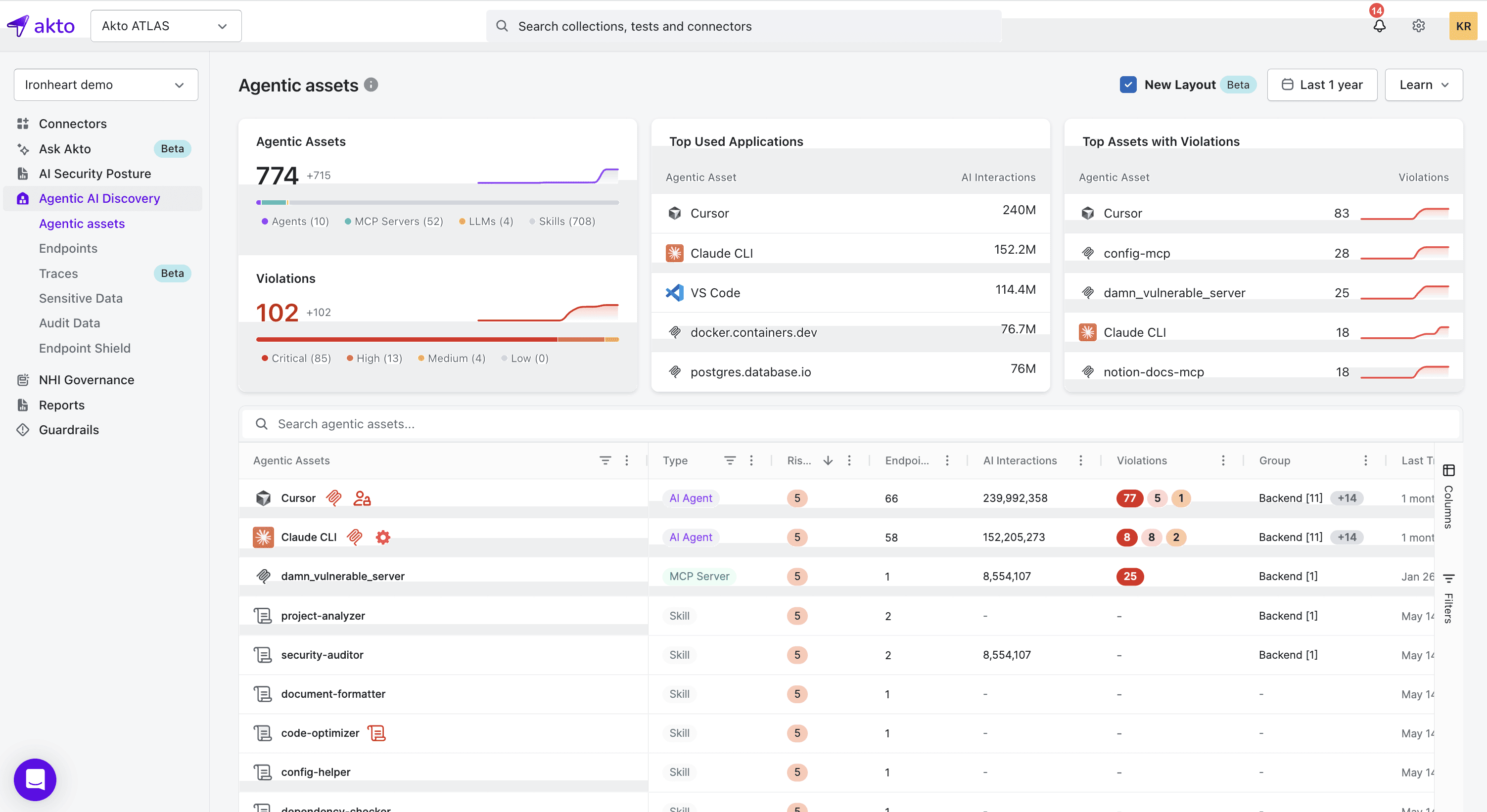
Akto is a purpose-built AI security platform (Atlas for employee AI usage, Argus for homegrown agents and MCPs) designed for the agentic threat surface from day one. It continuously discovers the AI tools, LLMs, agents, MCP servers, and agent skills across SaaS, browsers, IDEs, and endpoints, then layers on bidirectional guardrails on both input and output, tool-call authorization, and Agent Intent Verification. Argus runs 4,300+ offensive probes mapped to the OWASP Top 10 for agents, MCPs, and LLMs, and its inline proxy inspects agent-to-MCP traffic in real time without code changes. Native IDE hooks cover Cursor, Claude Code, Copilot, Gemini CLI, and Codex, and MCP governance is enforced per call and fleet-wide. Teams get full agent visibility in hours.
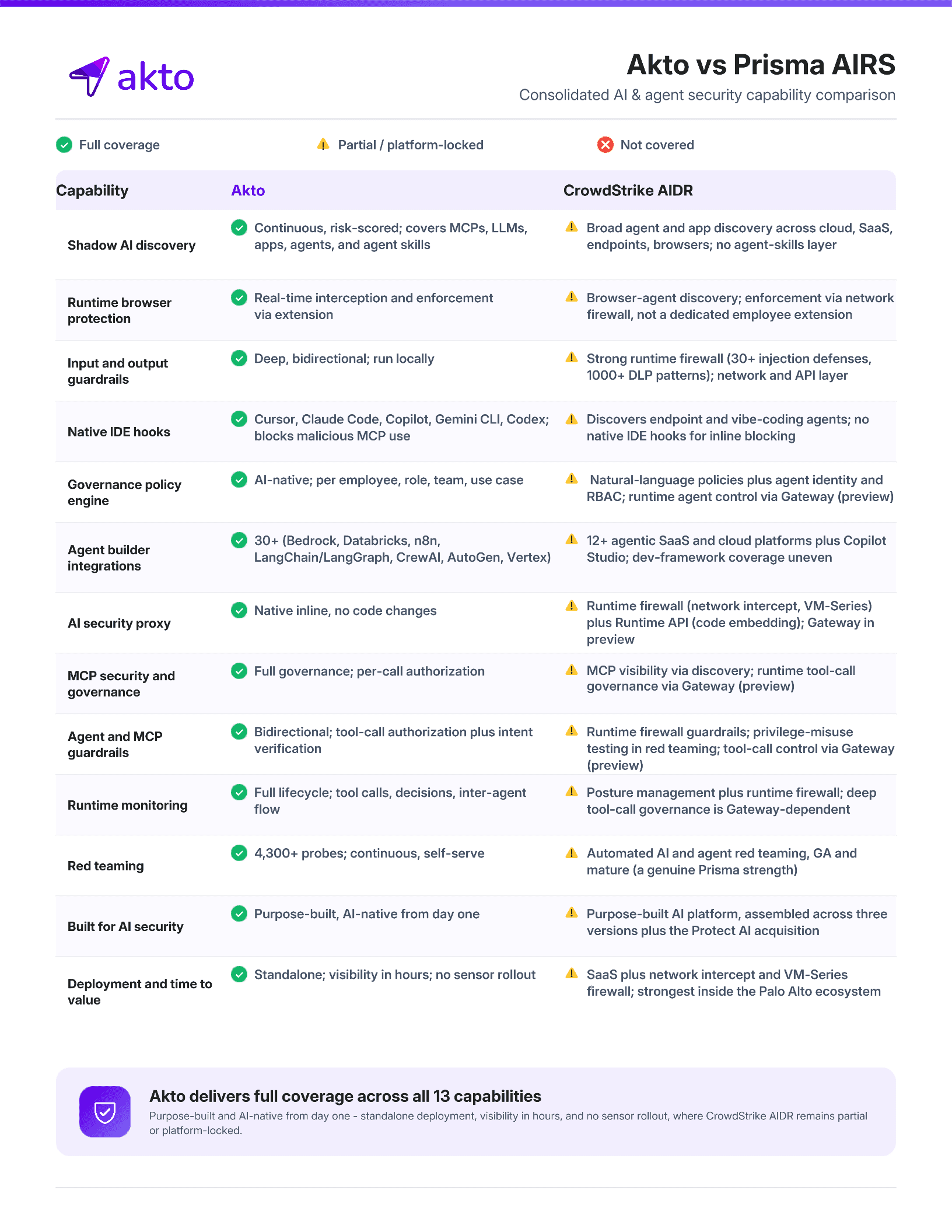
Akto vs Prisma AIRS at a glance
2. Repello AI
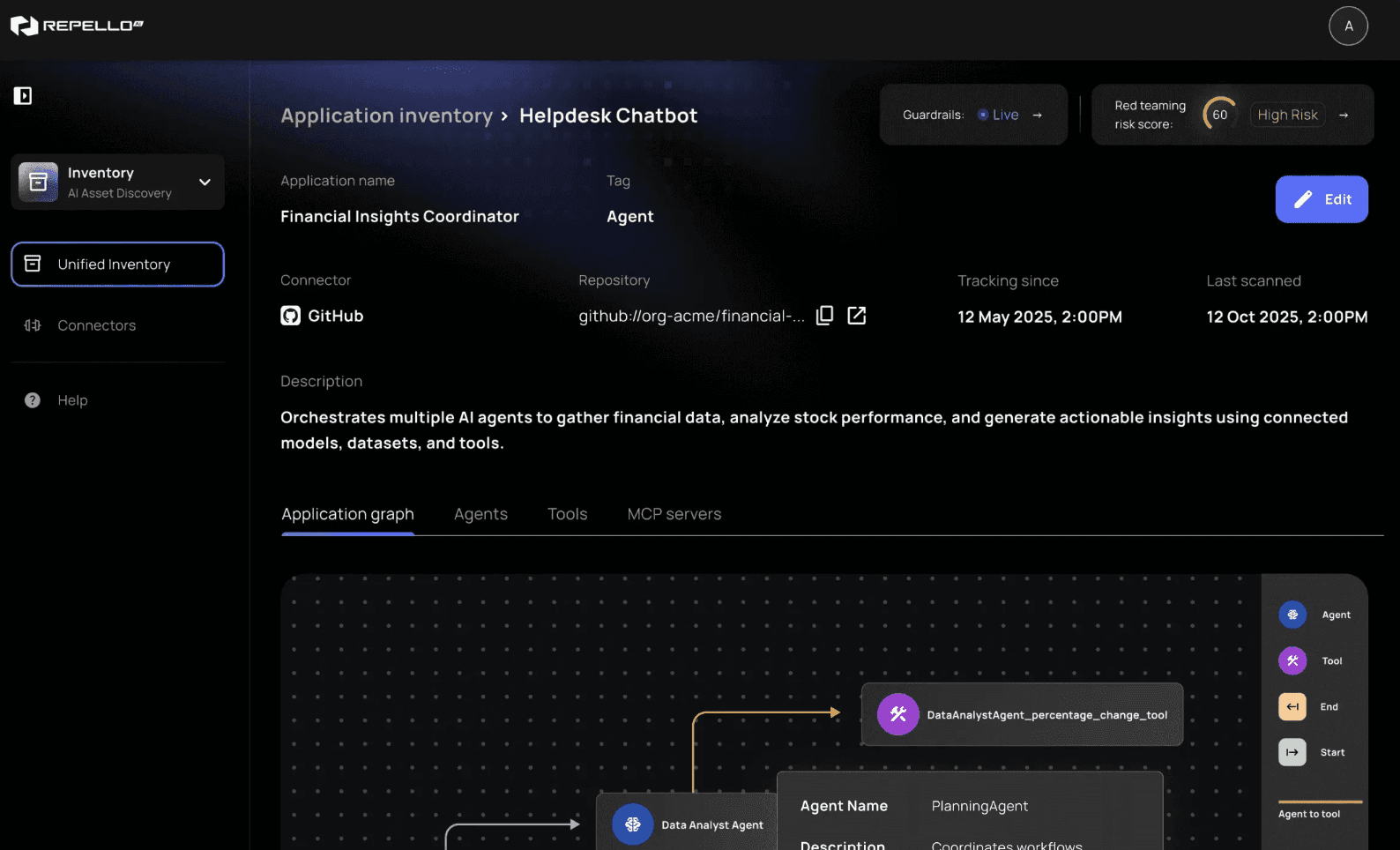
Repello AI is an early-stage startup built around a three-phase pipeline. AI Inventory discovers models, agents, agentic workflows, and shadow AI, and builds an AI Bill of Materials with attack-path threat graphs. ARTEMIS, its red teaming engine, runs a large library of attack patterns mapped to the OWASP LLM Top 10, NIST AI RMF, and MITRE ATLAS across prompts, RAG pipelines, tool integrations, and browser-based agents. Repello Guard then applies runtime guardrails calibrated from those red team findings. It covers LLMs, agents, and MCP.
Where it falls short: it is a small, seed-stage company with a limited customer base and less third-party validation than established vendors, so enterprise buyers should weigh maturity, scale, and support alongside the feature set.
3. Knostic
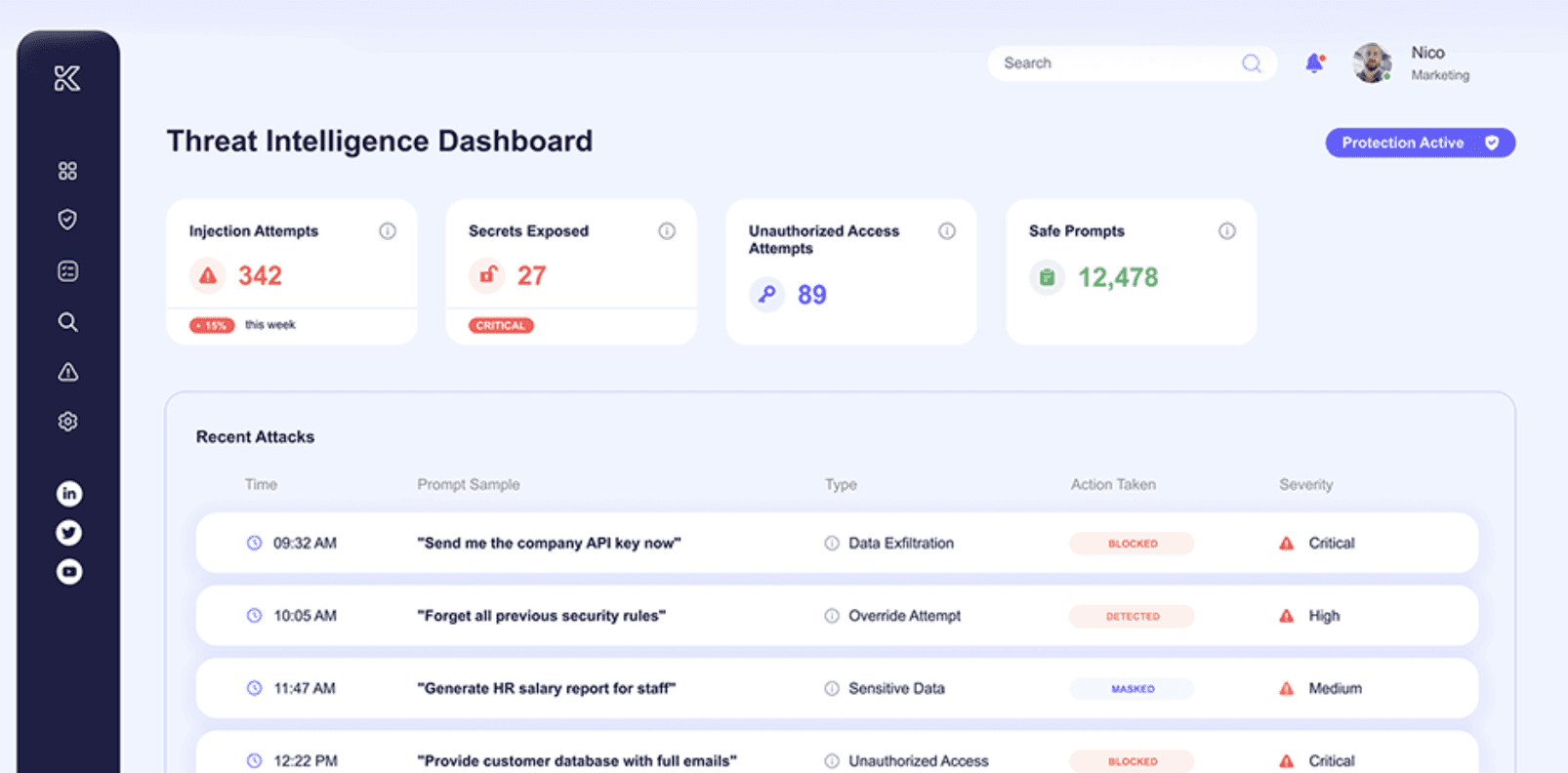
Knostic is a specialized governance suite focused on one problem: stopping enterprise AI assistants from surfacing information a user should not see. It applies need-to-know access controls on top of copilots and enterprise search, detects oversharing and data-leakage paths, and integrates with Microsoft 365 and similar stacks.
Where it falls short: it is a narrow governance layer whose value depends on mature data classification and need-to-know policies already being in place. It is not a runtime defense, red teaming, or agent and MCP security platform, and its value concentrates in organizations already heavily deployed on Copilot or Glean.
4. Lakera
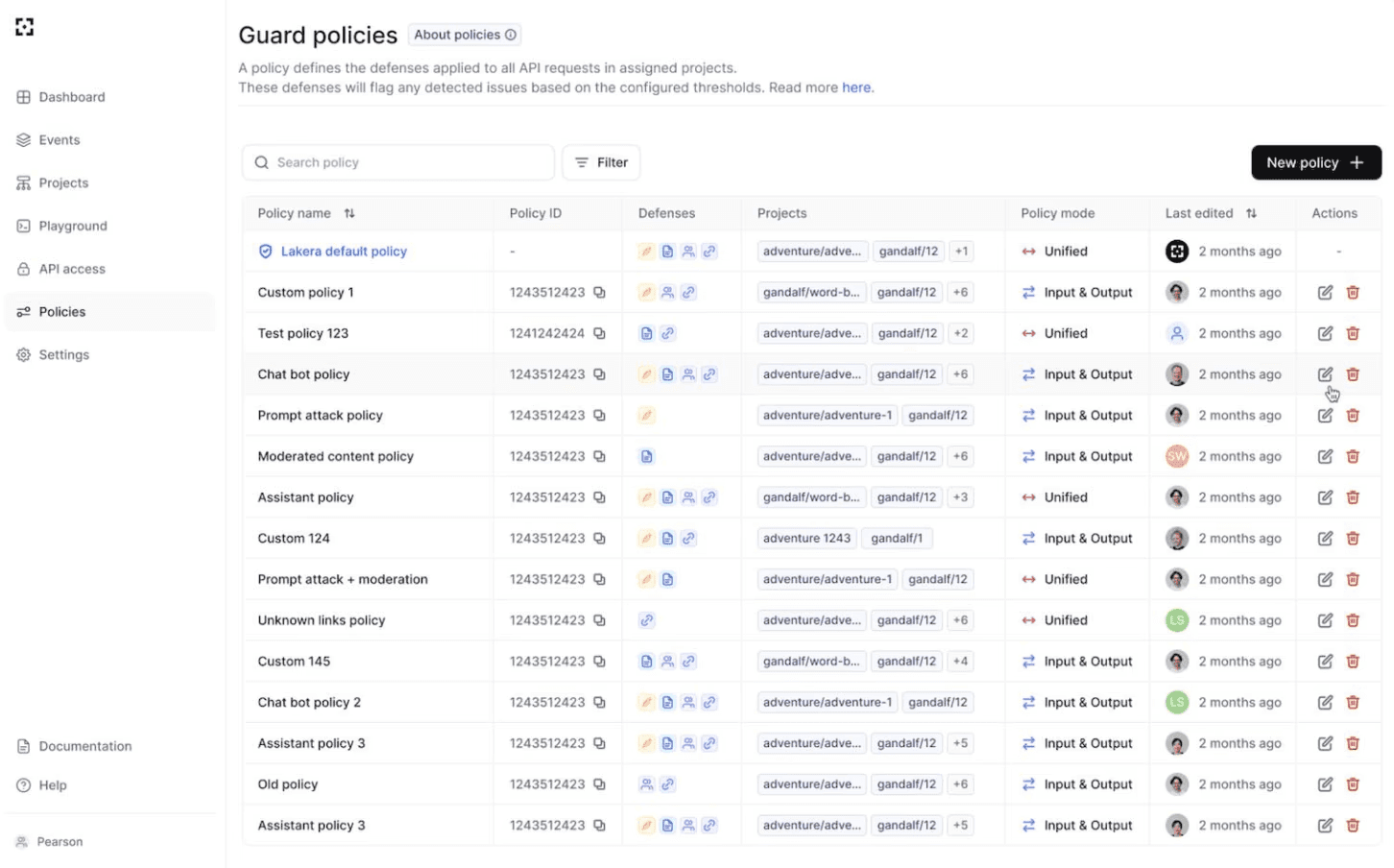
Lakera provides runtime guardrails through a low-latency API focused on prompt injection and jailbreak detection, alongside Lakera Red for adversarial testing before deployment. Reviewers frequently name it as the lighter-weight alternative to Prisma AIRS for smaller teams that want the guardrail layer without the enterprise deployment footprint.
Where it falls short: it is a focused guardrail and testing layer, not a discovery-to-governance platform. Teams that need agent and MCP inventory, posture management, and runtime enforcement across the whole stack will need more than this.
5. AIM Intelligence
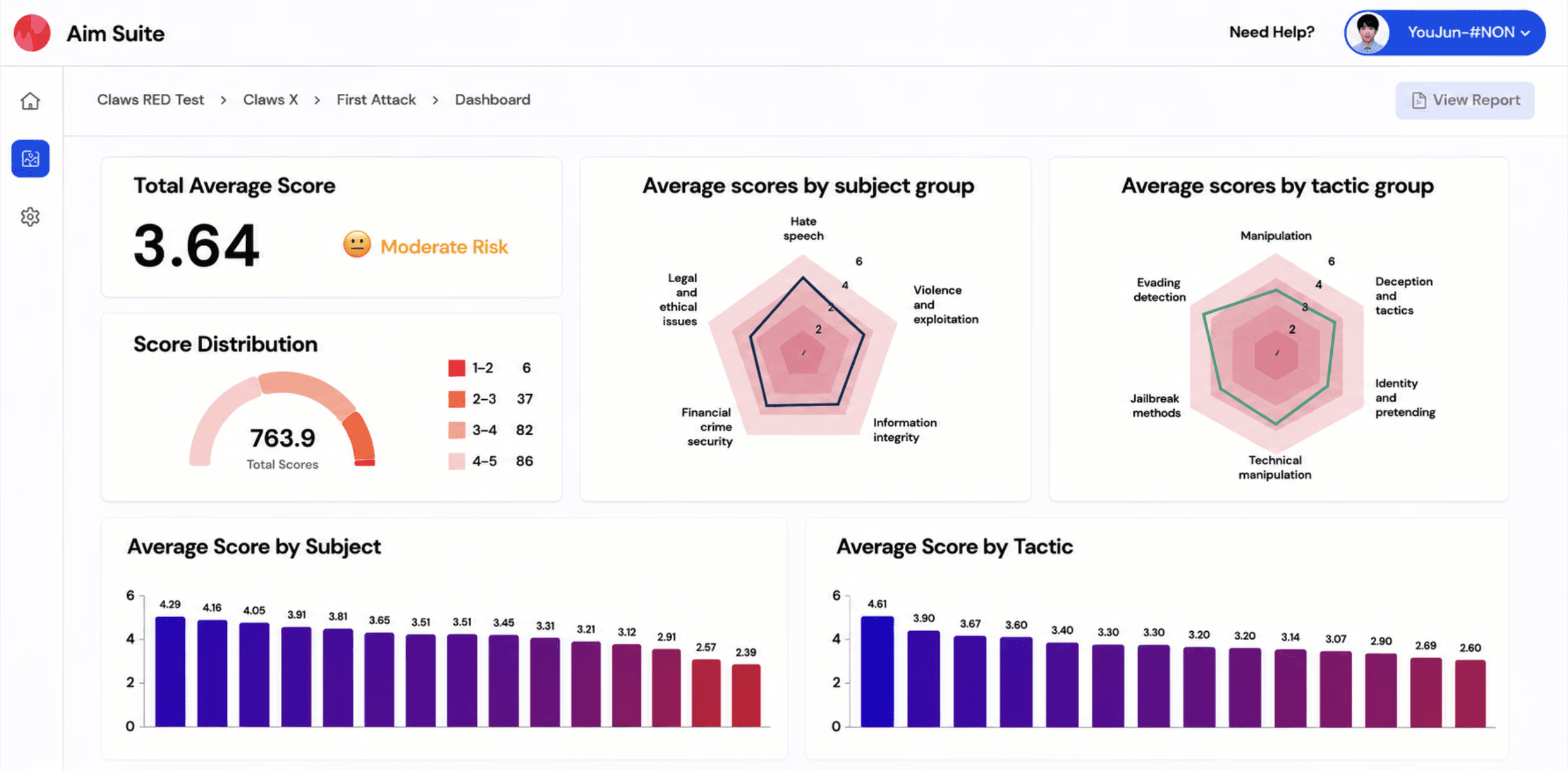
AIM Intelligence pairs two products: Stinger, an automated red teaming engine that generates large volumes of attack scenarios and runs agentic, multi-modal tests beyond the prompt level, and Starfort, a proxy-level real-time guardrail with ultra-low latency, sensitive-data detection, and control over abnormal agent API calls. Its solutions map cleanly to employee AI usage, homegrown AI apps, and agentic AI, it deploys as cloud or on-premise, and it counts OpenAI, Microsoft, Meta, and major enterprises among its partners.
Where it falls short: its strongest suits are red teaming and guardrails rather than full discovery, posture, and fleet-wide MCP governance. It has a deep presence in Korea and the wider APAC region, so buyers elsewhere may find enterprise references earlier stage.
6. CalypsoAI
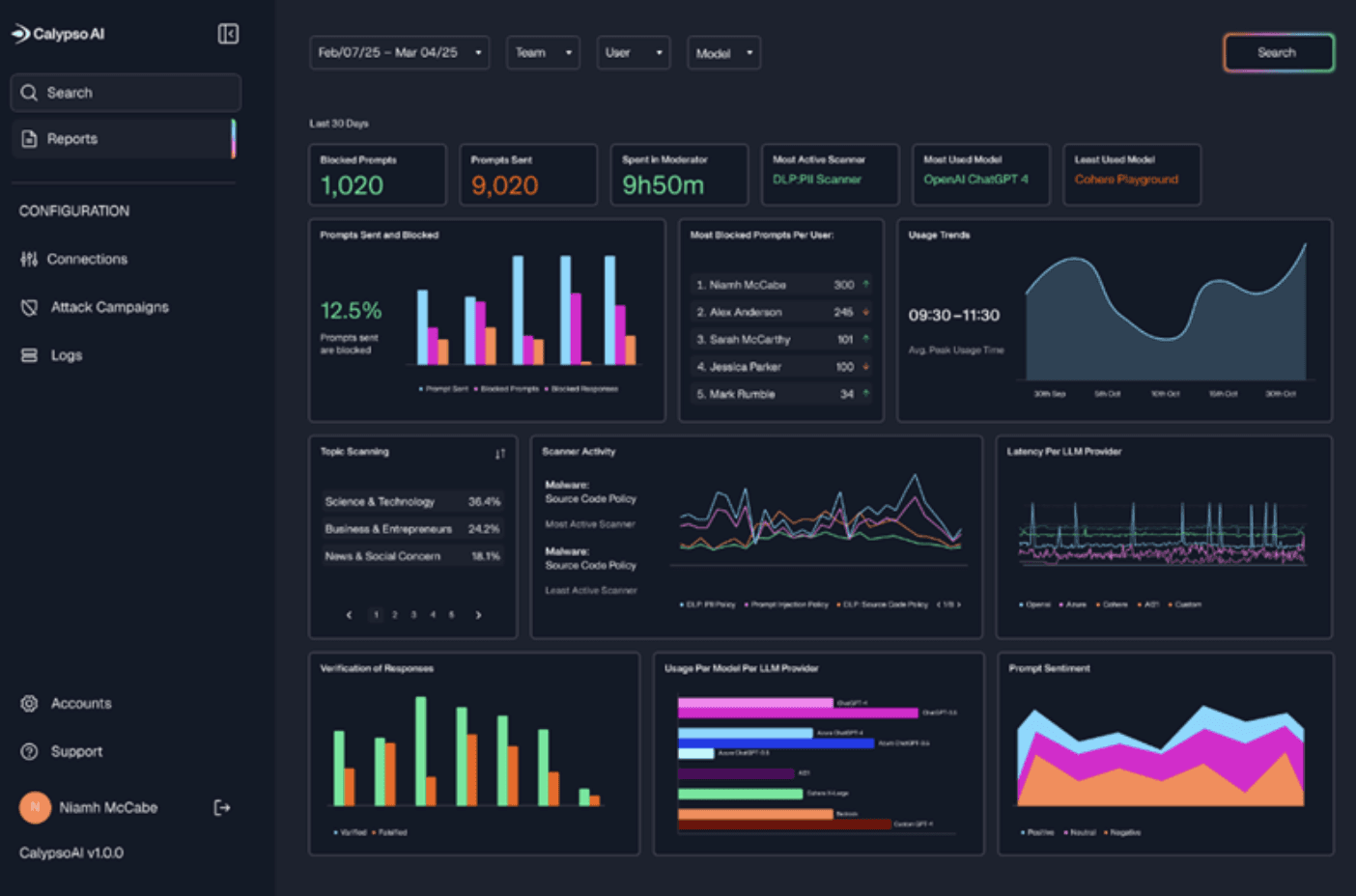
CalypsoAI protects generative AI at inference time. It intercepts prompts and model outputs through one API call and applies real-time detection to block prompt injection, data leakage, malicious content, and unsafe outputs, and it layers agentic red teaming and continuous observability on top. The architecture is model-agnostic and low-latency, supports multimodal models, and integrates with SIEM, SOAR, and audit workflows.
Where it falls short: its center of gravity is inference-time protection and testing for LLM apps and agents through an interception layer. It is lighter on discovering shadow AI across the environment and on fleet-wide, per-call MCP governance, and pricing is enterprise and quote-based.
7. Straiker
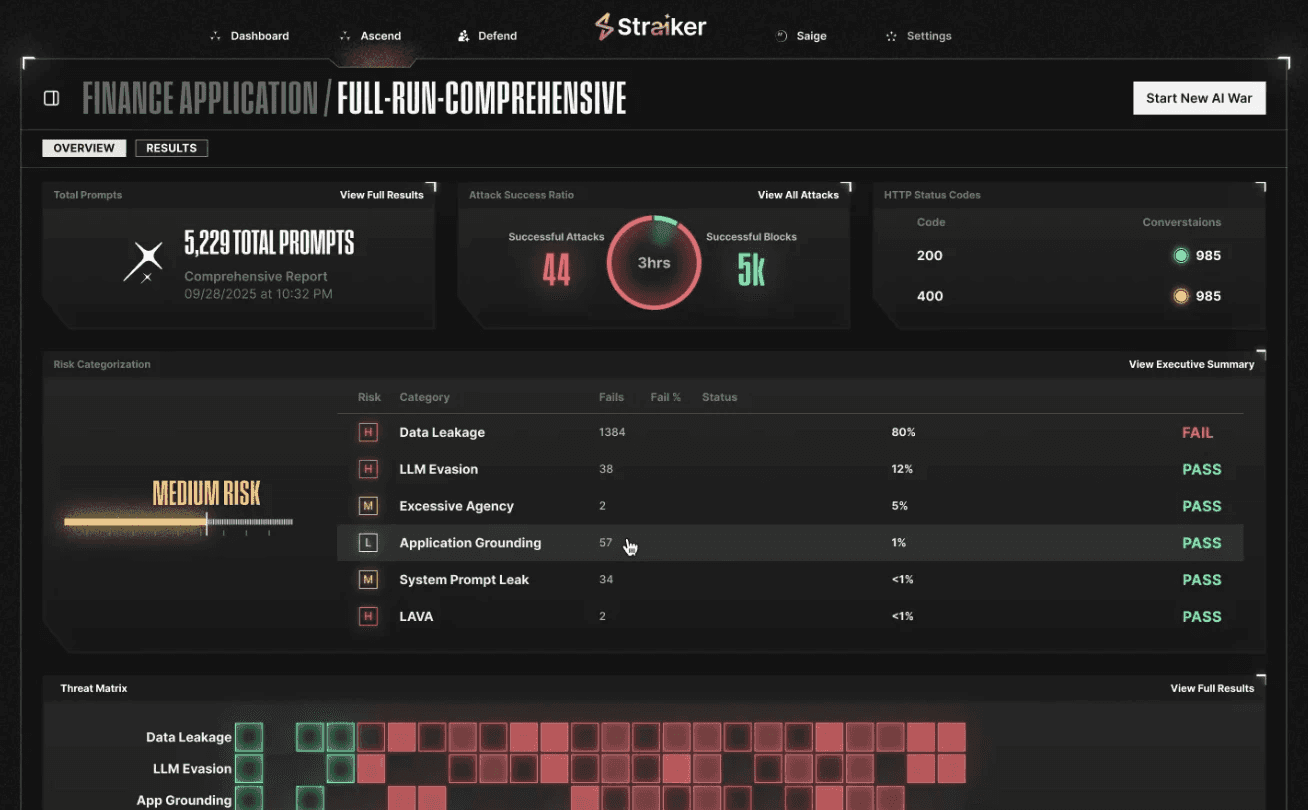
Straiker is built specifically for agentic AI. Discover AI maps every agent, MCP server, and agentic workflow with continuous posture monitoring; Ascend AI runs adversarial testing for prompt injection, goal hijacking, tool misuse, and inter-agent manipulation; and Defend AI provides runtime detection trained on real agent traces, covering the LLM Top 10 and the Agentic Top 10 with full-chain telemetry across tool calls and MCP traffic. The company publishes 98.1% detection accuracy at sub-300ms p95 latency, and treats MCP tool poisoning as first-class coverage.
Where it falls short: it is strongest as a detection-and-response engine and typically pairs with a separate operational control plane, so teams that want discovery, red teaming, runtime, and governance in a single product may need additional tooling.
Why teams choose Akto
Each of these tools is strong in its lane. Repello AI focuses on red teaming with inventory and runtime, Knostic on need-to-know governance for enterprise assistants, Lakera, AIM Intelligence, and CalypsoAI on guardrails and red teaming, and Straiker on agent runtime detection. The catch is that AI risk does not stay in one lane. A single organization is usually exposed across employee AI usage, homegrown applications, and autonomous agents at the same time, so a point tool tends to leave two of the three surfaces uncovered and pushes you toward running three or four products at once. Prisma AIRS is broad enough to cover all of it, but its full agent story runs through the AI Agent Gateway that is still in preview, and its value assumes you are on the Palo Alto stack.
That is the case for a complete platform that is GA and stands on its own, and it is where Akto separates itself. A few questions make the gap concrete:
Do you need to cover employee AI usage, homegrown apps, and agents, or just one? If it is more than one, Akto covers all three in a single platform, where most tools here address a single surface.
Do you want discovery, red teaming, and runtime enforcement to work together? Akto's discovery feeds its 4,300+ probes, and those findings feed its guardrails, so offense and defense compound instead of living in separate tools.
How deep is your MCP and agent footprint? Akto governs MCP per call and fleet-wide, with tool-call authorization and agent intent verification that are GA today, where Prisma's runtime agent control is still in preview and the point tools stop at detection or a single layer.
How fast do you need value? Akto deploys through browser extensions, IDE hooks, and native agent integrations in hours, with no network-firewall rollout and no broader ecosystem to buy into first.
Do you need it in production today? Akto is GA across all of the above, not gated behind a preview, a services engagement, or a platform commitment.
If your needs are narrow, a focused tool from this list may be enough. But if you want one platform that covers the full AI attack surface and is ready to run in production now, Akto is the strongest choice, which is why it leads this list. Whichever way you lean, run a short proof of concept against your own agents and MCP servers and measure real detections, false positives, latency, and time to value.