AI Agent Identity Threats & Detection: What Security Teams Need to Watch
Learn the core AI agent identity threats - credential leakage, tool hijacking, privilege escalation - and how to detect and respond to them.

Arpashree

An AI agent's identity is not a login. It is a standing set of credentials, tool permissions, and delegated authority that acts continuously, often without a human anywhere in the loop. AI agent identity threats exploit exactly that gap: an attacker does not need to steal a password when an agent's own reasoning can be redirected into handing over access voluntarily. This guide covers the threats security teams need to watch for, why traditional detection tools miss most of them, and what actual AI agent identity detection requires.
Why AI Agent Identity Needs Its Own Threat Model
Human identity and machine identity have always been governed differently, but AI agents break the assumptions both models were built on. An agent is not a person who logs in and out, and it is not a static service account with fixed, predictable calls either. It holds credentials, acquires new permissions dynamically at runtime, spawns sub-agents, and chains actions across dozens of systems in ways no identity model anticipated when it was designed. Treating an agent's identity like a human user's misses the scale and speed at which it operates. Treating it like a traditional service account misses that its behavior is not fixed code; it is a reasoning process an attacker can manipulate without ever touching a credential store.
Semantic Attacks vs. Traditional Identity Attacks
Traditional identity attacks exploit implementation flaws through mechanisms security teams have understood for decades: credential stuffing, session hijacking, token replay. These attacks violate syntactic constraints, meaning they produce malformed or anomalous requests that pattern-matching detection can catch because the attack itself looks wrong at the protocol or code level. Research on AI agent security draws a sharp distinction here: agent attacks instead operate through semantic manipulation of natural language reasoning, and they maintain perfect syntactic validity throughout. An indirect prompt injection that convinces an agent to hand over credentials or invoke a tool outside its scope produces a request that is completely well-formed. Nothing about the API call itself looks malicious. Detecting it requires understanding what the agent is actually doing and why, not whether the request matches a known bad pattern. This is the core reason AI agent identity threats slip past detection systems built for a world where attacks looked broken. Here, the attack looks correct.
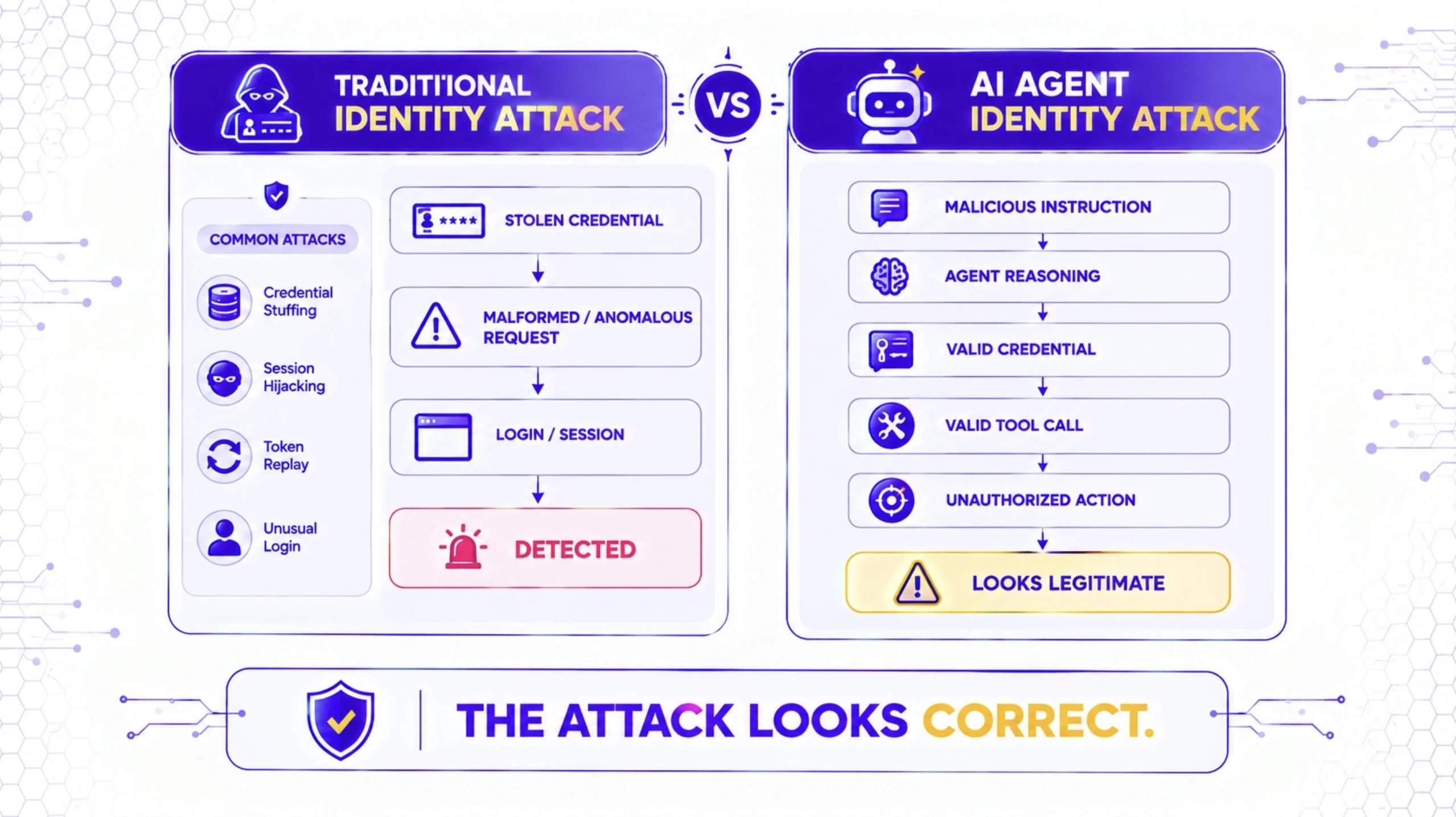
Core AI Agent Identity Threats
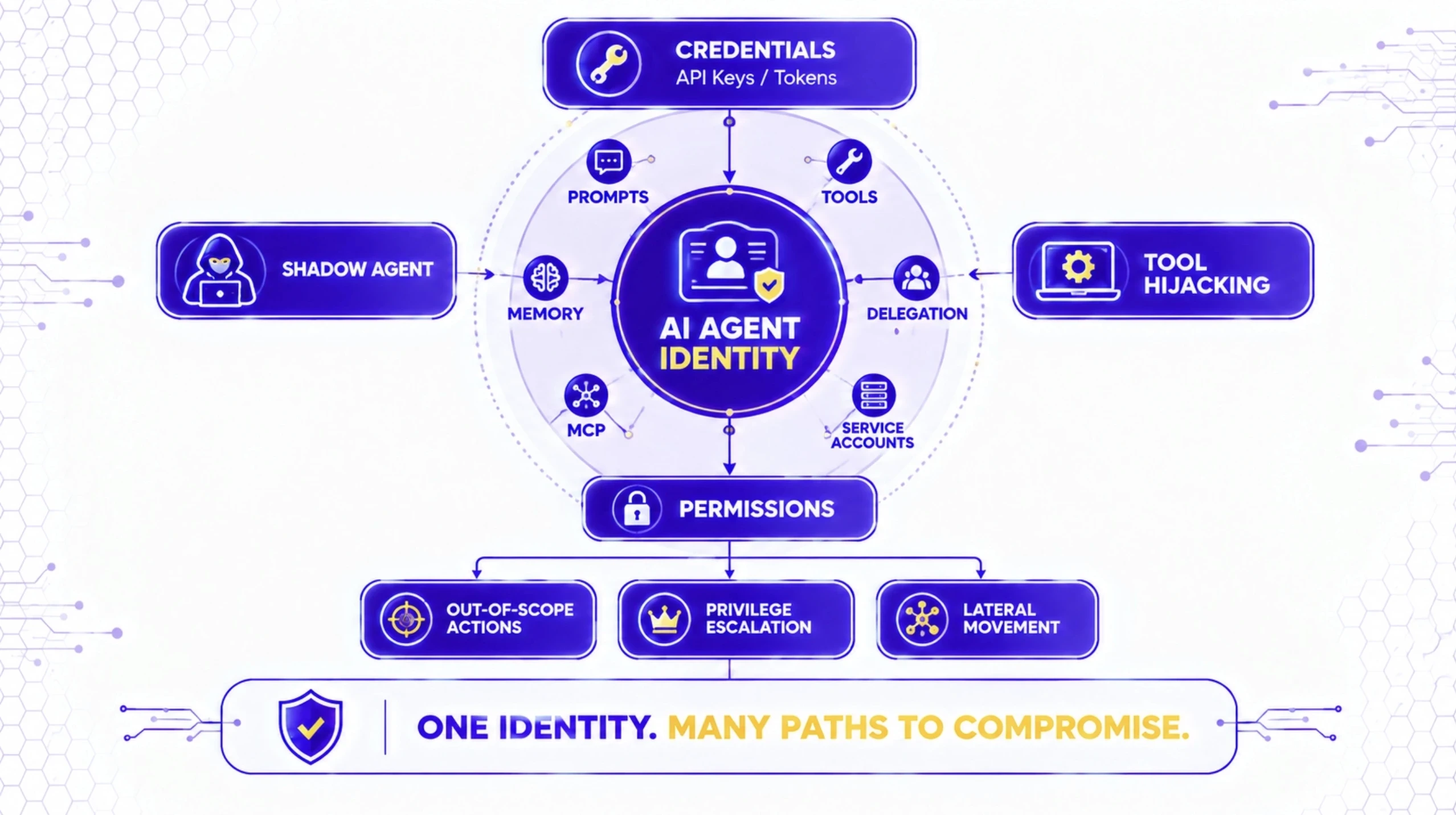
Credential and Secret Leakage
Agents frequently need standing credentials, API keys, database connection strings, and service tokens to do their jobs, and those credentials often end up embedded in prompts, logs, or memory in ways no human login ever would be. A credential that leaks from a compromised agent session is not just one login exposed. It is often a long-lived key that keeps working long after the specific incident is contained, because nobody built a fast revocation path for it.
Out-of-Scope and Unauthorized Actions
An agent operating within its documented permissions can still take actions no one intended, because permission scope and task scope are not the same thing. An agent authorized to read customer records for support purposes technically has the access to export them in bulk, even though that was never the intended use. This gap between what an agent is allowed to do and what it is supposed to do is where a large share of agent identity incidents originate.
Tool Hijacking
Tool hijacking redirects an agent's operations toward attacker-controlled endpoints instead of the legitimate destination the agent was meant to reach. A manipulated tool description, a poisoned response from an upstream service, or a compromised MCP connection can all cause an agent to send data, credentials, or commands somewhere the identity's owner never authorized, while the agent's own logs show it doing exactly what it believed it was supposed to do.
Privilege Escalation and Lateral Movement
An agent's identity rarely stays confined to its original scope for long. Delegation chains, where one agent calls another, create a path for privilege escalation if the receiving agent inherits or claims permissions the orchestrator cannot independently verify. Once an attacker controls one agent identity, lateral movement across every system that agent's identity can reach becomes a matter of the agent doing what it was designed to do, just for the wrong requester.
Service Account and Non-Human Identity Abuse
Agents are one entry in a much larger and faster-growing category: non-human identities. Industry surveys in 2026 put the ratio of machine identities to human identities anywhere from roughly 80 to 1 to well over 100 to 1 in the average enterprise, with AI agent deployment accelerating that ratio further. Most of these identities sit outside the identity governance programs built for human users, which means an agent identity abused for unauthorized access often looks, to existing tooling, like just another service account doing service account things.
Indirect Prompt Injection Leading to Identity Misuse
Indirect prompt injection does not need to target an agent's identity directly to compromise it. Malicious instructions embedded in a document, a webpage, or a tool response the agent reads can convince the agent to invoke a credentialed action on the attacker's behalf, meaning the agent's own valid identity becomes the mechanism of compromise rather than something an attacker had to separately steal.
Shadow Agents Operating with Unmanaged Credentials
An agent spun up outside security review carries the same identity risks as any other agent, with none of the governance. A shadow agent holding live, unmonitored credentials is often the least detectable threat in this entire category, precisely because no one is looking for it in the first place.
Why Traditional ITDR Tools Miss These Threats
Identity threat detection and response tools have matured considerably for human accounts, and most security teams already run some form of agent identity threat detection and response for service accounts. Most of that maturity does not transfer to agents.
Built for Human Login Patterns, Not Autonomous Agent Behavior
Traditional ITDR assumes a login event, a session, and a logout, with recognizable patterns like time of day, geolocation, and device fingerprint to baseline against. An agent has none of these markers in a way that maps cleanly onto human behavioral models. It may run continuously, make thousands of calls per hour, and operate from infrastructure that looks identical whether the activity is legitimate or compromised.
No Baseline for "Normal" Agent Behavior at Deployment Time
A new employee's access pattern takes weeks to establish a baseline, but at least the shape of normal, logging in during business hours, accessing role-relevant systems, is already known from every other employee. A newly deployed agent has no equivalent reference class. Its normal behavior has to be learned from its own activity, which means the earliest days of deployment are also the hardest to secure, since there is no baseline yet against which to catch a deviation.
How AI Agent Identity Detection Works
Behavioral Baselining
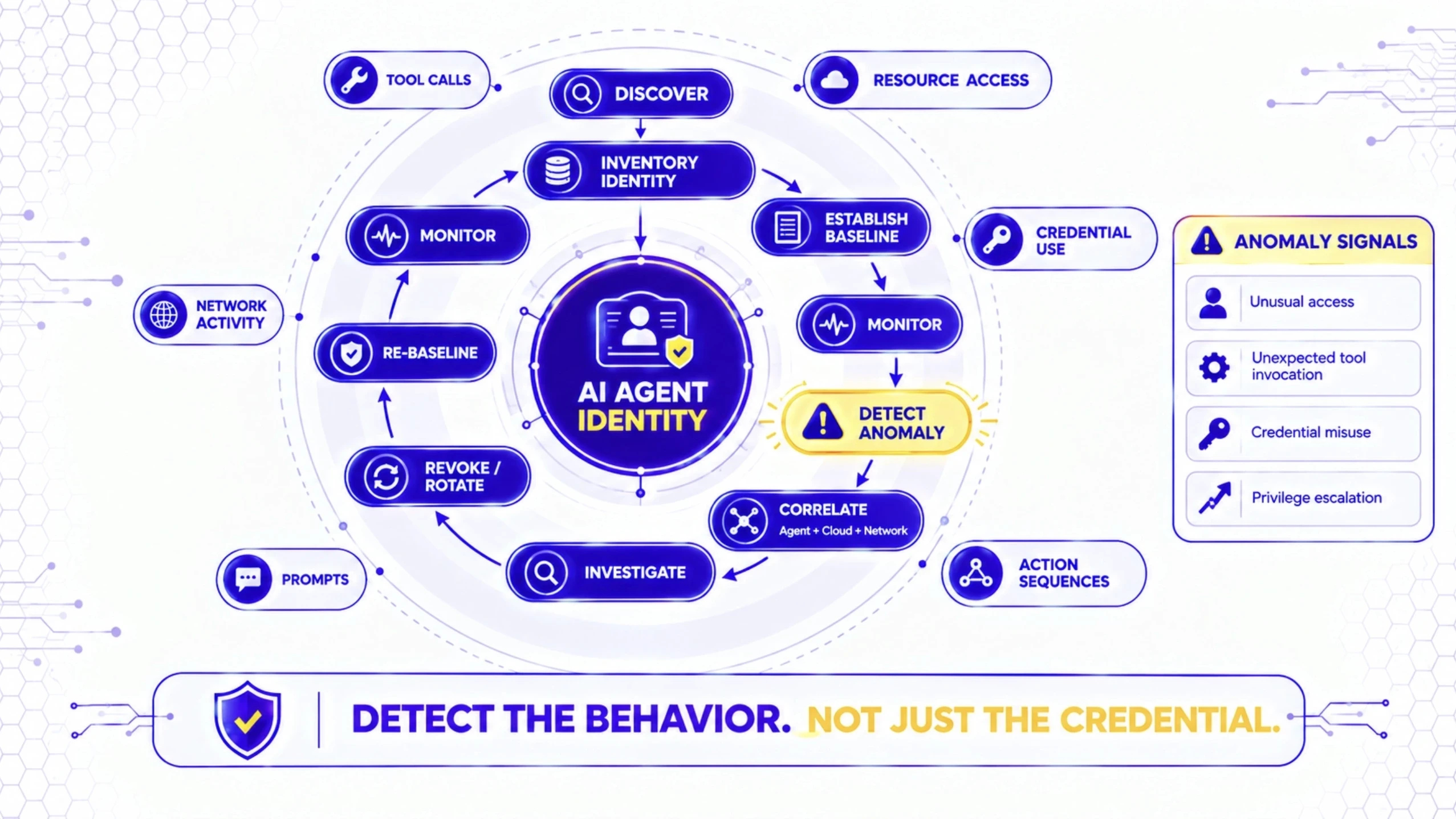
Effective detection starts by comparing an agent's real-time activity against its own historical patterns rather than a generic human-derived model. What tools does it normally call, in what sequence, at what volume, and with what typical outcomes. Deviations from that agent-specific baseline, not deviations from a human norm, are what matter.
Anomaly Detection: Access Patterns, Secrets, Out-of-Scope Actions
Beyond baselining, detection needs to watch for specific categories of anomaly: access to resources outside an agent's documented scope, credentials or secrets appearing in unexpected locations such as logs or outputs, and actions that fall technically within permissions but outside the agent's normal task pattern.
Correlating Agent Identity with Telemetry
An agent's identity does not operate in isolation. Correlating its activity with endpoint, cloud, and network telemetry closes the gap between what the agent's own logs claim happened and what other systems independently observed, which matters most when an agent has been manipulated into believing its own actions are legitimate.
Forensic Visibility and Full-Context Audit Trails
When an anomaly is flagged, investigators need more than an isolated log line. Full-context audit trails, capturing the prompt, the reasoning, the tool call, and the credential used together, are what actually let a security team determine whether an action was legitimate or the product of a manipulated identity.
Signals That Indicate a Compromised or Misbehaving Agent
Detecting compromised AI agents early depends on watching for a handful of consistent signal categories rather than waiting for an obviously malicious action.
Unusual Access Patterns or Resource Requests
An agent suddenly reaching for data or systems it has never touched before, even if technically permitted, is one of the earliest and most reliable indicators that something has changed.
Unexpected Tool Invocations
A tool call that does not fit the agent's normal task flow, especially one directed at an endpoint the agent has not previously used, is a strong signal of either tool hijacking or a manipulated reasoning chain.
Credential Use Outside Expected Scope or Time Window
Credentials used at unusual hours, from unexpected infrastructure, or for purposes outside an agent's documented function often indicate the credential itself has been extracted and is being used independently of the agent that originally held it.
Rapid or Repeated Privilege Escalation Attempts
A pattern of an agent repeatedly attempting actions just beyond its current permission boundary, especially in quick succession, suggests either a compromised identity probing for what it can reach or a manipulated reasoning process testing the limits of what it has been told to do.
Responding to AI Agent Identity Threats
Automated Response: Revoke Access, Rotate Secrets, Fix Configs
Manual response is too slow for identities that can act at machine speed. Automated response needs to revoke the specific compromised identity's access immediately, rotate any credentials it held, and correct any configuration drift, such as an overly broad permission grant, that allowed the incident to happen in the first place.
SIEM/SOAR Integration for Incident Workflows
Agent identity detection produces limited value if it lives in a separate console security teams have to check independently. Integrating agent-specific signals into existing SIEM and SOAR workflows means an agent identity incident triggers the same investigation and escalation paths as any other security event, rather than requiring a parallel process.
Root Cause and Blast Radius Investigation
Once contained, the investigation needs to answer two separate questions: what allowed this specific compromise to happen, and what else could that identity have reached before it was caught. Blast radius investigation depends entirely on having a complete map of what the agent's identity was actually authorized to touch, not just what it was observed touching.
Building an AI Agent Identity Detection Program
Building AI agent ITDR into an existing security program does not require starting from scratch, but it does require deliberate sequencing.
Inventory Every Agent Identity First
None of the detection or response capabilities above work without knowing which agent identities exist in the first place. A complete inventory of every agent, its credentials, and its permission scope is the prerequisite every other step in this program depends on.
Establish Behavioral Baselines Early
Baselines should start forming from an agent's first day in production, not months later once an incident has already prompted a retroactive review. The earlier a baseline exists, the sooner a deviation becomes detectable.
Integrate Detection with Existing ITDR/SIEM Stack
Agent identity detection should extend an organization's existing identity threat detection and response investment rather than replace it, feeding agent-specific signals into the same tools and workflows security teams already use for human and service account threats.
How Akto Detects and Responds to AI Agent Identity Threats
Continuous Discovery of Agent Identities and Credentials
Akto continuously discovers every agent identity across an organization's environment, including the credentials and permission scopes tied to each one, closing the visibility gap that makes shadow agents and unmanaged non-human identities so hard to catch with traditional tools.
Behavioral and Semantic Anomaly Detection
Because agent attacks succeed precisely by looking syntactically valid, Akto's detection goes beyond pattern matching to flag semantic anomalies, actions that are technically permitted but inconsistent with an agent's established behavioral baseline and task scope.
Runtime Guardrails and Automated Response
When an anomaly is confirmed, Akto's runtime guardrails can revoke access and flag the identity for review without waiting for a human analyst to manually intervene, closing the gap between detection and containment that matters most for identities capable of acting at machine speed.
Final Thoughts on AI Agent Identity Threat and Detection
AI agent identity threats do not look like traditional identity attacks, and treating them as a variant of human account compromise or ordinary service account abuse misses what makes them dangerous. The attacks are semantically valid, the identities involved often outnumber human accounts by an order of magnitude, and the tools built to protect human logins were never designed to baseline autonomous, machine-speed behavior. Closing that gap starts with a complete inventory of every agent identity in the environment, followed by detection built specifically for how agents actually behave rather than how humans do.
FAQs: AI Agent Identity Threats & Detection
1. What are AI agent identity threats?
Security risks that exploit an AI agent's credentials, permissions, or delegated authority, including credential leakage, tool hijacking, privilege escalation, and unauthorized actions taken through the agent's own valid identity.
2. How do AI agent identity threats differ from traditional identity threats?
Traditional identity threats typically involve syntactically anomalous activity, like malformed login attempts, that pattern-matching detection can catch. AI agent identity threats often involve semantically manipulated but syntactically valid requests, since the agent's own reasoning, not its credentials, is what got compromised.
3. What is a semantic attack on an AI agent, and how is it different from a syntactic attack?
A syntactic attack exploits implementation flaws, like a buffer overflow or malformed input, that produce recognizably broken requests. A semantic attack manipulates the agent's natural language reasoning to produce a request that is completely well-formed but serves the attacker's intent instead of the legitimate task.
4. Why do traditional ITDR tools struggle to detect AI agent identity threats?
They were built around human login patterns, such as time of day and device fingerprint, that do not map onto continuous, machine-speed agent behavior, and there is no equivalent reference class for what "normal" looks like at the moment a new agent is deployed.
5. What is tool hijacking in the context of AI agents?
Tool hijacking redirects an agent's operations toward an attacker-controlled endpoint instead of its intended destination, often through a manipulated tool description or compromised connection, while the agent's own logs show it behaving as expected.
6. How does credential or secret leakage happen with AI agents?
Agent credentials frequently end up embedded in prompts, logs, or memory in ways human logins never are, so a compromised session can expose a long-lived key that continues working well after the specific incident is contained.
7. What signals indicate an AI agent identity has been compromised?
Unusual access patterns, unexpected tool invocations, credential use outside the agent's normal scope or time window, and rapid or repeated privilege escalation attempts are the primary indicators.
8. How does behavioral baselining work for detecting agent identity anomalies?
Detection compares an agent's real-time activity against its own historical patterns, tool sequences, call volume, and typical outcomes, rather than against a generic human-derived behavioral model, since agents have no equivalent reference class to humans.
9. Can indirect prompt injection lead to identity-based compromise?
Yes. Malicious instructions embedded in a document, webpage, or tool response an agent reads can convince it to invoke a credentialed action on an attacker's behalf, making the agent's own valid identity the mechanism of compromise.
10. How do shadow agents contribute to AI agent identity threats?
Agents deployed outside security review carry live, unmonitored credentials with none of the governance applied to sanctioned agents, making them one of the least detectable sources of identity risk in an organization.
11. What should an automated response look like when an agent identity is compromised?
Immediate revocation of the specific identity's access, rotation of any credentials it held, and correction of the configuration gap, such as an overly broad permission grant, that allowed the compromise in the first place.
12. How does AI agent identity detection integrate with existing SIEM or SOAR tools?
Agent-specific signals should feed into the same SIEM and SOAR workflows already used for human and service account threats, so an agent identity incident triggers standard investigation and escalation paths rather than a separate process.
13. What is the difference between AI agent identity threats and non-human identity (NHI) threats generally?
AI agents are one category within the broader non-human identity landscape, which also includes service accounts, API keys, and OAuth tokens. Agent identities carry additional risk because they act autonomously and can be manipulated through reasoning rather than only through stolen credentials.
14. How do you investigate root cause and blast radius after an agent identity incident?
Root cause identifies what allowed the specific compromise, while blast radius investigation requires a complete map of everything the compromised identity was authorized to reach, not just what it was directly observed touching.
15. How does Akto detect and respond to AI agent identity threats?
Akto continuously discovers agent identities and their credentials, applies behavioral and semantic anomaly detection beyond simple pattern matching, and enforces runtime guardrails that can revoke access automatically once an anomaly is confirmed.

Experience enterprise-grade Agentic Security solution