AI TRiSM Explained: Building Secure and Trusted AI Systems
Explore AI TRiSM frameworks, governance, risk management, security controls, and compliance strategies for enterprise AI systems.

Bhagyashree
2026 State of Agentic AI Security
How ready is your organization to secure AI agents?
3 quick questions. See how you compare to other security leaders.
As AI becomes a significant part of decision-making processes across different industries, the risks related to bias, data privacy, and compliance grow at an increasing rate. To counter this, the AI TRiSM framework was created. It is a comprehensive framework that focuses on transparency, responsibility, and inclusivity as the pillars for building trust, mitigating risk, and ensuring the security of AI systems. According to Gartner, organizations that operationalize AI transparency, trust, and security within their AI initiatives can expect a 50% improvement in AI adoption, business goal attainment, and user acceptance.
Without a framework like AI TRiSM, security teams risk significant exposure. AI TRiSM does not just serve as a defense mechanism; it also enables the responsible and trustworthy development of AI technology.
This blog takes a deep dive into AI TRiSM and how it benefits AI development and overall security.
What is AI TRiSM?
Artificial intelligence trust, risk, and security management, or AI TRiSM, is a framework created to validate and verify that AI systems are safe, reliable, and compliant with ethical standards. According to Gartner, "AI trust, risk and security management (AI TRiSM) ensures fairness, trustworthiness, governance, reliability and data protection in AI deployments" (Gartner, AI TRiSM glossary definition).
It prioritizes controlling the risks associated with AI, such as bias, transparency, data privacy, and compliance, and it establishes processes to create and preserve confidence in AI systems.
AI TRiSM assists enterprises in implementing AI solutions that are efficient and reliable by embedding governance, risk management, and security into the AI lifecycle. In today's AI-driven landscape, the significance of AI TRiSM cannot be overstated. The chances of AI systems being misused also rise as these systems become more important to decision-making across different sectors. To lower these risks and enable security, accountability, and transparency in AI deployments, AI TRiSM offers a systematic method. This framework helps organizations maintain regulatory compliance, uphold stakeholder confidence, and secure their AI systems in this AI-driven era.
Why Is AI TRiSM Important?
The AI TRiSM framework provides a unified approach, bringing together the most crucial parts of multiple frameworks for holistic management of AI technologies. This framework is considered important because it helps mitigate risks and cyberthreats related to the advancement and growing use of generative AI, such as large language models (LLMs). A key advantage of AI TRiSM lies in applications like finance and healthcare, where it supports remediation, improved model monitoring, and protection against cyberthreats and unauthorized access.
What are the 4 Pillars of AI TRiSM?
Gartner's original AI TRiSM model, introduced in 2022, comprises four pillars. Implementing these pillars helps organizations build functional, trustworthy AI systems and prevent security risks. Here's a breakdown of each pillar, followed by how Gartner's more recent guidance has expanded on this model.
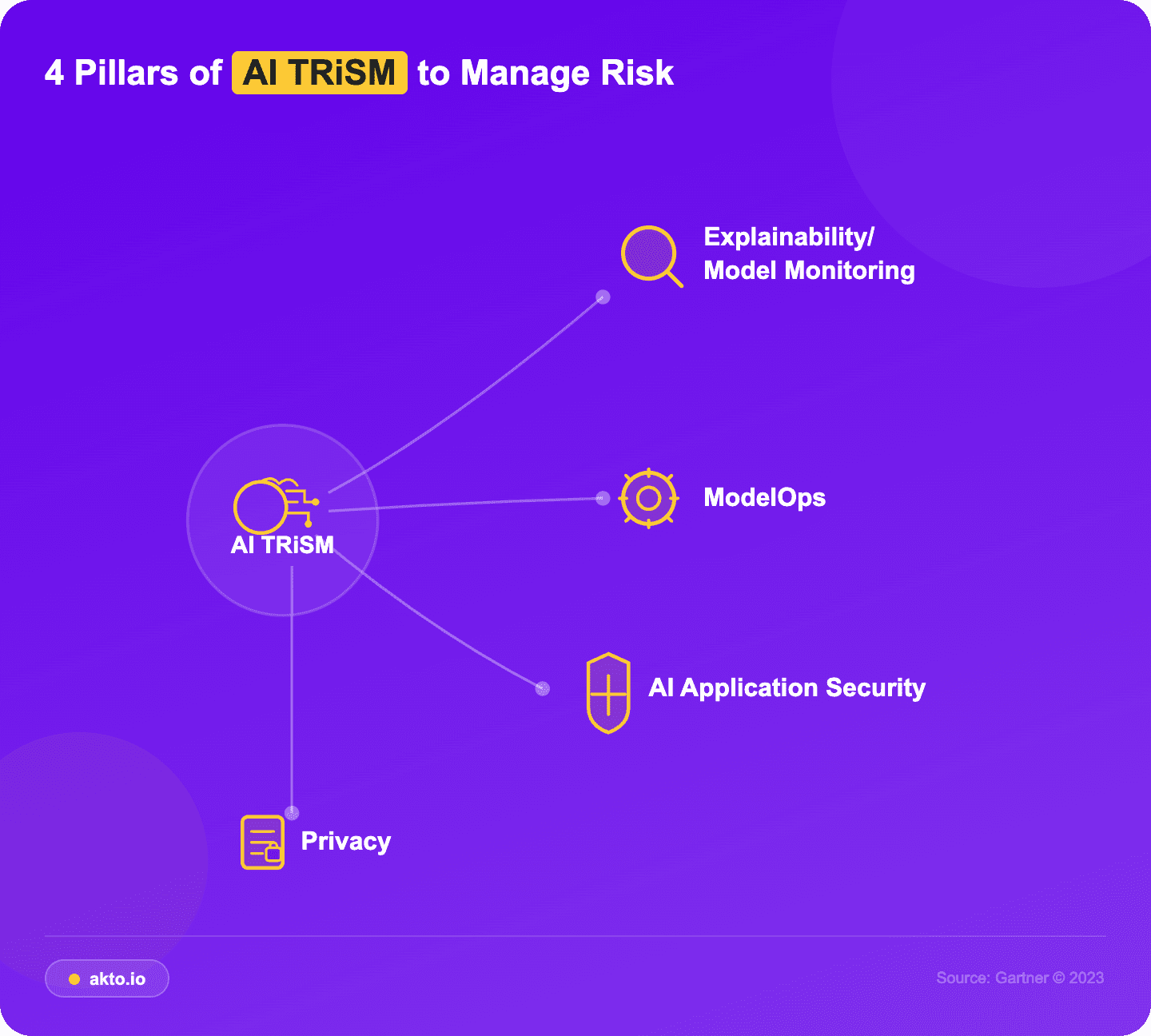
Image source: Gartner
Explainability
A significant part of AI development is understanding how a model processes data, especially for high-stakes applications that require responsible AI practices. Security teams should be able to explain what data a model uses and why it requires that information. This matters because it keeps the system accountable, which allows users and stakeholders to trust it. If security teams can understand how a model reaches its conclusions, they can depend on its outputs. In a "black box" process, where the model's reasoning is hidden, there is no way to be sure its outputs are accurate.
Without explainability, AI models carry a significant risk: they become difficult to debug, and their trustworthiness is harder to establish. It is also a legal and regulatory liability. If users cannot trust a model, they are less likely to adopt it.
Model Ops
Model operations (ModelOps) covers both manual and automated performance and reliability management for AI models. It recommends maintaining version control over models to track changes and issues during development, along with robust testing at every stage of the model lifecycle to ensure consistency. Periodic retraining also keeps the model up to date with new data to preserve accuracy and relevance. These processes enable organizations to simplify and scale AI operations to match changing business needs.
AI App Sec
AI applications face numerous threats that require a distinctive approach to security, known as AI AppSec. For example, cyberattackers may corrupt input data to undermine model training, which could result in false or incorrect outcomes. AI AppSec protects against these risks by enforcing encryption of model data at rest and in transit, and by implementing access controls around AI development systems. It also extends security across the AI development supply chain, including tooling, hardware, and software libraries, to support overall trustworthiness.
Data Privacy Risks
All models are trained on data, and some of that data can be confidential. For instance, if you train an AI model on customer information from a CRM, that data is protected under data privacy laws. Under these regulations, security teams are required to inform customers when their data is used or stored for training AI models. Customers should also be informed about how long their information will be retained and what it will be used for.
Another requirement is that this information be strictly protected, so that only authorized personnel can view it. Without proper security, a generative AI model can be prompted into leaking sensitive information.
Security teams are also obligated to follow data privacy requirements. This means understanding which regulations apply to their operations. For instance, businesses that serve customers worldwide must follow laws like the GDPR in the European Union (EU), which applies to anyone who was in the EU when their data was collected. Other regulations, like the CCPA, protect only users residing in California.
Some regulations require opt-in consent, where explicit permission is needed to collect data, while others follow an opt-out model that puts the responsibility on users. These laws require security teams to have a valid reason for collecting personal data, and they impose restrictions on how much of that data can be collected. They also demand a clear plan for disposing of or deleting information once its purpose has been fulfilled. Security teams must also demonstrate that they have proper security measures in place and maintain documentation of user consent.
Overall, AI TRiSM came into existence because organizations needed one unified framework that could assess AI risk and control model inputs and outputs at runtime.
Gartner's Updated AI TRiSM Architecture
The four pillars above come from Gartner's original 2022 framework, and they remain a useful starting point for understanding AI TRiSM. However, Gartner's February 2025 Market Guide for AI Trust, Risk and Security Management expanded the model into a set of mandatory features that better reflect how organizations manage AI models, applications, and agents today:
AI catalog. An inventory of every AI entity in use, including models, agents, and applications, whether embedded in third-party software, built in-house, or used through retrieval-augmented generation.
AI data mapping. Visibility into the data used to train, fine-tune, or provide context to AI models and agentic systems.
Continuous assurance and evaluation. Ongoing evaluation of performance, reliability, and safety against baseline expectations, applied both before and after deployment.
Runtime inspection and enforcement. Real-time inspection of connections, inputs, and outputs to check for policy violations, with anomalies blocked, auto-remediated, or escalated to a human reviewer.
This shift matters because it moves AI TRiSM from a documentation exercise toward an operational one. In its June 2026 guidance on AI governance, Gartner noted that policies establish intent but do not ensure AI systems behave as expected in real time, and that organizations must move from policy-based governance toward enforceable technical controls (Gartner, "AI Governance Needs More Than Policies," June 2026). That is precisely the gap runtime enforcement is meant to close, and it is also why agentic systems, which take actions with limited human oversight, need this layer more than static models do.
How is AI TRiSM Different From AI Governance, AI Security, and Responsible AI?
AI TRiSM is often confused with responsible AI, AI governance, and AI security, and the overlap can make it harder for organizations to know where operational controls actually fit. Each discipline focuses on a different part of the problem.
Discipline | What It Focuses On | How It Differs From AI TRiSM |
Responsible AI | Ethical principles and high-level values, such as fairness, transparency, and accountability | Responsible AI defines what should happen. AI TRiSM enforces what must happen by applying policies and detecting violations during real AI interactions. |
AI Governance | Policies, approvals, documentation, and oversight across the AI lifecycle | Governance sets expectations and manages process-level compliance. AI TRiSM operationalizes those expectations through cataloging, risk scoring, continuous evaluation, and runtime enforcement. |
AI Security | Protecting AI models, applications, data, and pipelines from threats and unauthorized access | Security focuses on threats and vulnerabilities. AI TRiSM combines those signals with governance requirements and applies risk-based controls at the moment of interaction. |
At a high level, these disciplines work together, but AI TRiSM is the layer that applies their requirements in real time, at the point where AI actually operates.
How Does AI TRiSM Work
AI TRiSM functions by systematically organizing the controls that govern AI systems into one structured model. It combines governance expectations, data protections, and runtime evaluation so they can be applied consistently across different systems, such as agents, models, and applications. It creates a single place to define how AI should work and how its behavior should be evaluated. The AI TRiSM framework relies on three core principles.
Documentation
Organizations document how their AI systems work, the data they depend on, and the conditions under which they should be used. This information defines what the anticipated behavior looks like.
Alignment
Data policies, governance rules, and acceptable use requirements are aligned so they are not managed in separate silos. This alignment ensures that controls in other layers have the information they need to properly analyze activity.
Enforcement
AI TRiSM connects rules, documentation, and evaluation criteria to the points in the environment where AI interactions happen. This approach allows AI activity to be evaluated against the policies defined earlier, and escalated when something looks risky.
Operationalizing AI TRiSM
Operationalizing AI TRiSM means building risk, trust, and security controls directly into how models behave, communicate, and make decisions in real time. By blending automated red teaming, adversarial testing, continuous security validation, and dynamic guardrails, companies can move from static compliance to adaptive, always-on AI security that grows with evolving AI environments.
Here's how teams can operationalize AI TRiSM:
Automated AI Red Teaming Simulate real-world attacks, such as misuse scenarios, prompt injection, and data leakage, using automated agents to identify weaknesses in AI systems.
Move From Static Policies to Runtime Enforcement Move beyond documentation and audits by integrating security controls directly into live AI interactions, ensuring policies are enforced during execution, not just defined on paper.
Adversarial Testing for LLMs Test models with malicious and ambiguous edge case inputs to surface vulnerabilities in reasoning, context handling, and safety alignment before attackers can exploit them.
Regular Security Testing Embed automated security checks into CI/CD pipelines and runtime environments so that every model update, prompt change, or workflow modification is validated instantly.
Guardrails Implementation Implement guardrails that filter inputs, validate outputs, and enforce compliance policies in real time to ensure safe AI behavior.
Policy Implementation in Agent Workflows Implement access control, data protection rules, and action-level validation across autonomous agents that interact with APIs, systems, and tools.
Closed-Loop Feedback Feed insights from testing and runtime monitoring back into policies and guardrails, creating an adaptive security posture aligned with AI TRiSM principles.
How Can AI TRiSM Be Applied to Different Systems
AI TRiSM applies its controls differently depending on whether the system is a model, an application, or an agent, because each one behaves differently. The risk looks different, and the enforcement points do as well. Here's a breakdown of how this framework applies to each system type.
Applications
Applications connect users to models and pull information from other systems. This means they create different risks. Applications can leak excess data if permissions are not strictly controlled, or if context windows pull from overshared content. Runtime inspection evaluates what the application retrieves and returns. It applies access controls, classification, and output validation.
Models
Models take inputs, generate outputs, and sit underneath the application layer. AI TRiSM inspects those inputs and outputs before they are formatted or sent to the user. For instance, it checks for data extraction attempts, prompt injections, or outputs that fall outside a model's intended use. It also checks for harmful or malicious behaviors, like hallucinations or unsafe responses. This layer focuses on safety, model correctness, and misuse prevention.
Agents
Agents run sequences of specific actions. They call tools and make decisions that could chain into more actions. AI TRiSM verifies whether these actions match the agent's intended scope. It also monitors for unexpected behaviors. For instance, if an agent suddenly attempts to access systems outside its intended workflow, the system restricts the action or redirects it for review. Agents require alignment checks, close monitoring, and real-time enforcement, because their behavior is dynamic.
Use Cases of AI TRiSM
Here are two use cases that highlight the potential of AI TRiSM. They show how organizations have used AI TRiSM to drive innovation and create value for both business and society.
Use Case 1: Financial Transaction Monitoring
The Danish Business Authority (DBA) wanted to ensure its AI models were transparent, fair, and accountable. To do this, DBA tied its ethical principles to concrete actions, such as:
Establishing a model monitoring framework.
Regularly checking model predictions against fairness tests.
DBA used these strategies to deploy and maintain 16 AI models that monitor large volumes of financial transactions. This approach helped DBA validate that its AI models complied with standards, while building trust with stakeholders and customers.
Use Case 2: Healthcare and Drug Development
In healthcare, AI TRiSM helps ensure the safety, accuracy, and reliability of AI systems used to assess and treat patients. Patient information must remain private and confidential, and any decision an AI system contributes to needs to be explainable and trustworthy.
Pharmaceutical and healthcare organizations that apply AI TRiSM principles during drug development and diagnostics typically combine strict data privacy controls with continuous model monitoring. This reduces the risk of errors in high-stakes decisions, such as treatment recommendations or trial data analysis, while keeping patient data secure throughout the AI lifecycle.
Best Practices to Maximize the Effectiveness of AI TRiSM
Implementing AI TRiSM works best when it starts small and grows in deliberate steps. The goal is not to deploy every control at once. It is to build a foundation that makes the rest of the framework effective.
Start With Visibility
It is challenging to manage unseen risk. Most organizations underestimate their AI footprint, which includes shadow tools, experiments, and third-party integrations. Start by building a centralized AI inventory that monitors all deployments. Include every technology in use: AI-powered applications, underlying data sources, and integration points. This ensures full visibility into the AI ecosystem and removes blind spots.
Solidify Governance
Solve the data layer before focusing on the AI layer. Poorly classified data breaks AI TRiSM, because runtime controls cannot enforce rules if the underlying permissions are wrong. Begin by improving classification, cleaning up access, and reducing broad exposure.
Discover the AI Already in Use
Many companies have models, agents, and applications scattered across teams. These need to be inventoried and documented, including how each one works. Each should also be assigned an initial risk score, so the highest-risk systems get attention first.
Create an AI Catalog
The catalog anchors AI TRiSM, because it organizes AI entities, their owners, and the data they depend on. It defines what normal AI behavior should look like. This context is required for runtime enforcement to make safer decisions.
Deploy Runtime Inspection
Start with systems that handle sensitive data or external AI services, since this keeps enforcement manageable and avoids slowing teams down. From there, runtime controls can analyze each interaction, generate blended risk scores, and block or escalate risky behavior.
Align Responsibilities Across Teams
AI TRiSM spans data governance, legal, AI engineering, compliance, security, and the business. Every escalation path must be clearly defined, so runtime events reach the right team without confusion.
Final Thoughts on AI TRiSM
AI TRiSM has become essential for governing agentic AI systems. As AI becomes more autonomous and MCP-driven, risks accumulate in real time, making static policies and periodic audits insufficient on their own. Security teams need to shift toward testing, visibility, and runtime enforcement to keep AI systems secure, compliant, and trustworthy. The value of AI TRiSM lies in its ability to move beyond static governance frameworks and function as a living, adaptive security model.
Akto supports this transition by operationalizing AI TRiSM principles within real environments. It enforces policies at runtime by monitoring AI interactions and applying guardrails to prevent data exposure and exploitation. It also offers continuous agent discovery, mapping AI agents, MCP servers, and tool integrations against a range of security risks.
See Akto's agentic AI security and MCP security in action. Book an AI agent security demo today.
Important Links

Experience enterprise-grade Agentic Security solution