
Runtime Security for Amazon Quick AI Agents with Akto
See how Akto traces employee interactions and enforces guardrails across Amazon Quick prompts, tool calls and responses.

Krishanu
Amazon Quick is designed to bring research, analytics, enterprise knowledge, and workflow automation into one AI-powered workspace. An employee can ask a question in natural language, have an agent search internal and external sources, turn the findings into an analysis, and then take action in another application, all without moving between several tools.
That makes Amazon Quick useful far beyond traditional business intelligence. It also means that a conversation can touch confidential documents, structured business data, connected applications, and external websites within the same workflow.
How Employees Use Amazon Quick
Amazon Quick gives employees a chat interface for research, analytics, and enterprise knowledge. Agents use instructions, spaces, knowledge bases, datasets, dashboards, and connected tools to answer questions and complete work.
Amazon Quick Research combines internal documents and data with web and third-party sources to produce cited reports. This speeds up competitive and market research, but it also introduces untrusted content from webpages, uploads, connectors, and remote MCP tools. Amazon identifies these risks in its security guidance.
Employees can ask Amazon Quick to analyze live business data, create charts, explain trends, and draft executive summaries. Teams can also build role-specific agents for sales, HR, or IT, ground them in selected knowledge and actions, then share or embed them.
Actions, Automation and Deliverables
Through action connectors, OpenAPI integrations, and remote MCP servers, Amazon Quick agents can read information, update records, and trigger external workflows. Amazon Quick Flows automate repeatable tasks, while Quick Automate supports processes that make contextual decisions and run without an employee watching every step.
Amazon Quick can also create documents, presentations, spreadsheets, images, and lightweight web apps, and it works through extensions and its desktop application. An answer can therefore become an email, ticket, file, or downstream action almost immediately. That moves the risk beyond inaccurate text: a manipulated or over-permissioned agent can expose data, modify records, or trigger work in another system.
What Amazon Quick’s Native Guardrails Still Miss
Amazon Quick includes useful native safeguards: harmful-content and prompt-attack screening, safety instructions, blocked phrases, permissions, document-level ACLs, approvals. Amazon documents these controls here.
Amazon Quick records prompts and responses and applies native safety checks. However, it does not provide a unified trace of tool-call requests and results or evaluate the complete execution chain using organization-specific runtime policies and anomaly detection. Risk may come from pasted data, untrusted web content, tool output, or information the user is technically allowed to access.
This gap appears when each step is technically permitted, but the complete interaction violates company policy. An agent may combine data from approved sources, invoke an approved tool, and return or send information in a way the organization never intended. Runtime security must evaluate the context and outcome of every prompt, tool call, and response, not access alone.
How Akto Changes the Outcome
Akto Atlas adds an independent control point around how employees use Amazon Quick Agents. It gives security teams session-level visibility and evaluates prompts, model responses, and tool calls while the interaction is happening.
1. Trace the Full Agent Session
Akto Traces brings each AI session into one timeline. Security teams can see the employee, agent, or model, topics, token usage, prompts, tool calls, and responses instead of investigating disconnected log entries.
For the HR example, a trace can show the initial instruction override, the Quick agent’s attempt to retrieve workforce data, the tool involved, and the response that triggered a policy. Teams can determine not only that Quick was used, but how the agent moved from a prompt to a sensitive outcome.
This also exposes patterns across sessions: an agent that repeatedly returns sensitive information, a department placing customer data into prompts, or a user repeatedly attempting restricted requests.
2. Guardrails on Tool Calls, not Only Prompts and Responses
Amazon Quick agents can call actions, connectors, and MCP tools to retrieve data or change another system. That means a safe-looking prompt can still lead to an unsafe execution.
Akto can evaluate a tool request before it executes and the tool response before it returns to the agent. Tool-call policies can stop unauthorized tool use, permission escalation, unexpected destinations, unsafe parameters, and sensitive data moving through tool results. A research agent attempting to send an internal report to an unapproved external service can therefore be blocked at the action, not merely flagged after the final answer is generated.
This is a substantial difference from controls that inspect only the employee’s message or the model’s final text. The highest-impact step may happen between them.
3. LLM-Based Guardrails for Organization-Specific Policies
Static patterns work for known secrets and predictable data formats. They are weaker when a policy depends on meaning and context.
Akto lets security teams create a custom rule by writing the requirement as a natural-language prompt. An LLM then evaluates that rule against user inputs, model responses, or both. For example:
Block requests or responses that compile compensation or performance information for multiple employees outside an approved HR use case.
The rule can recognize “salary,” “total rewards,” “pay bands,” or indirect requests for the same information without security teams enumerating every possible phrase. Teams can apply different policies by role, department, or agent and choose whether a violation should be flagged, redacted, or blocked.
Akto Guardrails combine these LLM-based rules with purpose-built scanners for prompt injection, sensitive data, secrets, malicious URLs, prohibited code, restricted topics, toxicity, and bias.
4. Detect Chained Attacks That Individual Rules Miss
Agentic attacks often unfold across several individually acceptable steps. A research agent may read a webpage containing a hidden instruction, query an internal connector, summarize the retrieved data, and use another tool to send the result elsewhere. No single prompt, response, or tool call necessarily looks malicious on its own. The risk becomes visible only when the steps are evaluated as one execution chain.
Akto combines session traces with anomaly detection to surface unusual tool sequences, off-pattern workflows, actions outside an agent’s expected scope, and abnormal invocation volume. For example, a Quick Research agent moving from public web research to repeated payroll queries and then attempting an external file transfer would stand out as a chained attack, even if every individual call uses valid credentials and an approved tool.
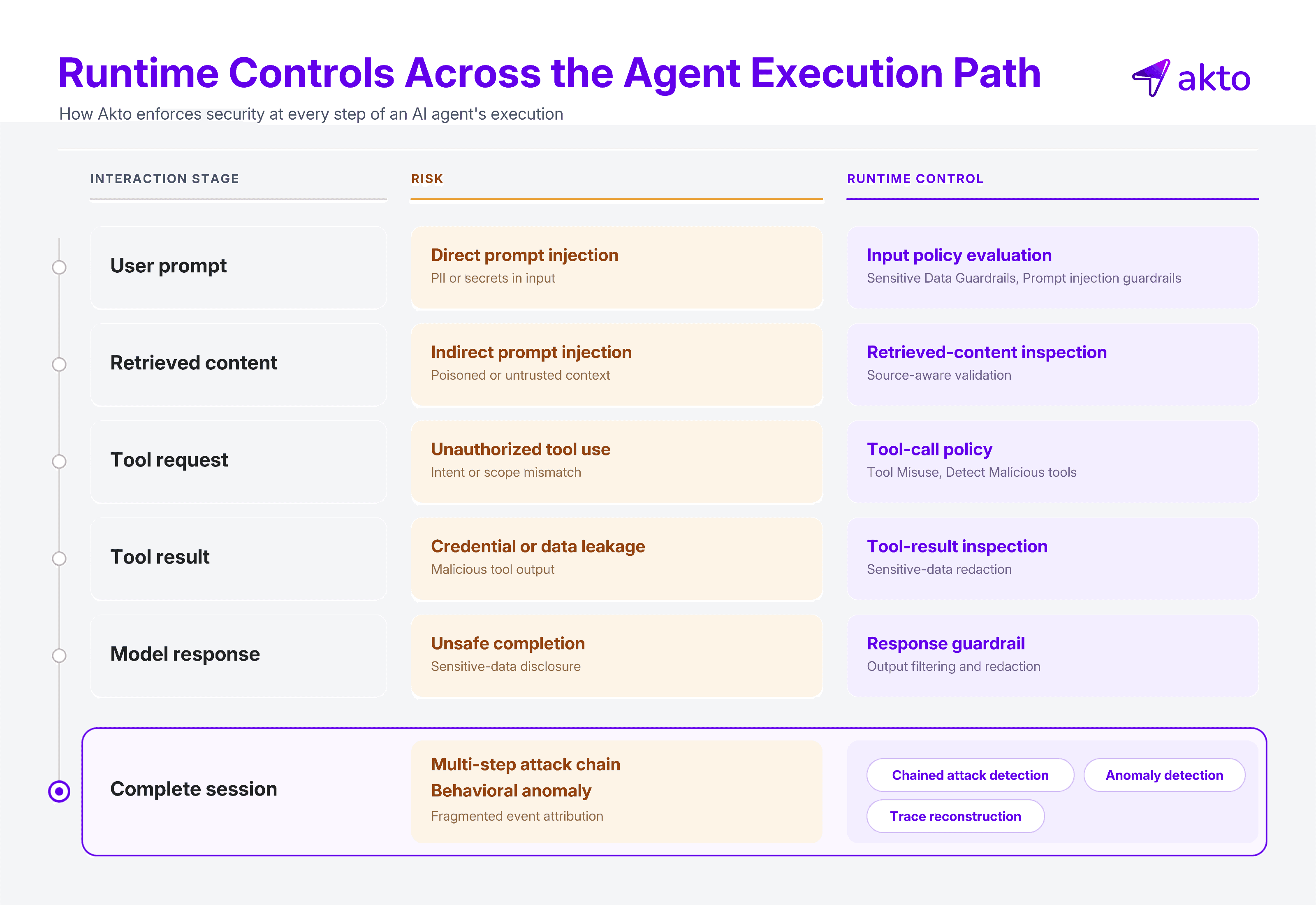
This helps security teams detect goal hijacking and multi-step data exfiltration without having to predict the exact prompt or payload an attacker will use.
Build Security Around the Full Interaction
The safest deployment model combines the strengths of both platforms:
Use Amazon Quick identity, custom permissions, sharing controls, and document-level ACLs to minimize what each user and agent can access.
Review every connector, MCP server, Space, knowledge base, and action before making it available.
Enable Amazon Quick’s native safety screening, Microsoft Purview DLP, approval workflows, and logging where appropriate.
Use Akto Atlas to gain visibility into how employees interact with each Quick agent.
Enforce runtime guardrails on prompts and responses to block or redact policy violations before sensitive information reaches the wrong destination.
Use Quick logs and Akto security events together for audit, investigation, and continuous improvement.

Experience enterprise-grade Agentic Security solution