Securing Agent Identities: 8 Risks Every CISO Must Address
AI agents are expanding the identity attack surface faster than legacy IAM can contain. Here are 10 agent identity risks every CISO needs to address.

Krishanu

Enterprises have spent two decades building real discipline around human identity: provisioning, least privilege, access reviews, clean deprovisioning. AI agents arrived faster than that discipline could be extended to them, so a population of powerful new identities is now operating ahead of the controls meant to govern it.
An agent acts within the identity it is given, and that identity is often over-provisioned from the start, carrying broad, inherited, or standing access well beyond what any single task requires. Once that identity is handed to an agent, it gets used to its full extent, and at machine speed, with no human pausing to weigh whether a given permission fits the moment.
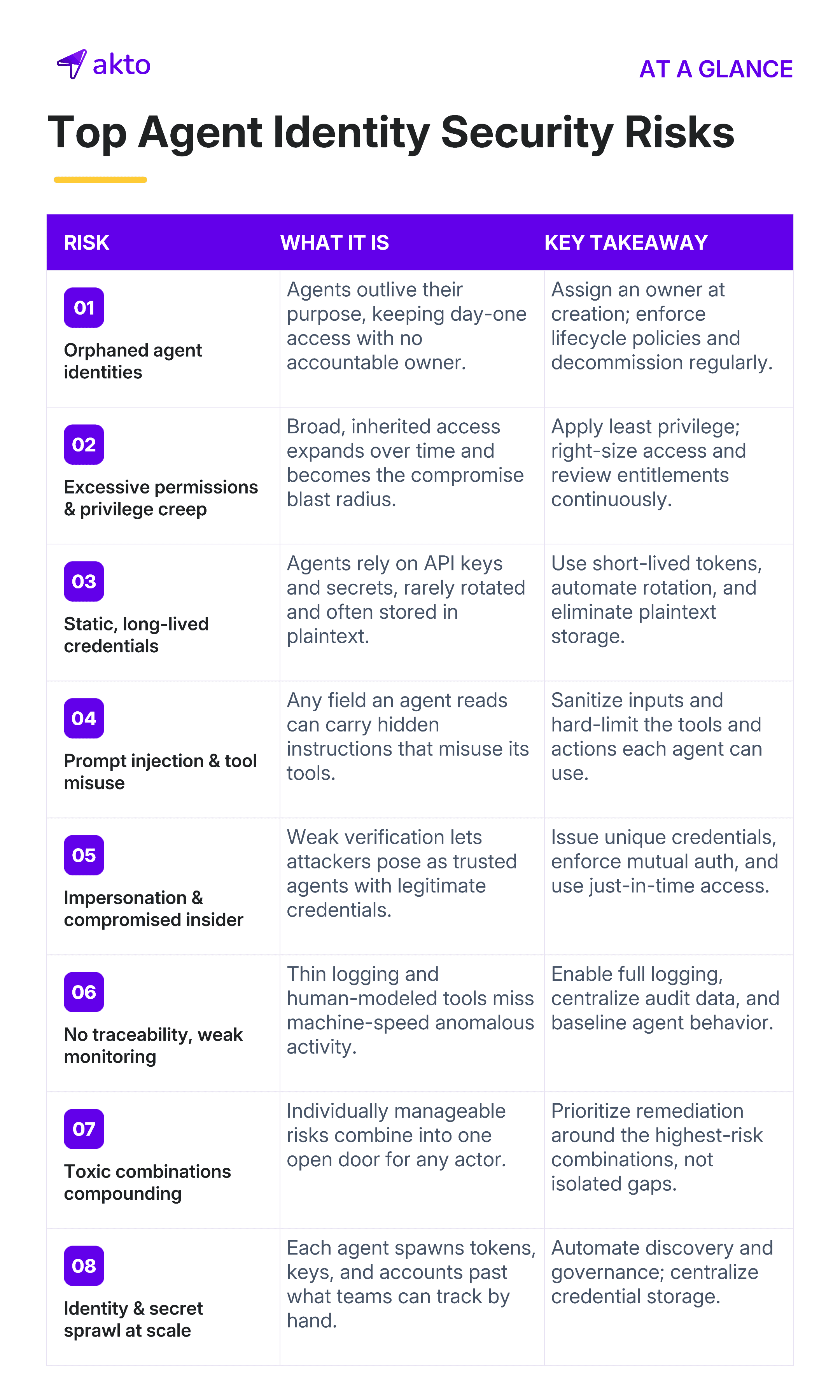
The eight risks below are the ones that matter most for a CISO deciding where to start securing agent identities.
1. Orphaned Agent Identities
AI agents often outlive the purpose they were built for. Without lifecycle management, they linger in production long after they should have been retired, still holding the access they were granted on day one. Many also have no accountable owner, so when an orphaned agent begins behaving unexpectedly, no one is positioned to notice it, investigate it, or shut it down. Each one becomes an unmonitored, standing entry point for an attacker and a direct finding in your next audit.
Key takeaway: Assign an owner to every agent at creation, enforce lifecycle policies, and regularly audit and decommission agents so unmanaged identities never become invisible risks.
2. Excessive Permissions and Privilege Creep
Agents are routinely granted broad or inherited permissions for convenience, and their access expands over time rather than contracting. An agent does not evaluate whether a privilege level is appropriate; it uses whatever is available to reach its goal, so its fastest path is often its broadest. Excessive privilege is the single biggest determinant of blast radius when an agent is compromised.
Key takeaway: Apply least privilege rigorously, right-size access to each agent's specific task, and review entitlements continuously rather than once.
3. Static, Long-Lived Credentials
Agents cannot answer a multi-factor prompt, so they authenticate with API keys, tokens, and hardcoded secrets that are rarely rotated and often stored in plaintext. An attacker who reaches the environment does not need to break anything, because the credential is already exposed and ready to use. An agent operating inside your environment can read those same configuration files by default.
Key takeaway: Replace static secrets with short-lived tokens or certificates, automate rotation, and eliminate plaintext storage through proper secrets management.
4. Prompt Injection and Tool Misuse
Agents are uniquely vulnerable to manipulation through the data they process. In one well-known case, a customer-facing agent built only to list vendor orders was compromised when an attacker hid a malicious instruction in an order's shipping address, which drove the agent to misuse an invoicing tool and leak sensitive bank details. Any field an agent reads can carry instructions, which makes your input surface an attack surface.
Key takeaway: Combine input sanitization with hard limits on the tools and actions any agent is permitted to use.
5. Impersonation and the Compromised Agent as Insider
Weak verification between systems lets an attacker pose as a legitimate agent and hijack the trust other systems place in it. A compromised agent operates with legitimate credentials, so traditional defenses read its actions as authorized and it becomes a trusted insider. This is where perimeter thinking fails, because the attacker is no longer breaking in but acting as something your systems already trust.
Key takeaway: Issue unique credentials to every agent, enforce mutual authentication between systems, and use just-in-time access to limit what a hijacked agent can reach.
6. No Traceability and Weak Behavioral Monitoring
When agents act autonomously, thin logging makes it nearly impossible to reconstruct what an agent did or why. Most monitoring tools also model human behavior, so they have no baseline for a machine operating at speed, and anomalous activity slips through unnoticed. The cost is both operational and regulatory, since you cannot separate a routine action from a malicious one or satisfy the accountability that frameworks like the EU AI Act increasingly demand.
Key takeaway: Enable comprehensive logging, centralize audit data, and build behavioral baselines that treat agents as first-class identities.
7. Toxic Combinations That Compound Into Open Doors
Each risk above is manageable on its own, but the danger is what happens when they combine. An orphaned agent that authenticates locally, carries excessive privilege, and generates no audit logs is not four separate problems. It is one open door any actor can walk through without setting off an alarm. The goal is not to work through a checklist of isolated boxes but to find the combinations that create the most exploitable conditions.
Key takeaway: Prioritize remediation around the highest-risk combinations in your environment rather than treating each gap in isolation.
8. Identity and Secret Sprawl at Machine Scale
Every agent you deploy spawns identities and secrets: tokens, API keys, service accounts, and certificates, often several per agent and often created on the fly. As agent adoption scales, that volume grows past anything a team can track by hand, and secrets end up scattered across code, config files, pipelines, and third-party platforms with no central record of what exists or what it can access. Non-human identities already outnumber human ones by a wide margin in most enterprises, and agents are pouring fuel on that fire. The problem here is not any single credential but the sheer count of them, because you cannot secure, rotate, or revoke what you were never tracking in the first place.
Key takeaway: Automate discovery and governance of every agent identity and secret, and centralize credential storage so proliferation never outruns your ability to manage it.
Establishing an Agent Identity Security Baseline
Every gap on this list was exploitable before agents arrived. What changed is the exploiter. The invisible, unmanaged layer of enterprise identity was tolerable when the actors in it were slow and bounded. Autonomous agents are neither.
The principle to take away is about sequence. Fix the identity foundation first, then scale the agents. Organizations that invert that order are handing autonomous actors the keys to an environment their security team cannot fully see. If you want a place to start this week, four moves matter most. Discover and inventory every agent. Assign an accountable owner to each one. Right-size privilege so no agent holds more access than its task requires. Turn on logging so every agent action leaves a trail you can follow.

Experience enterprise-grade Agentic Security solution