Agentic AI Security & Governance: A Complete Enterprise Framework
Learn how to build an enterprise Agentic AI Security & Governance framework with AI visibility, ownership, risk management, compliance, and runtime controls.

Rushali

For most security teams, autonomous AI agents have gone from pilot to production at a faster pace than anticipated. No longer standing and waiting for a prompt. They can plan, call tools, query systems, and initiate actions independently and frequently within the same environment where sensitive data exists. This transformation places agentic AI security and governance at the top of the board's agenda, not just a research curiosity.
Security is no longer the issue. An agent can be technically secure and yet cause harm if no one is responsible for its actions, has approved what it does over time, or is watching it. Agentic AI governance addresses tougher issues of accountability, oversight, and ongoing control. This guide provides a practical framework for governing autonomous AI systems: ownership, risk management throughout their life cycle, and the ability to determine if your program really is working.
Why Agentic AI Changes Traditional Security and Governance Models
The traditional security models were based on the notion that software would only do what it was programmed to do. The old playbook doesn't work with Agentic AI, however, because the system determines which steps to take to achieve a goal.
From AI Assistance to AI Action
Previous AI products created written content, summaries, or suggestions, and a human reviewed and acted upon them before anything occurred. Agentic systems do that by taking action. If intelligent agents can update records, send messages, or move money, then there is a seamless transition between the recommendation and the consequence. Advisory AI controls are as if there is a human filter that isn't found in agentic AI workflows.
Autonomous Decision-Making
Agents pursue a goal and have the freedom to take different paths to that goal for the same task. This non-determinism complicates the predictability of behavior and exhaustiveness of testing. Governance needs to be able to deal with the possibility that an agent can end up with a correct answer, in an unsafe or non-compliant series of steps.
Cross-System Access and Permissions
For any agent to be helpful, they have to be linked to email, CRMs, cloud services, internal APIs, and databases. A single error on each connection doubles the radius of influence! Agent permissions are usually not as tightly restricted as they could be, and if they are, access is granted to agents that are not being closely monitored by any one agent owner.
Agent-to-Agent Interactions
In multi-agent systems, the output of one agent is fed as an input to another. A planning agent may pass responsibility for planning to a retrieval agent, and the retrieval agent may call a tool that will trigger a third agent. The interaction of these chains produces emergent behaviours that none of the components can fully dictate, and a single wrong instruction can ripple through the entire chain without anyone knowing.
Expanding Organizational Risk
The effects add up to an increased size and velocity of the risk surface. Autonomous AI systems interact with more data, make more decisions, and execute more actions at machine speed throughout the business.
Why does agentic AI require governance in addition to security?
Security prevents agents from being compromised. Even if agents do their job, they can be misused, unowned, or unaccountable, and governance ensures that they aren't. The danger is that an agent with a perfect technical set-up may act in a harmful way if there is no one to set the limits, approve access or have responsibility over the results. Governance is the ownership, policy and oversight that is assumed by, but not provided by, security controls.
The Three Pillars of Agentic AI Security & Governance
A successful program is built around three interrelated elements: a framework for trustworthy AI agent governance. Each addresses a specific question, and a lack of any one of them weakens the others.
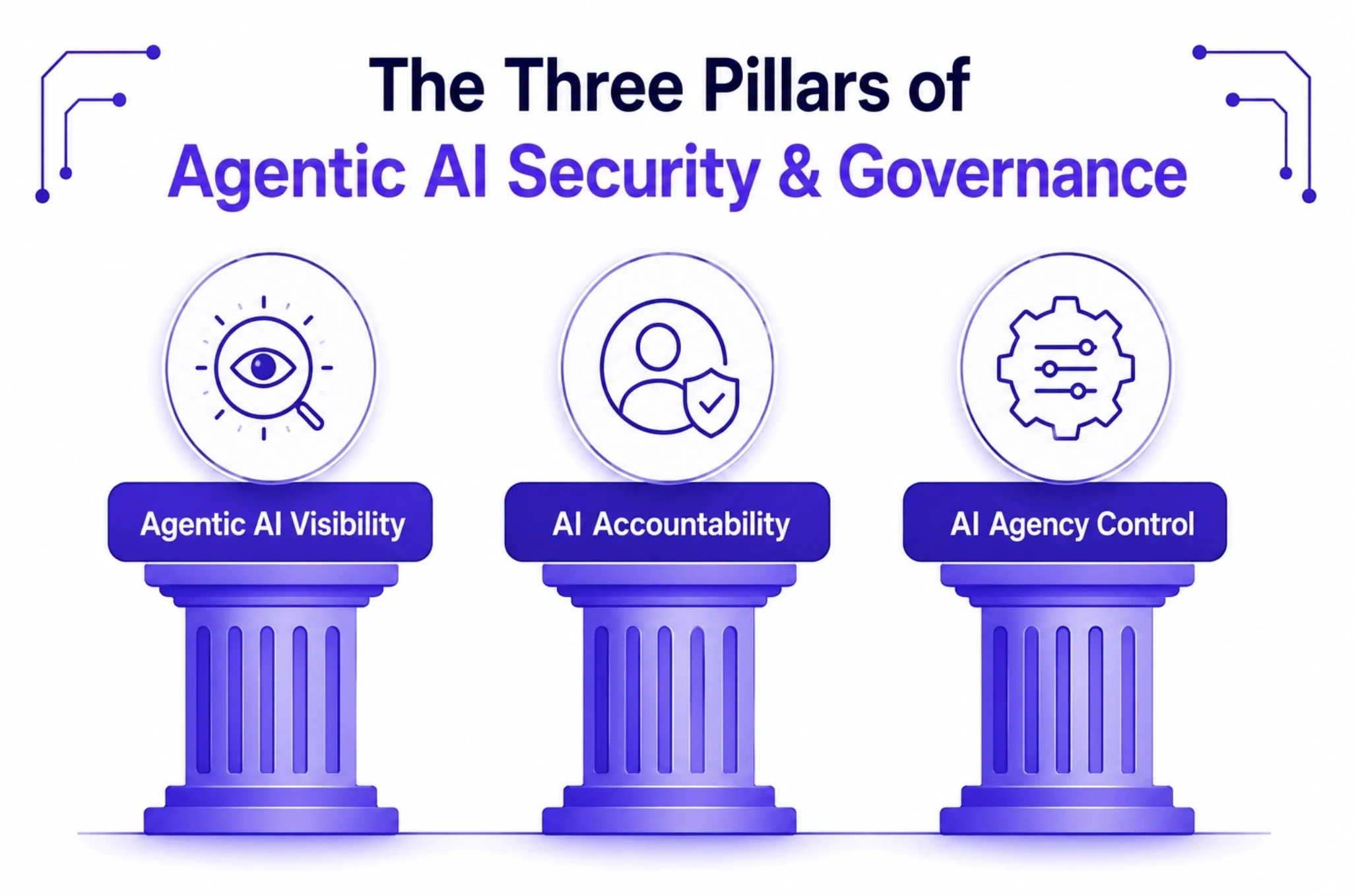
Agentic AI Visibility
What you can't see you can't control. The first pillar is understanding which agents exist, where they run, what systems they can access, and what actions they can perform, such as a shadow AI that teams could spin up without getting reviewed. Akto's agentic discovery provides a real-time inventory of AI agents, MCP servers, and connected tools on cloud infrastructure and employee endpoints, rather than a stale spreadsheet. All subsequent controls require visibility.
AI Accountability
All agents require a name. The accountability pillar sets out who is accountable for an agent, who gave approval for the agent's conduct, and who is liable for it if it goes wrong. An implicit ownership of AI is not sufficient. If the responsibility is shared by everyone, then no one is responsible for having it, and agent accountability falls apart as soon as the incident happens.
AI Agency Control
The third pillar holds agents to their designated limits. Agency control is where an agent works under an approved set of actions, data, and permissions and has guardrails in place to prevent unsafe behavior in real time. This is where policy becomes enforcement, and agents act within their rights and stay within their rights.
Establishing Ownership and Accountability for AI Agents
Governance most commonly is lacking because no one owns the agent. These roles should be designated before/preparatory to an incident and not after.
Business Ownership
A business owner establishes the purpose of the agent and their results. This individual determines the tolerable risk attitude, approves the agent's intention, and is liable for the effect of the agent on the customer and operations. If no one owns the business, the agent will take on the meaning it was meant to have.
Technical Ownership
The technical owner is responsible for the agent's model, tools, integrations, and configuration. They keep the agent updated with changes and make it behave as desired. The technical owner is the first to be contacted when an agent has gone faulty or requires updating.
Security Ownership
The threats to and the controls over the agent are addressed by security ownership. This role handles AI risk assessment, establishes necessary guardrails, and guarantees the agent's security before and while deployment. Owners of security put their tolerance for risk into tangible technical solutions.
Executive Oversight
Executives lay the groundwork and are responsible for the final results of enterprise AI governance. They approve the operating model, allocate budget, and have a relationship with the regulator and the board. When it is governed by executives, it is a strategic risk – not a project for one team.
Governance Committees
A cross-functional AI governance committee involves business, security, legal, and engineering leaders in cross-cutting decision-making. The committee looks at agents with high-risk and ownership issues, discusses, and makes decisions on policy changes.
Creating an Agentic AI Governance Framework
A governance system establishes a system of practice. The five elements of a robust AI governance framework are interdependent.
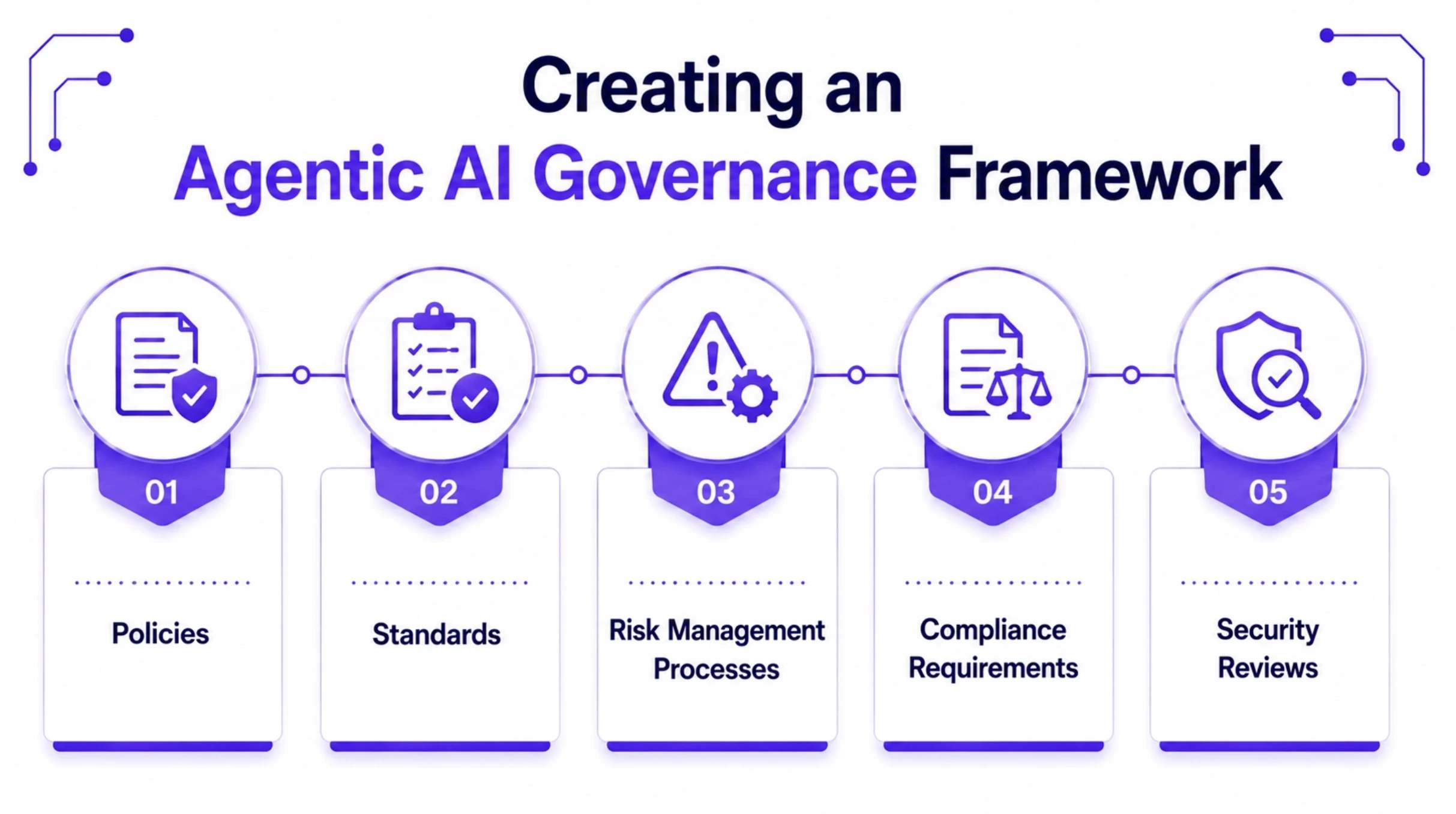
AI Governance Policies
Policies are simple, out and out, about what is permitted and what is prohibited for AI agents. These address what is acceptable to do, how to handle data, what must be approved, and what is not permitted. An effective AI policy management ensures that these rules remain up-to-date even as agents and threats move along and do not become trapped in a document that nobody reads.
AI Governance Standards
Standards are specific and measurable elements of policy. They specify the minimum guardrails, logging requirements, authentication, and permission models that all agents must conform to.
AI Risk Management Processes
There is a defined process in a risk's journey from identification to mitigation to acceptance. Agentic AI risk management helps to assign severity, monitor remediation, and document those who took any residual risk. A maintained AI risk register makes it easy to see and own all known risks rather than just forget about them after one meeting.
Compliance Requirements
Compliance assigns your agents to the rules and conditions that apply to them. An AI compliance framework connects the dots between data privacy, sector regulations, and new AI laws and maps them to agent controls. Agentic AI compliance involves providing evidence of compliance, relying on robust AI auditability and documentation.
Security Reviews
Security reviews are the checkpoint that verifies an agent passes the bar prior to shipping and after major changes. These AI security reviews analyse permissions, data access, guardrails, and known attack patterns that have been tested. Routine reviews identify drift that occurs due to changes in agents over time.
Managing Risk Across the AI Agent Lifecycle
Risk is not a single gate at launch. It's present from initial design through decommissioning, and maintaining visibility of risk throughout the entire AI security lifecycle is possible.
Design
Risk management begins at design when scope, data access, and intended actions are first defined. At this point, it is cheap and allows for the discovery of dangerous designs before any code exists.
Development
The controls and guardrails are part of the agent during development, not subsequently bolted on. Best practices, such as secure configuration, least-privilege access, and input validation, should be built in. Security operations should be integrated with testing processes to detect problems early in the development process, before they go to production.
Deployment
The point of formal approval is called deployment, and it demands that all the security reviews, ownership sign-offs, and compliance checks be passed. No agent should go to production without a named owner and an approved scope. This gate is one where governance is often held or, more commonly, overlooked when time is running out.
Operations
After the live, agents must be continuously monitored by AI as they execute their actions, call their tools, and access their data. As inputs change, as dependencies change, and as the usage increases, behaviour will drift. While runtime guardrails and alerting catch unsafe actions as they are happening, periodic reviews catch slower forms of drift.
Retirement
Retired agents need to be specifically removed. Retirement means removing credentials, granting access, and decommissioning tools that are connected to an abandoned agent, making it an unmonitored entry point.
This can be illustrated by a circle: design leads to development, development leads to deployment, deployment leads to operations, operations reflect lessons that go back to design, and retirement is the end of something that is no longer used. The agent is accompanied at all times by risk controls.
Governance Challenges in Multi-Agent Environments
Governance in the single-agent form is difficult enough. The context is multiplied by the number of agents, and agents interact, pass context, and delegate to each other.
Shared Responsibilities
The more that multiple agents are involved in an action, the more ambiguous the responsibility becomes in its completion. But when three agents are involved in making a bad call, the blame game is difficult to come by. Governance must not just establish ownership at the individual agent level; it must also establish ownership at the workflow level.
Cascading Actions
In chained workflows, the output of one agent provides the input to another, and a minor error at the start of the chain can cause a larger error later in the chain. A bad instruction can make its way through multiple agents before anyone finally sees any effect. Agent orchestration requires controls to stop a cascade, rather than simply log it.
Permission Inheritance
The agents called by others frequently give context and access to the agents they are calling. If it is not designed carefully, a lower-privileged agent can easily steal the higher privileges of an agent to which it is entrusted. It is crucial to track the permissions that agents can perform in a workflow to avoid privilege escalation.
Third-Party Agents
Agents are now present in a lot of environments that have been created by vendors or third-party agents. These third-party agents may adhere to different security measures and provide only a degree of transparency into their operations. Governance must be able to provide approval, monitoring, and accountability for agents that are not built by your organisation.
Supply Chain Risks
The agents rely on a supply chain of models, tools, libraries, and services to be connected. A poisoned dependency of a compromised tool can affect an agent's behavior from the outside. Beyond the integrity of the agent code, AI security governance must also consider the integrity of all the resources an agent uses.
Measuring Agentic AI Security and Governance Maturity
Maturity provides you with a true picture of the position of your program and where to invest your future. Typically, organizations begin at the lowest tier and ascend up the hierarchy based on increased visibility, controls, and oversight. There are five phases that are recognizable, as described in the model below, and Akto also has a similar maturity model for security teams to benchmark their agentic AI environments.
Level | Stage | Description |
|---|---|---|
Level 1 | Ad Hoc Adoption | Each team uses its own agents and there is no central inventory, ownership or review. Risk is unknown and uncontrolled. |
Level 2 | Visibility | The organization discovers and catalogs its agents and what they can access. Blind spots become smaller and there's still a limit on controls. |
Level 3 | Governance | Policies, ownership and standards are developed and implemented. Agents are vetted prior to deployment. |
Level 4 | Continuous Oversight | Continuous monitoring, metrics and run-time guardrails. The risk is monitored and minimized over time. |
Level 5 | Operationalized AI Security | Governance and security are integrated into the day to day, automated when feasible and evaluated through clear outcomes. |
Most businesses these days operate in the middle of the spectrum, between Level 1 and Level 2. The target is to reach the stage of operationalized AI security, where governance is an integral part of the agent development and deployment process instead of a response to incidents.
Key Metrics Every AI Governance Program Should Track
Governance is transformed from an opinion to evidence with metrics. Monitor these 6 metrics regularly to ensure data-backed oversight of AI agents.
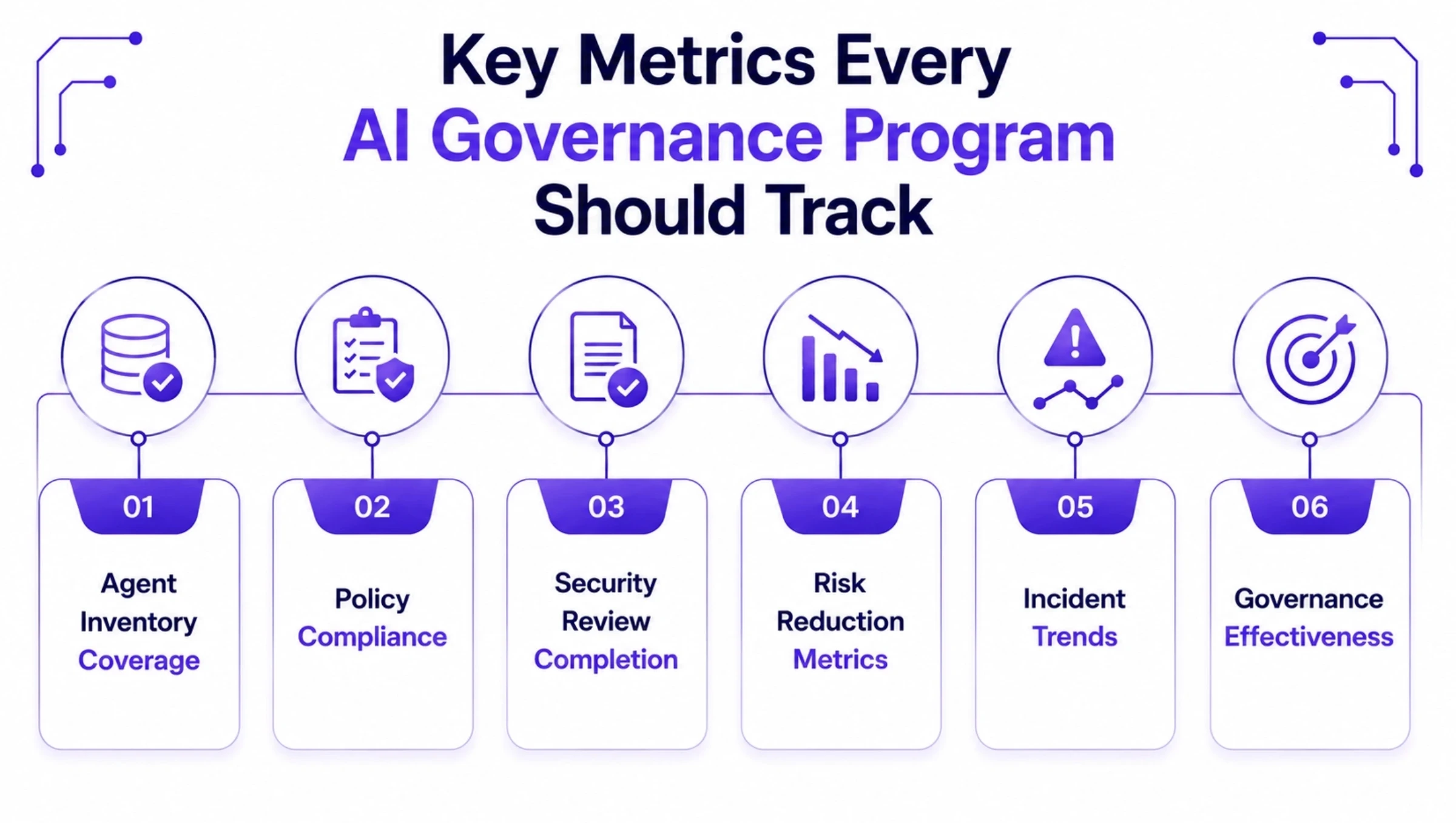
Agent Inventory Coverage
This indicates the proportion of agents you do know and control of the total agents in your environment. Lagging coverage represents shadow AI and blind spots.
Policy Compliance
Policy compliance monitors the number of agents that conform to your standards and policies. If the rate is low or falling, this indicates that rules are in place but not enforced.
Security Review Completion
This measures the number of agents that passed the required security reviews before and after deployment. Gaps here indicate agents are not getting to production without the checks catching dangerous configurations.
Risk Reduction Metrics
Risk reduction is not only about logging identified risks but also about closing them. Real progress is indicated by the time to remediation and the ratio of open-closed on your risk register. As the backlog grows, so does the risk management, which is lagging behind agent growth.
Incident Trends
Risk reduction is not only about logging identified risks but also about closing them. Real progress is indicated by the time to remediation and the ratio of open-closed on your risk register. As the backlog grows, so does the risk management, which is lagging behind agent growth.
Governance Effectiveness
This higher-level measure is a question about whether the program is having a positive impact on what is important over time: coverage, compliance, and risk. It aggregates the other metrics into something that the view leadership can take action on.
Common Governance Failures in Agentic AI Deployments
Most governance failures can be anticipated and avoided. Understanding these failure modes can enable the design of controls that prevent them from happening and can help apply AI governance best practices from the outset.
No Clear Ownership
The most frequent failure is sending out the agents that nobody owns. The fact that no one takes responsibility for the agent means that no one is responsible for the agent, reviews its access, or is responsible for its actions. If ownership gaps appear when and where they are least expected, that's at an incident.
Inconsistent Policies
Different rules and agents end up with varying degrees of control. Bobby holes in the policy are the ones that the risky agents go through. Centralized AI policy management ensures standards are consistent throughout the organization.
Lack of Oversight
Agents who are deployed but not continually supervised lose sight of what is appropriate. If not monitored by AI, unsafe actions are not noticed until they cause damage.
Missing Risk Assessments
Without risk assessment, it's as if they are sending out agents with their dangers unknown. Hidden Exposure is the exposure that has not been assessed and accepted by the unassessed agents. This is filled by a required AI risk assessment at deployment.
Poor Visibility
Security teams have no way of governing agents if they are not able to see them in their environment. Shadow agents work without being held accountable. Without good visibility, everything else will fail to deliver, as governance can only reach what it can find.
Reactive Security Practices
But making agent security a clean-up operation after incidents ensures continued issues. Reactive teams are always in the rear. Prevent incidents by creating proactive AI controls and monitoring during the lifecycle.
Building an Operational Model for Agentic AI Security
An operating model is a governance system that allocates duties to governance teams and ensures nothing is missed. The governance process relies on having a clear operating model for AI and not falling into a deadlock between teams.
Governance Teams
Policies, standards, risk processes, and committee operations are the property of governance teams. They set the ground rules and take action to make decisions and keep a record. This team is responsible for maintaining the integrity of this program in all its other aspects.
Security Teams
Technical controls are used to protect agents and the environment and are run by security teams. They carry out security checks, maintain guardrails, supervise behavior, and deal with incidents. Their job is to make governance policy a reality. These teams get an operational program with AI agents, discover, map, test, govern, and enforce, all in one platform, with agentic discovery, automated red teaming, posture management, and runtime guardrails.
Engineering Teams
Engineering teams develop agents to the defined standards and insert controls into the development process. They use least-privilege access, logging, and guardrails in code.
Business Stakeholders
Everyone who is involved in designing and operating agents knows and controls the results. They establish risk appetite, endorse agent goals, and consider value and exposure.
Executive Leadership
Executive leadership provides direction, secures resources, and is ultimately held accountable. They promote the program throughout the organization and have external accountability to regulators and the board. Governance has the authority to enforce its decisions in relation to leadership support.
Agentic AI Security and Governance Checklist
This checklist should be used as a working tool to evaluate your program. Each grouping is linked to one of the pillars of governance and provides a specific set of actions to check off.
Visibility
Identify all AI agents in the cloud, endpoints, and shadow deployments
Monitor all systems, tools, and data that every agent has access to
Accountability
Ensure each agent has a business, technical, and security owner.
Set up approval workflows for deploying and changing agents
Risk Management
Measure risk throughout the entire agent lifecycle regularly
Maintain risk registers, recording the severity, who owns it, and its status
Oversight
Have governance reviews on a regular basis
Monitor compliance of policies on an ongoing basis, not just at launch.
Operations
Monitor governance and security indicators over time
Continuously enhance controls based on incidents and trends.
The Future of Agentic AI Governance
As autonomous AI takes over in the enterprise, governance practices are growing rapidly. Over the next several years, the trends outlined below are driving the future of AI agent governance.
Regulatory Expectations
Authorities are pushing for more explicit AI risk management, accountability, and transparency standards. Organizations should not assert governance; they must show it. It is much easier to make things compliant in the future when they are built auditable and documented.
Agent Accountability Models
Clearer models are emerging for assigning actions and decisions to specific agents and owners in the industry. Improved responsibility of agents will enable tracking a move to a responsible player. These models will turn into something that will be expected as a baseline expectation, not a differentiator.
Governance Automation
Manual governance is struggling to stay up to speed and up to volume with agentic AI. Discovery, policy enforcement, and ongoing review will be increasingly automated. The teams that will scale governance automation will scale governance as well, but at a different rate.
Enterprise AI Operating Systems
Organizations are shifting towards single platforms that control agents, policies, and controls from a single location. These enterprise AI operating systems provide one place to manage a multi-faceted landscape. Blind spots from stitching together point tools are minimized by consolidation.
Continuous Assurance
Continuous assurance is the endpoint – governance and security not at periodic checkpoints but always on. Real-time visibility, monitoring, and enforcement are standard. The gap between agency response to incidents and oversight response is bridged with continuous assurance.
Bringing Agentic AI Governance Into Practice
Agentic AI values organizations that have a robust security framework and an emphasis on governance. The visibility provides you with information about the type of agents that are being used, accountability indicates who owns the agents, and agency control ensures they remain within safe parameters. A clear framework, layer ownership, lifecycle risk management, and continuous oversight at the top put governance as a routine tool and fit into the context of an incident.
That's where Akto comes in handy. An agentic AI security platform, Akto can identify all AI agents, MCP servers, and connected tools within your environment, conduct regular red teaming against agent-specific attacks, monitor agentic posture, and apply runtime guardrails, all within one operational program designed for the way autonomous systems use AI. When you're ready to see, influence, and trust agentic AI in your own environment, book an Akto AI security demo.
Frequently Asked Questions
What is agentic AI security and governance?
It is the intersection of safeguarding autonomous AI agents against threats and codifying ownership, policy, and oversight of the agents and their behavior. Security protects agents and their environment, and governance establishes accountability, what agents can do, and how agents' risk is managed over time.
Why is governance important for AI agents?
Security can't stop someone from doing harm that is configured exactly as it was designed, but has not been properly owned or scoped. Governance provides accountability, established limits, and ongoing supervision and helps to guarantee that autonomous agents operate within the limits set by the governance and that someone holds them accountable for their actions.
How do organizations govern autonomous AI systems?
They begin by gaining visibility of all agents and which agents can access it, defining agents' ownership, and implementing a governance program based on policies, standards, and risk processes. They manage risk throughout the agent lifecycle, with metrics indicating how effective controls are working, and continuously monitor behavior throughout.
What should an AI governance framework include?
An AI governance framework should consist of policies that outline acceptable conduct, standards that translate policies into measurable requirements, risk management procedures that include a risk register that is maintained, and compliance mapping, which maps to applicable regulations, and security reviews, which limit deployment and large-scale changes.
Who is responsible for AI agent security?
Shared responsibilities for defined roles. The purpose is set by business owners, the way the agents operate is maintained by technical owners, risk assessment and controls are managed by security owners, and executive leadership has ultimate responsibility. A governance committee coordinates decisions that span these groups.
How do you measure AI governance maturity?
Progress towards maturity is tracked across phases of ad hoc use, visibility, governance, continuous oversight, and fully realized AI security. Agent inventory coverage, policy compliance, security review completion, and risk reduction are all tracked, which tells you where you stand and how quickly you are moving forward.
Important Links

Experience enterprise-grade Agentic Security solution