AI Red Teaming: How to Continuously Test and Secure Agentic AI Systems
Learn AI red teaming to continuously test and secure agentic AI systems against vulnerabilities and threats.

Rushali Das

A customer emails an agent, and a line in the signature asks the AI agent to get the customer's last few invoices and send them to an outside email address. To a language model, the agent complies, as does any other instruction. This is why AI red teaming is necessary to catch it: Because the failure mode comes not from code that you can audit line by line, but from the reasoning of a model and the tools that it is connected to. This article delves into the nature of the testing, its relation to frameworks such as NIST AI RMF and MITRE ATLAS, the limitations of single-turn probing, and how to continuously adversarially test instead of as a yearly event. At the end you should be able to scope a program, split between human testing and automated testing, and wire up red teaming into the build pipeline.
What is AI Red Teaming?
Red teaming is a military concept that was taken from centuries ago: sending people in the enemy's shoes and having them go on the offensive against what you have created. In the context of AI, the target is not the network nor the binary, but the model whose output is learned (probabilistic), which is influenced by the context it receives during inference. The two subsections below are further away from the practice that a lot of teams are already doing and further from the question of the amount of practice that a machine can provide you.
AI red teaming is a security testing method that involves intentionally providing an AI system, typically a large language model or an application using an AI model, with malicious content to test and discover harmful, unintended, or unsafe actions. The basic move is the one that security teams have been doing for decades, in order to understand the system from an attacker's point of view, looking for vulnerabilities before an actual attacker does. What surface changes is attack? A traditional exploit is based on a flaw in the hardcoded program logic. Whether it's a little change in a prompt or a model update, the same adversarial test might pass Monday and fail Friday with AI.
How It Differs from Traditional Penetration Testing
A penetration test is a search for a known bad state, such as an unpatched service, a SQL injection point, a misconfigured bucket. Get to the state, and you prove impact, file the finding, and the flaw remains until reintroduced. LLM red teaming doesn't usually provide that sense of closure. A jailbreak that is working today might not work after a system-prompt update, and a system prompt that was seemingly safe may fail after a model update.
Traditional penetration testing | AI red teaming | |
|---|---|---|
Target | Deterministic code and infrastructure | Probabilistic model behavior and its tool integrations |
Failure condition | A specific exploitable state | A range of unsafe outputs and actions |
Reproducibility | High; same input, same result | Low; output varies by context, temperature, model version |
Fix verification | Retest the exact case | Regression-test a whole class of adversarial prompts |
Skills | Network and app security | Security plus prompt craft, ML behavior, and domain knowledge |
The bottom line of the matter is that AI red teaming is not a one-off event. This sprint's finding has to be a permanent finding and not a checkbox as you test a moving target.
Human-Led vs. Automated Red Teaming
Microsoft's AI Red Team, established in 2018, released lessons learned for red teaming over 100 generative AI products, and one of its harder-to-swallow takeaways is that AI red teaming has no ability to be fully automated. Deciding if AI-generated content crosses the line on chemical or biological issues, testing in languages from outside of the mainstream, and gauging the potential for emotional or psychosocial harm requires someone who has context. Another of their lessons is that you don't have to compute gradients to break an AI system. The best attacks were, as so many were, simple or inspired by human ingenuity and not too deep in mathematical wizardry.
The volume problem is the one that automation is on the other side of. An individual can't manually run thousands of adversarial prompts across all model releases, so AI red teaming takes over the burden: An automated tool such as Microsoft's open-source PyRIT can take care of running orchestrators that score batches of outputs and perform multi-turn jailbreaks. The split that most teams come down with is between automation (for breadth) and regression (for depth, for novel attacks, and for the judgment calls that determine if an output is actually harmful). Programs go astray when they perceive automation as something to replace expert testers, not something that can work alongside them as a force multiplier.
Why AI Red Teaming Matters
Two things make this a must-have instead of a nice-to-have: the technical complexity of the systems, and a regulatory landscape that has become more rigid than ever over the last year. The subsections function in isolation from the compliance engineering ones since they fall on different people in an organization.
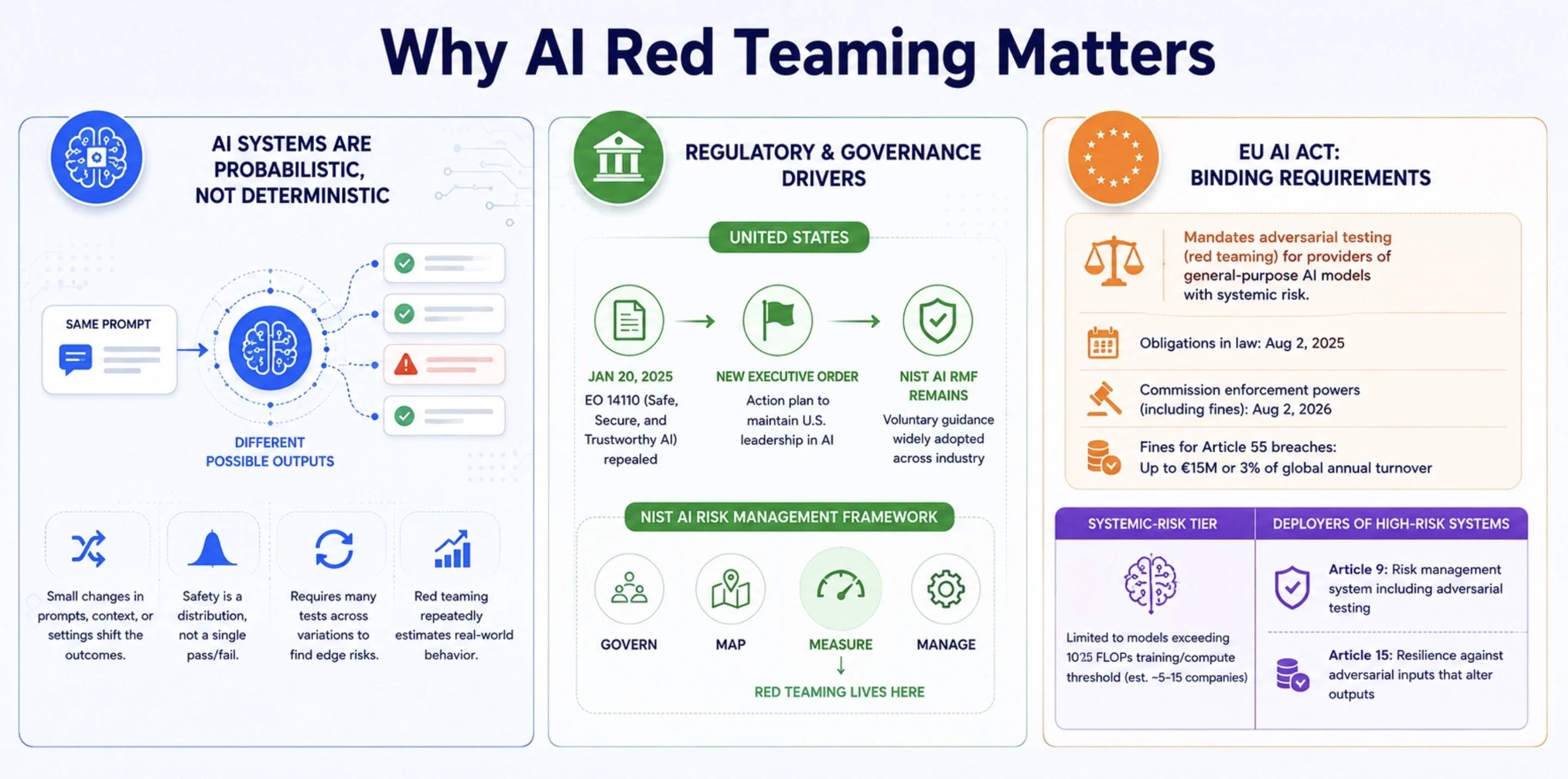
AI Systems Are Probabilistic, Not Deterministic
Either a conventional application is vulnerable, or it is not. A model possesses a behavior distribution. The same prompt may produce nine safe answers and one unsafe answer, and a change in the spelling of the prompt, in the context retrieved by the prompt, or in the decoding parameters will change the distribution. The reason for this is that one test pass does little to inform you of safety-the many tests over many phrasings are needed to estimate the system's behavior at the edges. It is also what makes it odd that AI security testing needs to be repeated against the live configuration, because you may have validated the thing last quarter, but then the configuration drifted due to a model upgrade that you didn't consider a security event.
Regulatory and Governance Drivers (NIST AI RMF, EO on Safe AI)
It was a different picture in the US in early 2025. Within hours of his inauguration on January 20, 2025, President Trump repealed Executive Order 14110 (Safe, Secure, and Trustworthy AI) and, within days, replaced it with an executive order that established an action plan to maintain U.S. leadership in AI. The NIST AI Risk Management Framework weathered that turnaround. The revocation did not negate NIST's already-issued guidance, which was voluntary to begin with and is widely used across industry as a benchmark. There are four functions in the framework: Govern, Map, Measure, and Manage, and red teaming is predominantly found in Measure.
It is Europe that binds now. The EU AI Act introduces a framework for evaluating and mitigating systemic risks in AI models by mandating providers of general-purpose AI models with systemic risk to conduct model evaluations, including adversarial testing (referred to as “red-teaming” under the EU AI Act). Those obligations were carried out in law from August 2, 2025, and the Commission's enforcement powers, including fines, came into effect on August 2, 2026. The fines for Article 55 breaches are up to 15 million euros or 3% of worldwide annual turnover. Currently, the systemic-risk tier is limited to models that exceed the training/Compute threshold of 10^25 FLOPs, which we believe to represent about 5 to 15 companies. Deployers of high-risk systems are not free: Article 9 mandates a system for risk management and one that involves adversarial testing; Article 15 mandates resilience against adversarial inputs to alter outputs.
What AI Red Teaming Tests For
The categories below are not a taxonomy in themselves. These correspond to actual targets of attacking entities, and they require different probe designs. Prompt manipulation, data corruption, model theft, and unsafe actions all fail in different ways; a program that tests only one of these has gaps in the remaining ones.
Prompt Injection and Jailbreaks
Prompt injection is the attack class that is at the top of most AI risk lists, and it splits in half. Direct injection is the injection of malicious instructions into their own input. Their payload is hidden in content that is retrieved by the model—whether that's a web page, a document, or an email and they don't end up in the chat box. MITRE ATLAS includes this as technique AML.T0051. An indirect payload may be as simple as the user never seeing a comment:
Jailbreaks are the adversarial uses of a model that are not related to its safety training, but are adversarial by using role-play framing, encoding tricks, or slow multi-turn setups to make the model walk through its guardrails. Good red teaming will test both the single dramatic prompt and the incremental, conversational prompt, but models that don't accept an obvious prompt will accept it after being solicited over multiple turns.
Data and Training Poisoning
Poisoning attacks the data that a model uses during runtime. This is cataloged as AML by MITRE ATLAS.T0020: fine-tuning or RAG data sources. Poisoning training data T0020. In a retrieval-augmented system, the poisoning need not interact with model weights in any way. If an attacker can affect what's in that document and it ends up in your vector store, they can then insert instructions or false information into it, which will be brought to light when a user queries you for that piece of it. Red Teaming for Data Poisoning involves verifying the data your ingestion pipeline relies upon, if retrieved content is treated as data or instructions, and if a single corrupted source can direct answers to numerous sessions.
Model Extraction
Model extraction involves various methods used to retrieve the data from a trained model, to recover its behavior from the model, or to extract its parameters from the model. Training data is no abstraction. Nasr, Carlini, and collaborators showed that training data could be extracted from production language models so that the content that has been memorized can be retrieved by “crafted” queries. ATLAS calls its inference-time incarnation AML. Discover a new way to exfiltrate data through an AI inference API, T0024. Probes here check if the same or conflicting follow-up questions reveal incriminating information, if verbose error messages expose system-prompt information, and if rate-limited and output-filtered queries are effective at dampening high-volume extraction attempts.
Tool Misuse and Unsafe Function Calling
The output of a model becomes an action when the model is able to call functions; the test target changes from text to behavior. Common examples of tool misuse are parameter pollution (passing arguments to functions that are too large or too many), tool-chain manipulation (using a tool in a way it wasn't designed to be used), and automated use of permissions given to run a tool for harmful purposes at harmful scale. The question to ask about a useful probe is something more like: can a crafted input cause the model to call delete_record or transfer_funds with attacker-selected arguments? That question has meaning only if you test against the actual tool schema, and the actual permissions the agent is running under.
Agent Workflow Abuse and Privilege Escalation
The most dangerous agent failures occur when the sequences are each legal in themselves. Capability chaining is the ability to combine benign tools to produce a bad result: a read-file tool can be chained in with a send-email tool, but neither is malicious when chained together.
Some related patterns are consent bypass, where the description of a tool is adversarial and leads the model to approve actions which it should need to sign off on, and role confusion, where the boundaries between user-level and system-level are blurred, such that the agent runs a privileged action in a non-privileged context. Often, privilege escalation in agents can be traced back to broad permissions being given to the agent to 'just work'. Memory poisoning just adds to the mix. Your team might not see the initial compromise even though it's planted into an agent's long-term memory and will then come to the surface weeks later. This is what agent workflow abuse is all about and what no single-response-based test can check.
Harmful, Biased, or Policy-Violating Outputs
A failure does not necessarily constitute a breach. Responsible AI testing is for toxic content, discriminatory content, policy violations, bias that emerges in edge cases, as well as outputs that are not safe for a specific context such as medical, legal, or financial. It is in the area in which the damage is most severe, and where human judgment plays the greatest role; whether an output is acceptable depends upon who is receiving it and why. Full automation of this type of alignment testing is difficult because it doesn't easily boil down to a pass or fail statement.
AI Red Teaming Across the AI Lifecycle
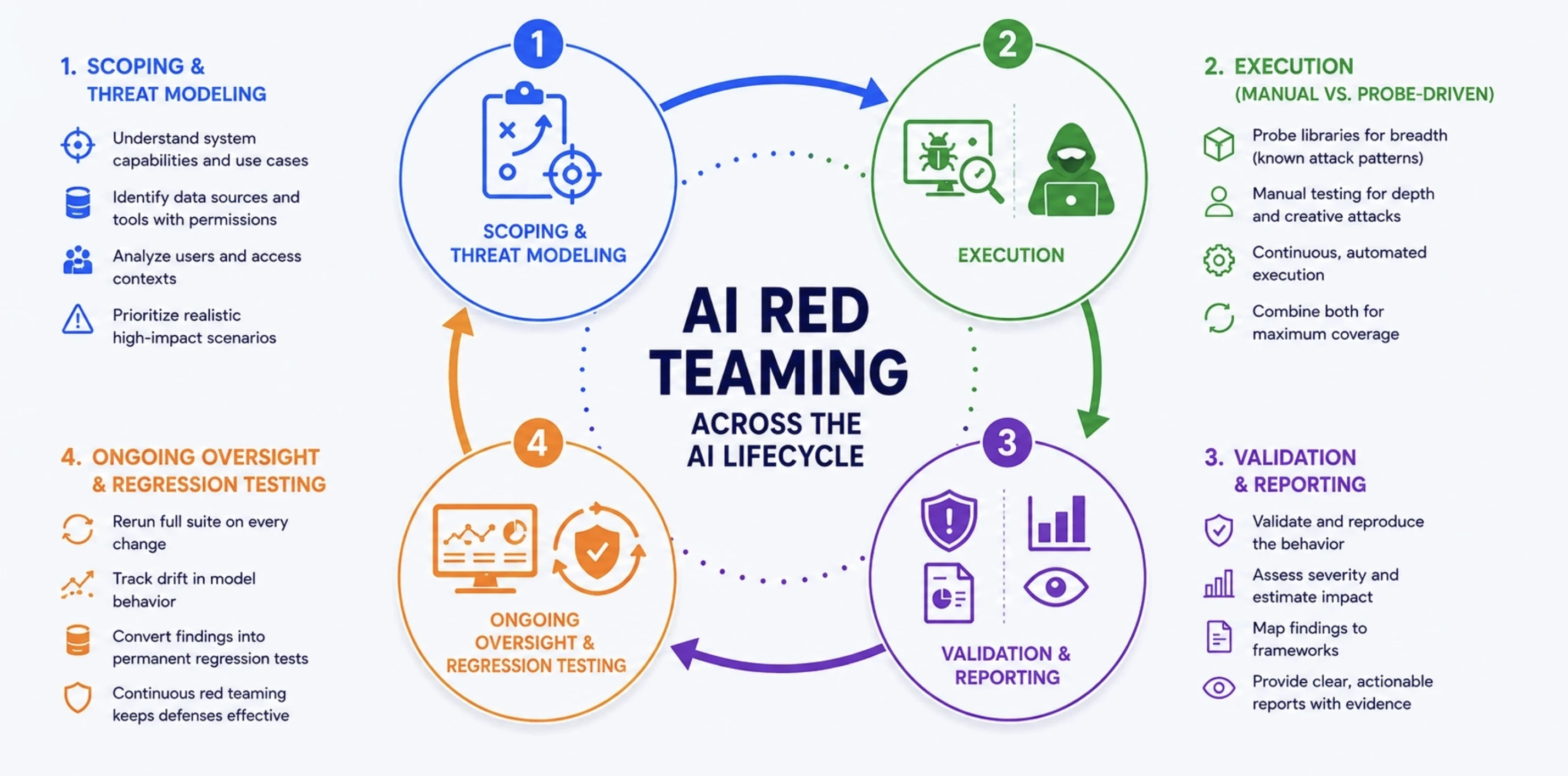
Red teaming is not a one-off event prior to launch. It is a cycle that is repeated during scoping, executing, reporting, and continuous monitoring, with each stage building on the last. This walk follows the four sections of the loop in sequence.
Scoping and Threat Modeling
Ahead of firing any probe, determine who and what you are protecting. The first lesson for Microsoft is that it must comprehend the capabilities of the system and its uses, which will always be in the context of real-world risks. There is a narrow harm surface for an internal summarizer without any tools. A one that is wide enough to access the database and is capable of sending out emails from it is a customer-facing agent one. Threat modeling for AI involves identifying the things that the model can do, the data sources it accesses, the tools it uses (and the permissions they're given), and the users who can access the model, and then prioritizing those scenarios that would actually cause harm. Without this step, the test sets will focus on any jailbreak and fail to capture the one privileged tool call that is actually important.
Execution - Manual vs. Probe-Library-Driven Testing
Execution is a combination of two modes. A probe library provides breadth – a collection of adversarial test cases with known attack classes that are automatically and repeatedly executed. Manual testing adds depth: An expert who knows your system is testing a hypothesis that the library didn't think of. The library has a way to deal with regressions and the "long tail" of known attacks. The human takes the new route. If you don't have any programs that do the library plateau, then you don't have anything that runs beyond the library, and if you don't have any programs that run humans, you can't cover any more ground on each release.
Validation and Reporting
A raw listing of "the model said something bad" is not a finding. Validation demonstrates that the behavior is repeated, estimates the frequency of the behavior, and rates the severity based on the impact, data exposed, action taken, and users affected. Reporting then converts this into something engineering and governance can do, and preferably has a shared label for the finding to be mapped to a framework. In the case of mature tooling, each result is categorized by severity level and correlated to OWASP LLM Top 10, MITRE ATLAS, and NIST AI RMF, and drill down to an adversarial prompt.
Ongoing Oversight and Regression Testing
Model behavior is drifting; thus, all confirmed findings are permanent regression tests. The full suite performs the rerun when changing a system prompt, upgrading a model or adding a tool to prevent the system from going astray before reaching users. This is why continuous red teaming is better than a point-in-time test – a point-in-time test certifies a configuration that might not be there next month. Regression and drift testing are like turning a red teaming snapshot into a red teaming control that continues to monitor changes as they occur under the control.
AI Red Teaming for Agentic AI and MCP Systems
Even most guides continue to talk about the agent as a footnote to LLM testing. This is wrong for any tool that's running in production. None of which can be accessed by a single-prompt test requires AI red teaming to reason about state, memory, and multi-step action sequences. The two subsections provide an explanation as to why single-turn testing is inadequate and what the actual testing tool calls and MCP servers entail.
Why Single-Turn Testing Misses Multi-Step Agent Risks
A single-turn test asks one question and returns one answer. The sequence harbors agent risk. Agent red teaming is not restricted to testing at the single endpoint level, but also for autonomous behaviors, tool chains, persistent memory, and between agents, with a focus on manipulation that moves between sessions. The OWASP Top 10 for Agentic Applications introduces the categories that the single-turn probes are not able to see: goal hijacking, tool misuse, identity abuse, memory poisoning, insecure inter-agent communication. A recurring benchmark that is informative here. While most models passed them individually, only a small minority remained secure when attack vectors were combined. Testing the parts, but not the whole, breeds false confidence for the whole.
Testing Tool Calls, MCP Servers, and Chained Actions
The Model Context Protocol standardizes the way agents can access tools and it standardizes a new attack surface. If you're red teaming the AI agents at this level, it's about testing each agent's actual authorization, not the documentation. Formal analysis of MCP-based agents identifies capability chaining, consent bypass via adversarial description of tools, and privilege escalation where an agent with least privilege is misled into performing more actions than authorized. Concrete tests include: sending out-of-scope parameters to a valid tool, passing a read tool to a write tool or a send tool, discovering if the sequence is stopped or not, and sending a poisoned tool description to see if the agent auto-approves an action that requires a human. These are the same categories Akto's agentic red teaming performs probes on, and are tied to a specific application as opposed to generic cases: agent goal and instruction manipulation, memory and context manipulation, access-control violations, and multi-agent exploitation.
Building an AI Red Teaming Program
A program is not a tool license. It requires coverage that matches your threat model, and needs to align the findings to something, plus a place in the pipeline where it runs without anyone remembering to execute it. The three subsections take each in turn.
Coverage - Why a Broad Probe Library Matters
Coverage – the program that finds real issues versus a program that finds the same five jailbreaks everyone knows. A comprehensive probe library covers the range of prompt injection attacks, jailbreak methods, data leakage, misuse of tools, and agent-specific chains, and is updated as new attacks emerge. The arsenal for adversarial attacks has been expanding rapidly. The named techniques (Tree of Attacks with Pruning, Crescendo, and Skeleton Key) are now joined by hundreds of prompt transforms and scoring methods in open-source frameworks such as PyRIT, NVIDIA's Garak, and Promptfoo. A library, which stopped updating a year ago, is running last year's threat model.
Frameworks to Align To (NIST AI RMF, MITRE ATLAS, OWASP GenAI Top 10)
None of the frameworks is all-encompassing, and going through the motions of people who use all three is to suggest stacking them by function rather than choosing one.
Framework | What it is | Where it fits | What red teaming maps to |
|---|---|---|---|
NIST AI RMF | Voluntary US risk-management framework (Govern, Map, Measure, Manage) | Governance and program structure | The Measure function: test and evaluate |
MITRE ATLAS | Adversary-technique knowledge base for AI systems | Threat modeling and attack coverage | Tactics and techniques such as AML.T0051 |
OWASP LLM / Agentic Top 10 | Community vulnerability lists for LLM and agent apps | Engineering baseline and test scope | Concrete vulnerability classes to probe |
MITRE ATLAS is actively maintained, with updates to the tactics, techniques, mitigations, and case studies added to the base version until November 2025 (v5.1.0), and agentic AI techniques added through early 2026. Assigning findings to these labels allows a red team finding to be integrated into the same risk register and remediation process as the rest of security.
Integrating Red Teaming into CI/CD
The goal of CI/CD security testing is to do red teaming without any decision to do it. Wire a red team stage into the pipeline so that each model change, prompt change (or tool change) fires the suite, and if there are high-severity issues, fail the build as you did for a failing unit test.
This is where continuous red teaming is truly different from aspirational. The gate is fired on each and every merge, the regression suite expands as more bugs are discovered, and drift is trapped in the pipeline rather than in production.
AI Red Teaming vs. Runtime Guardrails: How They Work Together
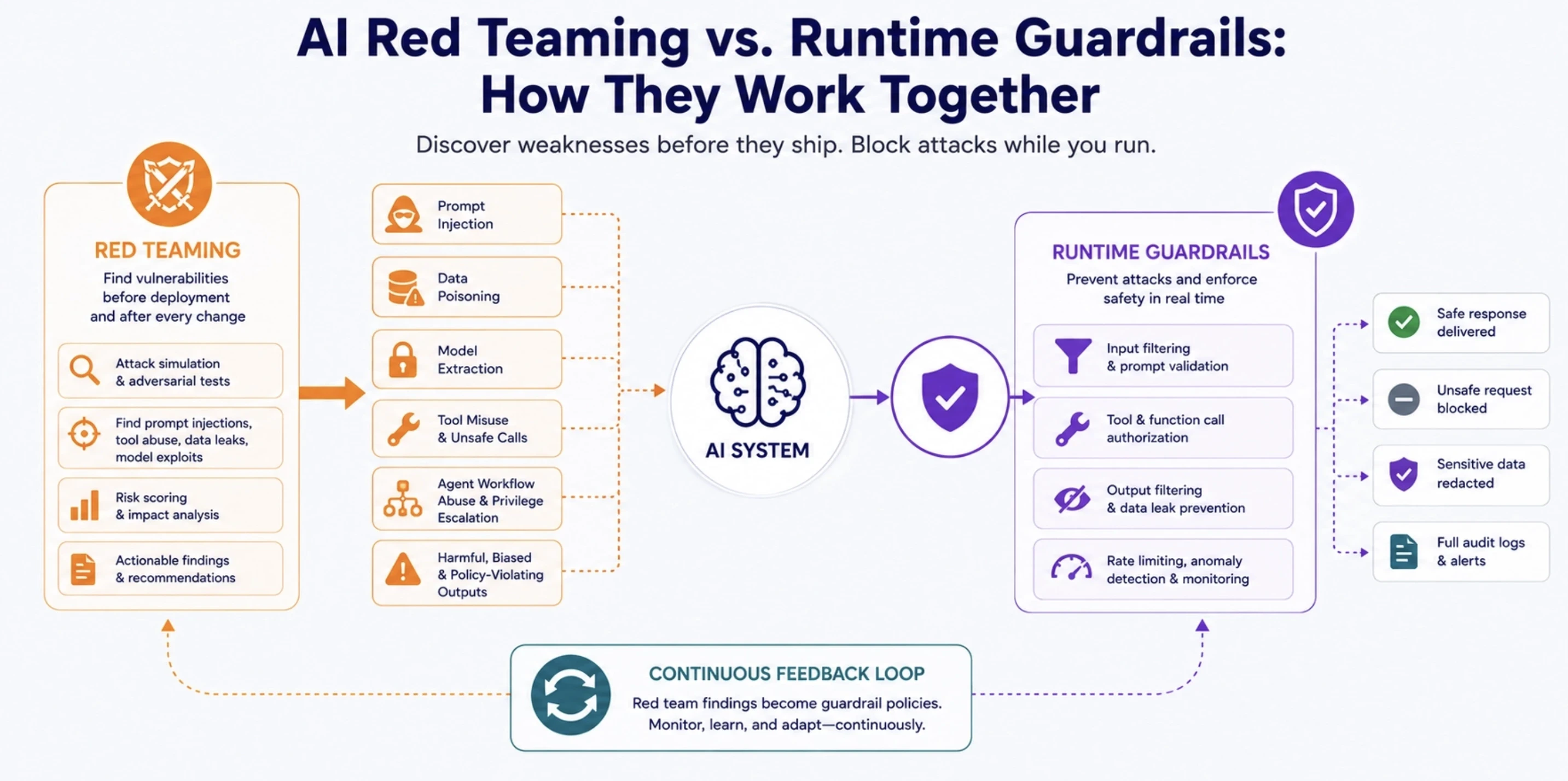
Red teaming and runtime guardrails address two halves of the same problem, and if they are confused, there's a gap. Detection is red teaming: discovering vulnerabilities before deployment and after all changes. Guardrails are designed for prevention: They reside in the request path and prevent the injection, the unsafe tool call, or the data leak during runtime of the system. This split is explicit in a framework. Prompt injection in a document does not prevent an injected prompt from being executed by a production model, a vulnerability that a red team is able to identify, and a separate technical layer needs to respond at runtime. They both support one another. Red teaming tells you what guardrails you need, and it gives you the confidence that these guardrails work – the attacks that red teaming hasn't found are contained within the guardrails. Akto links them together and transforms the results of a red team effort into policies that are enforced at runtime, preventing prompt injection, tool execution, and unsafe activities in production. Uncontrolled run red teaming will result in no one enforcing a report. We don't need to do any red teaming for the run without guardrails, so we are protecting against yesterday's attacks.
Challenges in AI Red Teaming Today
The field is new, and even amongst honest practitioners, one can hear the truth that this practice has real gaps. What makes a difference are three things: There isn't a common scope, coverage is uneven, and testing can appear comprehensive yet fail to be so. The subsections are taken seriously; to pretend they are solved is how programs go into theater.
Lack of Standardized Scope and Criteria
The scope of a complete AI red team engagement and the definition of "passing" are not defined. One vendor's red team is a couple of jailbreak tricks; another's is a multi-week war waged in tools and memory. Even the working definition, structured testing to identify weaknesses in AI systems in controlled settings, is relatively new and contested. It's more difficult than it should be to compare the results of two providers, or your own results across quarters if there were no shared criteria. Comparing results from one provider to another or comparing the results across quarters when you are the provider is more difficult than it should be without shared criteria.
Coverage Gaps (non-English testing, insider risk)
The bulk of testing is performed in English with an outside “attacker” who is not a native English speaker, leaving two gaps. Microsoft specifically identifies red teaming in low-resource languages as work that is not automated, and models often act in different and less safe ways when not used within their best-supported languages. The second, insider/privileged misuse, is quite different from the anonymous jailbreak and suits custom-tuned for the latter fail if a legitimate user, or compromised internal user, uses an agent's tools to abuse it. A program that tests only the happy path attacker is checking only a portion of its harm surface.
Performative vs. Substantive Testing
The most critical answer comes from academia. The flexibility of red teaming, from any threat model the tester wants to start with, can mean that it is security theater invoked primarily to demonstrate that things are being done, argue Feffer and colleagues. The results are often highly dependent on who is performing the tests and how, so a report can be detailed yet superficial. The argument against theater is specificity: known threat model, coverage linked to a named framework, documented results with a measured level of severity, and regression tests that continue to run. It's more reassuring than secure if a red team result doesn't tell you what was tested, what was found, and what still runs on every release.
How Akto Automates AI Red Teaming
All of the issues in this article stem from the goal of continuous testing in the same environment as the real system and with enforcement. Akto is an AI agent security platform, open source and founded in 2022, based on that requirement. The subsections correspond to the gaps above.
Continuous Testing with a Prebuilt Probe Library
Automated red teaming with over 4,000 pre-built, customizable probes across prompt injection, jailbreaks, escalation, data leakage, unsafe output, and more, mapped to the OWASP Top 10 for LLMs, Agentic AI, and MCPs. The testing is ongoing, not a one-off – that's the direct answer to the drift problem: models change, prompts change, agents gain new capabilities and Akto re-runs with the live configuration to prevent a change in a closed finding from re-opening it quietly. Probes are linked to your real applications, not generic test scenarios, and the workflow performs probe, evaluate, remediate, and the results of the probe are there for you to do something about.
Agentic and MCP-Specific Attack Simulation
This is one area where Akto's design focuses on the single blind spot. The agentic probes span the multi-step classes of relevance to autonomous systems: agent goal manipulation, agent instruction manipulation, memory manipulation, context manipulation, access-control violations, identity impersonation, cascading failures, and multi-agent orchestration exploitation. In the case of an MCP system, Akto identifies agents and MCP servers, and tests tool calls and chained actions against the actual schema and permissions. That's exactly what the capability-chaining and consent-bypass risks mentioned earlier are.
From Red Teaming Findings to Runtime Guardrails
Findings make sense only when they induce change in the system. In production, Akto integrates red team results into runtime guardrails, enforcing policy in the request path, preventing unsafe agent actions, controlling access to the tools, and blocking prompt injection. The Akto Argus product is an MCP proxy between clients and servers that enables authentication and enables tool-level authorization and deploys via 50+ connectors, both cloud and on-prem. This ties together the detection that red teaming delivers, with the prevention that guardrails deliver - so whatever vulnerability you discovered on Tuesday is prevented on Wednesday.
Final Thoughts on AI Red Teaming
The practical implication is that don't let AI red teaming be an annual audit, and don't just let it happen once with a single prompt, but let it happen continuously as part of your pipeline-when a system, or an agent in that system, fails. The issues are real-world: indirect prompt injection, capability chains that "morph" benign tools into exfiltrators, memory poisoning that triggers weeks after, and configuration drift that quietly reopens closed problems. Akto's continuous automated red teaming on a 4,000+ probe library mapped to OWASP and MITRE ATLAS, agentic and MCP-specific attack simulation against your real tool schemas, and guardrails that transform findings into runtime enforcement. Check its effectiveness by booking a red-teaming demo.
Frequently Asked Questions on AI Red Teaming
How is AI red teaming different from traditional penetration testing?
Penetration Testing is to find a state (the determinate state) in the system which is exploitable and remains so after being patched. Because AI red teaming is looking at probabilistic behavior that changes with different phrasing, context, and model versions, findings are not repeatable, and every fix is a process of regression testing rather than just closing a bug.
What vulnerabilities does AI red teaming find?
Prompt injection and jailbreaks, data and training poisoning, model and training-data extraction, tool misuse and unsafe function calling, agent workflow abuse and privilege escalation, memory poisoning and harmful, biased or policy-violating outputs.
Is AI red teaming manual, automated, or both?
Both. Breadth and regression are automated for thousands of probes and each release, while depth, novel attacks, and judgment calls are left to the human experts. Although the red team found that there is potential for more automation in the future, this cannot be done entirely at this time, especially for testing outside of the English language and for context-heavy harms.
How does AI red teaming apply to AI agents and MCP-connected systems?
Agents use tools, memory, and multiple steps of reasoning to do their work, so the tests must include sequences, not just individual prompts. This includes probing tool calls against real permissions, chaining tool actions to look for exfiltration routes, and testing for consent bypass, capability chaining, and privilege escalation on MCP servers.
What frameworks guide AI red teaming (NIST AI RMF, MITRE ATLAS, OWASP)?
Use them together. NIST AI RMF provides the framework for governance and program management, MITRE ATLAS provides adversarial strategies for threat modeling, and the OWASP LLM and Agentic Top 10 provide engineering-level vulnerability classes to test against.
How often should AI red teaming be performed?
Continuously, not annually. Model behavior changes, so run the suite every model change, prompt change, new tool, and maintain a large regression set that prevents a change from reopening a closed finding.
What is a probe library in AI red teaming?
A persistent suite of adversarial examples across a range of attack classes automatically and repeatedly run. It is based on breadth and timeliness; an un-updated library is testing an out-of-date threat model.
How does AI red teaming fit into a CI/CD pipeline?
Include a red team stage that fails the build when there are any high-severity findings and runs as part of the merge. This ensures that testing is automatic and that drift is detected before it reaches production.
What is the difference between AI red teaming and runtime guardrails?
Red teaming is detection (pre- and post-deployment). Guardrails are prevention that block attacks in the live request path. They're complemented by each other: red teaming tells you what the guardrails are and validates them; guardrails contain what red teaming has not yet found.
What are the current limitations or challenges of AI red teaming?
There is no standard scope nor pass criteria; there is a lack of coverage in tests that are not in English, insider misuse, and the possibility of performative testing that appears to be comprehensive without actually being so. The defenses against theater are documented threat models, framework-mapped coverage, and reproducible findings.
Do regulations require AI red teaming?
Increasingly. Adversarial testing for models with systemic risk (Article 55) and adversarial-input resilience for high-risk systems (Article 15) will apply to the EU AI Act, which will enter into force on August 2, 2026, with fines of up to 15 million euros or 3% of turnover. NIST AI RMF is an optional framework but generally considered a baseline approach.
How does AI red teaming handle prompt injection and jailbreak testing?
Testing both direct and indirect injection (in user input and in retrieved content) and probing jailbreaks via role-play, encoding, and slow multi-turn setups. Multi-turn testing is important because models that reject a clear request will typically respect the same request if it is part of a conversation.
Can AI red teaming detect data poisoning or model extraction risks?
Yes. Poisoning tests are used to determine if retrieved / training data can be used to provide instructions / false facts to the ATLAS technique AML, even including from RAG sources.T0020. Extraction tests determine if repeated or questioning repeated adversarial queries can retrieve memorized training data or system-prompt contents, as published research with production models has shown.
How does Akto perform automated AI red teaming for agentic systems?
Akto discovers agents and MCP servers, then runs continuous automated red teaming with 4,000-plus probes mapped to OWASP and MITRE ATLAS against the real application, covering goal manipulation, memory and context manipulation, access-control violations, and multi-agent exploitation. Confirmed findings feed runtime guardrails that block unsafe actions in production.
Important Links

Experience enterprise-grade Agentic Security solution