AI Governance: Principles, Frameworks & Best Practices (2026)
Learn what AI governance means, how it differs from compliance and ethics, core principles, key frameworks, and how to build a governance program.

Arpashree

AI systems are no longer limited to answering prompts or generating content. Enterprises are now deploying autonomous AI agents that can plan tasks, access tools, make decisions, and interact with business systems with minimal human involvement. As these agentic workflows expand across customer support, internal operations, software development, and analytics, the governance challenge becomes significantly more complex.
Traditional IT governance models were built for predictable software systems. Modern AI systems are probabilistic, adaptive, and capable of taking actions at runtime. That creates new concerns around accountability, transparency, AI compliance frameworks, model behavior, prompt injection, and AI agent security. Organizations now need governance structures that extend beyond policies and documentation into continuous monitoring, AI guardrails, runtime protection, and continuous security testing.
In this blog, we explore how modern AI governance works in practice, covering governance frameworks, operational controls, AI risk management strategies, automated red teaming, and best practices for securing agentic AI workflows at scale.
What Is AI Governance?
AI governance is the set of policies, processes, accountability structures, and technical controls that ensure AI systems are developed and used responsibly, safely, and in alignment with an organization's values and legal obligations. It spans everything from who signs off on a new model going into production, to how bias gets tested for before launch, to what happens when an autonomous agent takes an action nobody explicitly authorized. Governance isn't a single document or a single team's job; it's the coordinated system that makes responsible AI use possible at scale.
AI Governance vs. AI Compliance vs. AI Ethics
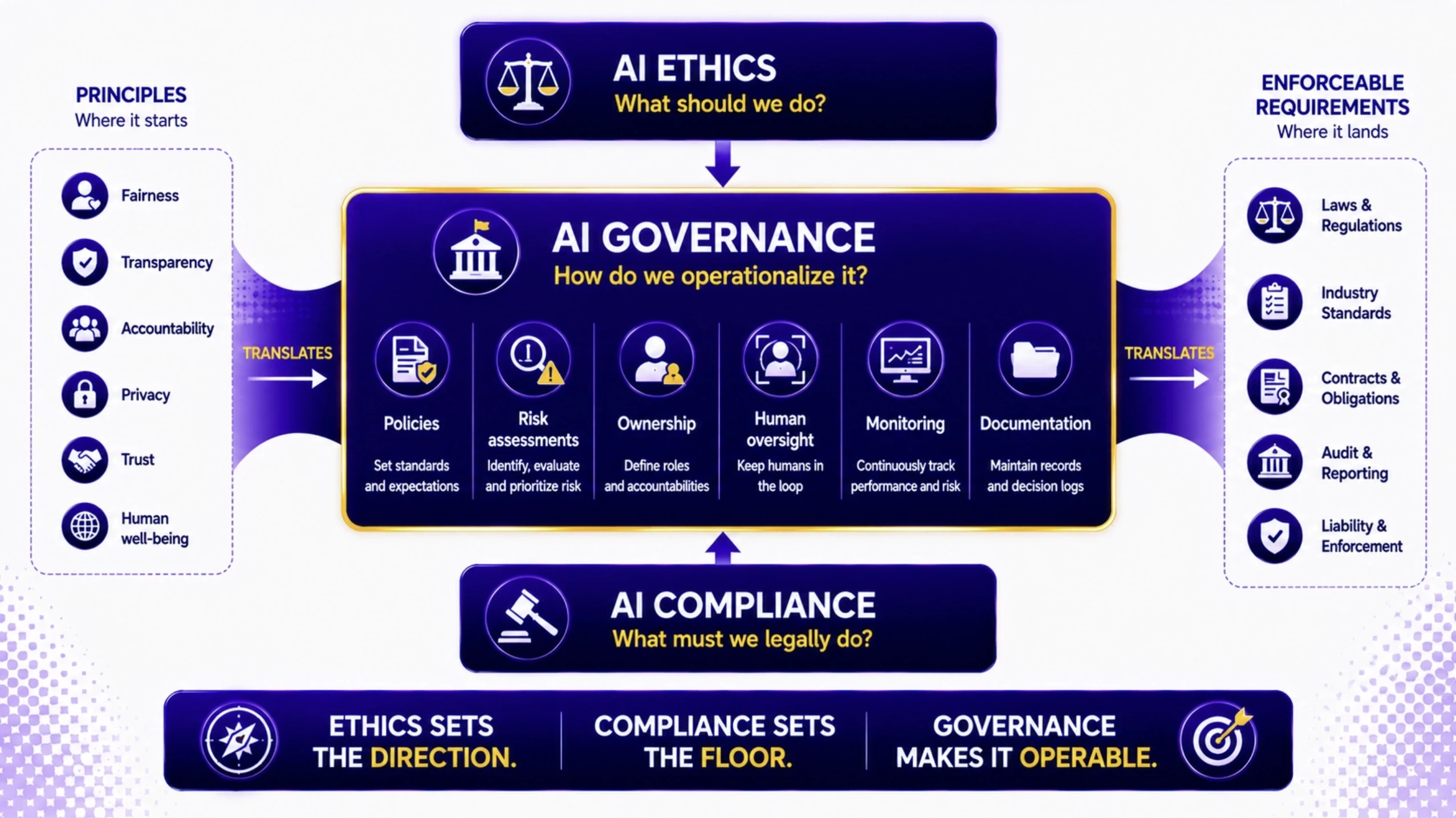
These three terms get used interchangeably often enough that the distinction is worth making explicit, because each answers a different question. AI ethics defines what responsible AI should look like: the principles and values, fairness, transparency, accountability, privacy, that establish the destination. AI compliance is the external, legally binding floor: the specific laws and regulatory mandates an organization must follow, such as the EU AI Act's tiered obligations or GDPR's data protection requirements. AI governance sits between the two, operationalizing ethical principles and ensuring regulatory compliance through internal controls, risk assessments, monitoring, documentation, and clear lines of responsibility. Ethics tells you what good looks like. Compliance tells you the legal minimum. Governance turns the first into evidence for the second, and it's broader than either alone, since an organization can be fully compliant with every applicable law and still have a governance gap that lets a biased model ship or an ungoverned agent take an unreviewed action.
Why AI Governance Isn't Just an IT Problem
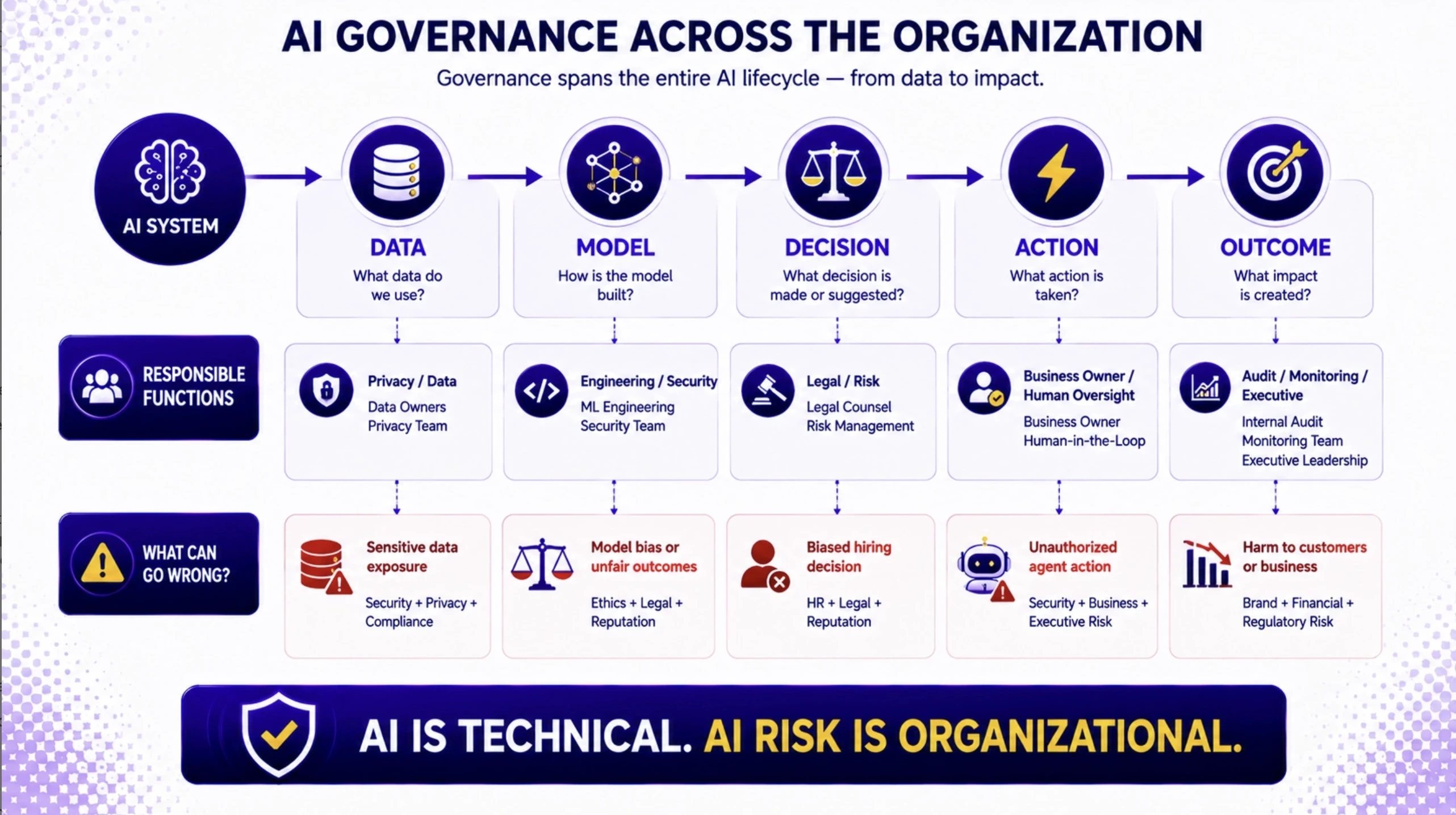
One of the most persistent misconceptions is that AI governance belongs to the technical team, since AI is software and software is IT's domain. That framing misses where the actual risk lives. A biased hiring model isn't a technical defect alone; it's an HR, legal, and reputational problem. An ungoverned customer-service agent leaking sensitive data isn't purely a security incident; it's a trust and compliance failure with board-level implications. Effective governance requires broad organizational involvement: legal counsel assessing regulatory exposure, business unit leaders defining acceptable use cases, security teams evaluating technical risk, and executive sponsorship ensuring the structure has actual authority. Treating governance as an IT checkbox produces programs that look complete on paper and fail the first time a real incident tests them.
Why AI Governance Matters
Risks of Ungoverned AI: Bias, Privacy, Security, Misinformation
Ungoverned AI doesn't fail quietly. Bias in a model trained or fine-tuned on unrepresentative data can systematically disadvantage groups of people in hiring, lending, or healthcare decisions, often invisibly until an external audit or a public incident surfaces it. Privacy risk compounds when models trained or grounded on sensitive data can be prompted into revealing more than intended, a problem that worsens as organizations connect AI systems to more internal data sources. Security risk in agentic systems specifically extends beyond data exposure to unauthorized action: an agent with excessive permissions and no oversight can take a consequential action, a database change, a financial transaction, a system configuration, that no human reviewed before it happened. Misinformation risk rounds out the picture, since models that generate confident, fluent, and sometimes entirely fabricated output can mislead users and downstream systems that trust that output without verification. None of these risks require a malicious actor. Most emerge from ordinary operation in the absence of the guardrails governance is meant to provide.
Business Case: Trust, Adoption, Competitive Advantage
Governance isn't purely defensive. Organizations with visible, credible AI governance earn faster internal adoption, since employees and business units trust systems that have demonstrably been reviewed rather than deployed unilaterally. Customer and partner trust follows the same logic externally, particularly in regulated industries where a vendor's governance maturity is now an explicit part of procurement evaluation. Organizations that can demonstrate a mature governance program, backed by real documentation rather than a policy that exists only on paper, increasingly win deals that poorly governed competitors lose on trust grounds alone.
Core Principles of AI Governance
Transparency and Explainability
Stakeholders, whether internal reviewers, regulators, or affected users, need to understand why an AI system produced a given output or took a given action. Transparency covers documenting what a system does and how it was built; explainability covers tracing a specific decision back to the factors that produced it.
Fairness and Bias Mitigation
Fairness requires actively testing for disparate impact across protected groups before deployment, not assuming a model is neutral because it wasn't designed to discriminate. Bias mitigation is an ongoing practice, since a model's behavior can drift as the population it interacts with shifts over time.
Accountability and Human Oversight
Every AI system needs a named, accountable owner who can answer for what the system does and intervene when it doesn't behave as expected. Human oversight means oversight mechanisms built into the workflow at points where intervention still matters, before a consequential action executes rather than after.
Privacy and Data Protection
AI systems that train on, retrieve from, or reference personal data inherit every privacy obligation attached to that data, and often introduce new exposure paths, such as a model inadvertently surfacing training data in its output. Governance needs to treat data minimization and purpose limitation as design constraints specific to AI systems, not just general data-handling policy AI happens to fall under.
Security
Security for AI systems covers both the traditional attack surface, unauthorized access and data exfiltration, and a newer one specific to agentic and generative systems: manipulation of the model or agent itself through prompt injection, data poisoning, or excessive permission grants that let a compromised system cause damage beyond generating a bad response.
AI Governance Frameworks and Standards
NIST AI Risk Management Framework
NIST AI RMF organizes AI risk management around four functions: Govern, Map, Measure, and Manage, providing a structured vocabulary many governance programs use as their operational backbone even though the framework remains voluntary. Its influence exceeds its formal status, since agencies including the FTC, CFPB, FDA, SEC, and EEOC all reference NIST AI RMF principles in enforcement guidance, and federal contractors face growing expectations to demonstrate NIST-aligned governance as a practical procurement condition.
ISO/IEC 42001
ISO 42001 is the certifiable international standard for an AI management system, producing an actual certificate issued by an accredited third-party auditor rather than a self-attested policy document. This distinction increasingly matters commercially: enterprise buyers in financial services, healthcare, and the public sector are beginning to require ISO 42001 certification as a condition of vendor qualification, making it as much a business development asset as a governance artifact.
EU AI Act (as a Governance Driver, Not Just Compliance Obligation)
Beyond its role as binding law, the EU AI Act functions as a governance driver because its risk-tiered structure, prohibited practices, high-risk systems, and limited-risk transparency obligations give organizations a ready-made framework for categorizing their own AI portfolio by risk level even outside EU jurisdiction. Many governance programs use the Act's risk categories as an internal classification scheme regardless of whether every system falls under EU enforcement, since the categorization logic is well-structured and increasingly recognized as shared vocabulary across jurisdictions.
Internal Governance Structures (AI Ethics Boards, Review Committees)
Frameworks provide the vocabulary and structure; internal governance bodies provide the actual decision-making authority. An AI ethics board or cross-functional review committee, typically drawing on legal, security, business, and technical representation, is where a specific use case actually gets approved, modified, or rejected. Without this internal structure, even a well-chosen external framework has no mechanism for applying its principles to a real decision.
Building an AI Governance Program
Establish Ownership and Accountability Structures
Start by naming who owns AI governance overall, and who owns each specific system within the broader program. Diffuse or unclear ownership is one of the most common reasons governance programs exist on paper but fail when a real decision needs to be made quickly.
Define Policies for Data, Models, and Use Cases
Policies need to be specific enough to guide an actual decision: what data can and can't train or ground a model, what review a new use case requires before launch, and what use cases are prohibited outright regardless of technical feasibility. Vague, aspirational policy language is functionally equivalent to no policy at all under time pressure.
Set Up Oversight and Review Processes
Review needs to happen before a system reaches production, not only after something goes wrong. This means defined checkpoints, a bias and fairness assessment before launch, a security review for any system with tool access or data connections, and documented sign-off from the accountable owner before deployment proceeds.
Monitor, Audit, and Iterate Continuously
A governance program that stops at launch review misses everything that happens afterward: model drift, new use cases layered onto an already-approved system, and new risks that didn't exist when the original review took place. Continuous monitoring and periodic re-audits need to be built in from the start, not added once a gap has already caused a problem.
AI Governance for Agentic AI and Autonomous Systems
New Governance Challenges: Autonomy, Tool Use, Multi-Step Actions
Governance built for models that generate text for human review doesn't transfer cleanly to agents that plan, decide, and act using tools across multiple steps. An agent's risk isn't confined to what it says; it extends to what it does, including database writes, API calls, and financial transactions, often executed before a human sees any intermediate reasoning. Governance for agentic systems needs to account for this expanded action surface explicitly, since a model that passes every content-safety review can still be part of an agent that's dangerously under-governed at the tool-call layer.
Governing Non-Human Identities and Agent Permissions
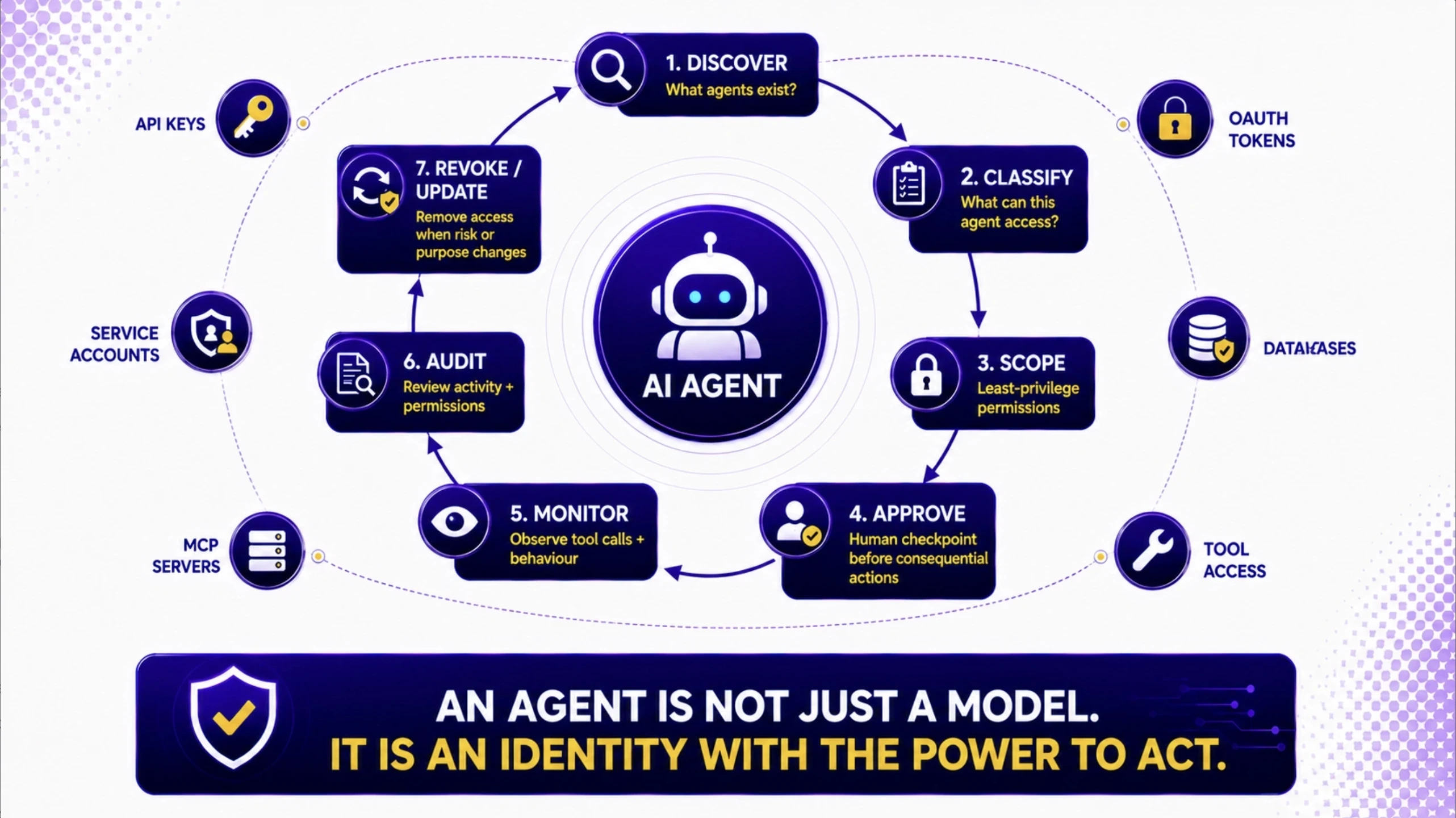
Agents increasingly hold their own credentials, API keys, service accounts, and OAuth tokens that need governance the same way human identities do, often more urgently, since an agent can act on those credentials continuously and at machine speed. This means treating agent permissions as a distinct governance category: least-privilege scoping per agent rather than broad, shared credentials; regular auditing of what an agent's permissions actually allow versus what its task requires; and clear ownership for revoking access when an agent is retired, modified, or found compromised.
Common AI Governance Misconceptions
"Governance Guarantees Perfect AI" and Other Myths
Governance reduces risk; it doesn't eliminate it, and treating a governance program as a guarantee against every possible failure sets an organization up to be blindsided when an unanticipated incident occurs despite an ostensibly compliant process. A related myth holds that governance only matters for large enterprises or heavily regulated industries, when any organization using AI faces the underlying risks governance addresses, regardless of size, and the absence of a formal program doesn't reduce exposure; it just removes the structure that would have caught the problem earlier.
Governance Is Ongoing, Not a One-Time Project
Perhaps the most consequential misconception is treating governance as a project with a completion date rather than an ongoing organizational capability. Models get updated, new use cases emerge, regulations evolve, and an agent's behavior can shift as it accumulates context over time. A governance program designed as a one-time initiative, complete once the policy document is published, is already stale by the time the next model update ships.
AI Governance Best Practices Checklist
Name an accountable owner for the overall governance program and for each individual AI system in production
Classify every AI system by risk tier before deployment, using a consistent framework such as the EU AI Act's risk categories
Require a documented bias, security, and privacy review before any new system or use case goes live
Define explicit policies for what data can train or ground models, and what use cases are prohibited outright
Build human oversight checkpoints into workflows at points where intervention still matters, not after a consequential action has already executed
Establish least-privilege permission scoping for every AI agent, and audit those permissions on a fixed schedule
Maintain continuous monitoring rather than treating launch review as the program's endpoint
Map governance evidence to recognized frameworks (NIST AI RMF, ISO 42001, EU AI Act) so documentation serves compliance and procurement needs simultaneously
Include shadow AI and third-party vendor AI explicitly in scope, not just internally built systems
Review and update governance policy on a fixed cadence, treating it as a living capability rather than a completed project
How Akto Supports AI Governance
Visibility into AI Agents, LLMs, and MCP Usage
Governance depends on knowing what exists, and Akto's continuous discovery surfaces AI agents, LLMs, and MCP server connections across an organization's environment, including shadow AI deployed outside formal review, giving governance programs the asset inventory that every framework above assumes as a starting point.
Continuous Risk Assessment and Policy Enforcement
Rather than a one-time pre-launch review, Akto's continuous red teaming and runtime guardrails apply ongoing risk assessment and policy enforcement to discovered systems, directly addressing the "governance is a one-time project" misconception by keeping evaluation running throughout a system's operational life, not just at launch.
Audit-Ready Reporting Mapped to Governance Frameworks
Findings from Akto's discovery and testing map directly to NIST AI RMF, ISO 42001, and EU AI Act categories, turning technical results into documentation a governance program can present to auditors, regulators, and enterprise customers without a separate translation effort.
Final Thoughts on AI Governance
AI governance is the operational layer that turns ethical principles and regulatory requirements into something an organization can actually demonstrate and improve on over time. It's broader than compliance, more actionable than ethics alone, and increasingly a distinct discipline of its own as AI systems move from generating text to taking autonomous action. Organizations that build governance as a continuous, cross-functional capability rather than a one-time policy exercise are the ones that will scale AI with confidence rather than discovering their gaps the hard way.
FAQs on AI Governance
How is AI governance different from AI compliance?
Compliance is the external, legally binding floor, meeting specific laws and regulations. Governance is broader: it's the internal system of controls, documentation, and accountability that both ensures compliance and goes beyond it to address risks a specific law may not yet cover.
How is AI governance different from AI ethics?
Ethics defines the principles, fairness, transparency, accountability, that describe what responsible AI should look like. Governance operationalizes those principles into concrete policies, review processes, and enforcement mechanisms that make ethical intent actionable at organizational scale.
Why is AI governance important for organizations of any size?
Every organization using AI faces the underlying risks- bias, privacy exposure, security gaps, and ungoverned agent action- that governance addresses, regardless of company size. The absence of a formal program doesn't reduce that exposure; it just removes the structure that would catch problems before they become incidents.
What are the core principles of AI governance?
Transparency and explainability, fairness and bias mitigation, accountability and human oversight, privacy and data protection, and security, covering both traditional data risks and newer manipulation risks specific to generative and agentic systems.
What frameworks support AI governance (NIST AI RMF, ISO 42001, EU AI Act)?
NIST AI RMF provides a voluntary but widely referenced structural vocabulary organized around Govern, Map, Measure, and Manage. ISO 42001 offers certifiable, third-party-verified assurance of governance maturity. The EU AI Act provides binding legal obligations plus a risk-tiering structure many organizations use internally regardless of jurisdiction.
Who is responsible for AI governance within an organization?
Responsibility should be explicitly assigned rather than assumed, typically through a named executive sponsor, a cross-functional review body such as an AI ethics board, and individual accountable owners for each system in production. Treating it as solely IT's responsibility is one of the most common reasons governance programs fail in practice.
What are common misconceptions about AI governance?
That governance guarantees perfect AI outcomes, that it's only relevant for large or heavily regulated organizations, that it belongs exclusively to IT, and that it's a one-time project completed once a policy document is published rather than an ongoing organizational capability.
How does AI governance address bias and fairness?
Through mandatory pre-launch testing for disparate impact across protected groups, combined with periodic reassessment after deployment, since a model's fairness profile can drift as the population it interacts with changes over time.
What role does human oversight play in AI governance?
Human oversight ensures a person can meaningfully intervene before a consequential action executes, not merely review output after the fact. For agentic systems specifically, this means building checkpoints into the workflow itself rather than assuming a human is passively watching.
How does AI governance need to change for agentic AI and autonomous agents?
Governance needs to extend beyond content and output review to cover autonomous action: tool access, multi-step decision chains, and non-human identity management for the credentials and permissions agents hold and use independently of direct human instruction.
What does an AI governance framework typically include?
Named ownership and accountability structures, documented policies for data and use cases, mandatory review processes before deployment, continuous monitoring after launch, and mapping to recognized external frameworks for audit and procurement purposes.
How often should AI governance policies be reviewed?
On a fixed, recurring cadence rather than only after an incident, since models, use cases, and regulations all continue evolving after initial policy publication. Many organizations pair scheduled reviews with event-triggered reassessment whenever a system undergoes a significant change.
What are the risks of not having AI governance in place?
Undetected bias affecting real decisions, privacy exposure through models trained or grounded on sensitive data, security incidents from ungoverned agent actions, and reputational and regulatory consequences that tend to surface publicly rather than quietly, since AI failures increasingly draw scrutiny once they occur.
How can platforms like Akto support AI governance efforts?
By providing continuous visibility into AI agents, LLMs, and MCP usage across an organization, applying ongoing risk assessment and policy enforcement rather than one-time review, and mapping findings directly to NIST AI RMF, ISO 42001, and EU AI Act categories for audit-ready reporting.
Important Links

Experience enterprise-grade Agentic Security solution