AI Security Solutions: How to Secure LLMs, Agents, and Enterprise AI in 2026
Explore AI security solutions for LLMs, AI agents, and MCP systems - covering threats, runtime protection, red teaming, and best practices for 2026.

Rushali

It only took one well-designed e-mail. Aim Security researchers revealed this June a zero-click vulnerability in Microsoft 365 Copilot, dubbed EchoLeak (CVE-2025-32711), which enabled them to extract internal files from an enterprise without requiring a single click, click of malware, or any user action. The payload was simple English within a message. It was a turning point where AI security solutions moved from being a compliance checkbox to an operational challenge for all teams deploying LLMs, agents, and MCP tooling. This guide tells you in 2026 what those solutions actually mean: what they protect against, what they actually can do, how the best platforms differ, and a step-by-step process to creating a program. At the end, you'll be able to scope your own attack surface and select the tooling for it.
What Are AI Security Solutions?
It's a broad term for a fast-splitting family of tools, so before you dissect them, it's good to make it a point to figure out what they have in common. As the name suggests, the AI security solution at its core identifies, maps, tests, and blocks the AI assets you're running and their vulnerabilities at runtime.
How AI Security Differs from Traditional Cybersecurity
A prompt injection can't be prevented by a SQL injection filter, and a web application firewall can't detect intent. That's what this category is all about. Traditional AppSec requires some specific action to be taken by a system with a fixed contract: A request is received, code determines if it should be granted, a response is sent. An LLM is an exception to that. It is free-form NLP, non-deterministic; the thing being manipulated by an attacker is not a parameter in a request, but the model's reasoning.
The OWASP Top 10 for LLM Applications (2025) makes the split concrete. It specifically addresses the way the model thinks, the data it has been trained on, the tools that it can call, and the systems of agents that it can power-all of which the current signatures don't comprehend. It's in the top of that list because prompt injection takes advantage of the way generative models function instead of a coding error that could be fixed. The addition of the ability to call tools and act increases the attack surface, leading to OWASP releasing a dedicated Top 10 for Agentic Applications in December 2025. Legacy controls remain useful for the layer below the HTTP layer but are opaque to the layer above the HTTP layer.
What They Need to Cover - Models, Data, Applications, Agentic Workflows
Coverage has to reach over four issues that were once considered separate problems. There are risks associated with the model itself, such as data poisoning and backdoors planted in the model during training or fine-tuning. It can transmit PII, credentials, or IP (IPR information) either from training data or from actual prompts, both of which OWASP considers sensitive information disclosure. The application is the one that receives the model's output, which other systems then execute - the problem is that if it gets the output wrong, it becomes an injected command. With the agentic workflow, a model plans, stores memory, and delegates tool calls, which creates failure modes that only become apparent once the system can act alone. A solution that does only one of these leaves the other three open. With a robust LLM security solution, the entire model, data, application, and workflow are seen as a single surface.
Categories of AI Security Solutions
Here, vendors use the same terms for products that are actually different, confusing the customers. There are a few general groupings based on the work that they perform and at what life stage they are.
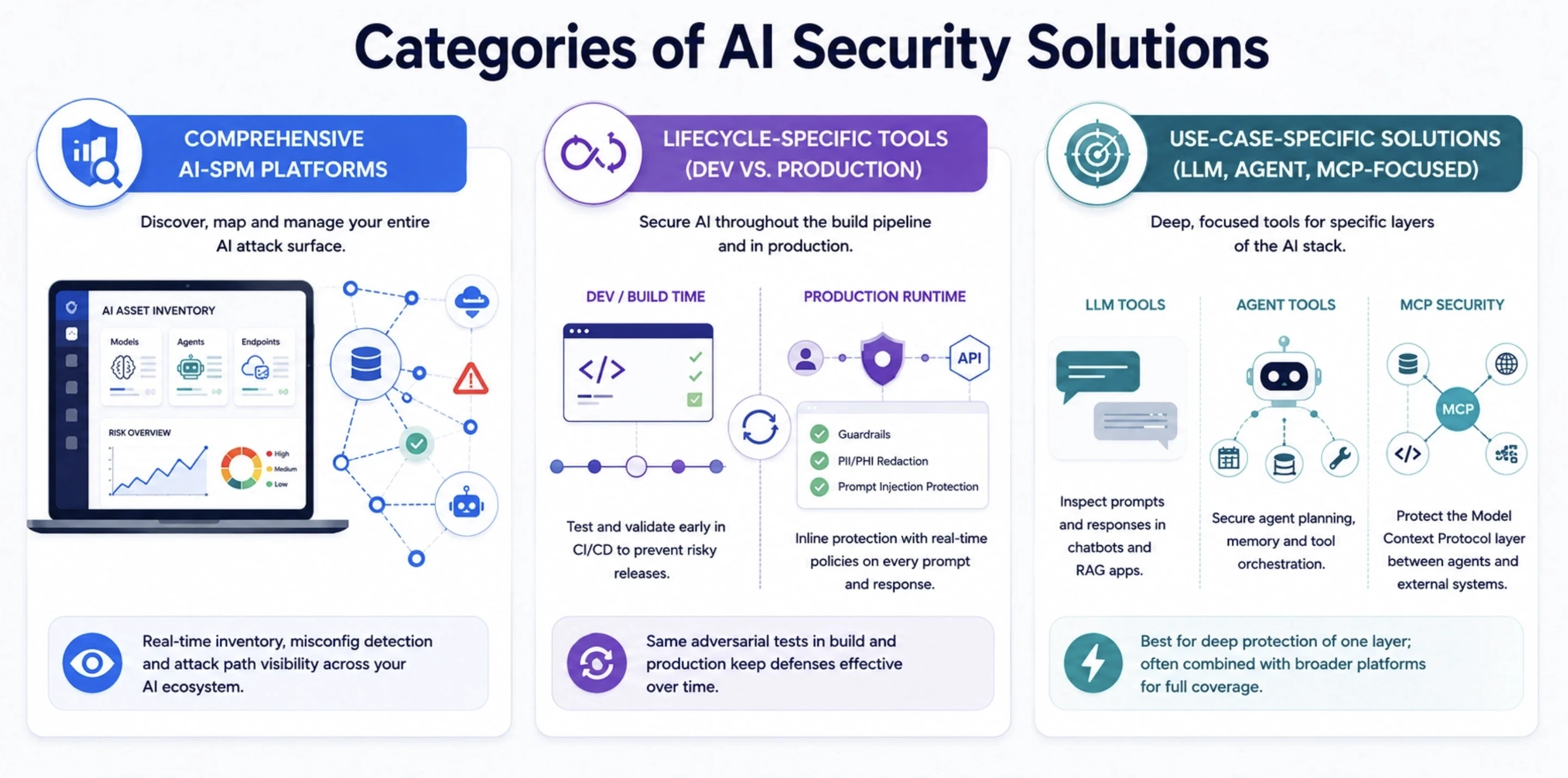
Comprehensive AI-SPM Platforms
The discovery and configuration layer is called AI security posture management (AI-SPM). These platforms create the real-time inventory of your AI assets, identify which models and agents can access which data, and identify misconfigurations and exposed assets. The most obvious example is Wiz, which adds a cloud-native security graph to identify shadow AI, deployed agents, unmanaged models, and exposed inference endpoints, and tracks the journey from a misconfigured storage bucket to a model serving endpoint. AI-SPM gets to the "what" and the "how" of poisoned products. It has a good ability to be seen and a weak ability to interrupt an attack midway.
Lifecycle-Specific Tools (Dev vs. Production)
Some tools exist in the build pipeline, some tools exist in production, and that's where the ownership of the tools lies. Adversarial tests are conducted against models and agents during the build-production process before they are released, and preferably as part of CI/CD, such that a failed test prevents the merge as a unit test does. Production tooling runs in-line and examines the traffic coming through it and applies policy to each prompt and response. An example on the production side is F5's AI Gateway, which is an inline proxy between the client and model endpoints that applies guardrail policies, redaction of PII and PHI, and fail-closed prompt injection protection. The mature pattern is the same for the two, and the same adversarial suite used to gate a release goes against production, since if a guardrail worked at launch, it could get out of reach over time as attack methods evolve.
Use-Case-Specific Solutions (LLM, Agent, MCP-focused)
The most narrow category is to address one part of the stack. LLM-only tools: They are built for prompt and response inspection of a chatbot or RAG application. Tools focused on the agent are used for planning, memory, and orchestrating tools. Since Anthropic, OpenAI, Google, and Microsoft all embraced the protocol, the Model Context Protocol layer between agents and external data and tools is now a separate security enclave. Check Point's Lakera Guard is an example use case designed to detect prompt injection and data leakage at the API layer in real time with sub-50 milliseconds latency. Because they delve so deeply into one problem, many teams resort to pairing a small runtime tool with a larger posture platform.
The 2026 AI Threat Landscape
The threats listed below are not hypothetical. All of them are mapped to named OWASP categories and, most of the time, to a disclosed CVE or to a documented incident. They also link together, making it more difficult to defend agentic systems than to defend standalone chatbots.
Prompt Injection (Direct & Indirect)
In Direct Injection, a user types an instruction that takes the place of the system prompt. The sneaky type of attack is hidden in the content that the model is reading during its function. This could be a document, a support ticket, a web page, an email, etc. The one whose name you will recognize is EchoLeak. The attacker included hidden instructions in the e-mail using white-on-white text and HTML comments, and the victim subsequently asked Copilot for a summary of recent e-mails, which resulted in the RAG engine adding the hidden e-mail to the context and then running the hidden payload. Exfiltrated data through the chain bypassed Microsoft's XPIA classifier, evaded link redaction using reference-style Markdown, and used a Teams proxy enabled by the content security policy to exfiltrate data. It had a CVSS rating of 9.3 and was patched by Microsoft on the server side; there is no reported use of it in the wild. This class of risk remained: the structural lesson overtook the patch.
Tool Misuse and API Abuse
OWASP considers this an agentic issue and tracks it as ASI02. The danger is not that an agent gets new tools, but that the agent uses existing tools or that the tool he has polluted, that he has manipulated in the tool-chain, or that he has delegated the tool in an unsafe manner. An agent who has an appropriate credential to a payments API can be directed towards a transfer in which every single one of the individual callouts appears authorized. The supply side variant: In April 2025, Invariant Labs demonstrated a hidden "add" function that was part of an MCP tool description, which would have been entered into the agent's context as trusted text, and which would have loaded a developer's SSH key and MCP config, silently and securely, and then pushed them to a remote endpoint. It evolved into OWASP MCP03:2025 and led to cataloged CVEs such as CurXecute (CVE-2025-54135, CVSS 8.6) and the MCPoison rug-pull (CVE-2025-54136, CVSS 8.8) in Cursor. The essence of MCP's security work is to see tool descriptors as not harmless metadata but as trusted supply-chain assets.
Memory/Context Poisoning
Agents condense and recall context from past interactions and conversations, using embeddings to guide subsequent actions. If the attacker's content makes it to that layer of memory, it remains there after one pass. It carries on, is re-summarized, and influences new plans. This is known as ASI06, Memory and Context Poisoning, and often the method that makes the hijacked goal stick. A memory entry whose memory is skewed becomes a repeated workflow decision. Defending it requires considering the persisting memory and retrieved context as inputs that must be treated as much as a live prompt is treated, rather than as trustworthy internal state.
Agentic Supply Chain Compromise
ASI04 includes the components that an agent relies on: models from third parties, datasets, packages, plugins, and the agent's tool definitions loaded at runtime. In this case, AI supply chain risk seems like a poisoned model that's been downloaded from a public repository or a dependency with a backdoor, or a schema retrieved from a remote location, and has no integrity checks that would prevent it from being mapped to a destructive operation. The GitHub MCP incident is an example of how fine the line is. According to Invariant Labs, a malicious issue posted in a public repository could manipulate an agent requested to read the issue, and then read the private repository to which it was attached and post it to the public pull request with a personal access token that had much more access than the agent should have had. In the proof of concept, it released a user's salary file and relocation plans. Invariant described it as a toxic agent flow, and it was clear that it had nothing to do with an issue in GitHub's code. The use of each tool call was authorized individually. The exfiltration occurred in the composition.
Identity & Non-Human Privilege Abuse
Agents are run with credentials, and the credentials are generally too general. The numbers don't lie, and ASI03 is about identity and privilege abuse. Elsewhere in the report, BeyondTrust revealed that non-human identities (NHI) already far exceed human identities, with enterprise AI agents increasing by more than 460 percent YoY, and most enterprises are also operating shadow AI agents whose access security teams do not have visibility of. The common failure is that an agent is started by a user with the same privileges as the user, including cloud keys, SSH keys, SSO tokens, and repository access, all without a scope or expiration. When you add an over-privileged agent, content it cannot trust to read, and an outbound channel, you've got the lethal trifecta, as Simon Willison put it. The shape of the 3 incidents above is the same.
Core Capabilities to Look for in an AI Security Solution
The categories are less important than the capabilities, as the same word has a different meaning between vendors. Are the solution functions actually risk-reducing or reporting? Match each with a particular problem from the threat section above.
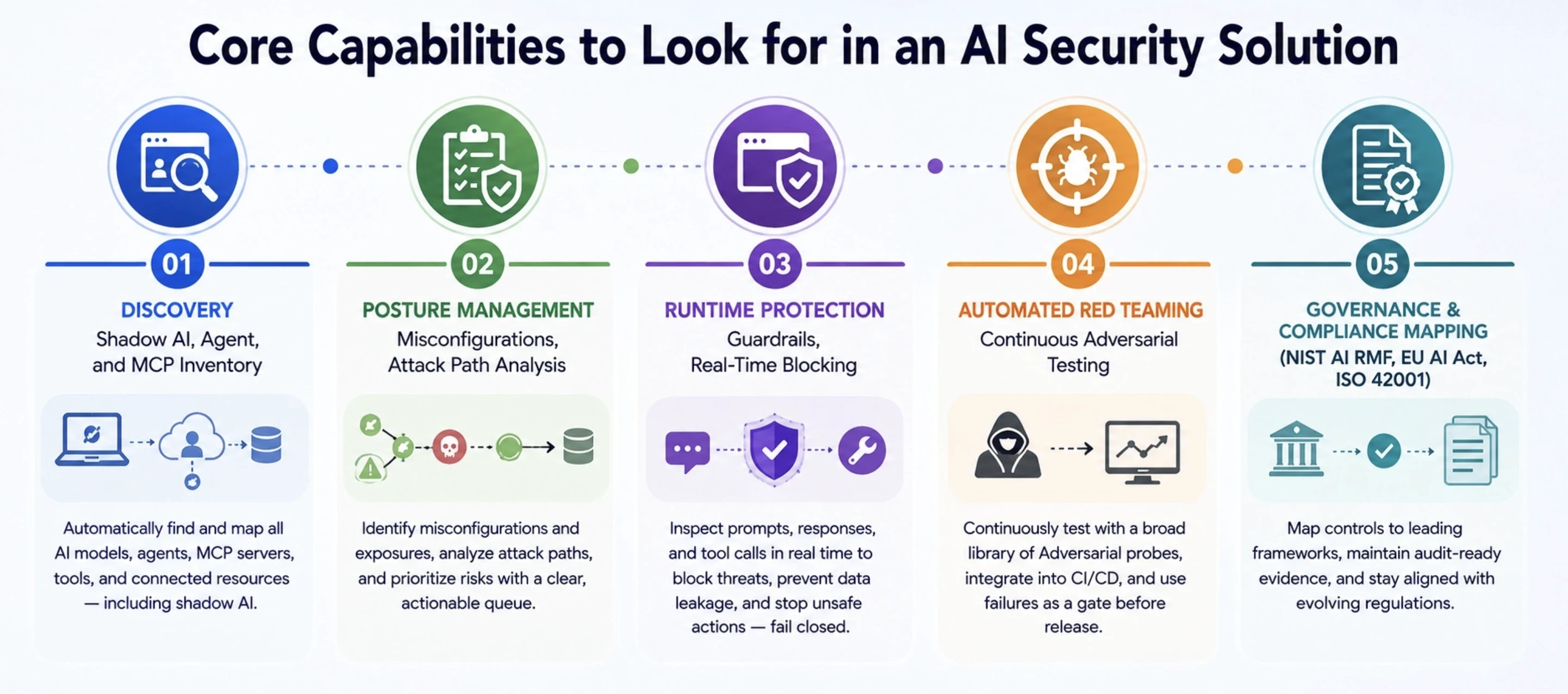
Discovery - Shadow AI, Agent, and MCP Inventory
What you can't protect you can't find, and AI assets seem to show up before you know that the procurement team has been able to track them. Discovery: An automatic and continuous inventory of all models, agents, MCP servers, tools, and connected resources, including the shadow AI on employee laptops and in browsers that no one registered. Relationships and data access paths are also mapped during a good discovery, which will show you which agent can access which sensitive store, and which inference endpoint is exposed. Other controls rely on a partial picture without this layer, and the shadow agent with a privileged token remains hidden from view until exploited
Posture Management - Misconfigurations, Attack Path Analysis
Posture management converts the inventory to be a risk-ranked list of things to do: Unsafe data access paths, Exposed MCP servers, Policy gaps, and Over-permissioned tools. Attack-path analysis brings all those findings together so you can visualize how a low-severity misconfiguration can be connected to a route to a reachable exfiltration point—just like when you build a cloud security graph to trace a path from a public bucket to a crown jewel database. The output needs to be in a prioritized queue, rather than a raw scan dump; most teams can't act on hundreds of undifferentiated alerts.
Runtime Protection - Guardrails, Real-Time Blocking
Discovery and posture minimize and narrow the attack surface prior to the attack, while AI runtime protection stops one in progress. Guardrails check prompts, responses, and tool calls as they are typed and prevent unsafe tool invocations, data leakage, malicious prompts, and outputs. However, for agents in particular, runtime protection needs to identify certain patterns of behavior that are not recognized by a single-request filter – agent loops, unauthorized tool calls, overuse, etc. The difference between a guardrail and a logger is fail-closed enforcement, as opposed to fail-allowed. The key difference between a guardrail and a logger is fail-closed enforcement instead of fail-allowed.
Automated Red Teaming - Continuous Adversarial Testing
Adversarial attacks against your models, agents, and MCP servers by AI before an attacker. The strength lies in breadth and repetition: a large library of probes covering prompt injection, privilege escalation, data exfiltration, tool misuse, and multi-step exploits that are repeated at regular intervals and not just initiated at startup. Finally, by wiring red teaming into CI/CD security testing, it becomes a gate: If a guardrail fails, the build doesn't ship. Probe libraries mapped to the OWASP LLM Top 10 and MITRE ATLAS provide you with a defensible reporting basis for coverage.
Governance & Compliance Mapping (NIST AI RMF, EU AI Act, ISO 42001)
Governance is where security meets the auditor, and the frameworks are moving from voluntary to enforced. The NIST AI RMF categorizes risk work into four functions: Govern, Map, Measure, and Manage, and includes LLM/agentic systems in its 2024 Generative AI Profile and is not penalizing; it simply appears in federal procurements. The ISO/IEC 42001:2023 is the first AI management-system standard that can be certified, fully auditable by an accredited body, with clauses 4-10 and Annex A controls. The EU AI Act (Regulation 2024/1689) is binding legislation, and penalties of up to 35 million euros or 7% of global turnover will be applied. It has a timeline to plan around and it has shifted – the general purpose AI obligations came into force on 2 August 2025, with the first enforcement action planned to follow on 2 August 2026, while this was deferred to 2 December 2027 under the 2026 Digital Omnibus (which includes the general obligations that apply to all AI systems) for the high risk obligations for AI systems in Annex III. A solution that allows you to map your controls to these frameworks will save you from having to rebuild evidence for each audit individually.
AI Red Teaming vs. Runtime Protection: How They Work Together
Both of these abilities are confused, and when they are used interchangeably, there is a void. Attack generation is attack generation and is scheduled by AI red teaming; it's offensive. AI runtime protection is defense and continuous: it examines real-time traffic and denies access to anything it matches policy. One of them will find the hole, the other will hold the line.
They all fail alone. Without Runtime Enforcement, Red Teaming yields a report of vulnerabilities that no one is blocking in production. Ongoing runtime protection without red teaming ensures that yesterday's protection is applied to today's attacks, since the protection of “guardrails” that have been implemented weakens over time as pipelines evolve and adversaries adapt. They are directly tied together by the working loop: Red team probes the system, finds a bypass, raises a guardrail, next red team run validates the fix and looks for the next bypass. Schedule that loop and a guardrail becomes a live control instead of a launch-day snapshot. The most developed programs consider them as a single feedback system instead of two separate line items.
Real-World Attack Scenarios
Actual chain traces are good for abstract threat categories. Below are the three cases of failure modes manifested end-to-end, and all three of these cases have the lethal trifecta shape of private data, untrusted content, and an exfiltration channel in one agent.
EchoLeak (CVE-2025-32711) is the purest example of indirect prompt injection making its way to actual exfiltration. An attacker sent a normal-looking e-mail with instructions inside that were hidden. The user also posed another unrelated query, which in turn triggers the RAG pipeline of Microsoft 365 Copilot that ingests it; it then follows the instructions and leaks the content, ultimately bypassing four different ways around Microsoft's own classifiers and content-security controls. None of the users pressed any buttons. It was the first time documented with prompt injection weaponized for real data exfiltration in a production AI system.
GitHub MCP toxic agent flow (May 2025, Invariant Labs) exhibits tool misuse in conjunction with identity abuse. A developer linked the official GitHub MCP server (about 14 k stars at the time) with their personal access token, granting public and private repositories. When it saw a poisoned issue in a public repo, it told the agent to check the private-repo contents and post them into a public pull request. All calls made by the agent were acceptable. The breach was not present in any individual request, but in the sequence as a whole; hence, it was not detected by per-call authorization checks.
The supply-chain variant was illustrated in the tool-poisoning proof of concept released by Invariant Labs in April, 2025. A benign-looking calculator tool was revealed by a malicious MCP server, with hidden instructions in the description. The agent loaded the list of tools, read the instructions, and executed them, copying the developer's SSH private key and MCP configuration. The tool was never called as promised. The payload was only a description, which is what static registries that have only a server listed in them will not catch.
Comparing Leading AI Security Solutions in 2026
No single vendor covers every layer equally, so comparison should be about fit, not a single winner. The table below maps six commonly evaluated options against the capabilities that matter, drawn from each vendor's own product documentation.
Comparison Table
Solution | Primary focus | Discovery | Red teaming | Runtime guardrails | Best fit |
|---|---|---|---|---|---|
Akto | AI agent, MCP, and LLM security in one platform | Agents, MCPs, tools, and shadow AI across cloud and employee endpoints via 80+ connectors | Yes, thousands of probes mapped to OWASP LLM Top 10 and MITRE ATLAS, run in CI/CD | Yes, MCP and agent guardrails with real-time blocking | Teams securing homegrown agents and employee AI who want discovery, testing, and runtime in one place |
Wiz (AI-SPM) | Cloud-native AI posture inside a CNAPP | Agentless discovery of models, agents, and inference endpoints via the security graph | Limited | Posture-led, lighter on agent runtime enforcement | Cloud-first teams already standardized on Wiz |
Palo Alto (Prisma AIRS) | End-to-end AI lifecycle in the Palo Alto stack | Apps, agents, and models including shadow agents | Yes, autonomous red teaming | Yes, inline prompt-injection and tool-misuse defense | Enterprises already invested in Palo Alto |
Check Point (Lakera Guard) | Real-time prompt injection and data-leakage at the API layer | Runtime-focused | Limited | Yes, low-latency inline enforcement with a free tier | Teams wanting a fast inline guardrail for LLM apps |
F5 (AI Gateway) | Inline governance of LLM traffic | MCP server registry and gateway-level visibility | No dedicated red teaming | Yes, 20+ guardrail policies with fail-closed enforcement | Teams already running F5 for app and API delivery |
BeyondTrust (Pathfinder) | Identity-first privilege enforcement for agents and NHI | Agent and non-human identity discovery with risk scoring | No | Privilege enforcement before an agent acts, at the endpoint | Identity and PAM-led teams governing agent privilege (AI Agent Security module reaching general availability in Fall 2026) |
How to Choose Based on Your AI Stack (LLM-only vs. agentic vs. MCP-heavy)
Begin with what you are running. If it is an exposure that is a customer-facing chatbot, or a RAG application, then most of the risk is covered by an LLM-focused inline guardrail with strong prompt-injection detection, and the low-latency option makes sense. If you send homegrown agents that plan and call tools, then you need discovery, red teaming, and agent-aware runtime protection all in one, since the threats live in the tool chaining and the memory, not in one prompt. If MCP is the predominant environment, focus on access control (per tool) scanning, per tool access control discovery, and MCP server discovery because the source of tool poisoning and toxic agent flows are in these areas. Teams that are cloud-first and already using CNAPP begin with posture and then add runtime; teams for which the primary concern of an over-privileged agent is identity start with identity first. Agentic AI security solutions vary most significantly in terms of their depth on the agent layer, but if your risk is on the agent layer, then take an extra layer of weight on that one.
AI Security Maturity Model
Maturity is not only about the amount of money spent on tooling; it's also about the speed of a control's response to an attack. Most organizations fall into one of the three stages, and advancing a stage brings the gap between detection and response into closer proximity.
Ad Hoc
Security is a reactive and manual process. AI assets are found by chance or during an incident, guardrails are not uniform between teams, and there is no continuous testing. At this point, a team is not likely to be able to respond to some of the more basic questions, such as how many agents are in production, what their qualifications are, or which prompts set off a sensitive action last week. Most of the market is at or near the point of being ready to secure agentic AI deployments, with 29 percent saying they are prepared to do so, according to Cisco's State of AI Security 2026. Discovery is the first step (after that, it's about what to do next) - because nothing else comes before an accurate inventory.
Proactive
Continuous and pre-deployment controls are warranted. There is an automatic inventory, posture management ranks fixes based on real exposure, and red teaming runs as part of CI/CD, meaning vulnerabilities are identified at build time. The runtime guardrails enforce the policy inline, and the findings will be reported in a framework such as NIST AI RMF or ISO 42001. The thing is, it tests and enforces on a prescribed schedule, not following a breach, and it's able to provide evidence, not intentions, to an auditor.
Autonomous
Detection and response run at machine speed and with minimal latency. The red-teaming and runtime layers are closed loop: when you find a bypass, it becomes a guardrail and is automatically re-validated. Behavioral monitoring will be watching for model drift and anomalous agent activity, and will send signals to SIEM and SOAR, and if desired, may initiate a kill switch or revoke a credential without waiting for a human triage queue. There is a shift from human review of individual alerts to policy and exceptions. There are few organizations that are fully here, and the true target for 2026 is to achieve solid proactive coverage and to get closer towards this loop.
Best Practices for Building an AI Security Program
Sequencing and ownership make the program; tools don't make the program. These five areas make a star of seven controls that are a fire drill for a security team and a checkmark for an auditor. Think of them as a build order, and not a menu.
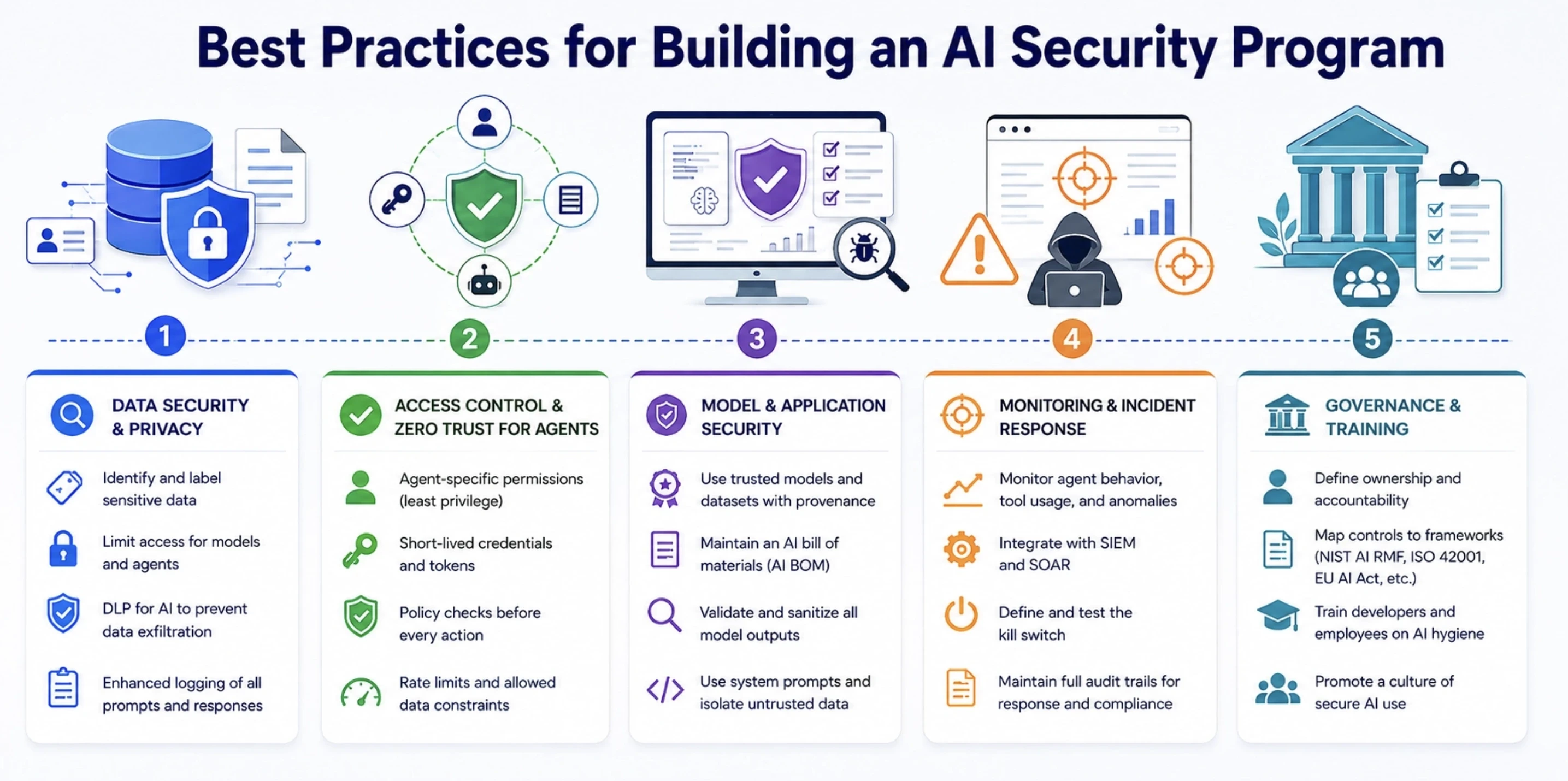
Data Security & Privacy
Because the majority of AI exfiltrations are data-access issues in an AI disguise. The trick in EchoLeak was that Copilot could access internal files to which the attacker's payload could then point back outwards, and the robust defense was scoping internal files, not just one injection path. Identify and label sensitive stores, limit access for any model or agent, and use DLP for AI to prevent the export of PII, credentials, and source code from leaving your boundary from prompts and responses. If something does go wrong, you'll have the audit trail as enhanced logging of all prompt and response transformations.
Access Control & Zero Trust for Agents
The range of an agent is the same as its credentials, so cut them down. Assign agent-specific permissions to each agent, rather than those of the launching user; use short-lived credentials rather than long-lived tokens; and implement least privilege per agent (rate limits, allowed-data constraints). Zero trust for AI involves separating out the planning from the execution, and executing a policy check before taking any action with a consequential impact, preventing a hijacked goal from tricking its way around a standing credential. The cautionary tale: the GitHub MCP breach and how one over-scoped token led to a leak of private data in a poisoned issue.
Model & Application Security
Protect the model and the code associated with the model. Use third-party models and datasets that support provenance to reduce data poisoning and limit backdoors, as well as keeping an AI bill of materials to know which are in play when a supply chain advisory is issued. Assume that the mere output of the model is unverifiable inputs, as you would to any external data source, because it is the way you handle the output that makes a string you generated a string you executed. Use system prompts to limit user behavior, set output formats, and isolate untrusted information so retrieved data does not appear as instructions.
Monitoring & Incident Response
You need a signal at runtime, and you need to do something with it. Track agent activity for changes in agent behavior, unrecognized tool calls, loops, model drift, and export these events to your SIEM and SOAR for AI incidents to be integrated into the same process as all other incidents. Before an incident, determine what the kill switch means to an agent; it could be revoking a credential, disabling a tool, or stopping a workflow altogether, but it's too late to decide in the middle of an incident. Here, it's important to have full audit trails for response and subsequent compliance proof.
Governance & Training
Ownership and educate humans in the loop. The Govern function of the NIST AI RMF and the management-system clauses of ISO 42001 are calling for this. Map your controls once against all the frameworks to which you're accountable, including the EU AI Act if interacting with the EU market. Educate developers and staff on AI-specific hygiene; because the indirect prompt injection is typically through regular docs and messages, no one suspects.
How Akto Delivers AI Security
Built for AI agents, MCP servers, LLM applications, and GenAI systems, Akto provides an end-to-end AI Agent Security Platform that helps organizations discover, assess, test, and protect AI systems across employee endpoints and production environments. Akto automatically discovers and catalogs AI agents, MCPs, tools, and resources across infrastructure, cloud, and employee devices, while providing continuous security testing, risk assessment, runtime protection, and guardrails.
Akto has two core products: Akto Atlas, which secures AI usage across employee workstations and devices, including Shadow AI, AI agents, MCP servers, and AI tools; and Akto Argus, which secures homegrown AI agents, GenAI applications, and MCP servers deployed in cloud and production environments. Together, Atlas and Argus provide visibility and security controls across employee-managed AI usage and AI systems built and deployed by organizations.
Akto also provides automated agentic red teaming, AI and MCP guardrails, security posture management, and runtime protection to help security teams identify and address risks throughout the AI lifecycle.
Discovery & Posture Management
Akto uses 80+ connectors to automatically discover and catalog MCPs, AI agents, tools, and resources on infrastructure, cloud, and employee laptops, including the “shadow” AI that inventory-by-spreadsheet never finds. This directly addresses the discovery gap caused by over-privileged agents and exposed MCP servers. Then, its agentic posture management identifies misconfigurations, over-permissioned tools, unsafe data access paths, exposed MCPs, and policy gaps, transforming the inventory into a prioritized list of what to fix, addressing the non-human identity sprawl identified by BeyondTrust's research and then addressed by NHI governance in Atlas.
Continuous Red Teaming
Akto's Agent Probe tests adversarial queries that discovered MCP servers and AI agents, boasting a probe library of 4,000+ probes, as mentioned on its AI security page, including prompt injection, privilege elevation, data leakage, and misuse of the tools, which are mapped to OWASP LLM Top 10 and MITRE ATLAS. It's implemented in CI/CD, meaning it is a build-time check for weaknesses in tool-chaining and injection used in incidents such as the GitHub MCP toxic agent flow, which gets caught at build time instead of in production. Prompt hardening strengthens system and user prompts to resist the goal-drift and injection patterns that are revealed by those probes.
Real-Time Guardrails
Guardrails inline are handled by Akto's MCP and agent proxy, which prevent malicious prompts, unsafe tool calls, harmful outputs, data leakage, and unauthorized actions before they run and identify behavioral signals, such as loops made by agents and excessive usage, that single-request filters can't. This is where the chains of indirect-injection-to-exfiltration would have been stored. It was released in July 2026 with real-time enforcement for coding agents such as Claude Cowork and Kiro CLI and human-in-the-loop overrides, which enabled enforcement to follow the agents' actual usage.
Final Thoughts on AI Security Solutions
The lesson learned is this: Don't think of AI security solutions as one-off products, but rather consider your own attack surface first – inventory all models, agents, MCP servers, reduce agent privileges to least privilege, and integrate adversarial testing into the same pipeline used for your AI product. All the threats of 2026 are of like shape: Indirect Prompt Injection leading to Exfiltration in EchoLeak; Tool Poisoning and Toxic Agent Flows on MCP; and Over-privileged, Non-Human Identities. All threats of 2026 are of like shape, and the defense is layered. Those are the same problems that Akto solves in one platform: Discovery and posture management surfaces tools that are out of control by shadow AI, continuous red teaming makes sure tools are chained and injected before build, and real-time guardrails block unsafe agent behavior at runtime. Check how it integrates with your existing stack by signing up for a AI security demo.
FAQs on AI Security Solutions
What are AI security solutions?
Tools that identify the AI assets running, evaluate how they are exposed, run tests against attacks, and prevent unsafe behaviors at runtime. Each includes a different class of risk – they include models, data, applications, and agentic workflows.
How is AI security different from traditional cybersecurity?
Traditional controls verify structured requests to static contracts. Handling free-form inputs, non-deterministic outputs, and attacks on the model's reasoning is a challenge for AI security. You can't trust that a firewall will detect intent and a SQL filter will prevent prompt injection, hence the separate Top 10 lists for LLM and agentic applications.
What types of AI security solutions exist?
In general, there are three types of AI-SPM platforms: discovery and posture, build-time testing, and production runtime enforcement, and there are use-case-specific platforms that are based around AI, agents, or MCP.
What is AI-SPM (AI Security Posture Management)?
The layer that stores your AI assets and catalogs which models and agents can access which data, and that ranks misconfigurations and exposed assets by actual risk. It responds to what you have and how it's exposed, and complements any runtime layer that prevents active attacks.
What are the biggest AI security threats in 2026?
Indirect prompt injection, misuse of tools, tool poisoning, memory poisoning, context poisoning, and non-human identity privilege abuse. This is why it is more difficult to defend agentic systems than chatbots.
What is prompt injection, and how do AI security solutions defend against it?
An attacker puts in instructions that affect the model's intended functionality either by direct communication in a chat or by what the model reads. Defenses are designed to include input/output filtering, separation of untrusted content, least-privilege access to tools, and inline guardrails that are fail-closed, as there is no way to patch it at the model level.
What is the difference between AI red teaming and runtime protection?
Red teaming is a planned attack (offensive) with the aim of finding weaknesses. Runtime protection is ongoing protection and blockage of matches from live traffic. They operate in a cycle: red teaming identifies a bypass, a guardrail closes, and the next run validates the guardrail.
What is shadow AI, and why is it a security risk?
Unsupervised AI agents, tools, and models on employee laptops and privileged browsers. They're a problem because you can't control what you can't see, and studies reveal that many businesses operate shadow agents whose team is not being monitored.
How do AI security solutions handle agentic AI and MCP-connected agents?
Through discovery and scanning of agents and MCP servers, addition of untrusted supply-chain assets as tool descriptors, addition of per-tool access control and scoped credentials, and runtime guardrails that catch not only single-prompt attacks, but agent-aware attacks as well.
What features should enterprises look for in an AI security platform?
Continuous discovery, posture management with attack-path analysis, AI runtime protection with fail-closed guardrails, automated red teaming integrated into CI/CD, and governance mapping to NIST AI RMF, EU AI Act, and ISO 42001.
How does AI security relate to compliance frameworks like the EU AI Act or NIST AI RMF?
The frameworks establish the obligations: The tooling generates evidence and controls. The EU AI Act has a due date, penalties, and is binding legislation; the NIST AI RMF is voluntary, but referenced in procurement; and ISO 42001 is a certifiable management standard. A mapping of controls to all three cuts is performed twice on a platform.
What is an AI security maturity model?
A method to measure the speed of your controls in relation to an attack, typically in three phases: ad hoc and reactive, proactive and recurrent tests, and enforcement and autonomous, closed red-team-to-runtime loop and machine-speed response.
Can AI security solutions protect against supply chain attacks on AI systems?
Yes, by checking the provenance of third-party models and datasets, keeping an AI bill of materials, and using integrity checks to ensure that a “safe” operation cannot be mapped to a “toxic” one in a poisoned schema.
What are the top AI security platforms in 2026?
Some of the most widely tested include Akto, Wiz, Palo Alto Prisma AIRS, Check Point's Lakera Guard, F5's AI Gateway and BeyondTrust's Pathfinder. They have different approaches to first call, either with posture, runtime, identity, or a mixed strategy to the agent, so the right one is for your stack.
How do I get started building an enterprise AI security program?
Start with discovery for an accurate inventory, scope agent credentials to least privilege, integrate posture management into rank fixes, integrate red teaming into CI/CD, introduce runtime guardrails, and apply everything to a governance framework. Order it based on build order, not purchasing tools at the same time.
Important Links

Experience enterprise-grade Agentic Security solution