AI Compliance: Frameworks, Regulations, and How to Prepare in 2026
Understand AI compliance requirements - from the EU AI Act and NIST AI RMF to ISO 42001 - and how to build a compliance program for AI and agentic systems.

Arpashree

AI compliance is the work of proving, with documentation and evidence, that an organization's AI systems meet the legal, regulatory, and ethical obligations that already apply to them. It's not optional, and it's not the same thing as simply having good intentions about how AI gets built. Getting AI governance and compliance right together, rather than treating either as sufficient on its own, is what actually satisfies both a regulator and an internal risk committee, and AI regulatory compliance specifically is the part of that work regulators can actually verify with documentation and evidence.
What Is AI Compliance?
AI compliance sits downstream of two related but distinct concepts that get conflated constantly.
AI Compliance vs. AI Governance vs. AI Compliance Framework
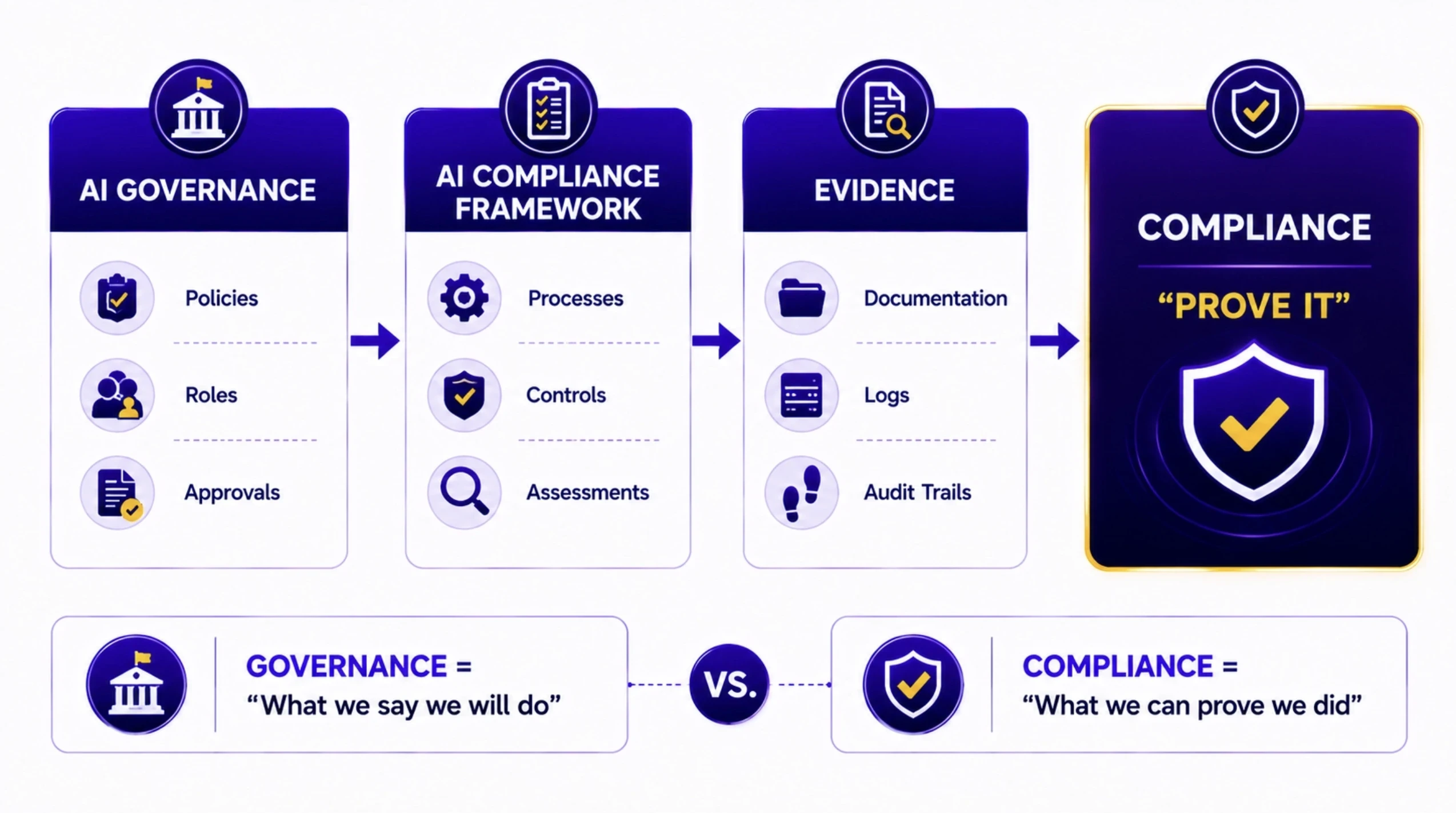
AI governance is the internal, proactive work: the policies, roles, and approval structures an organization sets up to decide how AI gets built, deployed, and monitored, before a system ever reaches production. AI compliance is the external, evidentiary side: proving to a regulator, auditor, or customer that those internal rules were actually followed, with documentation, logs, and audit trails to back it up. An AI compliance framework is the method connecting the two: the structured processes, tools, and controls an organization actually uses to turn governance intent into demonstrable compliance evidence. An organization can have governance without compliance, controls that work but no proof they meet a regulatory standard, and it can have compliance without governance, paperwork satisfying a regulator with no real control over how the AI actually behaves, neither substitutes for the other.
The distinction matters most at the exact moment something goes wrong. A governance control that blocks a policy-violating action operates in real time, before the violation occurs. A compliance review that identifies the same violation in an audit log operates days or weeks later, after the fact. An organization with extensive compliance documentation and no working governance controls has, in effect, told a regulator precisely which rules it knew about and failed to actually enforce, which tends to make liability worse rather than better once an incident is under investigation.
Why AI Compliance Matters Now
Regulatory pressure has moved from theoretical to active enforcement in the span of about eighteen months. The EU AI Act's prohibited-practices tier has been enforceable since February 2, 2025, its general-purpose AI model rules since August 2, 2025, and its high-risk system obligations were originally set for August 2026 before the EU's Digital Omnibus package pushed that deadline to December 2, 2027 for standalone high-risk systems specifically. At the same time, a 2026 infrastructure identity survey found that while 92% of organizations agree governing AI agents is critical, only 44% actually have policies in place to do it, a governance gap that becomes a compliance gap the moment an auditor asks for evidence.
Key AI Regulations and Standards
EU AI Act: Risk Tiers and Penalties
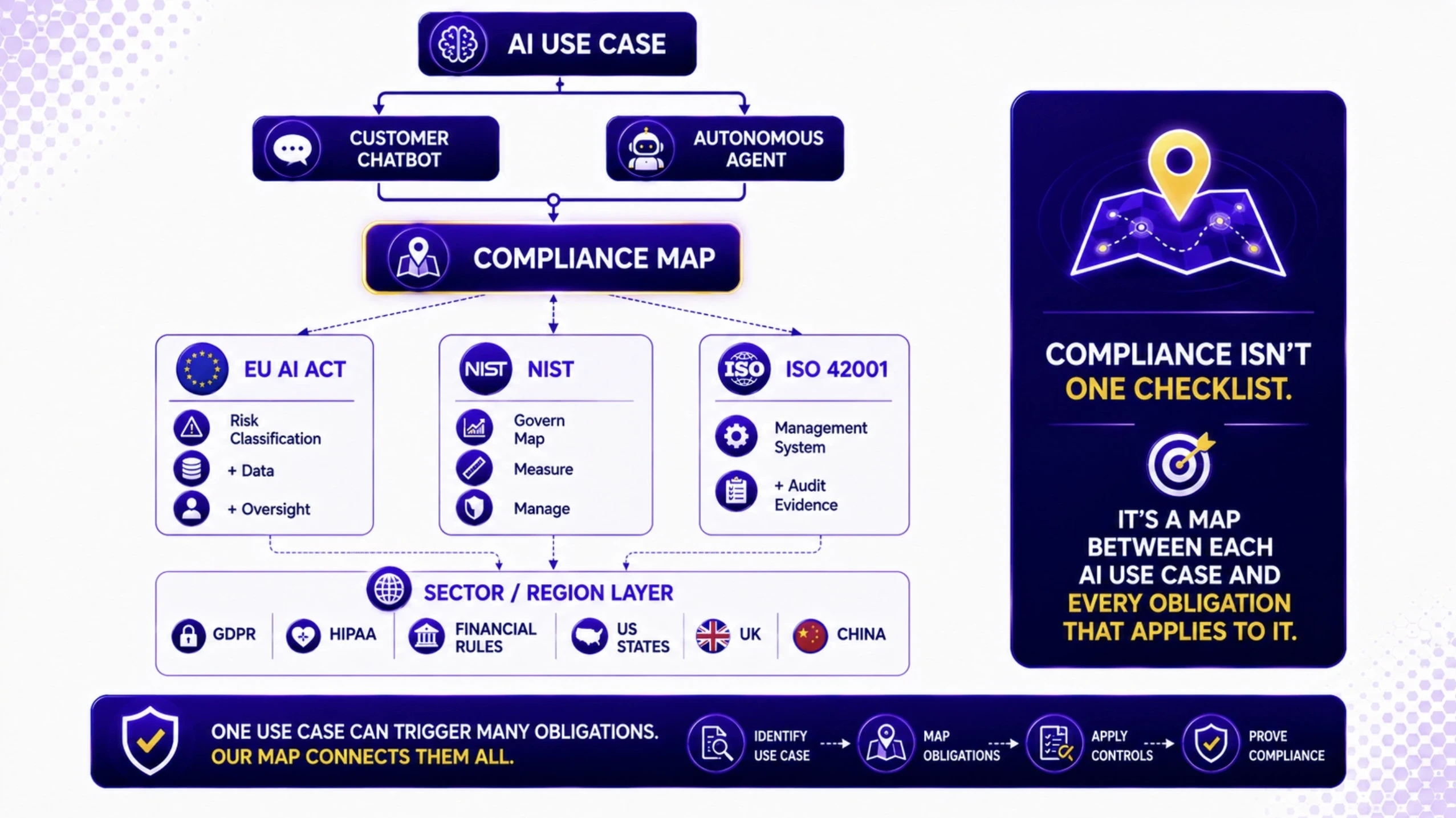
EU AI Act compliance starts with understanding its four-tier classification system: unacceptable risk (banned outright), high risk (strict obligations including risk management, data governance, and human oversight), limited risk (transparency requirements), and minimal risk (largely unregulated, covering an estimated 85% of AI systems in use). Penalties scale in three bands under Article 99: up to €35 million or 7% of global annual turnover for prohibited practices, up to €15 million or 3% for high-risk or general-purpose AI model violations, and up to €7.5 million or 1% for supplying incorrect or misleading information to regulators, whichever figure is higher in each case.
NIST AI Risk Management Framework (RMF)
NIST AI RMF, published in January 2023, organizes AI risk management around four functions: Govern, Map, Measure, and Manage. It's voluntary rather than mandatory, but it has become the default reference point for AI risk management best practices in the U.S., extended for generative AI specifically through the NIST AI 600-1 Generative AI Profile.
ISO/IEC 42001 (AI Management System)
ISO/IEC 42001, published in December 2023, is the first certifiable international standard for an AI management system, giving organizations an audit-based path to demonstrate structured AI governance the way ISO 27001 does for information security. Where NIST AI RMF gives you the risk-management content, ISO 42001 gives you the certifiable structure an external auditor can actually verify against.
Sector-Specific Rules (GDPR, HIPAA, Financial Services)
GDPR's automated decision-making provisions under Article 22 apply the moment an AI system contributes to a decision with legal or similarly significant effect on an EU individual, and its 72-hour breach notification window is the tightest widely applicable data-breach standard in force today. HIPAA's Security Rule applies to any AI system touching electronic protected health information, with HHS confirming that AI vendors handling PHI are business associates subject to the same obligations as any other. Financial services carries its own dense layer, FINRA's rules applying regardless of whether AI drafted a communication, and evolving bank-level guidance addressing agentic systems specifically.
Emerging Regional Frameworks (US State Laws, UK, China)
U.S. state AI law is moving fast and inconsistently. Colorado's original risk-based AI Act was repealed and replaced in 2026 by a narrower, disclosure-focused Automated Decision-Making Technology Act, while other states continue introducing their own, sometimes conflicting standards. The UK has favored a principles-based, regulator-led approach rather than a single AI-specific statute, and China has moved comparatively fast with binding rules on algorithmic recommendation systems and generative AI content labeling. Organizations operating across all three face genuinely different compliance obligations depending on where their users and data actually sit.
Core Pillars of an AI Compliance Framework
Transparency and Explainability
Transparency and explainability mean a system's decisions can be traced back to specific, reviewable reasoning, not just a confidence score presented as if it were an explanation.
Data Governance and Privacy
Data governance covers what data trains, is retrieved into, or is processed by an AI system, and privacy compliance requires that use to respect the original consent basis that data was collected under.
Risk Assessment and Classification
Every AI use case needs a documented risk classification, since obligations under frameworks like the EU AI Act scale directly with how a given system is classified, and misclassifying a system that actually qualifies as one of the high-risk AI systems under Annex III is itself a compliance failure regardless of how the system otherwise performs.
Human Oversight and Accountability
Human oversight means a defined point where a person can review, override, or halt an AI system's action, and algorithmic accountability means a named owner exists for every AI system, not just a general policy statement that humans are "involved".
Documentation (Model Cards, Datasheets, Audit Trails)
Model documentation, model cards and datasheets documenting a model's intended use, training data, and known limitations, paired with audit trails recording what a system actually did in production, together form the evidentiary backbone most compliance frameworks ultimately require. Bias and fairness testing belongs in this same documentation trail, since a model card that omits known fairness limitations gives an auditor an incomplete picture of what was actually assessed before deployment.
AI Compliance Across the AI Lifecycle
Development and Training Data Governance
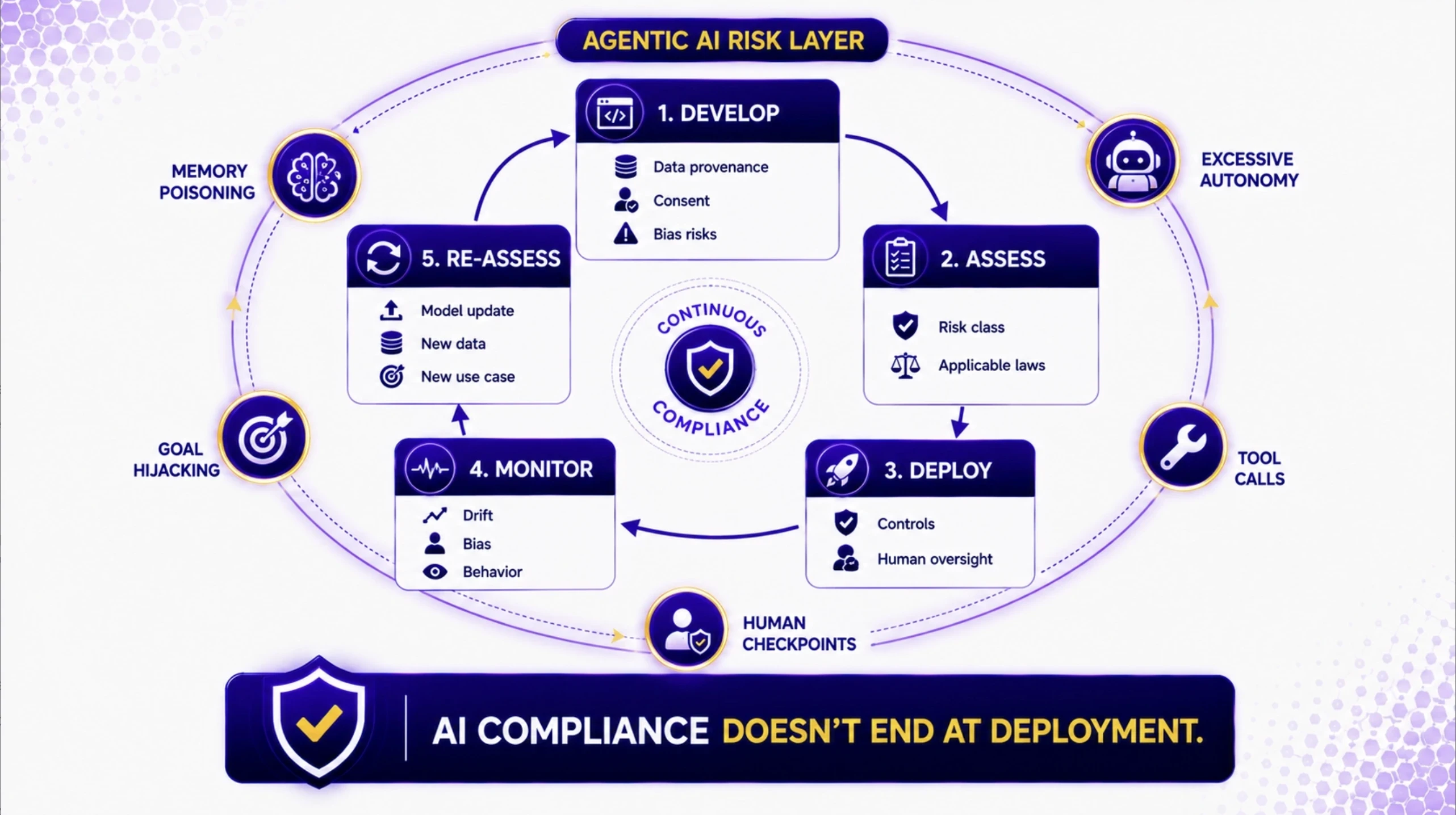
Compliance starts at development, documenting training data provenance, consent basis, and known bias risks before a model is ever deployed.
Pre-Deployment Risk Assessment
Before launch, a system needs a documented risk assessment matching it against applicable frameworks, since retrofitting that assessment after deployment is both harder and less credible to an auditor.
Deployment and Monitoring
Deployment isn't the finish line. Continuous monitoring for drift, bias, and unexpected behavior is what keeps a system's compliance posture accurate rather than reflecting only the day it launched.
Ongoing Auditing and Re-Assessment
Every material change, a new data source, an expanded use case, a model update, should trigger re-assessment rather than waiting for a fixed annual audit cycle to catch it.
AI Compliance Challenges Organizations Face
Regulatory Uncertainty and Fragmentation Across Regions
Rapidly shifting timelines, like the EU AI Act's own delayed high-risk deadline, and inconsistent state and national rules make it genuinely difficult to build a single compliance program that satisfies every jurisdiction at once.
Keeping Pace with Agentic AI and Autonomous Systems
Most existing compliance guidance was written with static, predictive models in mind: a model that classifies, scores, or predicts, then hands the output to a human for a decision. Agentic systems that plan, decide, and act introduce risk categories, unauthorized actions, cascading errors across multiple tool calls, and autonomous decisions with no human checkpoint in between that a model-centric compliance checklist simply doesn't ask about. A compliance program built entirely around the older, model-centric assumption will pass every check on paper while missing the actual behavior an autonomous agent exhibits in production, which is exactly the gap regulators and auditors are starting to probe for specifically.
Third-Party and Vendor AI Risk
Third-party and vendor AI risk compounds quickly, since a vendor's AI feature can process regulated data on an organization's behalf without that organization having full visibility into the vendor's own training data, security posture, or subprocessors.
AI Compliance for Agentic AI and MCP Systems
Agentic AI governance needs a different lens than the model-centric compliance most existing guidance assumes.
New Risks: Memory Poisoning, Goal Hijacking, Excessive Autonomy
Memory poisoning corrupts an agent's persistent context so a single successful manipulation shapes behavior across future sessions. Goal hijacking redirects an agent's stated objective mid-task, often through content embedded in a document the agent processes rather than a direct instruction. Excessive autonomy, an agent granted more tools or permissions than a task actually requires, turns any one of these manipulations into a much larger incident than it would otherwise be.
Mapping Agent Behavior to Governance Requirements
Mapping agent behavior to existing governance requirements means treating each agent as its own accountable entity, with defined authority, logged tool calls, and a human oversight checkpoint for its highest-risk actions, rather than assuming the governance built for a single predictive model already covers it.
Building an AI Compliance Program: Best Practices
These AI compliance best practices turn governance intent into something an auditor can actually verify.
Map Regulations to Your AI Use Cases
Start by mapping every applicable regulation to specific AI use cases rather than treating compliance as one undifferentiated obligation, since a customer service chatbot and an autonomous transaction agent carry entirely different regulatory weight.
Establish Governance Roles and Ownership
Assign a named, accountable owner for every AI system and every governance decision, since diffuse or undefined ownership is consistently where compliance programs fail under audit.
Automate Continuous Monitoring and Reporting
Continuous compliance monitoring, automated rather than manual, is what keeps a program's evidence current between audits instead of scrambling to reconstruct it after the fact.
Maintain Auditable Records and Documentation
Every model card, risk assessment, and audit trail needs to be stored in a format an auditor can actually query, not scattered across disconnected systems that require manual reconstruction under pressure.
How Akto Supports AI Compliance
Continuous Risk Assessment Across LLMs, Agents, and MCP
Akto continuously discovers and assesses risk across LLM applications, AI agents, and MCP server connections, building the AI system inventory nearly every compliance framework assumes already exists.
Mapping to NIST AI RMF, EU AI Act, and Other Standards
Findings map directly to NIST AI RMF, relevant EU AI Act obligations, and the OWASP Top 10 for LLM and Agentic Applications, giving compliance, legal, and security teams a shared vocabulary instead of three separate internal taxonomies.
Runtime Guardrails for Governance Enforcement
Runtime guardrails enforce the policies a governance program defines, turning documented intent into an actual control that blocks an out-of-scope action rather than a policy statement an auditor takes on faith.
Final Thoughts on AI Compliance
AI compliance is no longer a future consideration to plan around eventually. Enforcement is active, penalties are real, and the gap between how fast organizations are adopting agentic AI and how ready they are to govern it keeps widening rather than closing on its own. Building a program that maps regulations to actual use cases, assigns real ownership, and automates continuous monitoring rather than relying on a once-a-year audit is what turns compliance from a documentation exercise into something that actually holds up when a regulator asks for proof.
FAQs on AI Compliance
How is AI compliance different from AI governance?
Governance is internal and proactive: the policies and approval structures an organization sets before deploying AI. Compliance is external and evidentiary: the proof an organization provides to regulators or auditors that those internal rules were actually followed.
What is an AI compliance framework?
It's the structured set of processes, tools, and controls an organization uses to turn governance policy into demonstrable compliance evidence, typically built around pillars like transparency, data governance, risk classification, and documentation.
What does the EU AI Act require, and who does it apply to?
It requires risk-based obligations scaling from banned practices through strict high-risk requirements to lighter transparency rules, and it applies to any organization building, deploying, or importing AI systems that affect people in the EU, regardless of where that organization is headquartered.
What is the NIST AI Risk Management Framework?
A voluntary framework organizing AI risk management around four functions, Govern, Map, Measure, and Manage, that has become the default U.S. reference point for AI risk management best practices.
What is ISO/IEC 42001?
The first certifiable international standard for an AI management system, giving organizations an audit-based path to demonstrate structured AI governance similar to how ISO 27001 works for information security.
How does AI compliance apply to GDPR and HIPAA?
GDPR's automated decision-making provisions apply when AI contributes to a decision with legal effect on an EU individual, and HIPAA's Security Rule applies to any AI system touching electronic protected health information, treating AI vendors handling that data as business associates.
What are the risk tiers under the EU AI Act?
Four tiers: unacceptable risk (banned), high risk (strict obligations), limited risk (transparency requirements), and minimal risk (largely unregulated), with obligations and penalties scaling directly with tier.
What documentation is required for AI compliance (model cards, audit trails)?
Model cards and datasheets documenting a model's intended use, training data, and limitations, paired with audit trails recording what a system actually did in production, form the evidentiary core most frameworks require.
What are the biggest challenges in achieving AI compliance?
Regulatory fragmentation and shifting timelines across regions, compliance guidance that assumes static models rather than autonomous agents, and limited visibility into third-party and vendor AI risk.
How does AI compliance apply to agentic AI and autonomous agents?
Agentic systems introduce risks like memory poisoning, goal hijacking, and excessive autonomy that model-centric compliance checklists don't address, requiring each agent to be treated as its own accountable entity with logged behavior and defined human oversight.
What are the penalties for AI non-compliance?
Under the EU AI Act specifically, penalties reach up to €35 million or 7% of global annual turnover for prohibited practices, up to €15 million or 3% for high-risk or general-purpose AI model violations, and up to €7.5 million or 1% for providing incorrect information to regulators.
How often should AI systems be audited for compliance?
On a recurring schedule proportional to risk tier, plus immediately after any material change, a new data source, an expanded use case, or a model update, rather than waiting for a fixed annual cycle to catch drift.
What best practices help organizations build an AI compliance program?
Mapping specific regulations to specific use cases, assigning named accountable owners, automating continuous monitoring rather than relying on manual review, and maintaining documentation in a format that's actually queryable under audit.
How can platforms like Akto help with AI compliance?
By continuously discovering and assessing risk across LLMs, agents, and MCP connections, mapping findings to frameworks like NIST AI RMF and the EU AI Act, and enforcing governance policy through runtime guardrails rather than leaving it as undocumented intent.
Important Links

Experience enterprise-grade Agentic Security solution