AI Agent Identity Management: Runtime Security and Continuous Enforcement
Learn how AI agent identity management secures autonomous agents with identity verification, access controls, least privilege, and continuous monitoring.

Bhagyashree

Machine identities already outnumber human identities by more than 80 to 1 across the average enterprise, and AI agents are the fastest-growing slice of that number, each one spinning up API keys, OAuth tokens, and service credentials that most identity programs were never built to track. The stakes aren't abstract: Gartner predicts that over 40% of agentic AI projects will be canceled by the end of 2027, citing escalating costs, unclear business value, and inadequate risk controls as reasons, and identity is squarely within that risk-control gap.
This blog covers the technical mechanisms behind managing that identity sprawl: authentication, authorization, credential lifecycle, and access control for AI agents. For the policy and organizational side of the equation, ownership, accountability, and governance frameworks.
What is AI Agent Identity Management?
AI agent identity management treats individual AI agents as first-class principals, providing them each with appropriate, scoped credentials while tracking their actions for audit and control, rather than relying on shared API keys or human user identities.
This capability represents an extension of standard enterprise IAM practices to the domain of autonomous agents: applying authentication, authorization, and audit controls typically used to manage humans and other trusted computing services to AI models which perform actions faster, more autonomously, and with less direct oversight than human agents.
What are the Common Identity and Access Management (IAM) Issues with Agentic AI?
The root cause of most identity-related issues I've seen with agentic AI systems is that the agent was never treated as a first-class principal within the organization's IAM framework.
This manifests in several common antipatterns:
Shared credentials: A single service account or API key is used to run multiple agents, making it impossible to distinguish between their actions or securely manage their access
Long-lived credentials: An API key is embedded in an agent's deployment configuration with no planned rotation or expiration, representing a persistent security risk if compromised
Unscoped permissions: Agents are given broad access rights rather than permission to perform only the specific functions necessary to their role
These patterns are essentially the agentic equivalent of the insecure IAM practices that enterprises used to employ before adopting modern zero-trust architectures. With traditional microservices, for example, it was common to enable free cross-service communication under the assumption that services were inherently trustworthy.
Agentic AI systems present similar security and compliance challenges but with potentially greater risk since functional agents can perform actions at machine speed and scale while often operating on behalf of specific humans.
Key Identity Attributes of an AI Agent
When implementing agent identity management solutions, several key attributes should be considered when determining what an agent is capable of and how its access should be controlled:
Authentication credentials: While agents typically authenticate with API keys or certificates, this represents the primary security control over the agent, similar to how human users authenticate with IAM systems.
Provenance: Information about the agent's origin and creation, including which foundational model was used to create it and what training data was utilized.
Capabilities/scope: What actions the agent is authorized to perform, often specified as a set of tools and functions available to it, with controls to prevent excessive privilege escalation.
Delegation: How the agent can act on behalf of other users, often through limited-time tokens rather than direct access to human credentials.
Compliance posture: How the agent operates within regulatory requirements and frameworks, including data privacy rules and industry-specific compliance standards.
Runtime evaluation: While agents often have static authentication and permissions, every request must be evaluated in context at runtime based on the requesting agent, available capabilities, and applicable delegate policies.
By evaluating these factors, an enterprise can appropriately scope an agent's access and operations, defining clear boundaries similar to how human users are managed within enterprise IT systems. This enables appropriate least-privilege access while still allowing agents to perform necessary functions on behalf of end users.
Core Components of AI Agent Identity Management
Everything outlined above is based on a set of system-level components, organized into a rough architecture below:
Unique Identity per Agent
In other words, every agent has a unique and verifiable identity, not shared with any other agent, that is used to establish and maintain trust relationships. This allows for differentiated, fine-grained control over what every individual agent can do - including the ability to mitigate risk if one agent’s identity is compromised, without impacting the trust relationships of the rest. This can be implemented using SPIFFE/SVID.
Dynamic/Scoped Credentials
The credentials should have limited lifetime appropriate for the particular job or span of operation - no standing credentials. This is what makes zero standing privileges possible, and closes the exposure window of a compromised credential.
Brokered Authentication
There should be a separate component (a broker or PAM provider) in between agents and the resources they consume, which can issue or deny credentials for every access request on a per-call basis. This removes secrets from configuration and environment variables, provides visibility into the system for auditing, and acts as a control plane for revoking access.
Attribute-based Authorization
The authorization logic should be expressed in terms of attributes of the resource being accessed, rather than roles or groups of the accessing entity. In other words, what the agent can do depends on what it wants to do and what the justification for this is. Another way to think about it – the permissions follow the job, not the agent.
Delegation Chain Authority
Every time an agent delegates a task to another agent, the permissions granted to the latter must be no broader than those of the former. This applies to both authentication (delegation of identity) and authorization (delegation of permissions). By using cryptographically signed delegation chains, this allows for constraining and auditing every step of the privilege escalation.
Runtime Policy Enforcement
Since agents are often built using a sequence of autonomous function calls, each of which may access external resources, access control must be enforced for every individual function call inside the task. This includes authenticating and authorizing every access attempt, or, alternatively, rejecting it at the execution stage, rather than letting it happen and only then detecting and logging the violation.
Runtime Revocation
The connection to the service must be able to terminate upon revocation using protocols such as CAEP, rather than relying on credential expiration. This ensures that once a credential is revoked, the corresponding access is terminated immediately, rather than allowing potentially dangerous operations to continue until the credential would normally expire.
Guardrails for Critical Operations
Regardless of the agent’s authentication and authorization state, certain operations may require explicit approval before being executed. This serves as a control against accidental or unauthorized use of critical capabilities, such as data deletion, external communications, and financial operations.
Anchored Logging
The logs must be able to capture sufficient information to reconstruct the logic behind the use of every credential. This is important in order to be able to distinguish between a legitimate autonomous agent behavior and a potential compromise after the fact.
Inventory and Lifecycle Management
There must be an inventory of every agent in the system, with owners and permissions for every machine, and automatic auditing or alerting when permissions change to allow more access than justified by the task. This is important in order to be able to answer the basic questions of what agents exist in the system and what they can do.
As you can see, it is a stack of several interlocking components that include identity, authorization, constrained delegation, and scoped credential define what an agent can do and why, while runtime enforcement, logging, and revocation define whether it can even happen and whether anyone will be able to detect it if it does. Taken together, they provide a comprehensive security posture for autonomous AI agents, but obviously, there is always room for improvement. Do you have anything to add?
The Four-Phase Agent Identity Lifecycle
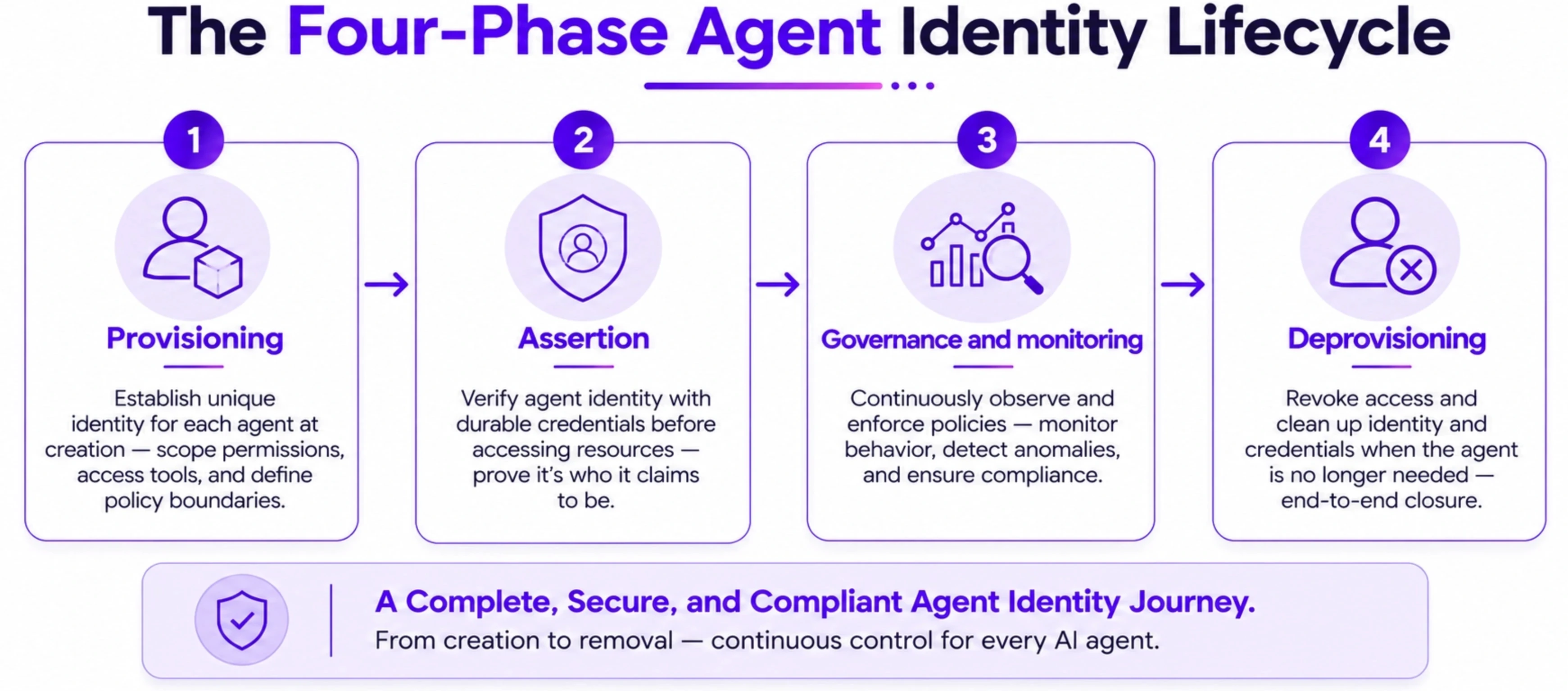
Unlike humans, who have relatively long-lived identities, are issued a credential upon hiring, and have their access revoked later upon termination, agents are often short-lived, dynamically created, and have no analogous centralized authority to revoke credentials when they are no longer needed. The problem of agent lifecycle management is complicated by the fact that agents may be created and destroyed in rapid succession, and their number may be difficult to track. This creates a gap between human identity management and agent lifecycle management that needs to be addressed, typically by implementing a four-phase lifecycle for agents:
Provisioning: Each agent instance must be issued a credential (or credentials) with a known owner, scope of access, purpose, and a defined lifetime, rather than reusing the same service account;
Assertion: During authentication, the agent’s credentials are used to verify the agent’s identity, and during authorization, access policies are enforced using least privilege;
Governance and monitoring: Entitlements are actively reviewed, anomalous activity flagged, and access patterns evaluated to determine if a live agent has privileges it no longer requires;
Deprovisioning: Access must be actively revoked and credentials removed when an agent is de-provisioned, with this action being audited and logged for policy verification.
The phase most identity programs get wrong, often, is the last one: there is a well-defined process for deprovisioning a human (their entry is removed from HRIS, which then notifies all downstream systems to remove associated entitlements and terminate processes such as access cards or network access). But there is rarely such a process for an agent: a team may decide to retire a certain workflow, destroy the compute instance holding it, and not revoke the service account’s access to other infrastructure, such as the secrets manager or API gateway, because there is no process in place to discover it. By enforcing a four-phase model, particularly automated discovery of entitlements and audit trails, a Zero Trust architecture can ensure that all components of an agent’s identity lifecycle are monitored and managed appropriately.
Security Challenges Unique to AI Agent Identities
Here are some of the common security challenges related to AI Agent Identities.
Identity Spoofing and Privilege Abuse
Unlike humans, agents do not give away their tracks, such as the time of logon from unusual locations, and therefore a compromised agent does not readily reveal itself. Compromise of an agent’s credentials results in an agent behaving exactly as it is supposed to. Worse still, agents typically extend their privileges using the same tooling for their operations, which frequently grants the attacker more access than anticipated.
Credential Leakage and Runtime Hijacking
The most frequent source of credential leakage is typically the development and debugging process, which often results in agents communicating inadvertently with production systems by relaying debug messages to the production log servers or the AI itself. The hijacked credentials remain active indefinitely because there is no centralized credential management, and copies reside in various backups after the initial compromise. The dynamic nature of such credentials renders traditional auditing and reactive response mechanisms largely ineffective, while the time it takes for enterprises to respond to such a breach typically exceeds the lifetime of the exfiltrated credential.
Control Drift: When Access Rules Live In Code Instead Of A Control Plane
It can sometimes happen that the implementation of access rules is embedded in the code of the very agents that are meant to enforce them, as opposed to a control plane accessible to human operators. As a result, such rules can only be discovered by analyzing the code, cannot be changed easily, and often lack standardized enforcement procedures. It creates challenges for operations security (OPSEC) and system integrity, resulting in different rules for the same system being implemented inconsistently across multiple agents and therefore becoming much harder to govern.
Best Practices and Implementation Strategies for AI Agent Identity Management
The following best practices and implementation methodologies exist for AI Identity management:
Zero Standing Privileges (ZSP)
Standing privileges are unused, but existing credentials, API keys that are already cached, long-lived but idle service accounts. Instead, ZSP uses Just-in-Time, on-demand, single-use authentication; credentials are issued the moment they are used, restricted to a single function and destroyed immediately after. There is nothing for an attacker to steal if nothing remains.
Zero Trust and Fine-Grained Access for AI Agents
Agent zero-trust is more than identity; it’s intent, delegation, and scope every time agents make a call. The agents are given a specific identity, a subset of their user's privileges and that is checked on each API call based on the context of where the request is coming from (resource, time, environment), since the agents can change what they are trying to do mid-action.
Continuous Testing and Runtime Enforcement in Practice
There's nothing a rule in system if it's not actively enforced: all tool calls have validation and high-priority actions have manual gate-keeping and credential lifetime policy. Continuous testing with the likes of red teaming, drift detection, simulation of attack verifies defenses actually limit blast radius.
The Future of AI Agent Identity Management
Agents-as-first-class-identities: Lifecycle of agent-specific credentials (as opposed to using shared human credentials or service accounts) automation creation → scoped access → monitoring → deprovisioning.
Platform-native identity layers are emerging: Microsoft Agent 365 assigns an Entra Agent ID to every agent tied to Conditional Access and Purview, but the stack is heterogeneous (Anthropic, AWS, open source), which requires different IdPs.
Protocol-level standards are beginning to gel around MCP: Auth0’s “Auth for MCP” and Okta’s new MCP server define least-privilege access per tool call, with authentication being just one component.
Formal governance frameworks now being developed: CSA’s Agentic Trust Framework (previewed in February 2026) begins to apply Zero Trust principles to agents, including a maturity model.
Big gap between where the industry is and where it needs to be: Only 18% of security leaders are confident in their ability to govern agents today, and just 23% have a formal strategy – suggesting significant headroom for growth, especially given increased spending and regulatory pressure.
Final Thoughts on AI Agent Identity Management
The identity of agents is becoming an essential part, and the key to addressing the problem stems from the fact that existing identity management solutions, be it service accounts, secrets managers, or IAMs, were designed to manage processes that execute the same set of instructions every time, not entities that make strategic decisions and operate at the speed of light. To bridge the gap between the two, we need to adjust our view of identity and reimagine it at the agent level.
The industry is already moving towards several promising directions, including building agent-specific, lifecycle-managed identities for every individual agent, restricting and auditing every single action performed by these agents, and standardizing the process around the notion of blended identity and asserting the agent’s and the human’s roles behind every automated action, neither of which can operate without the other. Leading platforms have already made their propositions, with Microsoft, Amazon, and Databricks being among the first in line.
Given the time it takes for standards bodies to respond to market needs, it is reasonable to expect that the first wave of solutions would exhibit varying degrees of divergence. As a result, it is essential to design processes that enable the emergence and adoption of the most practical approaches, both at the level of individual organizations and across broader ecosystems. If you are considering designing ownership, scoping, and auditing mechanisms for your own digital workforce, Akto’s Identity for AI agents is one such solution I would take particular care to review, as it covers the concept of the blended identity and decision-making entity in excellent detail.
Frequently Asked Questions on AI Agent Identity Management
1. What is the fundamental difference between AI agent identity management and AI agent identity governance?
Identity management is about day-to-day operations of issuing, authenticating, and revoking agent credentials, whereas identity governance is the set of policies that determine who gets to create which agents with what permissions.
2. What authentication protocols are available for use with AI agent identities?
Modern approaches to workload authentication, such as SPIFFE/SPIRE, are used extensively to establish trust between agents, and between agents and other systems, with mutual TLS. OAuth 2.0 with agents-specific extensions is used to delegate authorization, and the newer Continuous Access Evaluation Protocols (CAEP) standard is being developed to move beyond simple time-limited API keys and make agent authentication dynamically verifiable.
3. What is the broker model for issuing AI agent credentials?
A credential broker acts as an intermediary to issue credentials directly to the target service, instead of having agents request and hold on to credentials themselves.
Broker model addresses the misalignment between short-lived nature of many AI jobs and long expiration dates of security credentials by ensuring that credentials are issued to perform a specific task, and revoked as soon as this task is completed.
4. What is Zero Standing Privileges (ZSP) and why is it important for AI agents?
Zero Standing Privileges (ZSP) refers to the practice of eliminating any permissions that are not actively needed. AI agents are critically important in enabling ZSP by virtue of the fact that they are typically used to perform narrowly scoped tasks and then destroyed, resulting in dramatically reduced exposure of any credentials that may be bound to such agents.
5. What is the leading cause of failure for agentic AI initiatives?
Gartner estimates that more than 40% of all agentic AI initiatives will be cancelled by the end of 2027 due to rising costs and unclear value proposition, with inadequate identity and governance controls being a contributing factor to many of these failures.
6. What is SPIFFE/SVID and how is it used to secure AI systems?
These are open authentication standards developed by The Cloud Native Computing Foundation, with SPIFFE standing for Secure Production Identity For Everyone.
SPIFFE/SVID is used to issue cryptographic identities to every instance of every AI agent as it is launched, so that each agent can authenticate itself to other systems.
When launching, an agent binds itself to a specific orchestrator, task, and instance, and a unique cryptographic identity is used for each such combination, with no reuse afterwards.
7. What are some real-time guardrails that can be applied to prevent credential hijacking of AI agents?
Some common-sense guardrails that can be applied in real-time to detect and prevent hijacking of an AI agent include inline policy checking with every tool call, requiring approval for sensitive actions, terminating the session upon suspicious activity, and limiting the lifetime of agent credentials so that the agent itself cannot renew or extend them.
These measures help address the problem of credential sprawl that occurs when 53% of organizations experience their AI agents to operate beyond their intended scope.

Experience enterprise-grade Agentic Security solution