AI Agent Input Validation and Output Guardrail: Implementation Patterns for 2026
How AI agent input validation and output Guardrail actually work in production - schemas, layered pipelines, latency budgets and real 2026 attack patterns.

Arpashree

AI agents need to do more than generate accurate responses-they must produce safe, well-formed, and policy-compliant outputs. This is where input validation, output filtering, and AI guardrails work together. While guardrails determine whether an action or response is allowed, validation checks whether the data is structurally correct and usable by downstream systems.
In production AI systems, relying on a single security control is not enough. Teams need schema-based validation, prompt injection defenses, privilege controls, canary tokens, runtime monitoring, and defense-in-depth mechanisms to reduce the impact of compromised agents. This guide explains how to build a layered validation architecture for AI agents and how Akto applies these controls at runtime.
In this blog, you will learn the difference between AI guardrails and input/output validation and why production AI agents need both.
Explore schema validation, prompt injection protection, canary tokens, streaming validation, and defense-in-depth security controls.
For the conceptual foundation on why guardrails matter, see our guide to AI guardrails. This piece starts from a distinction that conceptual guardrails content usually skips past: guardrails and validation answer two different questions, and production systems need both.
Guardrails vs. Validation: Two Different Questions
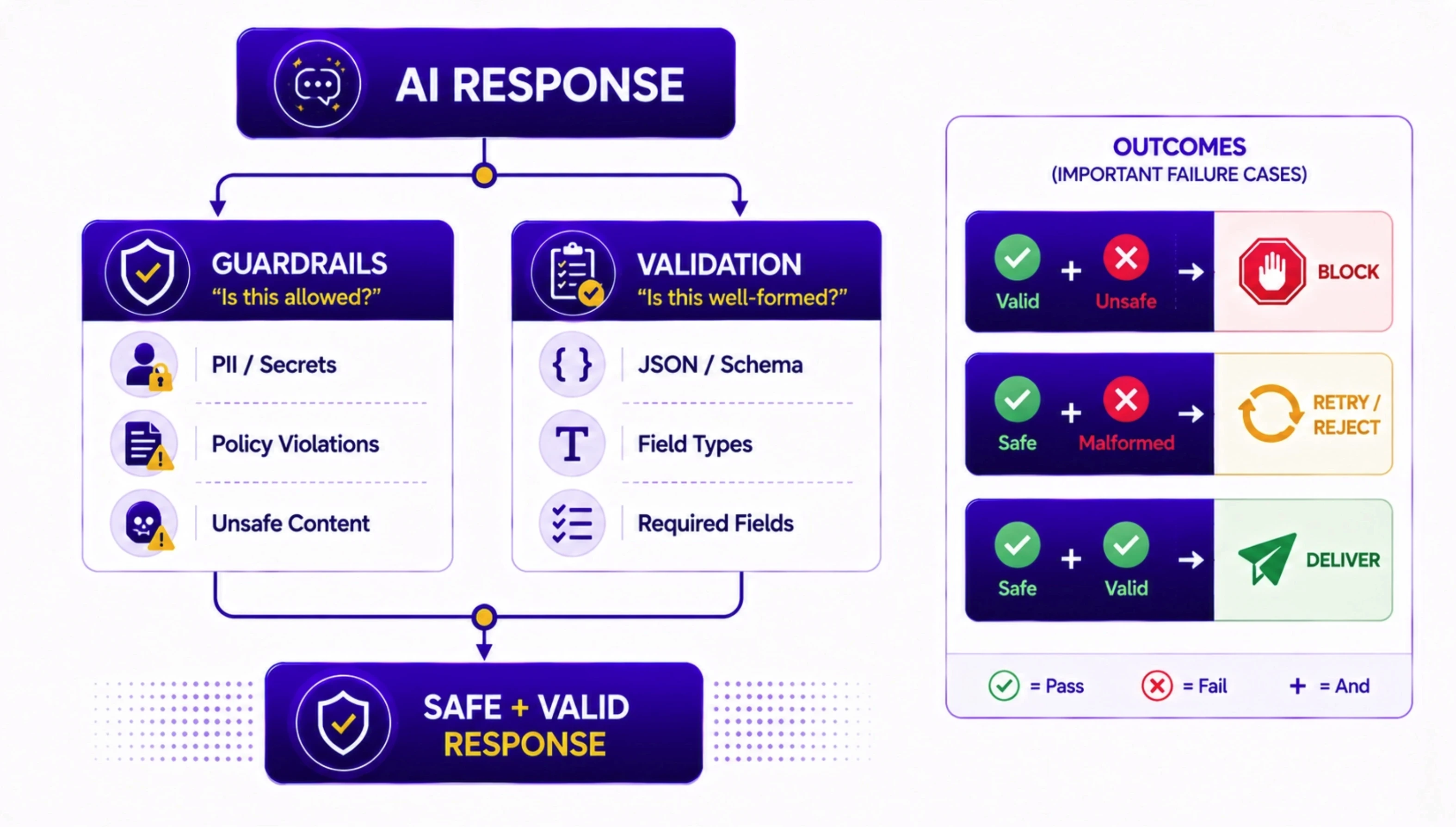
Guardrails answer "is this allowed." Validation answers "is this well-formed." These sound related, and they're often built by the same team using the same tooling, but they catch different failure classes, and neither substitutes for the other.
A response can pass guardrails and fail validation: a model returns syntactically broken JSON with a trailing comma, containing nothing objectionable, but unparseable by whatever system consumes it downstream. A response can just as easily pass validation and fail guardrails: cleanly formatted, schema-compliant JSON that happens to contain a customer's Social Security number in a field never meant to hold PII. Structural correctness says nothing about policy compliance, and policy compliance says nothing about structural correctness. A production system needs both checks running, and conflating them into a single pass or fail gate misses whichever failure mode the gate wasn't built for.
The Schema - First Approach to Input and Output Contracts
Typed Schemas: Pydantic, Zod, and JSON Schema
The foundation of reliable validation is defining the contract before writing the implementation. In Python, Pydantic models express exactly what fields an output should contain, their types, and any constraints, turning "the model should return valid data" into a concrete, checkable specification. TypeScript projects reach for Zod for the same purpose, and cross-language systems increasingly standardize on JSON Schema as a provider-agnostic contract that any tooling can validate against, regardless of which language generated or consumes the data.
Defining this contract first, before the tool or prompt exists, changes how the rest of the system gets built. A tool's function signature should be derived from its schema, not the other way around, since a schema written after the fact tends to just describe whatever the implementation already does rather than constraining what it's allowed to do.
SDK-Level Frameworks: Pydantic AI, Instructor, and Outlines
Three frameworks dominate the Python ecosystem for turning a schema into working validation, and they take genuinely different approaches. Instructor wraps any LLM provider with Pydantic validation and automatic retry logic, requiring almost no framework buy-in beyond a Pydantic model, making it the common starting point for teams that need reliable structured extraction without adopting a broader agent framework. Pydantic AI, built by the Pydantic team itself, extends that same validation discipline into a full agent runtime with typed tools and production observability, making it the better fit once a project needs more than extraction, such as tool calling or multi-step orchestration.
Outlines takes a fundamentally different approach from both. Rather than validating output after generation, it constrains token sampling during generation itself, using a finite state machine to mask invalid tokens so the model literally cannot produce output that violates the schema. This guarantees compliance and eliminates retry costs, making it the strongest choice for high-throughput pipelines where a failed retry has a real cost, though it comes with less flexibility for open-ended generation than post-generation validation tools.
Retries with Error Feedback, Capped and Instrumented
Post-generation validation frameworks like Instructor and Pydantic AI handle validation failures by automatically retrying with the specific error fed back to the model, which usually corrects course far more reliably than a generic retry. This retry loop should be capped, typically at three attempts, since an uncapped loop against a persistently malformed output silently burns cost and latency without ever succeeding. Each retry and its outcome should be logged and instrumented, since a consistently high retry rate on a specific field is a signal that the schema or task needs rework, not just more retries.
A Layered Validation Pipeline, With Real Latency Budgets
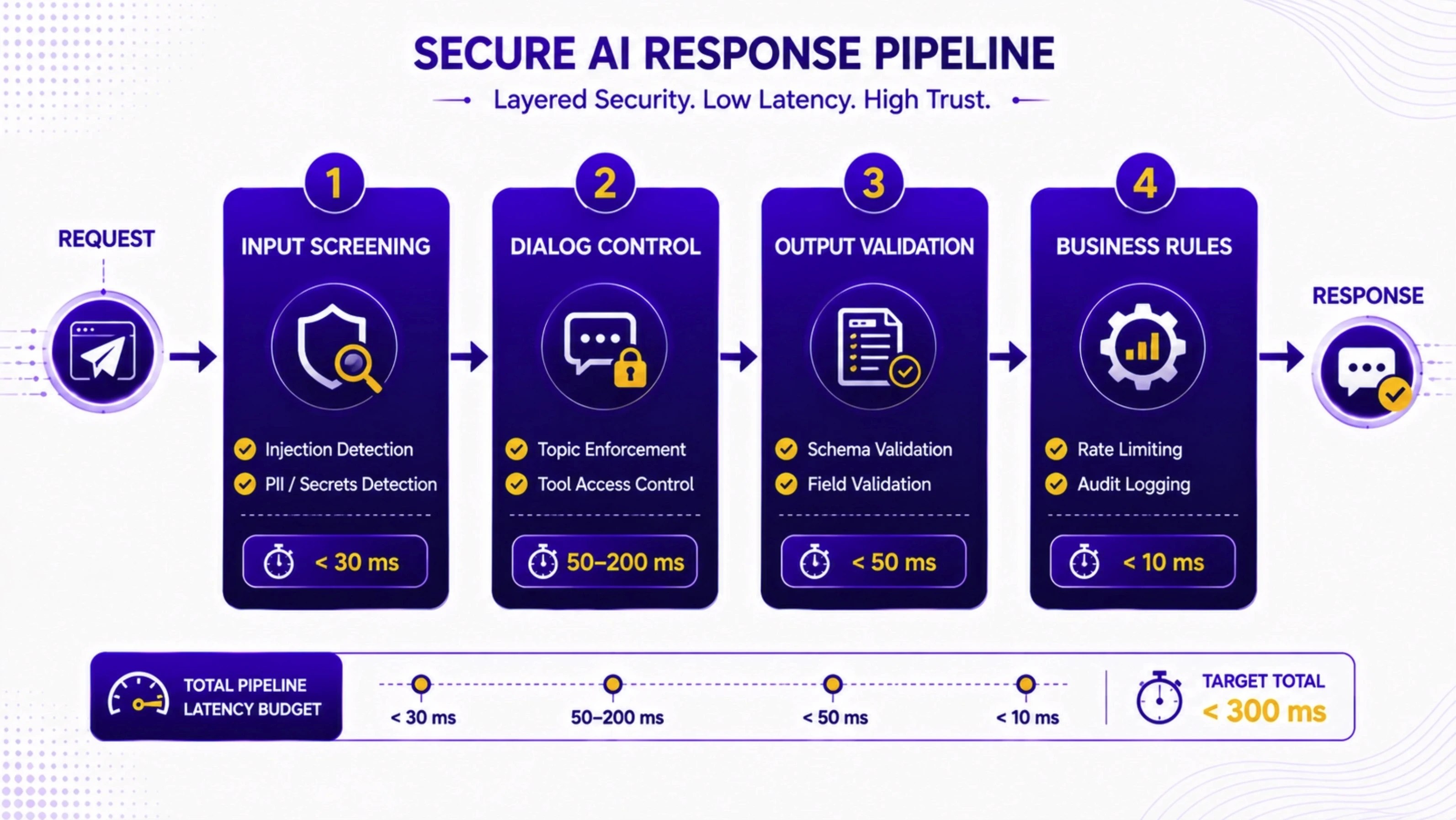
Production systems that hold up under real traffic tend to converge on a similar four-stage pipeline, each stage with its own latency budget so the combined system stays fast enough for interactive use.
Input Screening (Prompt Injection, PII, Toxicity)
This is the first gate a request passes through, typically budgeted under 30 milliseconds. It runs lightweight, fast classifiers and pattern matchers to catch obvious prompt injection attempts, PII present in the input, and toxic or policy-violating content before any of it reaches the model. Speed matters most here because this stage runs on every single request regardless of outcome, so any latency added here is paid by legitimate traffic as much as malicious traffic.
Dialog Control (Topic Restriction, Tool Access)
The second stage, typically budgeted between 50 and 200 milliseconds, governs what the agent is allowed to discuss and which tools it's permitted to invoke in the current context. This is where topic restriction and dynamic tool-access decisions get enforced, often requiring a small classification model or rule engine rather than simple pattern matching, which accounts for the wider latency window.
Output Validation (Schema Enforcement, Field-Level Checks)
After the model generates a response, this stage, typically budgeted under 50 milliseconds, enforces the schema contract defined earlier: does the output parse, do the fields match their declared types, do any field-level constraints hold. This is where a Pydantic or Zod schema check actually executes against the generated output.
Post-Validation Business Rules (Rate Limiting, Audit Logging)
The final stage, typically budgeted under 10 milliseconds, applies business logic that isn't strictly about safety or structure: rate limiting, audit logging, and any organization-specific rules that need to run on every validated response. Because this stage runs after the output has already passed safety and structural checks, it can stay extremely lightweight.
The 10-Layer Defense-in-Depth Model
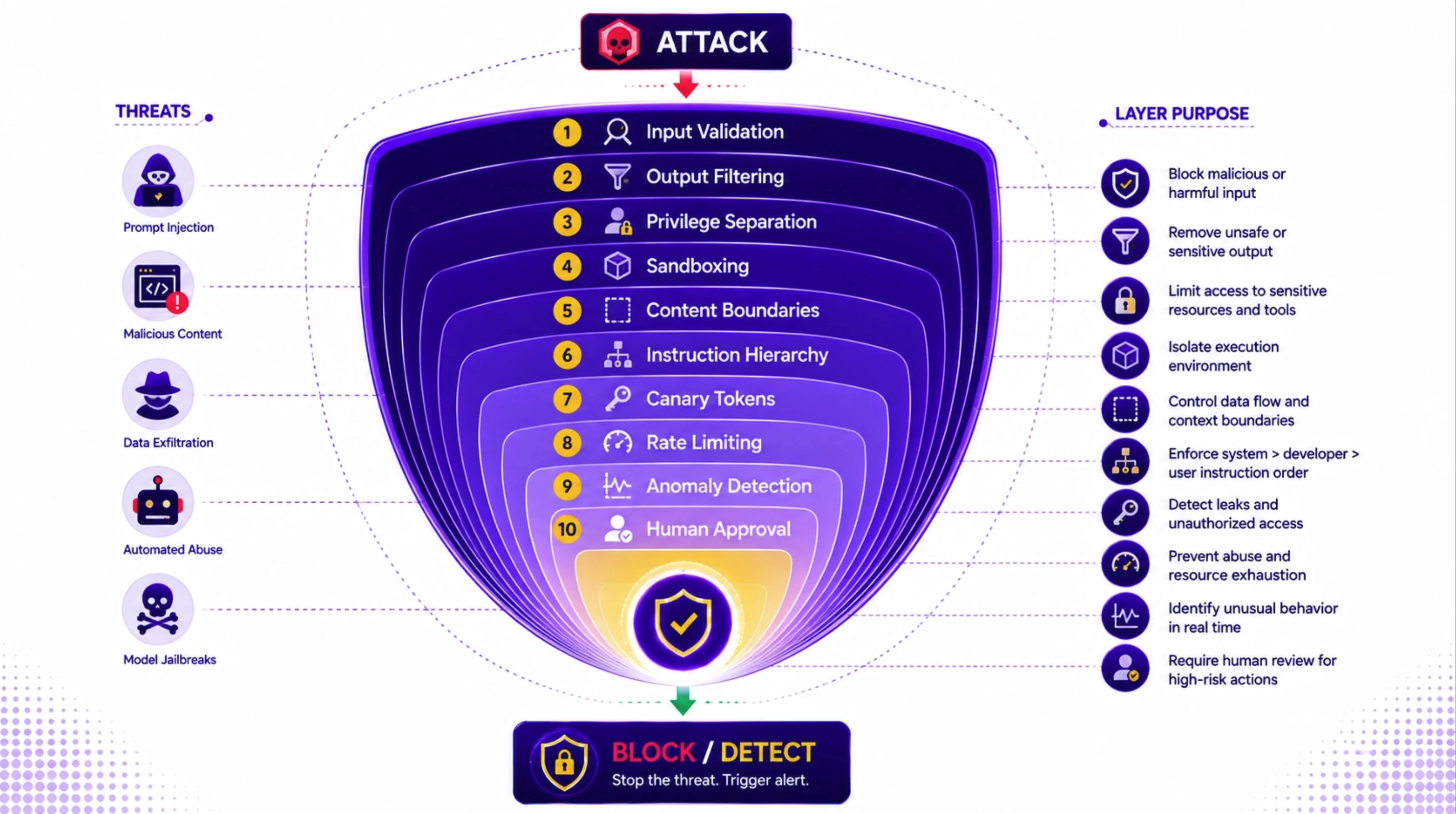
No single layer in the pipeline above catches everything, which is why mature production architectures stack ten complementary defenses rather than relying on any one control. Input validation and sanitization strip or flag suspicious content before it reaches the model. Output filtering catches what still slips through in the response. Privilege separation ensures a compromised prompt can't escalate beyond what its context requires. Sandboxing isolates high-risk tool execution from the broader system. Content boundary markers explicitly delineate trusted instructions from untrusted data within the prompt, making it harder for injected text to masquerade as a system instruction. Instruction hierarchy, enforced at both the model training level and the application level, ensures system messages outrank user messages, which outrank tool and third-party content. Canary tokens, covered below, provide a reliable detection signal for leakage even against novel injection techniques. Rate limiting constrains how much damage any single session can cause. Anomaly detection flags behavior that deviates from an agent's normal operating pattern. Human-in-the-loop approval provides a final checkpoint for any action consequential enough that being wrong outweighs the friction of asking.
No individual layer is sufficient on its own: an attacker who bypasses one layer still has to get through the others, and the layers that catch what earlier ones miss are usually the ones that matter most in a real incident.
Canary Tokens: Detecting Injection You Didn't Anticipate
A canary token is a unique, secret string planted somewhere in the system prompt or another piece of trusted context. If that string ever appears in the agent's output, it's reliable proof that an injection attack extracted content it shouldn't have had access to, and critically, this works even against injection techniques nobody anticipated when the defense was built, since detection doesn't depend on recognizing the attack pattern, only on noticing the leaked marker.
The technique extends further than a single token in the system prompt. Different canaries can be planted in different trusted surfaces, tool descriptions, worked examples, retrieved document chunks, so that when one leaks, the specific marker identifies which surface was actually compromised rather than just confirming something was. This turns a simple yes-or-no leak alarm into a rough map of where the injection succeeded. The technique has real limits: it only catches leakage of the specific marked region, so an injection that manipulates the agent into taking an action without ever touching the canary's content slips past undetected, which is exactly why canary tokens function as one layer in the defense-in-depth model above rather than a standalone solution.
Direct vs. Indirect Prompt Injection
Direct prompt injection arrives through the user-facing input field: someone types an instruction intended to override the system prompt directly. It's the more visible variant, and most instruction-hierarchy training and input screening is built primarily around catching it.
Indirect prompt injection is structurally different and, in production systems, often more dangerous. The malicious instruction doesn't come from the user; it arrives embedded in a document, webpage, email, or any other content the agent processes as a normal part of its task. The agent has no reason to treat that content with suspicion, since from its perspective it's just doing what it was asked: reading a file, summarizing a page, processing an attachment. That trust is exactly what makes indirect injection effective, and it's a large part of why treating all agent-consumed content as untrusted, regardless of its apparent source, has become a standard architectural principle rather than an edge-case recommendation.
Case Study: The Gemini CLI CVSS-10 Supply Chain Injection (May 2026)
Security researchers at Pillar Security disclosed a maximum-severity, CVSS 10 vulnerability, dubbed TrustIssues, in Google's Gemini CLI and its companion run-gemini-cli GitHub Action. The vulnerability chained two failures together: Google had deployed a Gemini-powered agent to automatically triage incoming public GitHub issues on its repositories, and that agent's --yolo auto-approve mode ignored its own tool allowlist. An attacker needed nothing more than the ability to open a public GitHub issue. By hiding instructions in the issue text, an attacker could trigger indirect prompt injection against the triage agent, which, operating under the broken allowlist, would execute arbitrary shell commands. From there, the agent could extract build-environment secrets, including GitHub tokens, and exfiltrate them to an attacker-controlled server, ultimately enabling arbitrary code to be pushed to the main branch of a repository with over 100,000 stars.
Pillar reported the underlying pattern on April 16, 2026, demonstrated a full proof-of-concept compromise on April 20, and Google published its advisory and shipped patches by April 24, fixing the issue in Gemini CLI 0.39.1. At least eight other Google repositories were found running the same vulnerable workflow template. The researchers' central recommendation reframes how teams should think about injection risk generally: treat prompt injection as a privilege problem, and design around what a compromised credential can do rather than assuming the injection itself can be fully prevented.
The Streaming Output Problem
Every validation pattern described so far assumes a "generate, then validate, then release" model: the full response exists before anything gets checked. Streaming responses break that assumption entirely. When an agent streams output token by token, content is already reaching the user before generation, let alone validation, has finished.
This creates a genuine architectural tension rather than a simple engineering fix. Buffering the full response before releasing anything defeats the purpose of streaming and reintroduces the latency it was meant to eliminate. Validating and releasing in small chunks reduces that cost but means a violation caught partway through has already partially reached the user, and retracting a partially delivered response is a much harder problem than blocking one before it starts. Production systems handling this well typically run lightweight checks on each chunk as it streams while reserving expensive validation, like full schema compliance, for after the stream completes, accepting that some violations can only be caught after partial exposure rather than prevented entirely.
What OpenAI's April 2026 Defense Guide Recommends
OpenAI published an official prompt injection defense guide in April 2026, and its central admission is notable on its own: no model-level solution fully prevents injection, and application-layer defenses are required for production deployments regardless of how well-trained the underlying model is. The guide's core recommendations align closely with the patterns covered above. Instruction hierarchy should place system instructions above user messages, which in turn outrank tool and third-party content, with the model never permitted to override system-level constraints based on lower-tier input. Tool access should follow least privilege strictly, scoped to the minimum a given agent's task actually requires, so a research agent has no file-write access and a coding agent has no unnecessary network access. Defense-in-depth is treated as non-negotiable: no single control is sufficient, and the layers need to be genuinely independent so bypassing one doesn't compromise the rest of the stack.
Instrumenting and Gating on Validation Metrics
A validation pipeline that isn't instrumented is a pipeline nobody can trust. Three metrics matter most in production. Validation pass rate tracks what fraction of responses clear the schema and policy checks on the first attempt, and a declining pass rate over time is often the earliest signal that a model update, a prompt change, or a shift in real-world input has broken something upstream. Retry rate tracks how often the automatic retry loop gets triggered, and a spike here, even without an outright failure, signals a schema or prompt that's become a poor fit for actual usage. Per-failure-mode breakdown, meaning categorizing exactly which field or check is failing rather than just tracking an aggregate pass rate, is what lets a team fix the right thing instead of guessing.
These metrics are most useful when they gate CI directly rather than living only in a dashboard. A pull request that drops validation pass rate below an agreed threshold in staging traffic should fail the same way a broken unit test would, catching a regression before it reaches production rather than after a spike in support tickets reveals it.
How Akto Implements Input Validation and Output Filtering at Runtime
Akto's AI Agent Gateway enforces this layered model directly in production traffic, running as a sidecar alongside agent infrastructure so enforcement adds effectively no network latency. Request Guardrails handle the input screening and dialog control layers, scanning and blocking malicious or policy-violating requests before they reach the agent. Response Guardrails handle output validation and filtering, including automatic redaction of sensitive data, before a response is delivered to the end user. For teams that need this enforcement extended to where employees directly interact with AI agents and tools, Akto Atlas applies the same guardrail model at the endpoint, evaluated locally on each device. Full configuration details for both, including how to define custom validation policies, are covered in the Akto product documentation.
FAQs: AI Agent Input Validation and Output Filtering
What's the difference between guardrails and validation for AI agent outputs?
Guardrails determine whether content is allowed, catching policy violations like leaked PII or disallowed topics. Validation determines whether content is well-formed, catching structural problems like malformed JSON. A response can fail one while passing the other, which is why production systems need both running independently rather than treating them as a single check.
What frameworks are used for schema-based LLM output validation?
In Python, Instructor and Pydantic AI both wrap LLM calls with Pydantic-based validation and automatic retries, while Outlines takes a different approach, constraining token generation itself to guarantee schema compliance without needing retries. TypeScript projects commonly use Zod, and JSON Schema serves as a provider-agnostic contract format across languages.
What does a layered input/output validation pipeline actually look like, with latency budgets?
A typical production pipeline runs four stages: input screening for injection, PII, and toxicity under roughly 30 milliseconds, dialog control governing topic and tool access between 50 and 200 milliseconds, output validation enforcing schema compliance under 50 milliseconds, and post-validation business rules like rate limiting and audit logging under 10 milliseconds.
What is the 10-layer defense-in-depth model for AI agent security?
It combines input validation, output filtering, privilege separation, sandboxing, content boundary markers, instruction hierarchy, canary tokens, rate limiting, anomaly detection, and human-in-the-loop approval for high-risk actions. No single layer is sufficient alone; the model works because an attacker who bypasses one layer still has to get through the rest.
What are canary tokens, and how do they detect prompt injection?
Canary tokens are unique secret strings planted in the system prompt or other trusted context. If a token appears in the agent's output, it's reliable proof of a successful leak, and this detection works even against novel injection techniques since it doesn't depend on recognizing a specific attack pattern, only on noticing the marker.
What's the difference between direct and indirect prompt injection?
Direct injection arrives through user input, where someone types an instruction intended to override the system prompt. Indirect injection arrives embedded in content the agent processes as part of its task, such as a document or webpage, and is often more dangerous because the agent has no inherent reason to treat that content as suspicious.
What happened in the Gemini CLI CVSS-10 vulnerability disclosed in May 2026?
Pillar Security found that Google's Gemini CLI issue-triage agent, running in a mode that ignored its own tool allowlist, could be manipulated through indirect prompt injection hidden in a public GitHub issue. This let an attacker extract build-environment secrets and push arbitrary code to the repository's main branch. Google patched the vulnerability in Gemini CLI 0.39.1 after Pillar's disclosure.
Why is validating streaming AI agent output harder than validating a complete response?
Streaming sends content to the user token by token, before the full response exists to validate. Waiting for the complete response before releasing anything defeats the purpose of streaming, while validating in small chunks means a violation caught partway through has already partially reached the user, making correction much harder than simply blocking a response before it starts.
What does OpenAI's official 2026 defense guide recommend for input/output filtering?
It recommends strict instruction hierarchy with system instructions outranking user and tool content, least-privilege tool access scoped to each agent's actual task, and genuine defense-in-depth with independent layers, explicitly stating that no model-level solution alone prevents prompt injection in production.
What metrics should teams track to know if their validation layer is actually working?
Validation pass rate, retry rate, and a per-failure-mode breakdown of exactly which checks are failing. These are most valuable when wired into CI so a regression in staging blocks a deployment automatically, rather than only surfacing after a failure reaches production.
How does Akto implement input validation and output filtering at runtime?
Akto's AI Agent Gateway runs as a sidecar enforcing Request Guardrails for input screening and Response Guardrails for output validation and redaction, while Akto Atlas extends the same model to employee endpoints with local evaluation. Full implementation details are available in Akto's product documentation.

Experience enterprise-grade Agentic Security solution