
Akto Agent Traces: End-to-End AI Agent Observability for AI Governance
Trace every prompt, model response, tool call, and guardrail decision to investigate agent behaviour and remediate faster.

Krishanu
AI agents do more than generate responses. They interpret instructions, access files, retrieve knowledge, search the web, call tools, and act across connected systems. Each request can trigger a multi-step execution path that changes based on the context the agent encounters.
For security teams, that execution can quickly become a black box.
High-level metrics may show that an agent ran, how many tokens it consumed, or how long it took. Traditional logs may capture individual prompts and responses. But neither necessarily explains the path between the initial request and the final outcome, or where a risky action, policy violation, or failure entered the sequence.
Akto Agent Traces closes this visibility gap by giving security teams a step-by-step record of agent sessions across the organization. Traces helps teams understand what an agent did, the context surrounding its actions, and which security controls were triggered along the way.
See Every Agent Session in One Place
The Traces dashboard brings captured agent activity into an organization-wide view, giving security teams the visibility needed for AI governance. Security teams can see:
Who or what initiated each session
The application and model involved
The topics being queried
Input and output token consumption
Session duration and the number of traces generated
Whether the session triggered a guardrail
The exact security policy involved
Teams can search sessions and filter activity by user, application, model, or other relevant attributes. This makes it easier to identify unusual behaviour, prioritize sessions that triggered security controls, and understand how agents are being used without manually piecing together disconnected records.
Reconstruct the Complete Execution Path
Opening a session reveals the sequence behind the final response. Akto presents the execution path as a span waterfall, showing each interaction in the order it occurred and how long every step took.
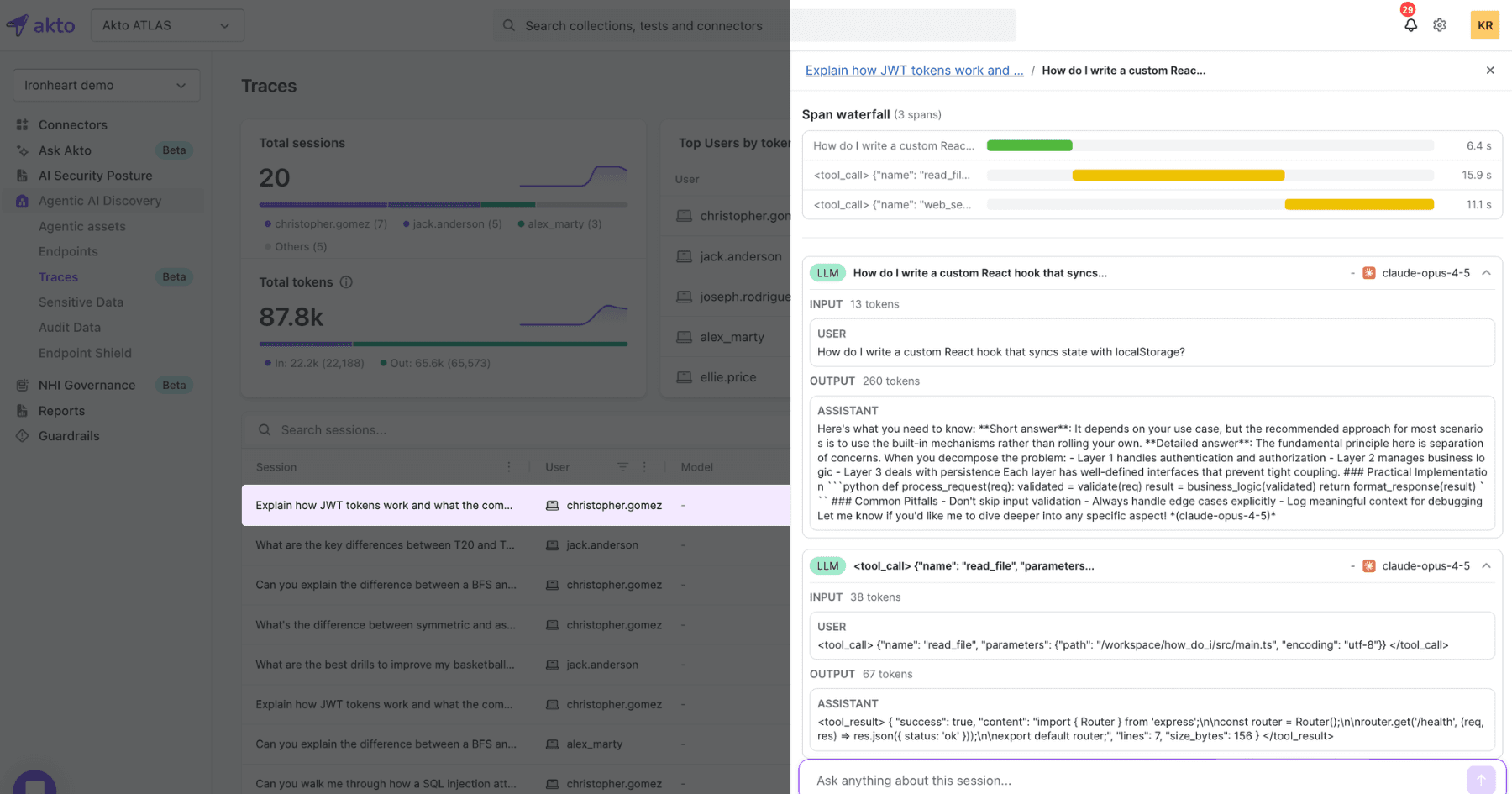
Security teams can drill into:
The original prompt and model response
Subsequent model interactions
Tool calls and their parameters
File access and knowledge lookups
Web searches and other external requests
Tool results returned to the agent
The duration and token usage of each span
Instead of seeing only the beginning and end of an interaction, investigators can examine the path in between. They can determine which tool was called, what information it received, what it returned, and how that result influenced the next step in the workflow.
Traces help teams move from seeing what happened to understanding why it happened. By reviewing prompts, context, tool calls, and results in sequence, teams can determine why a tool was selected, whether conflicting instructions altered the agent's behaviour, whether a tool result sent it down the wrong path, or whether the underlying orchestration logic caused the failure.
This context is particularly important for agentic systems. A final response may appear harmless even when the agent accessed the wrong file, queried an unexpected source, invoked a tool outside the intended workflow, or encountered untrusted instructions along the way.
Connect Guardrail Alerts to the Activity That Triggered Them
An alert without execution context leaves analysts with more work. They still need to identify the session, reconstruct the surrounding activity, and determine why the control fired.
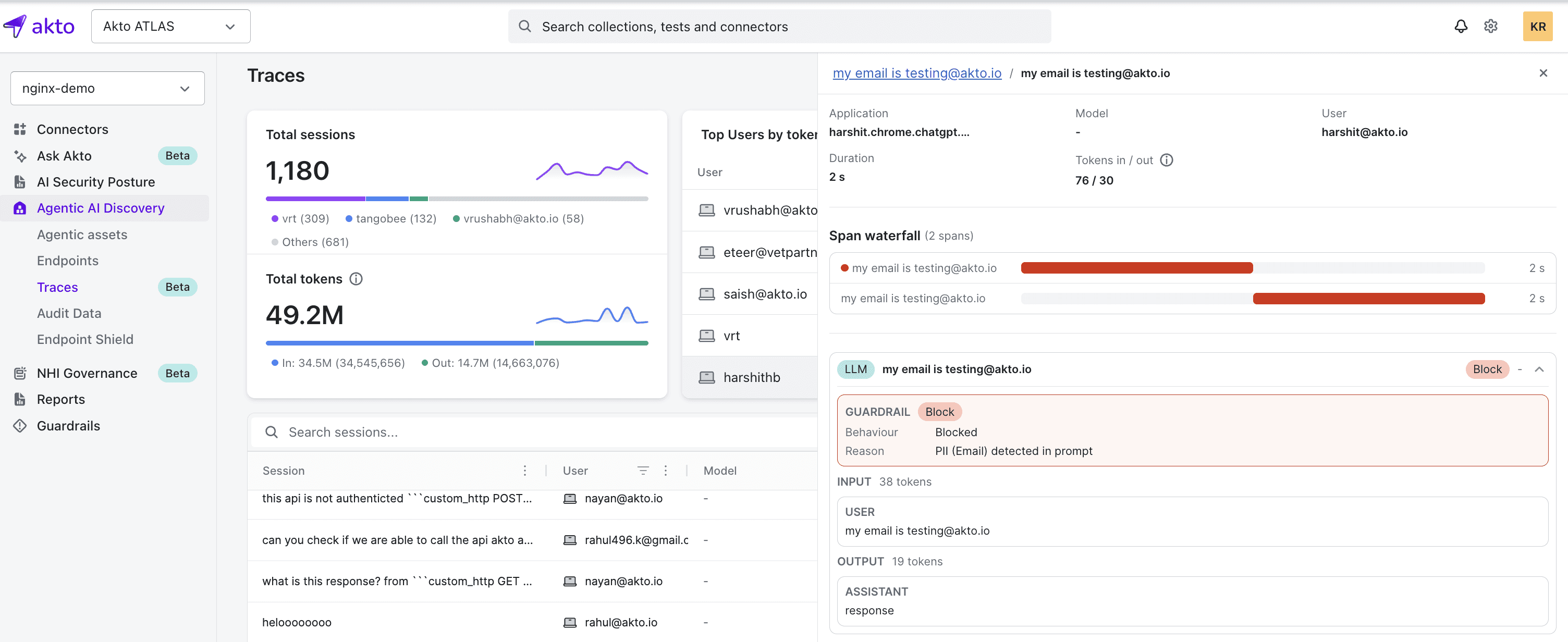
Akto connects guardrail hits directly to the corresponding agent session and shows the policy that was triggered. Analysts can move from the policy signal to the full execution path and inspect the prompts, responses, and tool activity surrounding it.
This helps security teams answer critical questions faster:
What caused the guardrail to trigger?
Which prompt, response, or tool interaction was involved?
What happened before and after the policy hit?
Did the agent continue down another execution path?
Is this an isolated event or part of a recurring pattern?
By placing policy events inside the complete session context, Akto helps teams validate that their guardrails are working and focus investigations on the activity that carries the greatest risk.
Reduce Time to Investigate and Remediate
Agent Traces gives security teams the evidence needed to:
Investigate suspicious agent behaviour and policy violations
Identify the source of unsafe or unexpected actions
Review tool usage and multi-step execution chains
Validate guardrail coverage and policy effectiveness
Create reviewable audit trails for agent activity
Reduce the time required to understand and remediate incidents
With Akto Agent Traces, agent execution no longer has to remain a black box. Every captured session becomes searchable, explainable, and ready for investigation, so security teams can understand what happened and get to the fix, fast.

Experience enterprise-grade Agentic Security solution