How to Validate AI Agent Guardrails in Production
Learn how to validate AI agent guardrails in production with practical tests for prompt injection, tool misuse, data leakage, policy enforcement, and runtime behavior.

Arpashree

If you need the basics on what guardrails are and how to build them, our guardrails guide and guardrails Q&A cover that ground. This page has a narrower job: proving that the guardrails you've already deployed actually hold up continuously under real, evolving conditions, not just on the day you configured them.
Why "Deployed" Doesn't Mean "Validated"
A guardrail that's been configured and a guardrail that's been proven to work are two different claims, and the gap between them is where most production incidents actually happen. Configuring a guardrail means writing the rule: block this pattern, require approval for that action, cap an agent's access to a specific tool. Validating it means confirming that rule actually fires, every time, against the full range of ways a real attacker or a genuinely confused agent might trigger it, and that it keeps firing after the model behind the agent gets updated, after a new tool gets connected, or after six months of production traffic no one specifically designed the rule against.
Teams routinely treat a guardrail's launch-day test as sufficient evidence it works indefinitely. It isn't. A prompt injection filter tuned against last quarter's attack patterns has no guarantee of catching a new phrasing an attacker discovers next week. A tool-call restriction that worked cleanly against a model's old behavior can silently stop firing the moment that model gets updated and starts reasoning about the same instruction differently. The guardrail's configuration hasn't changed in either case. What it actually catches has. Validated, in the sense that matters for production, means an organization has current, specific evidence a guardrail still does its job, not a memory of the day someone confirmed it once.
This distinction sounds obvious stated plainly, and yet it's rarely how teams actually operate. A security review checks whether a guardrail exists and whether its configuration looks reasonable on paper. It rarely asks when that guardrail was last tested against a live, adversarial scenario, or whether anyone has confirmed it still catches what it was built to catch after the three product changes that shipped since. The honest answer, in most organizations, is that nobody knows, which is a genuinely uncomfortable position to be in for a control everyone assumes is doing its job.
Scenario-Based Validation Testing
Validating a guardrail means testing it against scenarios that resemble how the guardrail will actually be challenged in production, not synthetic, single-turn prompts designed to make the guardrail look good.
Designing Realistic Multi-Step Test Scenarios
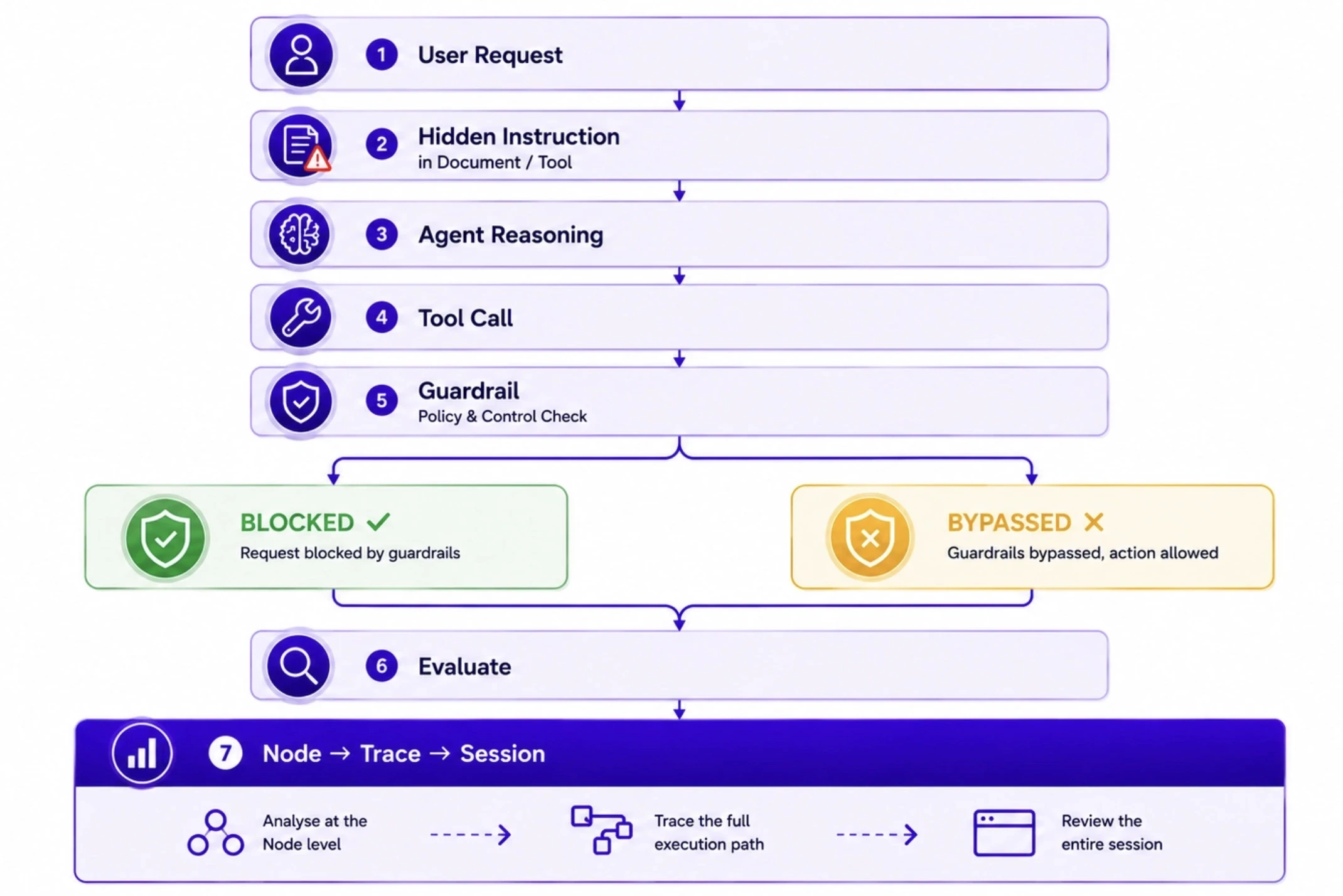
A single adversarial prompt tests whether a guardrail can be tricked in one shot. Real agent compromises rarely work that way. A realistic test scenario chains several steps together the way an actual attack or a genuine agent failure would: an initial, innocuous-looking request, a document or tool response containing a hidden instruction, and a subsequent action that the guardrail either catches or misses. Testing only single-turn prompts against a multi-step agent means validating a fraction of how that agent actually gets exploited, since a guardrail that catches an obvious single-shot injection can still miss the same manipulation smuggled in gradually across a longer interaction.
Good scenario design also varies the entry point. A guardrail meant to catch a malicious tool call needs to be tested from every plausible path that could reach that call: a direct user request, an instruction embedded in a retrieved document, a manipulated response from another tool the agent trusts, since a guardrail validated against only the most obvious path can still leave the others completely open. It's worth being deliberate about scenario coverage too, mapping which categories of risk, data exfiltration, unauthorized transactions, privilege escalation, actually have a corresponding test scenario and which are simply assumed to be covered because a related scenario exists nearby. That gap between assumed and actually tested coverage is where a surprising number of guardrail failures originate, not from a rule that was configured wrong, but from a rule that was never tested against the specific path an attacker eventually found.
Session, Trace, and Node-Level Evaluation
Effective validation looks at an agent's behavior at three different resolutions, and each one catches something the others miss. Node-level evaluation checks a single decision point: did the agent correctly refuse this one tool call, did this one output pass the content filter it should have. Trace-level evaluation looks at the full sequence of decisions within one agent run, since a guardrail can pass every individual node check and still let the overall trace drift toward an outcome nobody intended, each step technically defensible on its own while the pattern across them isn't. Session-level evaluation extends that further across multiple turns or even multiple related agent runs, catching the kind of gradual manipulation that only becomes visible when you look at behavior over time rather than at any single moment.
A validation program that only checks node-level pass/fail is the equivalent of reviewing individual lines of code and never running the program; it misses exactly the failures that only show up in how the pieces work together. In practice, this means a validation suite needs separate scoring for each resolution rather than a single pass/fail verdict per test, since a scenario can pass at the node level, where each individual action looked defensible, while failing at the trace level, where the sequence as a whole clearly drifted somewhere it shouldn't have. Reporting only the aggregate result hides exactly the information a team needs to fix the actual gap.
The Red-Team-to-Guardrail Feedback Loop
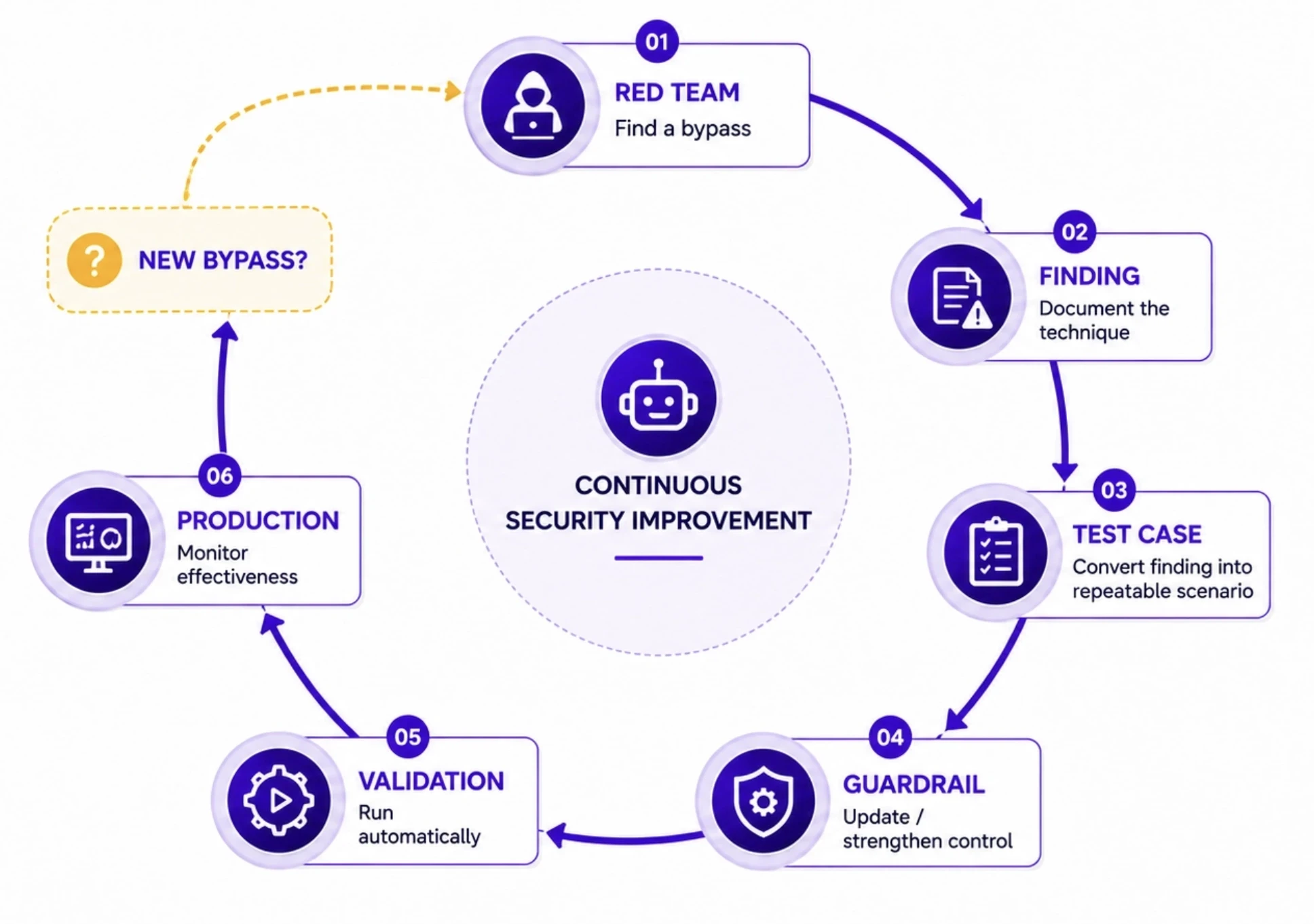
A red team finding that stays a report is a finding that gets rediscovered by an attacker before it gets rediscovered by your own team. The loop that actually closes this gap works in one direction only: every technique a red team successfully uses to bypass a guardrail becomes a permanent, automated test case added to that guardrail's ongoing validation suite, not a bullet point in a quarterly summary someone reads once and files away.
This matters because red teaming and validation solve different problems, but only when they're connected does either one compound in value. Red teaming discovers what's currently exploitable. Validation confirms a fix actually closes that specific hole and keeps it closed as everything else around the guardrail keeps changing. Without the feedback loop, a red team can find the same class of bypass six months apart because nothing from the first finding ever became a standing test. With it, every red team engagement makes the validation suite measurably more thorough than it was before, and a technique that worked once against an unguarded agent should never work again against the same one.
The mechanics of this loop matter as much as the principle. A finding needs to be translated into a specific, repeatable test scenario, not left as a narrative description in a report, since a scenario that isn't automated doesn't actually get re-run and therefore doesn't actually close the loop. It also needs an owner: someone accountable for confirming the corresponding guardrail rule was updated, that the new test case was added to the suite, and that the fix was verified to hold before the finding gets marked closed. Without that ownership, findings tend to get acknowledged, partially addressed, and then quietly dropped once attention moves to the next engagement.
There's a compounding effect worth naming directly. A validation suite that's been fed by a year of red team engagements is qualitatively different from one built from a single pre-launch assessment, not because any individual test case is more sophisticated, but because the collection as a whole reflects a much wider range of real attack techniques than any single team could have anticipated up front. That accumulated coverage is arguably the most valuable asset the feedback loop produces, more valuable than any individual finding, since it's what keeps a guardrail's effectiveness from resetting to zero every time institutional memory of a past incident fades.
Metrics That Actually Prove a Guardrail Is Working
A guardrail's own dashboard telling you it blocked some number of events last week isn't evidence it's doing its job well. Three specific metrics are what actually prove it.
False Positive / False Negative Rates
A false positive, a guardrail blocking legitimate agent behavior, has a real cost even when it never shows up as a security incident: it erodes trust in the guardrail itself, and teams facing constant false alarms eventually start working around the control rather than through it. A false negative, a guardrail failing to catch something it should have, is the more dangerous failure and the harder one to measure, since by definition it doesn't generate an alert telling you it happened. Measuring both rates requires a labeled test set of known-good and known-bad scenarios run against the guardrail on a recurring basis, not just watching production traffic and assuming silence means success.
Time-to-Block and Detection Latency
A guardrail that eventually catches a violation after the damage is already done isn't functioning the way a real-time control needs to. Time-to-block measures how quickly a guardrail actually intervenes once a violation begins, and detection latency measures the gap between an event occurring and the guardrail recognizing it at all. For an agent that can execute an irreversible action, a wire transfer, a data deletion, a message sent externally, in a single step, a guardrail with high detection accuracy but slow time-to-block can still fail to prevent the outcome it exists to stop. Validating these two numbers matters as much as validating whether the guardrail catches the violation at all.
Drift Detection: When a Previously Valid Guardrail Stops Holding
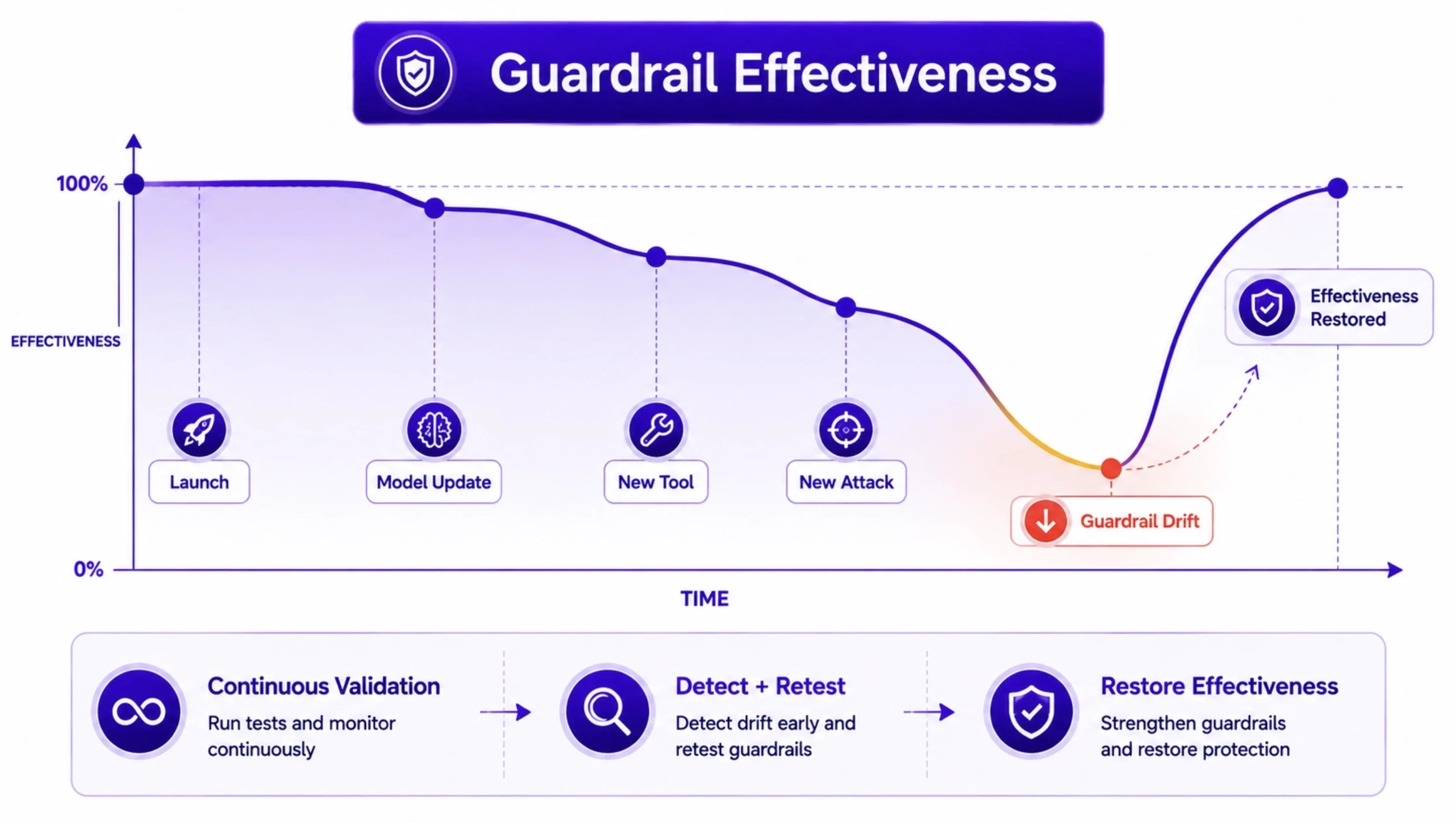
A guardrail that passed every test on launch day can quietly stop working without anyone changing its configuration. Drift detection is what catches this: comparing a guardrail's current effectiveness against its own historical baseline, not just checking whether it currently passes a fixed test suite. Three things reliably cause drift. A model update behind the agent can change how it responds to the same instruction the guardrail was tuned against. A new tool integration can open a path to the same restricted action that the original guardrail rule never accounted for. And a new attack technique, discovered anywhere in the wild rather than against this specific agent, can bypass a guardrail that was never tested against it because it didn't exist yet when the guardrail was built. None of these show up as a configuration change in the guardrail itself, which is exactly why drift has to be actively monitored rather than assumed away because nothing was touched.
Continuous Validation Cadence
A one-time launch check answers a single question: did this guardrail work on the day it was tested. It says nothing about whether it still works today. Continuous validation replaces that single checkpoint with an ongoing cycle, running the same scenario-based tests on a recurring schedule rather than once before deployment and never again.
That cadence also needs to be event-triggered, not just calendar-based. A model update behind an agent should trigger immediate re-validation of every guardrail depending on that model's behavior, since the guardrail's configuration didn't change but the thing it's governing did. A new tool integration should trigger validation of every guardrail that could plausibly be reached through that new tool, since a permission boundary that held cleanly before a new connection was added can't be assumed to hold after. And a newly disclosed attack technique, whether it was found against this specific agent or reported anywhere in the broader threat landscape, should trigger a check of whether existing guardrails would actually catch it. A validation program running only on a fixed calendar will always be behind the fastest-moving of these three triggers, which, in most production environments, is model updates on a vendor's release schedule rather than the organization's own testing calendar.
How This Differs from Red Teaming
Red teaming and guardrail validation get used interchangeably often enough that the distinction is worth stating plainly, with more detail available in our probe library and red teaming Q&A. Red teaming answers "what's exploitable": it's an adversarial search for weaknesses, actively trying new techniques an agent or its guardrails haven't been tested against before, with the goal of finding something nobody knew was broken. Validation answers a different question: "does this specific, known guardrail catch this specific, known scenario every single time." It's not adversarial in the same sense; it's confirmatory, running a defined set of test cases repeatedly to confirm a control that's supposed to work still does.
The two need each other to be useful. Red teaming without validation finds problems that get fixed once and never checked again, drifting back open the moment something upstream changes. Validation without red teaming only ever tests against scenarios someone already thought of, which means it can report a clean bill of health right up until an attacker finds the technique nobody tested for. Run together, in the feedback loop described above, they cover both what's currently unknown and what's supposed to already be handled.
How Akto Validates Guardrails Continuously in Production
Akto runs scenario-based validation against deployed guardrails on a continuous basis, testing multi-step scenarios at the node, trace, and session level rather than single-turn prompts in isolation. Every finding from Akto's red teaming feeds automatically into that ongoing validation suite, so a technique that successfully bypassed a guardrail once becomes a permanent test case rather than a report that goes stale. Validation runs are triggered both on a recurring schedule and by the specific events that cause drift, a model update, a new tool connection, a newly disclosed attack technique, and results are tracked against false positive and false negative rates, time-to-block, and detection latency, so a team can see not just whether a guardrail currently passes, but whether its effectiveness is holding steady or eroding over time.
FAQs: Validate AI Agent Guardrails Production
1. What does it mean to "validate" a guardrail, as opposed to just deploying one?
Deploying a guardrail means configuring the rule. Validating it means confirming, with current evidence, that the rule actually fires against the full range of ways it could be triggered, and continues to fire after the model, tools, or attack landscape around it changes.
2. What is scenario-based validation testing for AI agent guardrails?
It's testing a guardrail against realistic, often multi-step scenarios that resemble how it will actually be challenged in production, rather than single-turn synthetic prompts, and evaluating that behavior at the node, trace, and session level rather than checking only individual decision points in isolation.
3. What metrics indicate whether a guardrail is actually working in production?
False positive and false negative rates measured against a labeled test set; time-to-block and detection latency, indicating how quickly the guardrail actually intervenes; and drift detection, comparing current effectiveness against the guardrail's historical baseline.
4. How is guardrail validation different from red teaming?
Red teaming is adversarial: it searches for what's currently exploitable, including techniques nobody has tested for yet. Validation is confirmatory: it repeatedly tests a defined set of known scenarios to confirm a specific guardrail still catches them every time.
5. What causes a previously effective guardrail to stop working (drift)?
Three common causes: a model update changing how the agent responds to the same instruction the guardrail was tuned against, a new tool integration opening an unaccounted-for path to a restricted action, and a newly discovered attack technique the guardrail was never tested against because it didn't exist when the guardrail was built.
6. How often should guardrails be re-validated after initial deployment?
On a recurring schedule, plus immediately whenever a specific trigger occurs: a model update behind the agent, a new tool or integration connected to it, or a newly disclosed attack technique relevant to how the agent operates.
7. What is the feedback loop between red team findings and guardrail rules?
Every technique a red team successfully uses to bypass a guardrail should become a permanent, automated test case in that guardrail's ongoing validation suite, rather than a one-time finding in a report, so the same bypass can never succeed again unnoticed.
8. How does Akto continuously validate guardrail effectiveness in production?
Akto runs scenario-based, multi-level validation on a recurring and event-triggered basis, automatically converts red team findings into standing test cases, and tracks false-positive/negative rates, time-to-block, and drift against a historical baseline, so guardrail effectiveness is measured continuously rather than assumed.

Experience enterprise-grade Agentic Security solution