AI Agent Security for Regulated Industries
How AI agent security requirements differ across healthcare, finance, insurance, and government - and why compliance constraints define implementation, not prohibition.

Arpashree

Gartner's Q1 2026 survey found 80% of enterprises now have at least one production application embedding an AI agent, up from just 33% in 2024, a faster adoption curve than almost any enterprise software category on record. This guide covers AI agent security regulated industries teams actually need to build against, spanning healthcare, finance, insurance, and government. The core framing for regulated industries, specifically, is that compliance obligations define how an AI agent must be implemented, not whether it can be used at all. Healthcare, finance, insurance, and government all have existing regulatory frameworks that already apply to AI agents, whether or not those frameworks were written with agents in mind, and treating "we're regulated" as a reason to avoid agents entirely misreads what the actual constraint is. Getting AI agent compliance healthcare finance teams need right from the start is a matter of mapping existing obligations onto a new kind of system, not inventing a compliance program from nothing.
Why Regulated Industries Need a Different AI Agent Security Model
Generic AI security advice assumes a relatively permissive environment. Regulated industries don't have that luxury, and regulated-industry AI governance has to reflect it from the start, with AI agent security, healthcare, finance, and government teams building controls tighter than a general-purpose enterprise deployment would ever need.
Compliance Obligations Don't Change Because the Accessor Is a Machine
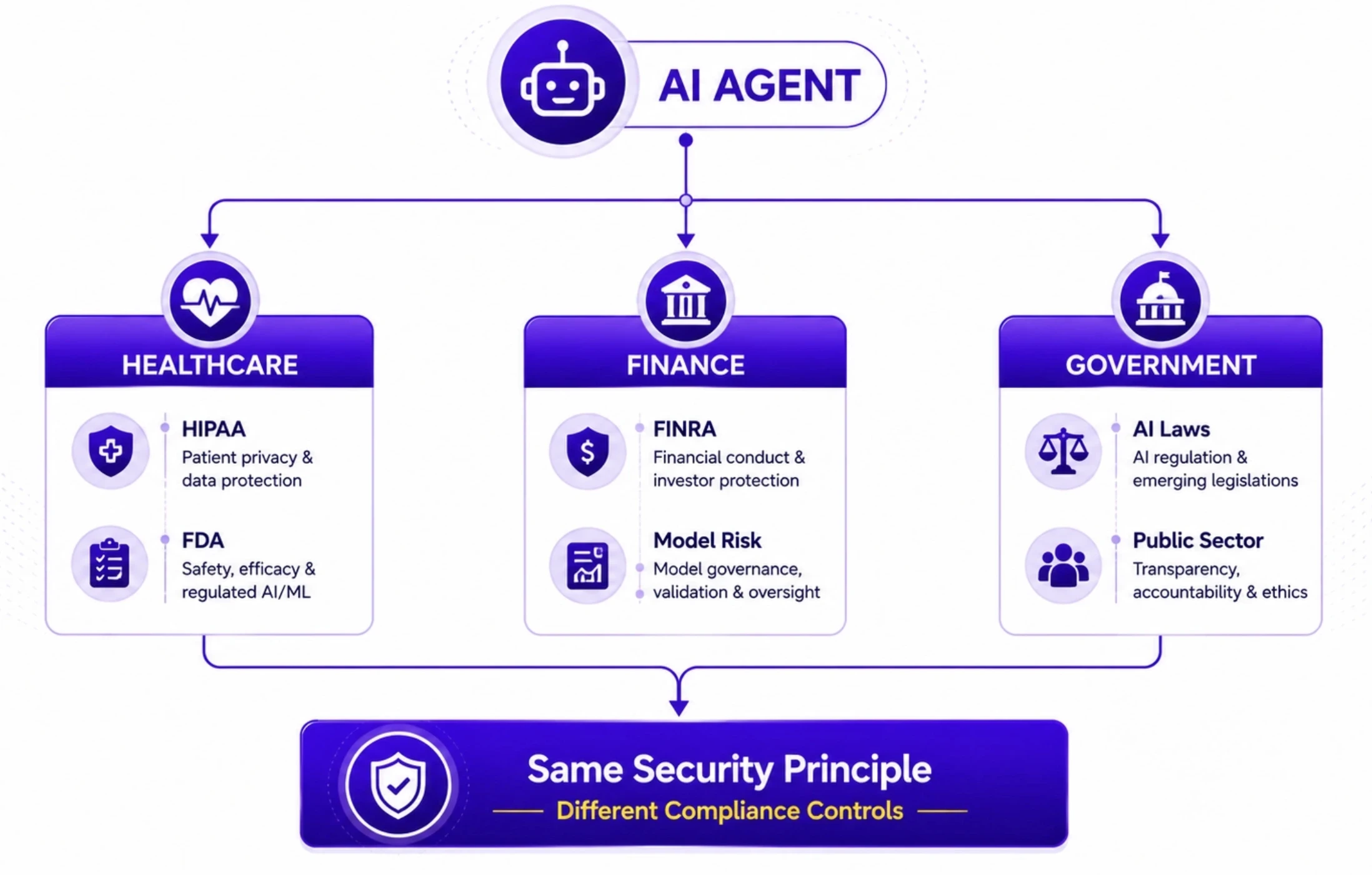
An AI agent reading a patient record, pulling a customer's account history, or drafting a legal document is subject to the exact same underlying obligations a human employee performing that task would be. HIPAA Security Rule AI agents provisions don't have a carve-out for automated access. FINRA's rules on communications with the public don't stop applying because a chatbot drafted the message instead of a registered representative. The specific technical controls needed to satisfy those obligations look different for a non-deterministic, tool-calling agent than for a human employee following a written procedure, but the underlying obligation itself is identical.
The Adoption-Outpacing-Oversight Gap
The gap between how fast agents are being deployed and how ready organizations are to govern them is stark. In Gartner's 2025 survey of IT application leaders, 74% viewed AI agents as a new attack vector, yet only 13% strongly agreed their organization had the governance structures needed to manage them effectively. That gap is worse, not better, in regulated sectors specifically, since sectoral deployment data shows banking and insurance leading production adoption at 47% while healthcare and government trail at 18% and 14% respectively, precisely the sectors where a governance failure carries the steepest regulatory consequence.
What's Common Across Regulated Sectors
Before splitting into sector-specific requirements, a handful of risks and controls show up identically across healthcare, finance, insurance, legal, and government deployments.
Hallucination as a Compliance Risk, Not Just an Accuracy Problem
In a regulated context, hallucination as compliance risk is the more accurate framing than treating it as a quality issue that just makes an agent look unreliable. An agent that fabricates a citation to a regulation, invents a clinical detail, or generates a policy term that doesn't exist has produced output that can trigger a reporting obligation, a disclosure requirement, or outright liability, independent of whether anyone acted on the fabricated content. Treating hallucination purely as an accuracy metric to improve over time understates what it actually represents in a regulated workflow: a compliance risk event that needs its own detection and escalation path, not just a lower target error rate.
Retrieval-Based Architectures with Validation Layers
The most effective retrieval-based validation architecture for reducing hallucination-as-compliance-risk grounds an agent's output in retrieval against verified source data rather than relying on a model's parametric knowledge alone, paired with a validation layer that checks a generated response against its retrieved sources before that response reaches a customer, patient, or regulator. This doesn't eliminate hallucination risk entirely, but it converts an ungrounded, unverifiable claim into one that can be traced back to a specific document or record, which is exactly the kind of traceability regulated industries need to defend a decision after the fact.
Auditability, Access Control, and Immutable Logging as Baseline Requirements
Across every regulated sector, three controls show up as a baseline rather than a differentiator: an immutable audit trail detailed enough to reconstruct a specific regulated data access event after the fact, access control scoped to what a given agent's task actually requires rather than broad standing permissions, and logging that can't be altered after the fact, since a log an insider could edit doesn't satisfy the evidentiary bar most regulators and auditors expect.
Healthcare and Life Sciences
Healthcare carries some of the most specific, most rapidly evolving requirements of any regulated sector right now, and getting HIPAA AI agents obligations and FDA Software as a Medical Device classification right is the core of that work.
HIPAA's Extension to AI Agents Touching ePHI
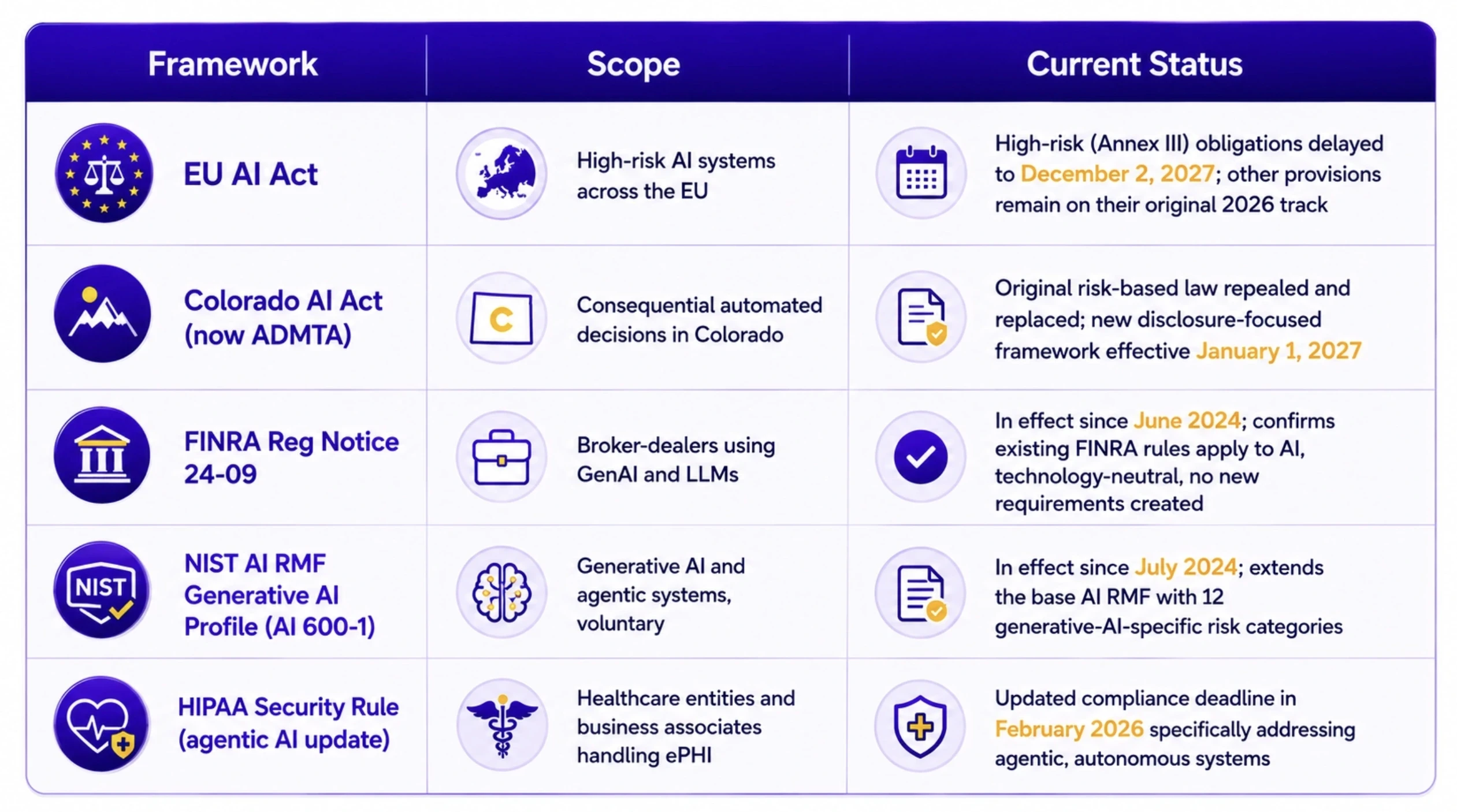
HIPAA's Security Rule requires administrative, physical, and technical safeguards for electronic protected health information, and it governs ePHI access control the same way regardless of whether the accessor is a person or a system. The HHS Office for Civil Rights has made clear that an AI vendor handling PHI is a business associate under HIPAA, full stop, subject to the same obligations any other business associate carries. The Security Rule's audit controls standard specifically requires activity records detailed enough to reconstruct what happened and who was responsible; a session log simply showing that an AI tool was used is not sufficient on its own. What's required is operation-level logging capturing which agent accessed which PHI, what it did with that access, and who authorized the underlying workflow. HHS has also moved to update the Security Rule with a specific compliance deadline in February 2026 addressing agentic AI directly, systems capable of autonomous decision-making, which is a clear signal that regulators no longer treat agentic systems as covered only by inference from older rules.
FDA Oversight for AI/ML as Software as a Medical Device (SaMD)
An AI agent that diagnoses, treats, or monitors a patient may fall under the FDA's Software as a Medical Device framework, and FDA AI medical device compliance is subject to 510(k) clearance or premarket approval, depending on risk classification. The FDA draws a specific line worth knowing: AI that informs a clinician's judgment while leaving that clinician able to independently review the basis for a recommendation carries a lower regulatory burden than AI making or substantially influencing a clinical decision in a way a clinician cannot meaningfully review. The FDA had authorized more than 1,350 AI-enabled devices by early 2026, roughly double the 2022 count, and its Predetermined Change Control Plans framework gives continuously learning systems a defined path to update without triggering a fresh submission every time, provided that update process follows Good Machine Learning Practice.
The Multi-Agency Pattern: FDA, FTC, HHS/OCR, and DOJ
Healthcare AI agents rarely answer to a single regulator, and multi-agency healthcare AI compliance is now the default posture rather than the exception. The U.S. Food and Drug Administration governs device classification and clinical safety, HHS's Office for Civil Rights governs HIPAA compliance for PHI through what amounts to ongoing HHS OCR AI guidance, the Federal Trade Commission has authority over deceptive or unfair practices in how AI capabilities are marketed and used, and the DOJ can pursue enforcement where AI-driven decisions intersect with fraud or civil rights statutes. A security review scoped only to HIPAA misses real exposure sitting under FDA's device rules or FTC's marketing-practices authority, which is exactly why a healthcare-specific risk review needs to explicitly check all four rather than assuming HIPAA coverage implies the rest.
Financial Services
Financial services carries its own dense, evolving regulatory stack, covering FINRA's technology-neutral rules, model risk management principles, and the specific bank-level obligations under SR 26-2. Rather than repeat that ground here, see our dedicated financial services solution page and our AI agent security risk review for banks guide for the full detail.
Insurance, Legal, and Government
Outside healthcare and finance, three sectors carry distinct constraints of their own.
Client Confidentiality and Privilege in Legal AI Deployments
An AI agent operating inside a law firm or legal department has to preserve attorney-client privilege and work-product protection, which raises a specific technical question generic AI security guidance doesn't address: whether a given agent's data handling, retention, and third-party model access could be construed as breaking privilege by exposing confidential communications to an unauthorized party. Vendor and infrastructure choices that would be a minor consideration for a generic enterprise deployment become a direct privilege risk in a legal context, which is why legal AI deployments generally need tighter data isolation and retention controls than an equivalent deployment elsewhere.
Public-Sector Exposure Under the EU AI Act and State AI Laws
Government and public-sector AI deployments face a genuinely unsettled regulatory landscape right now. The EU AI Act high-risk obligations were originally scheduled to become binding on August 2, 2026, but the EU's Digital Omnibus package, receiving final approval in mid-2026, pushed that deadline for standalone high-risk systems to December 2, 2027, while other transparency provisions remain on their earlier track. U.S. state AI law is moving even faster and less predictably: Colorado's original AI Act, a risk-based framework built around duty of care and mandatory impact assessments, was repealed and replaced in May 2026 by a narrower, disclosure-focused Automated Decision-Making Technology Act, now scheduled to take effect January 1, 2027, after two separate delays and a federal court challenge along the way. Public-sector buyers and vendors need to track both tracks simultaneously, since neither the EU's nor Colorado's timeline is fully settled, and other states are moving to fill the same regulatory space on their own schedules.
The 2026 Regulatory Landscape at a Glance
Building a Cross-Sector AI Agent Security Program
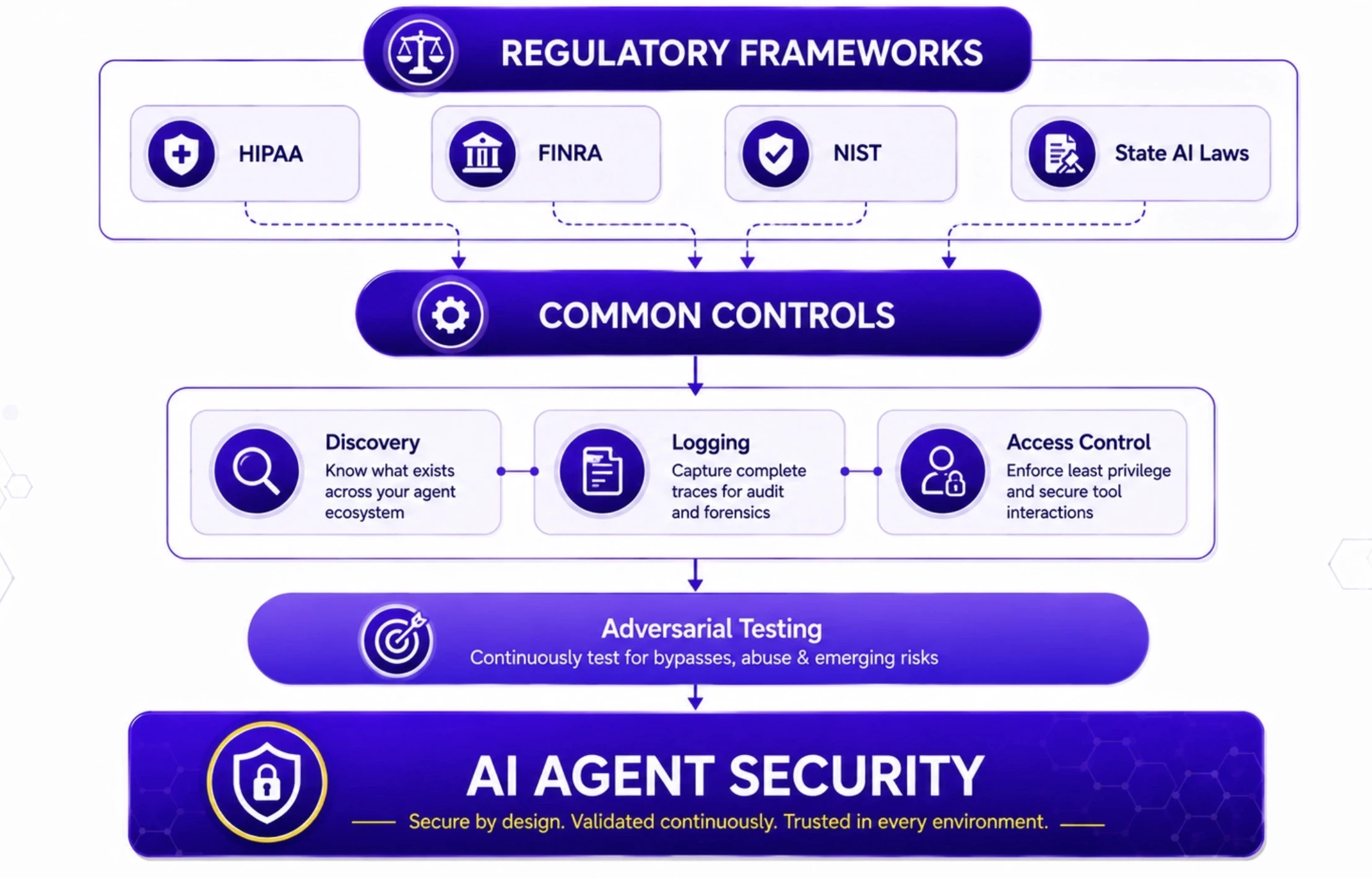
Rather than building a separate program per regulation, most of the real work is building one control set that satisfies several frameworks at once, then layering the specific pieces that don't overlap.
Common Controls That Satisfy Multiple Frameworks at Once
Continuous discovery of every agent, its data access, and its owner satisfies the inventory expectations underneath HIPAA, NIST AI RMF, and most state AI laws simultaneously. Immutable, operation-level audit logging satisfies HIPAA's audit controls standard, FINRA's recordkeeping expectations, and the evidentiary bar most AI-specific state laws are converging toward. Scoped, least-privilege access control and continuous adversarial red teaming for prompt injection and tool misuse satisfy the core security expectations underneath nearly every framework in the table above, since none of them specify a different technical approach to the same underlying problem.
Where Sector-Specific Requirements Diverge
What doesn't transfer cleanly is domain-specific classification and disclosure logic. FDA's device-classification line between informing and replacing clinical judgment has no equivalent in FINRA's rules. GDPR and EU AI Act automated decision-making provisions don't map directly onto HIPAA's minimum-necessary standard. A cross-sector program needs a shared technical foundation, discovery, logging, access control, and testing, with a thin, sector-specific layer on top handling the classification and disclosure logic unique to each regulator's own framing of risk.
How Akto Secures AI Agents Across Regulated Industries
Akto's continuous discovery, adversarial red teaming, and runtime guardrails provide the shared technical foundation regulated organizations need across sectors: a current agent inventory, operation-level audit logging built for reconstruction rather than summary, and scoped access enforcement validated continuously rather than checked once at launch. For the specific capability breakdown relevant to financial services, see our financial services solution page.
FAQs: AI Agent Security for Regulated Industries
1. Do HIPAA's requirements apply to AI agents the same way they apply to human employees?
Yes. HIPAA's Security Rule safeguards apply regardless of whether ePHI is accessed by a human or an AI agent, and HHS has confirmed that AI vendors handling PHI are business associates subject to the same obligations as any other business associate.
2. What makes AI agent security different in regulated industries compared to other sectors?
The underlying compliance obligations don't change, but the consequences of a failure are steeper and more specific: a HIPAA violation, an FDA device misclassification, or a FINRA recordkeeping gap carries defined regulatory exposure that a generic enterprise deployment doesn't face.
3. What is FDA oversight for AI/ML as Software as a Medical Device (SaMD)?
It's the FDA's framework classifying AI that diagnoses, treats, or monitors patients as a medical device subject to 510(k) clearance or premarket approval, with a Predetermined Change Control Plan process allowing continuously learning systems to update without a fresh submission for every change.
4. Which government agencies regulate healthcare AI agents simultaneously?
FDA governs device classification and clinical safety; HHS's Office for Civil Rights governs HIPAA compliance; the FTC has authority over deceptive or unfair AI marketing and use practices; and the DOJ can pursue enforcement where AI-driven decisions intersect with fraud or civil rights statutes.
5. Why is hallucination considered a compliance risk, not just an accuracy issue?
A fabricated citation, clinical detail, or policy term can trigger a reporting obligation, disclosure requirement, or liability exposure independent of whether anyone acted on it, which makes hallucination a compliance event in its own right rather than just a quality metric to improve.
6. What architectural approach reduces compliance risk from AI agent hallucination?
Retrieval-based architectures that ground an agent's output in verified source data, paired with a validation layer checking generated responses against those sources before they reach a customer, patient, or regulator, converting an unverifiable claim into a traceable one.
7. How much are enterprises adopting AI agents without security review, according to Gartner?
Gartner's 2025 survey found 74% of IT application leaders view AI agents as a new attack vector, but only 13% strongly agreed their organization had the governance structures in place to manage that risk effectively.
8. What 2026 regulations should regulated-industry security teams be tracking simultaneously?
The EU AI Act's high-risk obligations (now delayed to December 2027 for standalone high-risk systems), Colorado's replacement Automated Decision-Making Technology Act (effective January 2027), FINRA Reg Notice 24-09, the NIST AI RMF Generative AI Profile, and HIPAA's updated Security Rule provisions addressing agentic AI directly.
9. Do compliance obligations change if an AI agent accesses data instead of a human?
No. The underlying regulatory obligation stays the same regardless of whether a human or an AI agent performs the access; what changes is the specific technical control needed to demonstrate compliance for a non-deterministic, autonomous system.
10. How does AI agent security in healthcare differ from financial services?
Healthcare security has to account for FDA's device-classification logic and HIPAA's PHI-specific audit and business-associate requirements, while financial services security centers on FINRA's technology-neutral rules and model risk management principles, though both share the same underlying need for discovery, logging, and access control.
11. What common controls satisfy multiple regulatory frameworks at once?
Continuous agent discovery and inventory, immutable operation-level audit logging, scoped least-privilege access control, and continuous adversarial red teaming all satisfy overlapping expectations across HIPAA, FINRA, NIST AI RMF, and most state AI laws simultaneously.
12. How does Akto secure AI agents across different regulated industries?
Akto provides continuous discovery, adversarial red teaming, and runtime guardrails as a shared technical foundation across sectors, with sector-specific capability detail, including for financial services, available on our dedicated solution pages.

Experience enterprise-grade Agentic Security solution