Shadow AI Governance: How to Build an Effective Program
Learn how to build a Shadow AI governance program to discover unauthorized AI use, assess risks, enforce policies and secure AI across the enterprise.

Rushali

You've read our previous blog on what shadow AI is and why it spreads faster than shadow IT ever did, so you are already familiar with the problem's contours. That's relatively simple to describe in a blog post. The problem lies in the next set of issues that need to be addressed after that initial discovery: how serious it is, who is responsible for the response, what the policy is, and who needs to be warned about it? Being aware is not enough to decrease risk. A program does. This piece builds on that and goes through what an actual shadow AI governance program is if you get beyond "we know this is happening.
From Risk Awareness to a Governance Program
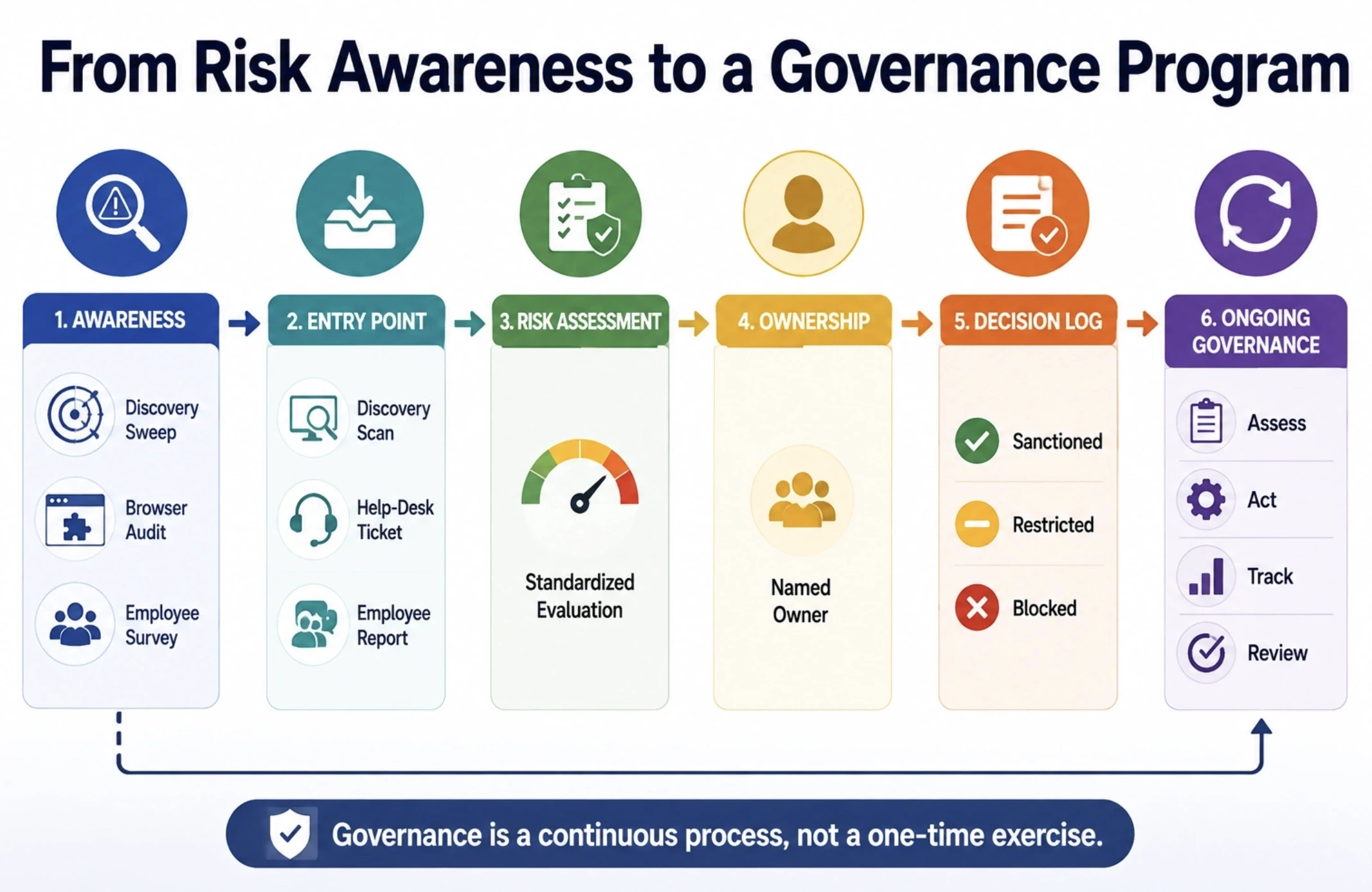
Security teams are more likely to be at the awareness stage sooner than they'd like. Whether it's a discovery sweep, a browser extension audit, or an employee survey, it produces a list of approved AI tools, namely a developer using an AI-backed IDE to develop production code, a sales team using a call transcription tool powered by AI, or a marketing team directly feeding a GenAI plugin into the CRM. The list is then shown on a slide, everyone nods, and then nothing really changes.
The disconnect is between awareness of the list and a repeatable process for executing the list. A governance program isn't a larger spreadsheet or an intimidating graph for the next board meeting. It's an operating model, a specific mechanism for how the findings are introduced, assessed, acted upon, tracked, and reviewed. If this is not in place, each discovery is a stand-alone fire drill, depending on who happens to see it first, and there is no consistency from one team's unsanctioned tool to another.
There are a number of components that are like the heart in a program, and you cannot do without them. There needs to be an entry point, a specific process through which a shadow AI finding will be entered, such as a discovery scan, help-desk ticket, or employee report. There needs to be a standardized method of assessing risk; otherwise, two identical tools will be treated in very different ways by different evaluators. Each finding must have a named owner, and not a general notion that "security will take care of it. And there needs to be a decision log (sanctioned, restricted, or blocked), as opposed to a verbal agreement in a Slack thread that can't be found six months later.
There is no special tooling needed to begin this. It's a process that needs to be managed like vulnerability management or vendor risk management; it's not something to be done every so often.
Tiering Shadow AI Findings by Risk
There's no one-to-one correspondence between unsanctioned tools and the same reaction – and assuming every one of them is equally dangerous will cause governance programs to lose credibility among the teams they are meant to serve. A risk involving a junior marketer who is using an AI writing assistant on a public blog draft is fundamentally different than a risk involving an engineer who is connecting an autonomous agent to a production database with write access. The response is proportionate due to tiering.
A viable tiering model categorizes findings into three outcomes:
Sanction. It addresses a problem in the real business and the point of data exposure is acceptable or can be limited; there is a vendor and/or a configuration path that allows it to be contracted, logged, and controlled. Sanctioning puts an end to a shadow tool, and often the most effective means of lowering risk, since it replaces an ungoverned workaround with a monitored and supported alternative.
Restrict. There are valid uses for the tool, but there are unaddressed risks, such as it accessing internal data but no review of data retention or it being an agent that is able to call tools but has not undergone testing for inappropriate use. Restriction typically translates to limiting scope – no regulated data, no write, required logging, or only use from a specific team until the data can be reviewed in full.
Block. There isn't a defensible path towards safe use of the tool at its current configuration – it has no guarantee of deletion of the prompts, it's broadly accessed into internal systems, or it's just a redundant tool when compared with an already-sanctioned tool. Blocking needs to be used in a specific situation; the more this is done, the more shadow AI goes underground.
It is not the tier label that is important, but its underlying criteria. The obvious one is data sensitivity: Does the tool access source code, customer records, or regulated data? The degree of autonomy is the one that's growing in significance more and more: tools that just summarise text are very different from those that can call APIs, update records, or even start downstream workflows without human intervention. A defensible scoring model is completed with vendor posture (no security review or only internal), exposure (internal-only or public facing), and business criticality of the function it touches.
Tiering isn't a final assessment, either. A tool authorized with a limited use case may get out of alignment - someone changes the data source, or a vendor releases an update that introduces agentic functionality that wasn't included when the tool was approved. Findings should be re-tiered, not set aside as "settled.
Assigning Ownership
Each shadow AI discovery has to have one accountable owner, and if that is determined in advance, the most common failure mode in these programs- a discovery that everyone agrees is a problem, but nobody does anything about- is eliminated.
There are 3 models that organizations tend to come to, and each one has a real trade-off.
Security owns everything. This provides consistency; exactly the same benchmark is applied to each discovery, but it is not scalable. It's not in the business context where security teams get the wisdom to determine if a tool is mission-critical to a function, and having all decisions centralized through one team places governance in the queue, which is just the type of friction that shifts adoption into the shadows.
It's the responsibility of the requesting team. It will keep decisions nearer to those involved in the use case and get them done more quickly, but it will also rest the judgment of risk on the shoulders of those who are not trained to judge risk. Not every team is excited about a new agentic tool, and they are not the best judge of their own blast radius.
Shared model, shared responsibilities based on function, not to one side. This is generally the most effective approach: the responsibility for the risk assessment, the tiering decision, and guardrails to make sanctioning safe are under security's responsibility. The day-to-day discipline of handling data and the accountability for how data is used by users is owned by the requesting/business team. After a tool is sanctioned, vendor terms and contracting, and any access provisioning, are owned by IT or procurement. There is a clear lane, rather than a vague responsibility that is unspoken, for each party.
Agentic tools make ownership even more complex because if an autonomous agent is not necessarily "used" by one person, it operates under a service identity, it touches multiple systems, and it may have been "set up" by a person who has left the team. Assignment of ownership should go past the identity of the ownership and encompass the non-human identity as well: to whom should the agent be accountable for what the agent is authorized to do, not just for what the agent is authorized to do.
The Policy Lifecycle
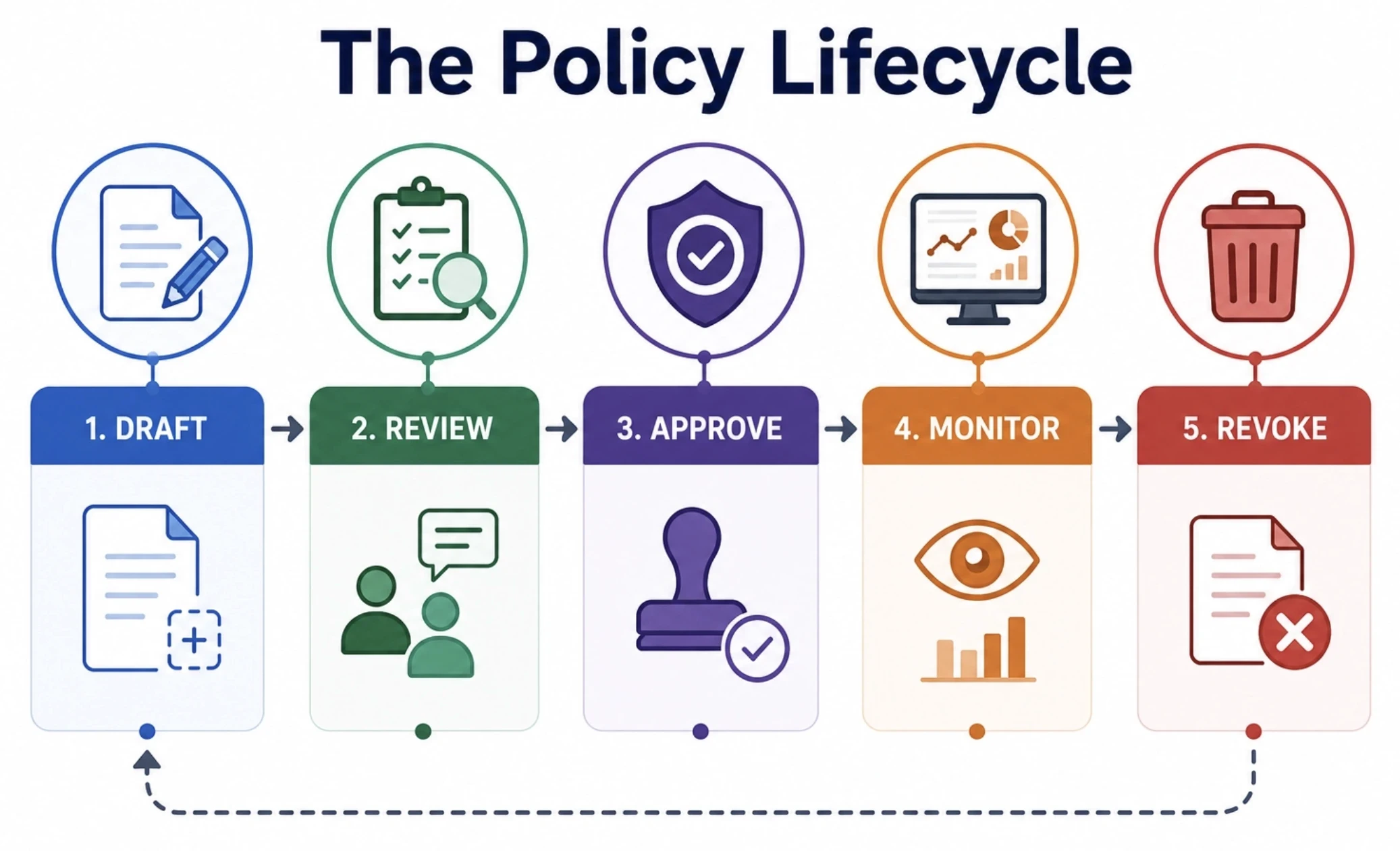
The biggest reason that programs stall out after a successful initial quarter is to treat shadow AI governance as an audit. An audit generates a snapshot: this is what we found; this is what we decided; done. AI tools do not remain stagnant; new tools emerge every week, and existing tools are given more features by their vendors, and agents are integrated into new tools without a change request being submitted. A policy must have a lifecycle and not just a one-off judgment.
There are five stages in a working lifecycle:
Draft. A policy is written for a specific tool, category of tool, or use case, allowing or disallowing use of the tool, sharing of data with the tool, and what actions (if any) an agent may take without human review.
Review. The draft is reviewed by security, legal, and, last of all, the business owner before it becomes a contract. This is where tiers are applied and where any restrictions are scoped.
Approve. The policy is adopted for the tool or category, and access is provisioned based on the policy, and it's recorded as the current, authoritative policy for that tool or category.
Monitor. Used continuously throughout the course of usage, it is checked against the policy - not only at approval time! This is the part most one-off audits miss, and it's where the drift happens: a tool approved to summarize data internally starts exposing customer data, or a new integration is introduced, and the agent can now act on more data.
Policies are retired or tightened when changes occur in the tool, the vendor's practices, or when the business need is eliminated. Revocation is just as “purposeful” as approval; an unused/revoked policy is a governance gap itself.
Continuity is the difference between this and a periodic audit. An audit will let you know where things were on the day of the audit. A lifecycle is a process that recognizes the picture is always evolving and integrates monitoring as an integral part of the process. It's here that governance becomes more than a compliance exercise and becomes operational - to have a policy that's correct on the day it's signed and correct all the time, not a document that's accurate on the day it's signed and is out of date after a month.
Escalation Paths and Executive Reporting
Not all shadow AI discoveries have to be reported to a CISO or to a board, and not all are enough to add to the credibility of the program when it is time to report discoveries when they really need to be reported. There are escalation paths to ensure that decisions that are run-of-the-mill, that don't have enough exposure, are differentiated from those that do.
For most programs, a few thresholds tend to justify escalation irrespective of the program's maturity. If a tool or agent is discovered that is processing regulated data, PII, PHI, or financial data without any prior review, it's in front of leadership's face, as it poses direct exposure to compliance. An agent that has been found with write permissions on production systems or the potential to cause irreversible actions is treated as an "unsanctioned tool" and is thus classified as an "unmanaged operational risk" and requires the same level of attention as other production incidents. If the finding is not owned by anyone after a few review cycles (such as 2 to 3 review cycles), it is beyond a single tool issue, and it is a shift in the program structure that needs to be addressed, regardless of the level of risk of the individual tool.
The threshold is not the most important aspect; what gets reported and how often the report gets made are equally important. There are better ways to use executive reporting than to list all the discoveries, how they were sanctioned, restricted, or blocked; the average time it takes to discover and document a decision; and the number of exceptions in the policy. It's best to get executive reporting from a short list of trend metrics, not a running list of discoveries, and likewise how they were sanctioned, restricted, or blocked; the average time from discovery to documenting a decision; and the number of exceptions open in the policy. Likewise, steady state reporting is typically done on a quarterly basis, though thresholds above may be escalated out of cycle. The point of executive reporting is not to get the leaders to agree to any single tool: it's to provide the leaders with a defensible answer to "how exposed are we" and evidence that the exposure is moving in the right direction.
That is the discovery and inventory activities detailed in our breakdown of what shadow AI is and how it differs from shadow IT, along with the continuous discovery of agents, MCP servers, and tools across an environment, which becomes the raw material for a governance program. Governance is the process layer; it's not a discovery. Programs that develop tiering and ownership frameworks before they have tackled the problem of visibility often find themselves controlling only the proportion of shadow AI that they see, leaving the remainder of the AI to run as before without control.
How Akto Supports Shadow AI Governance Programs
This article has been focused on the same gap that many organizations struggle with, which is a lack of a reliable and up-to-date understanding of the AI agents, MCP servers, and GenAI tools already deployed within their environment. According to Akto's own research, merely 21% of organizations have an accurate and up-to-date inventory of their AI agents, MCPs, and GenAI applications, and independent Akto data shows that a significant percentage of enterprises have limited or no visibility into actual runtime activity of their AI agents. A governance program based on the lack of that information is governing a part of the truth.
Akto Atlas encompasses employee-facing AI-based tools, such as AI IDEs, browser-based GenAI apps, AI-powered CLIs, and agent connections across the employee endpoints, while Akto Argus covers homegrown and internally built AI agents and MCP workflows. They provide a single source of truth for a security team to view what is running, as opposed to aggregating this information from browser extension audits and spreadsheets. Akto is known as a vendor in the agentic AI security space by Gartner, and the platform has been built to address issues of discovery, testing, and enforcement that agentic systems expose rather than tooling that was originally created for traditional software.
This aligns closely with governance programs in moving from the periodic review to continuous monitoring. The monitor step in a policy lifecycle can detect and alert on shadow agents as they emerge, not waiting for the next scheduled audit, which is only likely to occur after a few quarters. Decision on guardrails at tiering time, no regulated data, no unscoped write access, can be enforced at runtime instead of waiting for the policy document to be checked against by anyone.
Final Thoughts on the Shadow AI Governance Program
The discovery of shadow AI in your organization is not hard to do most security teams have had a suspicion for a while, and discovery sweeps usually confirm it in a short period of time. The difficult part is developing a program that is robust enough to sustain findings over time, put them to work with ownership, get them through a real policy process, and do the right thing at the right time with leadership without drowning them in noise. The program doesn't work unless it's supported with real-time, correct visibility of what's happening.
Akto provides visibility into how employees are using AI, other user-generated AI agents, and the guardrails and runtime enforcement required to make governance a reality, not a wish. Book an Agentic Security demo to see how Akto works in this space from "we know shadow AI is a problem" to a program that can stand the test of audit and executive review.
Frequently Asked Questions on Shadow AI Governance Program
What's the difference between knowing about shadow AI and having a shadow AI governance program?
When you know about shadow AI, it is typically a discovery exercise - a list of approved tools discovered either by scanning or surveying. The Program that is developed around that list is called a governance program and is repeatable: Risk Tiering, named ownership, A Life Cycle with continuous monitoring, and Escalation thresholds. A program is what will decrease the risk over time, whereas awareness is the identification of the problem.
How should discovered shadow AI tools be tiered by risk?
Classify the data as either sanction, restrict, or block based on sensitivity, level of autonomy, vendor security posture, and business criticality. Tools that address a genuine need and are subject to appropriate control are sanctioned; tools that have partial risk of unsafe application are subject to limited use; and tools that have no defensible path to safe application are blocked. Re-tier as needed; a tool's risk profile may shift after approval.
Who should own remediation when a shadow AI tool is discovered?
The best model is a shared one: security has responsibility for the risk assessment and guardrails needed, the requesting/business team has responsibility for the justification and discipline for everyday usage, and IT/procurement has responsibility for the vendor and access provisioning. The key is that there is one single account owner for each finding, rather than multiple teams that have thinly distributed responsibility.
What does a shadow AI policy lifecycle actually look like?
It goes through five steps: draft, review, approve, monitor, and revoke. In contrast to a one-time audit, the lifecycle also suggests that after approval, the use of the tools and the level of risk will continue to evolve and are incorporated into the process, not as a follow-up optional audit.
When should a shadow AI finding be escalated to leadership?
Raise the priority if the finding provides access to regulated data that was not previously reviewed, access to agents with write privileges to production, or access to agents that can perform irreversible operations, or if the finding has been unowned and past a defined review period. Routine tiering decisions should remain at the working level; escalation should be limited to situations involving exposure with compliance, operational, or accountability risk.
Should shadow AI tools always be blocked, or are there cases for sanctioning them instead?
Blocking should not be the norm. There is indeed a business need for many of the shadow AI tools, and prohibitions often appear to be driving use even deeper into the shadows. Sanctioning a tool, under contract, logged and access controlled, is often the quickest method of decreasing risk because it provides an alternative to an ungoverned workaround that is being monitored and supported.
How does shadow AI governance connect to broader AI asset discovery?
Any program that tiers, assigns ownership to, and escalates findings can only see findings it can tier. A governance program relies on a feed of discovery and inventory, which are the raw materials. If there is no ongoing visibility into agents, MCP servers, and GenAI tools, then the governance is only looking after shadow AI that a team happened to stumble upon.
How does Akto support building a shadow AI governance program?
Akto Atlas and Akto Argus provide real-time monitoring of employee AI usage and homegrown AI agents, respectively, and flag and alert on shadow agents as they emerge, not just during a periodic review. This real-time, accurate feed of inventory is combined with guardrail enforcement at runtime, which is the reason tiered decisions and policy restrictions are able to work on the ground rather than just on paper with a governance program.

Experience enterprise-grade Agentic Security solution