AI Security in 2026: Navigating LLM Risks, Threats, and Best Practices
Explore the evolving landscape of AI security in 2026. Uncover top LLM threats, vulnerabilities, and the expert best practices to secure enterprise AI systems.

Sucharitha

AI security was just a niche concern a few years back. But we’ve long passed the stage.
In 2026, LLMs can run complex human-like tasks, such as writing production code, running customer support queues, and summarizing business contracts.
Along with tools like ChatGPT, enterprise adoption of agentic AI changed how organizations approach automation and decision-making.
Unfortunately, AI security hasn’t kept pace, and traditional practices no longer make the cut.
Unlike conventional systems, LLMs interpret natural language dynamically, combine context sources at runtime, and may trigger automated downstream actions. So, if your organization is securing AI the same way it secures a REST API, you're already behind.
In this blog, we have explained the AI security threat landscape and explored how to tackle the looming challenges.
What is AI Security?
AI security is the practice of protecting AI systems, models, agents, and the infrastructure connecting them, from threats that exploit their unique architecture: manipulated inputs, poisoned data, unauthorized tool access, and exposed model endpoints. As AI moves from experimental pilots into production systems handling real data and taking real actions, securing those systems has become its own discipline, distinct from both general IT security and from the separate practice of using AI to strengthen security operations. What used to be a narrow concern for research teams building models from scratch is now a mainstream enterprise problem, since most organizations today are running some combination of internally built models, third-party AI tools, and increasingly autonomous agents, often without a unified picture of what's actually deployed.
AI Security vs. AI Used for Security
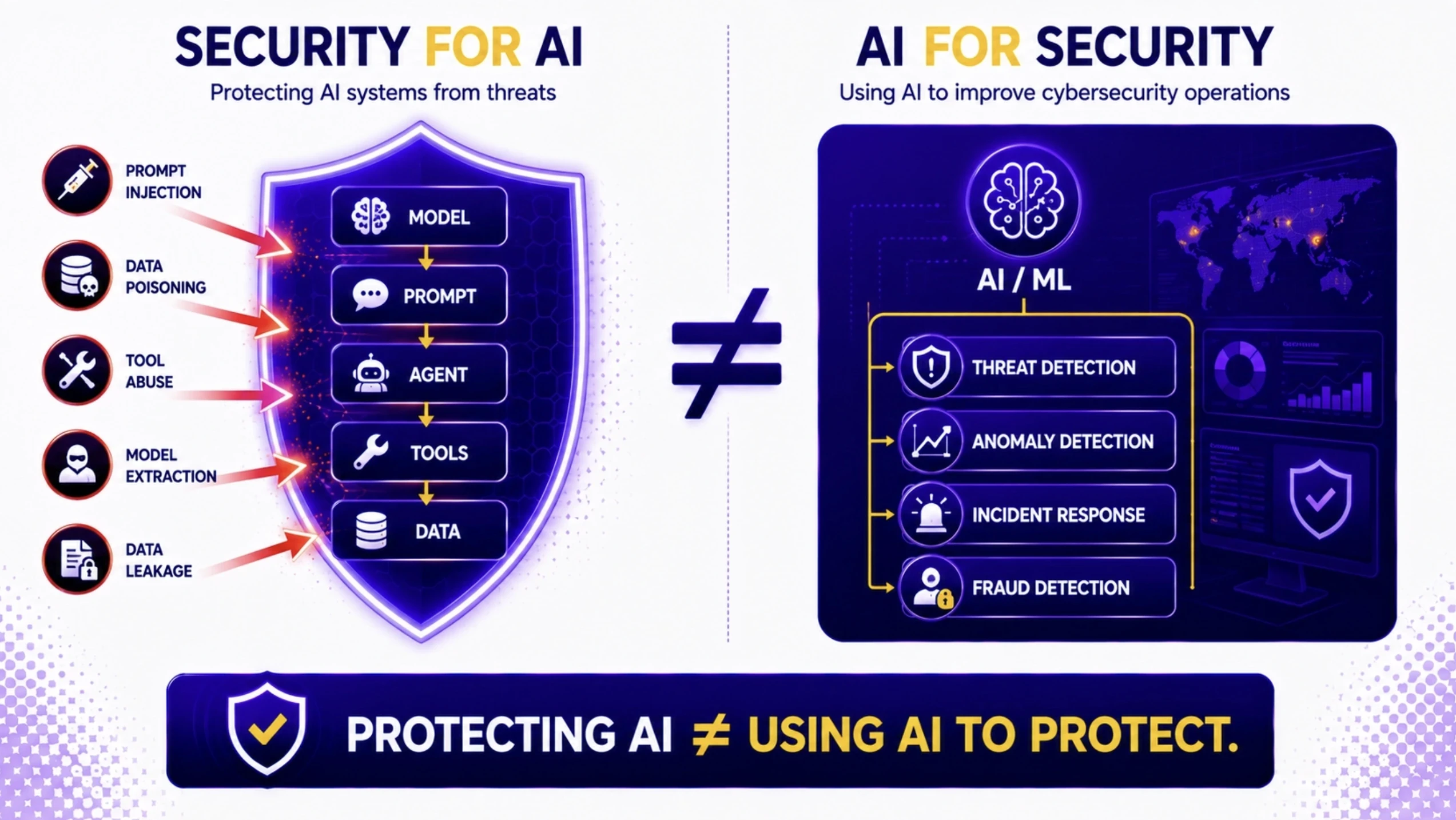
The term "AI security" genuinely means two different things depending on who's using it, and the ambiguity is baked into how major vendors themselves describe it. IBM's own "What Is AI Security?" page defines the term as AI enhancing an organization's security posture, using machine learning to analyze traffic patterns and flag anomalies faster than human analysts could, citing research that organizations with extensive security AI and automation identify and contain breaches over 100 days faster on average than those without. Trend Micro markets the same distinction explicitly as two separate categories on its own site: "Security for AI" and "AI for Security." This guide is about the first meaning: protecting AI systems themselves from being manipulated, exploited, or compromised, not about using AI as a tool to defend other systems. If you're looking for how AI improves threat detection and incident response, that's a related but separate topic; if you're looking for how to keep your own models, agents, and AI infrastructure from being attacked, you're in the right place.
Why AI Security Is a Distinct Discipline from Traditional Cybersecurity
Traditional cybersecurity assumes deterministic software: a system behaves the same way given the same input, and a patched vulnerability stays patched. AI systems break that assumption. A model's behavior is probabilistic, shaped by training data, context, and inputs no engineer explicitly coded, which means the same prompt can produce different behavior across sessions run under identical conditions. AI systems also introduce attack surfaces that didn't exist in traditional software architecture: the prompt itself becomes an input attackers can weaponize, the model's own reasoning becomes something that can be manipulated rather than merely exploited, and an agent's tool access turns a successful manipulation into a real-world action rather than just a bad output confined to a chat window. A firewall, an identity control, or a cloud monitoring tool wasn't built with any of this in mind, which is exactly why organizations that assume existing security measures already cover AI risk are frequently wrong, sometimes only discovering the gap after an incident makes it obvious.
The AI Security Landscape: Domains at a Glance
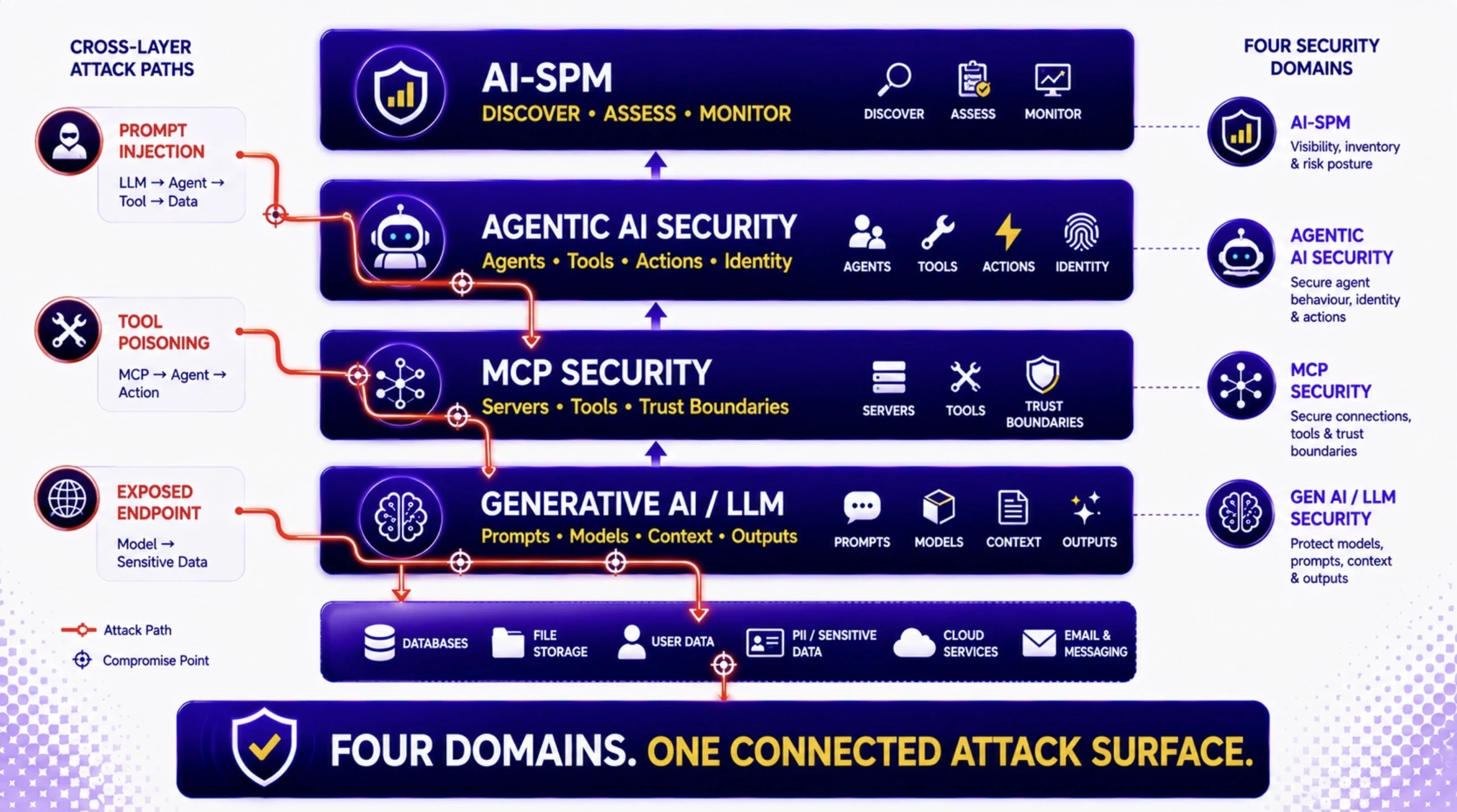
AI security isn't one discipline; it's several overlapping domains, each with its own threat model and tooling. This section maps the landscape rather than covering any domain in depth.
Generative AI / LLM Security
This domain covers the risks specific to large language models themselves: prompt injection, training data leakage, and output-handling vulnerabilities. It's the foundational layer most organizations encounter first, since nearly every AI security concern downstream, whether in an agent or an MCP integration, builds on securing the underlying model that powers it. For the full breakdown, see our Generative AI Security guide.
Agentic AI Security
Once a model gains the ability to plan, call tools, and take multi-step actions, the risk surface expands from what a model says to what an agent does. This domain covers tool misuse, excessive agency, and multi-agent attack chains that don't exist in single-turn LLM applications, and it's the fastest-growing area of AI security risk as organizations move from chatbots to autonomous workflows. See our Agentic AI Security guide for the complete picture.
MCP Security
The Model Context Protocol has become the default way agents discover and connect to external tools, and every MCP server introduces a new trust boundary. This domain addresses protocol-specific risks: server authentication, tool poisoning, and the shadow MCP servers that proliferate outside formal review, often configured locally by individual developers with no central record of the connection. Our MCP Security guide covers this domain in depth.
AI Security Posture Management (AI-SPM)
AI-SPM is the practice of continuously assessing the security configuration of every discovered AI asset, whether a model, an agent, or an MCP server, checking for issues like exposed endpoints or unmasked sensitive data. It depends on discovery having already happened and functions as the ongoing monitoring layer across the other three domains, turning a one-time inventory into a continuously validated security posture.
See our AI-SPM guide for details.
What AI Security Protects Against
A brief taxonomy of threat categories organized by where in the AI stack they operate; for the full breakdown of each, see our AI security risks guide.
Model-Level Threats
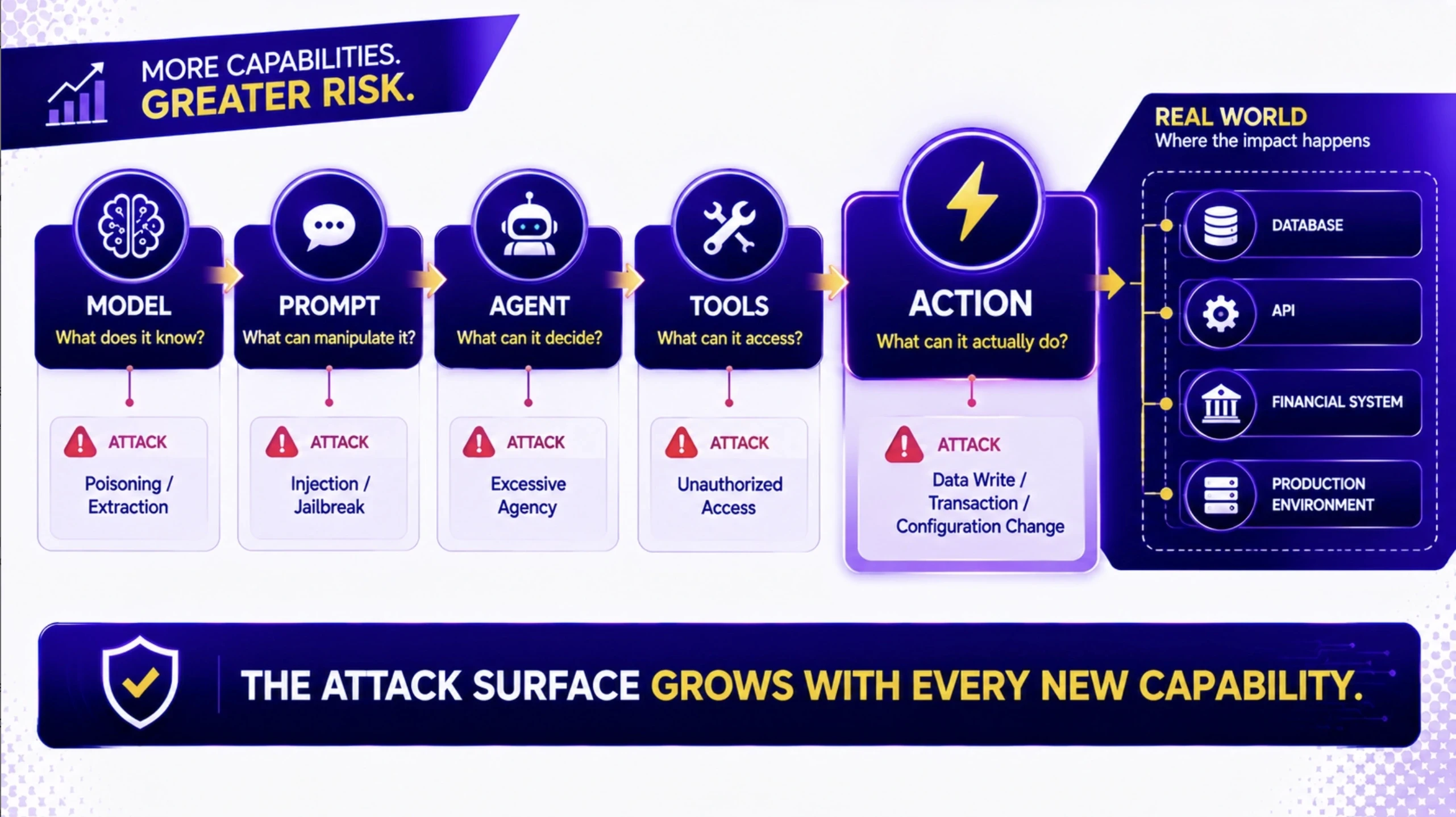
These target the model itself: data poisoning corrupts what a model learns from during training or fine-tuning, model extraction attempts to reverse-engineer proprietary model behavior through repeated querying, and adversarial inputs are specifically crafted to fool a model's classification or generation behavior in ways a human reviewer would never anticipate.
Application-Level Threats
Prompt injection and jailbreaking exploit the gap between what a model's system instructions intend and what crafted input can make it actually do, whether through direct manipulation typed straight into a conversation or content embedded in documents, emails, or webpages the model processes as part of a routine task.
Agentic/Tool-Level Threats
Once an agent can call tools, the threat expands to tool misuse, where an agent is manipulated into calling a tool outside its intended scope, and unauthorized actions, where an agent takes a consequential step, a data write, a transaction, a configuration change, that no human reviewed before it executed.
Data and Infrastructure Threats
These cover sensitive data leakage through model output or exposed vector databases, and AI supply chain risk from compromised dependencies, malicious skills, or poisoned third-party models entering the environment through the same channels that npm and PyPI packages once introduced risk into traditional software, now extended to the AI-specific marketplaces and integrations that didn't exist a few years ago.
Core Components of an AI Security Program
Discovery and Inventory (Including Shadow AI)
You can't secure what you don't know exists. A functioning program starts with continuous, automated discovery of every model, agent, and MCP server in use, including shadow AI deployed outside formal review, since a periodic manual inventory is stale within days in a fast-moving environment where new integrations get added constantly.
Guardrails and Runtime Protection
Guardrails intercept and enforce policy on both inputs and outputs in real time: screening incoming requests for injection attempts, and scanning outgoing responses for leaked credentials or sensitive data before delivery, closing the gap between a system passing pre-launch review and behaving safely under live, adversarial traffic. See our LLM guardrails guide for implementation details.
Red Teaming and Continuous Testing
Static review misses runtime behavior. Continuous, automated red teaming simulates real attacks, prompt injection, jailbreak attempts, and tool misuse against production systems on an ongoing basis rather than a one-time pre-launch check, catching regressions introduced by model updates or new integrations before they become incidents. Our AI red teaming guide covers this in full.
Governance and Compliance
Security findings need to connect to organizational accountability and regulatory obligation, not exist as an isolated technical exercise disconnected from how the rest of the organization manages risk. See our AI governance guide and AI compliance guide for how security work maps to broader program requirements.
AI Security vs. Traditional Cybersecurity
Probabilistic Behavior
Traditional security testing assumes a vulnerability either exists, or it doesn't, and a fix reliably closes it. AI systems are probabilistic: identical input can produce different output across runs, since behavior emerges from a model's training and context rather than a fixed code path. This means AI security testing has to characterize a distribution of behavior rather than confirm a single pass-or-fail result, and a fix validated once doesn't guarantee the same behavior holds indefinitely.
New Attack Surfaces (Models, Prompts, Agents, Tools)
Every layer of the AI stack introduces an attack surface traditional security tooling wasn't built to monitor. The model itself can be poisoned or extracted. The prompt, previously just a text field, is now a vector for injection. The agent's reasoning can be manipulated toward a goal the user never intended. The tools an agent can call turn a successful manipulation into a real action with real consequences, not just a bad response contained to a single output.
How to Evaluate AI Security Solutions
Choosing the right AI security tooling depends heavily on your specific stack, deployment model, and which domains above matter most to your organization, which is a comparison this guide doesn't attempt to resolve on its own. For a detailed breakdown of solution categories and how to evaluate them against your requirements, see our AI security solutions guide and our AI security tools comparison.
AI Security Best Practices: At a Glance
Maintain continuous discovery so security coverage keeps pace with how quickly new models, agents, and integrations get added
Apply guardrails at both the input and output layer, not just one or the other
Run red teaming continuously in production, not only as a one-time pre-launch check
Map every finding back to a governance framework so security work produces audit-ready evidence, not just isolated technical fixes
For the complete checklist, see our AI security best practices guide.
How Akto Approaches AI Security
Discovery Across LLMs, Agents, and MCP
Akto continuously discovers every LLM, agent, and MCP server across an organization's environment, including shadow AI deployed outside formal review, giving every other function in this guide the asset inventory it depends on to actually secure anything.
Continuous Red Teaming
Rather than a one-time pre-launch scan, Akto runs continuous, automated red teaming against discovered assets, mapping findings directly to OWASP's LLM, Agentic, and MCP Top 10 frameworks along with MITRE ATLAS and NIST AI RMF, so results translate into audit-ready evidence rather than an unstructured list of flagged issues.
Real-Time Guardrails
Akto's AI Agent Gateway enforces input and output guardrails in production, intercepting malicious requests and redacting sensitive data before it reaches an end user, while Akto Atlas extends the same enforcement to employee endpoints where AI agents and MCP tools are used directly.
Final Thoughts on AI Security
AI security spans a landscape wider than any single tool or checklist covers: model-level risk, application-level manipulation, agentic tool misuse, and the infrastructure connecting all three. Treating it as a single discipline with one solution undersells how much ground it actually covers, and treating it as a simple extension of traditional cybersecurity misses how differently AI systems fail and how quickly that failure mode can change. Organizations that build a program around continuous discovery, layered guardrails, ongoing red teaming, and governance mapping are the ones positioned to secure AI systems as they scale, rather than discovering the gaps only after something goes wrong.
FAQs on AI Security in 2026
What is the difference between "AI security" and "AI for security" (using AI to defend systems)?
AI security, as covered in this guide, means protecting AI systems themselves from attack. AI for security means the reverse: using AI and machine learning to strengthen an organization's broader security operations, such as anomaly detection in network traffic. Both are legitimate uses of the same term, which is why the distinction needs stating explicitly.
How is AI security different from traditional cybersecurity?
Traditional cybersecurity assumes deterministic software where a vulnerability either exists or doesn't, and a patch reliably closes it. AI systems behave probabilistically, and they introduce attack surfaces, the prompt, the model's own reasoning, an agent's tool access, that traditional security tooling wasn't built to monitor at all.
What are the main domains within AI security (LLM, agentic, MCP)?
Generative AI/LLM security covers risks to the model itself, such as prompt injection and training data leakage. Agentic AI security covers risks introduced once a model can plan and take multi-step actions using tools. MCP security covers protocol-specific risks in how agents discover and connect to external tools. AI-SPM sits across all three as the continuous posture-monitoring layer.
What threats does AI security protect against?
Threats span four broad categories: model-level threats like poisoning and extraction, application-level threats like prompt injection and jailbreaking, agentic and tool-level threats like unauthorized actions, and data and infrastructure threats including sensitive data leakage and AI supply chain compromise.
What is AI Security Posture Management (AI-SPM)?
AI-SPM is the continuous assessment of security configuration across every discovered AI asset, checking for issues like exposed endpoints or unmasked sensitive data. It depends on discovery having already happened and provides ongoing monitoring rather than a one-time review.
What are the core components of an AI security program?
Continuous discovery and inventory including shadow AI, guardrails enforcing policy at both the input and output layer, ongoing red teaming rather than one-time testing, and governance mapping that connects security findings to compliance and organizational accountability.
How do AI guardrails fit into AI security?
AI Guardrails are the runtime enforcement layer, intercepting malicious or policy-violating requests before they reach a model and screening responses for leaked data before delivery. They act on live traffic in real time, complementing red teaming, which finds vulnerabilities before deployment.
What role does red teaming play in AI security?
Red teaming simulates real attacks, prompt injection, jailbreak attempts, and tool misuse against a system to surface vulnerabilities that static review can't catch, since many AI-specific failures only appear once a system is actually running. Continuous red teaming, rather than a one-time pre-launch check, catches regressions introduced by model updates or new integrations.
How does AI security relate to AI governance and compliance?
AI Security work produces the technical evidence that AI governance and AI compliance programs need to demonstrate risk management, such as documented red teaming results mapped to a recognized framework. Without that connection, security findings remain isolated fixes rather than auditable evidence of a functioning program.
What should organizations look for when evaluating AI security solutions?
The right evaluation depends heavily on your specific stack and which domains, LLM, agentic, or MCP, matter most to your deployment, along with whether a solution provides continuous discovery, real-time enforcement, and reporting mapped to the frameworks your organization needs to satisfy.
How does AI security change for agentic AI and MCP-connected systems?
Security shifts from evaluating what a model says to evaluating what an agent does, since an agent with tool access can take a real, consequential action rather than only generating a bad response. MCP connections add a further layer, since every server an agent connects to introduces its own trust boundary that needs independent evaluation.
Is AI security only relevant to companies building AI, or also those using it?
Both. Organizations that build their own models face model-level and application-level risk directly, while organizations that only deploy third-party AI tools still face agentic, data, and supply chain risk through the systems they've adopted, regardless of who built the underlying model.
What are the biggest AI security challenges enterprises face today?
Lack of visibility into what AI is actually running across the organization, including shadow AI outside formal review, combined with security tooling and practices that were built for deterministic software and don't transfer cleanly to probabilistic, tool-using AI systems.
How does Akto approach AI security across the AI stack?
Akto combines continuous discovery of LLMs, agents, and MCP servers with ongoing automated red teaming mapped to major security frameworks, and enforces real-time guardrails at both the gateway and endpoint level, covering discovery, testing, and runtime protection as one connected program rather than separate tools.
Important Links

Experience enterprise-grade Agentic Security solution