Best AI Runtime Guardrail Platforms for Enterprises
The leading AI runtime guardrail platforms for 2026 compared on rail coverage, latency, deployment model, and compliance readiness - with picks by use case.

Rushali

The alignment occurs only once, during training, when a lab influences what type of behaviour a model will exhibit in general. Guardrails occur whenever that model is running in production; they verify the actual inputs and outputs before real users or real systems interact with them. That's the reason runtime guardrail platforms have been adopted as a “board-level” purchase instead of an engineering afterthought.
The EU AI Act is a major cause of many of the challenges of 2026. The high-risk obligations of the systems were targeted for the original deadline of December 2, 2026, with teams working towards that June deadline until the EU's Digital Omnibus extended those obligations to December 2, 2027, and GPAI obligations have been in effect since August 2025, with transparency obligations still coming this December. The compliance clock did not stand still; it got more complex. To understand how these controls work, review what AI guardrails are and how they evolve as a system becomes an autonomous agent, and then compare platforms below.
How to Evaluate an AI Runtime Guardrail Platform
In this business classification, most sellers tout themselves as real-time, model-agnostic, enterprise-ready. The differences that actually matter appear in four places: 1. Where the platform enters into the lifecycle of requests; 2. How long it takes to process those requests; 3. If the platform can be used on all model providers; 4. If there is evidence after a platform processes the request.
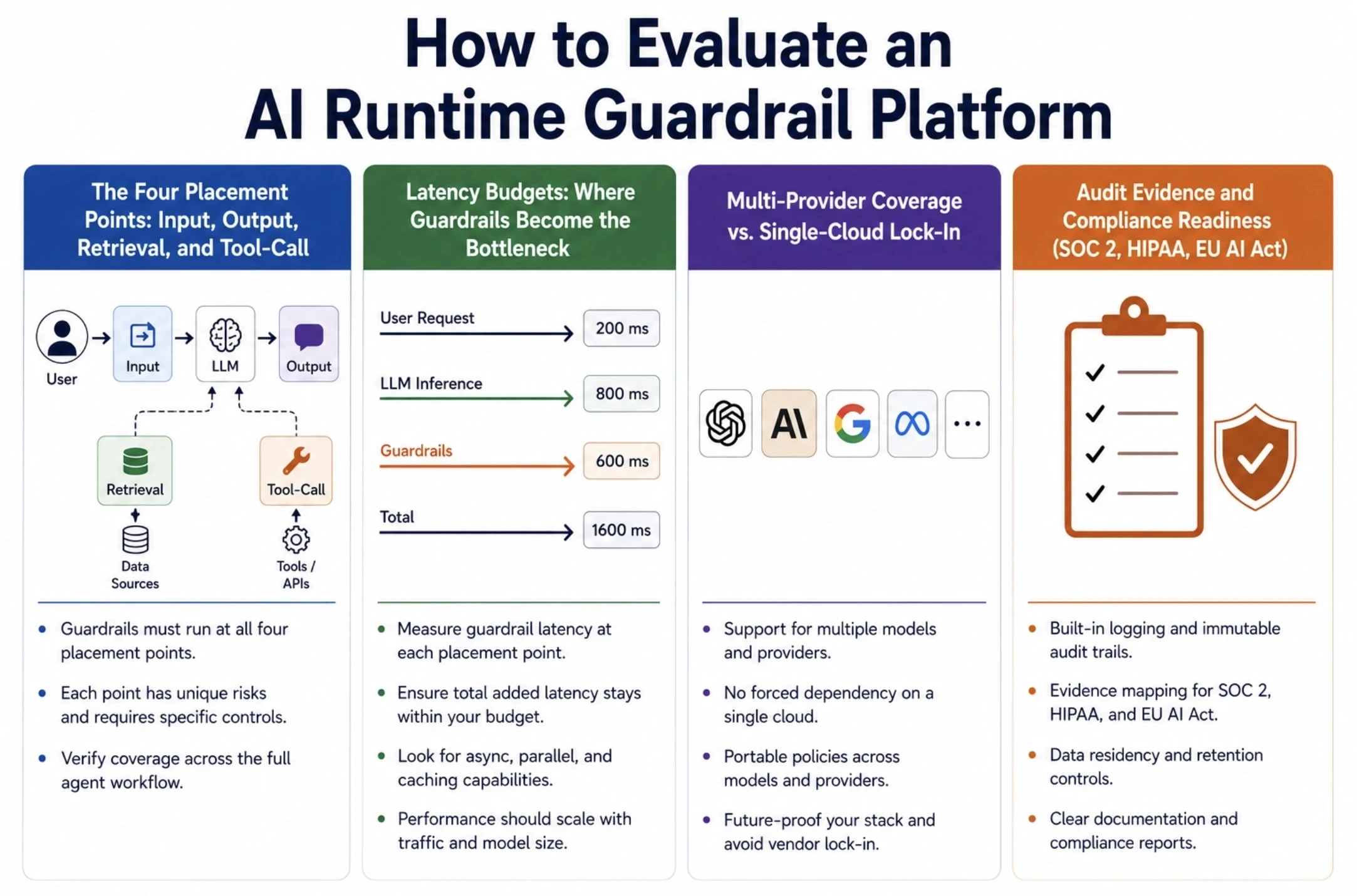
The Four Placement Points: Input, Output, Retrieval, and Tool-Call
The value of a guardrail is determined by its location in the pipeline, known as rail coverage for input, output, retrieval and tool call. Input rails check incoming user and/or upstream system prompts before they reach the user's model, which prevents prompt injection and unsafe requests. The Output Rails test the output that the model generates before it reaches a person or a downstream system, and intercept data leakage and policy violations. Specific to RAG pipelines, retrieval rails filter out documents it extracts from the knowledge base and retrieve only the content relevant to the embedded instructions before feeding it into the model's context window. The newest and most impactful category is tool-call rails, which will validate all interactions an agent makes with something that it is not allowed to interact with.
Only the first two of the above are addressed by most legacy guardrail tools. A platform that is unable to validate tool calls has a blind spot at exactly the place agentic systems have the greatest impact. There's a third and fourth stage that's required for agentic workloads that was never envisioned by tools built for the chatbot era: this is the place where dual-stage input-output validation falls short.
Latency Budgets: Where Guardrails Become the Bottleneck
All guardrail checks take time on the request path, and the overhead happens when multiple rails are chained together. There are no strict rules of thumb, but teams will typically have 100-300ms of guardrail latency overhead before users observe a lag; this threshold varies depending on use case: a customer-facing chat won't have as much "latency tolerance" as a batch job. What you should be asking every vendor for is the latency p50, which is a realistic production load, and not a best-case demo number. Purpose-built classifiers, which are run inline, typically pop up in the tens of milliseconds; guardrails that invoke a general-purpose LLM to serve as a judge routinely add a couple of seconds, which is far too long for real-time use.
Multi-Provider Coverage vs. Single-Cloud Lock-In
Very few companies are using just one model, from just one vendor, today. Multi-provider guardrails are important because a policy that is written once should be applied equally to requests to an OpenAI model, an Anthropic model, or a self-hosted open-weight model. If you are in total agreement with the cloud you are deploying to, then you can get a guardrail in place in the inference stack faster, but you also have a second layer of lock-in on top of the model lock-in you are trying to avoid. Do you need a guardrail policy to come with the request or is it stored in one provider's console?
Audit Evidence and Compliance Readiness (SOC 2, HIPAA, EU AI Act)
The other half of the equation is creating a record that a compliance team could use to block or flag something. The SOC 2 audit evidence that AI programs are becoming a requirement includes a log that contains a timestamp of what was audited, which policy was fired, and what action was taken, and the log is detailed enough to leave an auditor without having to piece it together. That maps onto frameworks that teams already use: OWASP Top 10 LLM Applications list, which catalogues the failure classes guardrails are designed to avoid, and the NIST AI RMF guardrails to be checked against, risk management around four functions: govern, map, measure, manage. For regulated buyers, EU AI Act guardrails obligations include documentation to demonstrate that the technical measures are ensuring that a high-risk system is used within its intended purpose. Regardless of detection accuracy, a platform that does not have exportable logs will not meet any of these requirements.
Chatbot/LLM Guardrails vs. Agentic Runtime Security — Not the Same Category
While marketing pages may make the distinction between agentic runtime security vs chatbot guardrails, two different tools address different problems. A large gap can be a problem when choosing a platform if a good chatbot guardrail is left exposed.
Why EDR-Style Assumptions Break Down for Agents
Traditional endpoint and network security solutions, such as CrowdStrike Falcon, were designed to be process-centric, file-centric, or network connection-centric, and use a model or signature to reason about them. An AI agent doesn't produce that sort of telemetry: The "actions" it produces are natural-language decisions converted to API calls, and what you're looking at is the intent behind a tool call, not the call. That's wide enough that vendors of the largest endpoint security products have created new lines of products without merely adding on what they already had: CrowdStrike has created an agent-focused detection capability alongside Falcon, for example, and Palo Alto Networks has developed Prisma AIRS as a runtime layer for AI agents rather than retrofitting its network security stack. If the biggest independent security vendors say that the assumptions on the EDR side don't make it over, then it's time to pay attention to those smaller security vendors promising agentic AI runtime security.
Matching the Platform to the Deployment Pattern
The type of AI runtime security solution that you are running will determine the right type of platform. One input/output classifier can be sufficient for one customer-facing chatbot in one provider. A fleet of internal agents, integrated with MCP servers and internal databases, requires something that is aware of the context of the tool call, the identity of the agent, and the cross-agent workflows – not just the content of the message. When a buyer chooses a tool created in the time of the chatbot, they typically find out of the hole after an agent has performed an unauthorized action.
Top AI Runtime Guardrail Platforms for 2026, Compared
The market for enterprise AI guardrails can be divided into six broad segments: security-native platforms built agent-first, focused classifier models, cloud-native managed services, gateway-layer products, open-source policy frameworks and evaluation platforms that have added on a guardrail layer.
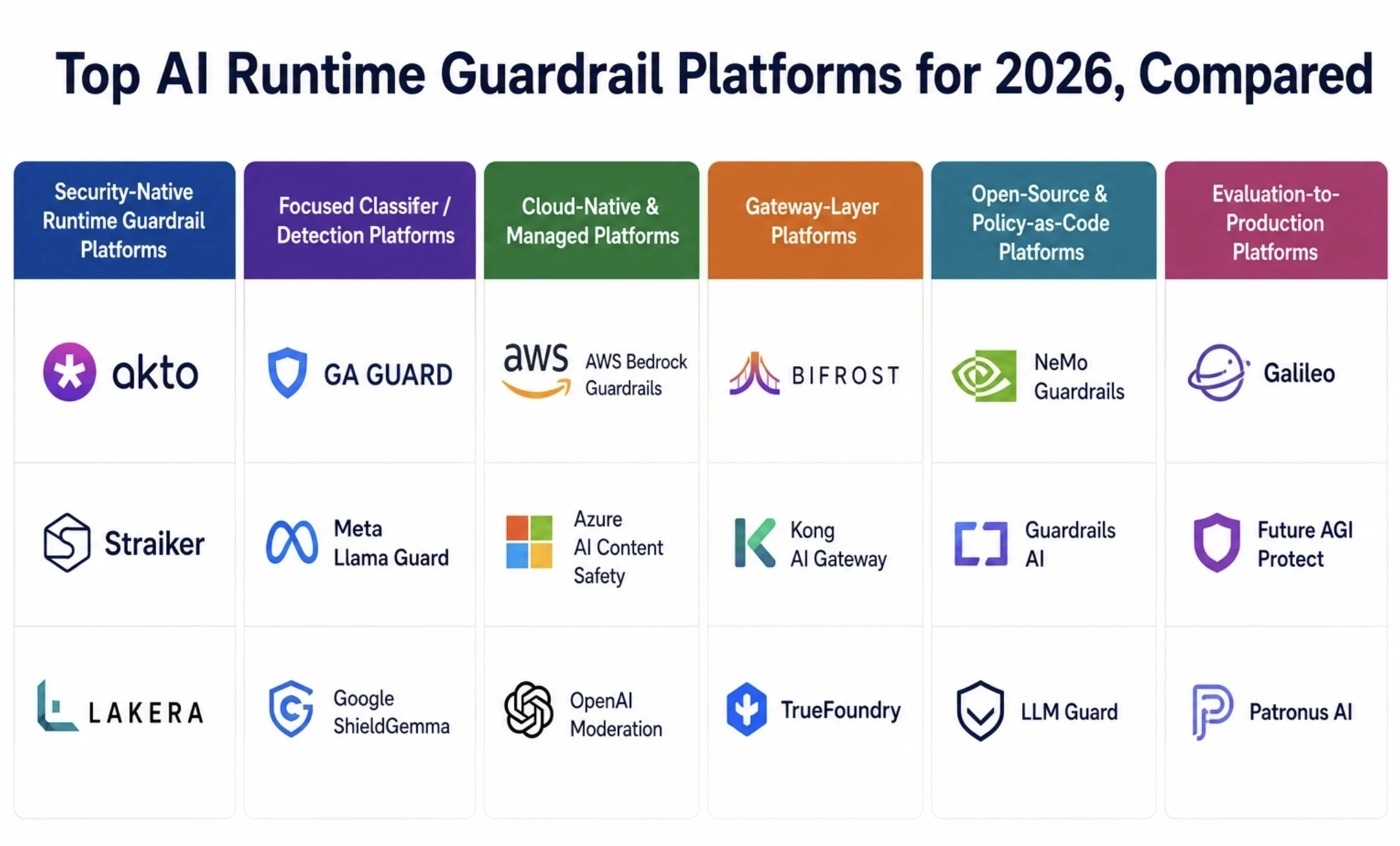
Security-Native Runtime Guardrail Platforms (Akto, Straiker, Lakera)
Akto is an agentic runtime protection system, not a filtering system on messages. It identifies MCP servers, AI agents and tools within an organisation's infrastructure and on devices, and by using a policy-driven guardrail, it intercepts every AI action, prompt, tool call, and MCP request before it is executed, and applies over 30 policy-based rules or custom and AI-based rules. Discovery and enforcement are on one platform, rather than a list that may turn stale. For the audit-readiness question above, Akto is SOC 2, HIPAA, ISO and GDPR compliant.
Similarly, Straiker has a runtime layer (Defend AI) that provides prompt injection, PII exposure and misuse of tools coverage in less than 300ms for agentic threats and less than 130ms for simpler checks, installed via a single hook, no gateway rebuild, and documented coverage for Cursor, GitHub Copilot, and Claude Code.
While Lakera Guard is not comprehensive for agentic surface, it emphasizes prompt injection and jailbreak detection, having been trained on a huge adversarial dataset collected via its Gandalf challenge with sub-50ms latency across over 100 languages. It's designed for teams that want to secure a singular LLM application instead of an agent estate.
Focused Classifier / Detection Platforms (GA Guard, Meta Llama Guard, Google ShieldGemma)
This type is the type of layer behind many products that are built on it: classifiers created specifically for the application and not as a complete product. GA Guard from General Analysis is an open-source family of classifiers trained with an adversarial pipeline which supports long-context moderation up to 256k tokens per context, and can be used for scoring full agent traces. Meta's Llama Guard, the third iteration, is an optimised safe-unsafe labeller classifier with a taxonomy-defined list of prompts and responses that is free, open-weight, and widely used as a baseline layer. Google's ShieldGemma, which is also based on Gemma, does the same for text, and in its second generation, images. None are shipped with tool-call or MCP awareness, but rather are wrapped by others with policy logic.
Cloud-Native & Managed Platforms (AWS Bedrock Guardrails, Azure AI Content Safety, OpenAI Moderation)
AWS Bedrock Guardrails is tightly integrated with Bedrock models, providing content filters, denied topics, and sensitive-information filters that are configured in the AWS console, and low friction for teams already using Bedrock. Similarly, Azure AI Content Safety is part of Microsoft's ecosystem, offering default filters, including ones for hate, self-harm, sexual, and violent content, while agentic controls are still coming to fruition. OpenAI's Moderation API is available to classify text and images at no cost and with minimal latency but is not designed to detect prompt injection attacks or authorize usage of tools. For all three, the trade is made easier because they can turn it on quickest if they are single-provider, or first to outgrow it if they are not.
Gateway-Layer Platforms (Bifrost, Kong AI Gateway, TrueFoundry)
Instead, gateway-layer guardrails are placed in the same path as the request is already routed and fails over, not as an additional service call. The open-source AI gateway, Bifrost, from Maxim AI combines LLM, MCP and agent gateway traffic behind one OpenAI-compatible API and spans 20+ providers, requiring an additional 11 microseconds per second at 5,000 requests per second; it can also be deployed in air-gapped and VPC environments. With a plugin architecture, Kong AI Gateway builds on Kong's long-standing platform by providing regex-based and semantic prompt guard plugins to help deny access to requests based on keywords or meaning and integrates with AWS Bedrock Guardrails and Lakera. With TrueFoundry's AI Gateway, you can hide behind one endpoint multiple guardrail vendors, and change them in no-click configuration, with built-in SOC 2, HIPAA and GDPR compliance, and added latency of 3-4ms.
Open-Source & Policy-as-Code Platforms (NeMo Guardrails, Guardrails AI, LLM Guard)
Policy-as-code guardrails enable teams to create rules as a versioned configuration instead of rules hidden in a vendor dashboard. The most structurally different is NVIDIA's NeMo Guardrails, which uses Colang, a purpose-built domain-specific language, to define five different types of rails: input, dialogue, retrieval, execution and output, which are used to control the flow of conversations rather than just filtering messages. Guardrails AI provides model outputs with a validator framework that imposes structure, type and quality guarantees, which is valuable when the danger is malformed output and not malicious input. Developed by Protect AI, LLM Guard is a self-hosted scanner library of 15 input and 20 output scanners ranging from prompt injection, PII, secrets, and toxicity. These three are freed to run, and engineering time is saved.
Evaluation-to-Production Platforms (Galileo, Future AGI Protect, Patronus AI)
This category began as evaluation tooling for offline analysis, and evolved to add a real-time enforcement layer. Galileo's evaluation models are distilled to run 20+ metrics at sub-200ms latency, and these same metrics that scored on evaluation can be used as guardrails in production - if the output is bad, it will be blocked. Natively multi-modal, Future AGI Protect uses four safety dimensions to scan text, image and audio content, with a median latency of 65-110ms. Patronus AI's credentials lie in its hallucination-detection model, Lynx, for use with RAG systems, and now it has a fast guardrail-grade evaluator as well as a slower, off-line judge, good for regulated workflows with a higher bar on the accuracy of the evaluators.
Comparison Table: Rail Coverage, Latency, Deployment, and Best Fit
The table below breaks down the categories above into a visual representation of the best AI guardrails 2026 has to offer, in terms of dimensions most relevant to a shortlist.
Platform | Rail Coverage | Latency (typical) | Deployment Model | Best Fit |
|---|---|---|---|---|
Akto | Input, output, tool-call, MCP | Real-time, pre-execution | Cloud, self-hosted, endpoint | Enterprise agent + MCP fleets |
Straiker (Defend AI) | Input, output, tool-call | <130ms–<300ms | SDK/hook, no proxy rebuild | Coding agents, agentic apps |
Lakera Guard | Input, output | <50ms | API | Single LLM app, prompt injection |
GA Guard | Input, output, long-context | Classifier-speed | Open-source, self-hosted | Long agent traces |
Meta Llama Guard | Input, output | Classifier-speed | Open-weight, self-hosted | Baseline safety layer |
Google ShieldGemma | Input, output | Classifier-speed | Open-weight, self-hosted | Text + image moderation |
AWS Bedrock Guardrails | Input, output | Managed | AWS-native | AWS/Bedrock-only stacks |
Azure AI Content Safety | Input, output | Managed | Azure-native | Microsoft-ecosystem teams |
OpenAI Moderation | Input, output | Low-latency, free | API | Lightweight content safety |
Bifrost | Input, output, tool-call, MCP | ~11µs gateway overhead | Open-source, self-hosted, VPC | Multi-provider, mission-critical |
Kong AI Gateway | Input, output | Plugin-dependent | Self-hosted, enterprise | Teams already on Kong |
TrueFoundry | Input, output, tool-call | ~3-4ms | Self-hosted, VPC, air-gapped | Regulated, multi-cloud enterprises |
NeMo Guardrails | Input, dialog, retrieval, execution, output | Adds ~100s of ms per rail | Open-source | Programmable dialog control |
Guardrails AI | Output structure/validation | Per-validator round trip | Open-source | Structured output enforcement |
LLM Guard | Input, output | Local inference | Open-source, self-hosted | Free, offline scanning |
Galileo | Input, output, agent traces | Sub-200ms | SaaS, VPC, on-prem | Eval-driven production guardrails |
Future AGI Protect | Input, output, multi-modal | ~65-110ms | SaaS, self-hostable | Multi-modal safety |
Patronus AI | Output, hallucination | Fast + thorough modes | API | RAG hallucination, regulated domains |
Choosing by Use Case
All of the above claim to be the enterprise's platform. The following picks are not of a general type, but rather of a specific type.
Best for Mission-Critical, Multi-Provider Enterprise Workloads
Bifrost or TrueFoundry should be strongly considered if the teams are using traffic across multiple model providers and are unwilling to accept any downtime: both allow for single-digit millisecond (or less) overhead, support VPC and air-gapped deployments, and allow policy to travel with the request, but not into the console of one provider. For agent-heavy environments where there is a need to cover both the area of the footprint and provide both tool-call and MCP coverage, Akto's discovery-plus-enforcement model provides that agent inventory piece that the gateways cannot natively offer.
Best for Coding Agents and Agentic Tool-Call Coverage
The coverage for specifically coding-agent tools is the most explicit and documented with Defend AI by Straiker, which blocks in sub-seconds and matches access control to the developer role. To authorise tool calls throughout the entire agent and MCP estate, not just the individual agent, Akto's guardrail engine prevents the call of any tools that an agent is not authorised to call.
Best for Regulated Industries Needing Audit-Ready Evidence
Regulated buyers, such as the healthcare and financial sectors, require a platform that generates structured and exportable audit logs – not simply a block/allow decision. Both TrueFoundry and Galileo record all guardrail decisions on the request trace, and platforms with SOC 2, HIPAA, and GDPR attestations as part of the box eliminate a step from the procurement process.
Best Free/Low-Cost Starting Point
For teams that haven't yet assigned a budget, there are actually open source options that are worth considering: LLM Guard covers the broadest spectrum of scanners, for free; NeMo Guardrails is best if you need to program dialogue flow control; Guardrails AI is best if it's about malformed output, not malicious input. Each of the three requires a subscription to get engineering time.
Where Runtime Guardrails Fit in a Complete AI Security Stack
The runtime guardrails aren't the entire program. They prevent bad inputs and outputs at runtime but can only apply policy once systems have been identified and tested. Because a policy that was never applied to an agent nobody knows is no use in protecting said agent, discovery must be the first step: map all the connections between AI agents, all the connections to and from MCP servers and all the tools connected. Guardrail policies also get outdated: a technique that is picked up by a policy today can be found in a variant six months later, which is why it's important for continuous red teaming to be incorporated back into policy and not just left in a report that no one reads.
Agent discovery, automatic red teaming, and runtime guardrails are all integrated into one platform, allowing a new agent to be tested in advance of trust and a finding from the red team to update the guardrail policy automatically. If you are considering tools that work on their own, that connection is the space to inspect before purchasing: Does the guardrail layer know what it is protecting, and does it continue to get smarter every time something tries to break it?
Final Thoughts: Runtime AI Guardrails
All platforms in this comparison address a subset of the running time guardrail issue, prompt injection, PII leakage, misuse of tools, or hallucinations. The decision that sticks in production is whether the guardrail is aware of what it is protecting, whether it's an agent, an MCP server, a specific model version, or whether that is maintained as your AI footprint expands each month.
With Akto, agent discovery, automated red teaming, and runtime guardrails based on policy are all part of one platform, meaning protection doesn't fall behind what's actually running in your environment. At the point of action, model behaviour, access to tools and sensitive data flow are governed by rule-based and AI-based policies, with a complete audit trail for compliance review that will always follow.
When considering a guardrail for 2026, book an AI Agent Security demo from Akto and experience the power of discovery, red teaming, and runtime enforcement in action against your agent estate.
FAQs: Top AI Runtime Guardrail Platforms for 2026
What is an AI runtime guardrail platform?
A system that monitors and sanctions AI input, output, retrieved content, and AI tool calls when the AI model or agent is deployed in production, preventing and/or detecting violations before they reach the user or the downstream system.
How is a runtime guardrail different from training-time alignment?
A model's behaviour is shaped once when it is trained. The runtime guardrails can be placed outside the model to validate all live requests against the current policy, without retraining.
What are the four placement points a guardrail platform should cover?
Input, output, retrieval (documents pulled into a RAG pipeline) and tool-call (actions an agent takes). Agentic workflows are vulnerable due to limited coverage of input/output.
How much latency overhead should an AI guardrail platform add?
Typically, most deployments can be done with a total time of less than 300ms, and purpose-built classifiers can be deployed in the tens of milliseconds. Guardrails that feed a general-purpose LLM as a judge introduce additional seconds; too slow for real-time use.
Why don't traditional EDR platforms work for securing AI agents?
EDR tools think about processes, files, and network connections. The risky behaviour of the agent is a piece of natural language that has been converted to an API call, which is why both CrowdStrike and Palo Alto Networks created a new line of products for dealing with AI-related threats instead of extending their existing EDR telemetry.
What compliance standards do enterprise AI guardrail platforms need to support?
SOC 2, HIPAA, GDPR, and ISO 27001 are baseline expectations, plus audit logging mapped to the OWASP Top 10 for LLM Applications, the NIST AI RMF, and EU AI Act documentation where applicable.
What's the difference between a gateway-layer guardrail and an application-level guardrail?
A gateway-layer guardrail is part of the network path that is already used for routing, and applies policy at the centre. Each app has an application-level guardrail that is called in the app's code, making configuration a copy everywhere.
Can one guardrail platform cover multiple LLM providers, or do I need one per provider?
Most of today's platforms are model-independent. Cloud native equivalents, such as AWS Bedrock Guardrails and Azure AI Content Safety, are the exception and are linked to their cloud's hosted models.
What is the EU AI Act's deadline for high-risk AI system obligations?
The deadline was originally August 2nd, 2026. The EU's Digital Omnibus adopted in mid-2026 extended the Annex III deadline to December 2, 2027, and the GPAI obligation took effect in August 2025, and transparency obligations remain this December.
Which AI guardrail platforms are open source vs. commercial?
NeMo Guardrails, Guardrails AI, LLM Guard, GA Guard, Llama Guard and ShieldGemma are open source/open-weight. Commercial: Akto, Straiker, Lakera, Galileo, Future AGI Protect, Patronus AI.
Do coding agents need different guardrail coverage than chatbots?
Yes. Coding agents execute file writes, shell commands, and repository actions a chatbot never touches, needing tool-call and role-based access coverage on top of content filtering.
How do I choose between a focused classifier and a full gateway platform?
A Llama Guard classifier will place one specific check within an existing pipeline. Once you have a single point of managing policy across multiple applications and agent fleets, you'll need a full gateway platform.
What audit evidence should a guardrail platform generate by default?
A record of the inspection, the policy that was triggered, what action was taken, and sufficient context to be able to recreate the decision which was made and handed to an auditor directly.
Are AI agent guardrails and AI runtime security platforms the same thing?
They overlap, but do not match. AI agent guardrails are a type of AI runtime security platform, which also includes discovery and red teaming.
How does Akto's approach to agentic runtime protection compare to standalone guardrail platforms?
Standalone tools check the messages for a fixed policy. Akto combines a guardrail engine with continuous agent and MCP detection and automated red teaming, meaning that policy is enforced on a live inventory and policy is updated by results of tests.

Experience enterprise-grade Agentic Security solution