Prompt Injection Defense for AI Agents and MCP Tools
Learn how to defend AI agents and MCP tools against prompt injection with proven security controls, testing strategies, and enterprise best practices.

Rushali

AI agents are gaining momentum from experimental copilots to systems capable of reading emails, asking questions of databases and internal systems without human input. It's this autonomy that makes prompt injection so dangerous. The wrong prompt can lead a chatbot to say the wrong thing. An agent can be fooled by the same prompt and send data out, make edits to a record or trigger a payment API. Prompt Injection Defense is now a board-level issue as AI agents are now embedded in real workflows connected via MCP servers and third-party tools that add to the attack surface with each new integration. This article explains why the traditional filtering approach is ineffective, the order of defense layers, threats to consider, and the actual shape of a production-ready AI agent security.
Why Prompt Injection Is a Critical Enterprise Risk
The moment enterprises began to entrust AI systems with the ability to take action, rather than just respond, prompt injection became more than a theoretical risk of language models. When an agent can call a tool, touch a database, or send a message on somebody's behalf, a manipulated prompt becomes an operational security incident rather than something embarrassing that's produced.
Why AI agents are different from chatbots
A chatbot creates text. An AI agent is the agent that plans, decides, and executes. It can contain credentials, make calls to APIs, link several steps together, and frequently persist memory from one session to the next or from one session to another completely. At the heart of Agentic AI is the ability to reason about a desired objective and execute that objective autonomously and independently, using tools as necessary and with only limited human oversight of each individual step. It's the whole agency thing, and an attacker uses it to their advantage. If the injected sentence in a chatbot succeeds, it generates a bad sentence. This is because a single successful injection into an agent can result in a bad action, so AI Agent Security needs to think about execution, not just generation.
Why traditional prompt filtering is no longer enough
The majority of the initial defenses were designed to block a much more basic attack model: a denylist of bad phrases, a regular expression for accepted jailbreak strings, or even a new classifier trained on a few examples of attacks. Those approaches only work for pre-known attacks; they fail if they're paraphrased, encoded tricks, encoded input in another language, or instructions hidden within a document or a tool's answer, not entered by a user. Static filtering can also have no idea of what happens after the prompt is accepted; it cannot know that an agent will call a tool it hasn't called before, or that it will pass data to a different destination than is typical. Real defense must go beyond the input box and apply in execution.
Why Traditional Defenses Fail for Agentic AI
To begin with, one must realize that all prompt injection is not alike when it comes to older controls. Some of it comes from a user, and some of it comes from an indirect source, hiding inside content to which the agent had no reason to distrust.
Direct vs. Indirect Prompt Injection
Direct prompt injection occurs when an attacker types an instruction directly into the chat window or API call to attempt to bypass the system prompt or to have the model disregard its instructions. It is the most obvious type of AI Agent Prompt Injection, and the type that most current filters are designed to detect. Indirect Prompt Injection is a different story: The attack is inserted into a web page, PDF, email message, support ticket, or data returned from a tool the agent uses and is retrieved as part of his or her work without an attacker being involved in the conversation. The same result can be achieved via either path, but indirect injection is the one that is least prepared for by enterprises because it doesn't appear like an attack at the point of entry.
Why Indirect Prompt Injection Is Harder to Detect
Indirect injection is difficult to detect since the malicious text is embedded in normal text the agent was already expected to handle. A hidden instruction in a product review, calendar invite, or API response can tell the agent to exfiltrate, call a different tool - and the surrounding text doesn't look suspicious to a keyword filter. It's a variation of ‘Context Manipulation’: the attacker does not attack the model directly, but they modify the information that the agent relies on, and the model follows the context as valid, only to end up on a path towards a dangerous action.
The Unique Threat of MCP Tool Poisoning
The Model Context Protocol has become much easier to use for connecting agents to external tools, with a new breed of risk: MCP Tool Poisoning. When the agent evaluates which tool to call, it may read and follow hidden instructions in the description or metadata field of a tool published by a malicious or compromised MCP server, with a legitimate-looking name. It is a more dangerous gap in current MCP Security practice because the description of tools is considered trusted configuration, rather than untrusted input; one that most application-layer defenses were never designed to examine.
Multi-Step and Multi-Turn Attack Chains
Agents don't all fall in one fell swoop. A more realistic attack sets an instruction in an early part of a session, allows it to remain in memory or context, and waits until a later step or another turn to cause the harmful action, which will often be given permission for by the agent at a previous step. The trouble with these multi-step chains is that they don't seem to be particularly alarming when they're separate. The sequence of each tool call can seem innocuous when taken individually; only when seen in concert does it show an attacker walking the agent to data exposure or what he was never meant to see yet.
A Layered Framework for Prompt Injection Defense
Prompt injection is not defeated by a single control; multiple layers of controls must be applied to achieve a multi-layered approach that prevents prompt injection. The three layers below cover the complete life cycle of a request, from before it reaches the model, through the life of the agent acting on the request, back to before the response leaves the system.
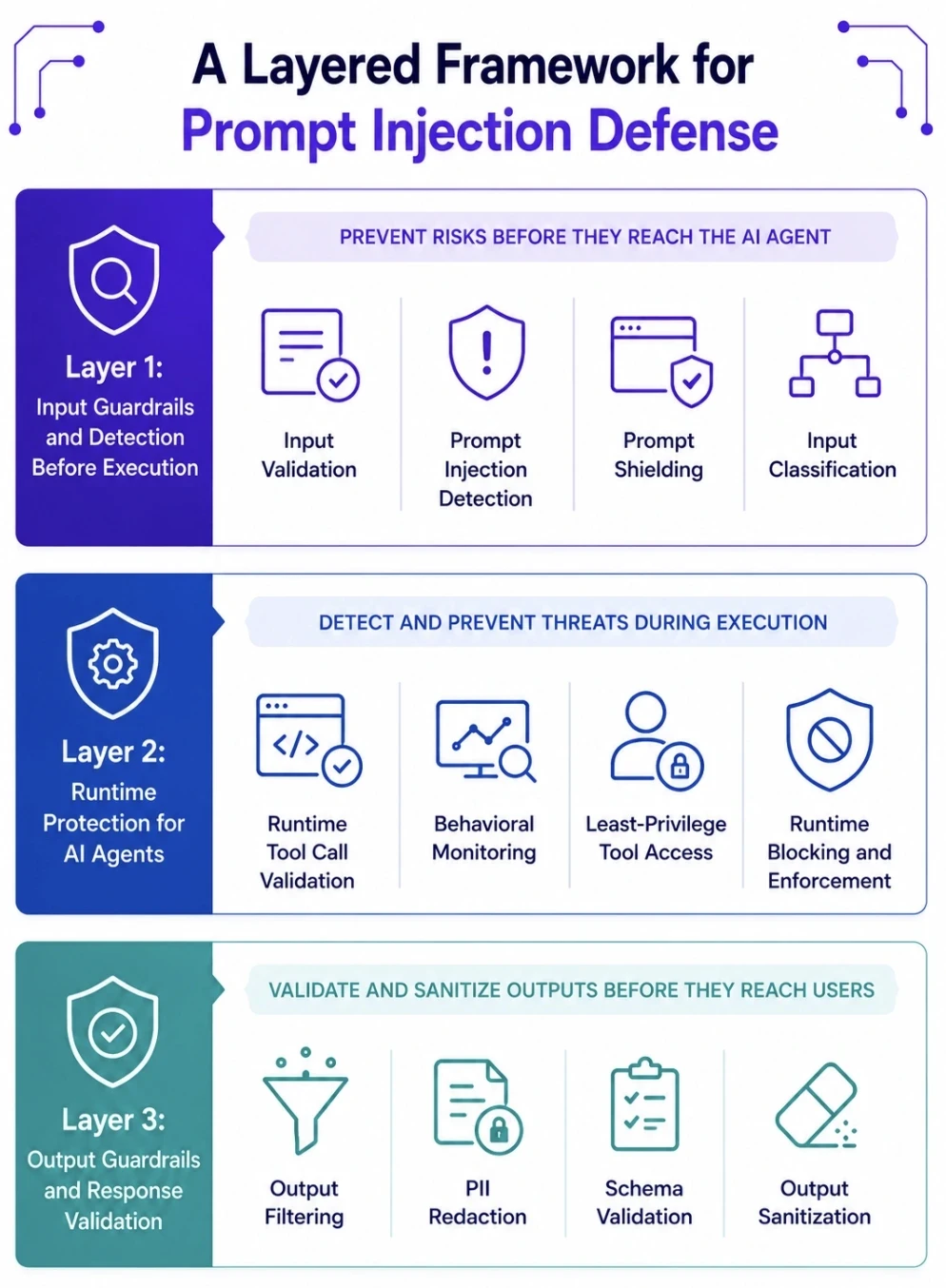
Layer 1: Input Guardrails and Detection Before Execution
The first layer operates on all inputs to the system, from user, document, or connected tools.
Input Validation: Ensuring incoming data is in the correct format, length, and type before the data is passed to the model, rather than getting passed through downstream boundaries without being recognized as incorrect or too large.
Prompt Injection Detection: Flagging instructions that try to change the behavior of the system with prompt injection, as opposed to generic content moderation, by using classifiers and pattern analysis specifically trained for prompt injection detection.
Prompt Shielding: Enclose untrusted content, such as documents retrieved from the internet or the output of a tool, in a manner that makes it easily identifiable as separate from trusted ones; make the model see it as data to consider, not instructions to follow.
Input Classification: Classifying inputs by sources and trust levels (user-provided, retrieved, tool-returned), allowing the lower trust levels to be automatically subjected to a higher level of scrutiny.
Layer 2: Runtime Protection for AI Agents
The second layer monitors the agent as it works, as this is where intent becomes action.
Runtime Tool Call Validation: Validate that all calls are made with valid parameters, valid tools, and valid task context at runtime in order to catch calls that are not consistent with what the agent should be doing at that step.
Behavioral Monitoring: Try to set a baseline of the way that an agent normally operates and, when a change happens, such as an unusual sequence of tool calls or a sudden increase in data volume accessed, flag the change.
Least-Privilege Tool Access: Minimize the access that agents have to tools and data, so even if the injection is successful, the damage radius is small rather than large.
Runtime Blocking and Enforcement: The ability to actively prevent a suspicious activity in real time, instead of just recording it, between the alert that no one sees in time and the attack that never takes place.
Layer 3: Output Guardrails and Response Validation
The third layer verifies the information that the agent intends to send back to the user or data to another system.
Output Filtering: The responses that were given when the model was scanned were checked for any evidence that the injected instruction was successful - e.g., leaked system prompts or unexpected formatting that indicated that the model had executed a hidden command.
PII Redaction: Detecting and masking all personal or sensitive data prior to it leaving the system – whether legitimately obtained or pulled out through manipulation.
Schema Validation: Validation of structured outputs (such as API payload or function call arguments) before execution downstream based on the corresponding schema.
Output Sanitization: Remove or sanitize any executable content, markup or embedded instructions from a response before displaying or sending it to another agent or tool.
Detection vs. Blocking: Why Runtime Enforcement Matters
Not every AI security solution is created to do the same thing, and the distinction between detection and prevention is most important in production.
Detection-Only Tools
Detection-only platforms are capable of analyzing traffic, logging suspicious traffic prompts, and generating alerts for a security team to review. Useful for viewing and investigation, but they work post-event; when an analyst has read the alert, the agent may have already called the tool, moved the data, or taken the action that the injection was intended to cause.
Runtime Blocking Platforms
Runtime blocking platforms are integrated into the execution path and assess a tool call, prompt or response as it is executed, preventing the ones that violate policy from finishing. This is Runtime Enforcement in action: the system doesn't just tell you something went wrong; it will not let it even get to the completion stage.
Why Enterprises Need Both Visibility and Enforcement
Enforcement is essential for visibility, or there is a gap between detection and damage. Implicit enforcement leaves decisions undecided without the sense of context to fine-tune them or to look back on them later. To achieve this, both components must work together: complete visibility of what agents and MCP tools are doing coupled with the runtime authority to block a bad action before it runs. This pairing is woven right into the fabric of Akto: Real-time discovery and monitoring of AI agents and MCP tools, with runtime guardrails that can block a malicious prompt, tool call, or data exposure before it can be executed.
Prompt Injection Attack Vectors Every Enterprise Must Defend Against
The first step in creating a defense program is to have a plan of what the program is going to defend against. The following vectors are the most frequently observed ones in the real world of agents and MCP deployments.
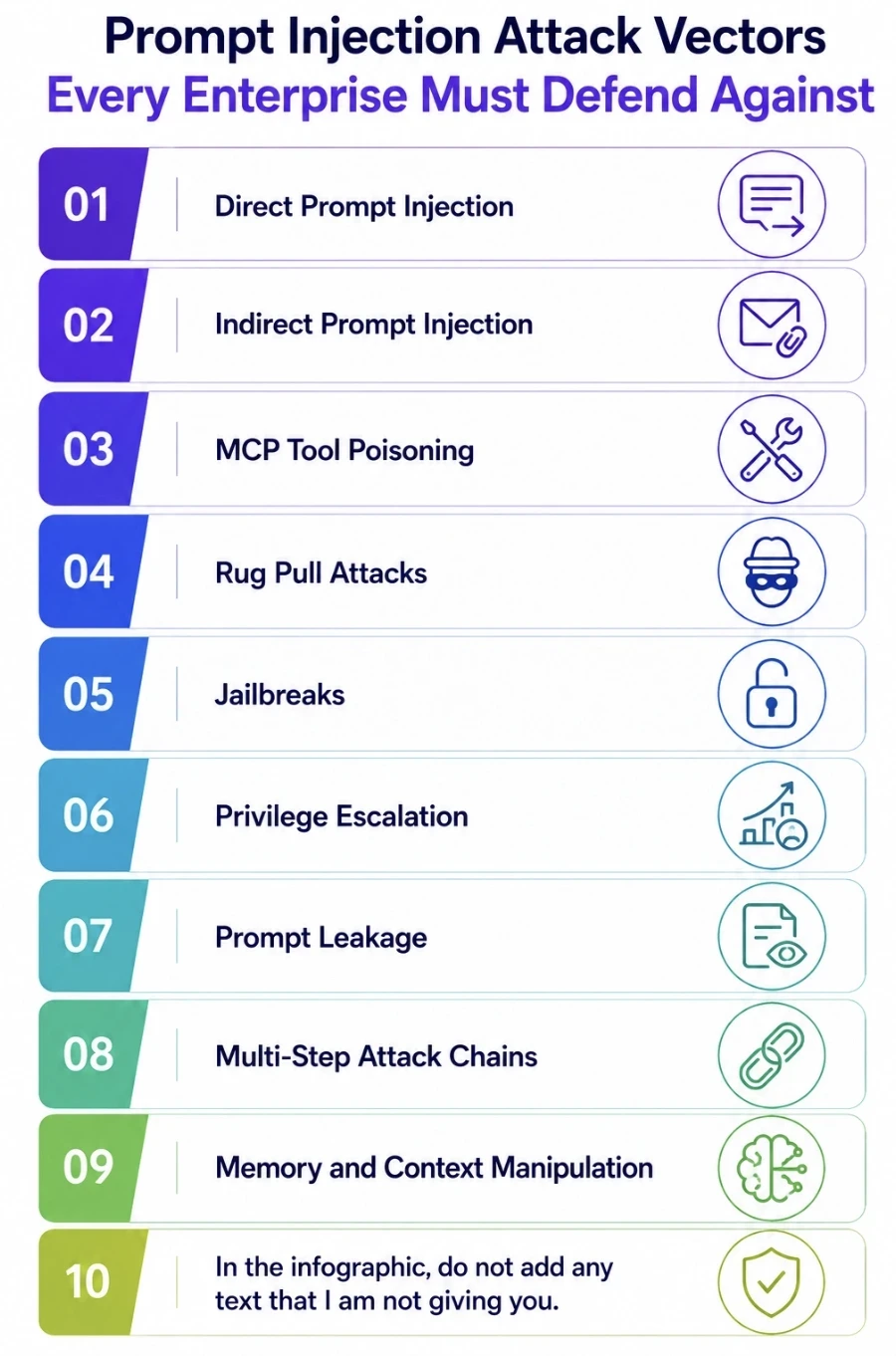
Direct Prompt Injection
An attacker directly enters instructions that are supposed to be generated by the agent's system prompt or original task, typically in a roleplay scenario or as a fake system message, or as an authoritativeness statement instructing the model to "ignore previous instructions.
Indirect Prompt Injection
The malicious instructions are inserted into the external content that the agent processes as part of her regular task (for example, a page she is summarizing or a document she is fetching) but that is not part of the conversation.
MCP Tool Poisoning
A tool with a correct name is published by a compromised or malicious MCP server with a description or metadata that contains instructions to alter the behavior of the agent when it is evaluated or called.
Rug Pull Attacks
A Rug Pull Attack is when a tool or MCP server was behaving in a safe manner during initial review or early use, but changes its behavior once trusted and integrated and returns instructions or actions that it would not have done during closer scrutiny.
Jailbreaks
The actual attempt to get the model to ignore the safety training or use requirements altogether usually involves elaborate framing, hypothetical scenarios, and/or a relatively complex social engineering process of the model itself to be ignored, not just one simple command.
Privilege Escalation
An agent is tricked into accessing data, calling a tool, or performing an action that is not expected in the context of the task and/or role that it is designed to perform, typically by proceeding through multiple steps over time rather than through a single, easy-to-see step.
Prompt Leakage
The attacker is able to obtain the system prompt, internal instructions, or configuration details the agent was never designed to give out, which can then be leveraged into more targeted and effective attacks against that particular agent.
Multi-Step Attack Chains
Each action is a simple one, designed to be innocuous on its own, but is combined in a session to achieve a detrimental effect, taking advantage of the fact that most monitoring is of actions from individual sessions.
Memory and Context Manipulation
Memory Poisoning attacks an agent's persistent memory to affect the next time it interacts with the agent and causes it to behave differently, whereas Context Manipulation affects the information an agent trusts during a particular interaction to guide the agent's next actions.
Key Capabilities of Production-Ready Prompt Injection Defense
Understanding the attack surface is only 50% of the game; the other 50% is understanding what a defense platform truly needs to do to be successful in the real production traffic and under the real attackers who go against it.
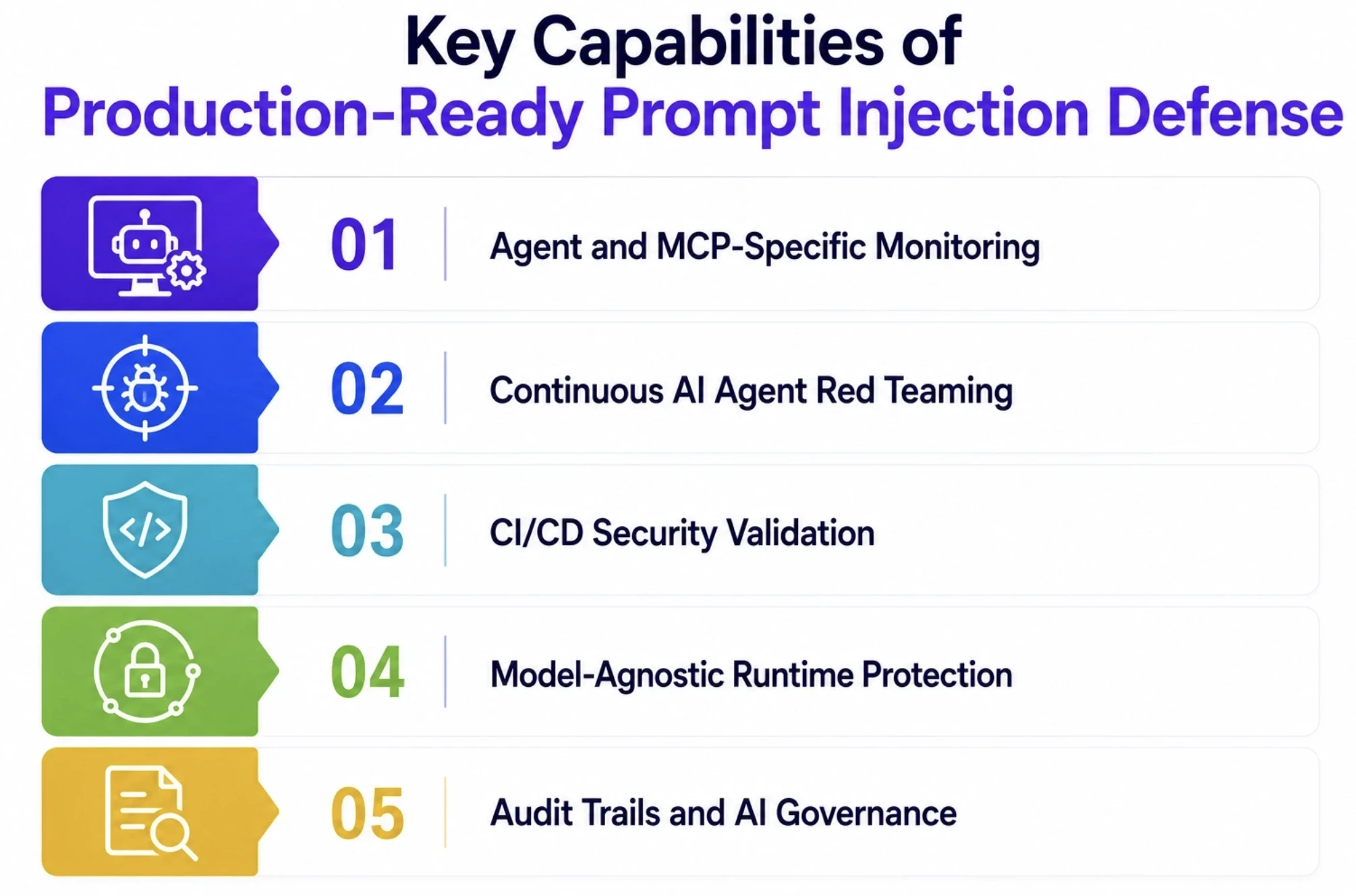
Agent and MCP-Specific Monitoring
Built for application monitoring, generic application monitoring was not designed to handle tool calls, agent reasoning steps, or MCP message flows. Monitoring designed for these types of structures is essential to production-ready defense, and combined with AI Discovery, which can discover all the agents, MCP servers, and tool connections in an environment – even those that were not explicitly approved.
Continuous AI Agent Red Teaming
Once you've done a static test, you've only done half the work, and it's only as if your security is safe, as both agents and the threat landscape are constantly changing. AI Agent Red Teaming is a constant simulation of real attack techniques against real or simulated agents, mapping to frameworks such as the OWASP LLM Top 10, to ensure weaknesses are exposed in guardrails before an actual attacker does.
CI/CD Security Validation
Injection resistance should not be a manual test before a major release; it should be checked automatically upon any change of agent, prompt, or tool configuration. Running security tests as part of CI/CD helps to identify regressions in guardrail effectiveness early in the process.
Model-Agnostic Runtime Protection
No enterprise standardizes to one model or one agent framework in particular, and any defense that only works with one vendor's stack can become a blind spot the second the team switches to the new one. AI Runtime Protection must work with a variety of LLMs, agent frameworks, and MCP implementations—and changing or using a mix of these does not require redoing the security layer from scratch.
Audit Trails and AI Governance
All prompts, tool calls, and blocked actions must be recorded in a manner that can be investigated, reported, and refined over time for compliance. The main principle behind AI Governance is that having one is essential if you want to be able to demonstrate what an agent did, why a block came up, or whether a policy is truly having the desired effect.
How Akto Delivers Prompt Injection Defense
Unlike any point along the chain, Akto is an AI agent and API security platform that tackles prompt injection as a problem across the entire lifecycle—from discovery, testing, and runtime enforcement.
Discover AI Agents, MCP Servers, and Shadow AI
AI agents, MCP servers, tools, and connected resources are automatically discovered and cataloged across cloud environments, employee endpoints, and internal infrastructure by Akto. That means Shadow AI: agents, copilots, and MCP connections not officially approved or monitored by a security group, where the highest unmanaged risk is typically found.
Continuously Test AI Agents with Red Teaming
Akto automatically conducts continuous red teaming against AI agents, LLMs, and MCP servers, simulating real attack techniques such as prompt injection, using tools inappropriately, privilege escalation, and unsafe multi-step behavior. Tests are aligned with known standards such as OWASP LLM Top 10, providing a framework for security teams to validate guardrails as opposed to conducting manual tests.
Protect AI Agents with Runtime Guardrails
Akto guards against prompt injection, credential exposure, and the leakage of sensitive data at the execution layer, and it stops it in its tracks to prevent it from ever happening, not just after it has happened. Policies limit the actions that can be taken in a tool call, data access, or output in a live execution.
Enforce Policies Across AI Agents and MCP Tools
Akto is also located between an agent and the MCP tools it uses, enforcing authentication and tool-level authorization, and also tracking the paths agents take to ensure rogue behavior or privilege escalation is detected during the execution of the tool, instead of after the fact during a post-incident review. Akto is recognized as one of the representative vendors in Gartner's API and AI agent protection Market Guide research and can be deployed in a cloud-managed or open-source, self-hosted manner.
Final Thoughts: Build a Runtime-First Prompt Injection Defense Strategy
Prompt injection cannot be fixed with a new filter at the front door. It needs multi-layered defense at all points of input, execution, and output; ongoing testing that keeps pace with the agents' own development and the attackers', and run-time enforcement that can prevent a bad action from completing, rather than explain what it does. The more agents become autonomous, and more tools come through MCP, the more it becomes a runtime-first approach.
Akto unifies discovery, continuous red teaming, and runtime guardrails and gives security teams visibility and enforcement power for this threat in one platform designed for AI agents and MCP tools. Schedule an AI agent security demo and discover how Akto can enhance your prompt injection protection approach.
Frequently Asked Questions
What is prompt injection in AI agents?
Prompt injection is the practice of tricking the AI agent to perform an action, expose information, or produce content that would otherwise not be generated by the agent, either by instructing the model directly or by embedding instructions in content the agent processes.
What is the difference between direct and indirect prompt injection?
Direct prompt injection is a user's type-in version of an override instruction. In indirect prompt injection, the agent reads content outside of the conversation, e.g., a document, page, or tool response, which contains the prompt, and there is no attacker in the conversation.
Why are AI agents more vulnerable than chatbots?
Agents do not only produce text, but they also contact tools, access data, and take real actions; in many cases, multiple actions and with standing credentials as well. Even though you may have a successful injection into a bot, the injection is likely to result in a negative impact in the real world, whereas a successful injection into a chatbot is likely to result in a negative response from the chatbot.
What is MCP tool poisoning?
If a malicious or compromised MCP server publishes a tool with a real name but a poisoned description or a hidden instruction in the tool's metadata field that affects the agent's behavior on evaluation or invocation of the tool, then it is said to be poisoned.
How do runtime guardrails prevent prompt injection?
Runtime guardrails compare the tool calls, prompts, and outputs as they're executed with policy rules at runtime and prevent the action from completing if there is a violation. This enables a system to be able to deny at runtime a malicious tool call or data exposure, instead of just picking it up from logs later.
What is the difference between prompt injection detection and prompt injection prevention?
Detection identifies and logs unusual activity to be reviewed, usually after it has happened. For agents that are capable of taking irreversible actions within seconds, it's best to stop the harmful action from happening at all, which is the prevention part of the equation: runtime blocking and enforcement.
How does AI agent red teaming test prompt injection defenses?
AI agent red teaming deploys simulated attacks against an agent, such as direct and indirect prompt injection, tool poisoning, or multi-step manipulation, in a controlled setting to determine if the agent's guardrails are effective, and to generate details of weaknesses to be addressed before they are exploited by real attackers.
Why do enterprises need runtime AI security?
Pre-deployment testing alone can never find all of the scenarios because the behavior of agents, tools connected to them, and techniques used by attackers evolve after deployment. Runtime AI security is constantly monitoring and enforcing policy on real agent activity to detect problems that may only manifest when a system is in production.
How do you secure MCP-connected AI agents?
Getting MCP-connected agents to work means finding all the MCP servers and tools that any agent can contact, and ensuring that tool calls and authorization work at runtime, monitoring for unusual or poisoned tool activity, and making sure that once it is connected, it will have limited power to do damage.
What should organizations look for in a prompt injection defense platform?
The platform should include discovery of agents and MCP tools, ongoing red teaming, identified by recognized frameworks, with runtime enforcement that can block violations when they occur, and audit trails that can be used to facilitate governance and compliance reporting.

Experience enterprise-grade Agentic Security solution