Shadow AI Visibility: How Security Teams Govern Employee AI Usage
Discover how security teams gain Shadow AI visibility, identify unauthorized AI tools, enforce governance, reduce risk, and secure employee AI usage.

Rushali

The employees have embraced GenAI sooner than most security teams have started monitoring it. Attached to almost every laptop in the enterprise are ChatGPT tabs, AI browser extensions, locally spun-up MCP servers, and sanctioned software. Much of this goes on without the IT folks knowing about it, without a security review, and without anyone noting what data went where. This is Shadow AI, and it's one of the quickest-growing blind spots in enterprise security.
The first step in solving that blind spot is to make Shadow AI visible. An AI system that employees are using that security teams are not aware of cannot be controlled by security teams, and an AI system designed for the pre-AI world cannot control employees' use of AI. In this article, you will learn what Shadow AI is, why it is important, and a four-step process to get from “visibility” to “enforceable” AI governance.
What is Shadow AI?
Teams must first have a common understanding of what they will be governing before they can develop a governance program. The two sections that follow delineate the distinction between Shadow AI and the risks faced by the IT industry prior to its advent, and also detail why this blind spot is growing so rapidly.
How Shadow AI Differs from Shadow IT
Shadow IT refers to employees signing up for unsanctioned SaaS apps or messaging platforms without a procurement process. It was a visibility issue, but a fairly simple one: It was available on a device, or it wasn't, and it had data on it that IT could eventually find.
Shadow AI carries with it that same disapproval, but with a different sense of risk. Generative AI tools are not only storing data, but they are also transforming and even taking action on it. If a customer contract is pasted by a staff member into an approved chatbot, or it is read to a third-party model from a browser extension without any user being aware of it, there is exposure the moment it occurs and not postponed to a time later when there is an audit of a server. Shadow AI also spreads via personal accounts and to applications already on the market that have AI integration features, making it more difficult to differentiate between sanctioned and non-sanctioned.
Why Shadow AI Is Growing Across Enterprises
There is growth from three forces. The benefits of using an AI tool are tangible and immediate, and they can boost productivity, so that employees are incentivized to use it without needing to get approval from their boss. Most only involve a browser tab or a free sign-up – eliminating friction in the way that once hindered unauthorized adoption. But while security teams are still defining their AI governance playbooks, policy comes after adoption, not before.
This leads to an upside-down approach to the uptake of AI, where bottom-up uptake leads to top-down oversight. AI-powered tools like generative AI, AI copilots, and autonomous AI agents appear in people's workflows, all before security has even approved, tested, or even inventoried them.
Why Shadow AI is a Critical Enterprise Security Risk
Shadow AI is not only an oversight problem but a real exposure problem, both data and compliance-wise and technically speaking. The five risk areas listed below are the most common locations of that exposure.
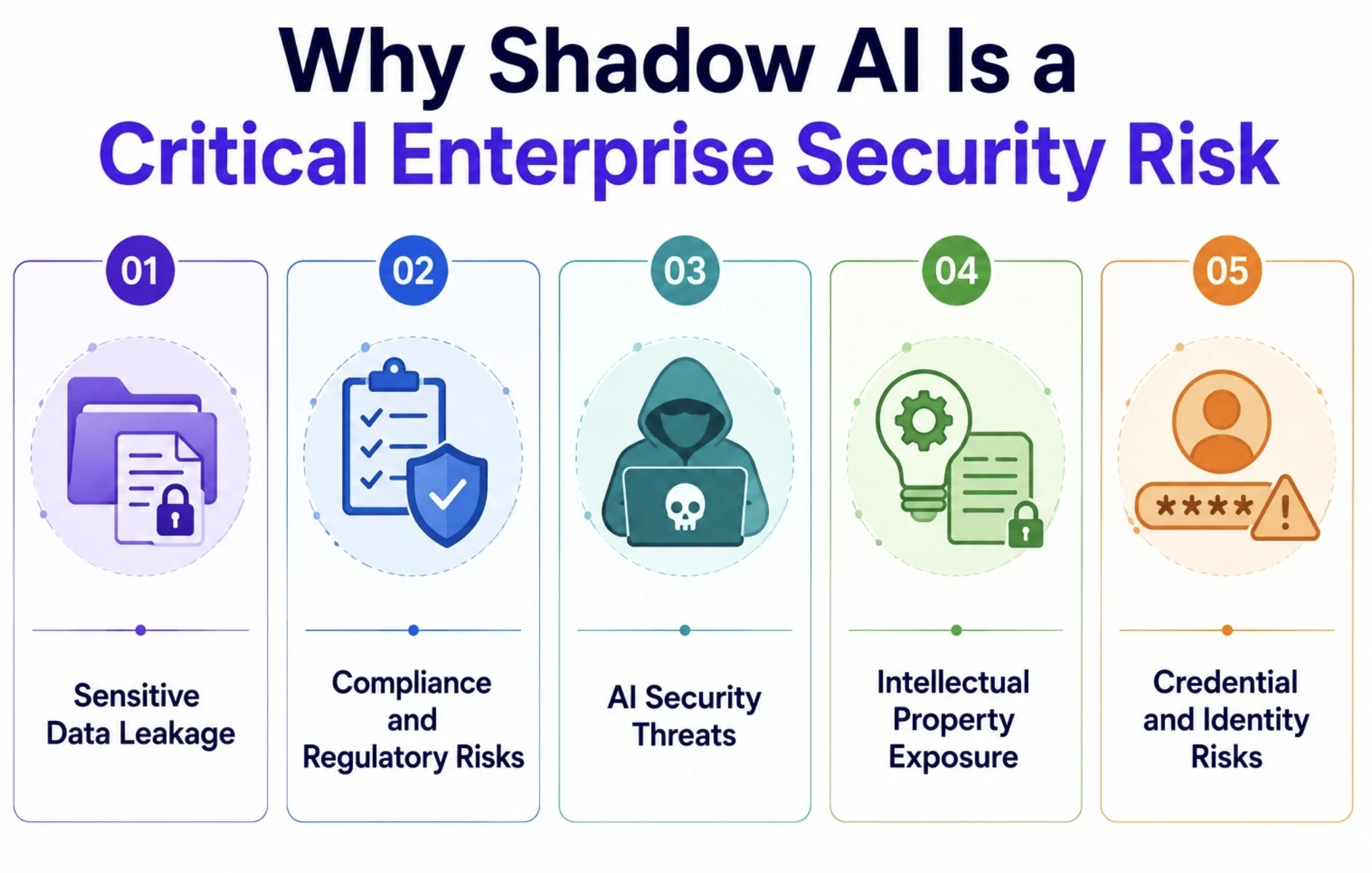
Sensitive Data Leakage
The first danger is that data will walk out the door in a prompt box. Staff consistently enter source code, financial models, and customer PII into these AI tools without being aware that these are not data handling or retention-approved sources or models. After the data exits the organization, there's typically no mechanism for getting it back, eradicating it, and verifying the use.
Compliance and Regulatory Risks
Uncontrolled AI use brings direct exposure to laws such as GDPR, HIPAA, and industry-specific data protection laws. Without a processing agreement, an employee might be putting regulated data into an AI tool without realizing the company is in violation, and neither the security team nor the legal team will find out until an audit brings it to their attention.
AI Security Threats
Traditional security tools have also not been designed to handle the attack surface created by Shadow AI. Unsanctioned AI Agents, MCP Servers, and assets can be misconfigured, over-permissioned, or susceptible to prompt injection, and all of this isn't identified in a typical Vulnerability Scan because they were never cataloged in the first place. Closing that blind spot is where Shadow AI security programs excel.
Intellectual Property Exposure
Source code, product roadmaps, and proprietary algorithms submitted to AI tools are often only checked for "just a quick check" and can be seen on infrastructure that the organization does not control, or in ways that can be difficult to trace back to the original leak. This is a serious challenge to the business for companies whose competitive advantage relies upon IP protection, rather than a mere compliance issue.
Credential and Identity Risks
The AI browser extensions and desktop apps typically ask for comprehensive permissions or long-term access to other accounts, email, and cloud storage. Standing credentials security teams are unaware of, cannot rotate on a regular basis, or often forget to revoke because the employee transitions or leaves the organization are created by employees when granting that access without prior review.
From Visibility to Governance: A 4-Step Framework
Knowing about the risk is one thing. Knowing about the risk is one thing. Creating a program to get it down is another. Creating a program that actually does it is another. The framework below takes a security team from having no idea what AI exists, all the way to identifying AI, to managing its use, in four steps.
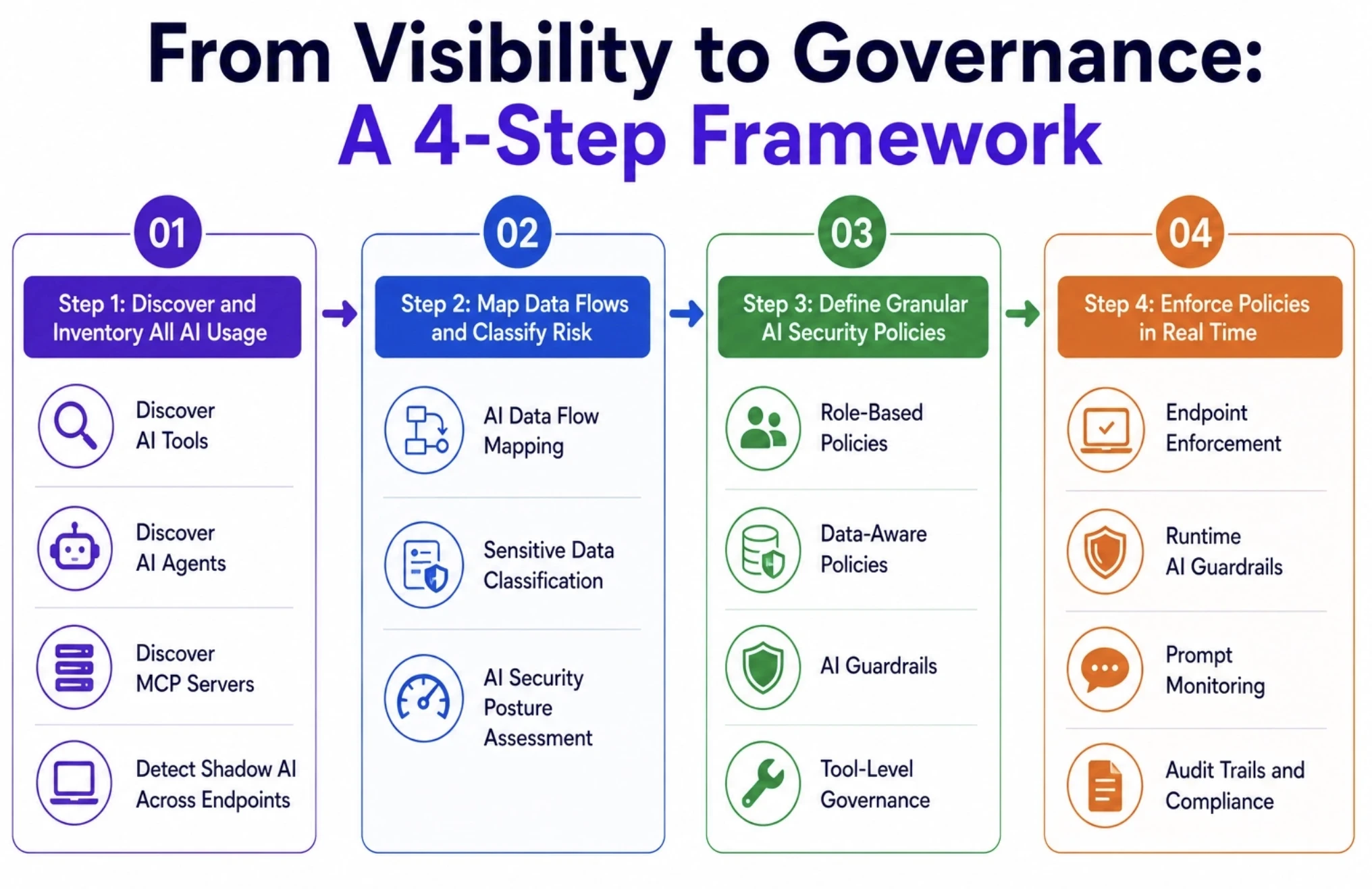
Step 1: Discover and Inventory All AI Usage
Discovery needs to go to all layers where AI appears, other than the browser tab that's easiest to track. However, each tool, agent, MCP server, and endpoint activity requires a discovery pass.
Discover AI Tools
First, document all the generative AI tools currently in use: sanctioned tools like copilots, and free tools that employees discover themselves. At this point, the AI discovery should include browser-based tools, as well as desktop applications and AI capabilities within existing SaaS apps that have been approved.
Discover AI Agents
Single-turn chatbots are not the same as autonomous AI agents, which are capable of actions and can call tools on the user's behalf. Inventorying AI agents involves monitoring the tools they have at their disposal and the systems with which they are integrated.
Discover MCP Servers
The standard method to link AI agents to internal tools and data is to deploy them with MCP servers, which are usually deployed on the local machine without being registered anywhere. Finding MCP servers, such as those on individual laptops, fills a hole that most traditional asset inventories leave.
Detect Shadow AI Across Endpoints
Shadow AI detection must take place where the use takes place - the endpoint, the browser, and throughout IDEs where developers test AI coding tools. Endpoint monitoring and browser monitoring collect locally installed AI apps and extensions that don't interact with a network log that a security team would normally monitor.
Step 2: Map Data Flows and Classify Risk
It's one thing to know we have an AI tool and another to know what it has access to. This step links each tool, agent, or MCP server found to the data it interacts with and assigns a level of risk to this link.
AI Data Flow Mapping
All AI tools and agents should be linked to the data they can access as well as the data they can store, such as SaaS connections, internal databases, and any retrieval-augmented pipeline they pull data from. RAG discovery is particularly important, as a chatbot that is linked to an internal knowledge base is at risk in a different way than a standalone AI chatbot.
Sensitive Data Classification
After the data flow map is completed, define what is moving in the data flow. Each type of PII or credentials, financial data, regulated health, or payment information has a distinct obligation, and a blanket "sensitive vs. not sensitive" designation is not granular enough to base policy upon.
AI Security Posture Assessment
Combining discovery and classification provides security teams with an AI security posture assessment: One place to see all AI assets, what they can access, and how exposed they are. This is the standard to which a governance program will compare itself over time, and it is typically where misconfigurations and over-permissioned tools first appear.
Step 3: Define Granular AI Security Policies
To establish the policy layer, visibility and risk classification are performed. This is where security teams convert their learning into rules that are actionable enough to be applied.
Role-Based Policies
AI access should be tailored to the needs of each employee. While a marketer working on content for external audiences may be subject to different risks than an engineer using an AI coding tool plugged into production repositories, policies shouldn't be treated as one size fits all.
Data-Aware Policies
Policies must also respond to the data, not the role. An AI tool may be permitted to summarise any public marketing content, but blocked from analyzing content marked as customer PII or source code data, whether from the customer or other parties.
AI Guardrails
AI guardrails are placed at the point of interaction and filter out prompts and replies that don't match policy or for which content is deemed unsafe or sensitive, before the round trip is finished. A Guardrails Language makes written policy into action rather than words.
Tool-Level Governance
In addition, individual policies should apply to the individual tool and MCP server. Not every AI tool is safe to trust, and a governance program should be able to permit one AI assistant and prevent another, even if they're doing the same thing, if the latter has a weaker data handling policy.
Step 4: Enforce Policies in Real Time
If a policy is written, it won't prevent a data leak. AI policy enforcement is the process that makes all of the things defined in step three real-time controls.
Endpoint Enforcement
At the endpoint, enforcement prevents actions by unsafe AI before the data can get to an external model. Generally speaking, it's a thin agent or browser-based control that can block, warn, or redact according to predefined policies.
Runtime AI Guardrails
In production, runtime AI guardrails work with agents and MCP-connected systems in the same way, analyzing tool calls and data access as they are made, as opposed to in a single review prior to deployment. The most important aspect of AI runtime protection is for agents who are making autonomous decisions, as their behavior may evolve after deployment.
Prompt Monitoring
Prompt monitoring provides a history of the prompts, content shared, and content returned by all AI tools that are in scope to security teams. This makes the use of AI an invisible activity become an activity with the same kind of audit trail as all other applications.
Audit Trails and Compliance
Every enforcement action, block, redaction, and policy exception should be recorded in some way that facilitates auditing and regulatory reporting. To achieve AI compliance, it's not enough for a policy to exist; it also needs to be followed by all employees and AI tools in the policy's scope.
Top Platforms for Shadow AI Visibility and Governance
After a team reaches the point of transitioning from policy to platform, there are several different ways to approach Shadow AI visibility and enforcement, ranging from network-layer gateways to endpoint-first AI governance platforms. Let's make a comparison of the six of them.
Akto
Akto, headquartered in San Francisco, is an AI agent security platform that discovers AI agents, MCP servers, and GenAI applications across employee endpoints and cloud infrastructure. Employee AI usage – spanning browsers, desktop apps, and IDEs - is covered by its Atlas product, while Argus secures homegrown agents and AI applications running in production. Akto is a Representative Vendor in the 2024 Gartner® Market Guide for API Protection, and is also referenced as a representative vendor in Gartner® Hype Cycle reports for APIs and for Application Security. It holds a 4.8/5 rating on Gartner Peer Insights and 4.5/5 on G2.
Prompt Security
Prompt Security provides browser extension-based, real-time visibility and control into GenAI usage, and uses proxy-based runtime defense to prevent prompt injection, jailbreaking, and PII exposure. In 2025, the company was acquired by SentinelOne, and the roadmap was merged into the SentinelOne platform.
WitnessAI
WitnessAI is an AI solution that manages AI at the network layer, with intent-based classification across all three modules of Observe, Control, and Protect. This agentless approach is attractive for larger enterprises, but requires AI traffic to traverse WitnessAI's network connector for it to be visible.
Zenity
Zenity's emphasis is on the AI agentic layer embedded in low-code platforms such as Microsoft Power Platform, Salesforce, and ServiceNow. It's suitable for organizations where business users, rather than developers, create AI agents and co-pilots without them being centralized for review.
Noma Security
Noma Security offers AI security posture management (AISPM) throughout the entire AI lifecycle, from training pipelines and data storage to models, agents, and MCP servers. It's more for organizations that are deploying their own in-house AI systems than for the actual use of AI by their employees.
Prisma AIRS
Prisma AIRS, Palo Alto Networks' AI runtime security offering, pulls in AI access security, model scanning, and posture management into the Prisma Cortex AI ecosystem. It's focused primarily on protecting the applications and models organizations develop with AI, and it's a notably smaller part of its focus to protect employees' Shadow AI governance.
Why Akto Is Built for Shadow AI Governance
The foundation of Akto's thinking around Shadow AI is this one thing: Governance can't work if discovery, monitoring, and enforcement are not on the same platform, but stitched together from different tools. That translates into the following capabilities.
Continuous AI Discovery
Akto continuously identifies AI agents, MCP servers, and GenAI applications in cloud environments and devices to keep a real-time inventory of AI instead of a point-in-time snapshot. New tools and locally spun-up MCP servers are added automatically as they appear.
Employee AI Usage Monitoring
Akto tracks employee AI usage throughout the browser, desktop applications, and IDEs, identifying the types of AI tools that employees are currently using, including those they are not approved to use. This provides security teams with the employee AI monitoring layer that most cloud-based security solutions do not provide.
MCP Server Visibility
Akto discovers MCP servers on endpoints as well as in the cloud, including servers that developers deploy locally and never register anywhere. That visibility is further expanded to any third-party MCP servers to which an organization connects but does not have direct control over.
Agent Skill Discovery
In addition to listing agents themselves, Akto lists the tools, permissions, and skills that each agent has available to them and provides the security team with a better understanding of what an agent could do—beyond just that it is available. In this context, it is important to consider who is a real threat and who is not when it comes to who represents which agents.
Unified AI Security Posture
By integrating discovery, agentic posture management, and risk findings into a unified AI security posture view, instead of having to reconcile individual dashboards for endpoint AI, cloud AI, and MCP security, teams can more easily spot cross-cutting risks and take proactive measures to mitigate them. That unification enables a security team to prioritize according to what they see is truly happening on the network rather than just asset counts.
Runtime Policy Enforcement
Akto applies policies while they are being used: Anything that the AI does, says, or asks for is intercepted, blocked, masked, or redacted according to the configured policies. Violations are found at the point of interaction, and violations are stopped before production.
How to Measure the Success of a Shadow AI Program
A governance program cannot stand on its own; it must be proven effective. These four sets of KPIs enable security and compliance teams to have a common set of measurements to follow.
Visibility KPIs
Monitor the percentage of AI tools and agents identified vs. total use, and the rate of new AI assets being identified once they are found. An obvious early indicator that a program is working is an increase in the amount of AI visibility, and a decreasing gap between estimated and confirmed usage.
Risk Reduction KPIs
Monitor sensitive data that has been blocked or redacted during an AI interaction, the number of agents whose access was over-permissioned and corrected, and unmanaged MCP servers reduced over time. They directly link to the organization's AI risk management objectives.
Operational KPIs
Monitor the time it takes to add a new AI tool to the program, the amount of manual review time saved by discovery, and the number of false positive enforcement actions produced. Any program that becomes too cumbersome for legit use of AI is going to be hard to sustain.
Governance KPIs
Track policy coverage throughout departments, the percent of AI use that is part of a policy as opposed to a gap, and how easily audits can be completed by reporting logs to compliance/legal teams when they are requested. These are the numbers that are most important in a regulatory review.
Best Practices for Governing Employee AI Usage
The above framework and KPIs break down to a short list of practices, consistently distinguishing between mature Shadow AI programs and those still catching up.
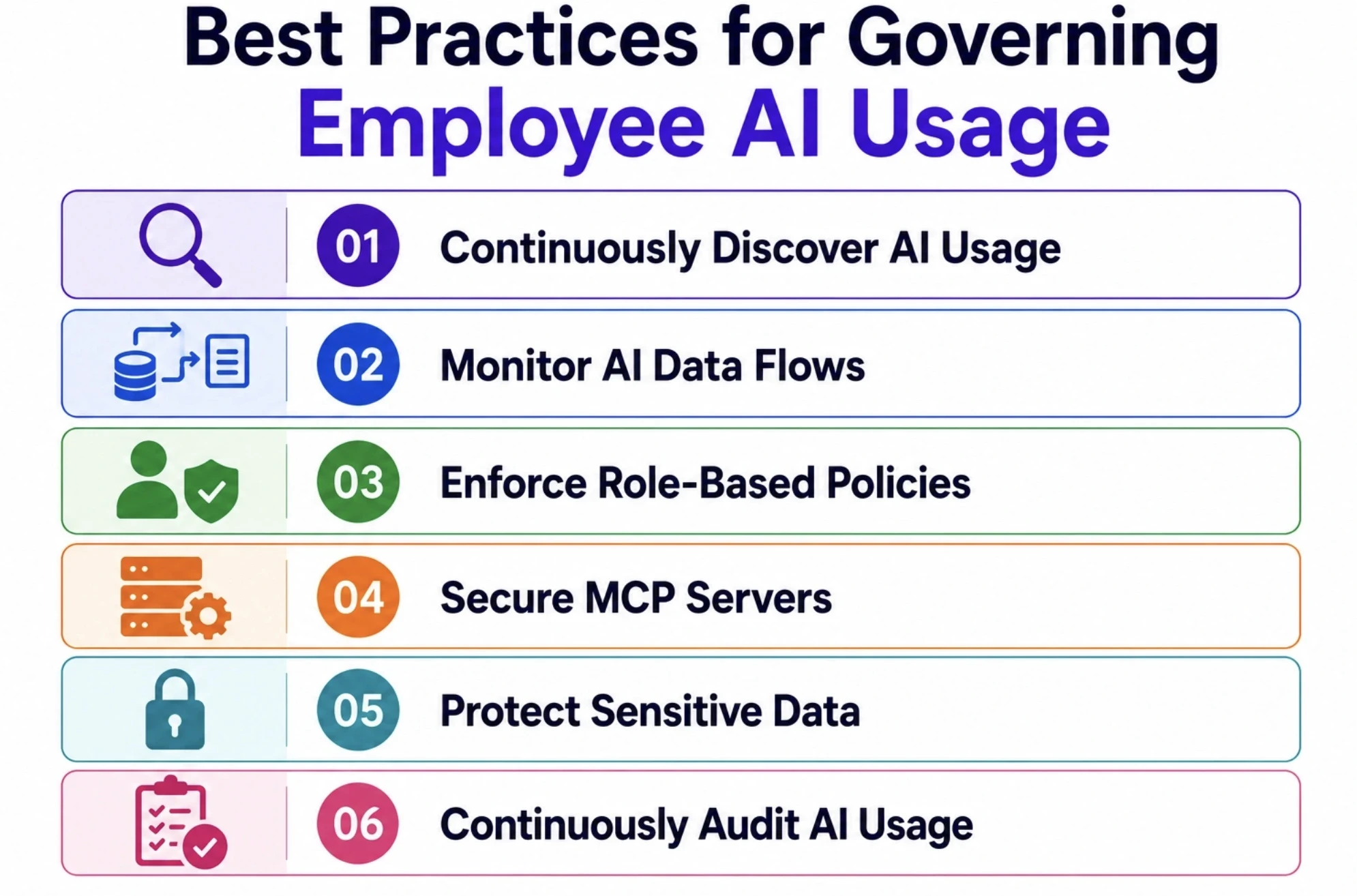
Continuously Discover AI Usage
AI discovery is not a one-off audit, as new tools, extensions, and locally deployed MCP servers are continually appearing. A scan from last quarter is of little use when it comes to today's scan.
Monitor AI Data Flows
Maintain visibility of the data flows that enter and exit all identified AI tools, not just the tools identified. When not used within a data flow context, it is difficult to distinguish whether a low-risk summarization tool is running on regulated data or not.
Enforce Role-Based Policies
Use policies according to the role and data sensitivity, not the one-size-fits-all approach. This ensures that the program doesn't block out legitimate productivity improvements or unmanaged use in the case of high-risk.
Secure MCP Servers
As with any production system, test MCP servers for authentication, access scope, and monitor internal and third-party servers. They are a young part of most environments and tend to be deployed before they are secured.
Protect Sensitive Data
Detect and block PII, credentials, and other sensitive information at the time it can leave the organization in an AI interaction, rather than in a log review. Real-time protection detects leaks before they turn into incidents.
Continuously Audit AI Usage
Keep continuous audit trails of AI interactions, policy exceptions, and enforcement activity for compliance and legal teams to always have evidence, not evidence that is built up after an incident. This is the part that makes a governance program more than just a policy document and more of a program that an auditor can check.
Gain Complete Shadow AI Visibility with Akto
Shadow AI does not pose a threat in the future. It's already being used by employees on their laptops and browsers throughout the enterprise, and is largely unseen by the security teams who already have tools in place. The first step to closing that gap is visibility, to be followed by mapping the data flow, implementing granular policy, and enforcing it in real-time. Writing rules for the use of AI without seeing it is like going straight to policy without visibility.
Security teams can seamlessly transition from Shadow AI visibility to governable usage without cobbling together point solutions by consolidating continuous AI discovery, AI usage monitoring for employees, and MCP server visibility and runtime policy enforcement into one platform, with Akto. If you already have Shadow AI in your organization- you almost certainly do- request an AI Security demo to learn how Akto can help you discover it and manage it.
Frequently Asked Questions
Why is Shadow AI a security risk?
It establishes blind spots throughout the entire data landscape—from data leakage, compliance, and credential exposure to the technical attack surface—until a compliance audit, breach, or regulatory inquiry puts the issue on the radar.
How do enterprises discover unauthorized AI tools?
Using endpoint monitoring, browser monitoring, and network-level detection, which recognizes AI tools, agents, and MCP servers, whether they are officially approved or not.
What is the difference between Shadow AI and AI agent security?
AI agent security is a more specific area of Shadow AI that focuses on testing and securing autonomous AI agents, including what they can do, what they are allowed to do, and how they are doing it.
Can security teams monitor employee AI usage?
Yes. Endpoint- and browser-based monitoring tools can be used to determine what AI applications, extensions, and agents employees use, without having to pre-approve the tool they use first.
How do organizations govern employee AI usage?
Continuous discovery, combined with policies based on roles and data, and then with real-time enforcement at the endpoint, browser, or network level where the AI interaction is occurring.
How does endpoint monitoring improve Shadow AI visibility?
Endpoint monitoring detects AI without ever hitting a network log, such as local AI apps, browser extensions, or the AI servers that developers spin off their own machines with MCP.
Why are MCP servers part of Shadow AI?
One of the least visible components of the modern AI stack, MCP servers are typically deployed locally by developers who connect AI agents to their own tools and data without registering these with IT.
What should organizations look for in a Shadow AI platform?
Seek end-to-end discovery, data flow mapping, granular policy enforcement, and audit-ready logging, with all managed and stored in a single AI governance platform and not in separate tools.
Which platforms provide Shadow AI visibility?
The platforms such as Prompt Security, WitnessAI, Zenity, Noma Security, and Prisma AIRS all offer some element of Shadow AI visibility, but vary in deployment model, endpoint coverage, and the depth of coverage of the agentic and MCP-specific risk

Experience enterprise-grade Agentic Security solution