How Enterprise Security Teams Defend AI Agents Against Prompt Injection
Learn how enterprise security teams detect, prevent, and mitigate prompt injection attacks with runtime protection, guardrails, and AI agent security.

Rushali

The battle against enterprise AI prompt injection defense has stepped from the research stage to the boardroom in just one year. Security teams that spent 10 years hardening APIs and Web applications are now observing autonomous agents calling in on their internal tools, reading customer data, and taking action without any more security scrutiny than a human employee would receive. Unlike zero-day, AI agent prompt injection does not require a specific day; it only requires a sentence in a document or a tool response that the agent just happens to trust. In this article, the writer explains how prompt injection attacks work within enterprise AI systems, why apps based on agents that use APIs are more difficult to defend than traditional ones, and the layered defense approach (hardening, runtime protection, least privilege, and continuous red teaming) that security teams use to put agentic AI back in the box.
The Anatomy of an Enterprise Prompt Injection Attack
It's best to have a good look at exactly how an attack against an AI agent actually unfolds before a defense strategy makes any sense. Next, we will look at what prompt injection is, the two ways attackers could get it into your system, and why the agents and the infrastructure they exist on are so appealing.
What is Prompt Injection?
Prompt injection is an attack method that uses specially designed input to trick a language model into disregarding its intended instructions and executing those of the attacker. Prompt injection attacks do not exploit some bug in software; instead, they exploit a weakness in the model of the software that it knows it is running. When it comes to an isolated chatbot, it's typically an off-brand reply that makes for the worst-case scenario. If an AI agent is capable of interacting with databases, email, or API calls, the same approach can be used to initiate real actions. Hence, the constant presence of AI agent prompt injection in the OWASP list of top threats to LLM-based apps and why it is considered an engineering issue and not a content moderation problem.
Direct vs. Indirect Prompt Injection
Direct prompt injection occurs when the attacker enters a maliciously crafted prompt directly into the chat interface or API call, attempting to force the prompt to change in real time. The one that is easier to test for is the one that is sent in a field that the application already controls; that is, it's the easier one. Indirect prompt injection is a threat to enterprise agents, as the malicious instructions come wrapped up in content that agents were never instructed to distrust, such as a resume that's uploaded to a hiring tool, a support ticket, a web page that's summarized by an agent, or a response from a downstream API. The agent reads content as a part of its job, and embedded instructions travel with it. Indirect attacks never affect the user-facing prompt, so they are able to evade protection mechanisms designed to examine what the user actually typed.
Why AI Agents Are More Vulnerable Than Traditional Applications
Traditional applications run through a specific set of code paths either way—request matches and runs code, or it doesn't match and runs code. Agentic AI systems are distinct in nature as they think through natural language, choose what tools to use, and connect multiple steps in an agent sequence to achieve an objective. It is this flexibility that an attacker takes advantage of. A single injected instruction may lead to agent goal hijacking, where the agent performs an unauthorized action such as exfiltrating data, escalating privileges, or triggering a transaction, all without the user's knowledge. As the agent's reasoning is done inside the model itself, there isn't a stack trace to point to when something goes wrong, so it's not only about code-level controls for AI agent security.
How MCP Servers and APIs Expand the Attack Surface
Most enterprise agents aren't doing anything alone; they're relying on connections to the MCP servers as well as to internal APIs and third-party tools to do their work, each of which is a new entry point. Attacks have begun to involve a malicious or compromised tool description that is sent to the agent in such a way that the agent executes it, giving it permissions it does not deserve, or revealing the context in which it was sent. An agent can be activated with a poisoned tool it didn't explicitly load because of MCP's tool-discovery model. When these tools ultimately require the use of APIs — often the same back-end services the traditional AppSec team protects — it's easy to see why security is now a shared goal for and responsibility of the MCP and AppSec teams, instead of it being a separate entity.
A Layered Defense Strategy for AI Agents
No single control stops prompt injection on its own, which is why mature teams build defense in depth around their agents instead of betting on one filter. The three layers below move from prevention to real-time detection to architectural limits on what an agent can even do if it's compromised.
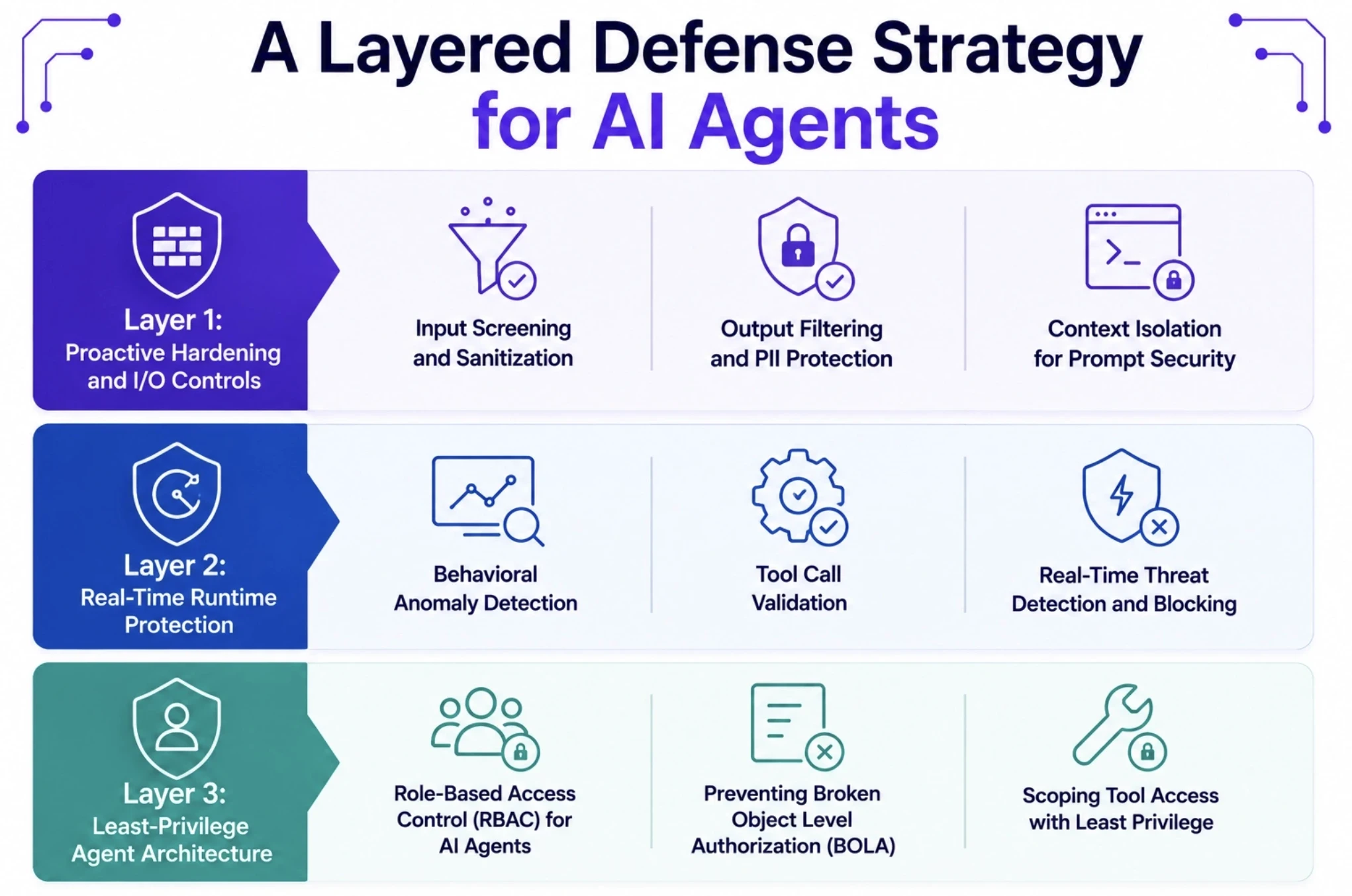
Layer 1: Proactive Hardening and I/O Controls
Prompt injection is a problem that cannot be solved with just one control, so a mature team relies on stacking controls around its agents to effectively defend. The three levels below go from prevention to real-time detection to architectural limits of what an agent can do if it fails.
Input Screening and Sanitization
It mitigates the amount of malicious content ever hitting the model, and the possible harm if the injection is successful. It addresses what the agent can ingest, what can exit from the agent, and how much of the environment it can trust.
The data entered into the application is screened and sanitized. Input data is screened and sanitized.
All content an agent consumes (including user messages, uploaded files, retrieved documents, tool responses, etc.) must go through screening before the model's context window can receive it. This includes looking for common patterns of injection, unusual formatting, such as system message-like text in metadata, or disguised text. While sanitization will not catch every new variation of attack an adversary can come up with, it will eliminate the easy attacks and force the adversary to use more sophisticated, indirect methods, which later layers will be able to catch.
Output Filtering and PII Protection
The "what" is as important as the "what". The output filtering check intercepted responses and tool call payloads as they were leaving the system to prevent exfiltrating credentials, customer information, or other sensitive data in what appeared to be a perfectly normal-looking response. This is also where PII protection should happen in the operation: mask or redact sensitive fields in outputs; this is one of the most common objectives of successful prompt injections: to have the agent leak data it has legitimate access to and shouldn't be exposed.
Context Isolation for Prompt Security
System instructions, trusted user inputs, and untrusted retrieved content are in separate channels, not in one blended prompt, through context isolation. A model is more likely to identify that instructions in a document are different than its operator because there is a cryptographic or structural difference between the system prompt and the instructions it is processing or executing. This single design decision prevents a significant portion of the indirect prompt injection attacks from ever reaching the point of being executed by any detection logic.
Layer 2: Real-Time Runtime Protection
Hardening decreases risk before deployment, but enterprise agents are constantly monitoring against unpredictable input at runtime, and runtime AI security must fill in the gaps left by pre-launch operations. This layer involves observing precisely what the agent is doing as he or she is doing it.
Behavioral Anomaly Detection
Behavioral anomaly detection creates a set of rules or expectations of what an agent typically does (what tools they call, the sequence, the frequency, etc.), and alerts when they deviate from those rules. If the agent starts calling an unfamiliar data export tool, or calls an already called tool again in a different sequence, this is a good indicator that its purpose has been hijacked, even if it has never been used with the same injected text before. This behavioral layer is able to detect novel attacks, which are not detected by pattern-based input filters.
Tool Call Validation
Instead of checking whether a tool exists in the permission set of the agent, tool call validation compares each action an agent attempts to make with what is allowed in the given context. Users ask a single customer's invoice from a billing tool; this is normal, but asking a billing tool to export a list of all invoices for all customers is not. Turning AI runtime protection from an "allowed" or "disallowed" toggle into an AI that understands intent is achieved by validating calls against context and expected parameters.
Real-Time Threat Detection and Blocking
If the output of the anomaly detection and/or the tool call validation is of any value, it's during the window that matters, before the tool call is executed, not after the damage. Real-time threat detection and blocking occurs in-line with the agent's execution path and blocks or allows suspicious actions as they are attempted. It's a distinction between a security log that is reviewed the following morning and a control that prevents an unauthorized transaction, data pull, or escalation of privileges as it occurs.
Layer 3: Least-Privilege Agent Architecture
No matter how good the input and runtime controls are, it is a safe bet that some people will be able to get into, and if they can, the last layer is what will give them the power to do so. Least privilege architecture assumes that an agent is treated like any other identity and should not have more access than what their job needs.
Role-Based Access Control (RBAC) for AI Agents
Instead of an all-permissive service account for the AI agents, RBAC for AI agents provides them with clear roles and permissions — and clearly documented, auditable permissions. A finance reporting agent does not need to be granted write permissions to HR systems, and a customer support agent does not need to be granted the ability to tweak pricing tables. This also makes it much easier to address the question that will always be asked during a security review: what can this agent do if it's hacked at this very moment?
Preventing Broken Object Level Authorization (BOLA)
Already one of the most prevalent API vulnerabilities, agentic AI brings it back into a different form: an agent that can technically call an endpoint, but should only access records for the user that it is serving. If there are no checks on each call, then the prompt-injected agent can be tricked into asking for another customer's data via the API to which it was already granted access. The key point here is that, unlike agentic systems, once the ownership is validated in the system, it is not enough to verify that the caller owns a valid token; it must be validated on each and every request.
Scoping Tool Access with Least Privilege
In addition to data access, the principle of least privilege should apply to the tools. If a connected app has an agent with calendar availability that does not need to send email, then the agent should not have the ability to send email as the other person. Access to the scoping tools is so restricted that it means that if a blast is successful, the blast radius is determined by the smallest of the permissions given, which is often enough the difference between a contained incident and a serious breach.
Validating Defenses with Continuous AI Red Teaming
The more layered the controls, the more recently they have been tested. While defenses were once fixed and then forgotten, AI agent red teaming is constantly attacking your agents as a real adversary would.
Why Continuous AI Red Teaming Matters
Agents are constantly changing – new tools are added, prompts are updated, model algorithms are changed – and each of these changes can effectively re-open a vulnerability without the user noticing. A red team exercise performed prior to launch provides little insight into an agent six months and a dozen prompt revisions later. Continuous testing is not a check box that you check off but a state of security that you continue to strive for.
Run Contextual Prompt Injection Simulations
While generic injection payloads detect generic errors, the specific attacks that succeed against enterprise agents tend to be specific to the tools, data, and processes for which the agent has access. Contextual simulations are crafted scenarios used to test an agent with realistic scenarios that attempt to cause goal hijacking or tool poisoning for that agent's role. This is a more meaningful challenge than the same generic prompt injection prevention checklist to every agent, irrespective of their specific functionality.
Simulate End-to-End AI Attack Chains
Real attacks do not end with the one injection; they follow with another action, such as using the leaked context from one tool call to make a more convincing request to another tool. End-to-end attack chain simulation asks if an agent can be walked in a step-by-step fashion from a point of compromise to a meaningful business impact (not just whether it can take a single malicious prompt). This type of testing reveals the hazards of many agents and tools, which are always overlooked in one-turn tests.
Integrate AI Security Testing into CI/CD
Prompt injection defenses need to be part of the same pipeline where the changes in the prompt, tool, or model version are shipped, and not a standalone quarterly event. Adversarial probes are automatically run on all builds, enabling teams to identify a regression before it goes into production. This is done directly in Akto, where teams can test a new prompt, tool or model update in their existing CI/CD pipeline without endangering users.
The Integrated Platform Approach: From Discovery to Enforcement
Powering input filtering, red teaming, and runtime blocking with a single tool addresses one problem, but trying to patch together dozens of agents to address security issues enterprise-wide is inefficient. This is the layer that Akto is based on.
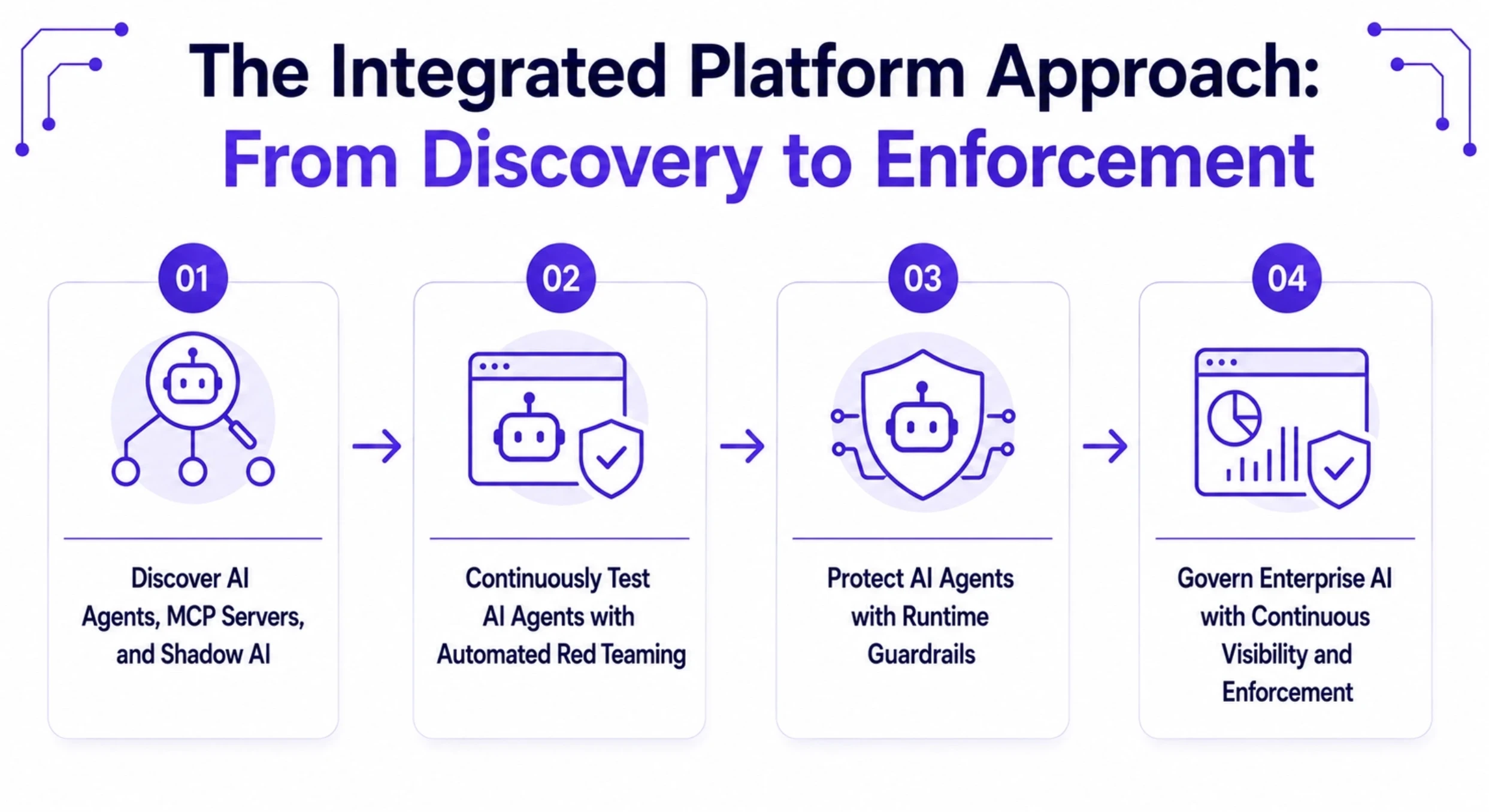
Discover AI Agents, MCP Servers, and Shadow AI
You can't defend what you don't know exists, and in most enterprises there are more AI agents and MCP servers in operation than there are officially approved by the security team. Cloud, on-prem infrastructure, and employee devices are all discovered and managed by Akto, revealing all the shadow AI that had not been approved to begin with. The inventory is the base on which all of the rest is built because test and guardrails are as thorough as the map of what's being protected.
Continuously Test AI Agents with Automated Red Teaming
Upon detection, Akto's automated red teaming uses a continually expanding database of adversarial probes, which span a variety of attack frameworks, such as the OWASP LLM Top 10 and MITRE ATLAS, to simulate prompt injection, tool poisoning, and multi-step attack chains against actual agents. It's not an evaluation that you do once; it's an ongoing process, meaning new tools connected or new prompts are automatically tested when they are added.
Protect AI Agents with Runtime Guardrails
Testing reveals the vulnerabilities; Runtime guardrails prevent attacks in production. Akto prevents sensitive data leaks in real time, blocks malicious prompts, unsafe tool calls, and unauthorized data access in real time, and can be placed between the MCP client and servers, enforcing authentication and tool authorization on each request. That's how the red teaming results become true protection and not just a report.
Govern Enterprise AI with Continuous Visibility and Enforcement
Security and compliance leaders require more than single controls—they need a holistic view of agentic risk throughout the organization. With discovery, red teaming and runtime enforcement combined on a single platform, teams have continuous visibility of misconfigurations, over-permissioned tools and policy gaps, as part of an ongoing AI governance program, not a series of point-in-time assessments. Available in a self-hosted or cloud deployment, Akto is open source, was founded in 2022, is headquartered in San Francisco, and is cited by Gartner as one of the representative vendors in the AI agent security market.
Best Practices for Preventing Prompt Injection in Enterprise AI
Implementing the layered approach mentioned above into a working prompt injection defense program is reduced to a short list of practices that teams should not compromise on, no matter which tools they employ to achieve these practices.
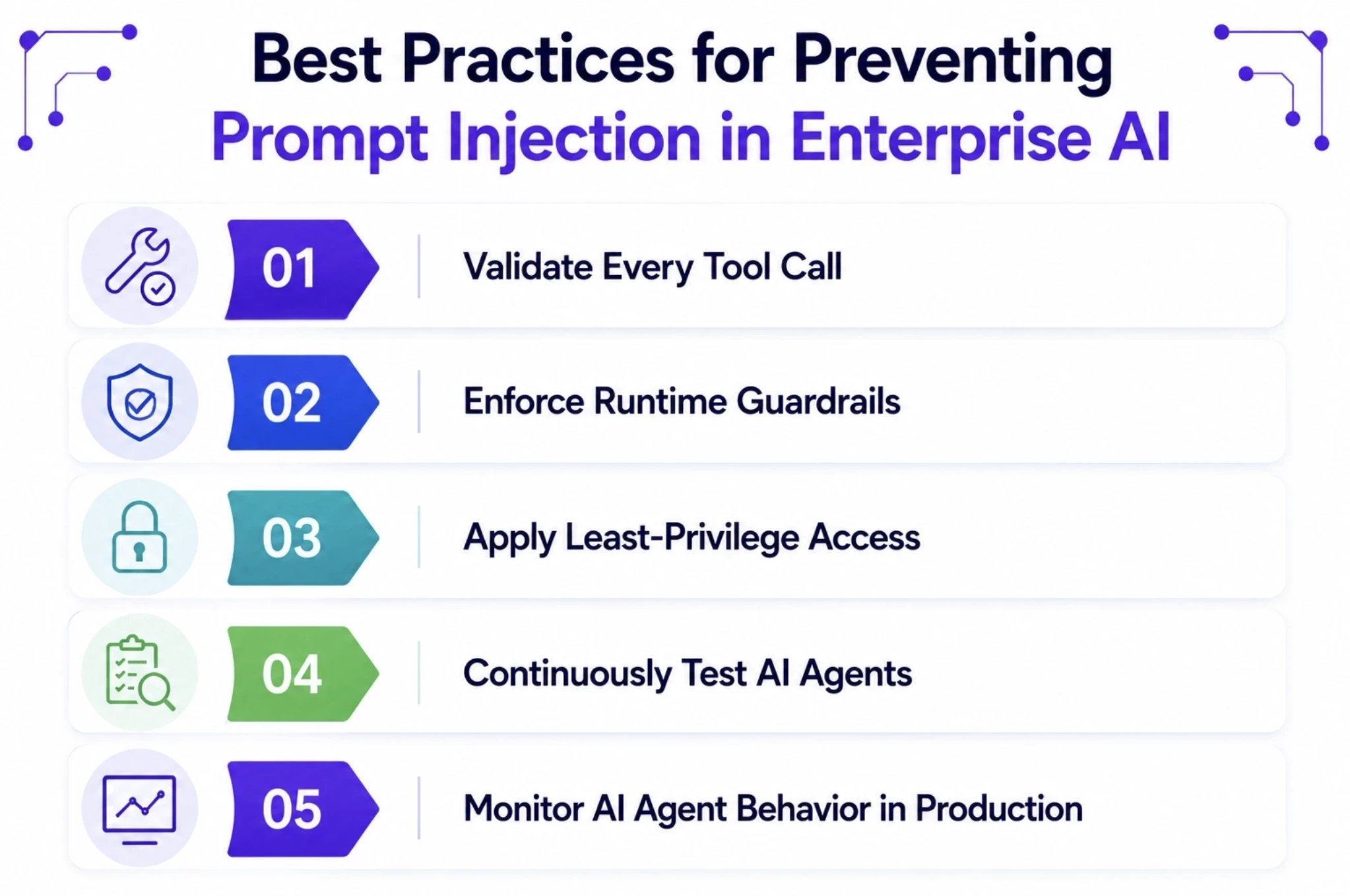
Validate Every Tool Call
Don't assume that a tool call is safe because the agent has been authorized to use the tool in general. Accept only the specific parameters, scope, and context of each individual call, and if they are different from what you expect for that call, that user, that time, say, "no.
Enforce Runtime Guardrails
Pre-deployment testing and hardening help minimize risk, but it is not a substitute for controls that are deployed when the agent is in operation. Make sure there are runtime guardrails that are able to inspect and block prompts, tool calls, and outputs in real time, and if a novel attack is able to evade previous guards, it will be stopped before it causes harm.
Apply Least-Privilege Access
Ensure each agent has only the necessary data access and tool permissions to perform its function, and no more. As agents acquire new privileges, make sure to periodically check those permissions, as privilege creep is as easy in agentic systems as in human accounts.
Continuously Test AI Agents
Do not use red teaming as an audit that happens only once before launch, but rather as an activity that is continuous in nature and linked to your release cycle. Each new connection to the tool, prompt change, or model change opens a previously closed vulnerability.
Monitor AI Agent Behavior in Production
Establish an "agent norm", and continuously monitor for deviations – some of the most harmful attacks are quite normal on the individual level of one request, but only noticeable as a trend over time. Production monitoring catches the slow, quiet compromise that test before launch could never detect.
Final Thoughts
Defending against agent prompt injection for enterprise AI is not just a product choice; it is a multi-layered discipline of hardening inputs and outputs, providing real-time runtime protection, designing for least-privilege, and ongoing red teaming. If any layer of security is bypassed, attackers can walk through a gap in a motivated manner, or a poorly constructed document can. The companies that remain in front will be the ones who view agent AI security as an ongoing effort and not a checklist for launch day. With AI discovery, runtime guardrails, and automated red teaming for AI agents and MCP's all in one AI security platform, security teams can discover, test, and protect their AI security agents without having to piece together disparate tools. When you're ready to experience the power in your environment, request the AI Agent Security demo.
Frequently Asked Questions
What is prompt injection in AI agents?
Prompt Injection: When an attacker tricks an AI agent into executing malicious instructions by exploiting the AI's input. For an agent that has access to a tool, this can directly manifest as unauthorized activity such as data exfiltration, unnecessary transactions, or misuse of a connected system.
What is the difference between direct and indirect prompt injection?
In direct prompt injection, the prompt is simply inserted directly into the interface or input field and attempts to bypass the system prompt in real time. Indirect prompt injection occurs when the agent processes content that contains the prompt, such as a document, email, or tool response, but is hidden, making it difficult to detect using input-only filters.
Why are AI agents more vulnerable to prompt injection?
Here, agents reason over natural language and dynamically choose which tools to call, which means that the attackers have a much greater and less predictable surface area than a traditional application where code paths are hard-coded. This flexibility, coupled with a truly available tool, can lead to a positive response, as opposed to a negative one, during an injection.
How do runtime guardrails stop prompt injection attacks?
Runtime guardrails examine prompts, tool calls, and outputs on-the-fly and prevent anything that is in violation of policy from running. This will trap any attacks that managed to slip through the cracks in the pre-deployment hardening, as the guardrail doesn't trust the text that it was given; it will trust the actual behavior of the agent.
How does MCP security reduce prompt injection risks?
MCP security enhances authentication, authorization, and monitoring at the protocol level where agents discover and call tools, where tool poisoning and unauthorized tool use often occur. This is an entry point that was not designed to be seen by traditional application security controls.
Why is least-privilege important for AI agents?
Even if a prompt injection is successful, least privilege helps to restrict the amount of damage an agent can inflict. No matter what instructions an attacker manages to inject, there is no one to escalate to other than an agent that is just meant for data and tools that are part of its job to use.
How does AI red teaming validate prompt injection defenses?
Rather than making the assumption of a well-maintained defense, AI red teaming conducts realistic, contextual attack simulations against an agent's tools, data, and defenses to determine if they are effective. It automatically detects backslips caused by changes in prompt, tool, or model without the attacker's knowledge, when run continuously.
What should enterprises look for in an AI security platform?
Search for a platform that includes discovery, ongoing red teaming, and runtime enforcement in a single place instead of three individual point tools that have no data sharing. One such platform, such as Akto, incorporates AI agent and MCP discovery, automated red teaming, and runtime guardrails in a single governance workflow.
Important Links

Experience enterprise-grade Agentic Security solution