AI Agent Security Program: A Complete Enterprise Implementation Guide
Learn how to build an AI agent security program with governance, AI agent discovery, risk management, continuous validation, AI red teaming, runtime protection, and security operations.

Rushali

More AI agents are coming to market more quickly than most security operations can monitor. A marketing team launches an independent research bot, an engineering team links an LLM to internal tools via MCP, and a finance analyst puts a browser extension that reads spreadsheets. They are each provided with data, systems, and decisions, and most have not been checked by security.
An AI agent security program takes an enterprise forward from this. It brings together disparate, ad hoc controls and offers a consistent means to find agents, assign ownership, monitor risk, audit behavior, and report to leadership. In this guide, you'll find a framework that you can follow: the five pillars, ownership models, inventories, risk registers, policies, a maturity model, and metrics that demonstrate that it works.
Why Every Organization Needs an AI Agent Security Program
Most security teams are already executing initiatives for application security, cloud, and identity. Between them all are AI agents, which are neither applications nor, for the most part, software running in the cloud, but they act with delegated identity, and none of them were designed to reason, plan, and act on their own, like software.
AI Adoption is Outpacing Security Processes
A new SaaS tool that has been passed through procurement, a questionnaire, and an access review prior to anyone touching it. Most of that is avoided with AI agents, as an employee can link one to data in their internal systems in a few clicks, and an ever-growing number of agents are going unassessed.
The Rise of Autonomous Workflows
Early enterprise AI was predominantly the answering of questions by a chatbot. Today, agents are linked together, tools are called, databases queried, and decisions are made at multiple stages, without any one person granting approval. That autonomy focuses risk, raises authorization and integrity issues, and creates execution paths not explicitly designed.
Why Point Controls Are Not Enough
Many teams respond by purchasing one control: a prompt-injection filter, a data-loss rule, or a guardrail on one app. Helpful, but they assume you have a clue about where the agents are. If the alert is not owned by anyone, it gets no response, and if it is unknown, it will not get a filter. A program ties controls together with discovery and accountability.
What is an AI agent security program? An AI agent security program is a systematic and organization-wide effort to identify, manage, and secure the AI agents used throughout the organization. It is visible to all agents, has ownership and policies, a risk-based approach of which agents are most important, ongoing validation of behavior, and ongoing operations and reporting. It does not handle each agent as a distinct issue, but rather as a single program with specific roles, processes, and metrics of an agentic attack surface.
The Five Pillars of an AI Agent Security Program
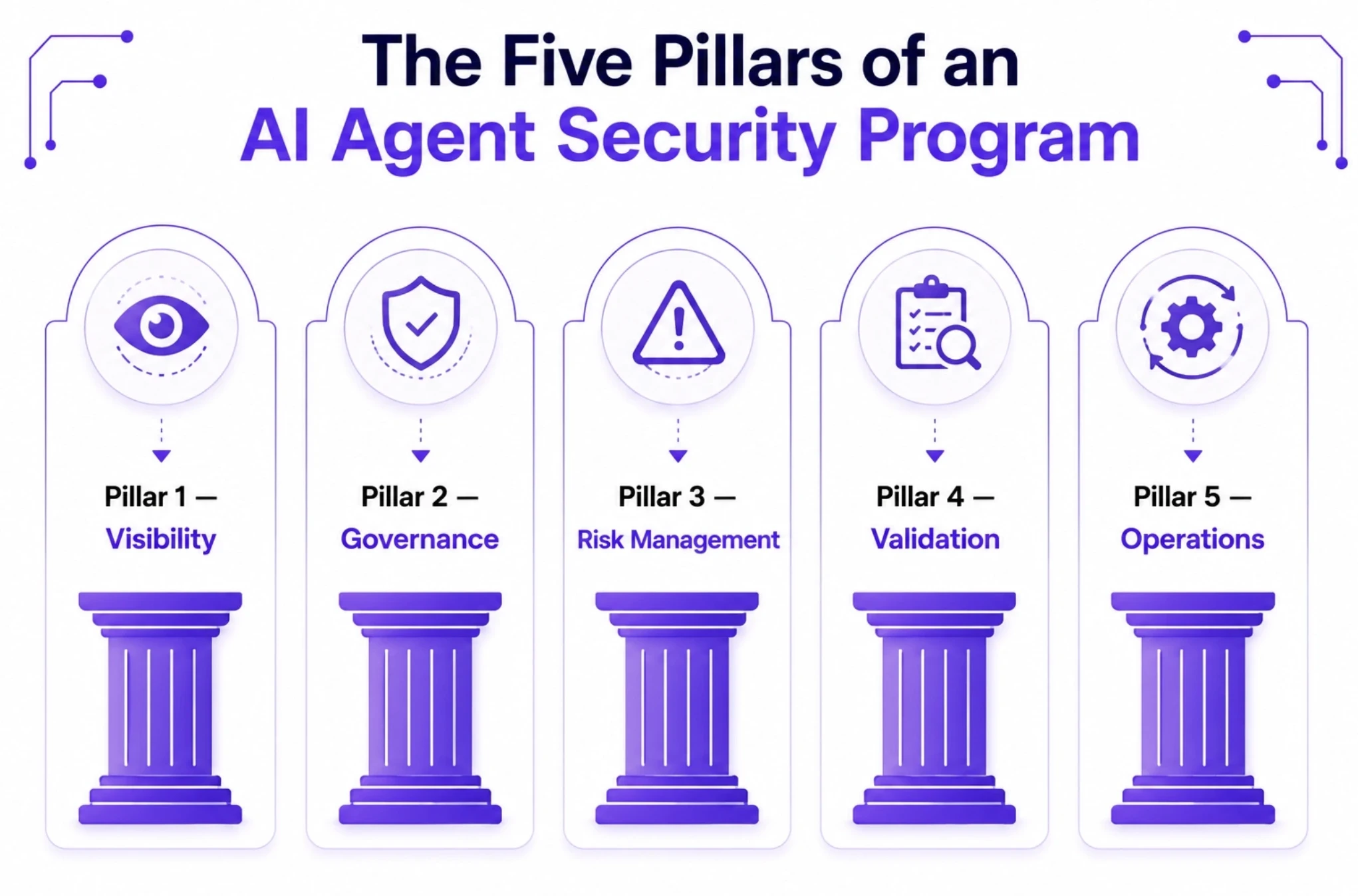
The backbone of a program must be understandable and repeatable to anyone. It is supported by five pillars that each answer a different question and collectively create the "umbrella" that your policies, inventories, and metrics hang under.
Pillar 1 - Visibility
Visibility equates to discovery from the moment the agents connect to the MCP servers and tools, and through the cloud, internal applications, employees' devices, browsers, and approved, homegrown, third-party, and shadow agents. It also involves relationships and a living inventory as opposed to a sheet of paper that quickly turns into a stale spreadsheet.
Pillar 2 - Governance
While visibility defines what exists, governance determines what is allowed and who is responsible for it. A policy-violating agent requires a named owner to modify or remove the agent, and a new agent requires an approval path so that the deployment of an agent is detected prior to going to production if the agent violates the policy.
Pillar 3 - Risk Management
All the agents are not equal. This pillar is focused on the identification of the important agents, classification of the data that they reach, business impact assessment in the event of their disappearance or abuse, and prioritization based on real exposure, not on raw numbers.
Pillar 4 - Validation
The existence of an agent and that it has an owner does not give information about its safety. Validation tests behavior: red teaming, automated testing for prompt injection and tool misuse, privilege escalation checks, and data exfiltration attempts, and is continuous because agents change as tools update, and prompts get rewritten. AI red teaming on platforms such as Akto identifies unsafe multi-step actions that are triggered by agents or LLM workflows by performing thousands of adversarial probes and going beyond point-in-time reviews.
Pillar 5 - Operations
The final pillar is the day-to-day work that sustains the program – monitoring agents in production, reviewing controls, responding to incidents, and improving over time. It makes the other four pillars a rhythm that repeats - incidents => lessons => return to policy, metrics => return to leadership.
Establish Ownership for Every AI Agent
There's only one major problem with AI security, and it's that nobody owns the agent. If ownership is unclear, the alerts don't get read, and risky agents remain, so preemptively identify who is responsible before inventories and tests are built. Typically, this is divided into three roles and an approval role.
Business Ownership
The business owner employs the agent and benefits from him, is responsible for his use, and is responsible for determining if he's worth the risk. Security identifies an issue, they determine to fix it, to restrict it, or to retire it, rather than stagnation where security is not happy to see an agent, and no one wants to see it.
Technical Ownership
The technical owner is responsible for the prompts, tool access, authentication, and changes pushed to and configuration of the agent. Their behavior is adapted when they encounter a validation problem, which becomes important since agents' tools and models change over time.
Security Ownership
The security owner evaluates the agent's risk and ensures that controls are in place, running or commissioning, and tracks risk over time. This job does not create the agent and does not determine the business's future; it is the assessment that the other owners would depend upon. In smaller organizations, it is held in a central team, and in larger organizations mapped to application teams.
Approval Processes
Ownership is only applicable as long as it has been created before that agent goes live, so a new agent must pass through an approval gate to get its new owners and a security review on production data. A brief intake of what the agent does, what it requires, who owns it, and a risk level is an adequate solution, provided it is easy to pick up and not put out of the way so that people do not avoid it.
Build an AI Agent Inventory
A complete, up-to-date inventory is the beating heart of the program: no risk scoring can be created without a full list of agents, no policies can be enforced without an up-to-date inventory, and no reporting can be done without a comprehensive list of agents. If inventories are created once and not updated, they do not work - they are just a 4-part asset that requires continuous maintenance.
Approved AI Agents
These have been vetted and have owners, and a healthy program maintains a high percentage of agents here. Any item not on the list is worth investigating; the inventory documents who owns the item, its purpose, how it is used for data access, tools it is connected to, risk tier, and last validation date.
Internal AI Agents
Internal or homegrown agents are the ones that your teams create, which are usually the highest value and highest risk because they typically have close access to proprietary systems. Record how they are built, the models and tools they use, and what they can access – the agents change often!
Third-Party AI Agents
Third-party agents are the AI services and tools that you purchase or integrate with from the vendor, such as vendor copilots or external API wrapping an LLM. What data is exposed from your environment, what the vendor does with it, and which systems the agent can impact—these are the areas to document.
Shadow AI Agents
The ones no one approved are shadow agents: Browser extensions developed by the developer, a personal AI account connected to work data, a local MCP server on a laptop. These are not things that can be reported on; they are things that must be actively found. For instance, Akto identifies AI agents, MCP servers, tools, and connected resources in the cloud, employee endpoints, and in browsers, bringing shadow AI to light that would otherwise remain off the books.
Create an AI Risk Register
An inventory provides answers to "what is there", a risk register provides answers to "what's the first thing to worry about". The register has hundreds or thousands of agents, and you can't treat all of them equally, which is why the register prioritizes each agent by exposure/impact, creating a prioritized, queued list of agents.
Identify Critical Agents
Distinguish between agents that might cause serious harm and those that would not. Typically, a critical agent has access to a wide range of systems, the ability to make consequential decisions, and a relationship to sensitive information or funds. The critical few are flags that maintain the register of the critical things that threaten the business.
Classify Data Exposure
Describe the different types of data that can be accessed by each agent, ranging from low-exposure agents who can only see public data to high-exposure agents who can see customer data, credentials, source code, or financial records. This helps to ensure compliance as well, as an agent who handles regulated data assumes the obligations of the data.
Evaluate Business Impact
Consider the impact that a failure or misuse of the agent will have on the operation. When an agent drafting internal memos fails, it's an inconvenience; when it happens in a revenue and reputation transaction flow, it's an event. When impact is added with data exposure and criticality, each agent will have a grounded risk profile.
Prioritize Risks
Order agents by likelihood of compromise and impact, and create tiers that further dictate the extent of validation and control that each agent receives. Exploitable exposure (access scope and blast radius) rather than counts of vulnerabilities prioritizes effort to be directed at agents that may be a breach path.
Define Security Policies for AI Agents
Policies provide rules for what people can do; without policies, every decision about an agent is a debate. There are four areas that cover most of the ground for good policies that are specific enough to enforce and practical enough that teams will adhere to them instead of finding ways around them.
Acceptable Use Policies
An acceptable use policy is a document that explains the purposes for which agents can be used and which purposes they can't be used for, types of work they can help with, and types of work they can't. Specific situations, like prohibiting agents from making final hiring or lending decisions, communicate what is permitted.
Data Handling Policies
Data handling policies dictate what data can be accessed, where it can be transferred, and how it must be protected – what data classes they are allowed to process, if data can be transferred to other services, what masking is necessary, and how long prompts and outputs are stored. Link these rules to your risk classifications on your risk register.
Access Control Policies
Access Control Policies specify permissions for agents and implement the principle of least privilege, as agents are often granted too many permissions, and it is this that an attacker takes advantage of. Only give a function what it needs, check periodically for access, and require a verifiable identity, not a shared credential.
Third-Party AI Policies
Third-party AI policies govern how to use external AI services, including criteria for a vendor agent's review, data that can be shared, and robust assurances prior to connection. They set up that there is no external service that connects to systems that are sensitive without a security review.
Measure AI Agent Security Maturity
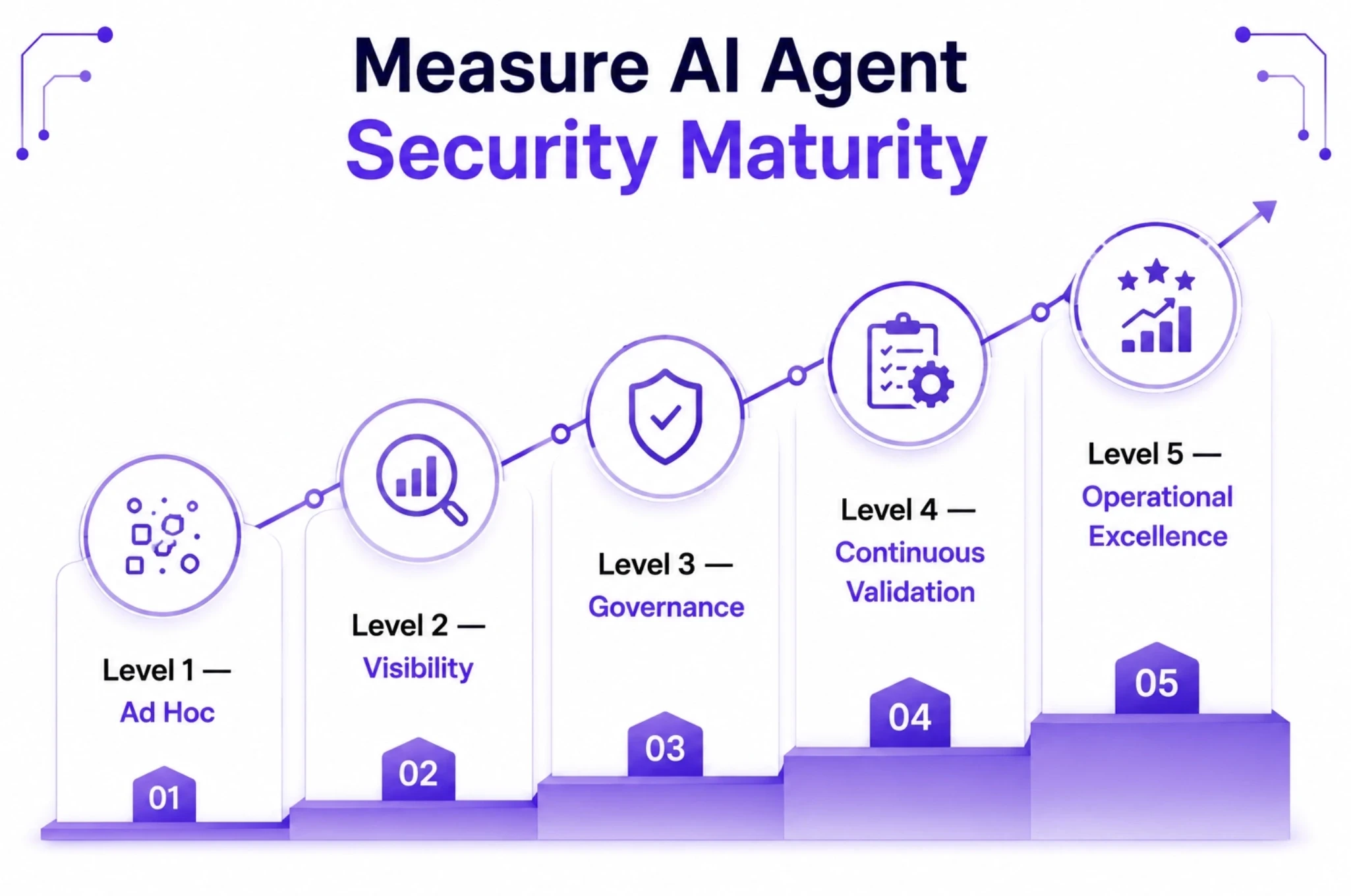
A maturity model provides the program with a way to measure its progress and a direction for future action – it replaces the feeling of falling behind or ahead with real measurements. The five levels below outline a typical progression from no program to an operationally robust program.
Level 1 - Ad Hoc
No program, but the security team will deal with the agents on an ad hoc basis, typically when something breaks, and there is no inventory, ownership, or policy. The hallmark of this level is reactivity, and the starting point is to make a choice to start to manage AI agents on their own as a category.
Level 2 - Visibility
While ownership and policy are still immature, the organization knows what agents exist, has discovery, maintains an inventory, and has surface AI. This level provides the greatest one-time posture improvement and is the endpoint rather than the starting point, whereas an inventory of the complete system is viewed as the endpoint.
Level 3 - Governance
Ownership and policies are in place and adhered to, all important agents are owned, new agents must be approved, and a risk register is prioritized. The riskiest deployments get caught before they make it to production, and findings are clear to be resolved.
Level 4 - Continuous Validation
The organization is proactive in testing the behavior of its agents on an ongoing basis, including the continuous running of red teaming, automated testing, and monitoring, and agents are re-validated as they change. This fills the void in which governance is currently lacking, as it allows you to know whose agent it is, but not whether it's safe today, given the evolving attack surface.
Level 5 - Operational Excellence
The program is a well-matured and balanced program, with visibility, governance, risk management, and validation embedded into day-to-day operation, decisions are based on metrics, and leadership is updated on the program regularly. There are not many organizations here, and if you are there, it's not that you are there; it's that the program becomes routine.
Level | Name | Characteristics | Primary Focus to Advance |
|---|---|---|---|
1 | Ad Hoc | No program; reactive, incident-driven; no inventory or ownership | Treat AI agents as a managed category |
2 | Visibility | Continuous discovery; maintained inventory; shadow AI surfaced | Add ownership and policy on top of visibility |
3 | Governance | Defined owners; approval process; policies enforced; risk register | Begin continuous testing of agent behavior |
4 | Continuous Validation | Ongoing red teaming, testing, monitoring; re-validation on change | Integrate into operations and metrics |
5 | Operational Excellence | Integrated, measured, self-improving; regular executive reporting | Sustain and refine across the organization |
Operationalizing AI Agent Security
So, any framework that is on paper doesn't mean anything till it becomes recurring work. Operating a program involves specifying what happens on the timeline, and who does it, and these five functions work out the rhythm of the pillars.
Security Reviews
Security reviews are reviews of agents conducted on a timeline based on risk level and are scheduled when an agent is approved or reapproved. Every review verifies that ownership is up-to-date, access remains appropriate to need, data handling is consistent, and validation results validate.
Risk Assessments
The register is updated with risk assessments as the environment changes, as new agents are introduced, and existing ones are gaining access. Agents are regularly assessed to capture those that have slipped into critical condition and reduce the risk for those with reduced risk, which in turn drives reporting around whether overall risk is increasing or decreasing.
Incident Management
Incident management is a process that outlines what is done when an agent is compromised, misused, or acts in an unsafe manner. The incidents involving AI have a unique form, such as prompt injection, data leakage via outputs, and unauthorized actions, and agents respond quickly and independently, so restricting access can have as much impact as detecting the incident.
Compliance Reporting
Compliance reporting will tie the security of AI agents to the compliance reporting requirements the organization already has in place – all agents accessing regulated data will be governed by the existing compliance reporting requirements, with additional AI-specific requirements. Maps agent controls to report to frameworks the organization is accountable for, including OWASP guidance on LLM and agentic risk, as well as MITRE ATLAS, and makes audit season a regular export.
Executive Reporting
Executive reporting conveys the risk of AI to leaders in their decision-making words, not a list of agents. It captures coverage, the highest risk agent state, incidents and their resolution, and progress towards the maturity model.
KPIs Every AI Security Team Should Track
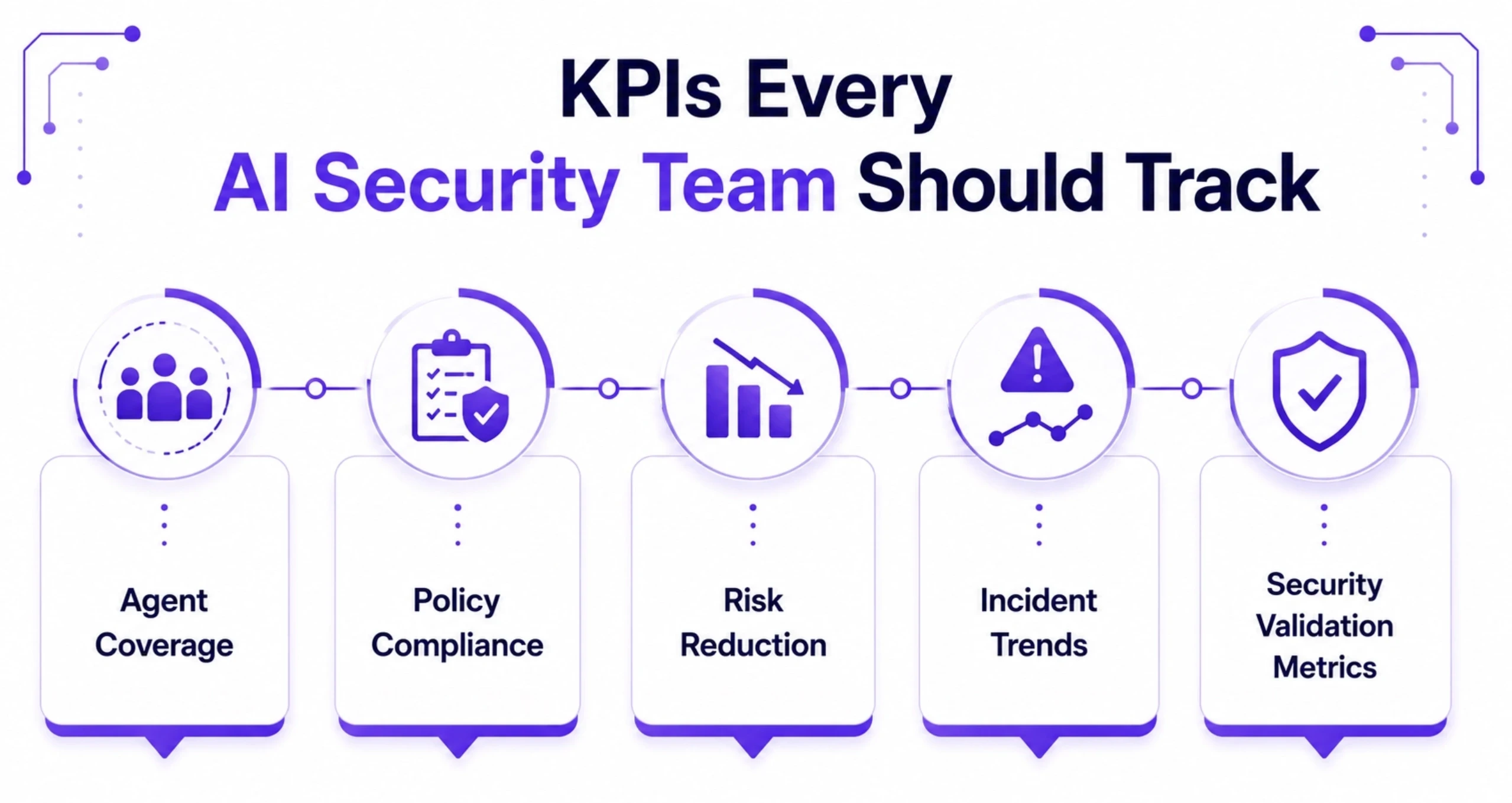
Metrics are the ways that the program demonstrates that it is effective and continues to be funded. The five listed below encompass the base ground of many programs that don't get the fundamentals right, and they are tied to the pillars that provide a truthful number to the leadership, not vanity numbers.
Agent Coverage
Agent Coverage: percentage of discovered agents that are in the inventory, have a policy, and have owners. It is basic because if the denominator is incorrect, then all the other numbers are incorrect.
Policy Compliance
Policy compliance reports the number of agents that follow the policies that you have set for acceptable use, data handling, access control, and third-party rules, in addition to counting the number of agents with policies. The results by area indicate the areas that are most concentrated in terms of gaps, as low access-control compliance indicates an over-permissioning issue.
Risk Reduction
Risk reduction monitors whether the programme is reducing exposure (but not just recording it), by observing the change in the risk profile of the agent population as the remediation progresses. As the number of agents increases, critical risk continues to decline – this is a positive indication that the program is functioning.
Incident Trends
Incident trends capture the number, class, and severity of incidents with AI agents throughout time, to identify risks that are emerging and help determine if incidents are being controlled. An increase in a specific type indicates areas for increased validation efforts, and a decrease in recurring incidents indicates that the actions taken to address the issues are working.
Security Validation Metrics
Validation metrics are measures on the testing end of the program, including the number of agents validated, when, what was discovered, and the speed at which results were remediated. Strong metrics indicate a high level of coverage of critical agents and reduced remediation times, which demonstrates that agents were subjected to real attacks and not simply listed.
Common AI Agent Security Program Mistakes
Those who fail in most programs do so in predictable ways. Understanding what can go wrong in advance allows you to avoid the pitfalls of the design process. Five keep coming back.
No Ownership
The worst-case scenario is to start without ownership for individual agents – if no one owns an agent, findings have no place to go, and decisions stall. The failure takes place quietly because the alerts are fired and the reports are generated even if the risky agents don't change.
No Inventory
Without a full inventory, building control will only protect the agents that you know about, while unknown agents remain unprotected, and shadow AI is a big winner in the middle. A program that bypasses discovery guards a portion of its actual attack surface and attributes it to being the entire surface.
No Risk Prioritization
Trivially, if they're all equally urgent, the program will be over before it gets to the agents that count, while the critical few sit in line with the trivial many. Real exposure and impact prioritization focuses effort on areas of most compromise.
Reactive Security
When an AI agent security approach is reactive, the organization is already a step behind, as when a breach is discovered, it means the agent is already compromised. The other issue with reactive programs is that they're not scalable—the more programs that get adopted, the more incidents get added to the team.
Lack of Governance
A program that is visible and tested, but without governance, can see and evaluate risk, but no one is responsible for taking action on it, so results accumulate without an owner, approval process, or authority. It resides behind top-notch tooling; dashboards are complete, and nothing moves.
AI Agent Security Program Checklist
Use this checklist to evaluate your program or to plan a new program. It organizes the essentials into an area to be viewed by different stakeholders.
Governance Checklist
Verify that all important agents have business, technical, and security owners. Ensure a documented approval process is in place and followed for new agents. Ensure that the acceptable use policy, data handling policy, access control policy, and third-party AI policy are written, published, and adhered to. Have a clear process for addressing policy violations.
Risk Management Checklist
Keep up-to-date inventory of approved, in-house, third-party, and shadow agents. Maintain a risk register that defines critical agents, categorizes the exposure of the data, assesses the impact on the business, and prioritizes the agents. Ensure that the register is reviewed periodically and kept up to date with changes in agents.
Operations Checklist
Organize security audits and risk assessments according to risk level. Automated and continuous validation (red teaming and automated testing) of critical agents and re-validation on change. Continue the incident process in an AI-aware manner that can quickly disable an affected agent. Maintain compliance mapping to frameworks for which you are responsible.
Executive Oversight Checklist
Report regular updates on AI risk in terms of coverage, trend, and condition of critical agents to leadership. Monitor agent coverage, policy compliance, risk reduction, trends in incidents, and validation metrics. Benchmark the program based on the program maturity model and determine the desired level of maturity. Ensure budget and authorization to act on the findings of the program.
Final Thoughts on AI Agent Security Program
AI agent security program is what helps you avoid falling behind in the arms of AI adoption. With the five pillars, you have structure, with ownership and inventories, you have accountability, with the risk register and policies, you have focus and rules, and with the maturity model and KPIs, you can measure progress and demonstrate it to leadership. None of it is merely a collection of point controls, so a program is better than a set of point controls.
The most difficult things in real life are finding all the agents, even the shadow AI agents, and being constantly assured that the agents remain safe as they evolve. This is where Akto comes in. Akto is a security control plane designed for AI agents, MCP ecosystems, and the LLMs they rely on that seamlessly automates discovery across cloud, endpoints, and browsers, providing continuous red teaming, AI agent posture management, and runtime guardrails all in one platform. When you're developing or expanding an AI agent security program, schedule AI Agentic Security demo to understand how Akto can provide the visibility and validation that your program needs.
Frequently Asked Questions on AI Agent Security Program
What is an AI agent security program?
It serves as a disciplined and comprehensive strategy for identifying, managing, and protecting the AI agents deployed throughout a business. It combines visibility of any agent, ownership, and policies, risk-based prioritization of which agents are most important, continuous validation, and continual operations and reporting, all in one program, to manage the entire agentic attack surface.
How do organizations govern AI agents?
They define ownership, set policies, and implement an approval process. One dedicated business owner for every important agent for its purpose, one technical owner for how it works, and one security owner for its risk assessment. Approval gate makes sure that new agents are checked and acquired prior to production.
What should an AI security program include?
A minimum of these components is continuous discovery, a maintained inventory of all agents, an ownership model, enforceable policies, a risk register prioritizing agents by exposure and impact, continuous validation, and a built-in incident process for AI risks and reporting to compliance and executive audiences. The 5 pillars will ensure nothing is left out of your essential tasks.
Who owns AI security in the enterprise?
There is typically a shared responsibility for accountability. The framework, policies, and reporting for the program are usually owned by a central security team, but ownership of individual agents is distributed among business, technical, and security agent roles. The priority and budget are owned by executive leadership; the common problem is that individual agents don't have an actual owner.
How do you measure AI security maturity?
The standard way is a maturity model. A typical model moves from Level 1 (ad hoc and reactive) to Level 2 (visibility) and then to Level 3 (governance) and Level 4 (continuous validation) and finally to Level 5 (operational excellence) in which the program is embedded, measured and self-improving. Measure, monitor, and establish goals around coverage, compliance, and risk reduction.

Experience enterprise-grade Agentic Security solution