Agentic AI Security Framework: A Stepwise, Technical Guide for 2026
Design

Rushali

AI-powered systems are increasingly manifesting in procurement processes, customer support lines, and codebases, outpacing most security teams. These agents can plan, call tools, and touch sensitive systems without the human clicking approve, altering the assumptions that traditional application security is based on. This is where an agentic AI security framework comes in: It defines a structured set of controls for discovering, governing, testing, and runtime protection of systems that operate in isolation. This is more important than it was a year ago, since regulators have begun to take notice, too. The Five Eyes intelligence community alliance issued joint guidance on May 1, 2026, stating that “Agentic AI systems can be assumed to act in unexpected ways until proven otherwise. This article provides an overview of the elements of an agentic AI security framework, the threats specific to autonomous agents, and the processes to operationalise governance throughout the agent lifecycle.
What Is an Agentic AI Security Framework?
Agentic AI security framework refers to a system of controls, policies, and processes that ensure the security of AI agents, autonomous systems that operate with their own tools to plan, make decisions, and act throughout their entire lifecycle, from discovery up to protection during runtime and incident response.
Defining Agentic AI and Agentic Workflows
Agentic AI is the one thing that sets it apart from the previous generations of generative AI – it takes action. A chatbot provides an answer to a question. An agentic workflow is a series of steps: an agent will call external tools or APIs, remember the information from one step to the next, and then change its next steps based on what they get back. This loop- plan, act, observe, replan- is what makes autonomous AI systems valuable for things such as writing code or deploying it, triaging tickets, or processing refunds. It's also what makes it a new form of attack surface. All agents that can be called by the agent, all data sources it can read, and all other agents that it can pass a task on to, whether or not anyone ever documented them, become part of the system's effective permissions for the agent.
Why Traditional Security Frameworks Fall Short
The security model is different with AI agents, as they are fundamentally unlike traditional applications because they are autonomous, remember their interactions, and can call tools. Unlike traditional applications, the security model with AI agents is different because they are autonomous, memory, and tool chaining changes the security model in ways legacy application security tools were never designed to address. Static Application Security Scan (SASS): Runs code before deployment. After deployment the agent's behavior may be altered by the prompts it receives, the tools it is given and what it stores in memory from deployment. Traditional identity and access management makes the assumption of a human or a predictable service account. An agent may spawn other agents, inherit credentials, and perform actions that no one has explicitly seen. This is why a dedicated agentic AI security framework exists – the disconnect between the speed of agents' delivery and the level of control over them.
Core Pillars of Agentic AI Security Governance
Agentic AI governance is not just about creating a policy document; it's about creating a framework of trust. Agentic AI governance is not a policy document; it's a framework of trust.
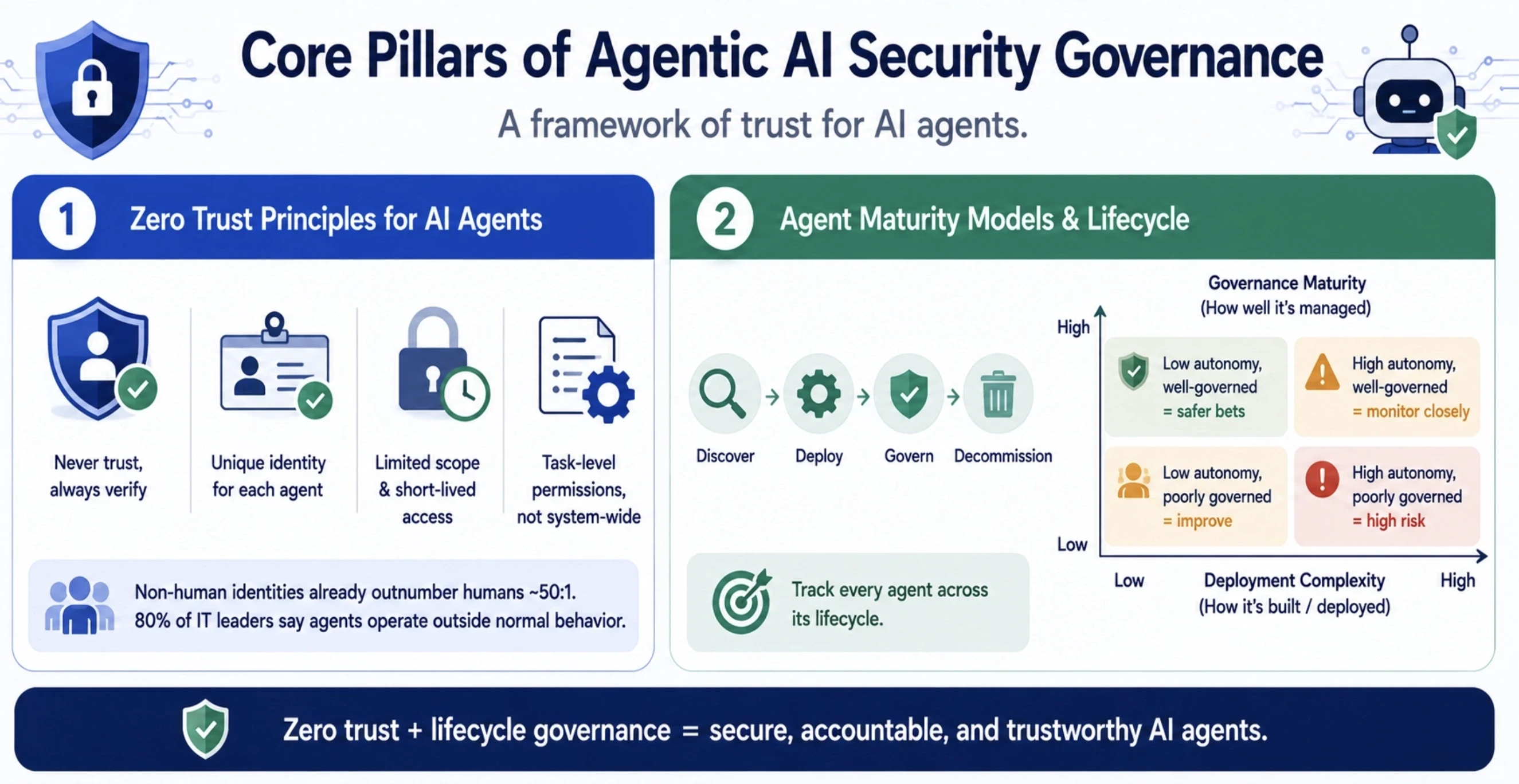
Zero Trust Principles for AI Agents
The principle of zero trust for AI agents is similar to that of any other system: "Never trust, always verify. That implies that, in practice, identity and access for AI agents will not be managed the same way as service accounts have been in the past: via an API key, and with standing permissions. Each agent must have its own identity, limited scope and limited duration of authorisation and permissions at the task level, not the system level. This is so important now because of the scale of the problem. Legacy identity and access management systems are already proving to be inadequate alone, as non-human identities already outnumber humans by a factor of approximately 50:1 in the average enterprise, and 80% of IT leaders report that agents are operating outside of normal behavior. When it comes to agents, zero trust principles are responsible for preventing a single compromised tool from inheriting the agent's entire privilege set.
Agent Maturity Models and Lifecycle
The AI agent security lifecycle consists of stages from discovery to decommission, but most organizations are even more behind than they realise. Helpfully, one can differentiate between deployment (a vendor-provided assistant is rather distinct from a customized code-executing agent built in-house) and governance (how well it's managed). Low autonomy, well-governed agents are fair bets. No matter how valuable they might be, high autonomy agents with ad hoc oversight are not. Plotting each agent on both axes (deployment complexity and governance maturity) provides a security team with a defensible approach to prioritizing investment and limiting autonomy until controls come on-board.
Threat Landscape: Unique Risks in Agentic AI
Agentic AI threats go beyond prompt injection, which was the primary security concern that arose early in the LLM security conversation, and agentic AI threat modelling must address a series of actions, not just a single interaction.
Attack Surfaces and Exploitation Paths
Shadow agents, prompt injection, tool poisoning, over-permissioned agents, agent spoofing, and zero-click agentic attacks are all key threats of the agent era. Shadow agents are those agents that no one in security either approved or authorized, these agents are typically developed by a single employee or team on a low code platform. Tool poisoning is the inability to manipulate a tool due to the tool being poisoned and returning a result that the agent can then manipulate. Agent spoofing is a technique that one agent can use to masquerade as another trusted agent within a multi-agent workflow-it is especially dangerous because it can generate valid audit logs up until the time an anomaly is detected. The agents with more permissions are among the most frequent issues for all of these: If a task requires read access to one system, it often has standing write access to multiple systems.
Case Study: Real-World Agentic AI Breach
The aim security team's revelation of one of the easiest ways to create a "zero-click" agentic risk scenario is a perfect example: by sending a single clever email, attackers can hijack Microsoft 365 Copilot to steal sensitive data. There was no need to click on links or open attachments. The reading and summarizing of the email content was the path of exploitation because it assumed that untrusted content in the email message was trusted instructions. It's a good case study because there was no new technique involved in the attack. It took advantage of the normal working of an agent's tool output processing-something a general-purpose AppSec scanner wouldn't be able to detect.
Stepwise Implementation: Operationalizing an Agentic AI Security Framework
Agentic AI security should be an ongoing process, not a one-off initiative, as each step builds on the previous one.
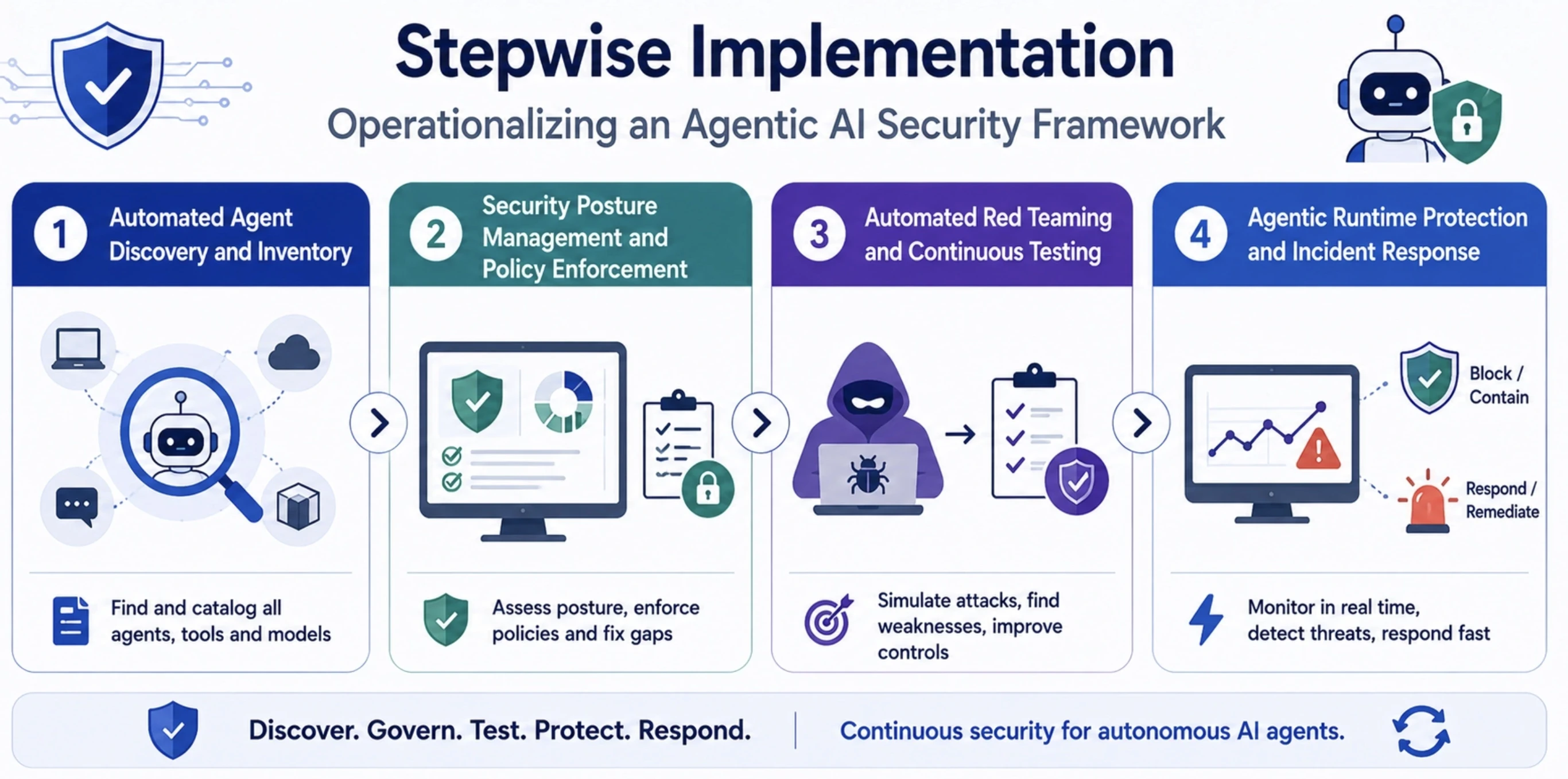
Step 1: Automated Agent Discovery and Inventory
The closer you are to the edge of the cliff, the more difficult it will be to find the agent. The farther you're away from the cliff, the harder it is to find the agent. The results of the latest industry survey indicated that 69% of enterprises already have AI agents deployed, while just 21% have a complete inventory of AI agents. Automated discovery should include both in-house and embedded agents, as well as MCP servers that interface with external systems, no matter how they’re deployed, whether in the cloud or on employees' devices: shadow agents do not often broadcast their presence.
Step 2: Security Posture Management and Policy Enforcement
When agents are inventoried, security posture management converts it into a continuous, enforceable baseline: agent permissions, data it can access, policies it's subject to, and how its configuration deviates from that baseline over time. This is before over-permissioned agents become an incident, not after!
Step 3: Automated Red Teaming and Continuous Testing
Point-in-time testing is not robust enough to be used in a system that can change behavior after deployment. AI red teaming for agents should be done not just on a single model, but on real agent configurations, with simulated prompt injection, tool poisoning, and privilege abuse. As agents can be chained, tests need to test multi-step sequences rather than just single tests.
Step 4: Agentic Runtime Protection and Incident Response
The layer that catches all of the things someone would not expect or anticipate, and which the tests did not catch, is runtime protection. Runtime protection monitors live agent activity for unexpected tool calls, data access, or actions that are outside of an agent's permissions and expectations. Incident response with agentic AI is also fundamentally different from traditional IR, as an agent can take thousands of actions over the time taken by a human analyst to open a ticket, meaning automated containment isn't just desirable; it's a must. This is where Akto's platform is a perfect fit: Akto discovers and catalogues MCPs, AI agents, tools and resources from 80+ connectors, runs automated red teaming and simulated attacks with 1,000+ probes and enforces agentic guardrails and runtime protection covering discovery, testing, and containment in one platform instead of three disconnected tools.
Mapping to Compliance and Existing Security Frameworks
AI agentic compliance is no new start. The majority of what regulators and auditors want is already known by security teams; it just needs to be applied to an autonomous system.
Crosswalk: Agentic AI Controls vs. NIST/ISO
A helpful NIST ISO crosswalk begins with the NIST AI Risk Management Framework that lays out the four functions of AI governance: Govern, Map, Measure, and Manage. ISO/IEC 42001 further enhances this with a certifiable AI management system. Neither was developed specifically for the use of autonomous tool-calling agents, so newer projects such as AIUC-1 and the Cloud Security Alliance's (CSA) threat modelling framework MAESTRO have begun publishing crosswalks to map the agent-specific controls back to NIST AI RMF, ISO 42001, the EU AI Act and MITRE ATLAS. There are also parallels with SOC 2: agentic AI systems accessed by customers or production systems fall under the scope of SOC 2 if they access customer data or production systems, and Processing Integrity is particularly relevant to agents that process financial or transactional systems, where processing integrity is defined as whether a system processes data accurately, completely, and with proper authorization. It is also important to closely monitor the EU AI Act, which will become fully enforceable in August 2026 and classifies many multi-agent orchestration systems as high-risk in high-impact sectors (and imposes human oversight and audit trail requirements).
Integrating Agentic AI Security into Enterprise GRC
Agentic AI can be integrated into enterprise GRC most effectively by piggybacking on the audit timelines and cycles organizations already have in place, instead of creating a parallel compliance track. Most GRC teams have a Type II observation window, a risk register, and a vendor review process that AI evidence from the agent can be inserted into. Vendor selection is important here as well: Akto is a Representative Vendor in Gartner's Guide for Securing AI Agents, 2025, and is available as GDPR, ISO 27001 and SOC 2 certified, both as open source and as a cloud service managed by Akto, providing GRC teams a starting point rather than a scratch build.
Best Practices and Common Pitfalls in Agentic AI Security
Agentic AI security best practices are often straightforward to say, and easy to overlook when it's time to deploy; that's why most incidents boil down to one or two really common pitfalls.
Checklist: Technical Do's and Don'ts
Do use each agent as their own account with short-term, scoped credentials, not an account shared by all.
Record all tool calls and agent-to-agent handoffs – this will allow for an incident to be reconstructed after the fact.
Test multi-step agent workflows and not just individual prompts – there are risks in multi-step workflows which single-turn testing is unable to detect.
Ensure that a task does not have standing write access to a system if it only requires reading from it.
Do not presume that a vendor-embedded assistant isn't part of the security review because it wasn't “built” by you.
Even if it slows down the agent, don't skip human-in-the-loop approval for high-risk actions such as financial transactions or infrastructure changes.
Pitfall Scenarios and How to Avoid Them
The usual mistake is to send an agent to perform a small and low-risk task, give it wide access "just in case", and eventually, other agents and processes rely on the agent's output without anyone taking a second look at the initial permission. A single compromised low-risk tool in that agent's workflow then inherits everything the agent can do. The solution is to change privilege allocation from a static to a dynamic privilege allocation model, and to review the privileges periodically as an agent's role evolves. A common mistake is assuming the agent's audit log is accurate without verifying. But logs can be falsified or corrupted by a spoofed or compromised agent and detection must be based on behavior, not on the presence of logs.
The Future of Agentic AI Security Frameworks
The next generation of agentic AI security is not necessarily driven by any one vendor—it's driven by the pace of standards bodies and attackers.
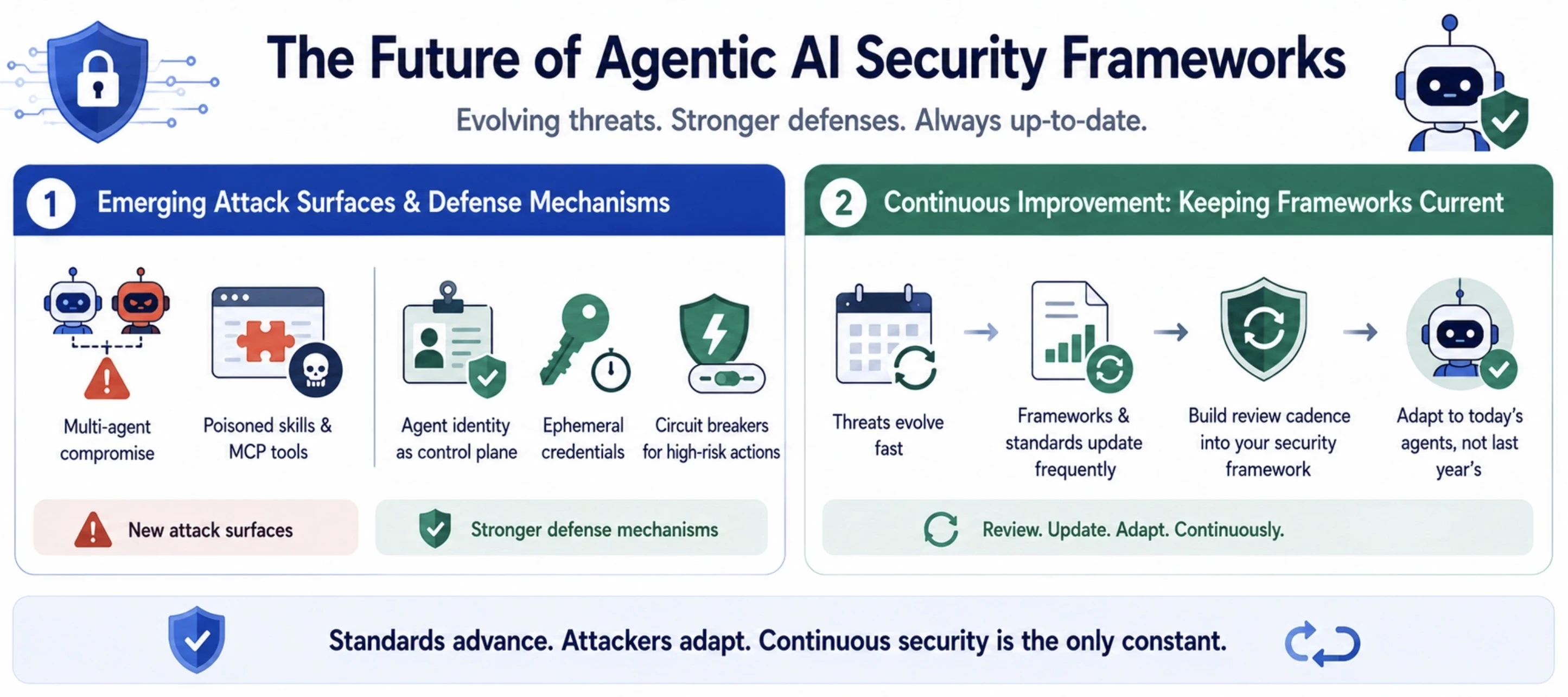
Emerging Attack Surfaces and Defense Mechanisms
Multi-agent systems, unlike single-agent architectures, do not lack risks. If one agent inside an orchestration chain is compromised or spoofed, then it can distribute its granted privileges downstream without any gap in the chain of trust. Agent skills and MCP-connected tools are also a new supply chain threat since, if a skill is poisoned or the registry entry is compromised, it will go from one agent to another. Defence is responding, with the focus moving to agent identity as the control plane, ephemeral credentials and cryptographic attestation rather than static tokens, and circuit breakers that can stop a high autonomy agent midway through a function, not just alert after the fact.
Continuous Improvement: Keeping Frameworks Current
Most security programs aren't used to frameworks in this space being updated so frequently. The Top 10 for Agentic Applications and the State of Agentic AI Security and Governance report were released within a year of the first time they were published, as the threats described as "hypothetical" in 2025 now had documented incidents to them by 2026. NIST's AI Agent Standards Initiative and the OpenID Foundation's work on agent identity delegation are on analogous schedules. The lesson for security teams is that the review cadence itself should be embedded within the framework, rather than in the agent that it enrols. A framework developed around the agent that existed last year will never work with the agent that exists this year.
Final Thoughts: Operationalizing Agentic AI Security with Akto
An agentic AI security framework merits its "agentic" name only when it is seen outside of a document and as an enforced, iterative, run-time protection. That is the difference between a framework and an operation. That's why Akto was created. It identifies and enumerates all the AI agents, MCP tools, and LLMs in your environment, performs automated red teaming and posture assessment against them, and applies guardrails and runtime protection in order to mitigate the risk posed by your AI agents continuously, instead of once a quarter. For organizations that are further advanced in agent deployment than in agent governance, take an AI security demo to see how Akto maps to your agent inventory.
FAQs: Agentic AI Security Framework
1. What is an agentic AI security framework?
An agentic AI security framework is a logical documentation of controls, policies and processes for securing autonomous AI agents, systems that plan, decide and act with tools, during their entire life cycle, from discovery to runtime protection and incident response.
2. Why don't traditional security frameworks work for agentic AI?
The capabilities of AI agents fundamentally alter the security model from what it has traditionally been.AI agents are different from traditional applications because their autonomy, memory, and tool chaining alter the security model from what legacy application security tools were designed to handle.
3. How many organizations have published agentic AI security frameworks?
Over the last 12 months, at least seven organizations have released security frameworks, guidance documents, or tooling that are dedicated to AI agent systems, such as OWASP, NIST, the EU, Cisco, Palo Alto, Google, and Lovable.
4. What did CISA and the Five Eyes alliance say about agentic AI?
The Five Eyes intelligence alliance released “Careful Adoption of Agentic AI Services” on May 1, 2026, that cautioned about the possibility of an agentic AI system acting in unexpected ways and to plan accordingly.
5. How common are AI agent security incidents?
According to Jeff Sutherland's Agent Security Framework, 67% of organisations suffered incidents related to AI agents in Q2 2026.
6. Why does identity matter so much in agentic AI security?
Non-human identities already far outnumber humans in the average enterprise, by about 50:1-and 80% of IT leaders say legacy identity and access management frameworks are inadequate by themselves to control agents acting outside expected business behavior.
7. What are the main attack types unique to agentic AI?
The following are key threats during the agent era: shadow agents, prompt injection, tool poisoning, over-permissioned agents, agent spoofing, and zero-click agentic attacks.
8. Does SOC 2 apply to agentic AI systems?
Yes. Agentic AI systems in production that are deployed to access customer data or production systems are considered part of the scope of SOC 2, particularly for agents interacting with financial or transactional production systems; Processing Integrity would be relevant.
9. Is NIST AI RMF enough to secure agentic AI on its own?
NIST AI RMF offers AI-specific controls which lag behind agentic deployment velocity and have a governance structure that dovetails into existing enterprise risk programs. It is best applied for mapping for organizational alignment instead of being used for technical controls.
10. What's the first step in operationalizing an agentic AI security framework?
Teams shipping agents to production are advised to configure monitoring for unusual or unexpected patterns of tool calls, or unusual data access patterns.
11. Is the EU AI Act relevant to agentic AI security?
Yes. The EU AI Act will be fully enforced in August 2026, and is one of the regulatory frameworks that organizations should be mindful of when implementing agentic AI.
12. What is OWASP's current view on agentic AI security maturity?
The OWASP State of Agentic AI Security and Governance report details the frameworks, governance models and regulatory mandates impacting the global adoption of agentic AI, and serves as a practical guide for agentic AI application teams developing, governing and deploying agentic applications safely.

Experience enterprise-grade Agentic Security solution