AI Agent Security Risk Review for Banks
What an AI agent security risk review actually involves for banks - how it maps to model risk management, and how it differs from an RFP or vendor pitch.

Arpashree

An AI agent security risk review is an internal assessment a bank runs against its own deployed AI agents, testing what an agent can actually be made to do, who's accountable for it, and how its behavior fits existing risk policy. As a category of AI agent risk assessment, banking teams are increasingly formalizing it; it is not the same exercise as issuing an RFP or scoring a vendor pitch, and treating the two as interchangeable is exactly how agents end up in production with no one having actually tested them. The regulatory backdrop here is genuinely unsettled right now, not a stable set of rules to check against: in April 2026, the Federal Reserve, the Office of the Comptroller of the Currency (OCC), and the FDIC jointly replaced SR 11-7, the model risk guidance banks have operated under since 2011, with SR 26-2, and the new guidance explicitly places generative and agentic AI outside its formal scope while still expecting banks to govern those systems under general risk management principles. That gap between "not formally in scope" and "still your responsibility" is precisely the space a bank AI security review exists to fill, and it's why financial services AI agent risk has become its own discipline rather than a subset of general vendor security review.
What a Security Risk Review Actually Covers
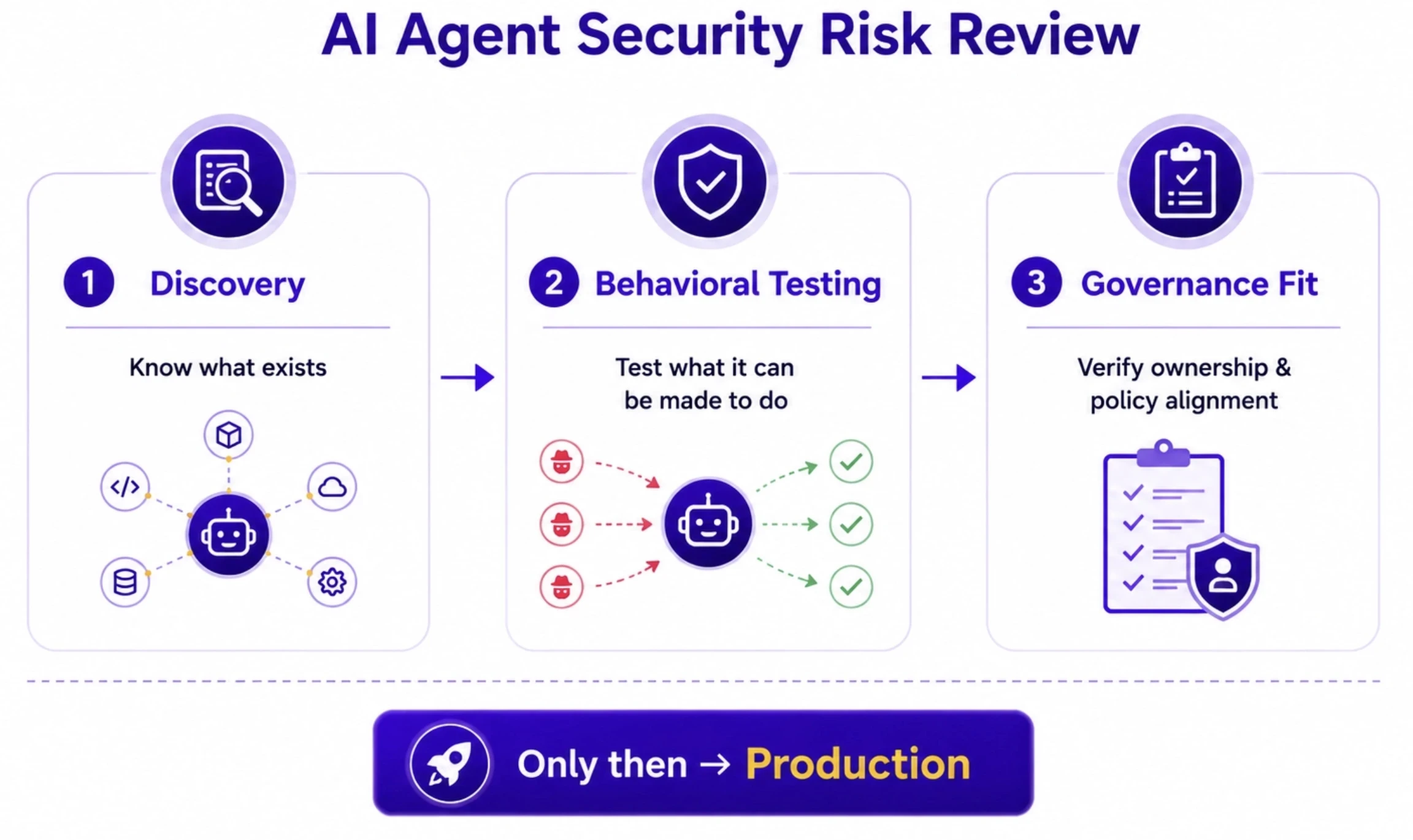
A real review moves through three distinct stages, and skipping any one of them leaves a predictable hole in the assessment. A well-run pre-deployment AI risk review treats all three as a gate an agent has to clear before it ever touches live customer data or transaction systems, not a formality completed after the fact to satisfy a checklist.
Discovery: What Agents Exist and What Do They Touch
Before testing anything, a review needs a current answer to a basic question: what agents actually exist, and what systems and data can each one reach. Agent discovery and classification means cataloging every agent, its connected tools, its data access, and its owner, since a bank cannot risk-review an agent nobody has inventoried. This step alone routinely surfaces agents that were never formally approved, built by an individual team to solve an immediate problem and never brought back for review once it worked, and shadow deployments are consistently where the most severe findings in a first-time review turn up.
Behavioral Testing: What Can the Agent Be Made to Do
Once an agent is identified, the review tests what it can actually be manipulated into doing, not just what it's documented to do. This means adversarial testing for prompt injection, tool misuse, and goal manipulation, run against the agent in something close to its real operating environment rather than a sanitized demo. A review that only checks configuration and never attempts to break the agent's intended behavior is testing the paperwork, not the system.
Governance Fit: Who Owns This Agent and Under What Policy
The final stage checks whether the agent has a real accountable owner and fits inside an actual governance policy, rather than existing in the gap between departments. An agent built by a trading desk, touching customer data, and deployed without model risk sign-off is a governance failure independent of whether it has ever misbehaved, since the absence of ownership is itself the risk. This stage also has to check whether the policy the agent supposedly falls under was actually written with an autonomous, tool-calling system in mind, since a policy built for a static model rarely anticipates an agent that can chain decisions together across multiple systems in a single task.
How This Maps to Existing Model Risk Management Discipline
Banks don't need to invent a review process from nothing. Model risk management already provides most of the discipline; the SR 11-7 agentic AI relationship and, now, the SR 26-2 agentic AI relationship just don't fit its assumptions cleanly.
The SR 11-7 / SR 26-2 Transition, and Why It's Still Unsettled for Agentic AI
SR 26-2, issued April 17, 2026, is the first full revision of federal model risk guidance in fifteen years, and it explicitly narrows what counts as a "model" for regulatory purposes. Buried in the guidance is a scope footnote stating that generative AI and agentic AI are "novel and rapidly evolving" and therefore not within SR 26-2's formal scope, even though the letter also makes clear that a bank's own risk management and governance practices should still determine appropriate controls for tools not explicitly covered. In practical terms: SR 26-2 replaced the old model risk rulebook and then declined to write agentic AI into the new one, which leaves banks holding the governance responsibility with no updated regulatory template to follow. Regulators have also signaled that they intend to gather more information on how banks are actually deploying generative and agentic AI before writing more specific rules, which means the current unsettled state is likely to persist for some time rather than resolve quickly. This is exactly why model risk management AI agents work can't simply wait for the next guidance update. The carve-out doesn't reduce the risk; it just removes the map most banks were expecting to use.
Where Agentic AI Strains the Traditional "Static Model" Assumption
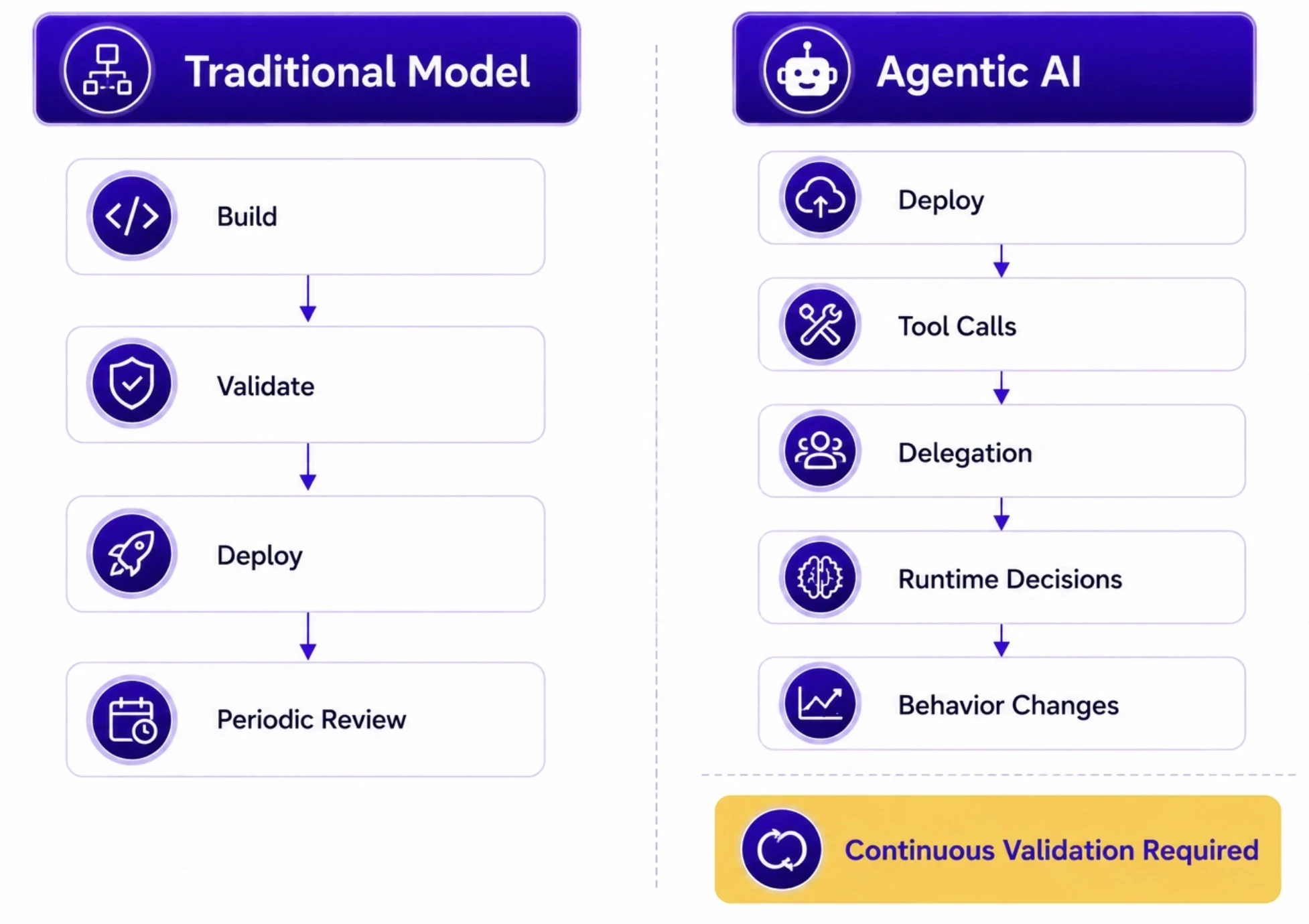
Traditional model risk management assumes a model is a fixed, versioned artifact: built, validated, deployed, and periodically revalidated on a schedule. An agent breaks that assumption structurally. It can call a different tool, delegate to a sub-agent, or shift its behavior across sessions without any underlying model version ever changing, which means the traditional trigger for revalidation, "did the model change," misses the actual risk entirely. A static model assumption applied to an agent produces a validation that passes cleanly while missing the exact behavior the review was supposed to catch.
Three-Tier Validation Applied to Non-Deterministic Systems
Traditional model risk management three-tier validation, tiering models by materiality and applying proportionally deeper independent model validation to higher-risk tiers, still works as an organizing principle for agents. What has to change is what "validation" actually tests for at each tier. For a non-deterministic, tool-calling agent, validation needs behavioral and adversarial testing layered on top of the traditional accuracy and performance checks a model validation team already runs, since an agent can pass every conventional performance metric and still be trivially manipulated into an action nobody approved.
Bank-Specific Risk Categories a Review Must Address
Generic AI risk categories don't map cleanly onto what actually threatens a bank. A review needs categories specific to what agents in financial services actually touch.
Unauthorized or Hallucinated Transactions
Hallucinated transactions, an agent generating and acting on financial details, account numbers, or instructions it fabricated rather than retrieved accurately, are a distinct risk category from a simple factual error, because in an agentic system the hallucination doesn't stop at incorrect output. It can trigger an unauthorized fund transfer or a booked trade before any human reviews it. Review testing needs to specifically probe whether an agent will act on fabricated details with the same confidence it acts on verified ones.
Data Exfiltration of Customer or Trading Data
Data exfiltration banking AI risk is amplified by exactly the tool access that makes an agent useful: an agent connected to customer records, trading systems, or internal communications has a plausible, legitimate-looking path to move that data externally through a tool it was already authorized to use. A review needs to test not just whether access controls exist on paper, but whether an agent can actually be induced to use its legitimate tool access for an illegitimate transfer, since that's the scenario a conventional DLP tool built for human behavior was never designed to catch.
Prompt Override and Goal Manipulation in Autonomous Workflows
Prompt override financial agents face is especially dangerous in multi-step financial processes because each individual step in an overridden workflow can still look procedurally correct. An attacker or a poisoned document redirecting an agent's stated goal mid-workflow doesn't need to make any single action look obviously wrong. A review has to test full workflows end-to-end, not single prompts in isolation, since goal manipulation often becomes visible only across a sequence of actions rather than any one of them.
Compliance Violations (PCI DSS, FINRA, GDPR, BSA/AML-Adjacent Exposure)
A risk review has to test compliance exposure directly rather than assuming it's covered elsewhere. Any agent touching cardholder data falls under PCI DSS regardless of whether it was built with payment data in mind. FINRA's 2026 guidance specifically addresses AI agents that can act or transact, expecting narrow scope and complete audit trails. GDPR's automated decision-making provisions apply the moment an agent contributes to a decision with legal effect for an EU customer. Older OCC guidance on outsourcing and third-party oversight, including bulletins like OCC Bulletin 2021-21, still informs how examiners think about a bank's accountability for a vendor-built agent even where AI-specific rules haven't caught up. And while SR 26-2 formally retired the 2021 interagency BSA/AML model risk statement, BSA/AML AI risk doesn't disappear with it: an agent touching transaction monitoring or customer due diligence still needs governance consistent with BSA/AML expectations, even without a single named framework currently covering it end to end. A thorough bank AI security review treats every one of these frameworks as a distinct test to run, not a single generic compliance checkbox.
Who Should Be in the Room
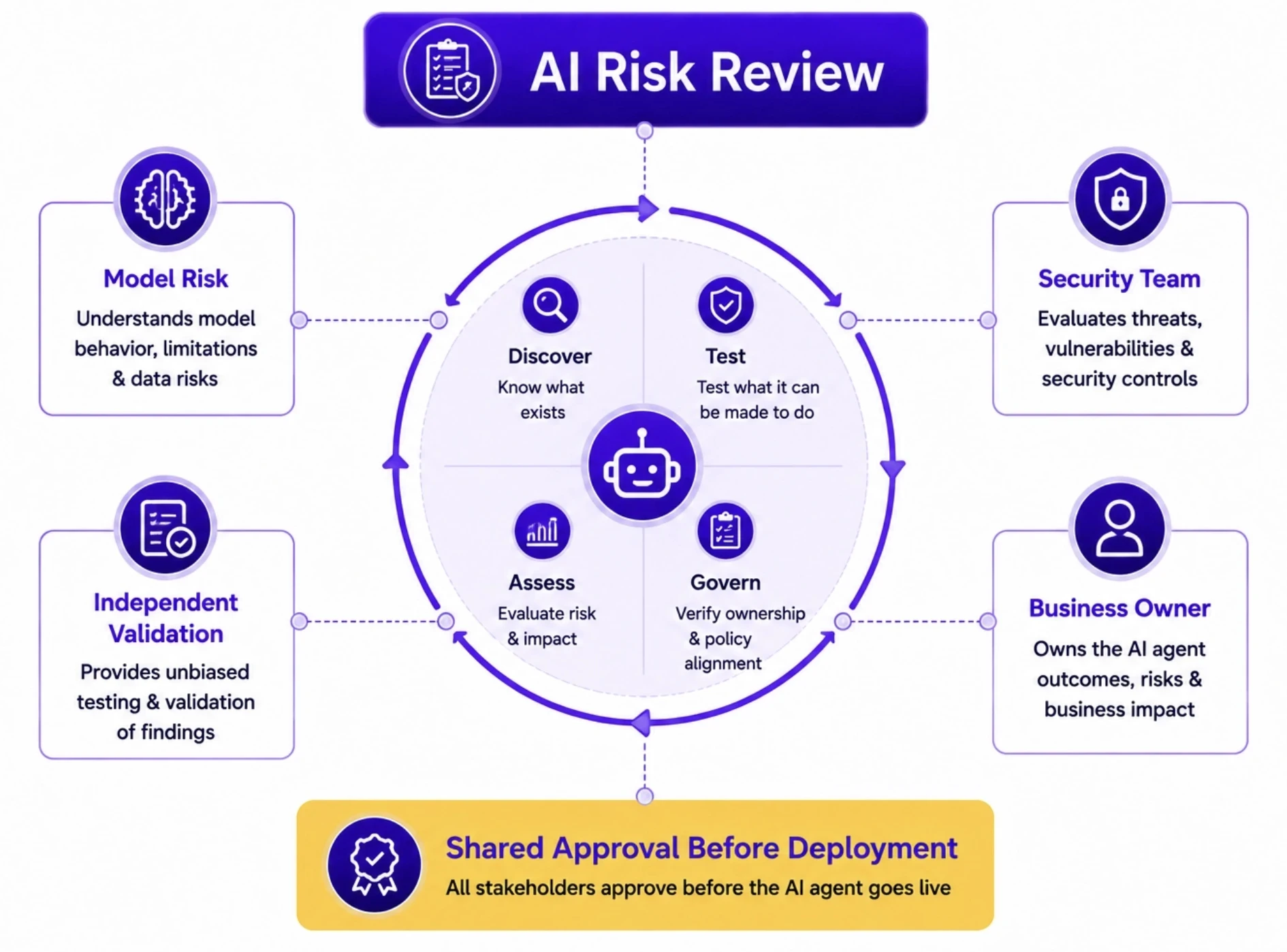
A review run by security alone, or by a business line alone, misses half of what actually matters. A cross-functional AI risk committee is the structural answer: the model risk committee, since agentic systems fall inside their remit even where formal guidance hasn't fully caught up; independent validation, structurally separate from whoever built or deployed the agent, to avoid the same team grading its own work; the security team, running the actual adversarial and behavioral testing; and the business line owner, the only person who can accurately describe what the agent is supposed to do and where deviations from that would actually cause harm. Leaving any one of these four out of the room is how a review ends up technically thorough and practically incomplete.
A Practical Risk Review Cadence
Every agent needs a pre-deployment review before it goes live, covering discovery, behavioral testing, and governance fit as a gate rather than a formality. Periodic re-review should follow on a schedule proportional to the agent's risk tier, more frequent for anything touching transactions or customer data directly, less frequent for lower-stakes internal tooling. Trigger-based model re-validation sits alongside the calendar: any material change, a new tool connection, an expanded permission scope, a new sub-agent added to the workflow, should force an immediate re-review regardless of when the last scheduled one happened, since that's precisely the moment an agent's actual risk profile shifts.
How This Differs from an RFP or a Vendor Evaluation
An RFP evaluates what a vendor claims their product can do before you've bought it, scored against written responses and a proof-of-value window. A security risk review evaluates what your own deployed agent actually does, after it's built or configured, inside your own environment, with your own data and your own tool integrations layered on top of whatever the vendor originally shipped. The two are complementary rather than substitutes, and running a strong RFP process is no guarantee the resulting deployment passes a risk review once it's live, since the configuration choices a bank's own team makes after procurement, which tools an agent gets connected to, how broadly its permissions get scoped, are frequently where the actual risk gets introduced. For the full framework on structuring vendor evaluation itself, see our AI security RFP guide.
How Akto Supports the Risk Review Process
Akto's continuous agent and MCP discovery, adversarial red teaming, and runtime guardrails map directly onto the discovery, behavioral testing, and ongoing monitoring stages a bank-specific risk review requires. Continuous discovery closes the gap where shadow agents routinely surface in a first-time review, red teaming supplies the adversarial evidence a governance committee actually needs rather than a self-reported assurance from whoever built the agent, and runtime guardrails give a bank the enforcement layer that turns a review's findings into an actual control rather than a recommendation that sits in a report. For a bank running AI agent risk assessment banking programs at scale across many agents rather than one pilot, that continuous layer is what keeps a point-in-time review from going stale the moment an agent's tool access changes. For the full breakdown of Akto's capabilities specifically for financial services, see our financial services solution page.
FAQs: AI Agent Security Risk Review for Banks
1. What is an AI agent security risk review, and how is it different from an RFP?
It's an internal assessment testing a bank's own already-deployed AI agents for behavioral, security, and governance risk. An RFP evaluates a vendor's claims before purchase; a risk review evaluates what an agent actually does once it's live in your environment.
2. Does SR 11-7 still apply to AI agents, or has it been replaced?
SR 11-7 was replaced by SR 26-2 in April 2026. Neither directly governs agentic AI: SR 26-2 explicitly places generative and agentic AI outside its formal scope while still expecting banks to govern those systems under general risk management practices.
3. What is SR 26-2, and does it cover generative and agentic AI?
SR 26-2 is the revised federal guidance on model risk management, issued jointly by the Federal Reserve, OCC, and FDIC on April 17, 2026, replacing SR 11-7. It explicitly excludes generative and agentic AI from its formal scope, calling them "novel and rapidly evolving."
4. Why does agentic AI strain the traditional definition of a "model" under model risk management?
Traditional model risk management assumes a fixed, versioned artifact revalidated on a schedule tied to changes in that artifact. An agent can change its behavior, call different tools, or delegate to sub-agents without any underlying model version changing, so the traditional revalidation trigger misses the actual risk.
5. What bank-specific risks should a security risk review test for?
Unauthorized or hallucinated transactions, data exfiltration of customer or trading data through an agent's own legitimate tool access, prompt override and goal manipulation across multi-step workflows, and compliance exposure under PCI DSS, FINRA, GDPR, and BSA/AML-adjacent expectations.
6. Who should be involved in reviewing an AI agent's security risk at a bank?
The model risk committee, an independent validation function structurally separate from whoever built the agent, the security team running adversarial testing, and the business line owner who can describe the agent's intended purpose and where deviations would cause real harm.
7. How often should a bank re-review an AI agent after initial deployment?
On a periodic schedule proportional to the agent's risk tier, plus immediate trigger-based re-review whenever a material change occurs, such as a new tool connection or expanded permission scope, regardless of where that falls in the regular review calendar.
8. What triggers a re-validation of an AI agent under model risk principles?
A new tool or data source connection, an expanded permission scope, the addition of a new sub-agent to a workflow, or any change to the agent's intended purpose, since each of these can shift the agent's actual risk profile independent of any change to its underlying model.
9. How does a risk review relate to PCI DSS, FINRA, and GDPR compliance?
The review has to test compliance exposure directly: whether an agent touching cardholder data meets PCI DSS expectations, whether it meets FINRA's guidance on agents that can act or transact, and whether it respects GDPR's automated decision-making provisions for EU customers.
10. How does this process differ from evaluating a third-party AI security vendor?
Vendor evaluation, covered in our AI security RFP guide, assesses a vendor's product before purchase. A risk review assesses your own agent's actual behavior after deployment, inside your real environment, which an RFP process alone cannot substitute for.
11. How does Akto support banks running this kind of risk review?
Akto provides continuous agent and MCP discovery, adversarial red teaming against prompt injection and tool misuse, and runtime guardrails, covering the discovery, behavioral testing, and ongoing monitoring stages a bank-specific risk review requires. See our financial services solution page for the full capability breakdown.

Experience enterprise-grade Agentic Security solution