AI Risk Compliance & Vendor Governance
Learn how to govern third-party AI risk, meet EU AI Act deployer obligations, and map controls across NIST AI RMF and ISO 42001 before August 2026.

Arpashree
2026 State of Agentic AI Security
How ready is your organization to secure AI agents?
3 quick questions. See how you compare to other security leaders.

Organizations in the top AI governance maturity tier reported AI-related incidents at a 34% rate over the past year. Organizations in the bottom tier reported them at 91%, according to Kiteworks' 2026 Data Security and Compliance Risk survey. That isn't a gradual slope, it's a fork in the road, and it maps onto a question most compliance programs haven't actually answered yet. The question isn't "is our AI compliant," which our general AI GRC guide already covers. It's narrower and, for most enterprises, considerably harder: are we compliant for the AI we didn't build ourselves.
Why Vendor AI Risk Is a Distinct Compliance Problem
You can't govern what you didn't build the same way you govern what you procured. Internal AI development gives you visibility into training data, model architecture, and every design decision along the way, which is exactly the visibility every major framework assumes when it asks an organization to document its risk management process. A third-party AI system hands you none of that by default. You're evaluating a black box based on whatever the vendor discloses, and your regulatory exposure doesn't shrink just because you didn't write the code, since the frameworks below assign real obligations to organizations that merely use a system, not only to the ones that built it. The Stanford HAI AI Incident Database logged 362 AI-related incidents in 2025, up 55% from 233 the year before, and a meaningful share of those incidents involved organizations that had deployed, not built, the system that failed. Vendor AI governance isn't a subset of general AI governance with a lighter compliance burden. It's a distinct problem requiring its own controls, because the information asymmetry between you and your vendor is the risk itself, not just a complicating factor around it.
Provider vs. Deployer: The Distinction That Changes Your Obligations
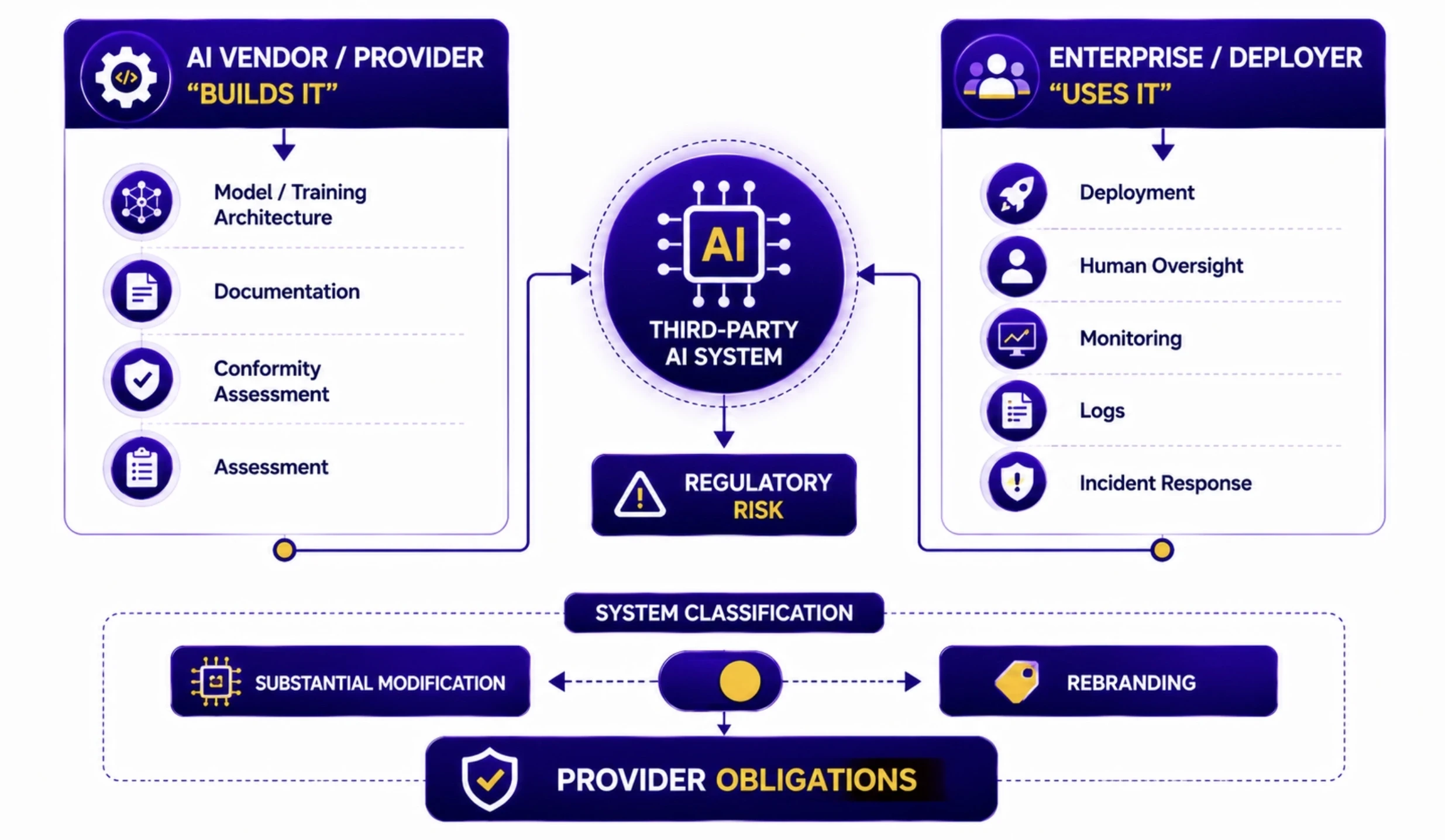
The EU AI Act's core framing, and increasingly the framing regulators and enterprise procurement teams reach for globally, splits AI actors into two roles with fundamentally different obligations. A provider develops an AI system or has one developed and places it on the market under its own name. A deployer uses an AI system under its own authority without having developed it. Most enterprises deploying third-party AI are deployers, not providers, and deployer obligations under Article 26 are routinely underestimated precisely because they're lighter than provider obligations, not because they're negligible or optional.
The distinction isn't static, though. Under Article 25, a deployer that substantially modifies a high-risk system it acquired, or rebrands and redistributes it, can be reclassified as a provider, inheriting the full weight of provider obligations: conformity assessment, technical documentation, and CE marking among them. Many organizations occupy both roles simultaneously across different systems, building a proprietary model in one business unit as a provider while deploying a licensed third-party tool in another as a deployer, sometimes within the same compliance program. Getting this classification right for each system in your portfolio is the first step in any vendor governance program, since the entire compliance obligation set that follows depends on it, and misclassifying even one system can leave a genuine legal obligation unmet.
What Each Framework Requires of Your Vendor Relationships
EU AI Act: Deployer Obligations for Third-Party High-Risk Systems
Article 26 sets a deployer's baseline obligations once a third-party high-risk system, meaning one falling under an Annex III use case, goes live. Deployers must use the system strictly according to the provider's instructions, assign human oversight to qualified individuals, monitor the system's operation, and retain automatically generated logs for at least six months. If the deployer identifies a risk to health, safety, or fundamental rights, it must inform the provider and, where relevant, the market surveillance authority. Deployers who are employers must inform affected workers and their representatives before putting a high-risk system into workplace use, and certain public-sector and public-facing private deployers must complete a fundamental rights impact assessment under Article 27 before deployment. None of this requires having built the system. All of it requires actively governing how it's used.
NIST AI RMF: Supply Chain Risk Under the GOVERN Function
NIST AI RMF treats third-party AI risk as an explicit part of the Govern function, the function concerned with organizational culture, accountability structures, and risk tolerance across an AI system's full lifecycle, including systems the organization didn't build. Though voluntary, the framework carries outsized weight: the FTC, CFPB, FDA, SEC, and EEOC all reference NIST AI RMF principles in enforcement guidance, and federal contractors face growing expectations to demonstrate NIST-aligned governance as a procurement condition. For vendor governance specifically, this means vendor risk questionnaires need updating to cover model provenance and data supply chain integrity directly, not just general security posture, since older questionnaires built before agentic and generative AI became common typically don't ask the right questions.
ISO 42001: Certification as a Procurement Requirement
ISO/IEC 42001 is the certifiable management system standard for AI, and unlike the other two frameworks discussed here, it produces an actual certificate issued by an accredited third-party auditor. That distinction is increasingly the point: enterprise buyers in financial services, healthcare, and the public sector are beginning to require ISO 42001 certification as a condition of vendor qualification, not merely a differentiator among otherwise similar bids. For a vendor governance program, this cuts two ways. When evaluating a vendor, ISO 42001 certification is a meaningful, externally verified signal you can request in place of building your own assessment from scratch. When your own organization is being evaluated by a customer as a provider, pursuing certification increasingly determines whether you clear procurement review at all.
The Four Shared Controls You Can Build Once
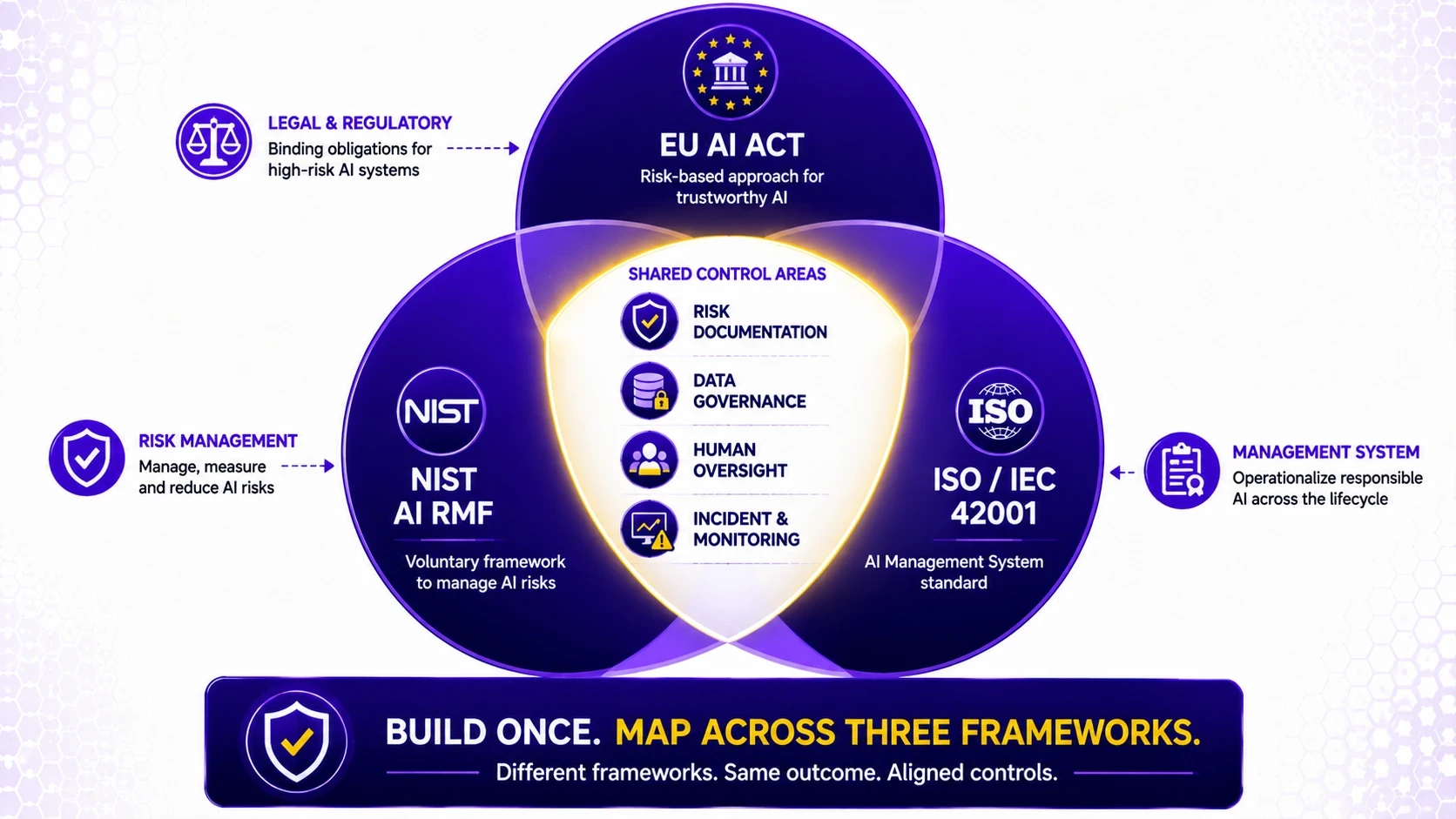
Despite their different legal force, mandatory law for the EU AI Act, voluntary-but-expected for NIST AI RMF, voluntary-and-certifiable for ISO 42001, all three frameworks converge on four shared control categories. Building each once, mapped across all three, avoids running three separate compliance programs that duplicate the majority of the underlying evidence-gathering work.
Risk documentation appears as technical documentation and conformity assessment records under the EU AI Act, as the Map function's system characterization under NIST AI RMF, and as the risk assessment and treatment records required under ISO 42001 Clause 6. Data governance covers training and input data quality under EU AI Act Article 10, supply chain data provenance under NIST's Govern function, and data management controls under ISO 42001. Human oversight is an explicit deployer obligation under Article 26, a core theme running through NIST's Govern and Manage functions, and a management system requirement under ISO 42001's leadership and operational planning clauses. Incident and monitoring processes cover the EU AI Act's serious incident reporting obligations, NIST's Measure and Manage functions for ongoing performance tracking, and ISO 42001's requirements for monitoring, measurement, and continual improvement. A vendor governance program built around these four categories, with evidence collection mapped to all three frameworks simultaneously, satisfies the large majority of what each framework separately demands.
Building a Compliant Vendor Governance Program
Vendor Risk Tiering by System Criticality
Not every AI security vendor relationship carries the same risk, and treating them identically wastes scrutiny on low-risk tools while under-scrutinizing the ones that matter. Tiering should follow system criticality: does the vendor's AI system touch an Annex III high-risk use case, process sensitive personal or health data, or make or materially influence decisions affecting people's rights, employment, or access to services? High-tier vendors warrant the full weight of contractual and monitoring controls below. Lower-tier vendors, an AI-powered scheduling assistant with no sensitive data access, for instance, can be governed with a lighter, faster review process without meaningfully increasing organizational risk.
Contractual Requirements (Audit Rights, DPAs, Incident Notification)
Vendor contracts need to do work that a general due diligence questionnaire can't, because a questionnaire captures a point-in-time claim while a contract creates an ongoing, enforceable obligation. At minimum, high-tier vendor contracts should include audit rights allowing the deploying organization to verify vendor claims rather than simply accepting them, data processing agreements specifying exactly how personal data flowing through the AI system is handled, and incident notification clauses obligating the vendor to inform the deployer promptly, ideally within a specific number of hours, of any security or safety incident affecting the system. Without contractual teeth, a vendor's compliance posture is a claim, not a guarantee, and Article 26's deployer obligation to inform authorities of identified risks is difficult to meet on time if the vendor itself is slow to disclose.
Ongoing Monitoring vs. Point-in-Time Due Diligence
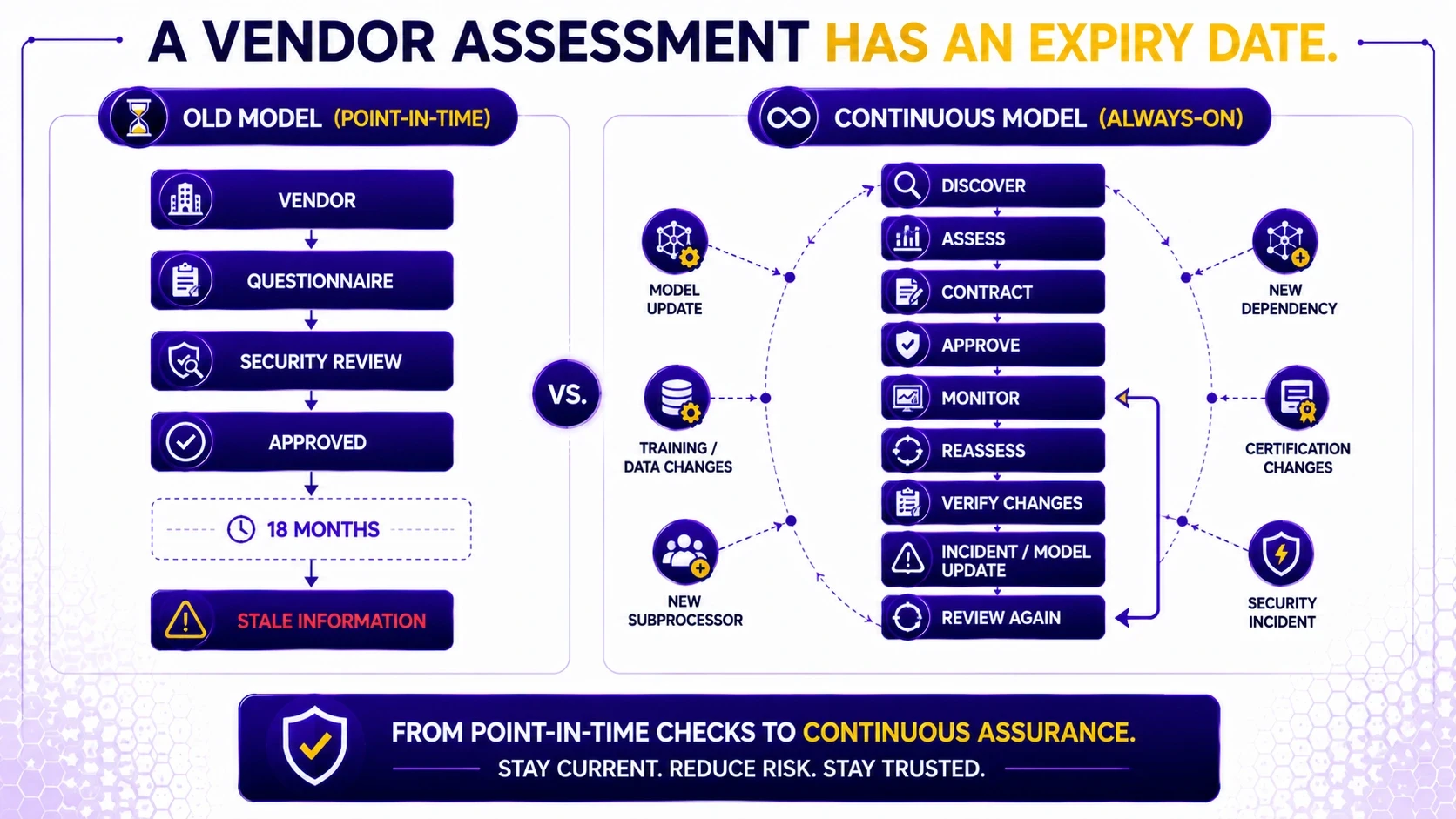
A vendor assessment completed at contract signing tells you almost nothing about the vendor's posture eighteen months later. Models get updated, training pipelines change, and a vendor's own subprocessors and dependencies shift, often without prominent notice to customers, sometimes buried in a routine terms-of-service update nobody on the deploying side reads closely. Point-in-time due diligence remains necessary as a gate before onboarding a new vendor, but it needs to be paired with ongoing monitoring, periodic reassessment, log review where contractually available, and tracking whether the vendor's certifications and conformity status remain current, rather than assuming a review conducted once at signing still holds true a year or two into the relationship.
The August 2026 Deadline and What It Means for Vendor Contracts
Obligations for high-risk AI systems under the EU AI Act, along with the Article 50 transparency requirements covering AI systems that interact with people or generate content, take effect August 2, 2026. Penalties for the most serious violations reach €35 million or 7% of global annual turnover, whichever is higher. For vendor contracts specifically, this deadline means existing agreements signed before the compliance landscape solidified likely lack the audit rights, incident notification timelines, and documentation-delivery clauses a deployer now needs to meet its own Article 26 obligations. Reviewing and, where necessary, amending vendor contracts ahead of this date isn't optional cleanup, it's the mechanism by which a deployer actually gets the provider cooperation Article 26 assumes exists. A deployer cannot retain logs it never receives, cannot escalate an incident a vendor didn't disclose, and cannot verify a conformity assessment a vendor won't produce, which makes contractual leverage the practical foundation everything else in this guide depends on.
How This Relates to MCP Governance and Technical Verification
Vendor governance as covered here addresses the organizational and contractual layer: who's accountable, what documentation exists, what the contract obligates. It doesn't address the technical layer of actually verifying what a specific integration or dependency does at runtime. For governance specific to Model Context Protocol servers and the trust boundaries they introduce, see our MCP governance guide. For the technical verification side, actually confirming a vendor's AI system behaves as documented rather than relying on their claims alone, see our Third-Party AI Security Verification piece. These sit alongside vendor governance rather than replacing it: a compliant contract and a verified integration are both necessary, and neither substitutes for the other.
How Akto Supports AI Risk Compliance and Vendor Governance
Akto's continuous AI asset discovery gives vendor governance programs the inventory layer that compliance documentation depends on, surfacing which third-party AI systems and MCP servers are actually in use across an organization, including shadow AI deployed outside formal vendor review. Findings from Akto's continuous red teaming map directly to EU AI Act, NIST AI RMF, and ISO 42001 requirements, turning technical test results into audit-ready evidence for the risk documentation and incident-monitoring controls both frameworks and vendor contracts require. Rather than treating vendor compliance as a one-time questionnaire, Akto's ongoing monitoring reflects a vendor's actual current risk posture, giving deployers the continuously updated evidence Article 26 and ISO 42001's monitoring clauses both call for, instead of a point-in-time assessment that goes stale the moment a vendor ships a model update.
FAQs: AI Risk Compliance & Vendor Governance
What's the difference between being an AI "provider" and a "deployer" under the EU AI Act?
A provider develops an AI system, or has one developed, and places it on the market under its own name, carrying the heaviest obligations including conformity assessment and technical documentation. A deployer uses an AI system under its own authority without having developed it, and carries lighter but still substantial obligations under Article 26. A deployer that substantially modifies or rebrands a third-party system can be reclassified as a provider.
What compliance obligations apply if we deploy a third-party AI system rather than build our own?
As a deployer of a high-risk system, Article 26 requires using the system according to the provider's instructions, assigning human oversight, monitoring its operation, retaining logs for at least six months, informing the provider and relevant authorities of identified risks, and, for certain public-facing deployers, completing a fundamental rights impact assessment before deployment.
How does NIST AI RMF address AI vendor and supply chain risk specifically?
Third-party AI risk falls under the Govern function, which addresses organizational accountability and risk tolerance across an AI system's full lifecycle regardless of who built it. Though voluntary, the framework is referenced in enforcement guidance from the FTC, CFPB, FDA, SEC, and EEOC, and vendor risk questionnaires should be updated to specifically cover model provenance and data supply chain integrity.
Why are enterprise buyers increasingly requiring ISO 42001 certification from AI vendors?
Unlike the EU AI Act or NIST AI RMF, ISO 42001 produces an actual certificate from an accredited third-party auditor, giving buyers externally verified evidence of a vendor's AI governance maturity rather than a self-reported claim. Enterprise buyers in financial services, healthcare, and the public sector increasingly treat this certification as a condition of vendor qualification rather than a differentiator.
What controls can satisfy EU AI Act, NIST AI RMF, and ISO 42001 simultaneously for vendor governance?
Four shared control categories cover the large majority of what all three frameworks separately require: risk documentation, data governance, human oversight, and incident and monitoring processes. Building evidence collection around these four categories, mapped across all three frameworks at once, avoids duplicating the same underlying work across three separate compliance tracks.
What should an AI vendor contract include for compliance purposes (audit rights, DPAs, incident notification)?
High-tier vendor contracts should include audit rights allowing verification rather than reliance on vendor claims, data processing agreements specifying how personal data is handled, and incident notification clauses with a specific disclosure timeline. Without these, a deployer's Article 26 obligation to inform authorities of identified risks is difficult to meet if the vendor itself discloses slowly or not at all.
What's the August 2026 EU AI Act deadline, and how does it affect existing vendor contracts?
High-risk AI system obligations and Article 50 transparency requirements take effect August 2, 2026, with penalties reaching €35 million or 7% of global turnover for the most serious violations. Vendor contracts signed before this deadline solidified often lack the audit rights, incident notification timelines, and documentation clauses a deployer needs to meet its own Article 26 obligations, making contract review and amendment a practical necessity ahead of the date, not optional cleanup.
How does vendor risk tiering work for AI-specific compliance programs?
Tiering should be based on system criticality: whether the vendor's AI touches an Annex III high-risk use case, processes sensitive data, or materially influences decisions affecting people's rights or access to services. High-tier vendors warrant full contractual and monitoring controls, while lower-risk vendors can be governed through a lighter review process without materially increasing organizational risk.
How does this relate to MCP-specific governance or technical dependency verification?
Vendor governance as covered here addresses the organizational and contractual layer of AI risk. MCP-specific governance addresses the trust boundaries introduced by Model Context Protocol servers specifically, and technical verification addresses confirming a vendor's system behaves as documented rather than relying on contractual claims alone. All three work together rather than substituting for one another.
How does Akto support AI risk compliance and vendor governance programs?
Akto provides continuous discovery of third-party AI systems and MCP servers in use across an organization, including shadow AI outside formal review, and maps continuous red teaming findings directly to EU AI Act, NIST AI RMF, and ISO 42001 requirements. This gives vendor governance programs continuously updated, audit-ready evidence rather than a point-in-time assessment that goes stale after a vendor's next model update.

Experience enterprise-grade Agentic Security solution