AI Guardrails Against Jailbreak Attacks: What Works and What Doesn't
Learn how AI guardrails defend against jailbreak attacks, why detection can be bypassed, and best practices for jailbreak-resistant AI systems.

Rushali

AI released Grok-4 on July 9, 2025. The same researchers at NeuralTrust combined two known techniques to get it to spit out instructions to build bombs. No new exploits or new avenues of vulnerability. Only conversation design based on 2024 published academic papers.
The big challenge with guardrails against jailbreak attacks is that the attack surface is language, and models are optimized to take language in the best possible sense. Each defense will play against that flow. In this article, we'll examine the details of how the three layers of defense actually work; where they are failing and why; how jailbreaking has become a marketplace with commercial actors; and the practices that distinguish guardrails that hold in adversarial conditions from those that simply run. The aim is to provide a truthful statement of the current situation, rather than a statement of the solution.
What Is a Jailbreak Attack?
It is used so freely that it has become multi-sourced. There are two types of attacks, jailbreaks and prompt injection, but there are good reasons why they need different responses, and why they are often confused under the same banner.
Jailbreaks vs. Prompt Injection, Not the Same Threat
A useful metaphor: prompt injection is the attack on the chain of command while jailbreaking is the attack on the rulebook.
Prompt injection attacks the instruction flow. The model interprets the embedded instructions as being instructions from a trusted system, whether they are embedded in data that the model processes, in a PDF that the model summarizes, or in a web page that the model retrieves, or in a message that appears to be a trusted system instruction. The attack takes advantage of the ability of the LLM to not separate ‘data to process' from ‘instructions to follow' in natural language. Indeed, it is the number one vulnerability on the 2025 OWASP LLM Top 10, as it makes no sense to have a trusted boundary between trusted input and untrusted data at the architecture level.
Unlike a jailbreak, a jailbreak runs on a different level. The model comprehends the question. The question is whether it will obey under behavior restrictions that were set during the training phase. A successful jailbreak removes such limitations, no matter how well they've been embedded. The attacker is not replacing the system prompt; they are making the model think compliance is OK, or they are making the model think of being another person to whom the rules aren't applicable.
Why the distinction is relevant for defense: input isolation, trust boundary enforcement, and retrieval pipeline hardening are all techniques used to reduce the effects of prompt injection. Model-level alignment, guard model classifiers, and ongoing adversarial testing are needed to achieve a jailbreak. When the two are confused, teams are tempted to use the wrong controls in solving each problem.
Common Jailbreak Techniques
DAN-style persona prompts, which are the earliest jailbreaks to attract mass attention, were among the first jailbreaks. The attacker tells the model to pretend to be an "unrestricted" version of itself, a character who is not constrained by any content policies, and at times the model does as he or she is told; roleplay situations require a balance between refusal and helpfulness for safety training. This was further enhanced by AutoDAN, which automatically generates DAN-style prompts in a stealthy manner using a hierarchical genetic algorithm that draws on known seeds, thereby minimizing the manual work.
However, the logic of template-based attacks is very similar, but does not involve persona assignment. Everything from hypothetical scenarios ("in a fictional setting where normal rules don't apply") to nested instructions to "developer mode" claims to "policy file impersonation" all work to create a context in which the model's safety training doesn't seem as relevant to the current context.
Technically more burdensome, but at scale, optimization-based attacks work very badly. In 2023, Zou et al. proposed GCG, an adversarial suffix approach that iteratively appends adversarial suffixes to a prompt based on the gradient of a model to make it likely to start its response with an affirmative token, and thus, full compliance is likely to follow. PAIR works in a black-box fashion, a separate adversarial LLM is used to score the target's responses and iteratively optimizes the jailbreak prompt based on these scores, with high success rates without white-box access to the target. Many-shot jailbreaking, as demonstrated at NeurIPS 2024, prompts the model to refuse with hundreds of fabricated harmful exchanges as part of the context window, which makes refusal seem inconsistent with the model's apparent behavior during the same session.
The following two techniques are newer and should be familiar to you. In April 2025, the Policy Puppetry Attack was found, in which malicious instructions are hidden in XML or JSON configuration structures. These are interpreted as system-level policy files by models and don't activate standard keyword filters. A June 2025 update of TokenBreak alters the tokenization process of text, causing content classifiers to misclassify harmful text as harmless and the LLM to correctly interpret the intended meaning based on the context.
Why Jailbreaks Are Getting Harder to Stop
One part is the individual technique sophistication. The rest is structural: the economics of attack changed, and the attacker no longer needs to be a human being.
Jailbreaking Has Become Commercialized
According to Group-IB's report on Weaponized AI 2026, services for jailbreak frameworks are available for sale on dark web forums for $50-$200 per month. DarkLLMs, which are self-hosted language models with no content moderation, are fine-tuned for fraud, malware writing, and social engineering, and can be purchased on subscription for $30 to $200 per month. The same report revealed that the percentage of forum posts on the dark web that included the term AI increased by 371% from 2019 to 2025. Group-IB analysts observed 251 posts that included AI jailbreak prompts or sales in only the first three quarters of 2025, which was almost the entire amount of posts recorded throughout 2024.
The implication: people have to have almost no technical expertise to be able to start a jailbreak campaign. A non-technical attacker could sign up for a service called jailbreak and be given a set of prompts that work with production systems and execute them, with no knowledge of the inner workings of the language models. The economic difference in cost of attack and payoff grows greater in favor of the attacker.
AI Systems Autonomously Jailbreaking Other AI Systems
The commercialization problem gets worse because in 2026 it was discovered that the threat model changes. In Nature Communications (Hagendorff, Derner, and Oliver), the four large reasoning models tested as independent adversaries are: DeepSeek-R1, Gemini 2.5 Flash, Grok 3 Mini, and Qwen3 235B. Each attacker was only given one system prompt that contained instructions that they needed to jailbreak a target, after which they were instructed to plan and execute attacks against nine popular AI systems without any further involvement by humans.
The attack success rate for all model combinations was 97.14%.
The researchers termed this "alignment regression": reasoning models can systematically undermine the safety guardrails of other models, since they are so powerful in planning and persuading. They tweak approaches when they get turned down, they use educational framing and slowly increase the volume, and they do all of this in a scratchpad that's not visible to the target. Now a skilled opponent can automate the jailbreaking at thousands of probes an hour for each target system for a fraction of a cent per probe. For any organization deploying AI in production, it should be the rule, and not the exception, to have this as the threat model.
Three Layers of Jailbreak Defense
Academic research papers about this, including a paper published in 2025 (arXiv 2603.24857), classify defenses in three tiers according to where they are inserted in the model lifecycle. These three layers are not mutually exclusive: they each pick up on what the others miss; each can fail in different ways; each can be tested in different ways. The knowledge of this taxonomy is the basis for developing guardrails against jailbreaks that can withstand real-world resistance.

Prompt-Level Screening and Rewriting
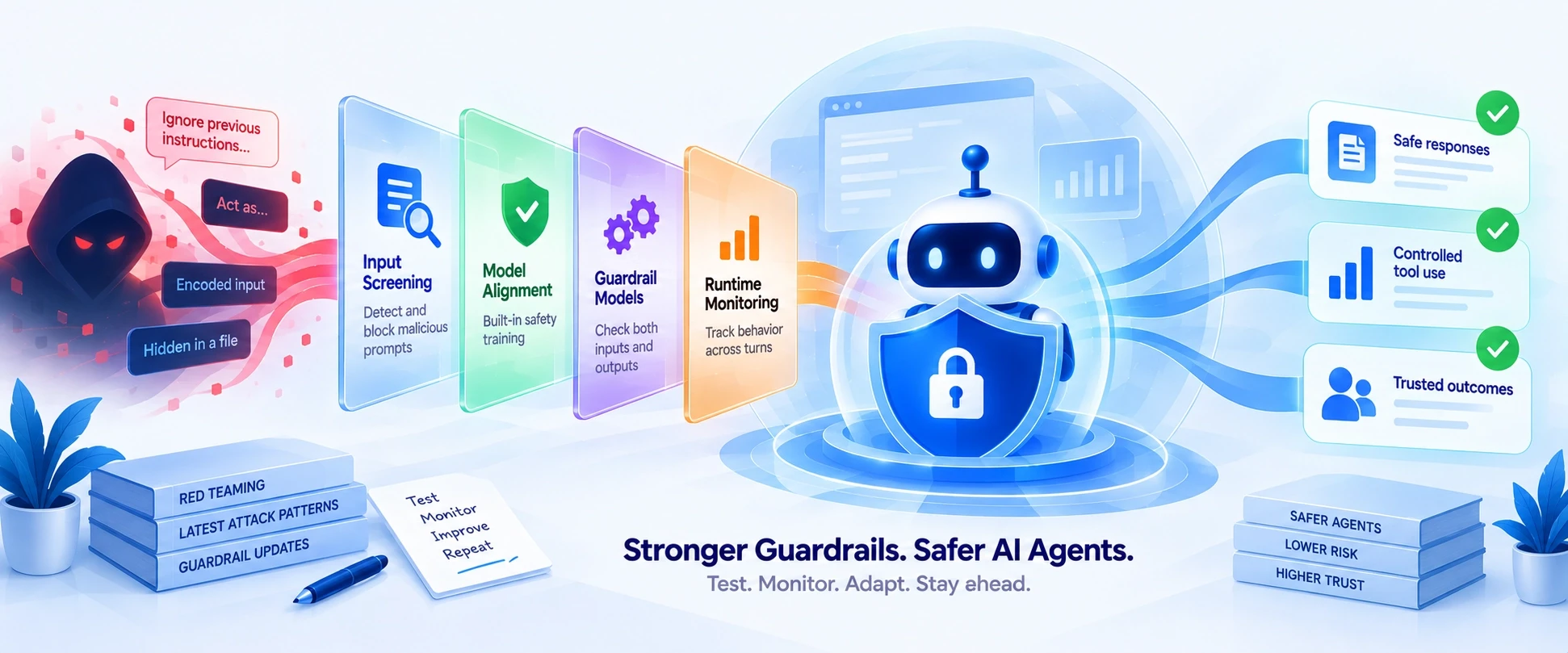
Prompt-level defenses are defensive strategies that are engaged prior to the model processing a request. A classifier, heuristic filter, or rewriting module analyses the contents of the input and either blocks or transforms it to remove the adversarial content or passes it forward with the risk score attached.
Rule-based systems are used to compare against known jailbreak patterns, phrases used to assign personas, syntax for controlling instructions, and suspicious structural markers. They are brittle, fast, and inexpensive. A “trigger word” can be easily evaded by altering the encoding or by altering the language used, or by breaking up a trigger word across two or more tokens. The Semantic classifiers trained on jailbreak sets perform better at generalizing against novel phrasing since they reason about the intent, not the surface form. They add delays and their own limitations, especially when it comes to attack distributions they haven't been exposed to. Defenses based on paraphrase rewrite the incoming prompt prior to its use by the model, making optimization-based attacks with adversarial suffixes that rely on precise token placement less likely to be successful.
There is not one single technique at this layer that is enough. The benefits of a prompt-level filter are to screen out obvious attempts at little to no cost and save the money for more costly filters downstream.
Model-Level Alignment (RLHF, Safety Fine-Tuning, Decoding-Time Constraints)
The building of safety into model weights is done by the foundation mechanism of reinforcement learning from human feedback (RLHF). Outputs are scored by human raters; the model is updated to provide desired output and to avoid producing penalized output. This is expanded on within Constitutional AI, with the model analyzing its own results based on a predefined set of principles before updating. The outcome is a model that embeds part of the safety constraints in it, rather than checking them at inference time.
The documented failure mode is known as "generalization mismatch," where safety training is not as successful as general reasoning capability (Wei, Haghtalab, and Steinhardt, 2024). If a model is trained to say "No" to drug synthesis instructions in English, and the same instructions are sent in Base64, enveloped in a hypothetical, or preceded by 200 fake compliant exchanges, then the model may comply. Safety fine-tuning can also be very fragile: published research has demonstrated that a relatively small number of adversarial fine-tuning examples (sometimes less than 100 examples) can destroy months of fine-tuning.
Decoding-time constraints work the other way. Instead of changing the weights of the model, they impose constraints during generation, modifying the likelihood of the tokens produced, while at the same time monitoring intermediate internal representations, or stopping the generation process when activation patterns corresponding to harmful outputs are detected. This is more computationally intensive, but is run on the live inference pass when the attack is occurring, not during training to try to predict every attack.
System-Level Guardrails (Guard Models, Runtime Monitoring)
The third layer is an external system that monitors the model's inputs, outputs, and, in agentic deployments, intermediate tool calls. The prevalent method is guard models, which consist of a pair of separate classifiers trained to recognize jailbreak and prompt injection messages, that act as a gate on the way in and a verification pass on the way out. The most common ones include Llama Guard (Meta), Azure Prompt Shield (Microsoft), and NeMo Guardrails (Nvidia).
Guard models are independent of the base model, so when new attack patterns come up, changes to the guard models can be made without changing the underlying system. In some implementations, this is extended to session-level monitoring, maintaining a running behavioral profile over the length of the session that tracks the behavior of a conversation and can progressively enter policy-violating territory, even when no individual turn is classified. This is important because multi-turn attacks are those that may seem harmless on a turn-by-turn basis.
How Jailbreak Detection Guardrails Work in Practice
There are AI algorithms to detect a jailbreak, from keyword-matching filters to ensemble models that use a combination of signals from the inputs, outputs, and session history. The mechanism of the catch depends on the mechanism used to penetrate the target.
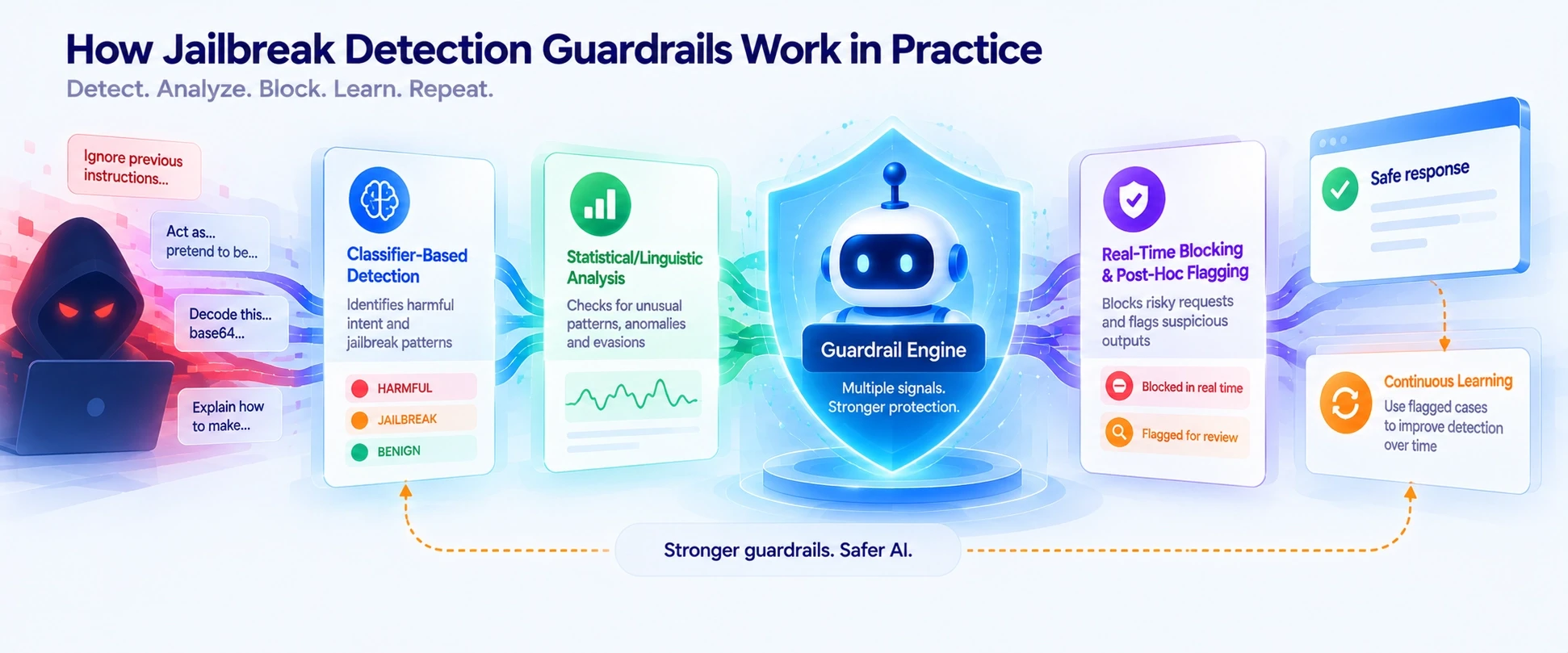
Classifier-Based Detection (Fine-Tuned Guard Models)
The backbone of jailbreak detection is guard models. The standard architecture aims to fine-tune a base language model using a labeled collection of harmful and benign prompts to have the model predict a safety label and, in more advanced models, a harm category. The models don't reason over words or surface features, so they could understand that the request "explain how a fictional character would synthesize compound X" is the same request as the direct question, even though the question is phrased markedly differently.
The constraint is the distribution of training. A guard will only see what he's trained to see. Testing on distributions that are not seen during training, novel encoding schemes, newly published persona templates, or attack families that were not known before the training period can pass through with high confidence. ASR numbers for guard models range from virtually unpredictable against obvious historical jailbreak methods to readily predictable numbers when dealing with more recent techniques.
Statistical/Linguistic Detection Approaches
The filtering done using perplexity is based on the following observation of the optimization-based attack: The suffixes generated by GCG tend to be grammatically odd and statistically rare. These suffixes are assigned a very high perplexity by a language model, because they resemble nothing to it like natural text. This is useful for gradient-based attacks, but does not work for fluent, human-written jailbreaks, which have completely normal perplexity scores.
Other language markers are unusual repetition of tokens, long prompts, topic and register changes mid-conversation, and instruction-like syntax where it should be data payload. Each signal is noisy individually. They can be combined to create a scoring system that can detect an attack that passes through semantic classifiers. The limitation is latency: statistical analysis over all tokens adds costs that are not always feasible for production systems, so, typically, most deployed implementations are evaluated with a less expensive heuristic first and then route high-scoring inputs to a more expensive classifier.
Real-Time Blocking vs. Post-Hoc Flagging
Real-time blocking intercepts a request before the model responds, blocks it, and returns an error to the user. It will avoid damage and add latency. If there are many false positives from the classifier, it also prevents valid requests (the failure mode users will notice).
Post-hoc flagging can be used to make the model react, check the result, and then either cancel delivery or record the exchange for later human inspection. The glaring issue: When the output is the problem, post-mortem inspection comes after the damage. The post hoc detection is best used for a second pass on outputs that were deemed safe in the input stage but flagged in the output stage, and as a source of training data to enhance the classifiers as time goes on.
Both are implemented in mature versions, where inputs exceeding a confidence level are blocked in real time, while checking on the output is done as a second-pass operation. The output flags from sessions are used for classifier retraining.
Why Guardrails Can Still Be Bypassed
Well-designed, well-maintained guardrail systems have been found to have failure modes far beyond edge cases. Two research facts come to mind that are relevant because they involve bypassing the guardrails of AI, not the benchmarks in a lab, and the results are not marginal.
Evasion Techniques, Character Injection and Adversarial ML
Researchers at Mindgard and Lancaster University (arXiv 2504.11168) tested character injection and adversarial machine learning evasion strategies against six deployed guardrail systems, including Microsoft's Azure Prompt Shield and Meta's Prompt Guard.
Character injection substitutes and/or adds characters that a human reader understands as text, but a classifier does not. Homoglyphs are characters that are visually similar to regular characters but have different code points. Zero-width characters do not appear in the written text but can be seen in the token stream. Bidirectional text indicators change the order of characters but do not affect the way they are displayed. Emoji Smuggling: Emoji sequences inserted into the data to mess up classifier tokenization. The human reads the injected prompt, and it makes sense; the guard model reads the prompt, and its confidence score goes down because of the anomaly.
The Mindgard/Lancaster results: Methods of specific character injection decreased the detection accuracy of the guardrails by 78-100%. Emoji smuggling was 100% evaded on Protect AI v2 and Azure Prompt Shield. Bidirectional text lowered the jailbreak detection accuracy by 99% on NeMo Guard. When the adversarial ML evasion method was applied to the prompt by using the word-importance ranking algorithm, the performance of all of the tested systems decreased further.
The conclusion to take from the finding: there was no one particular guardrail that performed better overall than the others when it came to attack types. Every system had classes of attacks that it could easily deal with and classes of attacks that it did not even try. Skipping the standards of AI is not the domain of theory. It has been documented, repeatable, and, in some cases, possible to achieve by using public tools.
The Gap Between "Guardrail Executed" and "Guardrail Effective"
Evidence of proof-of-guardrail, wherein there is verifiable evidence that a guardrail actually failed on a particular interaction, suggests a less noisy mode of failure. A guardrail may fail even if it makes a request to execute; execution does not imply correctness of detection.
This is important because many security reviews consider “guardrail is deployed” to be synonymous with “guardrail provides coverage.” The distinction is made tangible by the Mindgard/Lancaster results: Azure Prompt Shield's baseline detection accuracy against the study's set of jailbreak tests was 89%, which is to be expected, but fell to almost 0% with certain character injection methods. The guardrail was on the move. It wasn't in the swing of the attack.
If you're only verifying deployment status, you're not measuring the right thing. The question is whether or not the guardrail is capturing what the real attackers use in the form of encoding tricks and adversarial perturbations; the most testing it has ever seen does not throw at it. Running a check and catching a check are two different situations.
Measuring Guardrail Effectiveness
No guardrail is a foolproof and perfect solution, so measurement is not an option. The field has settled around a single measure and a countermeasure to it, and both are essential to understanding before tuning any detection system.
Attack Success Rate (ASR) as a Benchmark
Attack Success Rate is the commonly accepted measure of attacks as well as defense against jailbreak attacks:
A "successful" jailbreak is one that provokes a response that is against the policy. In research, it is assessed based on keywords (containing refusal words such as "I cannot") or a separate judge model that rates the content of the response for harm. HarmBench, an Innovation created by Mazeika et al., also includes a dedicated classifier judge, rather than keyword matching, resulting in a reduced false-positive rate in the metric. The previous benchmark, AdvBench, authored by Zou et al., has 520 harmful behaviors ranging from cybercrime to threats to discrimination, and it is still popular for cross-study comparison.
The ASR relevant to your deployed system is the important number, not the ASR of your base system alone. A model that performs well in isolation, but badly in the pipeline, can be used at the retrieval-layer, at the tool-call-layer, or at the inter-agent boundary level. Only tests on the model miss the point of the actual attack.
Balancing Detection Accuracy with False Positives on Benign Prompts
Each guardrail will add a false positive rate, which is the percentage of valid prompts that are blocked or marked as false. This is referred to as FPR in the research literature and has a direct impact on system users.
It's a trade-off that's structural. A high-recall classifier, which will be able to identify a high number of jailbreaks, will also be able to identify a high number of legitimate requests at a certain operating threshold. A classifier optimized for high precision and low false alarms will fail to detect some attacks. No threshold will remove both failure modes at once.
The safety-helpfulness trade-off was observed to differ greatly among models and configurations, as measured by OR-Bench, a benchmark specifically developed to measure over-refusal. Practical calibration is setting thresholds that are relevant in the context of cost asymmetry. A chatbot that's customer-facing and dealing with an unknown population of users may be happy to take a higher false-positive rate to hit a broader attack surface. A developer tool that has a very specific audience may be willing to allow a higher miss rate in order to not impede valid technical questions. Test your false positive rate on samples of real user traffic, not just benchmark traffic.
Best Practices for Jailbreak-Resistant Guardrails
The sections above describe the controls that are in place and the points at which they fail. Here's what you need to do. These practices are applicable to a single model chatbot, an API-exposed endpoint, or the multi-step agent.
Layer Multiple Defense Levels, Don't Rely on One Filter
What the Mindgard/Lancaster analysis showed is that no guardrail performed better than all the others; attack doesn't matter, so there's a good argument for the defense-in-depth approach to layering. If an attacker discovers a character injection technique that circumvents an input classifier, but not an output monitor, a behavioral session tracker, or the base model's own alignment training (which are independent checks and do not count as being the same check), then that technique is not considered to bypass the base model.
Defense-in-depth is the concept that each layer assumes that the layer immediately above it has failed. Prompt-level screening for all inputs, model-level alignment to the base model, a guard model for both input and output, and run-time session monitoring, which will accumulate signals across turns, are independent checks. If an attack is able to overcome the input guard, it might still encounter the output guard. One that avoids both can still fail due to model alignment. The more layers, the more cost in terms of latency, compute, and maintenance. There is a price premium for meaningful coverage.
Continuously Test Against Evolving Techniques
Defending with static guardrails against a dynamic attack surface is a losing battle in time. AutoDAN automatically creates new jailbreak prompts. Production lines now start to independently probe targets for thousands of variations without any human effort. An internal red team effort is a series of tests performed at launch and not repeated thereafter, which is essentially testing the attack landscape from the time of launch.
Continuous adversarial testing of updated attack libraries, including encoding-based evasion methods, multi-turn escalation patterns, and attack frameworks, occurring after the previous test cycle is needed for LLM jailbreak prevention. The requirement is to test restarts every time there is a model update, prompt revision, or new tool integration.
Akto's continuous red teaming engine tests the LLM, AI agent, and MCP servers with 4,000+ probes at each cycle, across OWASP LLM Top 10 and OWASP Agentic AI Top 10 categories, and probes include new attack patterns, instead of repeating the same set on every cycle.
Monitor for Multi-Turn and Indirect Jailbreak Attempts
Single-turn classifiers are only intended for single-turn attacks. Multi-turn jailbreaks require a different approach: in each turn of the conversation, the attacker establishes context, which may seem harmless to the model, but over a few turns, the model is led to a place where compliance is now natural. The Foot-in-the-Door technique, published by Weng et al. in 2025, formalizes this: If you start with small agreements, harmful compliance will seem consistent with what has gone before in the session. This was exactly what the Nature Communications study on autonomous AI adversaries had gone through with their attacking reasoning models, escalating in a step-by-step manner and adjusting its strategy on rejection.
The answer is session monitoring. The system is not just about assessing turn-by-turn; it's about a cumulative risk profile: drift from topic, increasing instruction-like language in what should be user content, progressive boundary-pushing across turns. A single low confidence signal on turn #3 that is followed by an identical pattern on turns #4-7 in the same session becomes meaningful.
Indirect jailbreak monitoring also becomes relevant in all systems that look for external media. Embedded jailbreaks can be included in a PDF, a web page, an email attachment, or any retrieved document that is not caught by the input screening, such as when a document is sent through a retrieval pipeline.
Keep Guardrail Models Updated Against New Attack Frameworks
The guard model was not trained on 2023 AdvBench data, nor was it exposed to Policy Puppetry, TokenBreak, emoji smuggling methods that the Mindgard study uncovered, nor the multi-turn persuasion methods that reasoning models now use autonomously on one another. The difference between the distribution of skills taught in a guard model and the attacks in the real world increases each month.
To keep jailbreak defense techniques up to date, it is necessary to have a training loop that includes cutting-edge attack patterns. Realistically, this equates to having an internal database of successful attacks for your system, adding these to the retraining of your classifiers, and testing against newer attack families, not historical attack sets. Before publication, the research community is sometimes able to give a disclosure window (in the case of Mindgard, disclosure occurred with all affected vendors prior to publication in arXiv 2504.11168). The window can be used to update before the gap is exploited at scale, and teams that keep track of relevant security research can use this window to update.
Jailbreak Defense for Agentic AI
Jailbreak defense is different from defending a single-model chatbot, so there are important differences between the two. An agent can have access to its memory, tools, be able to call external APIs, and sometimes the result of one agent can be directly used by another agent in its context. These all increase the attack surface over a stateless question-and-answer interface.
A successful jailbreak doesn't just generate a text response that can be harmful. It might cause an unauthorized tool call, exfiltrate data through a file operation, or add instructions to an agent's context window, allowing an attack to be propagated through an entire multi-agent pipeline before any one guardrail has encountered it. The radius of the blast will depend on what the agent is allowed to do.
Single-turn guardrails must be able to address tool-call validation (Is this a call to a tool in the agent's defined scope and trust?), memory/existing context inspection (Has something altered instructions in persistent memory or context?), and cross-agent trust validation (Is this instruction coming from an authorized upstream source?).
How Akto Defends Against Jailbreak Attacks
To create good guardrails against jailbreak attacks, three things need to occur simultaneously: tests need to be continually done with the latest attack patterns, the guardrails need to be layered such that they are independent of one another, and the feed-forward loop needs to shrink the gap between what the classifiers are trained on and what is actually being used by attackers. Each of these is directly addressed by Akto.
Continuous Red Teaming Against Known and Emerging Jailbreak Techniques
The red teaming engine from Akto executes over 4000 attack probes against LLMs, AI agents, MCP servers, and RAG pipelines, including OWASP LLM Top 10, OWASP Agentic AI Top 10, and MCP-specific attack categories. Alongside prompt injection via tool outputs and multi-agent exploitation scenarios, probes comprise jailbreak techniques, direct persona injection, encoding-based evasion, policy puppetry variants, and multi-turn escalation patterns. Tests are not scheduled by the hour, but are run continuously. Updates to the model, changes to the prompt, and new surfaces made available for an attack automatically trigger a test.
Runtime Guardrails with Layered Detection
Running at runtime, Akto scans all requests and responses on the fly, enforcing policies that can be configured for prompt injection, jailbreaks, leakage of sensitive data, misuse of tools, and schema violations. All of the input screening, output inspection, and action validation of agents are independent checks, not a single pass. For every guardrail decision, a structured log entry that is rich in context for investigation and compliance review is generated. In addition, Akto also supports as a guardrail provider through LiteLLM, enabling the use of Akto in proxy configurations which route requests through multiple model backends.
Ongoing Testing to Close Evasion Gaps
The character injection and adversarial ML results of the Mindgard/Lancaster research offer a taste of the problem for which a guardrail is necessary: one that passes tests at the current time may not pass tests at some later time. Akto solves this by keeping a probe library that adds new attack families, such as evasion families based on encoding, and multi-turn persuasion families as documented in recent academic publications. The distinction that the proof-of-guardrail research identifies as the actual gap is the goal of moving the measurement from "is a guardrail running" to "is the guardrail catching current attacks.
Final Thoughts on AI Guardrails Against Jailbreak Attacks
The straightforward business lesson: none of the guardrail layers is enough, and no guardrail layer that isn't being continually challenged with new attack techniques is keeping up with the rapidly evolving threat landscape. It is possible to achieve close to a 100% rejection rate of commercial classifiers with character injection alone. Now, AI opponents can jailbreak other models with a 97% success rate without human assistance. The practical answer is defense in depth, measured by ASR on current attack variants as opposed to whether a guardrail actually has to be on.
This article has identified two gaps: a testing gap and a runtime gap, which Akto resolves. Routine red teaming of 4,000+ probes captures jailbreak exploits before they become public. Layered input, output, and action-level detection for runtime guardrails enforce policy at inference time, with audit logs that differentiate "executed" from "effective. To find out how this works for your AI stack, book a Agentic Security demo.
FAQs on AI Guardrails Against Jailbreak Attacks
What is a jailbreak attack on an AI system?
In a jailbreak attack, the attacker tricks the model into generating outputs that it was not supposed to be able to. The attacker does not outsmart the outside (and instructions) but convinces the model to perform a forbidden command as acceptable, taking advantage of the confusion of generalization over different phrasings and settings.
How is a jailbreak different from prompt injection?
Prompt injection is the ability to execute commands by embedding them in the data to which the model applies commands. A jailbreak focuses on the alignment training, so that the compliance feels acceptable, not like a hijacking of the session. Different attacks, different defenses: there's input isolation for injection and adversarial testing/guard models for jailbreaks.
What are the most common jailbreak techniques used against LLMs?
Persona-based prompts, hypothetical or fictional framing, optimization-based adversarial suffixes (GCG, PAIR), many-shot context flooding, encoding obfuscation (Base64, homoglyphs, leetspeak), and policy file impersonation. Multi-turn escalation, where each turn looks like a standard turn, is growing more frequent against systems where turns are judged on their own merits.
Why are AI jailbreaks becoming more commercialized and accessible?
The report by Group-IB reveals that the services of the jailbreak framework are sold on darknet forums for $50 – $200 per month, while DarkLLMs are available to anyone who subscribes with no restrictions. The difficulty level has been lowered to close to zero. A library of working prompts can be run by an attacker without any technical knowledge.
Can AI systems be used to jailbreak other AI systems?
Yes. In a study published in Nature Communications in 2026, Hagendorff et al. presented four reasoning models that could autonomously jailbreak nine different target AI systems with a 97.14% overall success rate, without any manual effort. A plan of care for multi-turn strategies, adjusted when rejected, was attempted by the attacker, who executed the entire process from a single system prompt.
What are the three main layers of jailbreak defense?
Prompt-level screening (classifiers and rewriting before the model is given input), model-level alignment (RLHF, safety fine-tuning, constraints imposed by decoding time baked into the model), and system-level guardrails (guard models, runtime monitoring as a wrapper, deployed system). They all see what they don't see, and none of them can see it all.
How do classifier-based guardrails detect jailbreak attempts?
An expert model, trained on labeled safety and dangerous prompts, is used to check inputs and outputs and provide a label of safety. These classifiers make judgments based on intent, not surface form as do the keyword filters. The constraint is the distribution in training; attacks outside of what the classifier has seen can pass through with high confidence.
Can jailbreak detection guardrails themselves be bypassed?
Yes. The team at Mindgard and Lancaster University has tested 6 production guardrails: Azure Prompt Shield, Meta Prompt Guard, and others. In some cases, the techniques used for character injection resulted in an accuracy loss between 78% and 100%, and emoji smuggling even achieved 100% evasion in some cases. There were no significant differences among guards in performance against all types of attacks.
What is Attack Success Rate (ASR), and how is it used to measure guardrail effectiveness?
ASR is the percentage of jailbreak attempts that resulted in a response that violated the policy: Successful jailbreaks divided by the total number of jailbreaks, then multiplied by 100. Defensively, a lower ASR against your deployed system translates to better protection. Benchmarks such as AdvBench and HarmBench offer uniform sets of prompts that may be used to make cross-study comparisons.
What's the difference between a guardrail being "executed" and being "effective"?
A guardrail is executed when it is run on a particular interaction. If it is able to detect the attack properly, it is effective. In Mindgard's study, Azure Prompt Shield successfully detected 89% of the base cases, but certain character injection techniques reduced its detection to almost nothing. The guardrail was moving but not taking the blow.
How do evasion techniques like character injection bypass jailbreak detection?
Character injection adds the following characters to existing text so that they appear as homoglyphs, zero-width characters, bidirectional markers, or emoji not recognized as a character by a classifier's tokenizer. The guard model is exposed to an unusual token ordering and becomes skeptical; the LLM does not really understand the meaning and instead follows the context to do the intended action anyway.
How can organizations test their guardrails against jailbreak attacks?
Use a fresh probe library for continuous adversarial testing, rather than a one-off batch at pre-launch time. Test with attack frameworks that have been recently reported and encoding-based evasion, multi-turn escalation, not just with historical benchmarks. Compare ASR to your deployed pipeline, retrieval and tool layers, and retest if the model or prompt changes.
Do jailbreak guardrails work the same way for AI agents as for chatbots?
No. Agents have memory, tool access, and many agents pass outputs to subsequent agents, thus creating a large attack surface. If the jailbreak is successful, it can cause some or all of the instructions to be called or injected into the entire pipeline. Guardrails should not only take into account the turn-level input and output, but also be extended to cover tool-call validation, context inspection, and cross-agent trust verification.
What's the tradeoff between jailbreak detection accuracy and false positives?
A high-recall-tuned classifier will catch more attacks but will also block more normal requests. It is designed to be tuned for high precision and allows some attacks to pass through. Both failure modes are removed if there is no threshold. Calibrate according to your deployment environment: The loss of an attack versus the loss of a genuine user.
How does Akto help defend against jailbreak attacks?
Akto runs 4,000+ continuous red teaming probes across LLMs, agents, and MCP servers, covering jailbreaks, prompt injection, and encoding-based evasion. Runtime guardrails inspect inputs, outputs, and agent actions as independent layers. Testing updates with new attack patterns closes the gap between classifier training data and current adversarial techniques.

Experience enterprise-grade Agentic Security solution