AI Guardrail Compliance: Mapping Guardrails to Regulatory Requirements
Learn how AI guardrails map to EU AI Act, NIST AI RMF, and ISO 42001 requirements, and how to build audit-ready evidence from runtime enforcement.

Arpashree

Having guardrails and being compliant are not the same claim, even though most vendor content treats them as interchangeable. AI guardrail compliance is the discipline of connecting the two deliberately: knowing exactly which regulatory obligation each guardrail satisfies, and being able to prove it with evidence rather than an assertion. Building genuine AI guardrails for regulatory compliance means treating each control as an answer to a specific legal question, not a generic safety net. This guide maps compliance guardrails for LLMs and agents to the specific articles, clauses, and functions in the EU AI Act, NIST AI RMF, and ISO 42001 that they actually address.
What Is AI Guardrail Compliance?
AI guardrail compliance means an organization can point to a specific technical or procedural control and name the specific regulatory requirement that control satisfies, with evidence available to prove the connection holds in practice, not just in a policy document.

Guardrails as Enforcement, Compliance as the Requirement They Satisfy
A guardrail is a control. Compliance is the obligation that the control is supposed to discharge. These are not synonyms, and conflating them is where most AI governance programs go wrong. An output filter that blocks a chatbot from disclosing internal system prompts is a real, useful guardrail, but it does not by itself satisfy an obligation like the EU AI Act's human oversight requirement, data governance duties, or ISO 42001's operational control clause. Every guardrail needs an explicit answer to the question: which specific requirement does this satisfy, and how would I prove it to an auditor?
Why Model-Level Guardrails Aren't Enough for Compliance
Context-Layer Guardrails vs. Model-Level Guardrails
Model-level controls, system prompt instructions, output filters, and content classifiers operate after data has already entered the model's context window. By the time a model-level filter catches a problem, the sensitive data has already been retrieved, delivered, and processed. Context-layer guardrails work differently: they enforce policy at the moment data is retrieved and delivered to the model, before it ever reaches the context window, applying access control, classification, and versioning at the point of retrieval itself. This distinction is not cosmetic. Model-level controls generally cannot satisfy requirements like the EU AI Act's Article 10 data governance obligations, because those obligations are about what data enters the system and under what conditions, not what a model says afterward. Context-layer controls can, because they govern the data pipeline itself.

Why Auditors Need Lineage, Not Just Filtered Outputs
A filtered output tells an auditor what the system said. It does not tell them what data the system had access to, why it had that access, or whether that access was appropriate for the specific task. Lineage, a record of where data came from, what policy governed its delivery, and who or what accessed it, is what actually answers an auditor's question. A clean output log with no underlying lineage is evidence of good behavior in one instance, not evidence of a controlled system.
Mapping Guardrails to Major Regulatory Frameworks
Mapping guardrails EU AI Act obligations and guardrails NIST AI RMF functions to concrete controls is where most compliance programs either succeed or quietly fall apart.
EU AI Act: Human Oversight and Lineage-Backed Auditability
Three articles do most of the work for guardrail compliance under the EU AI Act. Article 10 covers data and data governance, requiring that datasets used by high-risk systems be relevant, representative, and free of errors to the extent possible. Article 12 requires that high-risk systems technically allow for automatic recording of events, meaning logs, so that the system's operation can be traced. Article 14 requires human oversight, meaning the system must be designed so natural persons can effectively understand, intervene in, and override its outputs during the period it is in use. A guardrail program aimed at EU AI Act compliance needs to map specific controls to each of these three articles individually, since a control satisfying Article 12's logging requirement does nothing for Article 14's oversight requirement.
NIST AI RMF: Map, Measure, Manage, Govern
NIST AI RMF's four functions each pull different guardrail categories into scope. Govern sets accountability for who owns which guardrails. Map requires an inventory of the data and tool access a guardrail actually needs to constrain. Measure requires testing whether a guardrail actually works as intended, not just that it exists in configuration. Manage requires the response and remediation process for when a guardrail fails or is bypassed. Guardrails that exist only as static configuration, with no Measure-function testing behind them, leave this framework only partially satisfied.
ISO/IEC 42001: Clause 8 Operational Control
ISO 42001's Clause 8, titled Operation, is where guardrails live most directly within the standard. Clause 8.1 requires operational planning and control over AI-related processes, including applying and monitoring controls and managing changes to them. Clause 8.2 requires regular AI risk assessments. Clause 8.3 requires an AI risk treatment plan that gets checked and updated as new risks appear. Guardrails are the operational controls Clause 8.1 refers to directly, which means an organization pursuing ISO 42001 certification needs documented evidence that its guardrails are not just deployed but actively monitored and adjusted as risk assessments evolve.
GDPR: Data Minimization and Data Subject Rights
GDPR's data minimization principle requires that only data necessary for a specific purpose be processed, which maps directly onto context-layer access controls that restrict what data a model or agent can retrieve for a given task. Data subject rights, including access, correction, and deletion requests, depend on the same lineage that guardrail logging provides: an organization cannot honor a deletion request for data it cannot trace through its AI systems in the first place.
Guardrail Categories That Compliance Programs Rely On
Data Access Controls
Role-based access controls applied at the point of retrieval or context delivery determine what data an AI system can reach before it ever processes a request. This is the guardrail category most directly tied to EU AI Act Article 10 and GDPR's minimization principle, since it governs data entry rather than output behavior.
Action and Tool Boundaries
Tool allowlists, rate limits, and sandboxing constrain what actions an AI system, particularly an agentic one, can actually take once it has reasoned about a task. These controls matter most where a system can take real-world action rather than just generate text, since an unconstrained tool call is a compliance and safety failure in a way an unconstrained sentence usually is not.
Output Validation
Output validation catches PII or PHI leakage and enforces structured output formats before a response reaches a user. This category satisfies part of the transparency and safety expectations across most frameworks, but on its own it does nothing for the data governance obligations that live upstream of the model's output.
Audit Logging and Evidence Generation
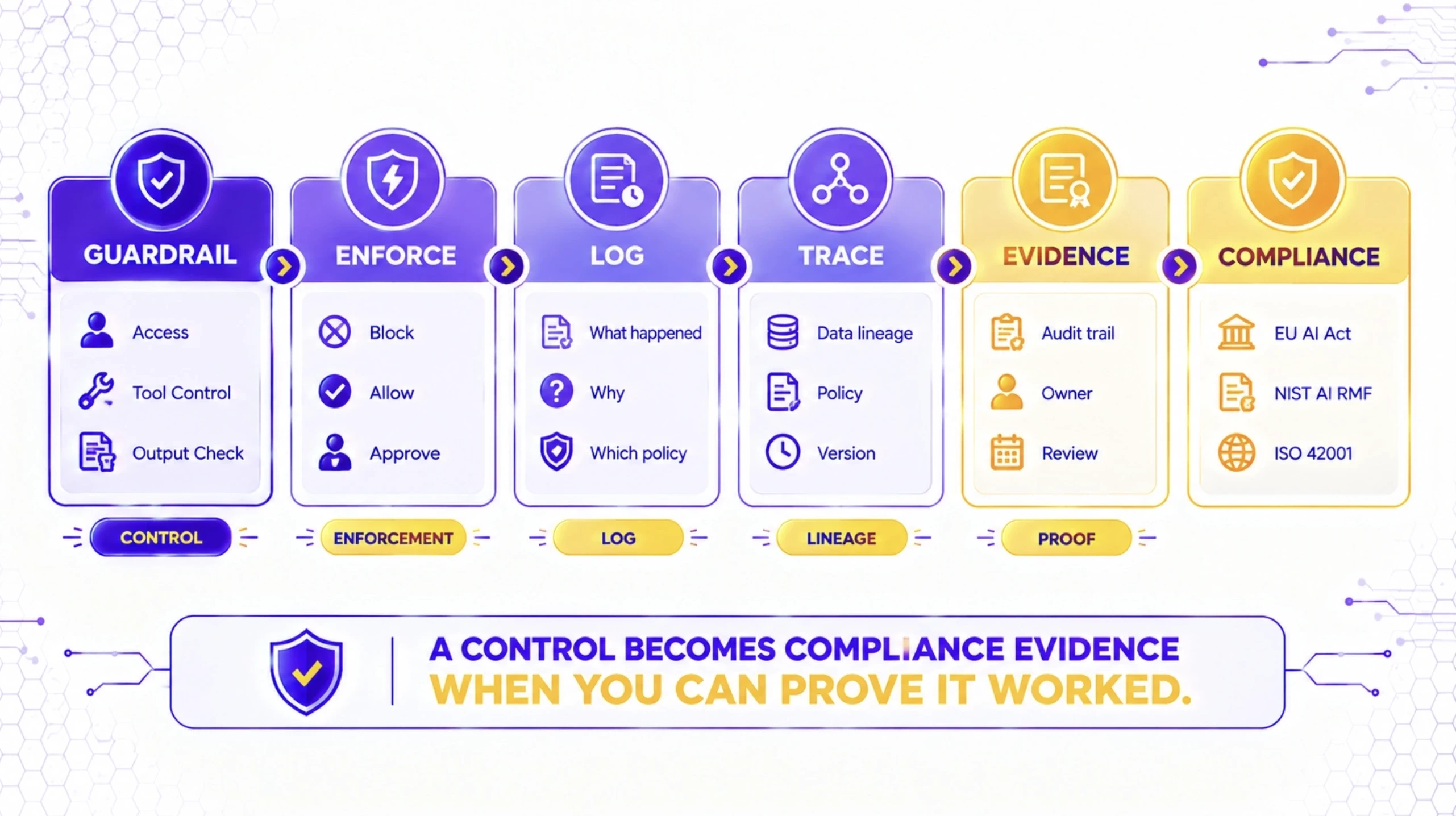
Every guardrail category above only becomes compliance evidence once it generates a log an auditor can actually review. A well-built AI guardrail audit trail captures not just that an action was blocked, but why, under which policy, and with what data in scope. A guardrail that silently blocks a bad action without recording that it did so satisfies the immediate safety goal but leaves no trail for the accountability obligations most frameworks also require.
Human-in-the-Loop for High-Risk Actions
Routing high-risk actions, financial transactions, medical guidance, and irreversible data changes to human review before execution is the guardrail category that most directly satisfies EU AI Act Article 14's human oversight requirement, provided the review is meaningful rather than a rubber-stamp step no one actually exercises.
Building Audit-Ready Evidence from Guardrails
What Auditors and Regulators Actually Ask For
Auditors generally want three things: proof a control exists, proof it was actually enforced during the period under review, and proof someone is accountable for it. A policy document satisfies the first. Logs satisfy the second. A named owner and review cadence satisfy the third. Most guardrail programs have the first and struggle to produce the second two on demand.
Versioned, Policy-Tagged Context Bundles
Auditable context governance means every piece of data delivered to a model is tagged with the policy that governed its delivery and versioned so that a specific historical decision can be reconstructed later. Without this, an organization can show its current guardrail configuration but cannot prove what configuration was actually in effect at the time a specific past decision was made.
Connecting Guardrail Logs to Compliance Documentation
Guardrail logs need to connect to broader compliance artifacts, an AI Bill of Materials cataloging every model and data source in use, and model cards documenting a system's intended use and limitations, so that a specific logged event can be traced back to the system and data lineage that produced it, rather than existing as an isolated record.
Incident Response as a Compliance Requirement
Documenting Guardrail Failures for Regulators
A guardrail failure is not just an operational incident; it is frequently a documentation obligation. Regulators reviewing an incident want to see what failed, why, what data or actions were affected, and what changed afterward to prevent recurrence. Treating a guardrail failure as purely an engineering fix, with no compliance-facing documentation, leaves an organization unable to answer the questions a regulator will eventually ask.
Isolate, Preserve, Analyze, Contain, Remediate, Document
A guardrail-specific incident response sequence should isolate the affected system, preserve the logs and context bundles active at the time of failure before they age out of retention, analyze the specific control gap that allowed the failure, contain any ongoing exposure, remediate the underlying gap, and document the entire sequence in a form a regulator or auditor could review directly.
Guardrail Compliance for Agentic AI
Agentic systems raise the stakes on every category above, since an agent's guardrail failure can mean an unauthorized action taken rather than just an unwanted sentence generated. The agentic AI security vulnerabilities that create compliance exposure and the MCP-specific controls that constrain tool access both feed directly into the guardrail categories covered above, particularly action and tool boundaries and audit logging, since an agent's tool calls are exactly the kind of effective runtime authority a compliance program needs visibility into.
Common Gaps Between Guardrails and Actual Compliance
Configured Permissions vs. Effective Runtime Authority
A permission set in configuration is not the same as what an agent can actually do in practice. Delegation chains, inherited tool access, and misconfigured scopes routinely give an agent effective authority well beyond what its documented permissions suggest, and a compliance program that only reviews configuration, never runtime behavior, misses this gap entirely.
Guardrails That Exist but Aren't Tested or Logged
A guardrail deployed once and never tested again is a snapshot of good intentions, not an active control. Guardrails need periodic testing to confirm they still function as new models, tools, and data sources are added, and every enforcement action needs to generate a log, or the guardrail exists in a form no auditor can verify.
How Akto Supports AI Guardrail Compliance
Continuous Testing of Guardrail Effectiveness
Akto continuously tests whether deployed guardrails actually function as intended, rather than assuming a control configured once remains effective as models, tools, and data sources change around it.
Mapping Runtime Enforcement to Regulatory Frameworks
Akto maps runtime guardrail enforcement directly to the specific articles, clauses, and functions in EU AI Act, NIST AI RMF, and ISO 42001 that each control satisfies, closing the gap between having a guardrail and being able to prove what it accomplishes.
Audit-Ready Logging and Reporting
Akto generates the versioned, lineage-backed logs auditors and regulators actually ask for, connecting individual guardrail enforcement events back to the broader compliance documentation an organization needs to produce on demand.
Final Thoughts on AI Guardrail Compliance
A guardrail that cannot be mapped to a specific regulatory requirement, tested for actual effectiveness, and evidenced through auditable logs is a control in name only. Closing the gap between having guardrails and being compliant means treating every enforcement point as an answer to a specific question a regulator will eventually ask, and being able to produce that answer with evidence rather than a policy document alone.
FAQs: AI Guardrail Compliance
1. What is AI guardrail compliance?
The discipline of mapping specific guardrail controls to the specific regulatory requirements they satisfy, backed by evidence that proves the control was actually enforced, rather than treating having guardrails as automatically equivalent to being compliant.
2. Do AI guardrails automatically make a system compliant with regulations like the EU AI Act?
No. A guardrail is a control; compliance is the obligation it is supposed to satisfy. A guardrail without a mapped requirement, testing evidence, and an accountable owner does not, by itself, demonstrate compliance.
3. What is the difference between context-layer and model-level guardrails?
Model-level guardrails, like output filters, act after data has already entered the model's context window. Context-layer guardrails enforce access and classification policy at the point of data retrieval, before it reaches the model, which is what most data governance obligations actually require.
4. How do AI guardrails map to the EU AI Act's requirements?
Data access controls map to Article 10's data governance obligations, audit logging maps to Article 12's record-keeping requirement, and human-in-the-loop review maps to Article 14's human oversight requirement.
5. How do AI guardrails support NIST AI RMF's map, measure, manage, govern functions?
Govern assigns ownership of guardrails, Map inventories what they constrain, Measure tests whether they actually work, and Manage governs the response when a guardrail fails or is bypassed.
6. What does ISO/IEC 42001 require for AI guardrail operational control?
Clause 8, Operation, requires organizations to plan, implement, and monitor controls over AI processes, conduct regular AI risk assessments, and maintain a risk treatment plan that is updated as new risks are identified.
7. What guardrail categories matter most for compliance (data access, action boundaries, auditability)?
Data access controls, action and tool boundaries, output validation, audit logging, and human-in-the-loop review for high-risk actions together cover most regulatory obligations, but each satisfies a different specific requirement and none substitutes for the others.
8. What evidence do auditors typically expect from AI guardrail logs?
Proof a control exists, proof it was actually enforced during the relevant period, and proof a named owner is accountable for it, ideally backed by versioned, policy-tagged records rather than a static configuration snapshot.
9. How do you document a guardrail failure for regulatory purposes?
Isolate the affected system, preserve logs and context bundles before they age out, analyze the specific control gap, contain ongoing exposure, remediate the gap, and document the full sequence in a form a regulator could review directly.
10. What's the difference between a configured permission and an agent's effective runtime authority?
A configured permission is what an agent is documented to be allowed to do. Effective runtime authority is what it can actually reach in practice, which delegation chains and inherited access often expand well beyond the documented scope.
11. Do compliance requirements for AI guardrails differ for agentic AI versus traditional LLM applications?
The underlying frameworks apply to both, but agentic systems raise the stakes on action and tool boundaries and audit logging specifically, since a guardrail failure can mean an unauthorized action taken rather than only an unwanted response generated.
12. How does human-in-the-loop factor into AI guardrail compliance?
It is the primary control satisfying human oversight requirements like EU AI Act Article 14, but only when the review is substantive enough for a person to meaningfully understand, intervene in, or override the system's action.
13. Can guardrails exist without meeting compliance requirements?
Yes. A guardrail that is deployed but never tested, never logged, or never mapped to a specific requirement exists as a technical control without functioning as compliance evidence.
14. How often should AI guardrail compliance be reviewed or audited?
Guardrails should be tested on an ongoing basis as models, tools, and data sources change, with formal compliance reviews aligned to each framework's own cadence, such as ISO 42001's periodic risk assessment requirements under Clause 8.2.
15. How does Akto help map AI guardrails to compliance requirements?
Akto continuously tests guardrail effectiveness, maps runtime enforcement directly to specific EU AI Act articles, NIST AI RMF functions, and ISO 42001 clauses, and generates the audit-ready, lineage-backed logs regulators and auditors actually request.

Experience enterprise-grade Agentic Security solution