AI Red Teaming Tools: A Methodology-Based Guide
AI red teaming tools classified by testing methodology - static scanning, dynamic adversarial, multi-agent simulation, and continuous CI/CD - not a rank list.

Rushali

Most lists of “best AI red teaming tools” begin by asking the wrong question: what is the number of features in the tool or how many of the reviews are positive? The reader then has to make an educated guess as to whether the top tools test for the specific risks that are keeping them up at night. Different tools solve different problems, and no ranking reflects that. The more valuable question is which testing methodology maps to the risk that you are concerned about: a leaky system prompt, an agent getting talked into calling the wrong tool, or a sprawl of agents that slowly and silently drift out of policy after each model change. Looking for a list of top AI security tools, though, this article has got you covered. This one deals with the methodology below it.
Why Methodology Matters More Than Rank
An easy-to-understand vendor comparison chart provides a response to a specific question: which vendor has the most integrations, the nicest dashboard, the longest feature list. It doesn't tell you if the underlying AI red teaming approach for that product will be able to discover the vulnerability you want to address.
If an agent is asked nicely and they say something that is on the list, the static prompt scanner will detect it. It has no mechanism to check if the same agent, three tool calls down the support workflow, walks into the refund API with parameters that no one sanitized. This isn't a limitation on one vendor's product; it's a limitation on the way they're testing. The highest-ranked static scanner in the market will miss it if it is pointed at a multi-step tool-chaining exploit, since the exploit is not in any one prompt.
That is why the methodology must take precedence over the rank. Rank provides information on how a tool is performing relative to a category. Methodology provides you with information on whether it's in the correct category for your targeted attack surface. With the wrong methodology, an expensive five-star tool is useless, and the vulnerability would not have been tested in an incident report ship.
The Four Red Teaming Methodologies
There are four testing methodologies of AI red teaming tools, all targeting a different type of risk. Some search for known bad inputs. Others tweak their attack approach on the fly. Some of these attempt to mimic what a set of agents or tools can combine into, and there it is, multi-agent tool-chain simulation! And a smaller set that is running continuously, gating each deployment, instead of reporting a single one. Each of them is actually doing and where each stops.
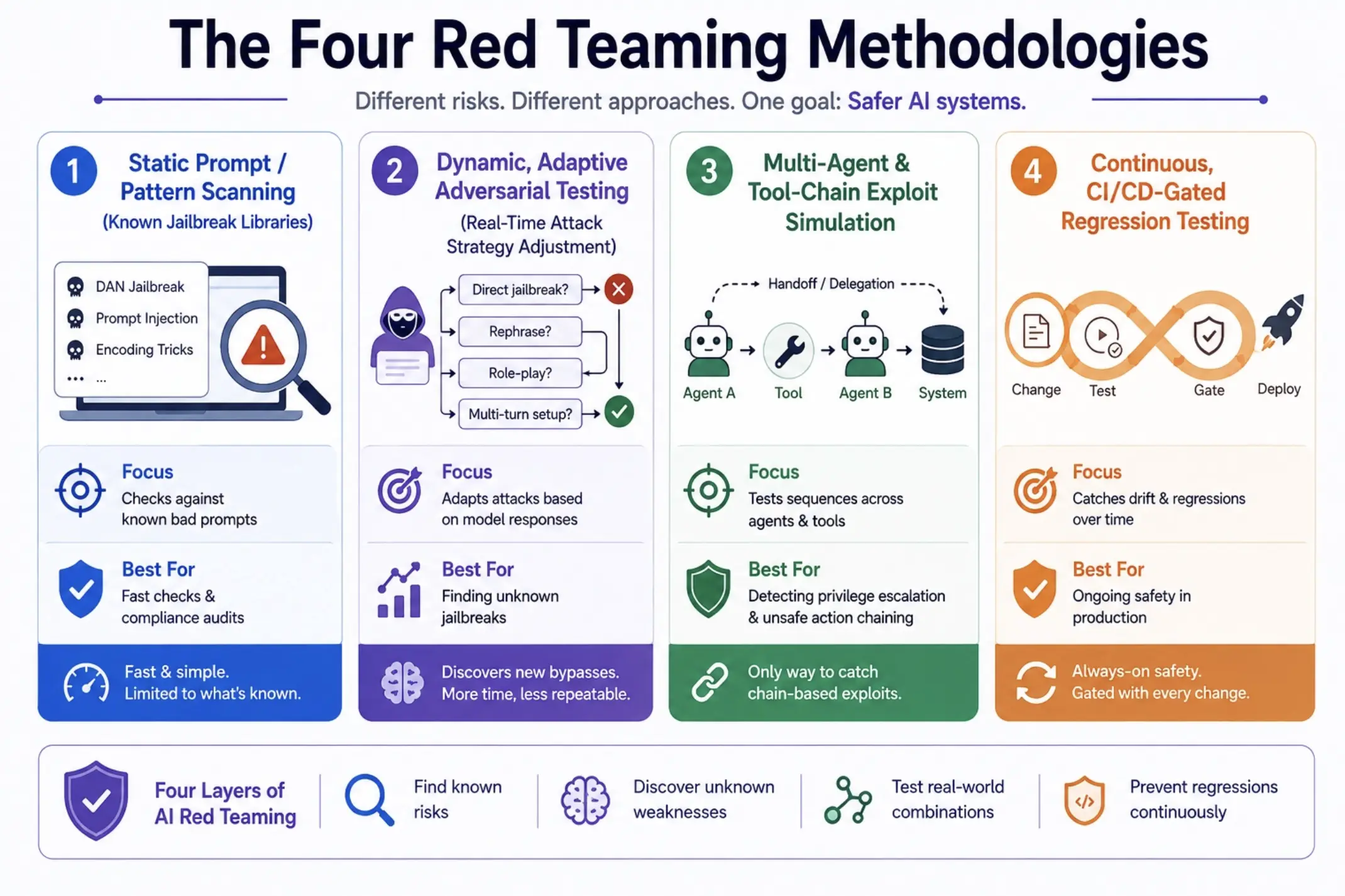
Static Prompt/Pattern Scanning (Known Jailbreak Libraries)
Static prompt scanning is a process that checks if a model or agent gives a flagged response on a set of known jailbreak prompt patterns, phrases, and injection patterns. It's the most expedient approach to run and the most straightforward approach to present to a compliance team: pass or fail, based on a set list.
The ceiling of the library is also a library. It captures what's already been documented: DAN-style jailbreaks, common encoding techniques, prompts extracted from jailbreak sites. It does not provide any way to create a new attack, and it only checks the input prompt, which is not followed by a multi-turn conversation or a tool call in a seemingly clean response. If a team only uses it, then they are likely to pass their audit and then get caught by an attack that they never saw in the library, as the library will only increase in size if someone writes the last attack down.
Dynamic, Adaptive Adversarial Testing (Real-Time Attack-Strategy Adjustment)
Dynamic adversarial testing tools do not execute a predetermined list; they execute an attack strategy based on the target's response. If the direct jailbreak is rejected, the tool attempts to rephrase the question, role-play the question, or set up the question through multiple turns that create context for the ask. This adversarial testing is dynamic rather than a checklist and more like an attacker that is willing to go back to the drawing board.
It detects a significantly larger number of failures than static scanning, with prompts that were not anywhere in any library, but were on-the-fly created by the tool based on the model's refusal pattern. The balance is set up and runtime. The adaptive testing method requires more time per target, requires tuning to prevent going down dead-end trails, and may result in more difficult repeatability of the findings because two runs against the same target could follow different routes to the same result. When testing one conversational model, this is typically a worthwhile tradeoff for the team.
Multi-Agent and Tool-Chain Exploit Simulation
Multi-agent red teaming examines the situation where other agents call tools, hand off tasks to other agents, or go through a server to connect to multiple backend systems. Often the vulnerability is not in the prompt nor in one response. It resides in the sequence, where an agent does something correct on its own, but when combined with another agent in the same sequence, or a permissive tool, it would not have been approved by the system owner on its own.
To simulate this, a real multi-step scenario needs to be created: agent A is manipulated into requesting data that he has no right to access; agent A provides agent B with this data, who has write access to a system agent A was never allowed to touch. It's not done in single-turn testing, either static or dynamic. This is not captured at a single turn, whether static or dynamic. The only methodology that can detect privilege escalation and unsafe action chaining, which only occurs when multiple agents/ tools are used in concert, is tool-chain exploit simulation.
Continuous, CI/CD-Gated Regression Testing
Red teaming is not a quarterly event, but rather a recurring check that runs when a model swap, prompt change, or agent deployment occurs. If the underlying model changes, a new tool is included in its permission set, or a prompt is edited to correct another bug, then it can fail in April, even if it passed March.
It is the methodology designed for regression and not for discovery. It assumes that the first three methods identified the big gaps, and concentrates on catching drift: installing a guardrail that was a different shape or had stopped firing, or putting in a jailbreak defense that failed this month's model but not last month's. The pipeline is continuously AI red-teamed, generating actionable feedback similar to the way it fails when a unit test fails, so it's a very different operating model than a periodic audit with a report nobody reads again until the next audit is scheduled.
Matching Methodology to What You're Actually Worried About
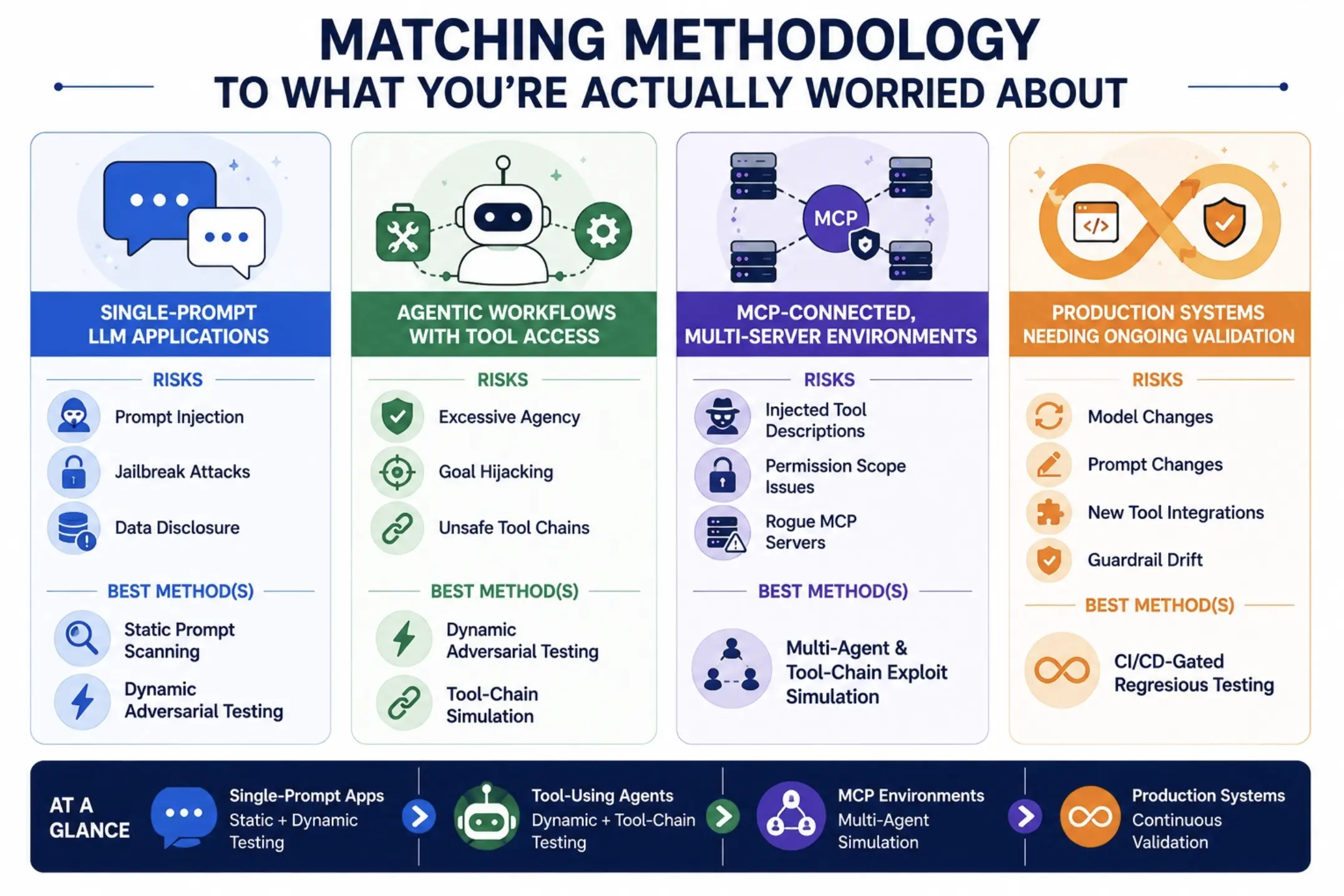
If you can't correlate the four methodologies with what you are running, then knowing them is of no benefit. The dominant risks are different for a single-prompt chatbot, an agent with live tool access, an environment comprised of multiple MCP servers, and a production system, and the most effective corresponding point on the methodology list above for each is also different. Here's how the fit tends to break down in practice.
Single-Prompt LLM Applications
The narrowest attack surface on this list is a single-turn assistant that takes a prompt and responds with a response, that has no access to tools, and no memory between sessions. The realistic dangers are prompt injection, jailbreak attacks (which are used to pull the system prompt out of the system), and output that reveals data that might not have been part of the prompt.
Most of this work is done by static prompt scanning, as the attack space is limited and well documented. In dynamic adversarial testing, the smaller group of new jailbreaks that a “static” library fails to cover is uncovered, and if the app does anything sensitive enough that a lack of coverage of the jailbreak has actual consequences, then that’s the group that can be caught by the dynamic testing. Rarely would it be appropriate to use multi-agent simulation or continuous CI/CD gating here. For single-prompt LLM testing, there is no need to construct infrastructure around the concept of tracking state among agents since there are no sequences of actions in which a vulnerability can be concealed.
Agentic Workflows with Tool Access
Once an agent can call tools, the risk profile changes even if only one agent is involved. Excessive agency - for example, when an agent calls a tool that they have more permission to use than the task calls for - and goal hijacking - where the injected instruction changes the goal of the agent mid-task - both are part of the interaction between the prompt and the tool call and not part of the prompt alone.
Agentic workflow red teaming requires some form of dynamic adversarial testing at least because the attacker's target is to get the agent to perform an action rather than merely say something unsafe. Even if there is only one agent, but the agent can chain together two or more tool calls in one task, consider tool-chain simulation too. The attack surface is the chain itself, and a methodology that only tests the first response in isolation will certify a chain that fails on the second or third response.
MCP-Connected, Multi-Server Environments
Multi-agent and tool-chain exploit simulation becomes a requirement when an environment exists in which an agent logs in via MCP to multiple servers, each of which has its own tools and permission boundaries. This risk is no longer limited to the blast radius of one system. A prompt delivered by an injected tool description from one MCP server can cause the agent to take actions on another server; in addition, many times the trust boundary preventing the agent from taking these actions does not exist, since most MCP servers were never designed with a hostile tool description in mind.
When using the MCP connected environment testing, authentication issues between the servers, permission scopes larger than the task, and the fact that a compromised/rogue MCP server may be the attack vector and not the model need to be considered. Akto Argus product operates as an inline proxy on MCP traffic to test and monitor this layer, and simulates the same type of chaining of tools that a single-server scanner can't see. The method should be used as the primary method rather than an addition to static scanning, in environments that have more than one connected server.
Production Systems Needing Ongoing Validation, Not a One-Time Audit
The failure mode of a system in use will be different from the failure mode of a system in development because the underlying model, a connected tool, or a prompt template has changed since being audited, and the change does not result in a failure of the system. A snapshot is a snapshot and snapshots become stale when anything upstream changes.
Production continuous validation requires the CI/CD-gated methodology, which is embedded in the same pipeline that delivers model updates, prompt edits, and new tool integrations. The aim is not to discover new classes of vulnerabilities; this was the purpose of a first audit, performed with dynamic or multi-agent testing. It's identifying the time when a current guardrail is failing, hopefully before it is released into production, instead of after a customer discovers it.
What Each Methodology Catches and Misses
The tables are easy to understand: the score, sorted top to bottom. One methodology comparison needs to balance two variables: red team coverage and false positive rate, as increased coverage can lead to increased false positives too. Again here, the static vs dynamic red teaming balance becomes apparent with a low false-positive rate in static scanning not being related to the strength of the tool but rather to the limited scope of the tool. The setup time is as varied as the tools themselves, ranging from a prompt library that can be up and running out of the box, to a simulated multi-agent environment that can take days to set up correctly.
Methodology | Coverage | False-Positive Rate | Setup Effort |
|---|---|---|---|
Static prompt scanning | Narrow, limited to catalogued attacks | Low | Minimal, runs out of the box |
Dynamic adversarial testing | Broad within single-turn interactions | Moderate | Light to moderate tuning |
Multi-agent / tool-chain simulation | Deep on chained and cross-system risk | Moderate to high without scoping | Significant, needs scenario mapping |
Continuous, CI/CD-gated | Narrow per run, broad over time | Low once baselined | Moderate, one-time pipeline integration |
All these numbers are without meaning all by themselves. With scenarios being limited to what the agent has permissions to do, the false-positive rate for multi-agent simulation drops significantly, and the set-up costs for continuous testing are mostly one-time and are amortized across all subsequent deployments. The table specifies the beginning point of each methodology, not the final place a correctly configured instance of it would reside.
Open Source vs. Commercial Within Each Methodology
There is no simple answer to the open source vs commercial red teaming question; the tradeoff will vary depending on methodology.
For static prompt scanning, it's frequently enough open source. Community-maintained jailbreak libraries update rapidly and are free to download and use initially, and the entire value proposition of the methodology is to run against a known library list and a target, which is not proprietary infrastructure. The gap becomes apparent in maintenance, because somebody has to keep this library up to date, and until it does, there isn't any pay for this person.
Commercial tools begin to gain ground in dynamic adversarial testing, primarily in the area of an attack-generation engine. It's a more challenging engineering problem to build a system that reacts to a target's response (which is a meaningful one – prompting a list is easier), and open source tools of this nature are usually research projects instead of production-ready systems.
Multi-agent and tool-chain simulation is almost always a commercial platform, not out of any inability to do it using open source, but because it is a very complex environment to simulate accurately and it's hard to build a simulation layer on top of open source platforms on its own.
If you're familiar with a continuous CI/CD-gated testing approach, you know that it's no different. The whole point of the methodology is pipeline integration, and that's a type of infrastructure that most teams would prefer to purchase, rather than carry out and keep up to date with the new versions of the models without breaking the build.
Questions to Ask Before You Shortlist Vendors
After determining the methodology or methodologies that match your risk, the vendor conversation is much shorter. A few questions break through all the marketing flair in a flash.
Check the actual mapping of the probe library. A vendor claiming to have a particular set of coverage against the OWASP LLM Top 10, OWASP Agentic and MCP frameworks, or the MITRE ATLAS is testing against a specific threat model. One that can't point to a framework is likely using an internal list that has not been scrutinized by anyone outside the company.
Inquire how the tool handles false positives at scale, as it is possible to aggressively flag false positives but then have to review them, which is just moving the work from the testing side to the review side. Do they have one methodology working on the platform well, but do multiple ones work well on the platform? Does adding a second methodology later require a second contract or a configuration change?
These questions for evaluating AI security vendors get more granular than the previous list of evaluation questions for choosing among AI security vendors, while this breakdown of tools for automating red teaming at enterprise scale explores those changes at enterprise scale.
How Akto Covers Multiple Methodologies in One Platform
Most of the AI red teaming tools focus on a single methodology and the remaining are handled by a second vendor. The red teaming module of Akto does not consist of three products that are only pieced together after the fact but of dynamic adaptive testing, multi-agent and tool-chain exploit simulations, and continuous CI/CD-gated checks from the same probe library.
The probe library runs more than 10,000 probes mapped to the OWASP LLM Top 10 and MITRE ATLAS, so the contextual attacks it generates are based on a documented threat model that is not based on an internal list that no one but Akto has looked over. On the multi-agent and tool-chain side, Akto Argus acts as an inline proxy on agents, MCP traffics and provides visibility of the cross-server tool chain that a single-endpoint scanner would not detect, and monitors the behavior of agents in production environments rather than during testing.
With Akto's CI/CD integrations, red teaming checks are integrated into the pipeline along with the delivery of model, prompt and tool changes, catching a regression before it reaches production, rather than being discovered in the next scheduled audit. On the employee-usage side, Akto Atlas provides browser extensions and IDE hooks to other tools, such as Cursor and Claude Code, which also reach the endpoint layer, thus capturing AI usage that occurs outside an employee's own infrastructure.
It is not a ranking statement to say that multiple methodologies are contained in one platform; it's a scope statement: fewer integration seams between the layers conducting the testing.
Choosing by Methodology, Not Rank
The question to begin with is not a ranking question since it implies that one testing method is superior to the other, but rather which testing method to match to the risk that is in front of one. Finally, a one-shot chatbot requires no multi-agent simulation, and a production system with five connected MCP servers will be no different than a production system with five chatterbots, regardless of how well the former is rated. Work down from the actual running to the tool.
If it is a combination of dynamic adversarial testing, multi-agent and tool-chain simulation, and never-ending CI/CD-gated checks, Akto's red teaming module runs all three from one probe library, rather than three separate contracts. Take a demo and compare it to your agent and MCP.
FAQs on AI Red Teaming Tools
1. What are the main testing methodologies used by AI red teaming tools?
There are 4 types of methodologies used in AI red teaming tools: Static prompt scanning against known jailbreak libraries, Adversarial testing in real-time (changing attack strategy), Multi-agent and tool-chain exploit simulation for chained or cross-system risk, and Continuous regression testing, CI/CD gated the test is executed on every deployment and not as a one-off audit.
2. What's the difference between static prompt scanning and dynamic adversarial testing?
Static prompt scanning involves scanning a target against a pre-defined library of known jailbreak patterns and injections, which means that it is quick, but only scans through a limited repertoire of what has been cataloged. Dynamic adversarial testing adapts its method of attack to the reaction of the target, producing novel prompts as it goes, which is more likely to catch more but slower to run and tune.
3. Why do multi-agent and tool-chain exploits need a different testing approach?
The exploits are not contained within a prompt or response, but in a series of actions performed across agents or tools. Methodology, which can only test one interaction at a time, cannot track the state across the chain, and certifies that it is safe - and, by missing a combination, the unsafe one that occurs only when multiple steps are run together.
4. What does "continuous, CI/CD-gated" red teaming mean, and why does it matter?
It is deploying red team checks that are automatic when they are added, deleted, or modified from the deployment pipeline, not on a quarterly audit schedule. It's important because if one release passes the test, the next one can regress without anyone having to perform the entire audit again, and CI/CD gating will detect it before the change is released.
5. Which methodology is best for testing MCP-connected, multi-server environments?
Multi-agent and tool-chain exploit simulation; most of the risk in an MCP-connected environment is likely to be from the interaction of the tools and servers, and not from any single prompt. Dynamic Adversarial Testing is a helpful component for the model-facing side but it will not identify a cross-server permissions gap.
6. What are the tradeoffs between open-source and commercial red teaming tools?
For static scanning of prompts, open source works fine as it is primarily a maintained library. In dynamic adversarial testing, multi-agent simulation, and CI/CD integration, commercial tools typically outperform open source options because the engineering and infrastructure required is deeper and more complex than keeping a timely list.
7. What questions should I ask a vendor before shortlisting a red teaming tool?
Ask about the framework(s) the probe library is based on, eg: the OWASP LLM Top 10 or MITRE ATLAS; how false positives are managed at scale; and if it is one or several methodologies, and under a single contract.
8. Can one platform cover multiple red teaming methodologies at once?
Yes, although most of the tools available on the market focus on one. Instead of using separate tools for each methodology, Akto's red teaming module uses a single probe library for dynamic adaptive testing, multi-agent and tool-chain simulation, and continuous CI/CD-gated checks.
9. Where can I find a ranked comparison of specific named red teaming vendors instead?
If you're looking for a comparison of the named products rather than a methodology breakdown, then use our ranked list of AI security tools.

Experience enterprise-grade Agentic Security solution