Akto Atlas for Codex: Visibility and Guardrails for AI Coding Assistants
Akto Atlas for Codex brings prompt guardrails, tool-call validation, and skill governance, helping teams secure, monitor, and govern how their employees use Codex.

Krishanu
Your developers have already adopted Codex. The real question is whether anyone can see what it's doing.
OpenAI's Codex has quickly become part of the daily workflow, in the terminal and on the desktop, reading codebases, running commands, and taking on real work with little human oversight. Developers extend it with skills, hand it a sensitive context, and let it act on their behalf to ship faster.
That speed is the whole appeal. But it also means a lot is now flowing through a tool your security team has no visibility: source code and secrets going out to a third-party model, unvetted skills running inside your environment, and commands executing on developer machines before anyone can review them.
Today, we're introducing Akto Atlas for Codex, adding runtime security and visibility through Codex's native hook system, across both Codex CLI and Codex Desktop. It inspects prompts before they leave, validates the commands Codex runs, governs the skills your employees install, and reports every event to your Akto dashboard.
Why Codex Needs Security Guardrails
Codex isn't just a chatbot in a terminal. It's an autonomous agent that your employees feed with real, sensitive material and extend in ways your security team never sees.
Three things make that a problem.
Employees are leaking sensitive data. Every day, developers paste source code, secrets, credentials, and customer data into Codex to get help, and every one of those prompts is sent straight to a third-party model. What feels like a quick question is, from a security standpoint, data leaving the building.
Employees install skills you've never vetted. To push Codex further, developers add skills, add-ons that extend what the agent can do. Each one is unapproved code running inside your environment, and a single malicious or careless skill can quietly exfiltrate data or take actions no one signed off on.
Codex acts on its own. To move fast, developers let Codex run with little friction, executing commands across their machines to get the job done. Nothing checks those commands before they run, and a dangerous one can come from a careless prompt, a compromised skill, or a hidden instruction the agent picks up while it works.
Now multiply all of that across every developer in the organization. Security has no idea what data is being shared, what commands are running, or which skills are even installed. You can't govern what you can't see.
Akto Atlas for Codex closes that gap by operating at every point that matters: before a prompt leaves, before a command runs, and across every skill and interaction in between.
Want to see how Akto catches these risks in real time? Book a demo →
How Akto secures Codex at runtime
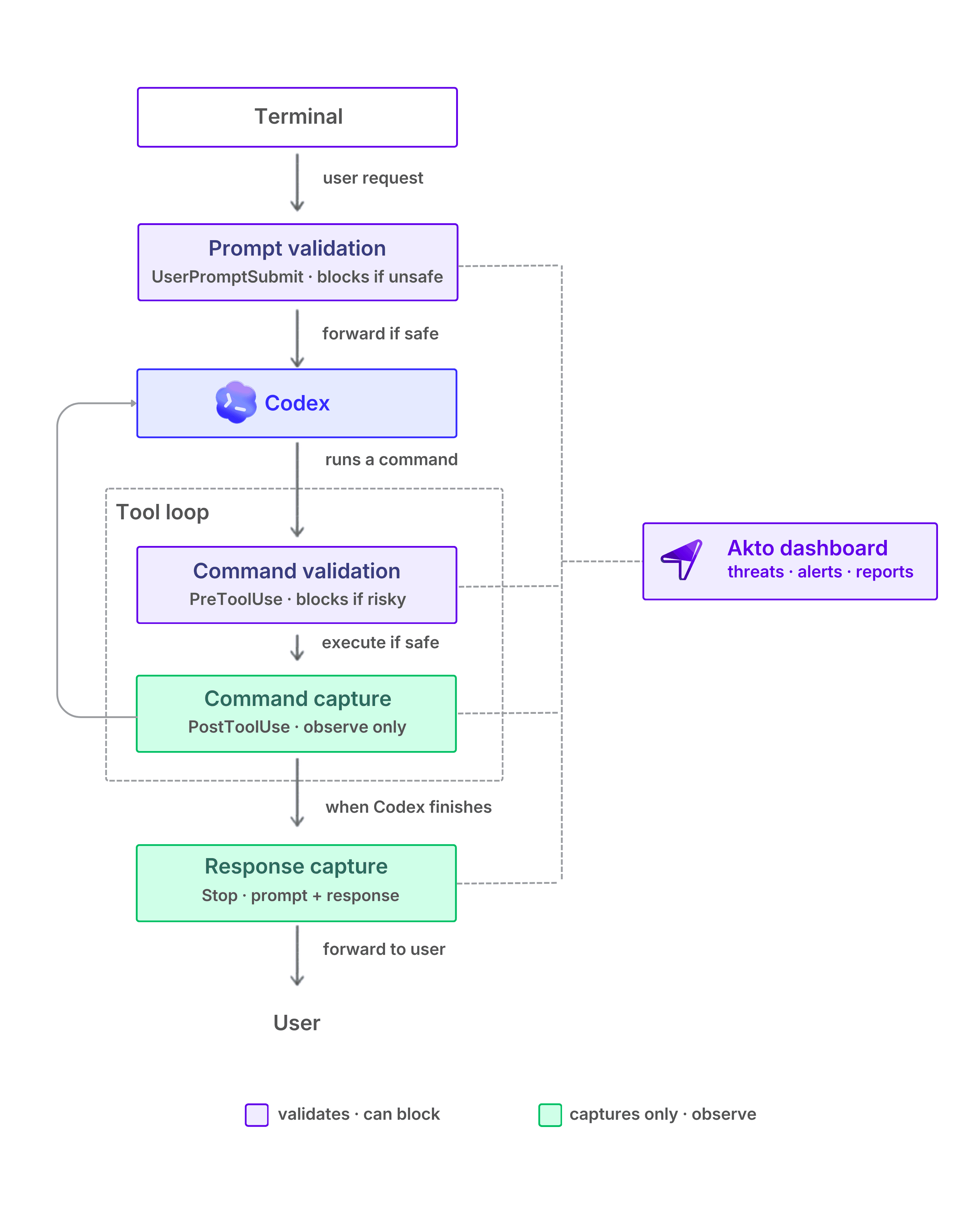
Codex provides a native hook system, shared across both CLI and Desktop, that lets Akto insert security controls at four points in the agent's lifecycle. Two of them let Akto step in and block: the prompt before it's sent, and the command before it runs. The other two capture everything Codex does, the prompt-and-response pair and the input and output of every command, so nothing happens off the record. The control that matters most, for an agent with real reach into your systems, is the one over the commands it actually executes.
All of this runs with zero change to how developers work.
Before the prompt leaves: prompt guardrails
When a developer submits a prompt, Akto inspects it in real time before it's ever sent to the Codex API.
It evaluates the request against your security policies, checking whether the prompt is carrying secrets, credentials, or other sensitive data out of your environment, whether it contains malicious patterns like prompt-injection attempts, and whether it violates organizational policy. If the prompt is unsafe, Akto blocks it immediately. The model is never called, and the event is logged to your dashboard with full context.
Before a command runs: tool-call validation
When Codex tries to run a tool call (the commands it executes on the developer's machine), Akto validates that request before it runs.
If the command is risky, Akto stops it at execution, not after the damage is done. This is the control that matters most for an agent with the power to touch your systems, and it catches dangerous actions no matter where they originate: a careless prompt, an injected instruction, or a compromised skill.
Across every skill: skill governance
The skills your employees install are often the biggest blind spot. Akto detects the skills running inside Codex, flags the malicious ones, and blocks them, so an unvetted add-on can't quietly become a backdoor into your environment.
See how your developers are using Codex before something goes wrong. Schedule a demo →
Full visibility, no blind spots
Throughout this entire flow, whether a prompt or command is blocked or allowed, Akto captures every event and reports it to a central dashboard. Every prompt-and-response pair and every command's input and output are recorded, so there's a complete record of what Codex was asked and what it actually did.
Security teams gain real-time visibility into what prompts developers are sending to Codex, which commands it's running, which skills are installed, where sensitive data was exposed, and a complete audit trail of every Codex interaction across the organization, spanning both CLI and Desktop.
All of this happens without slowing developers down or asking them to change how they work.
Final thoughts
Security shouldn't be an afterthought to agentic adoption. It should be embedded in it.
Codex is just one of many. Your developers are already spread across Claude Code, Cursor, GitHub Copilot, Gemini CLI, and whatever ships next, each with its own interaction model and its own surface area. The pattern is clear: AI agents are becoming the default interface for development, and security needs to meet them wherever they run.
That's the direction we're building toward at Akto: runtime guardrails that work across every agentic tool your team uses, governed from a single dashboard.
If your developers are already using Codex, this is the easiest way to get visibility and control without slowing them down.
Ready to secure Codex for your team? Talk to us →

Experience enterprise-grade Agentic Security solution