7 Claude Tag Security Risks: The Agent Identity Gap
Explore the top 7 Claude Tag security risks and learn how AI agent identity, least privilege, runtime protection, and governance reduce enterprise risk.

Akash

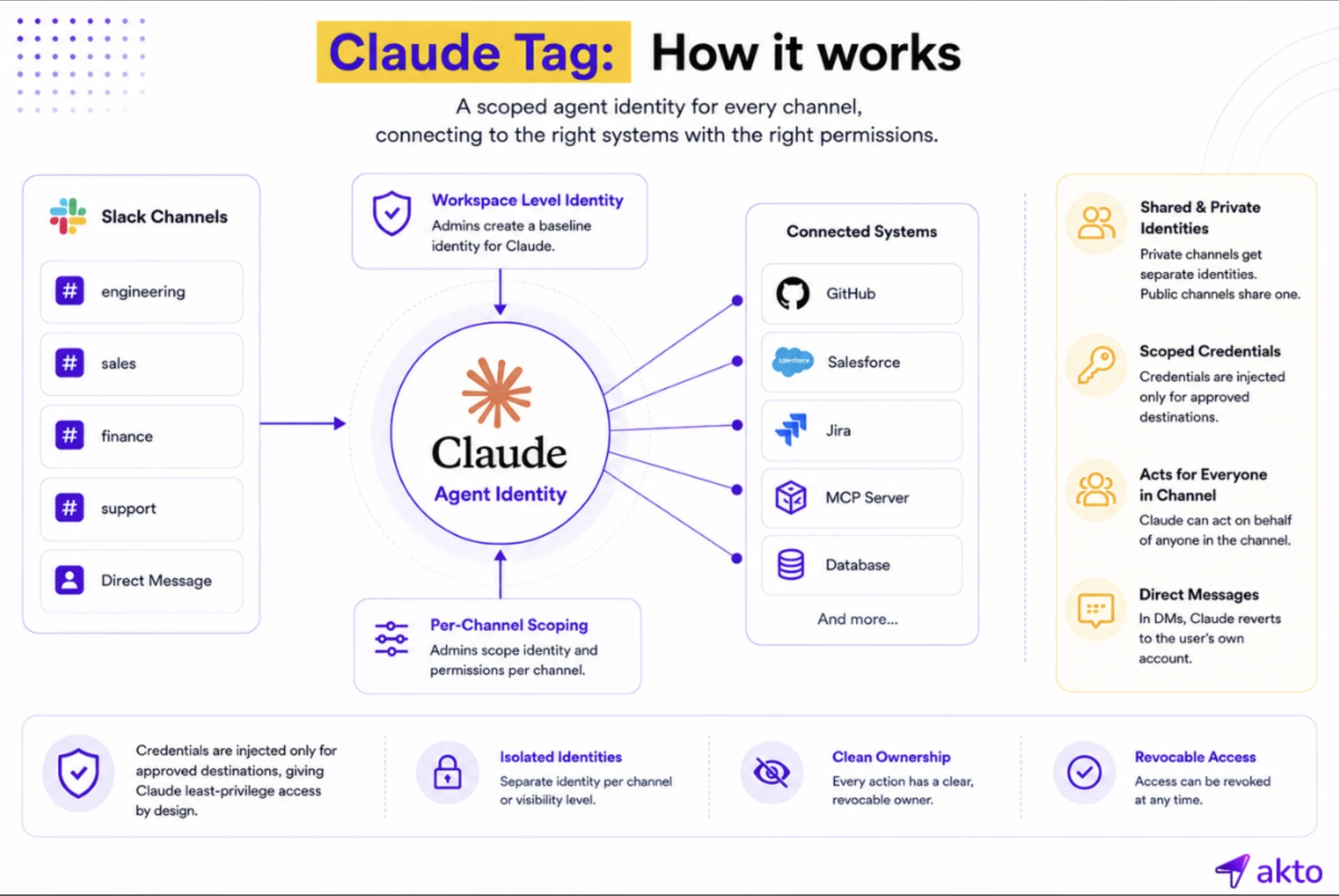
Anthropic's Claude Tag places an AI agent inside shared Slack channels with its own identity in connected systems. Rather than borrowing a person's credentials, the agent authenticates as itself, holds its own permissions, and acts for everyone in the channel. The design solves a real problem: it keeps a shared channel from becoming a side door into private accounts, and gives every action a clean, revocable owner.
It also relocates the hardest decision. Agent identity settles who acted. It leaves open who authorized the action, on whose behalf, and who should see the result. Most of the Claude Tag security risks below trace to that shift, from authenticating a user at login to authorizing an agent at the moment it acts.
What is Claude Tag in one minute?
Administrators give Claude a baseline identity at the workspace level, then scope it per channel, so an engineering channel might reach a code repository while a sales channel reaches a CRM. Private channels get separate identities, public channels share one, and credentials are injected only for approved destinations. In direct messages, Claude reverts to the user's own account.
Risk 1: Authorization laundering
Permissions attach to the agent, not the requester. A person who cannot reach a repository directly can ask Claude to read it, and the request succeeds because the channel's profile allows it. This is the confused deputy problem that identity teams spent years learning to contain. A product manager, for instance, can trigger a deployment rollback they could never run themselves.
Govern it: evaluate the requester's own permissions against the action, not only the channel's access.
Risk 2: Over-exposure of responses in shared channels
In a shared channel, everyone sees Claude's reply, but the data behind that reply may not suit every member. Analysis of Claude Tag has flagged this specifically: a question answered for one person becomes visible to the whole channel, including people the source system would never show it to. This is a visibility problem distinct from the access problem.
Govern it: scope sensitive responses to the requester, or check audience access before posting.
Risk 3: Your logs show Claude, not the person who asked
When Claude acts, connected systems and your SIEM record the action under Claude's service account, not the employee who initiated it. Anthropic's own log ties each task to a requester, so reconstructing intent means correlating two separate logs. Attribution to the agent improves, but accountability to the person does not follow automatically.
Govern it: tie the requester and their authority to each agent action, not just the agent principal.
Risk 4: Generous access by default widens the blast radius
Anthropic's guidance encourages teams to grant Claude generous access from the start and pare it back later. Each channel then holds one credential set that stays live until someone revokes it. The more systems the agent can reach, the more a single mistake, misread instruction, or oversight can affect.
Govern it: start least privilege and read-only, then expand only on evidence of need.
Risk 5: Ephemeral prompts break the audit trail
The instruction that triggered an action may be ephemeral, such as a buried Slack message or a comment inside a document the agent read. When something goes wrong, teams often cannot reconstruct why. Few organizations have an incident-response playbook for conversationally steered agents.
Govern it: log the triggering context and define an incident-response path before deployment.
Risk 6: Slack channel membership becomes an access decision
Adding someone to a channel now grants them the ability to invoke the agent's access, whether or not anyone intended that. Channels are collaboration spaces, and people join them for visibility or convenience, not as access-control groups. Yet membership now decides who can ask Claude to reach a repository, a warehouse, or a CRM. The people who can invoke a channel's agent identity are rarely mapped, so access spreads as membership changes.
Govern it: treat channel membership as an access grant, and map who can invoke each agent identity.
Risk 7: The control that closes the gap is still roadmap
The control that would resolve authorization laundering is announced but not yet shipped. Anthropic has described an identity-aware overlay, where both the channel profile and the requesting user's permissions must allow an action, alongside just-in-time credential grants. Until those arrive, the agent's scope alone governs access.
Govern it: provision as if the overlay does not exist, and add compensating checks now.
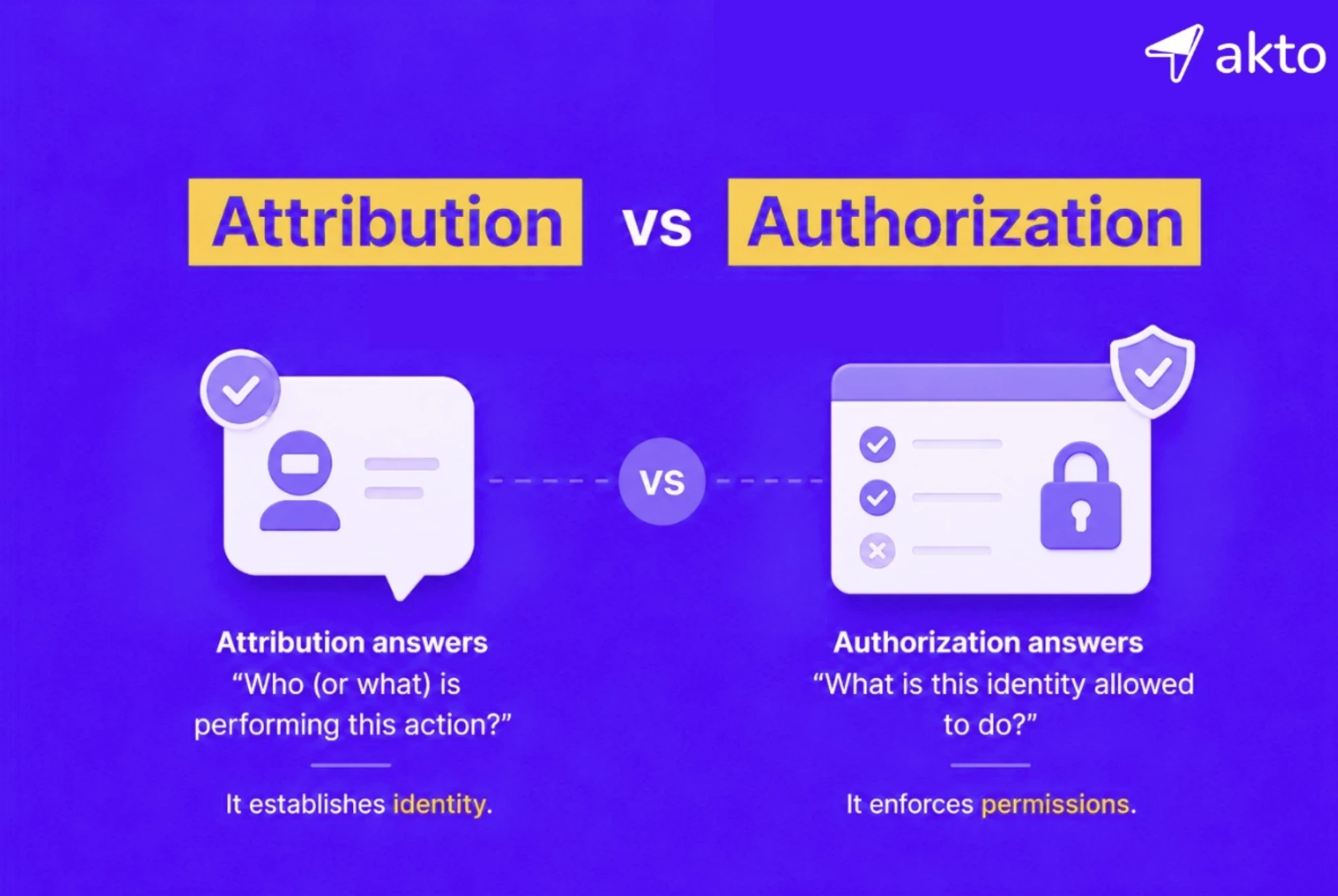
The common root: agent identity solves attribution, not authorization
Most of these risks share one cause. Agent identity moves the authorization decision from the user's login to the agent's action, and that is where most deployments have no enforcement. Identity settles who acted. It does not decide whether this person, in this channel, should cause this action, or who may see the outcome.
Where the control belongs
The reliable place to enforce that decision is at runtime, when the agent calls a tool or reads data. At that point, a control can weigh four things together: the requesting principal, the agent's scope, the data's sensitivity, and policy. Deciding before the call runs is what separates observing an agent from governing one.
Mapping to frameworks
These risks map onto existing guidance. Zero trust calls for authorization at request time rather than standing trust. The OWASP Agentic AI and Non-Human Identity Top 10 lists cover agent authorization and credential lifecycle, and NIST frames least privilege and continuous verification. This applies known controls to a new kind of actor, not a new category.
Agent identity governance checklist
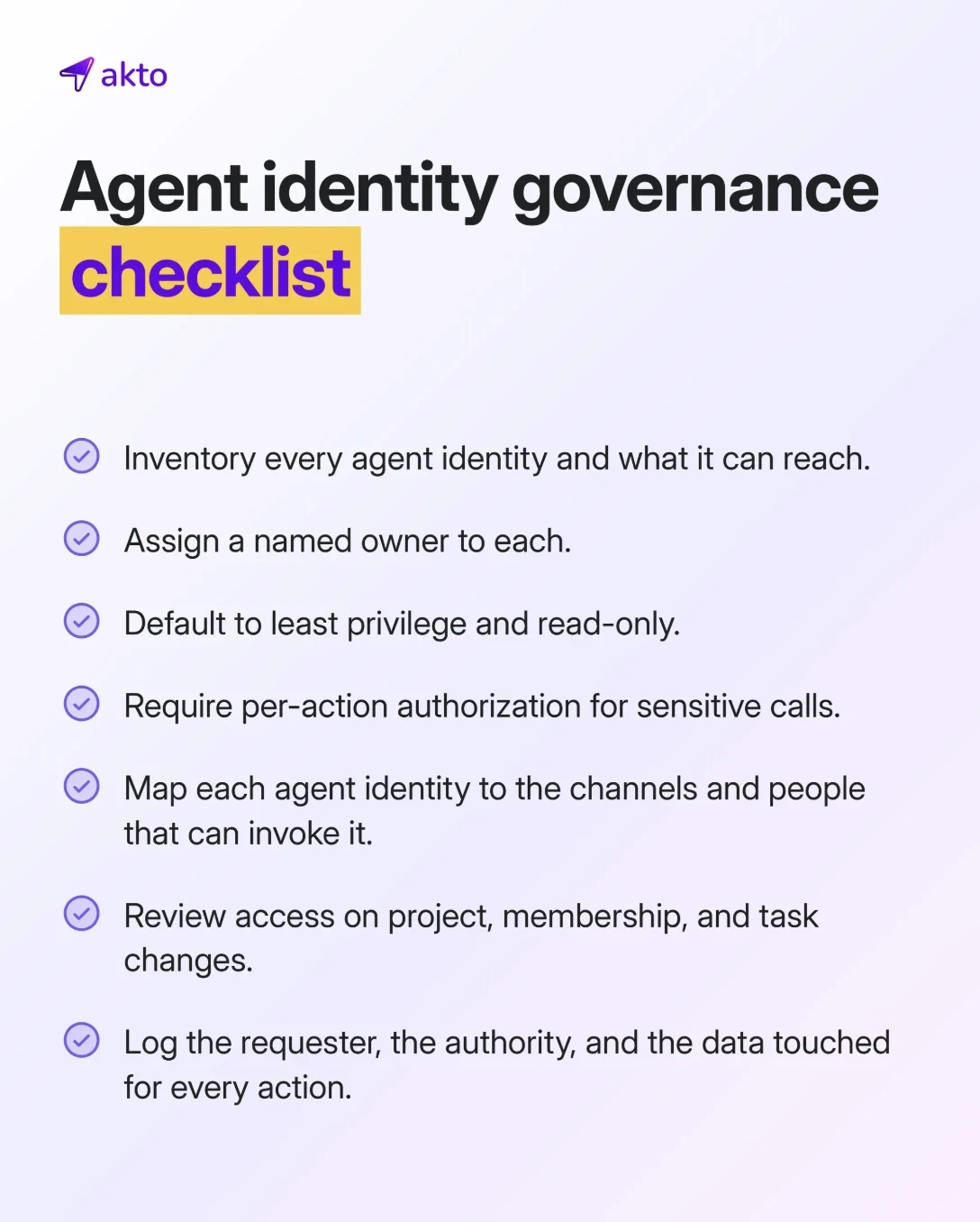
Inventory every agent identity and what it can reach.
Assign a named owner to each.
Default to least privilege and read-only.
Require per-action authorization for sensitive calls.
Map each agent identity to the channels and people that can invoke it.
Review access on project, membership, and task changes.
Log the requester, the authority, and the data touched for every action.
Securing agentic AI at runtime with Akto
Every risk above converges on the same control point: the moment an agent calls a tool, queries a system, or invokes an MCP server. That is where Akto operates. Akto Argus provides runtime protection for agentic and LLM applications, inspecting agent actions as they happen rather than cataloging permissions after the fact. It evaluates what an agent is about to do against policy, so an action that exceeds its intended scope can be stopped before it reaches the connected system.
Akto Atlas adds guardrails and shadow AI discovery, surfacing where agents are deployed and what they can reach across the environment. Continuous red teaming then probes those agents for authorization gaps and unsafe behavior before an attacker or an accident finds them.
The difference is enforcement, not observation. Inventory and logs tell you an agent acted. Behavioral runtime controls decide whether it should, at the point of action, across every tool and MCP call. That is the layer the risks in this article leave exposed, and the layer Akto is built to hold.
See how Akto secures agentic AI in production.
Frequently asked questions
Is Claude Tag secure for enterprise use?
It can be, with governance. Claude Tag gives the agent its own scoped, revocable identity and blocks unapproved connections. The open risks concern authorization and oversight, not authentication, so enterprise use depends on runtime controls and regular access reviews.
What is agent identity in Claude Tag?
Agent identity means Claude acts as itself in connected systems rather than borrowing a user's credentials. Administrators scope that identity per workspace and per channel.
How is agent identity different from a service account?
It behaves like one: a non-human identity with its own permissions and logs. The difference is that anyone in a channel can invoke it through natural language, so its effective access depends on who can reach it.
Can Claude Tag access data a user is not authorized to see?
Yes. If the channel's agent profile grants access, a user without that access directly can still ask Claude to retrieve it. Closing this gap requires checking the requesting user's own permissions, which Anthropic has described as planned.
How should teams govern Claude Tag access?
Treat the agent as a first-class identity with a named owner and a documented scope. Start with least privilege and read-only, map each channel to the people who can invoke it, require per-action authorization for sensitive calls, and log the requester and authority behind every action, not just the agent principal.

Experience enterprise-grade Agentic Security solution