LiteLLM AI Gateway Security
Secure your LiteLLM AI gateway in production - API key management, rate limiting, guardrails, and a full checklist for enterprise deployments.

Arpashree

LiteLLM AI gateway security covers more ground than most teams expect when they first stand up a proxy in front of their model providers. Routing traffic through a single layer brings real operational benefits, and it also concentrates risk that used to be spread across a dozen separate integrations into one place. Securing the LiteLLM proxy properly means treating identity, traffic, visibility, and content as separate pillars rather than assuming one control covers the rest. This guide walks through each pillar, the operational realities of running LiteLLM at real production scale, and closes with a practical LiteLLM security checklist for teams preparing to take a deployment live.
What LiteLLM Does as an AI Gateway
Multi-Provider Routing, Cost Tracking, and Load Balancing in One Layer
LiteLLM presents a single, OpenAI-compatible endpoint in front of more than 100 model providers, including Bedrock, Azure, OpenAI, Anthropic, and VertexAI, letting applications call any of them through one consistent interface without rewriting integration code for each provider separately. Beyond routing, it handles cost tracking per key and team, load balancing across multiple deployments or regions, and automatic fallback when a provider fails or rate-limits a request, so an application can keep functioning even when its primary model provider experiences an outage. This consolidation is exactly what makes the gateway valuable, and exactly what makes securing the LiteLLM proxy itself a higher-stakes undertaking than securing any single provider integration on its own, since the proxy now sits on the critical path for every model call the organization makes.
Why Gateway-Level Security Matters More as LiteLLM Scales in Production
One Proxy, Every Model, Every Application, and Every Risk, Concentrated in One Place
When every application in an organization routes its model calls through the same proxy, that proxy becomes the single point where a credential leak, a misconfigured rate limit, or a missing guardrail affects everything behind it at once. A security gap that would once have been contained to a single team's direct integration with a single provider now has the potential to touch every application sharing that proxy, simply because they all pass through the same layer. The consolidation that makes LiteLLM operationally efficient is the same property that makes LiteLLM gateway hardening non-optional once the deployment moves past a handful of internal prototypes and into supporting production applications that depend on it staying both available and secure.
Core Security Pillars for a LiteLLM Deployment

Identity and Access: API Key Management, Virtual Keys, Team-Based Access Control
LiteLLM's access model is built around virtual keys rather than handing out raw provider credentials. A virtual key is generated inside LiteLLM and given to an application or user, with its own budget, rate limits, and model access scope, so the underlying provider API keys never need to leave the proxy itself. Role-based access control layers on top of this through organizations, teams, and internal user roles: a Proxy Admin has full access across the deployment, a Team Admin can manage budgets, rate limits, and keys within their own team, and regular team members get whatever permissions their role has been configured to allow. This structure means a compromised application credential exposes only the scope of its specific virtual key, not the organization's actual provider API keys. One of the simplest and most consistently overlooked LiteLLM security best practices is never distributing the master key to applications or individual developers at all, since every application should instead receive a scoped virtual key generated specifically for its own use case.
Traffic Controls: Rate Limiting and Budget Controls Against Abuse
Rate limits and budgets can be set at the key, team, user, or end-customer level, tracked in requests and tokens per minute, with a defined resolution order when multiple levels apply: key-level metadata takes precedence over key-level model budgets, which take precedence over team-level settings. This layered model lets an organization cap what a single misbehaving application can consume without capping the entire team's shared budget alongside it, which matters when a single runaway script or compromised key could otherwise burn through a shared monthly allocation in hours. For multi-tenant deployments serving external customers rather than only internal teams, per-customer rate limits add a further layer, preventing one customer's unusually heavy or abusive usage pattern from degrading service for every other tenant sharing the same gateway.
Visibility: Audit Logging for Compliance and Investigation
Every request routed through LiteLLM can be logged with its key, team, model, token usage, and outcome, which becomes the evidence base for both compliance reporting and incident investigation. Without this logging in place and actually connected to a SIEM or observability stack, an organization cannot answer basic post-incident questions like which key made a specific call or what data a specific request actually contained. Logging that exists only as rows in LiteLLM's own database, never forwarded anywhere a security team actively monitors, provides little practical value during an active incident, since someone has to know to go looking in that specific table before the evidence becomes useful at all.
Content Controls: Guardrails Against Prompt Injection, PII Leakage, and Policy Violations
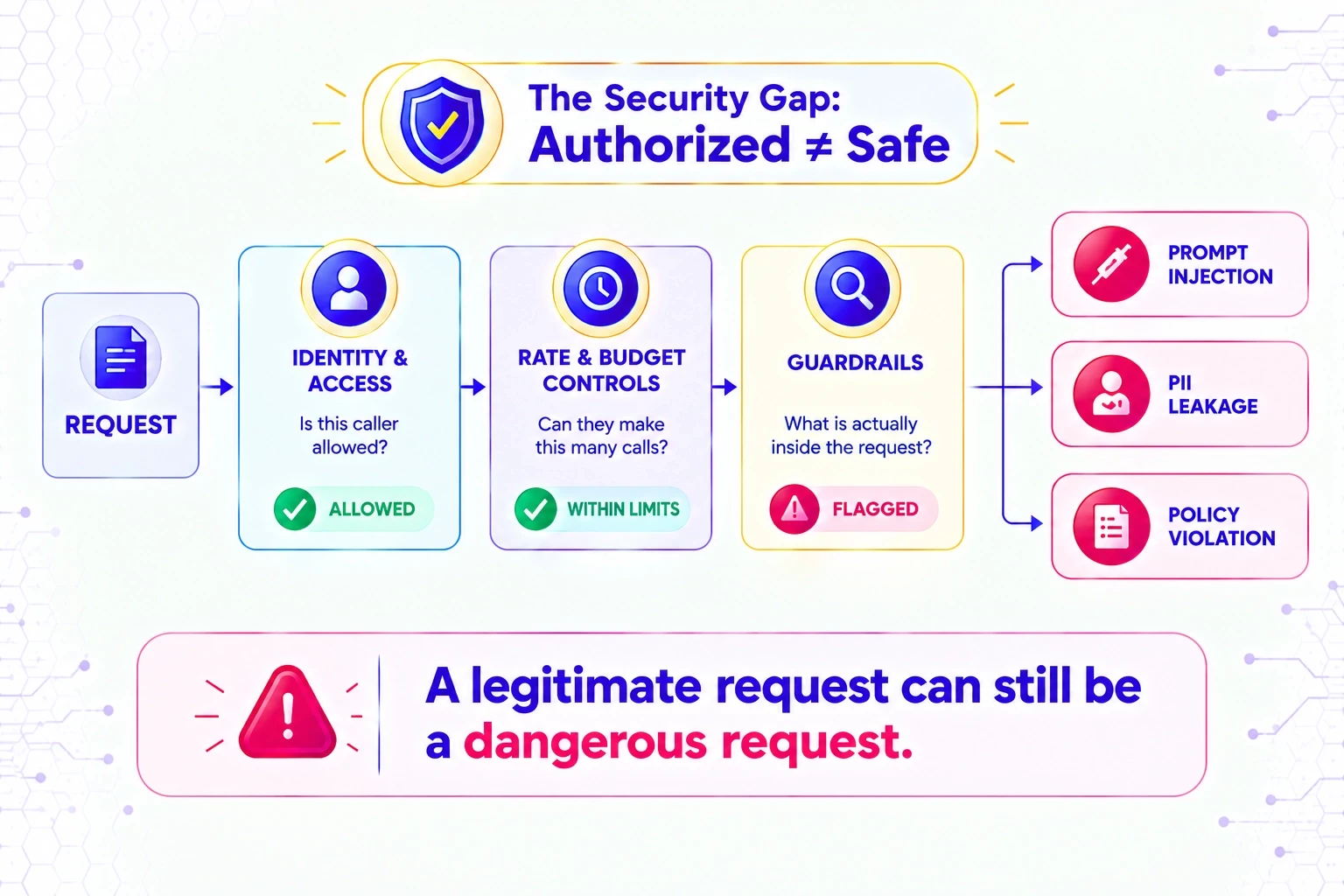
Identity, traffic, and visibility controls govern who can call the gateway and how much they can do, but none of them inspect what is actually inside a request or response. That is the job of guardrails, and it is the natural next layer once the first three pillars are in place.
Guardrails as the Content-Layer Pillar of Gateway Security
What Guardrails Add on Top of Access Control and Rate Limiting
A fully authorized, properly rate-limited request can still carry a prompt injection payload, leak PII in a model's response, or violate a content policy, none of which access control or rate limiting was ever designed to catch. Guardrails close that specific gap by inspecting the actual content of requests and responses at defined points in the call lifecycle, catching what identity and traffic controls structurally cannot see, regardless of how correctly those other two pillars happen to be configured.
Verified Integration: Akto Runs Natively as a LiteLLM Guardrail Provider
Akto is a native guardrail provider in LiteLLM, announced via the official LiteLLM × Akto partnership post, with reference architecture published on GitHub at akto-api-security/akto-litellm.
For the Full Guardrails Breakdown
See LiteLLM Guardrails: The Complete Guide for the full breakdown of native checks, third-party providers, and how to configure Akto's model-based detection on top of them.
Operational Security at Scale
Database Growth and Logging Table Bottlenecks
LiteLLM stores request-level logs, key budgets, and spend telemetry in PostgreSQL, and synchronous database queries executed during request verification have been documented to cause significant latency degradation once logging tables grow past roughly one million rows. Bounding the database connection pool per worker process, so a single misbehaving process cannot exhaust the database's available connections, is one of the more practical mitigations teams apply as logging tables grow. This is a security concern as much as a performance one: a gateway that slows down or times out under load during a spike is a gateway an organization cannot rely on to enforce its access and content controls consistently at exactly the moment traffic is least predictable, which tends to be exactly when a security control is needed most.
Worker Recycling and Memory Management Under Load
LiteLLM's own production documentation recommends recycling each worker process after a fixed number of requests, configured through max_requests_before_restart, to bound gradual memory growth observed under sustained load. Gunicorn's recycling mechanism is more mature than Uvicorn's default behavior and restarts workers one at a time so a pod keeps serving traffic while a worker is replaced, and staggering each worker's restart threshold with jitter prevents every worker in a deployment from recycling simultaneously and briefly dropping capacity all at once. Without a hard memory ceiling configured at the process level, a gradually leaking worker can consume all available memory on its host until the operating system's own out-of-memory killer intervenes, typically at the least convenient moment rather than during a planned maintenance window. Treating this as a standard production configuration rather than an edge case is part of LiteLLM production security, since an unplanned out-of-memory crash can take down the gateway everything else depends on, along with every access control and guardrail configured to run on top of it.

Self-Hosted vs. Managed LiteLLM Deployment Security
Choosing between self-hosting LiteLLM and using a managed deployment changes where responsibility for patching, database management, and infrastructure hardening actually sits, and it has direct implications for data sovereignty depending on where requests and logs are stored and processed. Self-hosting gives an organization full control over where data lives and how infrastructure is configured, at the cost of owning every patch, migration, and scaling decision internally. A managed deployment shifts that operational burden elsewhere, but it also means trusting a third party with exactly the kind of request and log data this guide has spent most of its length explaining how to protect. Neither option is inherently more secure; the right choice depends on an organization's existing operational capacity and its specific regulatory and residency requirements.
Securing Agentic and MCP Traffic Routed Through LiteLLM
As agents and MCP-connected tools increasingly route through the same LiteLLM proxy as standard chat completions, the gateway's security posture needs to extend to that traffic specifically, since MCP security and risks like tool poisoning operate differently from a standard prompt-and-response exchange and are not automatically covered by controls built only with chat completions in mind. A security review that only tests a LiteLLM deployment's chat completion endpoint and assumes agentic traffic inherits the same protections can leave a meaningful gap entirely unexamined.
A Gateway Security Checklist for Production LiteLLM Deployments
Identity and access controls configured, with virtual keys issued per application and role-based access control assigned by team
Rate limits and budget caps set per team and per key, not relying on a single shared, uncapped credential
Audit logging connected to a SIEM or observability stack, not just written to a local database no one reviews
Guardrails configured for prompt injection and PII, layering LiteLLM's native checks with model-based detection where deterministic rules fall short
Deployment architecture matched to data sovereignty requirements, whether self-hosted or managed
Agentic and MCP traffic covered by the same security posture as standard chat completions, not left outside it
Why Enterprises Layer Akto Into Their LiteLLM Gateway Security
Enterprises running LiteLLM in production increasingly add Akto specifically because the integration is officially verified rather than a community workaround; it layers onto an existing identity, traffic, and logging setup without requiring that setup to be rebuilt, and it closes the content-layer gap that access control, rate limiting, and audit logging were never designed to address on their own. Many organizations only discover this gap after their identity and traffic controls are already working well, at which point the absence of content-layer coverage becomes the most visible remaining weakness in an otherwise solid security posture. For organizations that have already built out the identity and traffic pillars covered in this guide, adding Akto's guardrail layer is typically the single highest-leverage next step toward a genuinely complete gateway security posture.
Get Started
See the 5-minute setup guide to add Akto's guardrail layer to an existing LiteLLM deployment, or go back to the LiteLLM Guardrails hub for the complete breakdown of native and third-party guardrail options.
Final Thoughts on LiteLLM AI Gateway Security
Securing a LiteLLM deployment in production means treating identity, traffic, visibility, and content as four distinct pillars, each covering a gap the others cannot, alongside the operational realities of running a proxy at real scale: database growth, worker memory management, and traffic that increasingly includes agents and MCP connections rather than only standard chat completions. A deployment missing any one of these pillars is not fully secured, regardless of how well the rest are configured. Teams that treat this as a one-time setup task rather than an ongoing operational discipline tend to discover the gaps in whichever pillar they skipped at the worst possible moment, usually during an incident rather than during a calm, planned review.
FAQs: LiteLLM AI Gateway Security
1. What security considerations apply specifically to running LiteLLM as an AI gateway?
Identity and access control through virtual keys and roles, traffic controls through rate limits and budgets, audit logging for visibility, content controls through guardrails, and the operational concerns of database growth and worker memory management at scale.
2. How should API keys and credentials be managed in a LiteLLM deployment?
Provider API keys should stay behind the proxy, with applications and users given scoped virtual keys instead, each carrying its own budget, rate limits, and model access rather than direct access to underlying provider credentials.
3. What are virtual keys in LiteLLM, and how do they support access control?
Virtual keys are credentials generated inside LiteLLM, given to applications or users with their own budget, rate limits, and model restrictions, so a compromised key exposes only its own narrow scope rather than the organization's actual provider credentials.
4. How do rate limiting and budget controls prevent abuse of a LiteLLM gateway?
Limits set at the key, team, user, or customer level, tracked in requests and tokens per minute, cap what any single credential can consume, with a defined resolution order so key-level limits can override broader team-level settings.
5. What audit logging should a production LiteLLM deployment maintain?
Logs covering which key made a request, the team and model involved, token usage, and the outcome, connected to a SIEM or observability stack rather than left in a database no one actively reviews.
6. How do guardrails fit into overall LiteLLM gateway security?
Guardrails inspect the actual content of requests and responses, catching prompt injection, PII leakage, and policy violations that identity, traffic, and logging controls were never designed to detect.
7. Is Akto a verified guardrail provider for securing LiteLLM gateway traffic?
Yes. The integration was announced through an official LiteLLM × Akto partnership post, documented directly in LiteLLM's own guardrail provider docs with a reference architecture published on GitHub.
8. What operational issues, like database growth or memory leaks, affect LiteLLM at scale?
Synchronous database queries used for request verification can degrade latency once logging tables grow past roughly one million rows, and sustained load can cause gradual memory growth that LiteLLM's own production documentation recommends addressing through scheduled worker recycling.
9. Is self-hosted LiteLLM more secure than a managed deployment?
Neither is inherently more secure. Self-hosting puts patching and infrastructure hardening entirely in an organization's own hands, while a managed deployment shifts that responsibility elsewhere, and the right choice depends on existing operational capacity and data residency requirements.
10. Does LiteLLM gateway security extend to agentic and MCP-routed traffic?
It needs to, deliberately, since agent and MCP traffic carries risks that standard chat-completion-focused controls do not automatically cover, and this should be verified rather than assumed for any given security configuration.
11. What should be on a security checklist before taking a LiteLLM deployment to production?
Identity and access controls, rate limits and budget caps per team and key, audit logging connected to observability tooling, guardrails for prompt injection and PII, a deployment architecture matching data sovereignty needs, and explicit coverage for agentic and MCP traffic.
12. Why do enterprises layer Akto into their LiteLLM gateway security setup?
Because it is an officially verified integration that adds onto existing identity and traffic controls without requiring them to be rebuilt, closing the specific content-layer gap those controls were never designed to cover.

Experience enterprise-grade Agentic Security solution