MCP Identity & Access: How Authentication and Authorization Work in MCP
Learn how identity and access work in MCP - OAuth 2.1, Enterprise-Managed Authorization, RBAC, and lifecycle management for AI agents.

Arpashree

Getting MCP identity and access right is harder than it looks, because the protocol was never designed to own identity in the first place. It delegates. Every authentication decision, every consent screen, every access grant ultimately traces back to an identity provider MCP trusts rather than one it manages itself. Understanding that one fact explains most of what makes MCP identity management and MCP access control different from securing a traditional API, and where the real gaps sit for enterprise deployments.
Why Identity and Access Are the Hardest Part of MCP Security
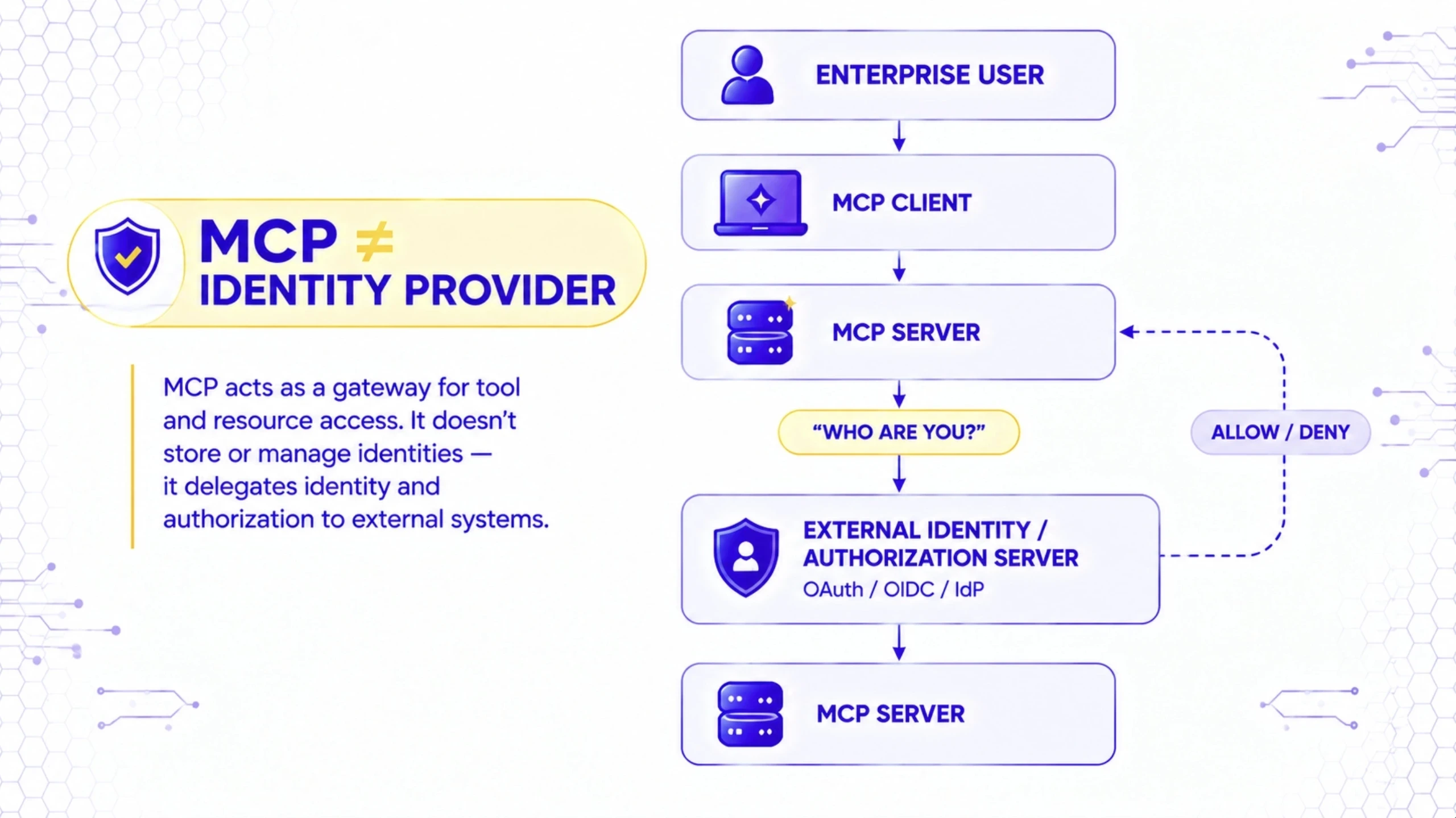
MCP Delegates Identity, It Doesn't Own It
MCP servers do not maintain their own user directories, password stores, or session management systems. Instead, they delegate to external identity providers and authorization servers for the actual work of proving who is asking and deciding what they are allowed to do. This is a deliberate design choice, and mostly a sound one: it means MCP servers do not need to reinvent identity infrastructure that already exists. But it also means every MCP identity and access problem is really an integration problem between the MCP layer and whatever identity system sits behind it. When that integration is thin, informal, or missing entirely, the gap shows up as exactly the kind of access sprawl and orphaned permissions this guide covers below.
How MCP Handles Identity by Default
OAuth 2.1 as the Authorization Baseline
The MCP Authorization Specification standardizes how MCP clients obtain access to protected MCP servers using OAuth 2.1. Getting MCP OAuth 2.1 identity verification right is the foundation everything else in this guide builds on. The spec decouples access control logic from the MCP server itself by deferring to a trusted OAuth 2.1 authorization server, and it standardizes how a client discovers what access it needs through Protected Resource Metadata. Access tokens are presented to the MCP server using a standard Authorization Bearer header, and the server validates that token before processing any tool call or resource request. This gives MCP a consistent, well-understood authorization baseline rather than each server inventing its own scheme.
PKCE and OIDC for Client and User Verification
PKCE, Proof Key for Code Exchange, is mandatory for every MCP authorization code flow, not optional. It exists because many MCP clients are public clients that cannot safely hold a static secret, and PKCE replaces that secret with a one-time cryptographic challenge generated fresh for each authorization attempt, closing the door on authorization code interception attacks. OpenID Connect layers identity on top of OAuth's authorization mechanics, giving the MCP client a verified assertion of who the human user actually is, not just a token that proves some authorization happened.
Per-User, Per-Server Consent Model
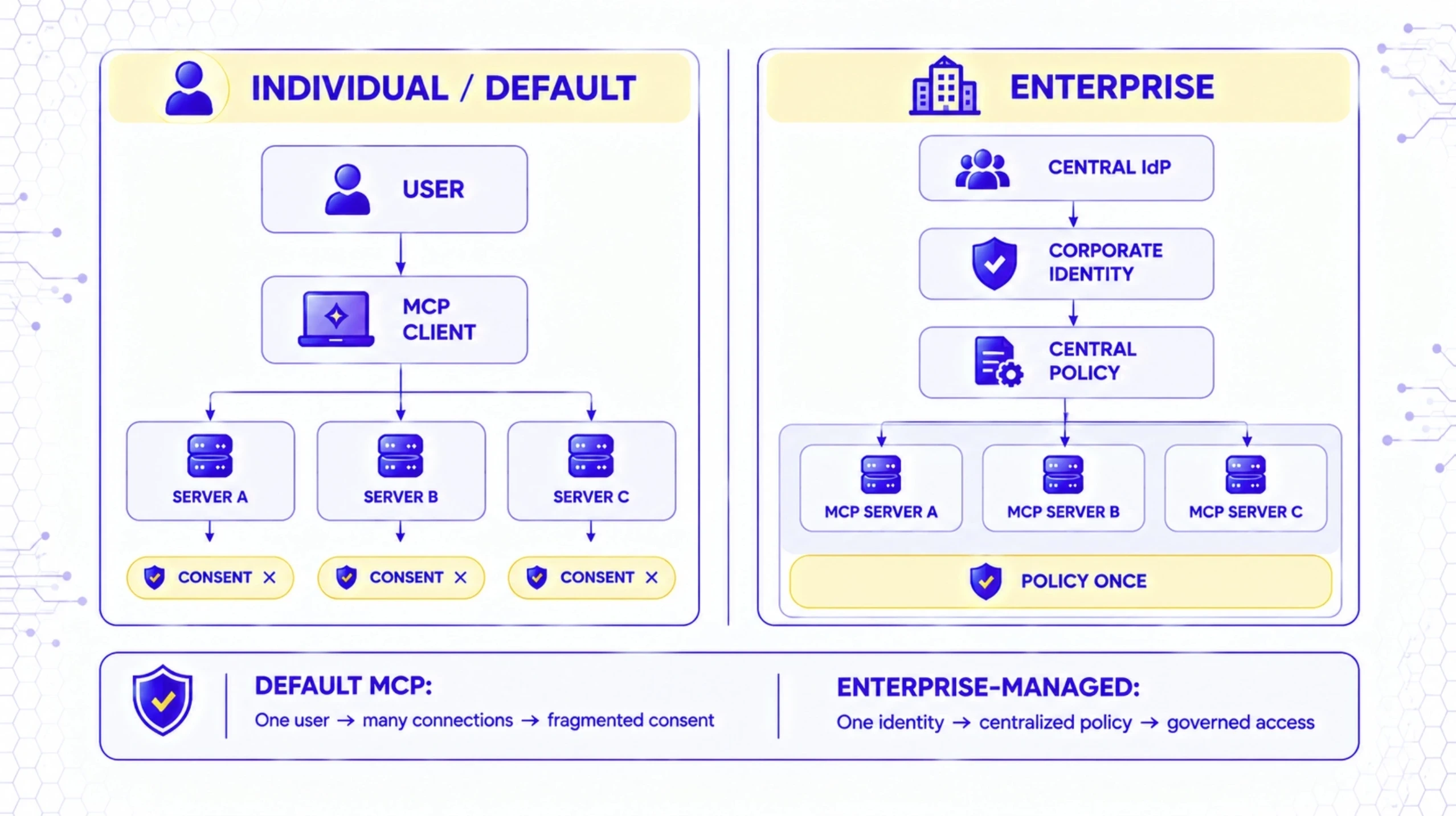
By default, MCP's authorization model is user-driven: a client discovers an MCP server, sends the user through that specific server's authorization flow, and the user consents individually to that connection. This works cleanly for a single person connecting their own client to their own accounts. It becomes a very different problem once an organization has hundreds of employees each needing to connect to dozens of approved MCP servers.
The Enterprise Gap in Default MCP Identity
User-Driven Authorization Works for Consumer Apps, Not Enterprises
The consent-per-connection model that makes sense for an individual choosing which app can reach their calendar becomes an authorization tax at enterprise scale. Every employee has to connect every approved MCP server individually; consent and account-selection prompts create inconsistent setup experiences, and security teams end up reasoning about access across dozens of separate, disconnected authorization relationships rather than one centrally governed policy.
No Native Provisioning, Review, or Deprovisioning Workflow
MCP's default model has no built-in answer to a question every enterprise identity program has to answer: what happens when someone leaves? An employee who connected their MCP client to a dozen servers over the course of a year leaves the company, and by default, nothing automatically revokes those connections. The access simply persists, tied to credentials or sessions no one is actively reviewing, until someone remembers to go looking for it, if anyone ever does. There is no native access review cadence built into the protocol either, which means MCP-connected access can drift silently away from what any policy intended.
Enterprise-Managed Authorization for MCP
How Centralized IdP Control Works
Enterprise-Managed Authorization is an MCP extension built specifically to close this gap. It makes the organization's identity provider the authoritative decision-maker for MCP server access, rather than leaving each connection to an individual user's discretion. Administrators define policy once, centrally, based on group membership, role, and conditional access rules already configured in tools like Okta or Microsoft Entra ID. Users authenticate with their existing corporate identity, and the IdP grants or denies MCP server access according to that centrally managed policy, without a separate per-server consent screen for every connection.
Identity Assertion JWT Authorization Grant (ID-JAG) Flow
The mechanism underneath Enterprise-Managed Authorization is a token type called the Identity Assertion JWT Authorization Grant, or ID-JAG, also referred to as Cross App Access. The flow works in three steps. First, the user signs into the MCP client through the enterprise IdP via standard single sign-on. Second, the client performs a token exchange with the IdP, presenting its existing identity token and requesting an ID-JAG scoped specifically to the MCP server it needs to reach. Third, the client presents that ID-JAG to the MCP server's own authorization server using a JWT bearer grant, and that authorization server validates the assertion, checks the audience and expiry, and issues its own scoped access token. The enterprise IdP never has to establish direct trust with every individual MCP server. It brokers the identity assertion, and each resource server still mints and controls its own access tokens.
Access Control Models for MCP
Role-Based Access Control (RBAC)
RBAC assigns MCP server and tool access based on a user's or agent's role within the organization, which maps cleanly onto how most enterprises already think about permissions. Applying RBAC to MCP servers means defining which roles can invoke which tools before any individual connection is made, rather than granting broad access and hoping usage stays reasonable.
Attribute-Based / Conditional Access
Attribute-based access control extends RBAC with conditions that depend on more than just role: time of day, the sensitivity of the specific resource being requested, or tags applied to a particular MCP server or tool. An agent might be permitted to query a customer database during business hours but blocked from the same query outside a defined maintenance window, or restricted from tools tagged as handling regulated data unless a separate approval condition is also met.
Per-Action Authorization vs. Session-Level Authorization
Session-level authorization grants an agent access for the duration of a connection, which is simpler to implement but leaves a wide window during which a compromised or manipulated agent can act freely within its granted scope. Per-action authorization instead evaluates each individual tool call against policy at the moment it happens, closing that window at the cost of additional latency and complexity. For high-risk tools, financial transactions, data deletion, external communications, per-action authorization is generally worth that added cost.
Identity Lifecycle Management for MCP-Connected Agents
Provisioning New Agents
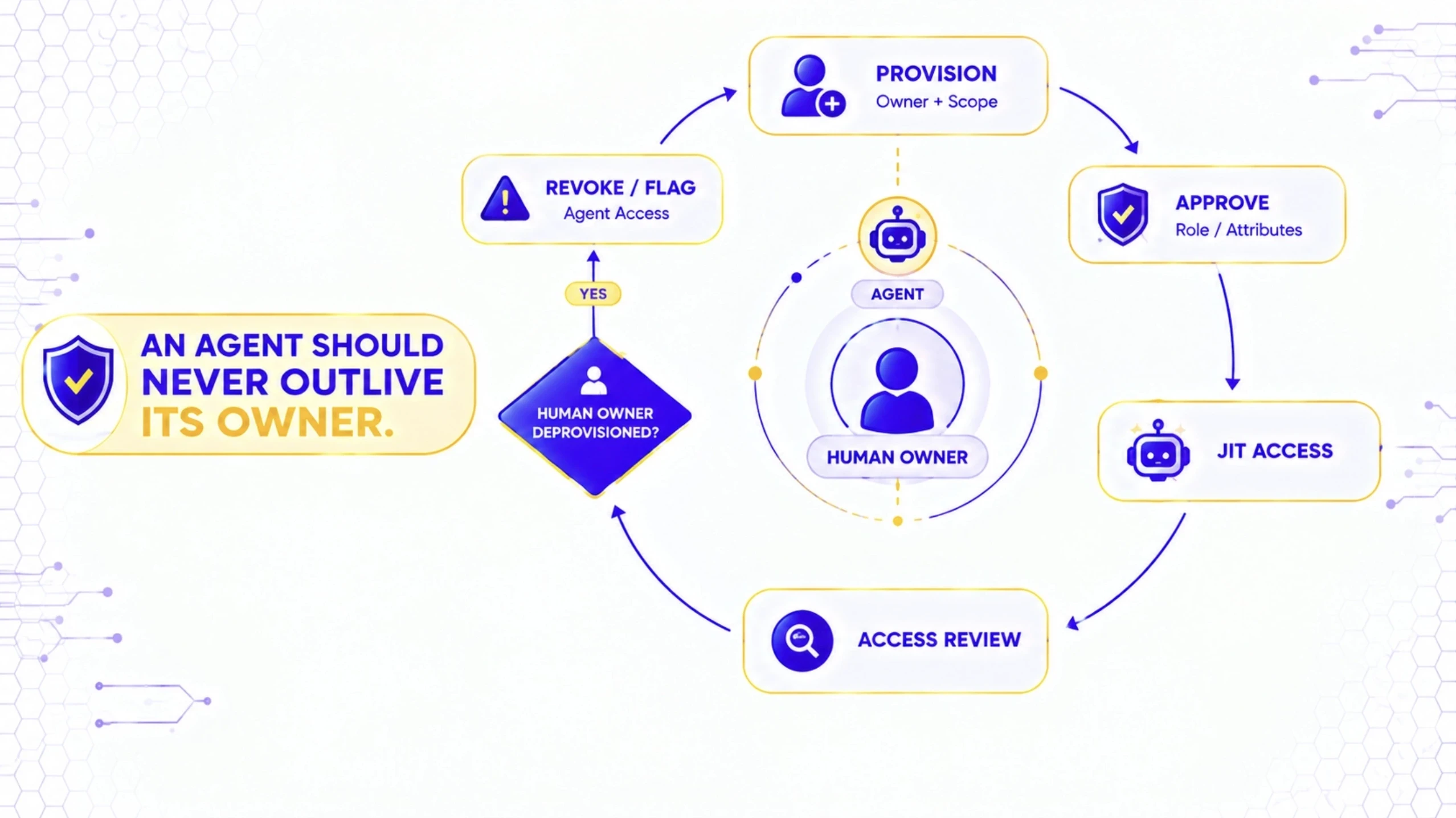
Provisioning an MCP-connected agent should mean more than generating a credential. It means assigning a documented owner, a defined scope of tools and resources, and a role or attribute set the access control model can actually evaluate, all before the agent makes its first live call.
Access Reviews Alongside Human Identity Reviews
Agent identities connected through MCP should appear in the same periodic access review process an organization already runs for human accounts, not a separate, less frequent, or entirely absent review cycle. An agent's access tends to accumulate the same way a long-tenured employee's does, and it needs the same periodic scrutiny.
Deprovisioning: Tying Agent Access to the Human Who Owns It
The cleanest way to solve MCP's missing deprovisioning trigger is to explicitly bind every agent identity's access lifecycle to the human owner who provisioned it. When that person's own account is deprovisioned through standard offboarding, the tie should automatically flag or revoke the agent connections tied to them, rather than leaving those connections to persist indefinitely as an orphaned credential.
Just-in-Time (JIT) Access to Reduce Standing Privilege
Just-in-time access grants an agent the permissions it needs only for the duration of a specific task, then revokes them automatically once that task completes. This directly reduces the standing privilege problem that makes a compromised agent identity dangerous: an agent with no standing access to a sensitive resource cannot leak or misuse a permission it was never holding in the first place.
Attribution and Audit: Knowing Who's Behind an Agent
Binding Agent Actions to Human and Non-Human Identities
Every action an MCP-connected agent takes should be traceable to both the agent's own workload identity and, where relevant, the human on whose behalf it is acting. This dual binding matters because accountability and troubleshooting both depend on knowing not just which agent made a call, but under whose authority it believed it was operating.
Building an Investigable Chain of Attribution
A genuinely investigable audit trail captures the full chain: which human or delegation authorized the action, which agent identity executed it, which MCP server and tool were involved, and what the outcome was. Without that complete chain, an incident investigation is left reconstructing intent from fragments rather than reading it directly from the record.
Where the Gateway Fits In
An MCP gateway sits at the enforcement point between agents and the MCP servers they connect to, giving security teams a single place to apply identity and access policy consistently rather than configuring it separately inside every individual server. The identity and access models covered above are only as effective as the point where they actually get enforced, and a gateway is typically that point.
Emerging Standards to Watch
SPIFFE Workload Identity for Agents
SPIFFE, the Secure Production Identity Framework for Everyone, issues cryptographically verifiable workload identities to agents, MCP servers, and every other software component in an environment, independent of any human login. An agent authenticates by presenting a SPIFFE Verifiable Identity Document, or SVID, rather than a static API key or long-lived secret, and every MCP tool call can carry a per-request identity token rather than relying on ambient trust for the life of a session. This matters specifically for autonomous agents that operate continuously without a human initiating each individual request, since SPIFFE establishes which software is acting even when no delegated human authority is directly involved.
Client ID Metadata Documents (CIMD) for Self-Registration at Scale
Client ID Metadata Documents solve a scaling problem that pre-registration cannot: a single MCP client may need to connect to thousands of MCP servers it has never interacted with before, and manually pre-registering with each one is not workable. Under CIMD, a client's identifier is simply an HTTPS URL pointing to a JSON document the client itself hosts and controls, describing its name, redirect URIs, and other metadata. The authorization server fetches and validates that document rather than requiring the client to register in advance through a separate process. CIMD proves a client controls a given domain, not that the client is inherently trustworthy, so servers still need their own trust policies for domains they have no prior relationship with. The current MCP specification treats CIMD as the preferred default for new client registrations, with Dynamic Client Registration retained as a fallback.
How Akto Supports MCP Identity and Access
Discovery of MCP Servers, Agents, and Their Identity Bindings
Akto continuously discovers every MCP server and agent connection across an organization's environment, along with the identity bindings, human owners, credentials, and permission scopes tied to each one, building the inventory that any lifecycle or access review process depends on.
Continuous Testing of Authorization and Consent Flows
Akto tests MCP authorization and consent flows on an ongoing basis rather than as a one-time configuration check, catching gaps such as overly broad scopes, missing PKCE enforcement, or consent flows that grant more access than a policy intended before those gaps are exploited.
Runtime Enforcement and Attribution
At runtime, Akto enforces access policy at the point of each tool call and maintains the attribution trail tying agent actions back to their human or workload identity, giving security teams the investigable chain that ad hoc logging rarely provides on its own.
Final Thoughts on MCP Identity and Access
MCP's decision to delegate identity rather than own it is a reasonable one, but it means every enterprise deploying MCP-connected agents inherits the responsibility of building the provisioning, review, and deprovisioning workflows the protocol itself does not provide. Enterprise-Managed Authorization, SPIFFE workload identity, and CIMD each close a specific piece of that gap, but none of them substitute for identity-aware MCP governance, an organization actually knowing which agents exist, what they can access, and who owns them.
FAQs: MCP Identity & Access
1. What is MCP identity and access management?
The set of practices and mechanisms, spanning authentication, authorization, and lifecycle management, that determine who and what can connect to an MCP server and what actions they are permitted to take once connected.
2. Does MCP have its own identity system, or does it rely on external providers?
MCP relies on external identity providers and OAuth 2.1 authorization servers. It defines a standardized way for clients and servers to interact with those external systems rather than implementing its own identity infrastructure.
3. How does OAuth 2.1 fit into MCP identity and access?
OAuth 2.1 is the authorization baseline the MCP specification standardizes around, defining how an MCP client obtains an access token from a trusted authorization server and presents it to the MCP server on each request.
4. What is the difference between authentication and authorization in MCP?
Authentication verifies who is making a request, typically through OpenID Connect layered on top of OAuth. Authorization determines what that verified identity is allowed to do, expressed through scopes and access tokens the MCP server validates.
5. What happens when an employee whose agent has MCP access leaves the company?
By default, nothing. MCP has no native deprovisioning trigger, so access persists until someone manually identifies and revokes it, which is why binding agent access to its human owner's identity lifecycle matters.
6. What is Enterprise-Managed Authorization in MCP, and how does it work?
It is an MCP extension that makes the organization's identity provider the central decision-maker for MCP server access, using centrally defined policy instead of individual per-server user consent.
7. What is an ID-JAG (Identity Assertion JWT Authorization Grant)?
A short-lived, signed JWT that an enterprise identity provider issues to vouch for a specific user's access to a specific MCP server, which the MCP client exchanges for a scoped access token from that server's own authorization server.
8. How does per-action authorization differ from session-level authorization in MCP?
Session-level authorization grants access for an entire connection's duration. Per-action authorization evaluates each individual tool call against policy at the moment it happens, reducing the window a compromised agent identity can exploit.
9. How do you apply RBAC or attribute-based access control to MCP servers?
RBAC assigns MCP tool and server access based on defined roles. Attribute-based access control adds further conditions, such as time of day or resource sensitivity, that must also be satisfied before access is granted.
10. What is just-in-time (JIT) access, and why does it matter for MCP agents?
JIT access grants an agent permissions only for the duration of a specific task and revokes them automatically afterward, minimizing the standing privilege a compromised agent identity could otherwise misuse.
11. How do you maintain an audit trail that ties agent actions back to a human identity?
By binding every agent action to both its workload identity and the human or delegation that authorized it, then capturing that full chain, authorizer, agent, server, tool, and outcome, in a single investigable record.
12. What is SPIFFE workload identity, and how does it relate to MCP agents?
SPIFFE issues cryptographically verifiable identities to software workloads, including agents and MCP servers, allowing per-request authentication independent of human login, which matters for agents that operate continuously without direct human initiation.
13. How does an MCP gateway enforce identity and access policies?
A gateway sits between agents and MCP servers as a single enforcement point, applying identity verification and access policy consistently across every connection rather than requiring each server to implement its own controls separately.
14. What are the risks of relying on default, user-driven MCP authorization in an enterprise?
Inconsistent per-server consent experiences, no centralized policy enforcement, and no native provisioning or deprovisioning workflow, which together let access accumulate and persist well beyond what any actual policy intended.
15. How does Akto help secure MCP identity and access?
Akto continuously discovers MCP servers, agents, and their identity bindings, tests authorization and consent flows on an ongoing basis, and enforces runtime access policy while maintaining a full attribution trail for every agent action.

Experience enterprise-grade Agentic Security solution