Top MCP Security Testing Vendors for 2026
Compare the top MCP security testing vendors for 2026. Explore their MCP security testing, discovery, runtime protection, and AI agent security capabilities.

Bhagyashree

Every AI agent integrated with some real-world tools is only one incorrectly described tool invocation away from being breached, and MCP is the thing tying those connections together at scale. This means that speed is a critical factor, which makes it a prime target for attacks.
These vendors offer tools designed to evaluate, test, and red-team secure MCPs. And those are different from tools meant to secure the MCP gateway itself or manage secrets and credentials.
In most cases, the only reliable way to understand how well-protected your own MCP is, is to attack it yourself and see what sticks. This blog covers various MCP security solutions that help protect MCP-connected agents from being used as an entrance to your systems.
What Counts as an "MCP Security Testing Vendor"
The MCP security marketplace is evolving, ranging from run-time enforcement to pre-deployment adversarial testing. Before jumping to comparisons, it’s useful to establish what precisely falls under the definition of “testing vendor” and why that category is differentiated from tools that operate in the traffic inspection space.
Testing/Red-Teaming Vs Gateways, Vaults, And Runtime Blockers
MCP (Model Communication Protocol) tools can be split a few different ways, and it's easy to get different categories mixed up. MCP gateways are middlemen that enforce policy at the message level between user agents and MCP servers, rate-limiting or otherwise blocking requests not passing their allowlist or schema checks. Vaults store and rotate credentials and API keys required for MCP servers to communicate with other services, isolating them from end-user access. Runtime blockers protect MCP servers from being weaponized by inspecting and denying suspicious tool calls as they happen, sometimes as part of a larger gateway.
Testing and red-teaming vendors, which this post will focus on, are different in that they operate outside of the traffic stream entirely. They perform authorized penetration tests against your MCP servers and tools, attempting to exploit injection vulnerabilities and poisoned tool behaviors, report back on what they were able to do, and often run on a regular schedule to verify that no regressions have been made. It's the difference between having a firewall and a security audit - the former keeps you safe, while the latter confirms that the former actually works.
The Need For Security Testing Even With A Gateway In Place
Gateways enforce rules, but can't tell you what rules you need. Testing vendors identify weaknesses in your current setup that a bad actor could exploit to gain unauthorized access to your system. It's one thing to have a well-designed API that prevents obviously malicious requests from being processed, but an attacker could exploit a vulnerability in the tool description to inject their own instructions. The gateway would accept the tool call as valid, and then do whatever the attacker told it to do. These scenarios are harder to account for with policy as code, because the rules are usually written in response to specific problems, rather than a broad attack surface.
The other issue is one of surface area. The more tools you have connected to your MCP server, the more points of entry there are for an attacker to exploit, potentially. New tools are added, existing tools are updated, and even the models themselves get upgraded, all of which can introduce new vulnerabilities, even if your gateway's rules aren't directly to blame. Regular red-teams can catch these issues before they become major security concerns. A properly configured gateway is still a critical part of any security posture, but it's only one part. The two approaches are complementary - while a gateway can greatly reduce the impact of an attack, it's not a substitute for actively identifying and remediating potential security concerns.
The Top MCP Security Testing Vendors for 2026
Here are the top MCP Security testing tools of 2026.
1. Akto
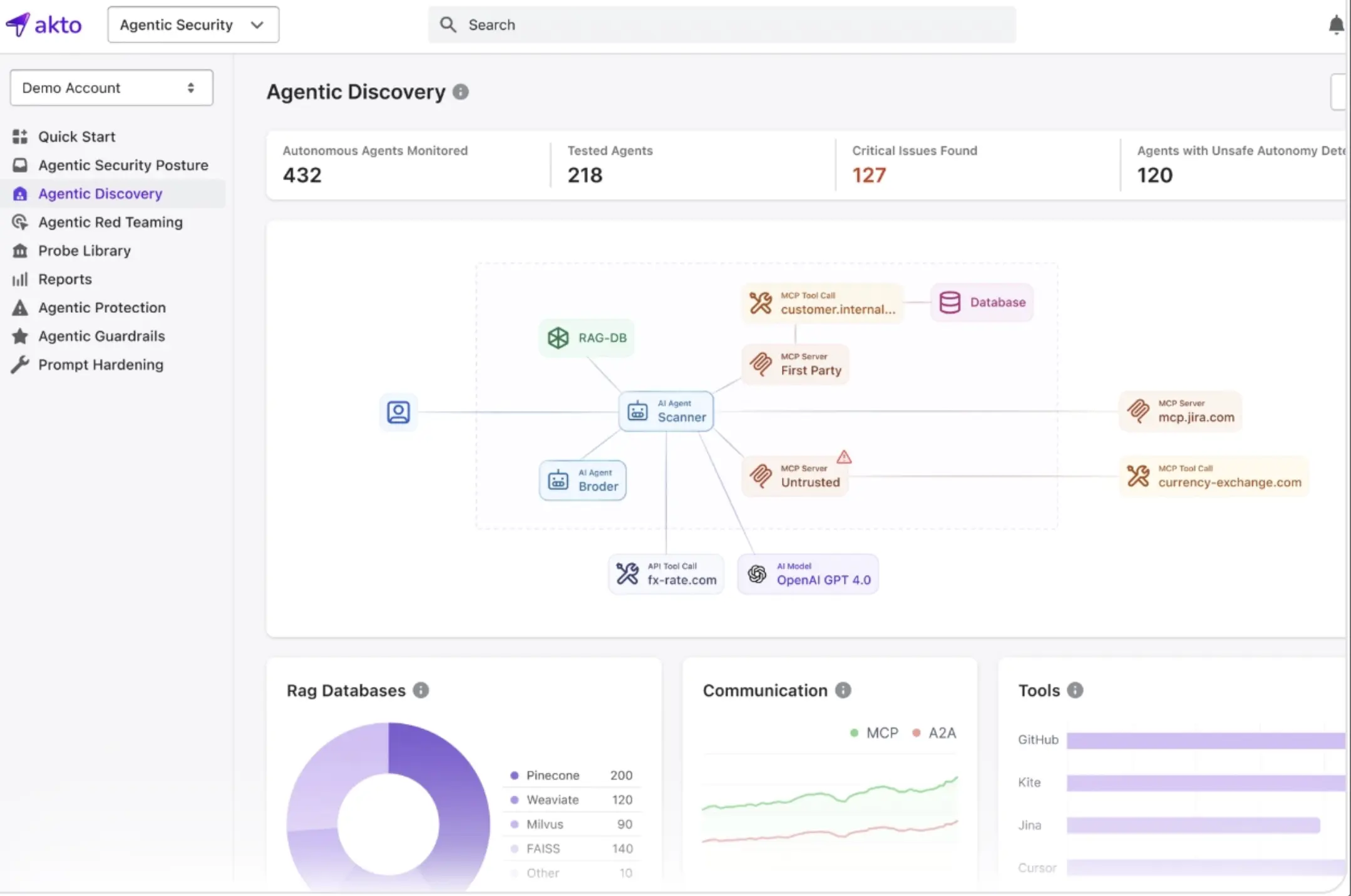
Akto is an AI Agent Security Platform that helps enterprises discover, test, monitor, and protect AI agents, MCP servers, tools, and connected resources across their environments. The platform combines agentic security discovery, red teaming, runtime monitoring, and guardrail enforcement to help security teams secure the entire agentic AI stack.
Features
Automatic discovery of AI agents, MCP servers, tools, and data sources with lineage tracking across dependencies.
Continuous attack simulation via an AI Agent Attack Matrix containing 1000+ real-world agent attack surface use cases.
Testing of prompt injection, tool poisoning, and cascading effects.
Connectors for 50+ traffic and code analysis sources across cloud, hybrid, and on-premises environments.
Runtime guardrails and posture management built on top of testing to enforce policies at the code level.
Ideal for: Enterprises with critical AI agent and MCP security needs spanning multiple teams, such as in finance, banking, fintech, or healthcare, who want a discovery + red teaming + runtime enforcement stack in one, rather than managing three separate solutions.
2. Tencent AI-Infra-Guard
Tencent AI-Infra Guard is an open-source, full-stack AI red-teaming platform from Tencent's Zhuque Lab, which considers Model Content Protection (MCP) as an independent attack layer, in addition to model-level and infrastructure-level testing.
Features
MCP Server & Agent: scanning across 14 risk categories.
Scanning from either source code or remote URLs.
AI infrastructure vulnerability scanning: 100+ frameworks, 1900+ CVEs.
Dataset-driven jailbreak evaluation with cross-model comparisons.
Modern web UI with one-click scanning and progress tracking, full API access.
Ideal for: Engineering-heavy companies and open source-first organizations that want broad, free MCP and AI-infrastructure coverage, with the ability to self-host and maintain the tool internally.
3. General Analysis
Intro: An automated adversarial-testing platform focused on persistent multidimensional attack search rather than a one-time compliance scan, one of whose system layers to evaluate is MCP.
Features
Continuous adversarial testing of production LLM applications, RAGs, MCP servers, coding agents, and production AI agents.
Attack surface exploration using advanced techniques such as tree-of-attacks, Crescendo, and PAIR
Multi-turn adversarial dialogues rather than one-shot queries.
Provision of findings as retestable traces, OWASP-sorted results, remediation tasks, and regression tests for releases.
Open-source MCP exploit research, including an example of an attack chain that abused a support-chat injection to exfiltrate data from Supabase.
Ideal for: Engineering teams that operate production agents with access to critical tools (database queries, API calls, financial transfers) needing to build regression testing into the CI/CD cycle, rather than performing a one-time compliance scan.
4. DeepTeam
DeepTeam is the open-source red-teaming engine; Confident AI is the managed platform on top of it, giving teams a free entry point and an upgrade path in case they need to move beyond open-source.
Features
20+ attack methodologies across single-turn (prompt injection, jailbreaking, encoding attacks) and multi-turn (cross-talk hijacking, iterative jailbreak progression) categories.
50+ built-in vulnerability categories, including bias, PII leakage, and excessive agency.
Integrated MCP server for running red teams and analyzing results in Cursor or Claude Code.
Attack iteration risk tracking and production monitoring for recurring issues.
Built-in alignment with OWASP Top 10 for LLMs and NIST AI RMF.
Ideal for: Teams that want to start using a free, in-code (via GitHub) red-teaming solution and later migrate to a dashboard-based managed platform without learning a new framework. A good fit for early-stage startups that want to build security-informed AI applications but also have to comply with enterprise security standards.
5. Mindgard
Built on a decade of AI security research at Lancaster University, Mindgard operates as an autonomous, attacker-aligned red teamer across models, agents, and MCP infrastructure.
Features
Discovery of models, agents, MCP/A2A servers, connected tools, and shadow AI.
Attack chain generation and agentic red-teaming.
Published MCP benchmarks, including 58.3% host-side attack success rate against Claude, 75% against OpenAI, and 81.7% against Cursor.
Deployment as code via CI/CD, Burp Suite, or with a single click.
Runtime detection and control validation on top of offensive testing.
Who needs it: Enterprises with established AppSec testing practices (e.g., Burp Suite, CI/CD) looking to complement their existing tooling with cutting-edge model/AI/MCP security testing capabilities.
6. Equixly
An API-security-first platform whose "Agentic AI Hacker can chain together attacks in the way a human hacker would", and now it's being extended to MCP servers and AI coding assistants.
Features
An attack-reasoning model fine-tuned for APIs, not a general-purpose LLM with security prompts.
Research on MCP-specific risks showing 43% of implementations had command injection vulnerabilities in testing.
Discoveries always include concrete proof-of-concept attacks, executive summaries, and engineering-specific context.
An MCP-specific integration making GitHub Copilot, Claude, and other AI coding assistants into attack surface discovery tools.
An interactive visual graph of your service exposing all the endpoints, services, and sensitive inputs.
Who It's For: API-driven fintech or SaaS platforms with mature API security postures that want to bolt on MCP-specific continuous penetration testing as an adjacent discipline.
7. Operant AI
Operant AI is mainly a run-time MCP gateway and defense platform, which is worth mentioning in this list with a caveat, as most of its products fall under the ‘gateway’ category that this roundup otherwise excludes, while it also offers an open-source offensive testing tool.
Features
Operant-mcp, an open-source security-testing MCP server with 51 tools for penetration testing, network forensics, memory analysis, and vulnerability scanning.
Real-time discovery, detection, and defense across the entire MCP stack.
Tool-usage pattern analysis detecting anomalous patterns of systematic enumeration and credential testing.
Data-flow analysis detecting exfiltration patterns such as high input rates with little accompanying text output.
AI Security Graphs, which annotate trust boundaries and most-critical data flows, are organized according to the OWASP Top 10 for LLMs and agents.
Ideal For: Enterprises that want runtime blocking as their primary defense and want to use this product’s open-source testing tool as a lighter-weight secondary check, rather than as a dedicated adversarial testing solution.
8. MCP-Scan (Free/Open Source Starter)
The tool that basically defined MCP-specific security tooling, created by Invariant Labs (now Snyk), after reporting on things like the WhatsApp MCP vulnerability.
Features
Analyzes MCP configs, connects to servers, and pulls tool descriptions for auditing.
Leverages the Invariant Guardrails API to spot malicious actors embedded in tool descriptions.
Built-in tool pinning to verify hashes of installed tools, guarding against MCP-tied “rug pulls”.
Detects poisoned tools and cross-origin/tool-shadowing at the config layer.
Lightweight, open-source, and needs no infrastructure to run in minutes.
Ideal for: Someone who wants entry-level MCP security for now, as either an initial barrier before shelling out cash on something bigger, or as a “floor” for their own adversarial red teaming – not meant to replace ongoing proactive defense, but to provide free baseline security.
Choosing by Priority
The choice of what makes a good fit for vendors relies on the outcomes sought rather than the checklist of features. For example, getting ahead of regressions that may creep into the software at each release, being one step ahead of threat models that have not yet emerged but will soon, and getting an initial assessment of one’s risk posture without spending any money. How to pair these goals with the available options discussed?
Best for Continuous, CI/CD-Integrated Testing
If the goal is folding adversarial testing into release pipelines to prevent vulnerable MCP servers from being deployed, General Analysis, Confident AI/DeepTeam, and Mindgard are the most viable options. General Analysis is the most feature-rich static analysis tool designed to expose known exploit patterns, which can be compiled into regression suites to ensure a vulnerability won’t slip through a future code deployment accidentally.
Confident AI/DeepTeam takes a similar approach but is more oriented towards open-source tools and CI/CD environments, with YAML/CLI compatibility, pytest plugin, and a built-in MCP server to deploy red teaming payloads in Cursor or Claude Code directly. Mindgard has the option for one-click deployment via CI/CD or Burp Suite if the security team prefers to operate within an established AppSec infrastructure. Akto and Equixly can be used for the same purpose if discovering and testing novel attacks alongside the core payload discovery is desired.
Best for Research-Driven, Novel Exploit Discovery
For research-focused organizations that want to prioritize truly novel discoveries and go beyond the known jailbreak templates, Tencent AI-Infra-Guard and Equixly are the best options. AI-Infra-Guard is developed by Zhuque Lab researchers who publish their findings at Black Hat, DEF CON, ICLR, CVPR, NeurIPS, and ACL conferences, and the tool itself is consistently updated according to the latest attack classes and mitigation signals from the scientific community.
There are 14 distinct risk categories related to MCP/skill security that get updated as new papers and technical reports emerge. Equixly uses a different paradigm altogether, with its proprietary model fine-tuned to exploit development rather than general-purpose jailbreaking, and its public repository contains reports on original discoveries, such as the 43% command injection rate across all tested MCP implementations. General Analysis and Mindgard also have research publications and exploit reports that can be used as the foundation for developing in-house testing capabilities if original research is not an option.
Best Free Starting Point Before Committing to a Platform
For cost-conscious teams that want to get started with adversarial testing without making a financial commitment right away, MCP-Scan is the most logical choice because of its dual open-source/free pricing tier, broad attack surface coverage (prompt injection, rug pulls), and the ability to analyze code/configuration minutes after deployment. There are no API keys or infrastructure to maintain since all the effort happens locally inside the browser.
Tencent AI-Infra-Guard is the natural progression for such teams beyond MCP-Scan due to its open-source status, extra sources to scan (code, URLs), expanded threat model (14 categories), jailbreak detection, and the ability to detect novel attacks in prompts/code. DeepTeam should also be considered at this stage due to its extensive but freely accessible testing capabilities – 50+ vulnerability types and 20+ attack methods would allow for thorough red teaming before any investment is made, and Confident AI offers an option to visualize findings in dashboards if committing to a full-scale platform is still too early.
Where MCP Security Testing Fits Alongside Gateways and Runtime Protection
These may sound like three interchangeable terms, but in practice, "security testing", "gateways" and "runtime protection" represent different approaches, each addressing a different aspect of an agent's lifecycle.
Understanding how the different aspects relate to each other is key to avoid designing programs that repeat the same work, or, worse, leave critical responsibility gaps.
Security testing: adversarial probing at pre-production and in CI/CD
Security testing aims to find attacks against your agent or MCP integration before they affect production by simulating an adversarial interaction with your system. Testing can take the form of red teaming, prompt injection attempts, tool misuse, privilege escalation, and similar approaches, applied to a staging instance of your agent, a proposed tool definition, or a modified system prompt, with the goal of finding input or interactions that would cause the agent to bypass safety mechanisms and perform an unsafe action.
A security testing program should be adversarial and iterative, attempting to not only find potential attacks, but to realistically evaluate their impact and likelihood of success. Testing is best automated and run as part of the CI/CD pipeline, ensuring that any new code or prompt modifications cannot introduce undiscovered attack vectors.
However, testing alone is necessarily limited: it only finds the attacks that were specifically attempted, and cannot react to subtle changes in the deployed instance or production traffic that could enable previously unknown attack patterns. Testing should be informed by real-world observations, and it must define the criteria that the gateway will use to identify and block attacks.
Gateways: inline enforcement
The MCP gateway is the system that enforces your MCP security policy, sitting inline with all agent/tool interactions, as described in the monitoring architecture section above. It acts as a proxy, inspecting each request for suspicious parameters, payloads, or patterns, and blocking requests that match known attack vectors, based on the criteria discovered during testing. It is the implementation of the policies identified during the threat modeling and testing phases, and, as such, it is the first line of defense against known attack vectors.
A gateway is no more than a policy engine, and it is only as good as the policies it enforces. However, it has no awareness of the larger context or of the conversation history, only inspecting individual requests: it cannot detect complex patterns that span multiple interactions. The gateway must be configured and updated based on the results of testing and runtime protection. It has no ability to learn or update itself, and it cannot distinguish between legitimate and malicious traffic on its own.
Runtime protection: telemetry and anomaly detection
Runtime protection consists in the additional instrumentation needed to perform monitoring and auditing of the agent/tool interactions, detecting anomalous patterns, and providing the telemetry needed to update and refine the gateway policies and inform the testing program of newly discovered attack patterns. It is the collection of logs, metrics, and events generated by the gateway and the agent, analyzed to identify unusual behaviors that might indicate an attempted attack, and additional checks that go beyond simple pattern matching to detect subtle variations or combinations of requests that could be used to bypass the gateway.
Runtime protection should be able to detect anomalies in the context of the conversation, such as requests that appear normal on their own but are made in rapid succession or with other requests that have suspicious parameters, or changes to the agent's behavior that could indicate a slow escalation of privileges. It is the component that detects the attack patterns that the testing program failed to identify and the gateway was unable to block, and it informs the rest of the security program about them, allowing the testing program to adapt to changing conditions and the gateway to be updated with new protection rules.
It is also the only component that detects attacks that have already succeeded and provides information to improve the overall security posture.
In short, runtime protection makes the other two components effective by feeding information back to them: what the runtime protection learns about the attack surface, the gateway uses to improve its pattern matching and block future attacks, and the testing program uses to update its attack scenarios.
A program with only testing and no gateway and runtime protection will identify attacks but not prevent them, while a program with only a gateway but no testing or runtime protection will have ineffective policies that fail to block known attacks.
Final Thoughts on MCP Security Testing Vendors
MCP security testing, as per various researches, is a must now, given the prevalence of attacks, ranging from zero-click exfiltration attempts to over 40% command-injection success rates across various implementations, to name a few. Thus, the choice of a vendor depends on whether the primary interest is continuous testing within the CI/CD cycle, as a means to ensure that any agent deployed has a necessary level of access to tools, research, as a means to keep up with the latest threats, or even a free option, such as MCP-Scan, to get a baseline. Of course, it should be noted that the tools are meant to be used for testing purposes only, and act as a supplement to a broader security strategy, as opposed to a primary defense or credential-repository mechanism.
Frequently Asked Questions: MCP Security Testing Vendors
1. What is an MCP security testing vendor, and how is it different from an MCP gateway vendor?
A testing/red-teaming MCP security vendor proactively launches attacks against your MCP servers and agents to uncover prompt injection, tool poisoning, and confused deputy flaws (among other misconfigurations) before deployment. An MCP gateway security vendor, by contrast, sits in the middle of a traffic flow and enforces certain policies at runtime (e.g., rate limiting, allow listing), or blocks requests. One is a proactive verification of your own rules; the other is a reactive enforcement of your own rules.
2. Why do we need testing vendors for MCP even if we have an MCP gateway?
An MCP gateway is good for enforcing rules you already know to write, but it cannot tell you what rules you are missing. As MCP servers, tools, and models evolve and update, each change carries the potential to reintroduce a vulnerability that a gateway policy previously protected against. In contrast, dedicated testing vendors for MCP can pinpoint these drift-related security issues that a single deployment-time check cannot catch.
3. What is MCP-Scan, and is it a good choice to try before investing in a commercial vendor?
MCP-Scan is an open-source scanner from Invariant Labs (now Snyk) that scans MCP config files and connects to servers to scan their tools' descriptions for injected malicious instructions, using both local analysis and the Invariant Guardrails AI. It also has built-in Tool Pinning to detect MCP rug pulls. It is a good first, free choice but should not be used as a standalone solution because it is a relatively simple, static analysis tool. It is not a replacement for dynamic analysis from a dedicated red-teaming vendor.
4. Which security vendors offer native support for continuous MCP testing in a CI/CD?
General Analysis (finding insights that become part of regression testing), Confident AI/DeepTeam (CLI/YAML scanning, pytest-style gating, and an integrated server for Cursor/Claude Code), Mindgard (one-click CI/CD or Burp Suite deployment), Equixly (MCP-native pentesting inside coding assistants), and Akto (retesting as part of the broader application security tooling) all offer first-party support for this use case.
5. Can traditional penetration testing companies perform MCP-specific tests now?
Yes, to some extent. Traditional penetration testing vendors offer MCP-specific audits for AI agents connected to external tools as part of a greater system that likely includes large language models, RAG, and other agents. For example, Software Secured has positioned itself as a specialist in product-driven AI security; it covers AI features, agents, chatbots, and MCP servers, offering human-led, hacker-style testing. However, only a few firms actually focus on the unique attack surface of RAG poisoning, agent abuse, and tool connection misconfigurations and have the expertise to go beyond API- and model-specific scanning. It is important to ask vendors about their specific MCP security experience beyond broad statements.
6. What should a first MCP security test look for?
It should look for tool description injection attempts (tool poisoning), tool behavior shifts after approval (rug pull), authentication/token management practices, tool use outside the intended scope (excessive agency), and the ability to leverage the server as a relay to access other data. MCP-Scan covers tool poisoning as a static analysis first step. Red-teaming vendors can check the rest in a dynamic analysis.

Experience enterprise-grade Agentic Security solution