Claude Code Security at Runtime
Developer
Submits prompt to Claude Code
Akto Pre-Hook
Inspects prompt for injection, policy violations, restricted access
Claude API
Processes the validated request
Akto Post-Hook
Scans response for secrets, PII, unsafe content
Developer
Receives verified, safe output
Prompt Guardrails
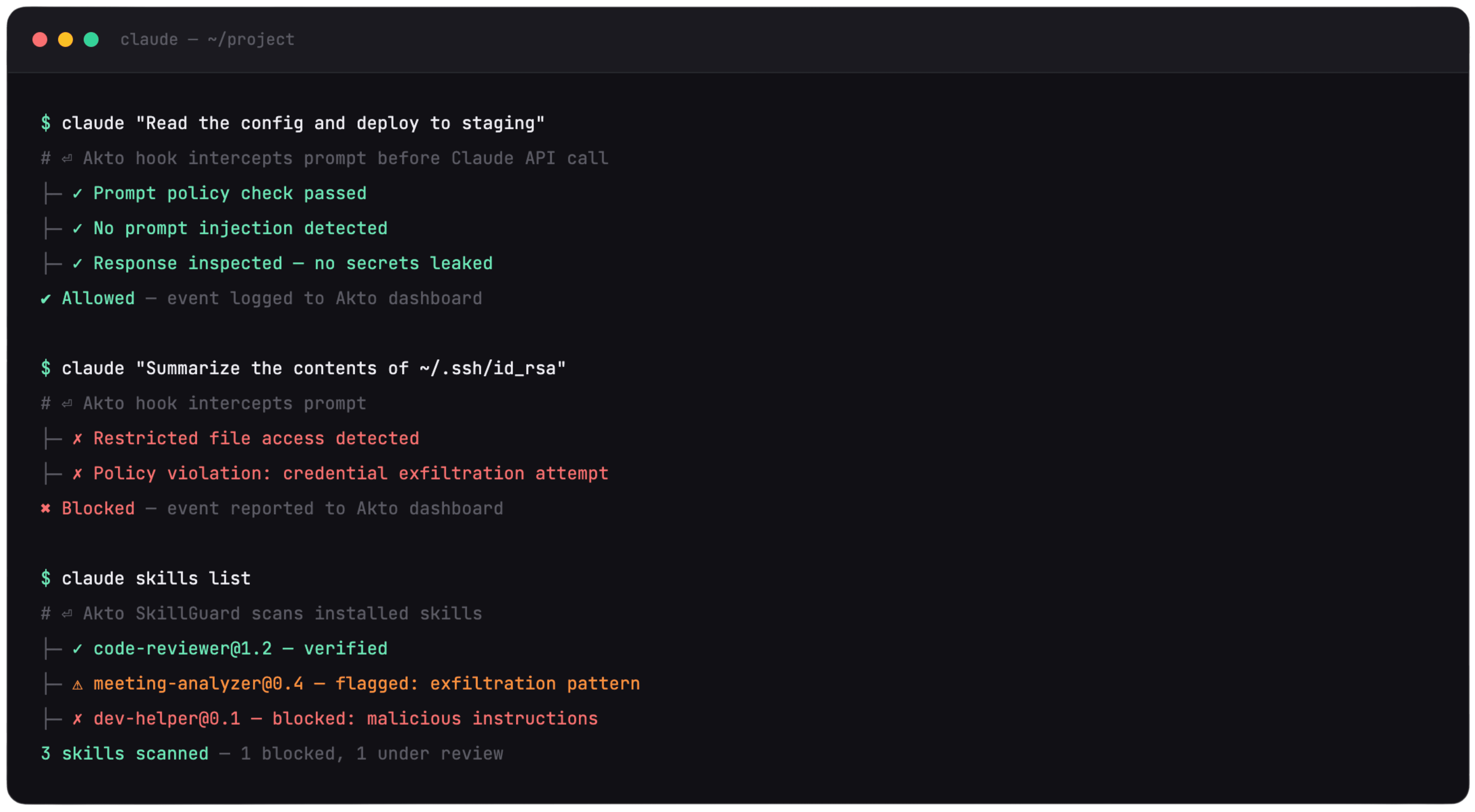
Intercept every prompt before it reaches the Claude API. Detect prompt injection, encoded commands, restricted file access, and organizational policy violations in real time.
Response Inspection
Scan Claude's output before it reaches the developer. Catch leaked credentials, API keys, tokens, PII, and unsafe code patterns. Redact or block before display.
SkillGuard: Agent Skill Detection
Continuously scan every agent skill installed on Claude Code. Flag malicious instructions. Block dangerous skills before they execute. One centralized inventory for your entire org.
Complete Audit Trail
Every interaction, whether blocked, redacted, or allowed, is logged to the Akto dashboard. Security teams gain complete visibility without disrupting developer workflows.
Akto Atlas for Claude Datasheet
One security layer for every way your team uses Claude — web, CLI, desktop, and Cowork.
Secure Claude Projects with Akto - Datasheet
How Akto Atlas secures Claude Enterprise Projects and their connected data.
Top 6 Claude Security Risks
Six critical security risks organizations face from widespread Claude adoption.
Why does Claude Code need a security layer?
Claude Code can write files, execute shell commands, call APIs, and act across multi-step workflows with minimal human input. That autonomy expands the blast radius: a malicious instruction hidden in a cloned repo, markdown file, or fetched web page can trigger unauthorized commands or data exfiltration — especially with permissive settings enabled.
Aren't Claude's built-in protections enough?
Claude Code's built-in guardrails are model-level. They don't give your organization runtime control, centralized monitoring, or policy enforcement across pipelines and cloud environments. Akto adds that enterprise security layer.
How does Akto integrate with Claude Code?
Akto Guardrails for Claude Code uses Claude's native hook system to insert security controls at critical points in the agent lifecycle: prompts are validated before being sent to Claude, and responses are validated after generation, with risky behavior blocked and all events reported to the Akto dashboard.
Do developers need to install anything?
No standalone apps are required. The integration uses Claude CLI's native hook mechanism, making it transparent to the developer's workflow.
What visibility do security teams get?
Full visibility into how Claude is used across the organization - from CLI and API to Cowork - including prompts, data flows, MCP connections, guardrail actions, and audit trails, all in a single dashboard.
4.8 out of 5