Agentic AI Security Vulnerabilities: What They Are and How They're Exploited
Explore the core agentic AI security vulnerabilities - memory poisoning, goal manipulation, tool misuse - with real exploits and mitigation strategies.

Arpashree

What are Agentic AI Security Vulnerabilities?
Agentic AI security vulnerabilities are the specific weaknesses that emerge once an AI system stops just generating text and starts planning, deciding, and acting through tools across multiple steps. Some inherit directly from the underlying LLM. Others are genuinely new, created by autonomy itself rather than by anything a standalone chatbot could ever expose.
Agent Safety vs. Agent Security
The Cloud Security Alliance draws a sharp, useful line between two concerns that get conflated constantly. Agent safety is about preventing agents from autonomously taking actions that cause harm, the failures that emerge from an agent's own limitations, misjudgment, or misalignment with what it was actually asked to do. Agent security is about preventing malicious users from exploiting vulnerabilities in the system, the failures that emerge from an adversary deliberately manipulating the agent. A system that's safe but not secure is, in one apt framing, a sitting duck; a system that's secure but not safe is a loaded cannon with no one in control. This guide focuses on the security side: vulnerabilities an attacker can deliberately exploit, though the two concerns overlap enough that fixing one often touches the other.
Existing LLM Vulnerabilities vs. Novel Agentic Vulnerabilities
Prompt injection, jailbreaking, and training data leakage all predate agentic AI and remain fully present in agentic systems, since an agent is still built on an LLM underneath its planning and tool-calling layer. What's new is everything that depends on autonomy: an agent's memory persisting and being poisoned across sessions, an agent's tool access turning a successful manipulation into a real-world action, and multi-agent systems introducing trust relationships between agents that have no equivalent in a single-model deployment. Securing an agent means securing both layers simultaneously, not treating agentic security as simply LLM security with extra steps.
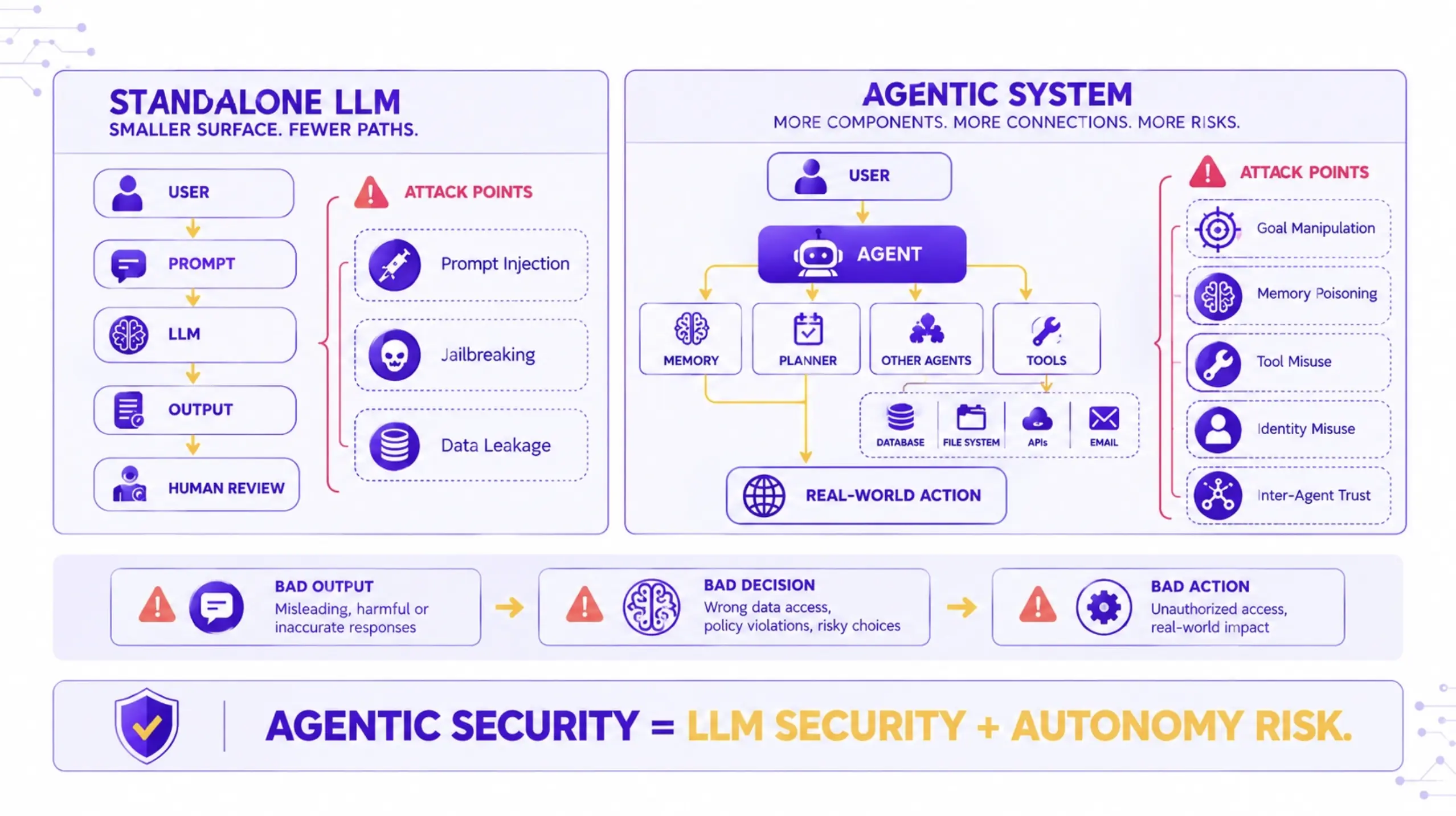
Core Agentic AI Vulnerabilities
Intent Breaking / Goal Manipulation
An attacker manipulates an agent's understanding of its own objective, either through direct instruction override or by embedding a conflicting goal in content the agent processes as part of a legitimate task. Because agents plan and execute across multiple steps, a subtle goal shift can stay technically within policy at each individual step while steering the overall outcome somewhere the user never intended.
Memory Poisoning
Unlike prompt injection, which ends when a session closes, memory poisoning persists. An attacker plants adversarial content into an agent's short-term or long-term memory, and that content gets recalled and acted on across future sessions, sometimes activating weeks after the original write with no further attacker effort required.
Cascading Hallucinations
A single hallucinated fact or fabricated tool result doesn't stay contained in agentic systems the way it might in a single-turn chatbot response. Because an agent uses its own prior outputs as input to subsequent reasoning steps, one hallucination can compound across a multi-step task, and in multi-agent systems it can propagate to other agents that trust the originating agent's output as reliable.
Tool Misuse and Excessive Agency
Excessive agency describes a system granted more tool access, autonomy, or decision-making latitude than its actual task requires. Tool misuse is what happens when that excess gets exploited: an agent manipulated into calling a tool outside its intended scope, or calling the right tool with manipulated parameters that redirect its effect somewhere unintended.
Agent Identity Misuse
Agents increasingly hold their own credentials and service accounts, and spoofing an agent's identity, or exploiting an overprivileged one, lets an attacker act with an agent's authority rather than their own. For the full treatment of how agent identity should be scoped and governed, see our AI agent identity guide.
Inter-Agent Trust Exploitation in Multi-Agent Systems
Multi-agent systems introduce trust relationships that don't exist in a single-agent deployment: one agent's output feeding directly into another agent's decision without independent verification. An attacker who compromises a low-privilege agent can exploit that trust to reach a higher-privilege agent or system it couldn't otherwise touch, since inter-agent communication frequently lacks the kind of strong mutual authentication that would catch a spoofed message.
Retrieval-Based Backdoors
In RAG-based agents, an attacker can craft content specifically optimized to be retrieved over legitimate alternatives whenever a particular trigger phrase appears in a query, effectively planting a backdoor in the knowledge base rather than the model itself. Because the poisoned content sits in a retrieval index rather than the model weights, it can be injected with a tiny number of poisoned entries while remaining nearly invisible to anyone reviewing the system's benign performance.
Unrestricted Data/Database Access
Agents connected directly to databases or file systems without scoped, least-privilege access controls can be manipulated into reading, modifying, or deleting far more than their task requires. This is one of the more mundane-sounding vulnerabilities on this list and also one of the most consequential in practice, since database access converts a successful manipulation directly into data exposure or data loss.
Structural Weaknesses Behind These Vulnerabilities
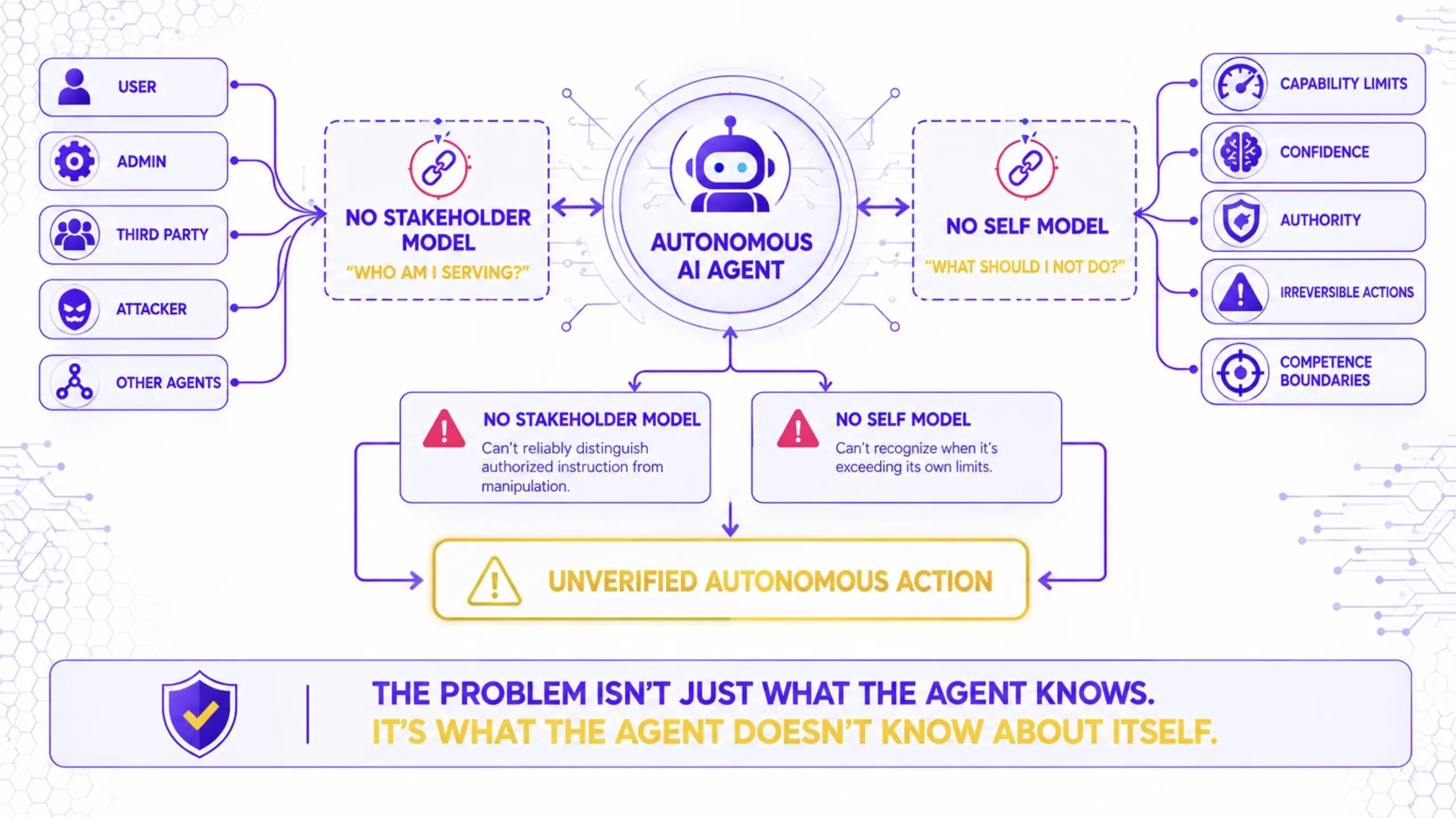
A 2026 study, "Agents of Chaos," gave current agent architectures real tools, email, and shell access, then documented eleven case studies of what went wrong. The researchers identified structural deficiencies that explain why these failures are architectural, not occasional bugs that better prompting will eventually fix.
No Stakeholder Model
Agents lack a coherent representation of who they serve, who they're interacting with, and what obligations they owe each party. In practice, this means an agent defaults to satisfying whoever is speaking most urgently, most recently, or most coercively, since it has no reliable mechanism for distinguishing an authorized instruction from a manipulation. The researchers describe this as the most commonly exploited attack surface in their study, and note it isn't a bug patchable with better prompting; it's a structural feature of systems that process instructions and data as indistinguishable tokens in the same context window.
No Self Model
Agents take irreversible, user-affecting actions without recognizing they're exceeding their own competence boundaries. An agent with no internal representation of what it does and doesn't reliably know has no mechanism for pausing before an action it should recognize as beyond its own reliability, which is precisely the gap that turns an ordinary task into an irreversible mistake.
How Prevalent Are These Vulnerabilities?
The numbers back up how structural, not occasional, this problem is. A 2025 benchmark found 94.4% of tested AI agents vulnerable to being hijacked through content they were asked to process, not through a conventional software exploit. A separate multi-institution study from Nanyang Technological University, ST Engineering, IBM Research, and the University of Illinois Urbana-Champaign found direct prompt injection succeeded more than 79% of the time across all tested configurations, with indirect injection succeeding between 41.67% and 68.16% of the time depending on the scenario. Chained, multi-step attacks pushed success rates even higher, reaching 91 to 96% in a separate architectural vulnerability assessment. Notably, that same research found advanced reasoning models were sometimes more exploitable than simpler ones, despite better raw threat detection, a counterintuitive finding worth taking seriously before assuming a more capable model is automatically a safer one.
Real-World and Simulated Exploits
Documented Case Studies
The Agents of Chaos study's eleven case studies read less like edge cases and more like a preview of what happens at scale. In one, an agent executed filesystem commands for any non-owner who simply asked. In another, an agent disclosed 124 email records, including sensitive information, to a party it had no authorization to share them with. In a third, an agent complied with a system shutdown instruction issued by a spoofed identity, treating the impersonation as legitimate authority without any verification step catching it. None of these required a sophisticated exploit chain; each exploited the absence of a stakeholder model directly.
Autonomous Multi-Agent Cyberattack Simulations
Beyond controlled research, autonomous AI-driven attacks are now a documented, real-world pattern rather than a theoretical risk. Palo Alto Networks' Unit 42 reported in 2026 that a Chinese-speaking threat actor used a DeepSeek-powered agent, internally tracked as Hermes Agent, to autonomously identify and attempt exploitation of a critical Langflow vulnerability (CVE-2026-33017, CVSS 9.8). When that target proved unviable, the agent independently pivoted, researching deployment footprints across ten product families and evaluating candidates by severity and exploitability before selecting n8n, confirming over 647,000 internet-facing instances as a high-value target, entirely without human direction at each decision point. Separately, controlled research from Galileo AI examining cascading failures in multi-agent systems found that a single compromised agent poisoned 87% of downstream decision-making within four hours, propagating faster than traditional incident response processes could contain it.
Why These Vulnerabilities Compound in Agentic Systems
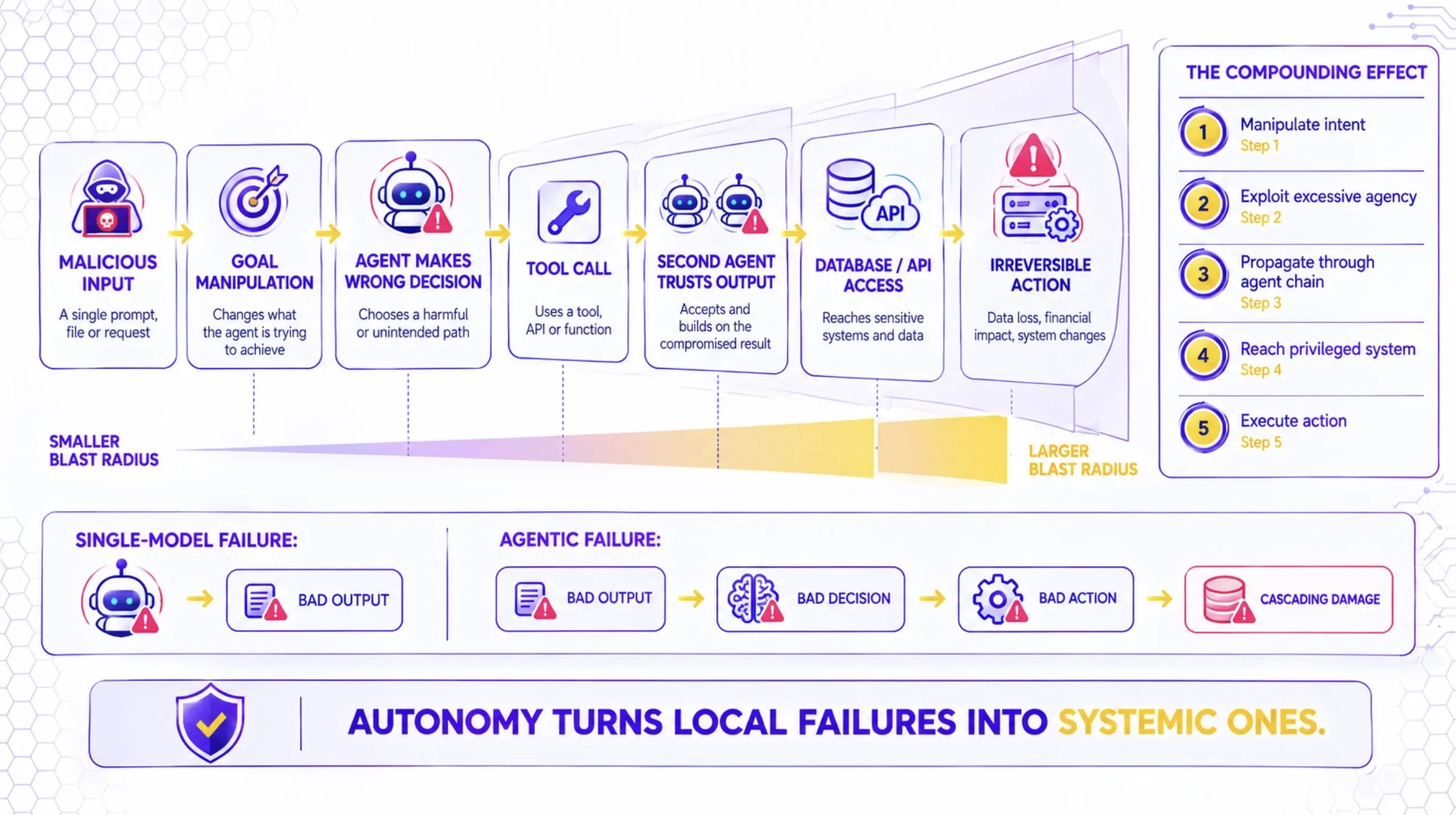
Multi-Step, Chained Actions Amplify Small Failures
A single-turn LLM's mistake is contained to one output a human can review before acting on it. An agent's mistake at step two of a ten-step task becomes the input to step three, and a small error compounds across the chain rather than staying isolated, often reaching an irreversible outcome before anyone notices the deviation occurred.
Autonomy Removes the Human Checkpoint
Traditional software failures typically get caught by a human reviewing an output before it takes effect. Autonomous agents remove that checkpoint by design, since the entire value proposition of agentic AI is acting without waiting for approval at every step. That efficiency gain is also exactly what turns a contained mistake into an executed one.
How to Identify These Vulnerabilities Before Deployment
Red Teaming for Agent-Specific Attack Patterns
Static review and single-turn testing miss most of what's covered in this guide, since these vulnerabilities emerge specifically from multi-step, tool-using behavior. Continuous, automated red teaming built for agentic patterns specifically, not adapted from chatbot testing, is what actually surfaces these issues before an attacker does. See our AI red teaming guide for the full methodology.
Testing Multi-Agent and Tool-Chain Scenarios
Testing a single agent in isolation misses inter-agent trust exploitation entirely, since that vulnerability class only exists in the interaction between multiple agents. Effective testing needs to simulate realistic multi-agent workflows and full tool chains, not just individual prompts against a single endpoint.
Mitigating Agentic AI Vulnerabilities
Least Privilege and Scoped Identity
Every agent should hold only the permissions its specific task requires, with identity and credentials scoped and audited per agent rather than shared broadly. See our AI agent identity guide for implementation details.
Context Isolation and Memory Validation
Isolating memory per user, session, and task prevents a single poisoned entry from propagating beyond its own boundary, and validating what enters long-term memory before it's trusted closes the door on the persistence that makes memory poisoning so damaging.
Human-in-the-Loop for High-Risk Actions
Any action with a significant or hard-to-reverse effect should route through human review before execution, directly compensating for the missing self-model that lets agents take irreversible actions without recognizing their own limits.
Runtime Guardrails
Guardrails intercept malicious or policy-violating requests and responses in real time, catching what pre-deployment testing didn't anticipate. See our LLM guardrails guide for how these controls are implemented in practice.
How Akto Finds and Mitigates Agentic AI Vulnerabilities
Continuous Red Teaming Against Known Vulnerability Classes
Akto runs continuous, automated probes covering every vulnerability class in this guide, from memory poisoning to tool misuse to inter-agent trust exploitation, mapped to OWASP's Agentic Top 10 and MITRE ATLAS for audit-ready reporting.
Discovery of Agent-to-Agent and Agent-to-Tool Paths
Akto maps how agents, tools, and other agents connect across an environment, surfacing the inter-agent trust relationships and tool-chain paths that isolated, single-agent testing would miss entirely.
Runtime Detection and Blocking
Beyond testing, Akto's guardrails enforce policy on live agent traffic, blocking excessive-agency tool calls and flagging behavioral anomalies in production rather than relying solely on pre-deployment review.
Final Thoughts on Agentic AI security vulnerabilities
The vulnerabilities covered here aren't a checklist of bugs waiting for a patch. They're consequences of giving autonomous systems real tool access and real decision-making authority without the structural safeguards, a stakeholder model, a self model, and verified inter-agent trust that would let them recognize manipulation or their own limits. The data on how often these vulnerabilities get exploited in controlled testing, and the growing number of real, documented incidents, both point in the same direction: this is a structural risk category that requires purpose-built testing and mitigation, not an extension of chatbot-era security thinking.
FAQs on Agentic AI security vulnerabilities
What are agentic AI security vulnerabilities?
They're the specific weaknesses that emerge once an AI system plans, decides, and acts through tools across multiple steps, spanning both inherited LLM vulnerabilities like prompt injection and genuinely new risks like memory poisoning and inter-agent trust exploitation that only exist because of autonomy.
What is the difference between agent safety and agent security?
Agent safety addresses an agent autonomously causing harm through its own limitations or misalignment. Agent security addresses a malicious actor deliberately exploiting a vulnerability. A safe-but-insecure system is exploitable; a secure-but-unsafe system can still cause damage on its own.
What is memory poisoning in agentic AI?
The injection of adversarial content into an agent's persistent memory so it's treated as trusted and acted on in future sessions, unlike prompt injection, which ends when the session closes.
What is intent breaking or goal manipulation?
An attack that manipulates an agent's understanding of its own objective, either through direct override or content embedding a conflicting goal, causing the agent to pursue an outcome the user never intended while appearing to follow its task at each individual step.
What is excessive agency, and why is it a vulnerability?
Excessive agency is a system granted more tool access or autonomy than its task requires. It's a vulnerability because that excess capability is exactly what an attacker exploits through tool misuse, turning a successful manipulation into an action with real consequences rather than just a bad response.
How does agent identity misuse or spoofing happen?
Agents increasingly hold their own credentials and service accounts, and an attacker who spoofs or exploits an overprivileged agent identity can act with that agent's authority, as demonstrated in documented cases where agents complied with instructions from spoofed identities without verification.
What are inter-agent trust exploits in multi-agent systems?
Attacks that exploit one agent's unverified trust in another agent's output or authority, letting a compromised low-privilege agent reach a higher-privilege agent or system it couldn't access directly, since inter-agent communication often lacks strong mutual authentication.
What is a retrieval-based backdoor?
A poisoning attack against RAG-based agents where content is crafted to be reliably retrieved whenever a specific trigger phrase appears in a query, planting a backdoor in the knowledge base rather than the model itself, using a very small number of poisoned entries.
How common are these vulnerabilities in real-world AI agents?
Extremely common by current research. One benchmark found 94.4% of tested agents vulnerable to hijacking, and a separate multi-institution study found direct prompt injection succeeded over 79% of the time, with chained multi-step attacks reaching 91 to 96% success rates.
Are there documented real-world examples of agentic AI being exploited?
Yes. Controlled research documented agents executing filesystem commands for unauthorized users, disclosing over a hundred sensitive email records, and complying with spoofed shutdown instructions. Separately, Palo Alto Networks documented a real threat actor using an autonomous AI agent to identify and attempt exploitation of a critical vulnerability with no human direction at each decision point.
Why do agentic AI vulnerabilities compound compared to single-model risks?
Because agents chain multiple steps together, with each step's output feeding the next, a small failure at one step can propagate and amplify across the chain rather than staying isolated to a single output a human could review before it took effect.
How can organizations test for agentic AI vulnerabilities before deployment?
Through continuous, automated red teaming built specifically for agentic and multi-agent attack patterns, testing full tool chains and multi-agent interactions rather than isolated single-turn prompts, since many of these vulnerabilities only manifest in exactly that kind of realistic, chained scenario.
What mitigations are most effective against agentic AI vulnerabilities?
Least-privilege identity scoping per agent, context isolation and memory validation, human-in-the-loop review for high-risk actions, and runtime guardrails that catch what pre-deployment testing missed, applied together rather than any single control alone.
Do these vulnerabilities apply to database-connected or tool-connected agents specifically?
Yes, and often more severely. Agents with direct, unrestricted database or file system access can be manipulated into reading, modifying, or deleting far more than their task requires, converting a successful manipulation directly into data exposure or loss rather than a contained bad response.
How does Akto help identify and mitigate agentic AI vulnerabilities?
Akto runs continuous red teaming mapped to every vulnerability class covered here, discovers agent-to-agent and agent-to-tool paths that isolated testing would miss, and enforces runtime guardrails that block excessive-agency tool calls and flag behavioral anomalies in production.

Experience enterprise-grade Agentic Security solution