
Secure Your AI Infrastructure with Akto AI Agent Gateway
Discover AI usage, enforce runtime guardrails, and investigate agent activity across LLM and MCP traffic with Akto AI Agent Gateway.

Krishanu
An AI agent may make several outbound calls before it produces one answer. It can query an LLM, retrieve records through an MCP server, inspect a file, invoke a tool, and send data to another service.
Application, model, and tool logs capture pieces of that run. They rarely show the complete sequence or provide one place to stop a risky interaction while it is happening.
Akto AI Agent Gateway puts security controls in the path between an agent and the LLMs and MCP servers it calls. It inspects outbound requests and returning responses, applies security policies, blocks unsafe traffic, redacts sensitive data, enforces token limits, and records the session as a trace.
Agent risk develops during execution
Checking the user's initial prompt covers only the first step of an agent session. New instructions and data enter throughout the run.
An agent may retrieve a document containing a hidden prompt injection. A model response may include credentials or personal information. A tool call may carry customer data to an external service. Each event can change what the agent does next.
OWASP notes that prompt injection can lead to sensitive-data disclosure, unauthorized function use, and arbitrary command execution. With indirect prompt injection, the malicious instruction may arrive through retrieved content, a webpage, a file, or a tool result rather than the user's prompt.
Consider an agent asked to review support tickets and escalate the most urgent case. It searches the ticketing system through MCP, retrieves customer conversations, asks a model to rank the cases, creates an escalation, and notifies the account team. If one ticket contains instructions to copy private customer records into the escalation, the session becomes unsafe several steps after the original request.
Security controls must cover the full execution path.
How Akto AI Agent Gateway works
Akto AI Agent Gateway sits in the agent's outbound communication path. Calls to an LLM or MCP server pass through it, along with the responses sent back to the agent.
For each interaction, the gateway can:
Intercept the request before it reaches the model or MCP server.
Inspect the content against configured guardrails.
Enforce the resulting allow, block, or redaction decision.
Inspect the returning response before the agent receives it.
Record the request, response, policy decision, and position in the session trace.
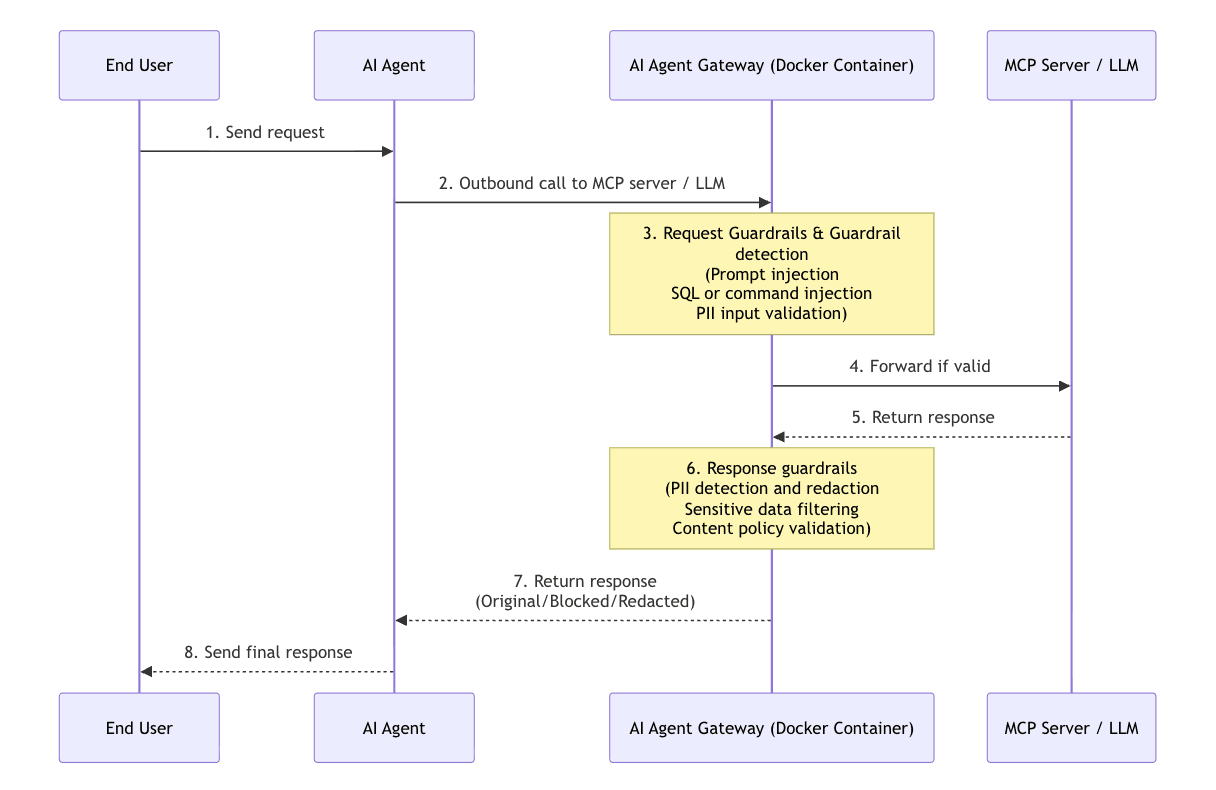
Request and response checks can cover:
SQL injection
Command injection
Sensitive or personally identifiable information
Unsafe content
Token-limit violations
Unauthorized agent-to-model or agent-to-MCP combinations
Custom organizational policies
If a request violates policy, Akto can block it before the destination processes it. If a response contains sensitive information, Akto can redact that information before the agent uses or displays it.
Discover, govern, and secure agent activity
Discover AI usage
Akto shows the activity behind each agent session, including prompts, model responses, MCP and tool calls, parameters, results, knowledge lookups, and external requests.
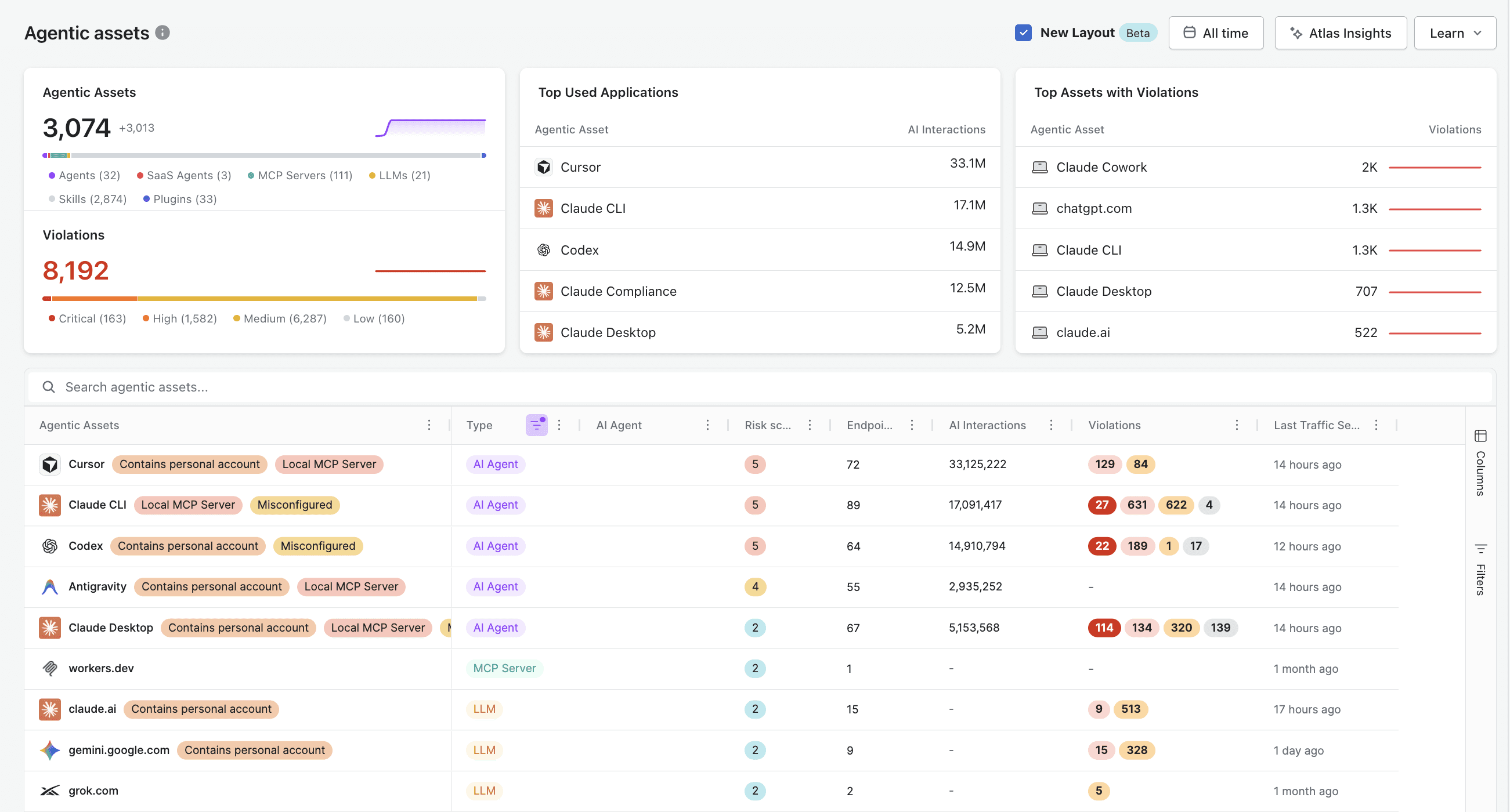
Security teams can answer:
Which agents are communicating with which models and MCP servers?
Which tools are being invoked?
What data is moving through the session?
Which guardrails are firing?
Which policy produced each decision?
Govern AI interactions
Akto gives security teams one control layer for how agents use models, MCP servers, tools, and enterprise data.
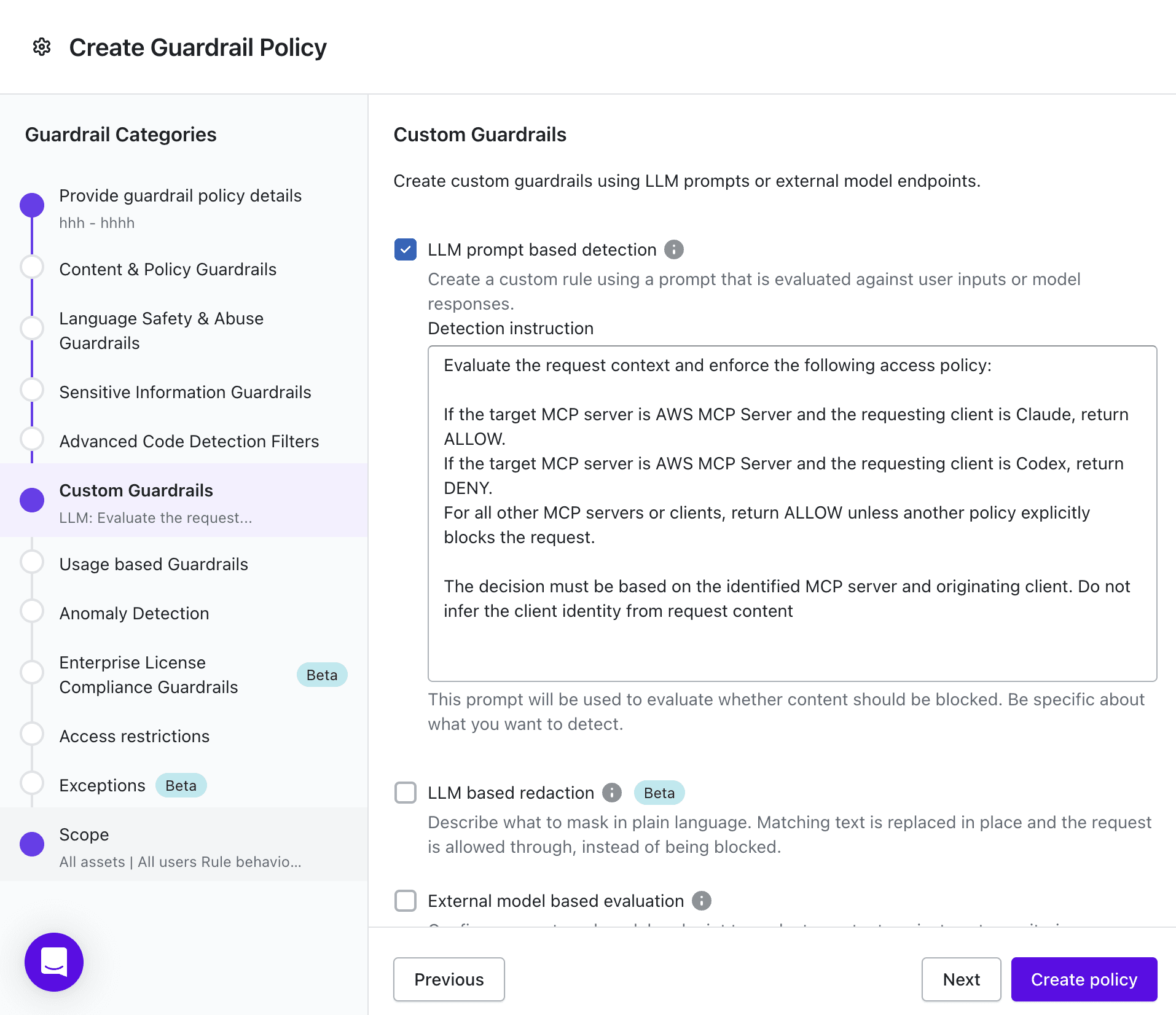
Teams can enforce guardrails for data loss prevention (DLP), prompt-injection filtering, token limits, response redaction, content policies, and custom organizational rules.
Contextual access policies can evaluate the user, team, agent, application, environment, model, MCP server, requested action, and data involved. For example, a security team can allow the AWS MCP Server when the request comes from Claude, while denying the same server when the request comes from Codex.
From the same layer, teams can restrict production agents to approved models and MCP servers, prevent contractors from invoking tools that handle customer data, redact sensitive fields based on the user or role, and set token limits by user, team, agent, or session.
Akto evaluates the relevant policies when the agent makes the request, before the model or MCP server receives it. Teams can update governance centrally as AI usage and access requirements change.
Secure every agent at runtime
Akto evaluates requests and responses while the agent is running. Prompt injection, SQL injection, command injection, unsafe content, and policy violations can be blocked before the interaction continues. Sensitive information can be removed from a response before it reaches the agent.
In the support-ticket example, Akto can inspect the request produced from the malicious ticket, block the injected instruction, and record the affected step. If the model response contains customer information, a response guardrail can redact it before the agent creates the escalation.
Investigate with full session traces
Akto Agent Traces records the complete execution path behind each session. Security teams can follow the initial prompt through every model interaction, MCP request, knowledge lookup, tool call, and external request.
The trace shows the parameters, results, duration, and token consumption for each step. When a guardrail fires, Akto marks the exact step and policy involved.
Investigators can see what the agent received, what it attempted next, and where the session crossed policy. They can identify the root cause and remediate faster without reconciling logs from multiple systems.
When an AI Agent Gateway becomes necessary
An AI Agent Gateway becomes relevant when:
Multiple agents are moving into production
Agents handle sensitive or regulated data
MCP servers and tools can trigger external actions
Different teams must follow the same security policies
Agents need different permissions for models, MCP servers, and tool actions
Token consumption and runaway loops need limits
Security teams need full traces for audits and investigations
Implementing controls separately inside every agent now creates gaps and slows down policy changes. Security teams need a shared enforcement layer.
Deploy alongside existing agent infrastructure
Akto AI Agent Gateway can run as a Docker container or as a Kubernetes sidecar alongside the agent.
In a Kubernetes deployment, the gateway runs in the same pod as the agent. The agent communicates with it locally, and the gateway inspects LLM and MCP traffic before forwarding it. The sidecar scales with the application and maintains per-pod isolation.
A practical rollout can follow six steps:
Map the execution path. Identify model endpoints, MCP servers, tools, data sources, and external actions.
Route traffic through the gateway. Confirm that outbound requests and returning responses are visible.
Review baseline traces. Understand normal prompts, tool calls, data flows, and token usage.
Enable high-confidence policies. Begin with known injection patterns, sensitive-data redaction, and token limits based on expected usage.
Test enforcement. Validate blocking, redaction, false-positive handling, latency, and failure behavior.
Use trace evidence to tune controls. Review recurring violations and update policies as the agent changes.

Experience enterprise-grade Agentic Security solution