AI Agent Guardrails Checklist: A Practical Security Framework
A complete, actionable AI agent guardrails checklist covering input, processing, and output layers - plus best practices, anti-patterns, and a rollout plan.

Arpashree

If you want the concepts behind agent guardrails, our guide to AI guardrails covers the theory. This is the working version: a checklist you can actually run against an agent before it ships, and a printable cheat sheet PDF is linked at the end for teams who want it on the wall.
The Three-Layer Guardrails Checklist
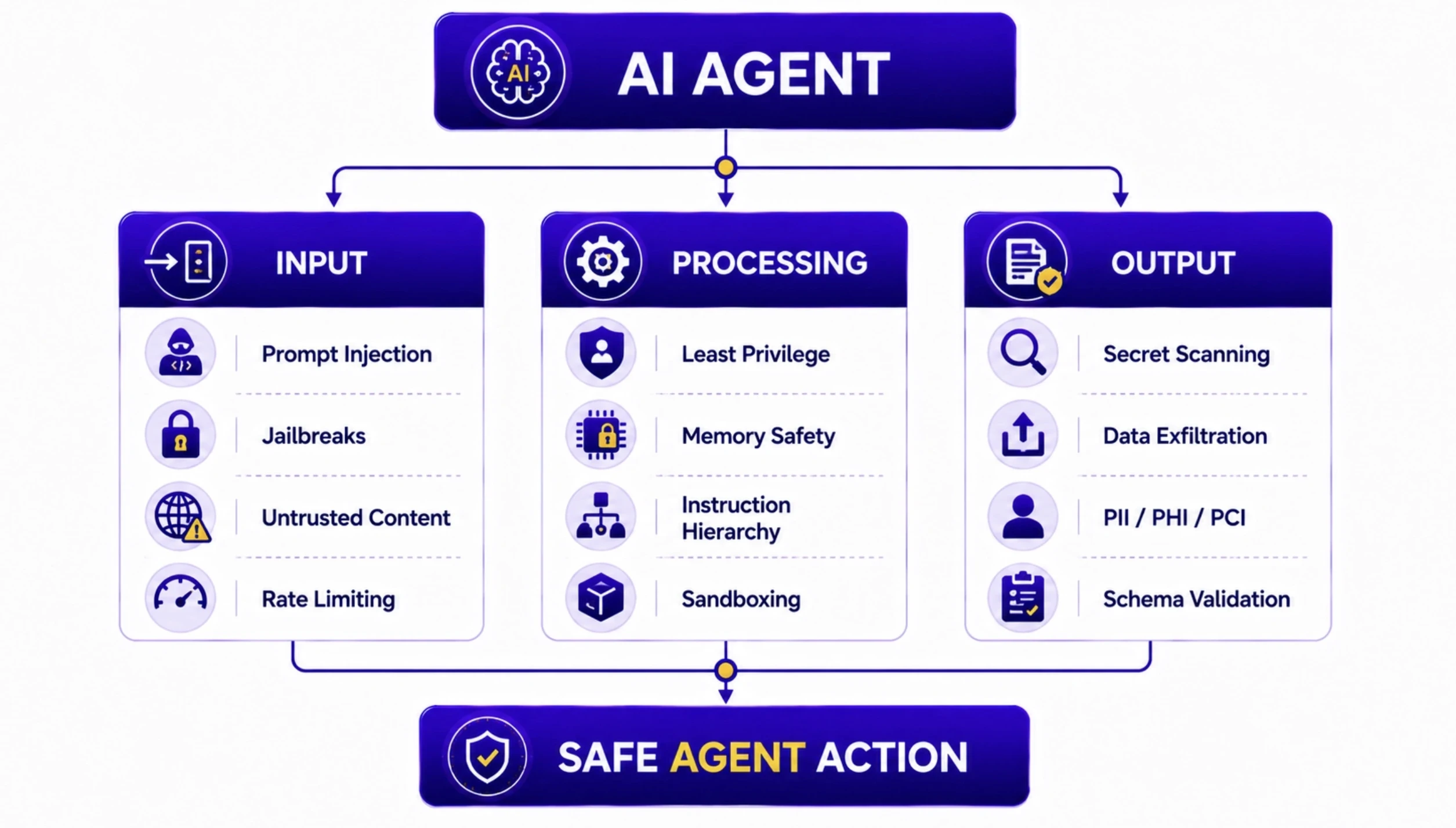
Effective agent guardrails operate at three distinct layers, since a control that catches a bad input won't catch a bad tool call, and a control that catches a bad tool call won't catch a bad response. Each layer needs its own checklist.
Input Layer Checklist
Prompt injection detection active on every inbound request, not sampled traffic
Jailbreak pattern screening in place, covering both direct attempts and multi-turn manipulation
Untrusted content, including documents, emails, and web pages, flagged before it reaches the model
Rate limiting configured per user and per session, not just at the application level
Processing Layer Checklist
Tool access scoped to least privilege per agent, not inherited broadly from a shared service account
Memory and context poisoning monitoring in place for both short-term session state and long-term stored memory
Instruction hierarchy enforced, so system instructions outrank user input, which outranks tool output
Sandboxed execution for high-risk tool calls, isolating anything that writes data, spends money, or touches external systems
Output Layer Checklist
Credential and secret leakage scanning on every response, not just responses flagged as suspicious
Data exfiltration pattern detection, catching large or unusual data transfers embedded in normal-looking output
PII, PHI, and PCI redaction before delivery, applied consistently regardless of which model or provider generated the response
Response schema validation for structured outputs, rejecting malformed JSON or unexpected fields before they reach downstream systems
The Five Critical Risks Every Checklist Must Cover
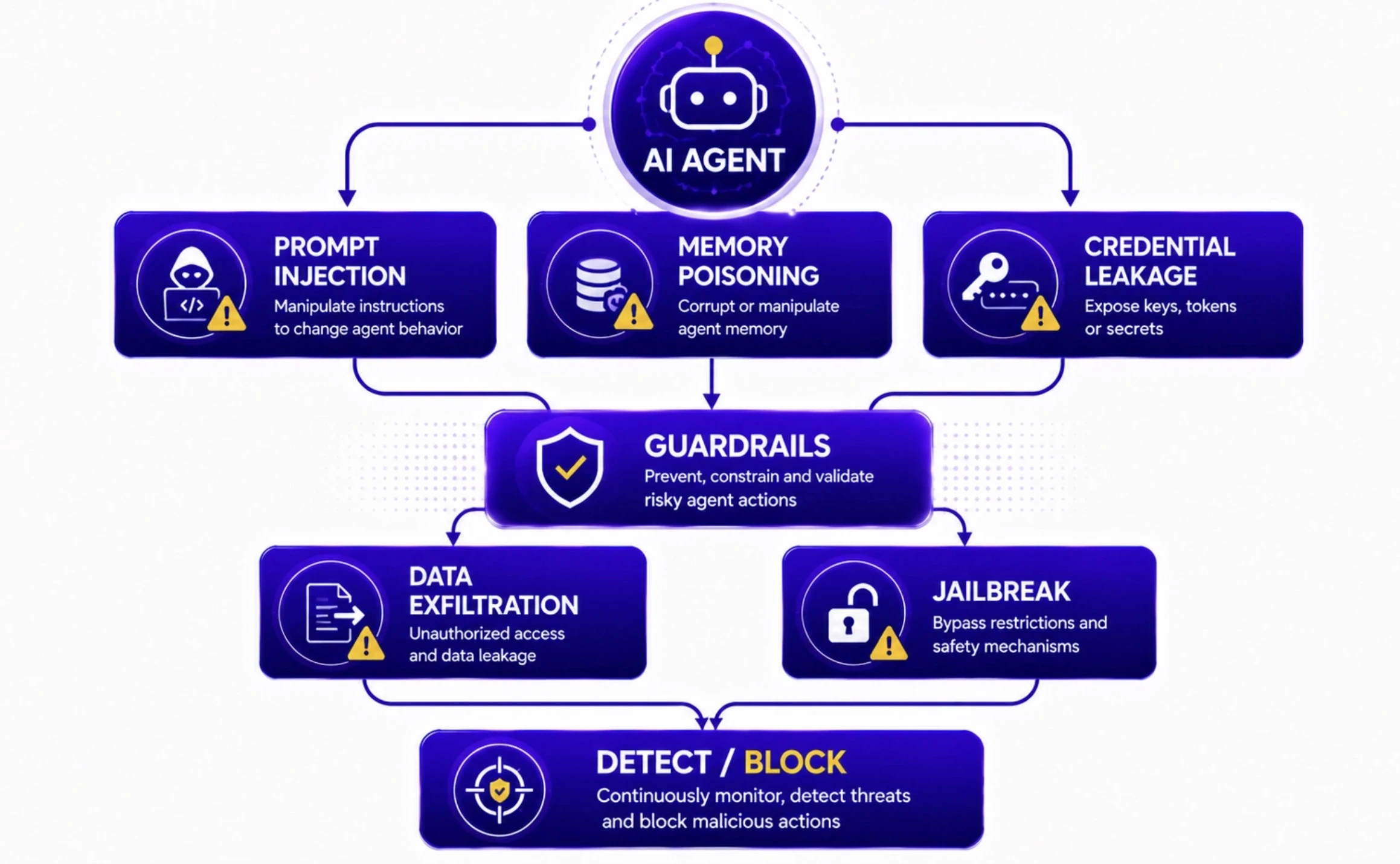
A checklist built around specific risks holds up better than one built around generic categories. These five recur across nearly every production agent incident.
Prompt Injection
Crafted input, whether typed directly by a user or embedded in a document the agent processes, that overrides the agent's intended instructions. This is consistently ranked the top risk to LLM-based systems because most models can't reliably separate trusted instructions from untrusted content by default. A guardrails checklist needs to test for both direct injection, where an attacker types the malicious instruction straight into the conversation, and the indirect variant, where the instruction arrives through a file, email, or webpage the agent reads as part of its normal task. Indirect injection is harder to catch because the malicious content never looks like an attack from the user's side of the conversation; it only becomes visible once the agent has already processed it.
Jailbreak Attempts
Techniques specifically aimed at bypassing an agent's safety guardrails to produce prohibited output or unauthorized behavior. Unlike a single malicious prompt, jailbreaks often build across multiple turns, establishing context or apparent trust before making the actual harmful request. A common pattern involves framing a harmful request as fiction, roleplay, or a hypothetical scenario, gradually shifting the conversation until the agent's guardrails no longer register the request as dangerous. Static, single-message screening misses this pattern entirely; effective detection needs to evaluate conversation history as a whole, not just the latest message in isolation.
Credential Leakage
The exposure of API keys, passwords, tokens, or other secrets through an agent's output, whether pulled from its training data, its context window, or a connected tool's response. This risk grows with agent complexity, since every tool integration is a new place a credential could end up in context without anyone intending it to. A connected database tool that returns a full configuration object, for instance, might include a connection string with embedded credentials that the agent then repeats back verbatim in a later response. Guardrails scanning for this risk need to recognize credential patterns generically, not just match against a known list of secrets, since the specific format of a leaked key varies by provider and system.
Memory Poisoning
Corruption of an agent's short-term session context or long-term stored memory, so that a single successful manipulation continues influencing behavior well after the initial attack. This is one of the hardest risks to catch with input-layer controls alone, since the poisoned instruction may have entered the system in a prior session and only surface as a problem much later, once the agent references that corrupted memory in an unrelated task. Monitoring for this risk means periodically auditing what an agent's stored memory actually contains, not just filtering what enters it in real time.
Data Exfiltration
Unauthorized transfer of sensitive data out of the system, whether through an agent's response, a tool call to an external service, or an unexpected combination of the two. Data exfiltration frequently piggybacks on legitimate-looking agent behavior, since an agent with normal-seeming API access can be manipulated into sending data somewhere it shouldn't go without triggering an obvious security alert. Detection needs to watch for unusual data volume and unusual destination patterns rather than only screening for obviously malicious requests, since the most damaging exfiltration attempts are the ones designed to blend into ordinary traffic.
Enterprise Best Practices Checklist
A checklist tells you what to verify. These practices describe how mature teams actually run that verification day to day, beyond the one-time pre-launch review.
Establish acceptable use policies that define, in writing, what the agent should never do, including prohibited data handling and prohibited use cases specific to that agent's role
Treat guardrails as enforcement, not suggestion. A system prompt instruction to "never reveal secrets" is not a guardrail; it's a request a sufficiently creative prompt injection will bypass, since system prompts are suggestive to the model rather than technically enforced
Apply input validation to 100% of traffic on anything touching customer data, payments, or health information, rather than sampling, since the cost of a missed attack on sensitive flows far outweighs the marginal latency of full coverage
Apply output validation to 100% of traffic wherever a hallucination or data leak would cause real harm, with sampling reserved for lower-risk, high-volume endpoints where full coverage isn't yet justified
Assign clear ownership for each agent's guardrail configuration, so a policy gap has a named person accountable for closing it rather than becoming an orphaned responsibility
Log every blocked request and response, since blocked traffic is direct evidence of what attacks a system is actually facing, and that data should feed back into tuning rather than sitting unreviewed
Review guardrail policies on a fixed cadence, not just after an incident, since attack patterns shift faster than most annual review cycles account for
Differentiate guardrail strictness by agent risk profile. A research assistant and a customer-facing agent with payment access should not run the same policy set, and treating them identically either over-restricts the low-risk agent or under-protects the high-risk one
Common Anti-Patterns to Avoid
Knowing what to build matters less if the rollout repeats mistakes other teams have already made. These patterns show up repeatedly across production incidents and are worth explicitly ruling out.
Don't rely on the system prompt alone to enforce behavior. System prompts are suggestive, not enforceable, and guardrails exist precisely because prompts can be overridden by a sufficiently determined attacker
Don't add guardrails after launch as an afterthought. Retrofitting security controls onto a live agent is far more disruptive than designing them into the pipeline from the start, and it often means shipping without coverage during the exact window when an agent is newest and least battle-tested
Don't sample security-critical traffic to save on latency or cost. A gap in coverage is an invitation, and attackers will find the sampled-out portion faster than a security team notices the gap
Don't treat every agent the same. Applying a single guardrail policy across agents with wildly different risk profiles either over-restricts low-risk agents or under-protects high-risk ones, and both outcomes erode trust in the system over time
Don't skip logging on blocked requests. Discarding blocked traffic throws away the clearest signal available about what's actually being attempted against the system
Don't assume a single guardrail vendor or model covers every risk category. Prompt injection detection, PII redaction, and jailbreak screening often require different specialized approaches, and no single control catches everything
Don't leave tool permissions broader than the task requires. Overly broad access is one of the most common root causes behind agents taking unintended, high-impact actions
A Practical Implementation Workflow
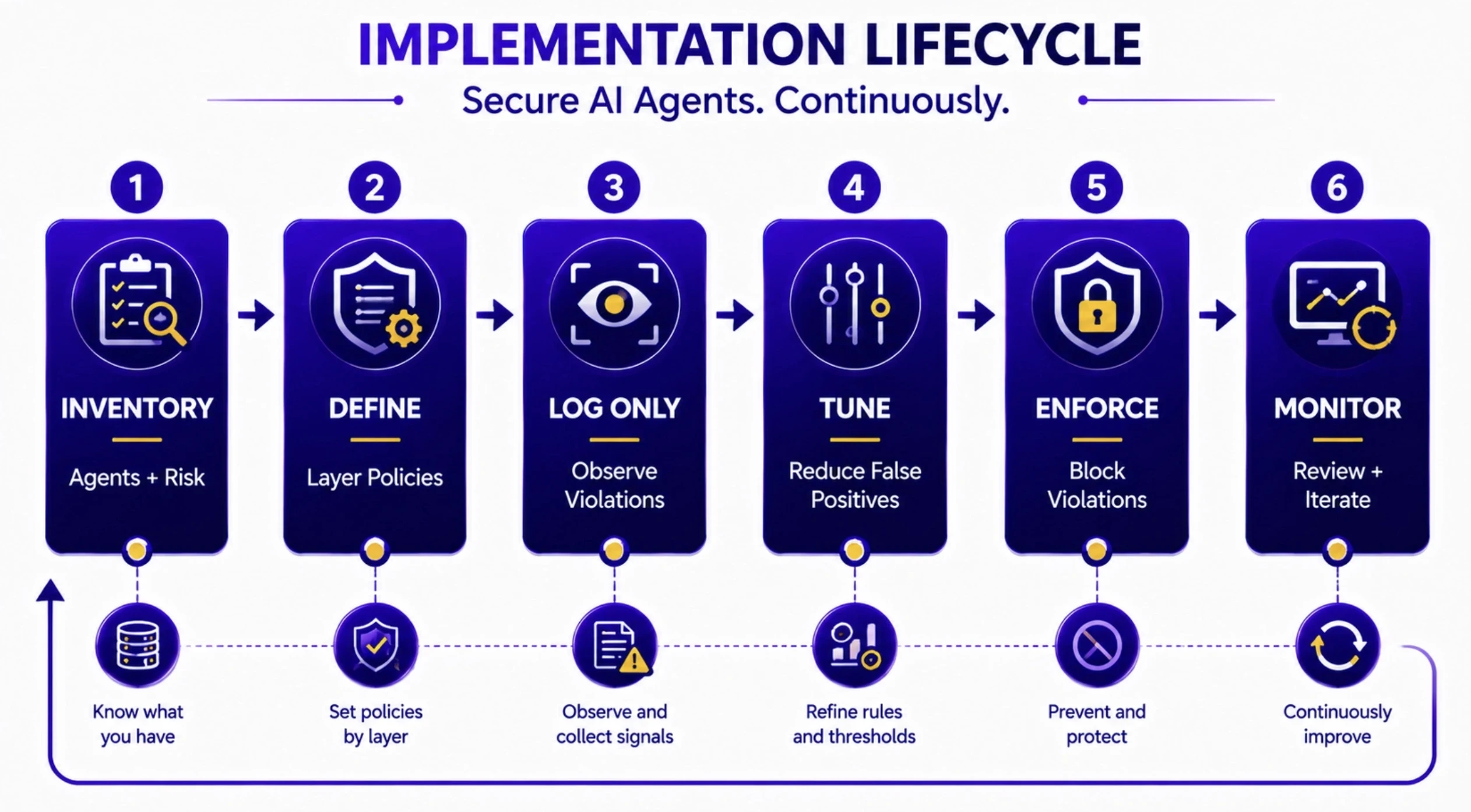
Rolling out guardrails works best as a sequence rather than a single deployment event, since jumping straight to full enforcement without visibility into real traffic tends to produce either dangerous gaps or a flood of false positives that erodes trust in the system.
Step 1: Inventory agents and their risk profiles. Before configuring any guardrail, catalog every agent in the environment, what data it touches, what tools it can call, and who it's exposed to, whether that's internal employees or external customers. Risk profile drives policy strictness, so this step has to come first, and it often surfaces agents nobody remembered were still running.
Step 2: Define policies per layer. Write explicit input, processing, and output policies for each agent, referencing the three-layer checklist above. Avoid vague policy language; each item should be specific enough that a pass or fail is unambiguous, since a policy like "prevent harmful output" gives an implementation team nothing concrete to build against.
Step 3: Deploy in log-only mode first. Run new guardrail policies in a mode that logs violations without blocking them, giving the team visibility into false positive rates and real-world traffic patterns before anything gets enforced. This step is frequently skipped under launch pressure, and it's almost always the step teams regret skipping once enforcement mode produces unexpected blocks on legitimate traffic.
Step 4: Tune thresholds against real traffic. Use the log-only data to adjust detection sensitivity, closing gaps where real attacks slipped through undetected and loosening rules that generated excessive false positives on legitimate use. This is typically an iterative process spanning several cycles rather than a single adjustment.
Step 5: Switch to enforcement mode. Move from log-only to active blocking once false positive rates are acceptable, typically starting with the highest-risk agents and highest-confidence detections first, then expanding coverage outward as confidence grows.
Step 6: Monitor and iterate continuously. Guardrails aren't a one-time configuration. New tool integrations, new attack patterns, and model updates all shift what needs enforcing, so policies need a regular review cadence rather than a set-and-forget deployment, with blocked-traffic logs feeding directly back into policy refinement.
A Pre-Launch Sign-Off Checklist
Before any agent goes to production, confirm each of the following:
All four input layer controls are active and tested against known attack patterns
All four processing layer controls are active, with tool permissions reviewed and scoped to least privilege
All four output layer controls are active, including verified PII, PHI, and PCI redaction
Each of the five critical risks has been specifically tested against this agent, not just covered in principle
Guardrail policies have run in log-only mode long enough to establish a reliable false positive baseline
Blocked request logging is active and routed somewhere the security team actually reviews
A named owner is accountable for this agent's guardrail configuration going forward
An incident response path exists specifically for this agent, including how to identify what it did during a session and how to contain downstream effects
Guardrail policy strictness matches the agent's actual risk profile, not a default template
If any item on this list isn't checked, the agent isn't ready for production traffic.
Get the Full Checklist as a Downloadable Cheatsheet
Everything above is also available as a printable, one-page PDF cheatsheet, built for teams that want this checklist on hand during implementation reviews or posted somewhere the whole team can reference it. Download the AI Agent Guardrails Cheatsheet.
How Akto Enforces This Checklist Automatically
A checklist is only as useful as the enforcement behind it, and manually verifying every item on every agent release doesn't scale once an organization is running more than a handful of agents. Akto's AI Agent Gateway enforces the input and output layers of this checklist directly, running as a sidecar alongside agent infrastructure to intercept traffic before it reaches the agent and before responses reach the end user. Request Guardrails handle input-layer enforcement, including prompt injection and jailbreak screening, while Response Guardrails handle output-layer enforcement, including automatic redaction of sensitive data before a response is delivered. Because the gateway runs as a sidecar rather than a separate network hop, enforcement adds effectively no latency to the agent's response time.
For guardrail enforcement at the endpoint, where employees interact directly with AI agents, MCP servers, and GenAI tools, Akto Atlas ships with more than 20 built-in guardrail policies covering both input and output threats, evaluated locally on each device so risky prompts and tool calls are stopped at the source rather than relying solely on cloud-side filtering. This matters specifically because a meaningful share of AI usage, including locally configured MCP servers and browser-based AI tools, never passes through a central gateway at all. Because policies are defined centrally in Akto and enforced locally, security teams get consistent coverage across browsers, IDEs, and other endpoint surfaces without disrupting developer workflows or requiring per-application configuration work. Together, the AI Agent Gateway and Akto Atlas give teams the automated enforcement layer this checklist is built to describe, turning a manual review process into a continuously running control that scales with the number of agents an organization deploys.
FAQs: AI Agent Guardrails Checklist
What should an AI agent guardrails checklist cover at minimum?
At minimum, a checklist needs coverage across three layers: input controls like prompt injection detection and rate limiting, processing controls like least-privilege tool access and instruction hierarchy enforcement, and output controls like credential leakage scanning and PII redaction. It should also explicitly address five recurring risks: prompt injection, jailbreak attempts, credential leakage, memory poisoning, and data exfiltration.
What's the difference between input, processing, and output layer guardrails?
Input layer guardrails inspect what comes into the agent before it's processed, catching prompt injection and untrusted content. Processing layer guardrails govern what the agent does internally, including tool access scope and instruction hierarchy. Output layer guardrails inspect what the agent sends back, catching credential leaks, sensitive data, and malformed structured responses before delivery.
What are the five most critical risks a guardrails checklist should address?
Prompt injection, jailbreak attempts, credential leakage, memory poisoning, and data exfiltration. These five recur across the large majority of production agent security incidents, and each requires a distinct detection approach rather than a single generic control.
What are common anti-patterns teams should avoid when implementing guardrails?
Relying on system prompts alone as enforcement, adding guardrails only after launch, sampling security-critical traffic to save on latency, applying identical policies across agents with different risk profiles, and discarding logs from blocked requests instead of using them to improve detection.
What does a practical guardrails implementation workflow look like, step by step?
Inventory every agent and its risk profile, define explicit policies per layer, deploy new policies in log-only mode first, tune detection thresholds against real traffic data, switch to active enforcement starting with the highest-risk agents, and monitor continuously rather than treating the rollout as a one-time deployment.
What should be checked before an AI agent goes live in production?
Every item across the three-layer checklist should be active and tested, each of the five critical risks should be specifically validated against that agent, guardrails should have run in log-only mode long enough to establish a false positive baseline, blocked request logging should be routed to the security team, and a named owner should be accountable for the agent's ongoing guardrail configuration.
Is a checklist enough, or does it need to be paired with automated enforcement?
A checklist alone doesn't scale past a handful of agents, since manually verifying every item on every release becomes impractical as agent count grows. Automated enforcement, ideally running at both the gateway and endpoint level, is what turns a one-time checklist review into a continuously enforced control that catches violations in real time rather than after the fact.
Where can I get a downloadable version of this checklist?
A printable, one-page PDF version covering the full three-layer checklist is available at /resources/ai-agent-guardrails-cheatsheet, built for teams that want a physical or shareable reference during implementation reviews.
How does Akto automatically enforce these checklist items at runtime?
Akto's AI Agent Gateway runs as a sidecar alongside agent infrastructure, enforcing input-layer controls through Request Guardrails and output-layer controls, including automatic sensitive data redaction, through Response Guardrails. Akto Atlas extends enforcement to employee endpoints with more than 20 built-in guardrail policies evaluated locally on each device, giving teams consistent coverage across the gateway and endpoints without manual per-agent review.

Experience enterprise-grade Agentic Security solution