AI Security Gateway: The Technical Backbone of Secure LLM and Agentic Workflows
How AI security gateways secure LLM and agentic traffic-architecture, prompt injection defense, cost governance, and how leading platforms compare in 2026.

Rushali
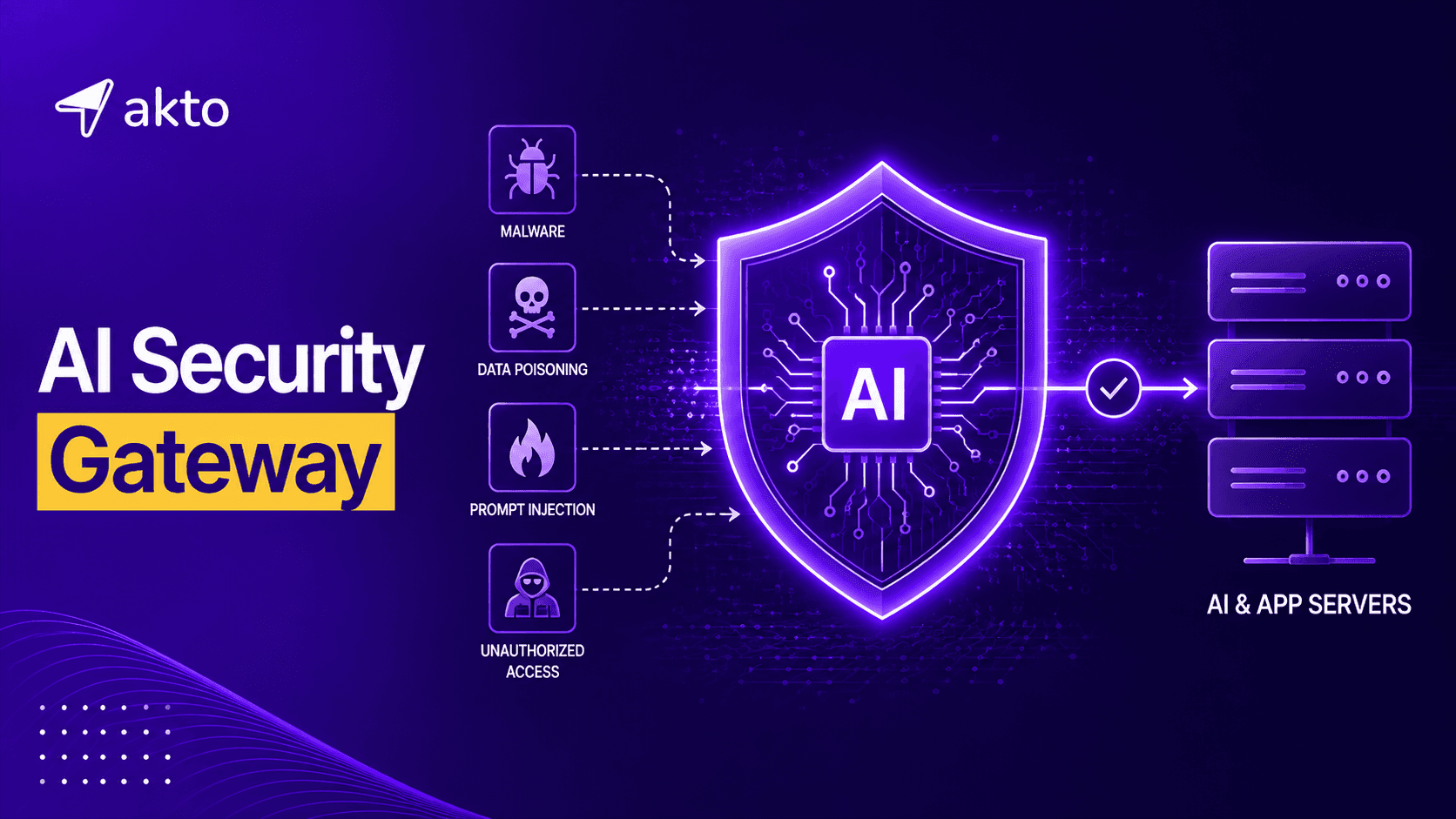
Gartner's Market Guide for AI Gateways predicts that by 2028, 70% of software engineering teams developing multimodel applications will be using AI gateways, up from 25% in 2025. That growth is supported by real spend – foundation model API investment alone amounted to $12.5 billion according to Menlo Ventures' latest enterprise AI survey, and 53% of AI teams say they spend 40% more on costs than they had originally predicted in their models as they scale. The AI security gateway is the control point engineered to control that growth: a policy layer in front of all applications and model, agent, and tool calls that checks all traffic for injection attempts, sensitive data, and out-of-control spending before it goes to production. It's not the same as an MCP gateway, which controls a single protocol, though, and an AI security gateway typically sits a layer above, which we discuss in greater detail in our MCP Gateway guide.
What Is an AI Security Gateway? Core Concepts and Modern Use Cases
So, what is an AI security gateway, you'll ask? It is a reverse proxy tailored for AI traffic, where all requests to a model provider, and now more and more, requests to MCP tools and actions from agents are handled through it. The gateway will check for authentication of the caller, security policy, and cost policy; then it will forward or deny the request. This is made concrete through two similarities.
AI Security Gateway vs. API Gateway vs. MCP Gateway
Traditional API gateways were designed to handle predictable traffic patterns: stateless request/response, fixed endpoints, rate limits based on number of requests. This AI gateway vs API gateway comparison is also about the routing and auth plumbing, but adds to the mix a series of additional concerns existing only in the AI space: token-based rate limiting, semantic caching for near-duplicate prompts, multi-provider routing for OpenAI, Anthropic, and open models, and inline inspection of prompt and completion content a traditional gateway never had to parse. An MCP gateway is another specialization where it gets very specific about one protocol, the Model Context Protocol agents use to discover and call tools, specific to tool authentication and per-tool authorization. These are the types of AI security gateways that exist today: Most of the AI security gateways on the market today either come with an MCP gateway module or are integrated with a separate MCP gateway.
Why AI Security Gateways Are Essential in 2026
This infrastructure was not an option, but had to be built due to three forces. First, demonstrate sprawl: the majority of enterprises use at least three LLM providers in production, and code calling each one directly becomes unmaintainable in a matter of a few quarters. Second, the risk profile got altered owing to agentic AI. These agents, which call tools, write files, and launch actions on their own, will give rise to new categories of LLM risk: prompt injection and data exfiltration via a chatbot interface. Thirdly, the cost curve is no longer predictable: Most companies are budgeting larger AI initiatives, and a significant proportion are exceeding their budgets. A gateway handles all three at one enforcement point, allowing security and platform teams to implement policy once and for all, across the entire application.
Technical Architecture of AI Security Gateways
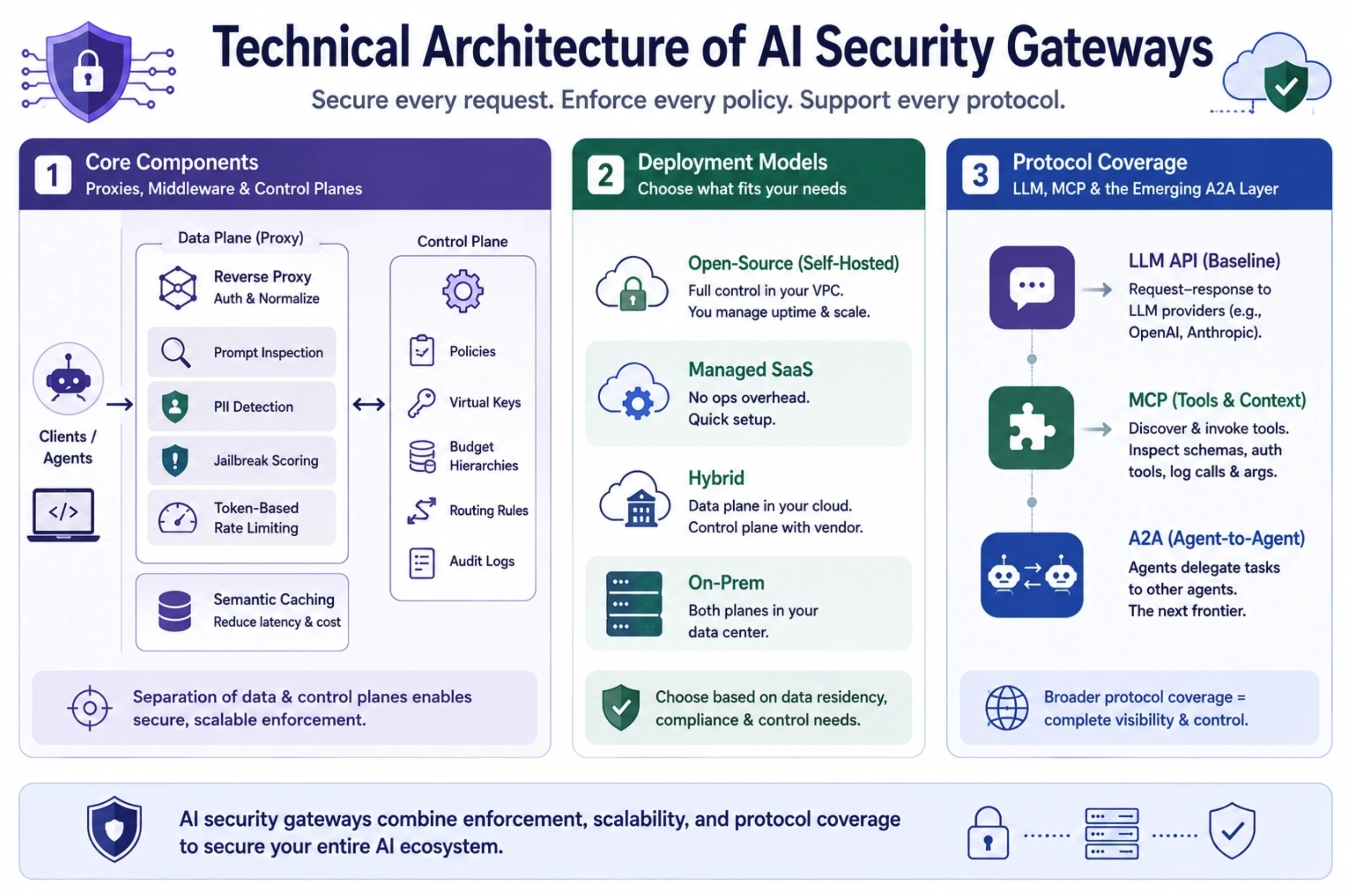
The architecture question arises early when evaluating any gateway, as it will define what you can enforce on the gateway and the overhead latency added to the gateway. A useful AI gateway architecture is that it has components that deal with any request that touches any part of the system, and components that coordinate the policy centrally and add support on top of every protocol that the agents use.
Core Components: Proxies, Middleware, and Control Planes
In the middle is a reverse proxy to receive LLM traffic: All incoming requests are authenticated, all normalized to a common schema, irrespective of provider, and then run through a chain of middlewares. The chain is usually done in sequence, with prompt inspection followed by PII detection and then jailbreak scoring, and sets a rate limit on the tokens using the token-based rate-limiting model to prevent a misbehaving script or looping agent from spending a whole budget in just a few minutes. In addition to the proxy, Semantic caching matches nearby similar prompts to responses that have been served in the past to reduce latency and spend. A control plane is placed above the data plane and contains the policy itself, virtual keys, budget hierarchies, routing rules, and audit logs; it communicates configuration changes to each proxy node without having to make application-layer changes. This separation is what allows a gateway to scale to support enterprise traffic without being the choke point.
Deployment Models: Open-Source, Managed, Hybrid, and On-Prem
Data residency, compliance, and the desire to own infrastructure are used to choose the deployment model for teams. Open-source gateways operate completely within a company's own VPC, but prompts never cross the perimeter, in exchange for ownership of uptime and scalability. Fully managed SaaS gateways give up that control for no operational overhead and quick setup. Hybrid deployments simply strike a balance: the data plane is deployed within the customer's cloud account, whereas the control plane and dashboards remain with the vendor. On-prem deployments go the extra mile by flying both planes inside the customer's own data center, which is most important for regulated industries such as healthcare, financial services, and other industries that frequently handle protected data. Today most vendors have at least two of these four modes.
Protocol Coverage: LLM, MCP, and the Emerging A2A Layer
What portion of an organization's true AI traffic a gateway sees is governed by the coverage of the protocol. The first protocol every gateway supported was LLM API traffic, which has been used by the request-response calls that go to OpenAI, Anthropic, and similar providers, and is the baseline. Next came coverage for MCP, with agents starting to discover and invoke tools via the Model Context Protocol, and crucially, being able to inspect tool schemas, have the tools authenticated, and log the agents calling the tools and what arguments were passed in. A plain API gateway has no understanding of this. The second new layer is agent-to-agent traffic, the A2A protocol, which enables an autonomous agent to hand a task off to another autonomous agent, instead of a tool. That's why Google Cloud's Agent Gateway has been designed with client-to-agent and agent-to-anywhere paths in mind. It is still a developing feature here, and you should check whether A2A is supported or not, but not assume it based on a gateway's LLM or MCP support.
Key Security Features: Beyond Basic DLP and PII Redaction
While all vendors advertise a “Security Coverage”, there is a huge variation in depth from what is checked in a checkbox regex filter to true runtime defense. The features listed below differentiate gateways that security teams can trust from those that primarily create dashboards.
Prompt Injection and Jailbreak Blocking Mechanisms
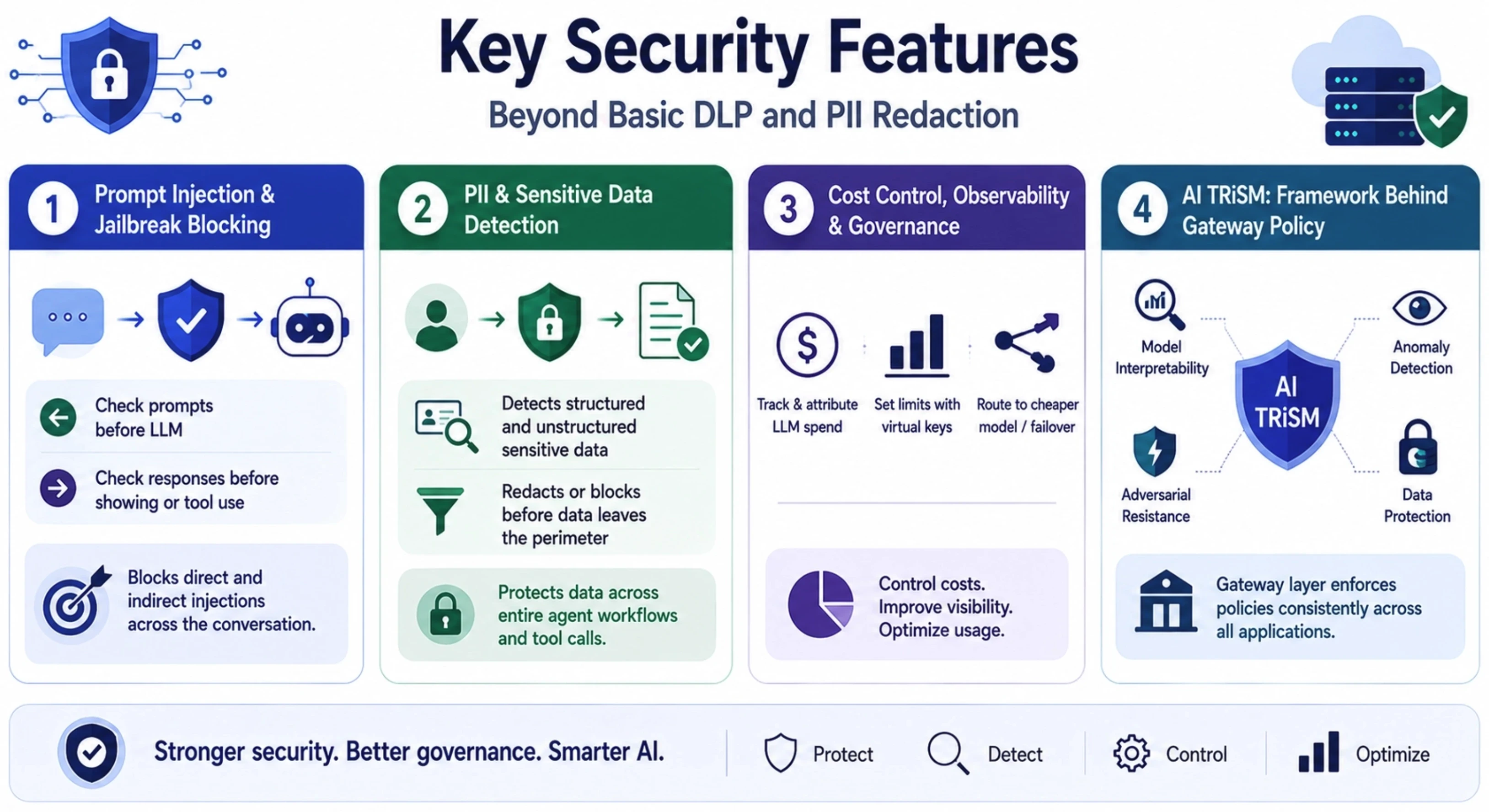
Prompt injection blocking is applied at two places: First, when a prompt is sent to the LLM, it is checked for possible injection; Second, when a response from the LLM is shown to a user or used to trigger a tool, it is checked for possible injection. This technique is called input-side jailbreak detection because it combines pattern matching against known attack patterns and a classifier identifying the probability of the prompt attempting an override, as attackers change their prompts more quickly than the static pattern matching rules can. Output-side content moderation AI scans completions to detect policy violations or if the model was tampered with, blocking/reducing the output. The more difficult case is “indirect injection,” in which the instruction comes from a document or tool that the model reads during the conversation. Single-prompt filtering isn't enough: You need to track context across turns, as NeuralTrust's disclosure of the Echo Chamber jailbreak demonstrates, which succeeded with more than 90% success rate against many of the most popular models, by poisoning an already fed model's own previous replies.
PII and Sensitive Data Detection in LLM Traffic
Both directions of LLM traffic need to capture sensitive information: inbound, when the user pastes in sensitive information from their customer records, and outbound when the user fills out information that could potentially leak sensitive data. Advanced gateways both detect structured identifiers, such as card numbers with pattern-based classifiers, and unstructured ones, such as named-entity recognition in free text, and then either redact or block them before they exit the perimeter. The more challenging version appears in agentic workflows where an agent may pull a customer record from a CRM system and only surface it in a summary at the end, long after a single point inspection would have been able to find it. As part of its AI agent security testing capabilities, Akto's detection of and protection against PII and credentials is invoked on API and LLM traffic, and not just the initial prompt but throughout the entire chain of tool calls that an agent makes.
Cost Control, Observability, and Governance
Foundation model APIs are now generating $12.5 billion in revenue, and 53% of AI teams report that they're spending more than they'd anticipated on AI—and that's on the depressing side! The rapid expansion of AI infrastructure spending has turned it into a board-level discussion instead of an afterthought, as 53% of AI teams are spending more than their budgets on AI, and that's just the bad news. Gateways resolve this by tagging each request with an LLM and allowing finance to be able to see where that workload is being used to generate the bill, rather than having one bill for the entire business. Hard limits are added on top: virtual keys have hierarchical limits that prevent requests from exceeding a threshold after it's reached; otherwise, a runaway agent could burn through that month's budget in a couple of hours. The second lever, provided by multi-provider routing, is to reroute to an alternative, cheaper model when quality is acceptable, or failover during an outage. These combined make LLM spend a line item that can be metered and attributed.
AI TRiSM: The Framework Behind Gateway-Layer Policy Enforcement
AI TRiSM, which stands for AI Trust, Risk, and Security Management, is a framework Gartner has introduced in its Hype Cycle for Generative AI to assist organizations in governing the trustworthiness, fairness, robustness, and data protection of models as one connected discipline and not as point solutions. It ranges from Model Interpretability, Anomaly Detection, Adversarial Resistance, and Data Protection, and Gartner estimates measurable benefits to AI use for organizations that make it happen. Where AI TRiSM becomes real in the real world is in the AI security gateway: the natural chokepoint to consistently enforce content filtering, access control, and audit logging, without having to rely on each application team managing their own governance.
Real-World Attack Surfaces and Threat Scenarios
Feature lists give only part of the picture. Now that traffic is being routed from one chatbot to a multi-tool agent workflow, let's explore some examples of AI gateway threats in action. Once traffic shifts from a single chatbot to a multi-tool agent workflow, here are some examples of AI gateway threats in action.
Case Study: Closing the DLP Gap in Multi-Tool Agent Workflows
For known data flows, such as endpoints, file shares, and email, Enterprise DLP programs were created using detection rules that were tuned across hundreds of data identifiers and exact-data-matching profiles mapped to customer databases. Agentic AI develops new flows that these programs never anticipated. When a prompt is sent to an LLM by an agent, it may include customer data retrieved from a CRM system just a few seconds ago, without any specific place for the traditional DLP agent to exist. To solve this, Symantec and Google Cloud enhanced Google Cloud's Agent Gateway, the network-level enforcement point for all agent traffic on the Gemini Enterprise Agent Platform, with Symantec's DLP scanning capability. The integration monitors inference requests from LLMs in real time and checks tool calls of MCP against existing DLP policies, without any code changes. It's a prime example of the fundamental principle of DLP agentic AI: that the gateway is the only place where all these paths pass.
Threats Unique to Agentic AI and LLM Applications
In addition to the risks of injection and leakage, which are well-known in application security, agentic systems give rise to failure modes that are not present in traditional application security. Tool poisoning occurs when an attacker is able to alter the output of a connected tool. Jumping line performs a trick to fool an agent and proceed directly to a sensitive action. Tool shadowing enables a malicious tool to masquerade as a legitimate tool and hijack execution. Rug-pull attacks modify a tool's functionality after it has been reviewed and published, which compromises the assumption of trust that the agent had. When an agent has more permissions than a task needs, it becomes a wide compromise – this is called excessive agency. A gateway that only sees one request/response pair will be oblivious to the majority of these.
Integrating AI Security Gateways into the Modern SDLC
Good architecture either pays off or is discarded when it comes to the integration of AI gateway. A model-calling code rewrite at every application is unlikely to win the adoption battle from whatever is fastest, while a policy engine that doesn't get updated after it is deployed quickly goes stale in a quarter.
Setup, Integration, and Policy Management
The quickest way to adoption is to replace the base URL of the provider's SDK with the gateway's URL – most modern gateways will expose an OpenAI-compatible endpoint and no other SDK changes will need to be made. Policy management then occurs centrally via virtual keys, scoped to a team or environment or app, with their own set rate limits, budget constraints, and security rules. Once a gateway crosses different business units, access to policy is different from access to logs, and role-based access control gives flexibility in this situation. If you want a gateway to remain useful, then it's not a matter of reviewing policy through the same change process as app code; it's the treatment of policy as a versioned configuration that's reviewed through the same change process as app code that makes it stay useful; otherwise, it will be viewed by nobody as new models come online and it will get bypassed.
Continuous Security Testing and Automated Red Teaming
Static policy is not sufficient, as attack methods are constantly changing and outpacing many teams' ability to track them. Regularly scheduled security tests conduct adversarial, jailbreak variants, and data-extraction tests on production or staging endpoints, uncovering regressions that might be a result of a model upgrade unintentionally reopening a vulnerability. Automated red teaming is able to take this a step further – instead of just a prompt, it can simulate pivoting between tool calls after the attacker gains a foothold. In the same pipeline used to test traditional APIs, Akto folds its red teaming test suite, which includes thousands of adversarial probes ranging from injection to escalation, data leakage, and misuse of tools, onto AI agents and MCP tools.
Beyond the Gateway: Agentic Runtime Protection and Continuous Security Testing
A gateway is a required piece of infrastructure, NOT a full security program. The key difference between a true defense in depth and a single point of enforcement with a false sense of security is the understanding of where it ends.
Limitations of Current AI Security Gateways
Gateways inspect traffic at the network boundary, which means they're blind to anything happening inside an agent's own reasoning or a tool's execution environment once a request has already been approved. A tool subtly compromised weeks earlier, a rug-pull attack that changes behavior only after passing review, or an agent making a series of individually authorized but collectively harmful decisions can all slip past a gateway that only sees discrete request-response pairs. Latency is a second constraint: every inline inspection step adds overhead, varying from microseconds in the fastest implementations to tens of milliseconds in others. Detection accuracy is not perfect either; both false positives and false negatives remain open problems, which is why enforcement needs pairing with runtime and posture layers that watch what happens after a request is approved.
Agentic Security Posture Management and Runtime Protection
Agentic security posture management picks up where gateway inspection stops, treating an organization's full inventory of agents, MCP tools, and permissions as a continuously assessed attack surface rather than a one-time approval. Runtime protection extends that into live behavioral monitoring: watching for agent loops, unauthorized tool calls, and usage patterns that deviate from an agent's baseline, then intervening in real time rather than only logging the event after. Akto builds this into its AI agent security platform: it discovers and catalogs every AI agent, LLM, and MCP tool across an organization's infrastructure, cloud, and employee devices, continuously tests them through automated red teaming, and enforces guardrails and runtime protection against agent abuse and unauthorized tool calls in production. That combination closes the gap a gateway alone can't: visibility into what an agent does across an entire session, not just a single request on the way in.
Selecting and Evaluating an AI Security Gateway: Technical Checklist
Choosing among the field of AI security gateways available in 2026 comes down to matching deployment model, protocol coverage, and security depth to what an organization actually runs, not to whichever vendor has the longest feature list.
Feature Comparison Table: Open-Source and Commercial Gateways
The table below reflects publicly documented capabilities as of mid-2026; features and licensing change quickly, so confirm specifics with each vendor before committing.
Gateway | Deployment | Standout Strength | Best Fit |
|---|---|---|---|
Bifrost | Open-source, self-hosted, Apache 2.0 | Go-based, ~11µs overhead at 5,000 RPS, native MCP client/server support | High-throughput, low-latency self-hosted infrastructure |
NeuralTrust TrustGate | Open-source, SaaS, or hybrid | Zero-trust jailbreak/injection detection, split-plane data residency, dedicated red-teaming product | Security-first teams wanting adversarial testing in-ecosystem |
Portkey / Prisma AIRS | Managed, now part of Palo Alto Networks' Prisma AIRS | Deep governance and guardrails, integrated agent identity and observability tooling | Enterprises standardizing on Palo Alto Networks for AI runtime security |
Kong AI Gateway | Self-hosted or managed, plugin-based | Extends an existing Kong API estate with AI-specific plugins and enterprise SSO | Organizations already running Kong for API management |
Cloudflare AI Gateway | Fully managed, edge network | Zero infra setup, edge caching, unified billing across providers | Teams already built on Cloudflare's Workers and CDN ecosystem |
LiteLLM | Open-source, self-hosted | Broad provider coverage, full customization via Python-based proxy | Teams wanting full ownership and willing to manage infrastructure |
These can't replace in-depth AI agent security testing and runtime protection. A gateway routes and enforces policy on traffic in transit, but most gateways would not bother with discovering and red-teaming agents and MCP tools and protecting them at runtime.
Best Practices for Secure LLM and Agentic Deployments
A few practices set apart deployments that stand up under genuine attack traffic from those that just pass on the slide. From the first day of every new model or agent integration, utilize the gateway instead of integrating directly, as it requires an audit of all existing call sites. Apply token budget limits prior to the first production traffic, not the first surprise invoice. Use multiple measures of input and output inspection – a single point is tended to by techniques such as context-poisoning jailbreaks. Assign permissions to MCP tools and agents in the same manner as you would assign permissions to human accounts – with least privilege – as one of the most frequent causes of agentic incidents is excessive permissions for the agents themselves. Test against adversaries all the time, not just at launch; explicitly check A2A and MCP protocol coverage during evaluation; marketing claims vs support still vary across vendors in 2026.
Final Thoughts: AI Security Gateway
Today, nearly every organization is deploying production LLM and agentic workloads; the AI security gateway is the infrastructure layer that's required: routing, cost control, and inline defense against prompt injection and data leakage, all managed from a single point – rather than in application code. However, a gateway is not involved in what an agent does during a complete session; it's not going to find the shadow AI tools that your teams have already used, and it won't red-team your agent before an attacker does. Akto fills that void. It identifies all the AI agents, LLM's, and MCP tools within your infrastructure and performs automated, real-time red team activities on them, as well as runtime guardrails for agent abuse and unauthorized tool calls, all in addition to any gateway that is in front of your traffic. Schedule an AI Agent security demo to experience Akto securing your agentic AI stack.
FAQs: AI Security Gateways and Agentic AI Security
What is an AI security gateway?
A policy layer between applications and AI providers, agents, and tools that checks for request/response injection, sensitive data, and cost to ensure it doesn't go to production.
How is an AI security gateway different from a traditional API gateway?
API gateways process stateless traffic that has limits on the number of requests. AI security gateways include token-based rate limiting, semantic caching, multi-provider routing, and inline content inspection.
Is an AI security gateway the same thing as an MCP gateway?
No. One protocol is controlled by an MCP gateway. Typically, an AI security gateway will be a layer above, coordinating with both the LLM and MCP traffic.
What is AI TRiSM, and how does it relate to gateway-layer security?
AI TRiSM is Gartner's model governance framework for trust, risk, and data protection. Much of it is enforced in the operation of gateways by consistent filtering, access control, and audit logging.
How much is enterprise LLM spend growing, and why does gateway-level cost control matter?
The average AI team says costs are 40% higher than expected, and 53% are spending more on foundation model API than planned, says Menlo Ventures. The budget caps prevent overruns before the bill is passed.
What are the most common security features built into AI security gateways?
Prompt injection and jailbreak detection, PII redaction, output content moderation, token-based rate limiting, multi-provider routing and audit logging.
Can an AI security gateway prevent prompt injection attacks?
It prevents many known patterns and decreases exposure, but no gateway will stop all injection, particularly indirect injection from documents. It is a piece of the puzzle in the defense in depth, not the entire puzzle.
How does gateway-level DLP work for agentic workflows with multiple tool calls?
The gateway is a network-based enforcement point for all agent-to-tool calls, adding real-time support for LLM inference and MCP calls to existing DLP policies.
Does an AI security gateway support agent-to-agent (A2A) traffic?
There is growing support, albeit not widespread. Now, standard coverage is for LLM and MCP – check with a vendor, do not take it for granted.
What are the deployment options for an AI security gateway (SaaS, hybrid, on-prem)?
Open source, self-hosted, fully managed SaaS, hybrid deployments for the data plane in the customer's cloud, and full on-prem deployments in regulated industries.
What are the limitations of AI security gateways on their own?
Gateways perform checks at the edge of the network and do not have visibility into what is in an agent's mind after a request is granted. They must be coupled with posture management and runtime protection.
How many organizations are expected to adopt AI gateways by 2028?
By 2028, AI gateways will be used by 70% of software engineering teams developing multi-model applications, compared with 25% in 2025, according to Gartner.
What should I evaluate when comparing AI security gateway platforms?
Fit for deployment, protocol coverage for LLM, MCP and A2A, injection depth, PII detection, cost control and integration with CI/CD and identity systems.
Does Portkey's acquisition by Palo Alto Networks change how it handles AI security?
Yes. Portkey was integrated into the foundational AI Gateway within Prisma AIRS in agent identity and observability tooling during its closure by Palo Alto Networks in May 2026.
How does an AI security gateway fit alongside runtime agent protection and red teaming?
The gateway applies policy to traffic while it is in transit; runtime protection and red teaming apply to traffic that cannot be seen by the gateway; agent behavior applies to a full session of traffic; vulnerabilities apply before attackers can see them.

Experience enterprise-grade Agentic Security solution