Claude Code Security Tool: What You Actually Need to Secure Agentic Coding
Compare the tools that actually secure Claude Code deployments-from built-in scanning to hooks, SAST, secret detection, and runtime AI agent protection.

Arpashree

Anthropic ships Claude Code with its own built-in scanner, Claude Code Security, which reads a codebase the way a human researcher would and suggests patches for a developer to approve (more on that below, with a link to Anthropic's own page on it). That's a genuinely useful layer, but it's one layer. A real Claude Code deployment generates risk at the configuration level, in CI/CD, and at runtime while the agent is working, and a single Claude Code security tool, however capable, was never going to cover all three at once.
Why "One Tool" Doesn't Secure Claude Code
Securing Claude Code means treating it less like a single application to scan and more like a pipeline: configuration decisions made before a session starts, code generated during it, and autonomous actions taken while it runs. Each stage fails in a different way, and each needs a different kind of tool to watch it.
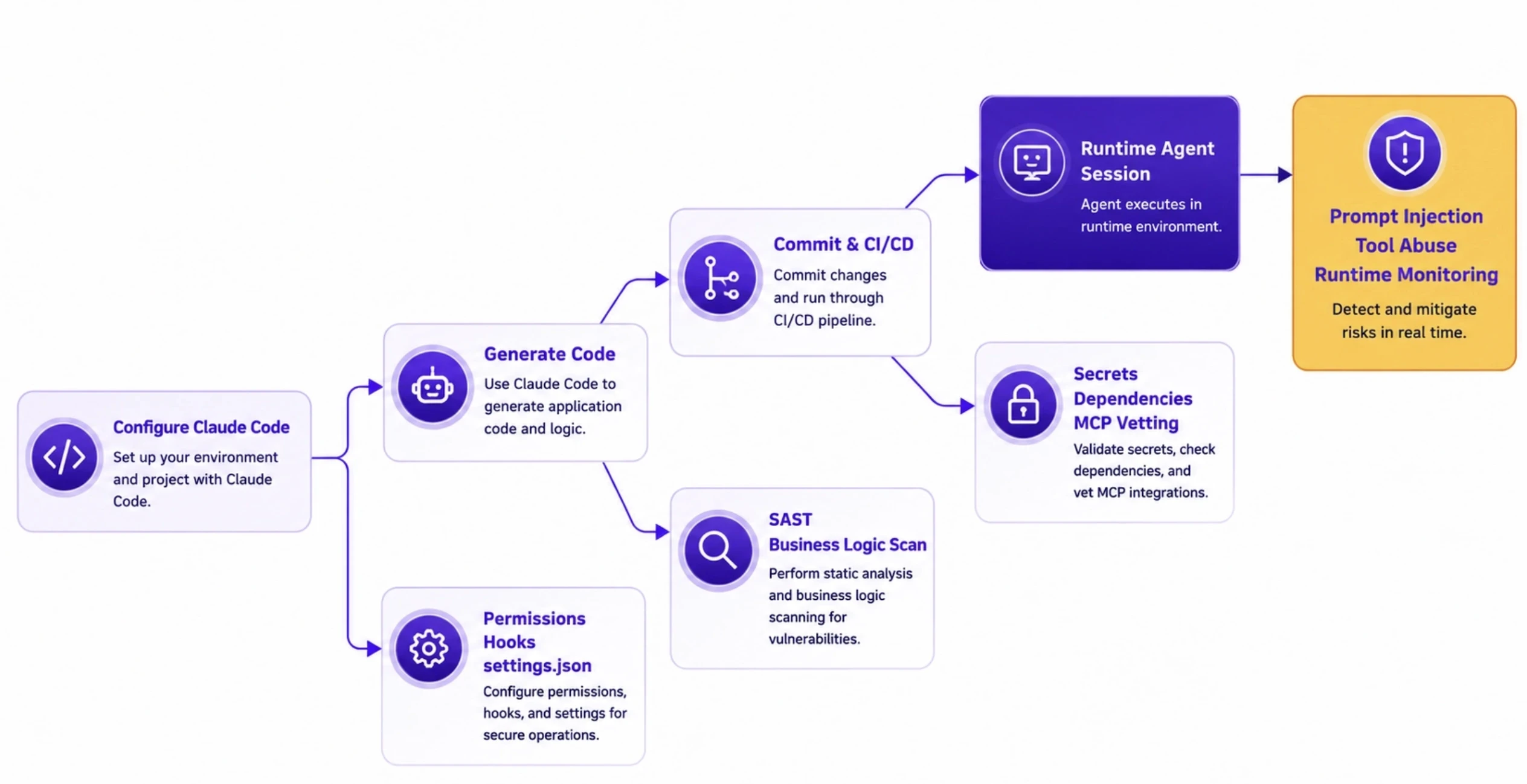
The Gap Between Pre-Execution Scanning and Runtime Behavior
Static scanners, including Anthropic's own, read source code and reason about what it will probably do. That's valuable, but it's a pre-execution activity. It can't see what happens once Claude Code is running with real permissions, calling real tools, and connecting to real MCP servers in a live session. A code sample can look safe in isolation and still be part of an agent session that gets manipulated into calling the wrong tool, reading a file it shouldn't, or acting on an instruction smuggled in through a document it was asked to summarize. None of that shows up in a static diff. It only shows up by watching the agent behave.
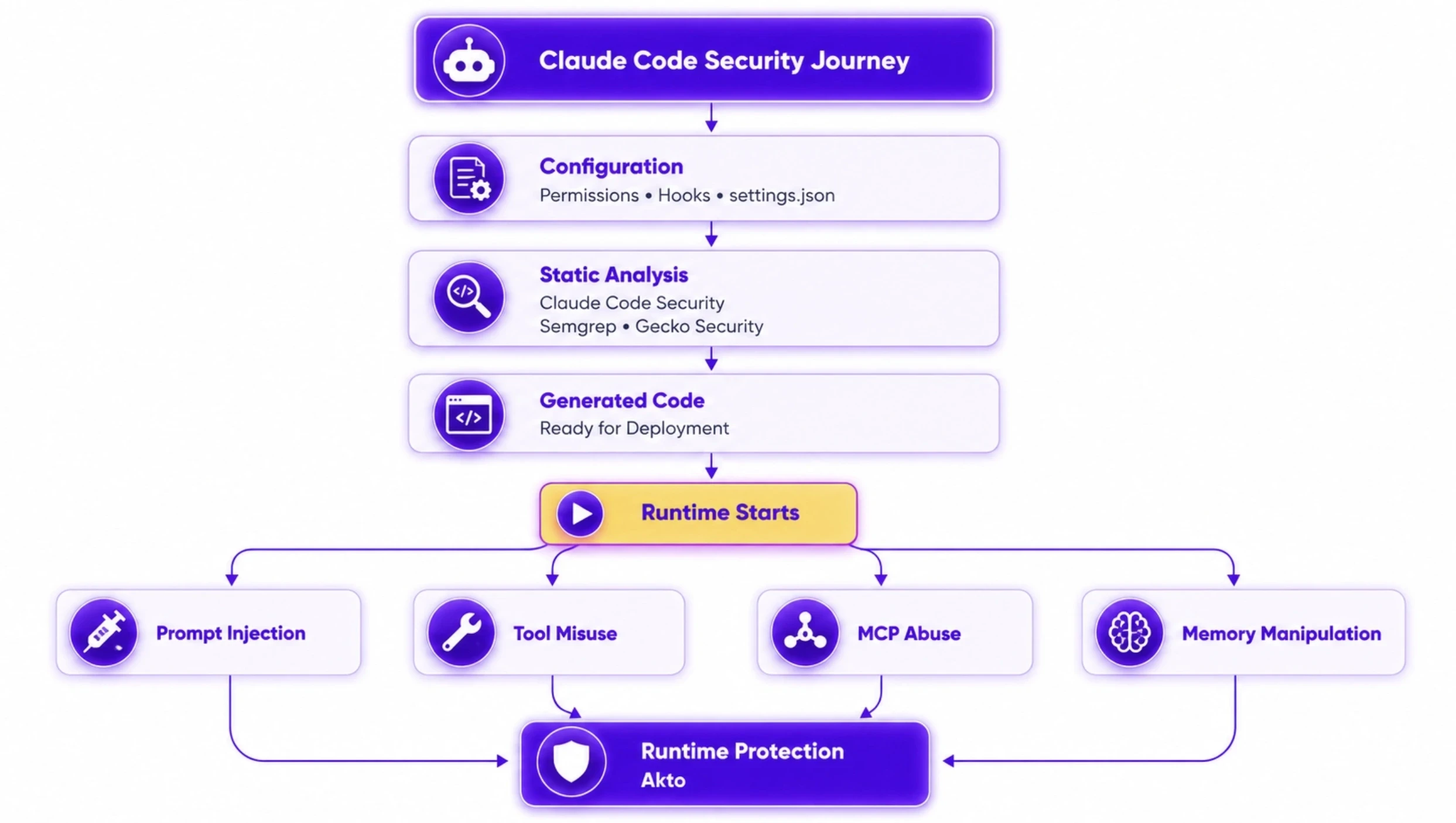
What a Complete Claude Code Security Toolchain Covers
A complete toolchain needs four things working together: native configuration hardening at the tool level, static and generated-code scanning before merge, secrets and supply chain checks across dependencies and MCP servers, and runtime protection that watches the agent while it's actually working. Skipping any one leaves a specific, predictable gap. Skip configuration hardening, and a single overly permissive session can do real damage. Skip SAST, and generated code ships with known flaws. Skip secrets scanning, and a session leaks a credential. Skip runtime protection, and nothing catches a live prompt injection or tool-abuse attempt until after the fact.
Category 1: Native and Configuration-Level Tools
The first layer of Claude Code security tooling is the configuration Anthropic already ships. Getting this right costs nothing but attention, and most teams still get it wrong.
Claude Code Security (Anthropic's Built-In Scanner)
Claude Code Security, launched by Anthropic in February 2026 and now in public beta for Enterprise customers, scans a codebase for vulnerabilities and recommends patches for a developer to review, tracing data flows across files and reasoning about business logic rather than matching fixed patterns the way traditional static analyzers do. Every finding goes through a multi-stage verification pass before it's surfaced, cutting down on false positives. It's a strong first layer, but Anthropic frames it as source-code analysis, not a replacement for testing a running application or for anything happening at runtime.
Hooks, Permissions, and .claude/settings.json Hardening
Claude Code hooks let a team enforce deterministic control over what the agent does at specific points in its workflow, like blocking a dangerous command before it runs or auto-formatting a file after an edit, defined through PreToolUse and PostToolUse events in .claude/settings.json. It's worth being precise about what hooks actually are: they run with the full permissions of the user account, with no sandbox by default, so a misconfigured hook can do just as much damage as a misconfigured permission. Pairing hooks with explicit permission rules, an allow, deny, and ask structure scoped to specific tools, is the real configuration-level control surface. Enterprises can lock this down further with an allowManagedHooksOnly setting that restricts users to organization-approved hooks only. This is also where teams should think hard about the command-line flag colloquially known in the developer community as "YOLO mode," which skips permission prompts entirely. It's a reasonable option for a sandboxed, disposable environment and a genuinely risky one for anything touching production credentials or real user data.
.claudeignore and Secrets Exclusion Patterns
A .claudeignore file, modeled on .gitignore, is a pattern many teams reach for to keep Claude Code away from files containing secrets. It's worth flagging clearly here: independent testing reported in early 2026 found that Claude Code did not reliably respect .claudeignore entries in practice, with the model still able to read .env files despite matching exclusion patterns. The mechanism that is actually documented and enforced is the permissions.deny array inside .claude/settings.json, using rules like Read(./.env) or Read(./secrets/**), which blocks the read at the tool-permission layer rather than relying on the model to voluntarily skip a file. Teams building a real secrets exclusion strategy should treat permission denials as the enforcement mechanism and .claudeignore as, at best, a convention layered on top rather than a security boundary on its own.
Category 2: SAST and Generated-Code Scanning Tools
Generated-code risk is a real, well-documented problem rather than a hypothetical one. Veracode's 2026 GenAI Code Security research, testing over 100 large language models across dozens of coding tasks, found security pass rates holding steady at roughly 45 to 55 percent, meaning something close to half of AI-generated code samples introduce a known vulnerability when no explicit security guidance is provided. Generated code vulnerabilities of this kind are exactly the gap Claude Code SAST tooling exists to close.
Semgrep and Traditional SAST Integration
Semgrep integrates with Claude Code through a dedicated plugin and MCP server, injecting secure coding defaults at session start and running an automatic scan after every file write through a post-tool hook, catching injection flaws, hardcoded secrets, and insecure patterns before they reach a pull request. This kind of Semgrep Claude Code integration runs fast enough to fire on every generation event, which matters because a scan that only runs at commit time misses the point where fixing the issue is cheapest, right after the agent writes the code.
Gecko Security and Business-Logic-Aware Scanners
Traditional SAST is built around pattern matching, which is exactly why it misses business logic flaws: a missing authorization check or a broken access control path that's syntactically valid but logically wrong. Gecko Security is one of a newer class of scanners built to catch this category, building a semantic graph of a codebase to trace call chains and trust boundaries across services rather than matching known signatures, and validating findings with a generated proof-of-concept to keep false positives down.
Where Generated-Code Scanners Still Miss Agentic Risk
Even a strong combination of pattern-based and semantic scanners is still reading code, not watching an agent operate. Neither category can tell you whether a Claude Code session was manipulated into calling a tool outside its intended scope, whether an MCP server connection was compromised, or whether a multi-step agentic workflow drifted from its original goal under the influence of a poisoned document it processed. That gap is structural, not a maturity problem; these tools will eventually close, since it's simply outside what code analysis is built to observe.
Category 3: Secrets, Dependency, and Supply Chain Tools
Claude Code secrets scanning and supply chain vetting cover the risk that shows up in what a session touches rather than what it writes.
Secret Detection and Auto-Rotation Tools
Established secret-scanning tools like TruffleHog and GitGuardian catch credentials that land in a repository, a commit, or a session log, and increasingly pair detection with automated rotation so a leaked key gets invalidated rather than just flagged. This matters for Claude Code specifically because a session can encounter a credential through a file read, a tool output, or generated code, and any one of those paths can end up committed or logged before a human notices.
Dependency and MCP Server Vetting Tools
Claude Code MCP security has become its own category of concern as agents increasingly connect to third-party MCP servers to extend their capabilities. Every MCP server is a new piece of software with its own supply chain, and a growing body of reported vulnerabilities across MCP implementations, from path traversal issues to malicious servers posing as legitimate tools, makes vetting these connections before approving them a genuine security control rather than a formality. Dependency scanning tools that already check open-source packages for known vulnerabilities are being extended to cover MCP server manifests and tool descriptions for the same reason: an agent that trusts a compromised dependency or a poisoned tool description inherits that compromise directly.
Category 4: Runtime and Agentic Security Platforms
Runtime is where static analysis stops being useful and where a Claude Code runtime security tool actually earns its place, because this is the only layer that observes what an agent does rather than what code says it might do.
AI Agent Discovery and Shadow Agent Detection
Most organizations have more Claude Code instances and connected agents running than security teams have inventoried. Shadow AI agent detection matters here specifically because Claude Code is easy for any developer or team to adopt without routing the decision through procurement or security review, and an agent nobody has inventoried is an agent nobody is protecting. Discovery tooling needs to map not just where Claude Code is running, but what MCP servers, tools, and data sources each instance can reach.
Prompt Injection and Tool-Abuse Guardrails
Prompt injection guardrails need to sit in the actual path of a live session, capable of flagging or blocking a manipulated instruction as it's processed rather than surfacing it in a report afterward. This matters more for coding agents than it might first appear, since a Claude Code session reading a file, a ticket, or a pulled dependency's documentation is processing untrusted content the same way any agentic system does, and an instruction hidden in any of that content can attempt to redirect what the agent does next.
Continuous Red Teaming for Agentic Workflows
Agentic AI red teaming, running structured adversarial tests against a Claude Code deployment for prompt injection, tool misuse, and unsafe multi-step behavior, needs to run continuously rather than as a single pre-launch check. A configuration that passed review last month can still be exposed to a new attack technique today, and ongoing testing is what catches that drift before an attacker finds it first.
Comparing Claude Code Security Tools by Category
Looking at the best Claude Code security tools side by side makes the coverage gaps easier to see than reading about each category in isolation.
Comparison Table: Coverage, Deployment Stage, and Gaps
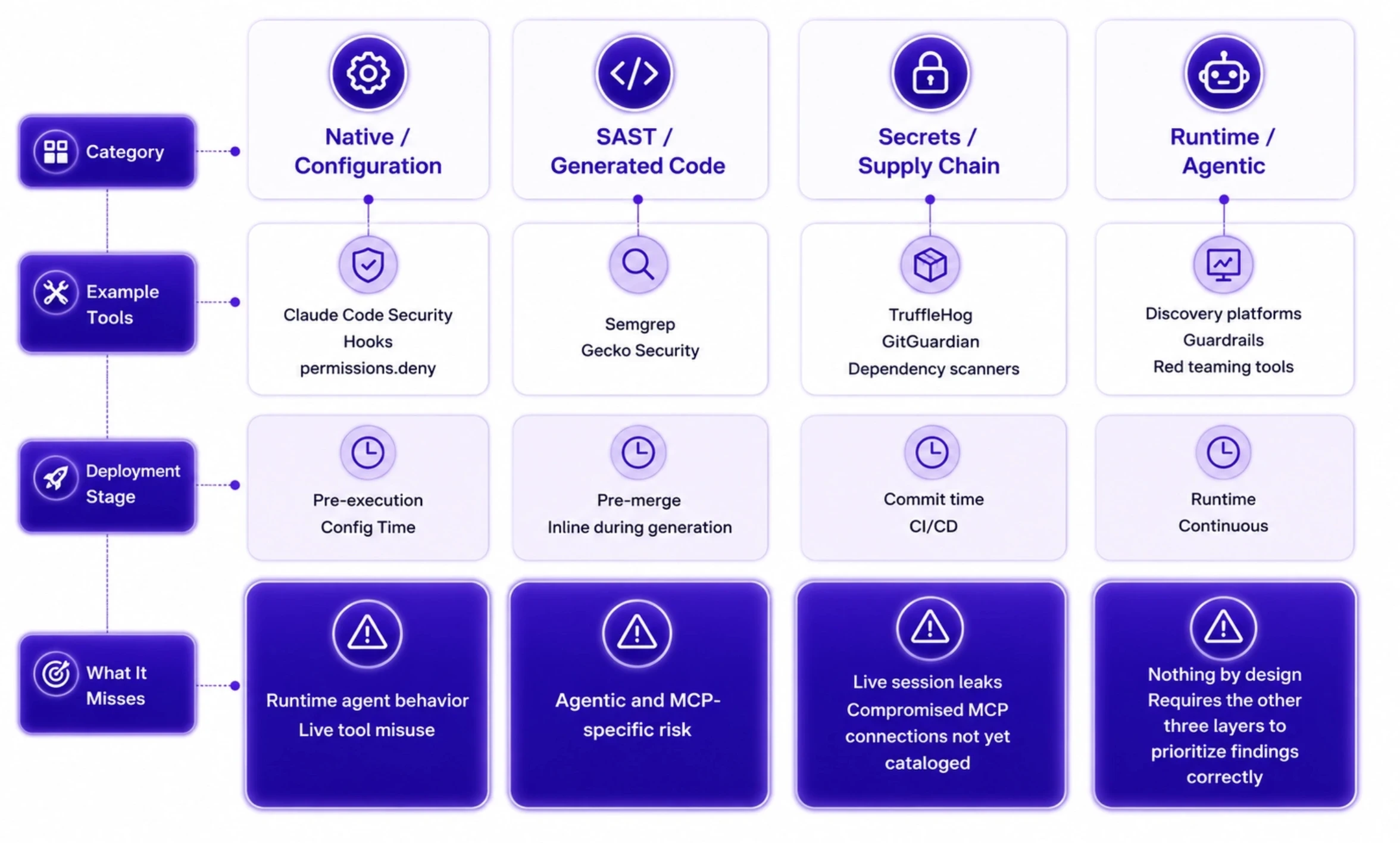
Open-Source vs. Commercial Options
Open-source tools like Semgrep's core engine, TruffleHog, and adversarial testing frameworks like Garak and PyRIT give security-mature teams full control and no licensing cost, at the price of engineering time spent integrating and maintaining them. Commercial platforms trade some of that control for faster deployment, ongoing rule and probe updates, and support that matters when an incident happens at 2 am. Most enterprise teams run a mix: open-source SAST for baseline coverage, paired with a commercial platform for the runtime and agentic layer that's hardest to build in-house. Whichever mix a team lands on, the best Claude Code security tools are the ones that actually get maintained and monitored, not the ones with the longest feature list on a comparison page.
How Akto Secures Claude Code End-to-End
Seeing how a dedicated platform maps onto the gaps above makes the runtime layer concrete rather than abstract.
Discovery: Finding Every Claude Code Instance and Agent
Akto continuously discovers Claude Code instances, connected MCP servers, and agentic workflows across an organization's environment, building the inventory that configuration-level and CI/CD tools alone can't produce, since neither of those layers is designed to find agents nobody registered in the first place.
Red Teaming and Runtime Guardrails for Agentic Workflows
Akto runs continuous, automated red teaming against discovered Claude Code deployments, testing for prompt injection, tool misuse, memory manipulation, and MCP-specific exploits, and feeds findings directly into runtime guardrails so an exploit that succeeds during testing gets blocked in production rather than sitting in a report nobody actioned.
Where Akto Fits Alongside Anthropic's Built-In Scanner
Akto isn't a replacement for Claude Code Security or for a Semgrep integration, and it isn't trying to be. It sits alongside them, covering the discovery, runtime, and continuous testing layer that pre-execution scanners were never built to reach. A mature Claude Code security posture uses Anthropic's scanner and a SAST tool to catch what's in the code, and a platform like Akto to catch what happens once that code is running as part of a live, tool-calling agent.
Building a Claude Code Security Toolchain: A Practical Checklist
Start with configuration: harden .claude/settings.json permissions using explicit allow, deny, and ask rules, restrict hooks to organization-approved commands in managed environments, and treat .claudeignore as a convention rather than an enforced boundary, relying on permissions.deny for anything that needs to be blocked. Add a Claude Code SAST layer next, running Semgrep or a similar scanner inline during generation rather than only at commit time, and layer in a business-logic-aware scanner for flaws pattern matching won't catch. Build a CI/CD security gate that blocks merges on critical findings from both the native scanner and SAST tooling. Extend secrets scanning and dependency checks to cover MCP server manifests specifically, since that's the newest and least mature part of most teams' supply chain review. Finally, close the loop with a real Claude Code runtime security layer: discover every Claude Code instance and connected agent, apply prompt injection and tool-abuse guardrails at the session level, and run agentic red teaming continuously rather than once before launch. Securing Claude Code end to end means every one of these layers running at once, not just the one that was easiest to set up first.
FAQs: Claude Code Security Tools
1. What tools are needed to fully secure a Claude Code deployment?
A complete toolchain needs four layers: native configuration hardening (permissions, hooks, and settings.json), SAST and generated-code scanning (Semgrep and business-logic-aware scanners like Gecko Security), secrets and supply chain tools (secret detection plus dependency and MCP server vetting), and a runtime and agentic security platform for discovery, guardrails, and continuous red teaming.
2. Is Anthropic's built-in Claude Code Security feature enough on its own?
No. Claude Code Security is a strong source-code analysis layer that traces data flows and suggests patches, but Anthropic positions it as code analysis rather than a replacement for runtime testing. It doesn't watch a live session, doesn't cover MCP-specific risk, and doesn't replace dedicated SAST or secrets scanning.
3. What's the difference between SAST tools and runtime security tools for Claude Code?
SAST tools read source code before or during generation and flag known vulnerability patterns or logic flaws. Runtime security tools watch a Claude Code session while it's actually running, catching things like prompt injection, tool misuse, or agentic behavior drift that never show up in a static diff.
4. Can Semgrep or traditional SAST tools catch Claude Code's agentic risks?
Not fully. Semgrep and similar SAST tools are effective at catching pattern-based issues like injection flaws and hardcoded secrets in generated code, but they can't detect whether a live agent session was manipulated into calling the wrong tool or whether an MCP connection was abused, since that requires observing runtime behavior rather than reading code.
5. What is .claudeignore, and why does it matter for Claude Code security?
.claudeignore is a .gitignore-style pattern file some teams use to try to keep Claude Code away from sensitive files. Independent testing has found it isn't reliably enforced in practice, so the actual enforced control for excluding secrets is the permissions.deny setting in .claude/settings.json, which blocks reads at the permission layer rather than relying on the model to respect a convention.
6. How do you detect secrets accidentally exposed through Claude Code sessions?
Established secret-scanning tools like TruffleHog and GitGuardian can catch credentials that land in commits, session logs, or generated code, and pairing detection with automated key rotation limits the damage if a secret does leak before anyone notices.
7. What tools detect shadow or unmonitored Claude Code agents in an organization?
Dedicated AI agent discovery platforms continuously scan an environment for Claude Code instances, connected MCP servers, and agentic workflows that were never registered with security or IT, since traditional shadow IT scanning tools weren't built to recognize agent-specific signatures.
8. Can any tool fully stop prompt injection in Claude Code?
No single tool eliminates prompt injection entirely, since it's a fundamental challenge with how large language models process instructions and untrusted content in the same channel. Runtime guardrails can flag or block manipulated instructions as they're processed, and continuous red teaming helps catch new injection techniques, but the risk is mitigated in layers rather than solved outright.
9. What should a CI/CD security gate for Claude Code include?
A solid gate blocks merges on critical findings from both Anthropic's built-in scanner and a SAST tool like Semgrep, includes secret detection on every commit, and extends dependency checks to cover any new MCP server connections introduced in that change.
10. How does Akto complement or extend Claude Code's built-in security scanning?
Akto covers the discovery, runtime, and continuous red-teaming layer that Claude Code Security and SAST tools don't reach, finding every Claude Code instance and connected agent, testing them continuously for risks like prompt injection and tool misuse, and feeding findings into runtime guardrails rather than a static report.

Experience enterprise-grade Agentic Security solution