AI Agent Security Platforms: What Enterprise AppSec Teams Actually Need
Learn what enterprise AppSec teams should evaluate in an AI agent security platform, including discovery, runtime security, and AI red teaming.

Bhagyashree

AI security software encompasses the set of tools involved in detecting and responding to potential risks and vulnerabilities in relation to artificial intelligence, from safeguarding large language models (LLMs) and AI agents against prompt injection/data leakage to utilising AI for improved endpoint security, network security, and cloud security.
Choosing the right one comes down to the threat model you want to protect: what you are deploying, where it runs, and what regulations you need to comply with. For reference, 77% of organisations lack the essential data and AI security practices to adequately protect their critical business models, data pipelines, and cloud workloads, according to the Accenture State of Cybersecurity Resilience 2025 report. This blog explores what Enterprise AppSec teams should actually evaluate in an AI agent security platform.
What is an AI Agent Security Platform?
An AI agent security platform is specialised infrastructure for securing autonomous AI functions – that is, software that makes decisions, carries out tasks, and has a degree of reasoning embedded into its operations with limited direct human input. The category is also nascent and fragmented – a recent enterprise buying guide groups vendors according to best practices around five verticals that represent attack surfaces, with few covering the entire stack.
Why Enterprise AppSec Needs a New Security Category
Conventional appsec typically treats apps as relatively monolithic entities: they have endpoints, code, and users who interact with them in a fairly straightforward way. Autonomous agents disrupt this order – if the 2026 threat report is to be believed, organisations have invested significantly in securing the model layer, namely what tools the employees can use, what procurement channels are available for third-party vendors, and what data is visible to these tools. However, the execution layer presents vastly different risks, many of which have manifested in the last year.
Specifically, the report cites an agent-based code completion tool that wiped a production database, the first-ever CVE for an agentic AI system that allowed remote code execution via poisoned skill packages, and an attack chain that took advantage of an agent marketplace and distributed over one thousand malicious skills to exfiltrate developer credentials. Analysts at Gartner were also critical of the prompt filtering approach in the quote above, arguing that the fundamental difference between chatbots and agents that perform actions outside of the conversation thread makes the current state of the art largely irrelevant. Similarly, Gartner estimates that privilege misconfigurations will be the reason for over 50% of successful attacks on agents through 2029, with the existing tooling and identity management solutions ill-suited for the task of protecting processes executed by these agents.
Agent Concepts Compared to Traditional Applications
Identity and lifecycle: While conventional apps tend to use long-lived, documented service accounts, agents are used for narrow tasks and are often deleted immediately after. Non-human identities already outnumber humans in most enterprises at least 50:1, with some projections suggesting 80:1 in the near future.
Delegated authority
An agent that carries out tasks on behalf of a user essentially possesses a credential itself, embedding the privileges of the user it serves. This makes it both an enterprise asset (with its own set of permissions) and a carrier of delegated, potentially privileged authority.
Behaviour over signatures
A compromised traditional application typically manifests through clearly malicious behaviours: unusual network traffic, unexpected code execution, etc. An agent, however, may act on a prompt to execute a benign-looking command: read a document as a user, treat subsequent input as instructions, and use an API it already has access to.
Scale and sprawl
There are reports within the industry of agents being used to spawn other agents – similar to how operating systems and service meshes allow for the creation of new processes and microservices. This represents the same risk at scale: processes communicating with each other and carrying out privileged tasks without sufficient visibility and isolation.
Risk frameworks
OWASP only released its first reference architecture for this category towards the end of 2025. The list of potential agent-specific attack vectors includes hijacking of goals and memory, poisoned training data, and rogue agents – none of which have clear analogues in the current OWASP Web Application Top 10.
Four Capabilities Every Enterprise Platform Should Provide
Discovery and inventory: the ability to see not only the agents in use but also non-human identities, connections, and behaviours that have some relation to them. This goes beyond the capabilities of model monitoring tools that only track prompts sent to and received from the agent.
Identity, access, and least-privilege governance: according to the report, these are the most critical capabilities from an analyst’s perspective. Tools that can enforce least privilege inside the agent execution environment can stop many attacks in their tracks. The ability to make runtime decisions within the agent processing context is a must-have.
Runtime detection and enforcement: behavioural monitoring and prevention of jailbreaks, prompt injection, and task exfiltration during execution. The capability to respond at the speed of the agent execution environment is critical.
Full lifecycle governance: discovery, build-time posture, runtime prevention, and response as a continuous security workflow.
Why Traditional AppSec falls short for AI Agents
Below is why traditional AppSec falls short for AI Agents:
Agents are fundamentally different from traditional applications: Apps perform predictable operations, so tools like SAST scan all possible execution paths, finding all bugs with a single pass. Agents reason, plan, and execute actions, making them harder to reason about at a code level. Attackers can manipulate the plan early on, and these changes can silently persist through subsequent steps, with far-reaching consequences.
They present new attack surfaces: Prompt injection embeds harmful instructions in the content read by an agent. Tool misuse combines trustworthy actions to perform some unintended act. MCP connections often lack required authentication or auditing. Memory poisoning poisons what an agent learns (“remembers”). Goal hijacking pulls an agent away from its intended task. Agent impersonation exploits weaknesses in the trust infrastructure. And excessive agency is the root cause of many actual attacks.
Static code tools cannot account for emergent properties of models: SAST searches through code for known bad patterns while DAST attacks endpoints. An agent’s risk is not inherent in either of these – rather, it emerges from decisions the model makes for open-ended prompts.
Infrastructure tools cannot see intent: API security tools assume that any call is made with the intent to perform it, missing delegated or injected instructions. Network monitoring solutions watch for unusual traffic, but a compromised agent is simply making authorised calls. CSPM finds configuration issues, but cannot evaluate if an agent ever used the misconfigured resource.
Model-layer security is not the same as workflow security: Filtering out malicious prompts protects the conversation, but the tools, data, and actions performed by the agent are at risk. The actual execution of reasoning as an action is the point at which the system is vulnerable, and generic large language model security fails to intervene.
The Four Pillars of an Enterprise AI Agent Security Platform
Here are four pillars of an enterprise AI agent security platform that teams need to look for:
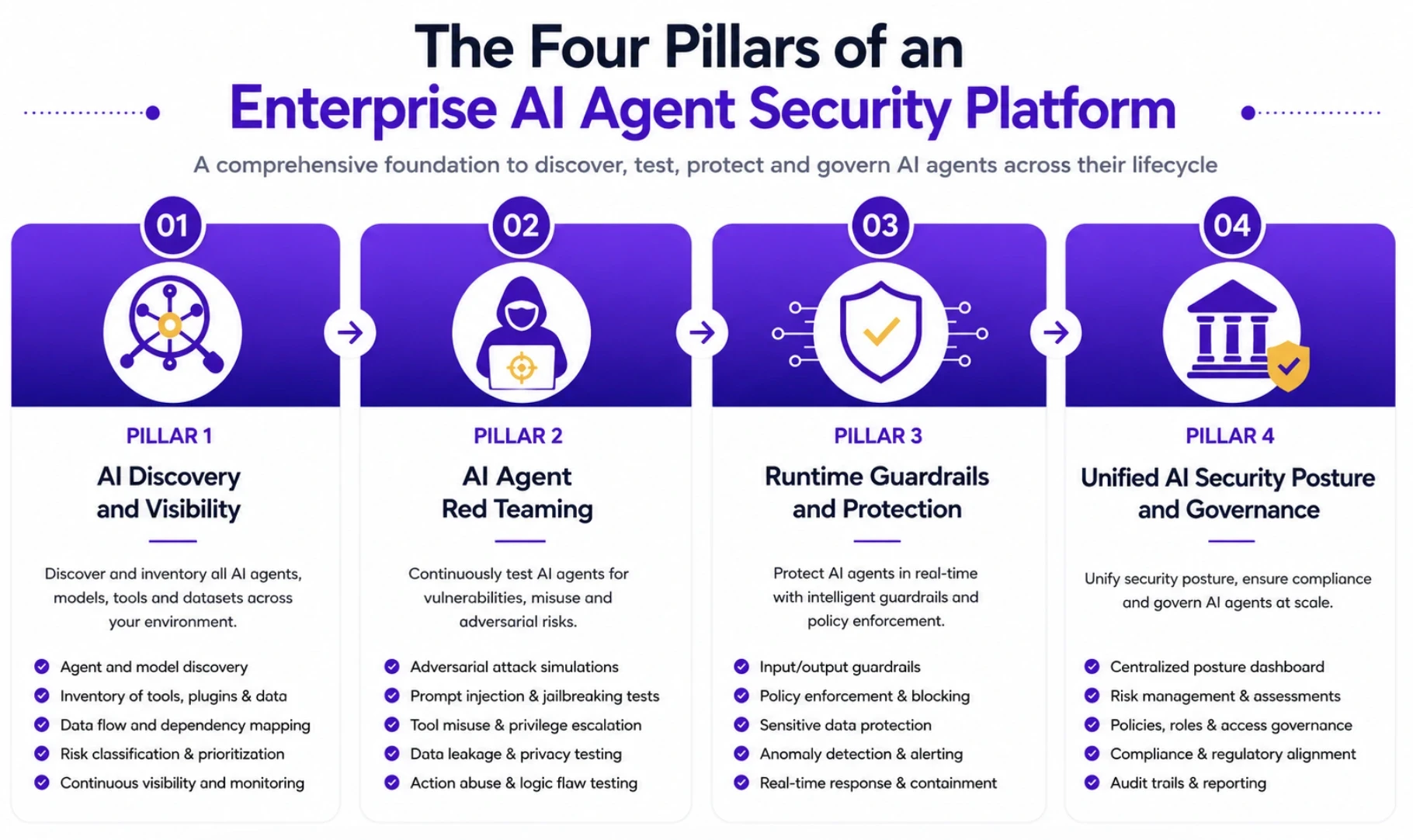
Pillar 1 - AI Discovery and Visibility
You can’t secure what you don’t know exists. This pillar continuously discovers enterprise agents, including MCP servers, tools, APIs, and models, including shadow AI agents such as employee-created agents or unauthorised copilots, and builds a living context graph of the agentic attack surface by understanding relationships, data flows, and dependencies between tools and data.
Pillar 2 - AI Agent Red Teaming
Since an agent’s behaviour can change drastically with different inputs, continuous testing is required. This pillar continuously probes agents with prompt injection, jailbreak, tool abuse, memory poisoning, goal hacking, multi-agent attacks, and more using automated probe libraries mapped to OWASP LLM Top 10, MITRE ATLAS, NIST AI RMF, and other standards as code and integrated into enterprise CI/CD for agent security regression testing.
Pillar 3 - Runtime Guardrails and Protection
Testing agents at rest only find so much. This pillar applies and enforces policy at runtime to detect and prevent data exfiltration, unauthorised tool calling, hallucination, and unsafe model outputs by analysing prompts and responses, filtering inputs, authorising tools, and validating outputs. It also continuously monitors agent behaviour while running to enforce policies around token abuse, spending, and more.
Pillar 4 - Unified AI Security Posture and Governance
This all comes together in this unified view of posture and governance mapped to roles and departments while aligning with regulatory requirements, including the EU AI Act and ISO 42001. This dashboard provides insights into the risk, trends, coverage, and findings of your agent security posture while applying controls mapped to OWASP, MITRE ATLAS, NIST AI RMF, and other frameworks for continuous governance.
AI Agent Security Platforms Comparisons
There is no common axis for the competition between the industry players. Some products were born from the API security space, some from the ML model scanning, some from network security, and some were conceived as agent security products. Their differentiation is rooted in the original purpose. It is therefore important to establish the evaluation criteria before attempting to compare the vendors.
Enterprise Evaluation Criteria
Discovery – the ability to discover agents, MCP servers, and other shadow AI, not just those deployed by the customer
Runtime protection – can the solution protect against attacks during the agent runtime or does it simply monitor and report
Red teaming – can it perform continuous attack simulation or is limited to one-time pre-production scanning
MCP security – does it address the unique exposure of MCPs (servers’ authentication, tools’ authorisation, aggregated credentials), or do they represent generic API calls
AI gateways – is there an inline gateway component for agents or do they operate on the data and code requested by the agents
Runtime latency – what is the latency added by inline processing (important for user-facing agents), 50 ms is about the acceptable threshold
Deployment – SaaS, self-hosted, agentless, or requiring network appliances or a particular cloud
Compliance – does the solution incorporate controls mapped to emerging regulations and standards (OWASP, MITRE ATLAS, NIST AI RMF, EU AI Act, ISO 42001), or is the customer expected to implement them on top of the product
CI/CD – can the product be integrated into the CI/CD pipeline to enforce scanning and policy checks, or is it only applicable as a production product
SIEM integration – does it interface with the SIEM systems the customer is using, or does it exist as a separate console with its own dashboards and alerts.
Platform Comparision Table
Feature | Akto | Noma Security | Lakera | Prisma AIRS | Protect AI | Microsoft | HiddenLayer |
|---|---|---|---|---|---|---|---|
AI Discovery | ✅ Comprehensive discovery of AI apps, agents, APIs and MCP assets | ✅ AI asset discovery | Limited | Limited | Model-focused discovery | Microsoft AI ecosystem visibility | Model inventory |
AI Red Teaming | ✅ Automated continuous AI red teaming | Partial | Limited | Partial | ✅ Strong model and application testing | Limited | ✅ Model-focused testing |
Runtime Protection | ✅ Full runtime monitoring and enforcement | ✅ Runtime monitoring | ✅ Prompt protection | ✅ AI runtime security | Partial | Microsoft Defender integration | Model runtime defence |
MCP Security | ✅ Native MCP discovery, governance and runtime protection | Partial | No | No | Limited | Emerging capabilities | No |
Guardrails | ✅ Built-in input, output and policy guardrails | Policy controls | Prompt guardrails | Runtime policies | Model guardrails | Azure AI guardrails | Model protections |
CI/CD Integration | ✅ Native DevSecOps integration | Partial | Limited | Partial | ✅ Strong pipeline integrations | Azure DevOps integration | Partial |
Deployment | SaaS, Self-hosted, Hybrid, On-premises | SaaS | SaaS | Cloud | SaaS | Azure ecosystem | SaaS |
Enterprise Focus | Complete AI agent security lifecycle | Enterprise AI security | LLM application protection | Enterprise runtime security | AI/ML security | Microsoft-centric enterprises | AI model protection |
Consider this list as a starting point, not an endpoint: many of the vendors highlighted above release updates to their capabilities constantly, while Protect AI and Lakera have recently been acquired by bigger companies, shifting their priorities.
What sets Akto apart from the rest
End-to-end agent lifecycle security: Akto secures the entire lifecycle of AI agents from discovery/testing to deployment, runtime, and compliance within a singular platform.
Native MCP security: Akto natively discovers, governs, and protects Model Context Protocol (MCP)servers, tools, and agents.
AI discovery with context graph: Akto auto-discovers all AI assets and builds a comprehensive context graph of interrelationships between models, prompts, APIs, tools, identities, and data.
Runtime protection: The platform detects prompt injection, data exfiltration, tool misuse, and policy violations while enforcing security during AI agent execution.
Automated red-teaming and guardrails: Akto continuously probes AI agents for attack surfaces and employs guardrails to sanitize inputs/output, validating against organizational security policies.
How to Evaluate an AI Security Platform
Choosing an AI security platform requires more than comparing feature lists. Enterprises should evaluate how effectively a platform secures the entire AI lifecycle, from discovering AI assets and testing applications to protecting agents in production and maintaining compliance. A practical evaluation should focus on visibility, runtime protection, integration capabilities, governance, and support for modern AI architectures to ensure long-term scalability and security.
Questions Every Security Team Should Ask
Before selecting an AI security platform, ask the following questions:
Can the platform automatically discover unknown AI agents, LLM applications, APIs, and shadow AI deployments?
Does it provide native security for MCP servers, tools, and AI agent communications?
Can it continuously monitor AI applications instead of relying only on periodic security scans?
Does it offer runtime enforcement to block prompt injection, data leakage, and unauthorized tool usage in real time?
Does it integrate with existing CI/CD pipelines to automate AI security testing during development?
Can it secure both commercial AI applications and custom-built AI agents across cloud, hybrid, and on-premises environments?
Final Thoughts on Enterprise AI Agent Security Platform
Security considerations have to be deeply embedded in the full lifecycle of an AI application, from design and development through to implementation and ongoing maintenance and governance. The right platforms offer discovery and testing capabilities plus runtime protection and compliance to help organizations secure AI while delivering on its business value at scale.
Frequently Asked Questions: AI Agent Security Platform
How is AI agent security different from regular LLM security?
Regular large language model (LLM) security tools focus on filtering inputs and outputs of a conversation with the LLM, detecting jailbreaks, and preventing the model from responding with unsafe content. However, an AI agent’s security is about granting or denying permissions to the agent to perform certain tasks or access specific information. An AI agent can appear safe at the conversation level but execute dangerous actions if it can call certain tools or has access to restricted data. Tools, models, and data should be guarded, not merely the conversation.
How do enterprises secure autonomous AI agents?
Enterprises secure autonomous AI agents by applying traditional IT security principles. This involves continuous discovery of all AI agents and associated MCP infrastructure, red-teaming these agents, implementing least-privilege identity and access management for agents interacting with systems, and deploying runtime application self-protection for agents following execution. Enterprises also structure these controls around established regulatory frameworks and compliance standards such as OWASP, MITRE, ATLAS, NIST AI RMF, and the EU AI Act.
What is AI agent red teaming?
Red teaming involves continuous penetration testing of an AI agent to identify security weaknesses that could be exploited. It works by attempting to attack the agent with prompt injections, misusing available tools, tampering with memory, hijacking goals, and employing other methods to compromise the agent’s security. Effective red-teaming platforms perform these tests continuously and update the agent’s runtime guardrails based on the findings.

Experience enterprise-grade Agentic Security solution