AI Agent Guardrails: Runtime Enforcement for Production Agents
Enforce runtime guardrails for AI agents with continuous policy validation, threat prevention, and enterprise AI security

Bhagyashree

Production agents now take thouSands of autonomous decisions every minute, far too many for human eyes to follow. With one wrong output, a data leak of customer information, hallucination, or other undesirable outcome, the damage may already be done. For context, Deloitte’s 2026 report on AI governance shows that less than 20% of organizations have the infrastructure in place for effective AI governance, leaving the rest of the companies vulnerable to unsafe production at scale. Runtime guardrails offer a solution to this problem by allowing us to react to both unsafe inputs and outputs in real time and prevent undesirable outcomes.
This article explores why AI runtime guardrails are important and best practices for deploying them.
What are AI Agent Runtime Guardrails?
AI agent runtime guardrails are mechanisms that enforce constraints on the behavior of an AI agent at runtime, i.e., when actually performing actions, as opposed to during the model training or auditing phases. They operate at the level of actual operations: API calls, database accesses, transactions, etc. The most common procedures fall under the jurisdiction of permission control and policy checking, human approvals for critical decisions, sandboxing, kill switches, and other related procedures. In contrast to the measures taken at the model training stage, runtime checks are a fail-safe mechanism that directly counteracts the ability of an AI agent to perform potentially harmful or undesirable actions.
Why Runtime Guardrails Are the Foundation of AI Agent Security
Here’s a breakdown of why AI agent guardrails are crucial for enterprises:
Action Over Output: AI agents take real-world actions such as API calls and file operations, not just respond with text. Therefore, risk is tied to the execution of actions, not the generation of text. Static checks for appropriateness during response generation cannot control actions taken at execution time, requiring different technical mechanisms.
Emergent and Compositional Risk: Risky actions are often emergent properties of combinations of actions and tools that could be used. Individual tools or actions taken in isolation may not present risks, but their combination can be more than the sum of their parts. This compositional risk cannot be fully anticipated in testing or design.
External Injection: Many AI agents operate on external content such as documents or webpages. Some allow execution of code, and all can be compromised by injection attacks. Similar to code injection, these attacks could involve malicious input to be processed or acted upon by the agent.
Non-Determinism: Agents often behave non-deterministically depending on external factors such as the state and contents of webpages or documents they are interacting with. Even different actions taken at response time with the same prompt can lead to different behaviors. Furthermore, similar prompts can lead to dramatically different actions if prompted differently. Therefore, many risks can only be mitigated at runtime.
Training Time Limitations: Many alignment approaches operate at training time to steer the model towards certain behaviors. However, they cannot observe or incorporate the particular tools, parameters, or systems that a model is operating with at runtime. Therefore, training-time-only approaches cannot encode or enforce precise limitations around particular tools, parameters, or systems. Moreover, many tools have complex permissioning, approval, or auditing requirements that are better enforced at runtime.
Deterministic Backstop: In a defense-in-depth approach to safety, model alignment serves as one component in a broader system. Monitoring can detect some risky behaviors after the fact, but runtime guardrails are needed to deterministically prevent risky behaviors based on first principles, such as by limiting specific actions, operations, or systems, or requiring explicit user approvals.
A Three-Layer Framework for AI Agent Guardrails
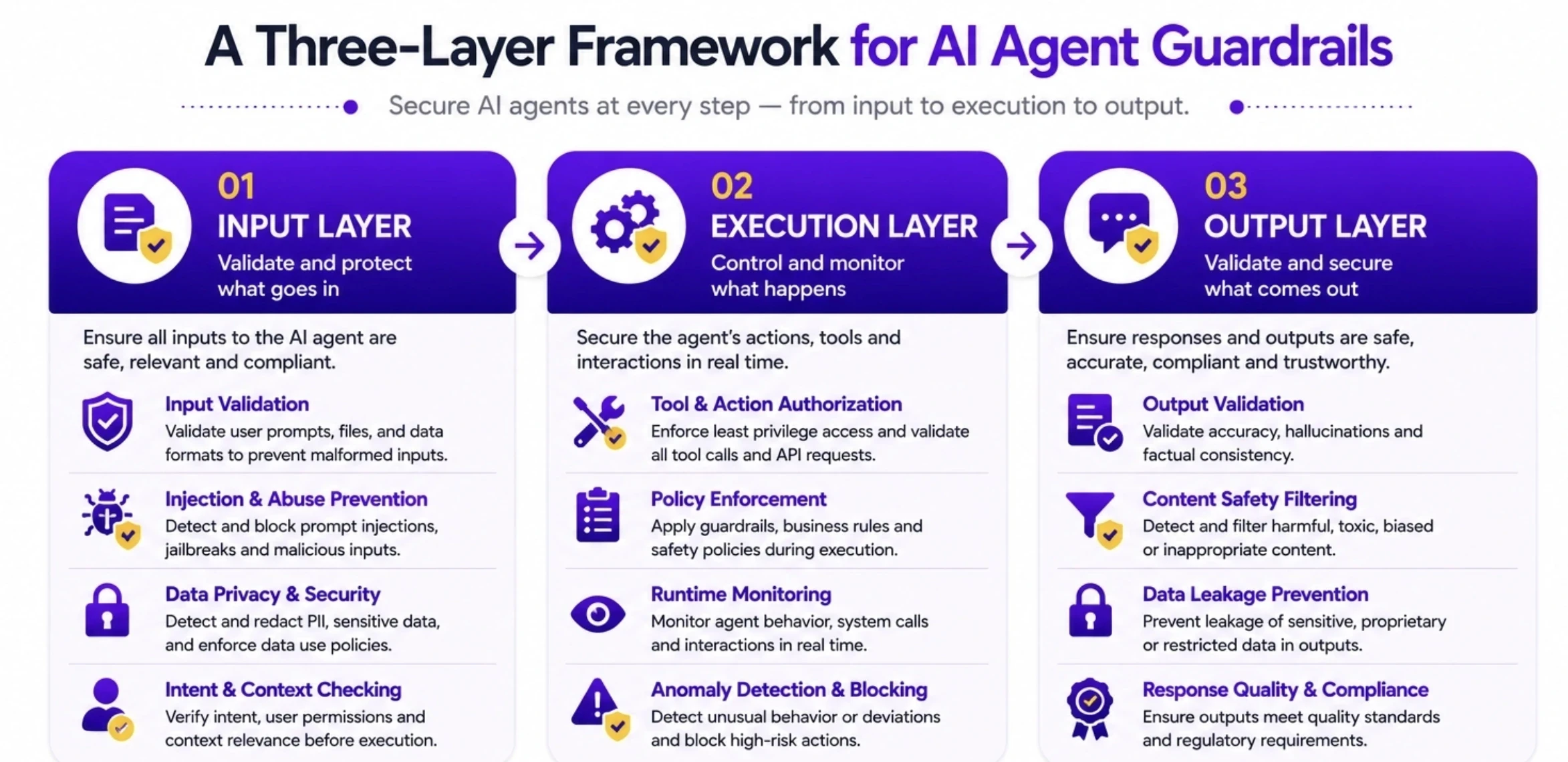
The three-layer framework for AI Agent Guardrails is as follows:
Guardrail architectures tend to be multifactorial, but often boil down to three core stages, based on different points in the agent's execution stack:
Input Layer
This layer prevents the agent from doing something wrong by filtering what gets injected into the system before it starts thinking and executing. Activities in this category include:
Prompt injection detection - looking for adversarial input or manipulations with the prompt (injections) that would steer the model toward unsafe behaviors
Content moderation - flagging the requests themselves as potentially unsafe
Input validation - checking the format, structure, rate, etc. of API requests
Context sanitization - removing or neutralizing potentially unsafe instructions from the context before passing it to the model, including tools and search results
The input layer reduces the attack surface, making sure that the initial context and the requests don't contain anything that could compromise the agent.
Execution Layer
This is the agentic part of guardrails, and it protects the system while it executes actions by intervening when something goes awry and stopping it. Activities in this category include:
Permission validation - enforcing a fixed set of permissions, independent of whatever the model thinks it should be able to do
Policy validation - scanning individual actions taken by the agent for policy violations
Human review - requesting human judgment for high-risk operationsSandboxing - isolating the agent's execution environment
Reasoning/action divergence detection - detecting if and when the agent's actions begin to deviate from its stated intent
The execution layer is the most interesting from the agent security perspective, since it's the one that actually deals with the consequences of unsafe behaviors.
Output Layer
Finally, this layer scans the results produced by the agent to ensure they conform to the desired standards. This includes:
Output validation
Data leakage detection scanners
Anomaly detection
Auditing trails
The output layer serves both as a control mechanism (stopping the agent from doing something wrong) and providing continuous feedback for training and improvement.
How Runtime Guardrails Protect AI Agents in Production
AI agents can reason, act, and operate independently, so their execution security is critical. Runtime guardrails provide continuous observation of an agent’s behavior to ensure it complies with specific instructions during the execution stage. In this way, runtime security helps protect agents in production from internal attacks, policy violations, and unauthorized use.
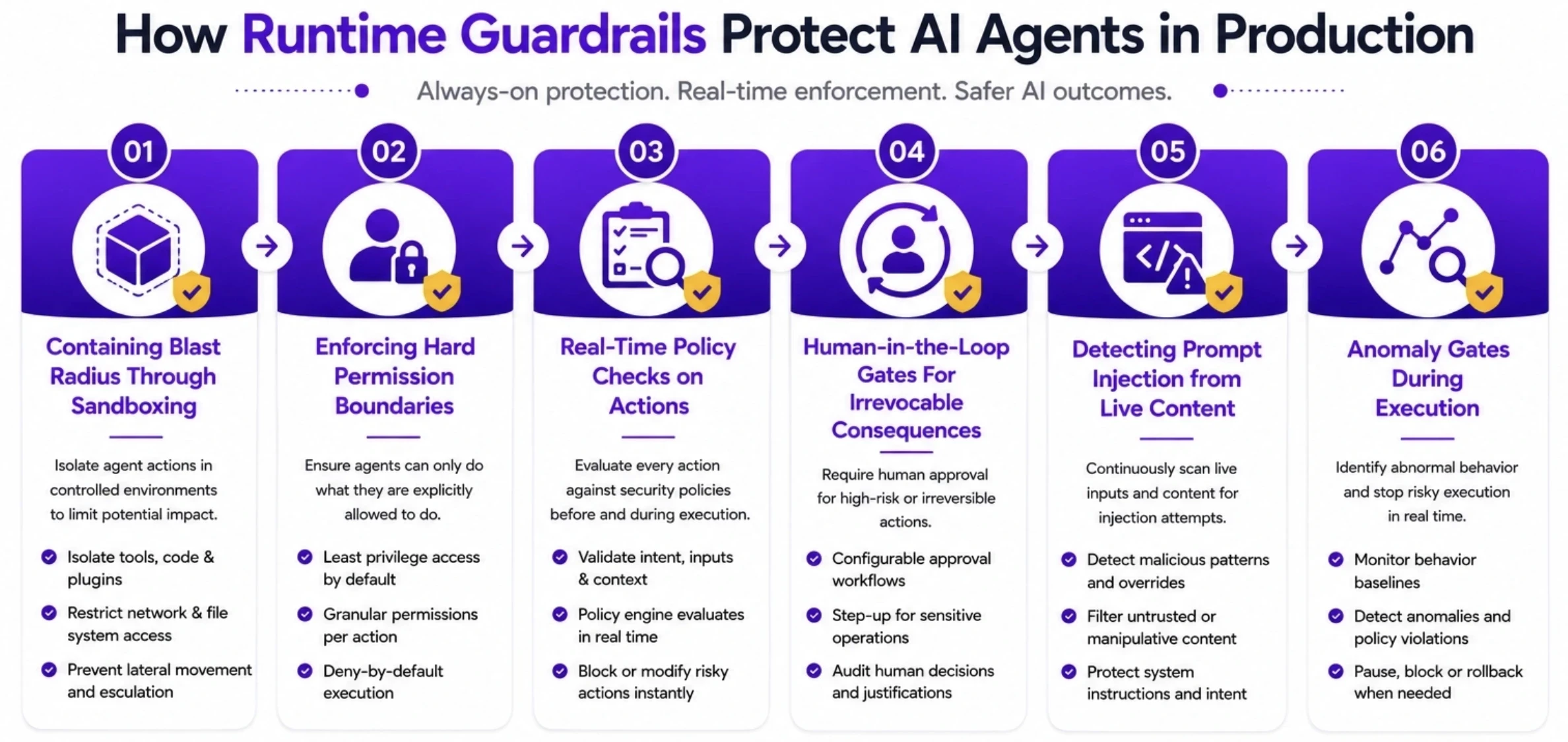
Containing Blast Radius Through Sandboxing
Production agents are executing code, reading databases, or calling external APIs. By sandboxing these operations, we ensure that a compromised, hallucinating, or otherwise compromised agent cannot do anything more than what it is supposed to - and nothing beyond that.
Enforcing Hard Permission Boundaries
Rather than asking the agent to reason about what it should and shouldn’t do, runtime guardrails enforce strict permission boundaries for what tools, data, and systems the agent can access no matter what. There is no room for interpretation.
Real-Time Policy Checks on Actions
Before the agent takes an action that has downstream real-world consequences (money transferred, files deleted, emails sent outside of the company domain), runtime guardrails check it against a list of irreversible, explicitly written policy rules.
Human-in-the-Loop Gates For Irrevocable Consequences
To maximize the autonomy of production agents while still retaining control over particularly concerning or irreversible actions, runtime guardrails can pause agent operations and require human approval before proceeding.
Detecting Prompt Injection from Live Content
Agents in production routinely consume live external content, which can include malicious injections or hidden prompts. By analyzing whether an agent has changed its behavior while operating on a particular content source, runtime guardrails can detect when a prompt injection or similar attack has occurred.
Anomaly Gates During Execution
By observing the pattern of an agent’s operations (how many actions it takes, which systems or tools it invokes), runtime guardrails can halt processing of a request if it begins to diverge from known patterns, intervening before the agent has completed processing of the request.
Best Practices for Deploying AI Agent Guardrails at Enterprise Scale
As enterprises adopt AI, there is a growing need to develop an approach for securing multiple agents across teams and use cases from a centralized security operations function. Enterprise-grade guardrails offer policy-as-code enforcement, centralized control, and runtime protection for AI agents, enabling organizations to secure any AI agent across large-scale, heterogeneous environments.
Risk-Tier Your Inventory of Agent Actions
When deploying guardrails, you should categorize agent actions according to risk tiers. This means that you will prioritize irreversible actions (e.g., money transfers, record deletions) over reversible ones (e.g., reading a public document) and decide which require hard blocking, approvals, or lighter monitoring. You should use your inventory of actions and their consequences to guide your guardrail selection.
Least-Privilege Defaults for Tools and Data
You should configure your agents for least-privilege data and tool access by default. By only allowing agents to access the tools and data necessary for a specific task, you reduce your risk surface. This minimization is even more critical at the infrastructure level – privilege escalation should always be explicit, not assumed.
Separate Reversible and Irreversible Approvals
Actions with irreversible or organizationally critical consequences should always require explicit human approval. Other actions can be automated or have lighter approval rules. The two types of approvals should be separated – trying to make them similar decreases either safety or efficiency.
Design for Non-Determinism and Emergent Behavior
A given input might cause an agent to perform subtly different actions on different runs. You should always assume that emergent behaviors could lead to additional security risks. You should therefore test your guardrails extensively on production traffic, not just on development and staging environments.
Log Everything Important for Forensics and Auditing
You should make sure that all agent actions are auditable, ideally with full context about the circumstances in which they occurred. This allows you to verify that everything your agent does is authorized and that no unauthorized actions go unregistered.
Rate-Limit and Alert on Suspicious Patterns
You should configure your system to flag suspicious patterns and potentially slow down your agents until you manually investigate. Since actions performed by your agents often occur faster than a human can review, rate-limiting suspicious-looking requests can help you stay within your risk tolerances.
Test Beyond Standard Operating Procedures
You should test that your guardrails respond appropriately to both standard operating procedures as well as adversarial inputs. Since your agents will likely process various external inputs, including potentially malicious ones, prompt injection attacks, and tool misuse, are common attack vectors that should have dedicated testing.
Assign Ownership and Governance for Guardrails
Many enterprise-level risks stem from inadequate guardrail governance. For example, Deloitte’s 2026 AI governance survey found that only 19% of enterprises felt confident about their AI governance posture.
When to Test and Validate Runtime Guardrails
Runtime guardrails should be constantly tested to ensure that they are effective against evolving AI threats. AI Guardrails need to be validated before deployment to identify potential security weaknesses and then tested in production to ensure they enforce policies, prevent attacks, and allow compliant AI agent operations.
Before Deployment: Test Guardrails
Before deploying the guardrails, test them to ensure that they work correctly. Conduct functional testing, adversarial red-teaming of prompt injection, tool composition testing, and edge-case probing around policy thresholds. Test the system’s non-determinism by executing the same prompts multiple times to identify inconsistencies. Finally, ensure that sandboxing truly isolates the agent and that kill-switch mechanisms are functional before relying on them in production.
After Deployment: Continue Monitoring
Once the guardrails are deployed, continue monitoring their effectiveness because testing can only identify a subset of potential issues. Look out for deviations and anomalies in the agent’s behavior. Re-test the guardrails after any incident or policy change, and perform adversarial red-teaming exercises regularly to uncover new attack vectors. Additionally, check audit trails for signs of hidden failures, verify kill-switch functionality, and update policies as the agent’s capabilities evolve.
How Akto Delivers Runtime Guardrails for AI Agents
As AI agents grow both self-sufficient and complex, enterprises must ensure runtime safety through the entire lifecycle of an AI agent, from development to production. With Akto, organizations get AI discovery, runtime guardrails for AI agents, continuous security validation, and centralized governance to secure AI agents, MCP servers, and GenAI apps from being exploited at every stage.
AI Discovery
Akto can automatically identify all AI applications, AI agents, MCP servers, models, prompts, APIs, and connected tools across clouds. With Akto discovery, organizations can get full insight into their enterprise AI applications, uncover shadow AI agents, prioritize and define security policies for each discovered asset, and mitigate risks before they reach production.
AI Agent Guardrails
Akto enforces runtime guardrails that continually validate prompts, monitor decisions made by agents, inspect their tool calls, and apply security policies before any action is taken by the agent. These guardrails prevent prompt injection, unauthorized access to tools, use of excessive permissions, and other attacks while allowing your AI agents to operate freely without disrupting their intended functionality.
Runtime AI Protection with Akto Argus
Akto Argus is a runtime security layer that protects cloud-hosted AI agents, GenAI applications, and MCP servers. It monitors all requests and responses of your AI application at runtime to detect, prevent, and respond to threats and vulnerabilities while providing continuous security without making any changes to your existing application.
Continuous AI Agent Red Teaming
Akto continuously red-teams your AI agents to design prompt injection attacks, utilize tools, escalate privileges through model and agent interfaces, and attempt to compromise the security of your models and applications. Unlike traditional one-time red-teaming exercises, continuous red-teaming ensures that all your AI application’s guardrails are effective and up-to-date, especially as your prompts, models, and enterprise processes evolve.
Centralized AI Security Governance
Akto enables centralized governance of security policies, monitoring of AI infrastructure, and auditing of all events relating to your AI agents to help you manage, secure, and scale multiple AI applications in one place. With governance, enterprises can enforce policies company-wide while giving developers the flexibility to build AI applications while satisfying regulatory and security requirements.
Final Thoughts on AI Agent Runtime Guardrails
Runtime guardrails are not an optional add-on to make production use of AI agents seem responsible - they are the enablers for that production use to be truly feasible in the first place. As agents operate faster and on more decisions, the riskiest part of their operation is the point where the decision is implemented in the real world - which is the part only the system itself can control. It is the last mile of implementation, and it is the one that is the hardest to get right.
The companies that will be best prepared for realizing the potential of AI agents in production are going to be the ones that treat such guardrails as core design elements to their systems. This means building them in a way that they are always present, tiered according to the risks they entail, designed to be continuously validated rather than tested once, and built with clear accountability in mind (who took responsibility for what if something goes wrong). Because while there is little doubt that such a solution requires technical know-how on the part of the system designers, the reality is that the majority of companies (probably more than 80%) do not have such know-how in-house, leaving them in a precarious position.
This is why the right approach to building safer AI agents in production is not a compromise between speed and caution but rather a way to make the latter the foundation for the former. After all, the proper runtime guardrails allow agents to proceed to act faster because the consequences of their actions are contained in a predictable environment.

Experience enterprise-grade Agentic Security solution