How to Address Gen AI Model Security Risks: A Technical Blueprint for Continuous Protection
A technical blueprint to address GenAI model security risks-prompt injection, model poisoning, and agentic threats-with continuous protection strategies.

Rushali

Generative AI has transitioned from prototype to production systems that interact with customer data, enterprise tools and business-critical processes. That's faster than the adoption rate than they've been able to get it secured. Learning to deal with threats to Gen AI models is a new type of threat that was never covered by traditional application security: manipulated prompts, poisoned training data, leaky outputs, and autonomous agents making real-world decisions.
This guide explains the distinct risks that GenAI brings, practical lessons learned from real incidents, how legacy tools fail to safeguard GenAI, and actionable steps for governance, mitigation, and automation to create a defensible GenAI security posture. Whether you're deploying a single LLM-based feature or many autonomous agents, you want to be able to monitor, test and control as these systems behave in real time.
Understanding the Unique Security Risks of GenAI Models
However, unlike traditional software vulnerabilities, the attack surface for GenAI is not only code, but language, data and autonomous decision-making. A technically “secure” model might be able to be manipulated into leaking data, executing unauthorized actions, or producing damaging content, just by the words put into it, from a network perspective. That's what makes GenAI security a different field from the AppSec practice; it's probabilistic.
Prompt Injection and Output Manipulation
Prompt injection involves sending harmful commands within user input, documents, or even within the output of third-party tools. An example of this is a support chatbot that reads a customer's email and has instructions in there to ignore previous rules and show internal pricing. Layered input/output sanitization is critical: sanitizing input into the model, limiting the content the model can produce, and validating output from the model before it is presented to a user or other downstream system. The other side of the coin is output manipulation, and the attacker induces the model to output misinformation, biased content, or instructions to trigger unsafe action in connected tools.
Model Poisoning and Data Supply Chain Attacks
Model poisoning attacks the data and pipelines that influence the behaviour of a model, not the model at inference time. An attacker with the ability to manipulate training data, fine-tuning datasets or embed parts of their own code into the embedding can subtly influence the output of a model, introduce backdoors that activate when a certain input is presented to the model, or cause the model to perform poorly, which is difficult to detect until the moment of deployment. The AI supply chain is now a real threat, rather than just a theoretical one, since most of the organisations use open-source datasets, third-party embeddings and pre-trained checkpoints. Data provenance verification and monitoring for bizarre training behaviour have become standard.
Data Leakage and Sensitive Information Exposure
There are two categories of data leakage problems in LLMs: unintentional exposure of data learned during training; exposure of data through the application itself, such as inadequate context isolation, or overly loose retrieval systems. Both can be used to return customer PII, credentials or proprietary business data in the model's response. This risk is increased if employees input sensitive information into public AI tools without supervision, which is why data leakage is one of the most frequently reported AI risks in enterprise surveys.
Agentic Workflow and Tool Call Risks
Agentic AI threats occur when models no longer only produce text, but begin to act: call APIs, run code, or use tools on behalf of a user. An agent that is compromised or manipulated will not only generate a poor response; it may also send an email, change a database record or trigger a payment. Threats here involve that agents may not be doing the necessary validation steps when given adversarial input, that a tool may be impersonated in a multi-agent system, and that checks for authorizations were written for human users and never adapted for autonomous, even machine, speed decision-making.
Real-World GenAI Security Incidents and What They Teach Us
GenAI security incidents are now not a thing of the imagination. While other organisations are transitioning their LLM applications to production, the number of publicly reported breaches and near-misses provides increasing evidence of how these systems really fail in the real world, and the patterns are remarkably uniform by industry.
Case Study: Prompt Injection in a Production LLM Application
Prompt injection has been demonstrated multiple times in public with chatbots deployed in customer-facing apps, and it's easy to see how it could be used to target production systems. Crafted inputs have led to chatbots agreeing to fake policies, revealing system prompts, or generating content the business would not have authorized. The common theme in each of these cases is that the application assumed that the user's input was a safe source of context: in decades past, it was an assumed safe source of input for SQL injection; now, it is an assumed safe source of input for natural language processing.
Case Study: Model Poisoning via Compromised Training Pipeline
Poisoning incidents tend to be more difficult to identify and emerge in public only when certain "magic words" are spoken, as security researchers have shown again and again how to put backdoors in open-source datasets or simply adjust pipelines to trigger only at specific words. In actuality, this has taken the form of models that are normal when tested, but deliver twisted results when they are put into use and are hit by the trigger. The security lesson is that model validation doesn't end after the model is written into the output; it must also be done in the input where the training data is generated and who can write into the pipeline.
Why Traditional Security Controls Fall Short for GenAI
The security principles of traditional systems such as firewalls, static code scanners, and signature-based detection are designed to identify known malicious patterns within deterministic systems. These traditional security mechanisms, such as firewalls, static code scanners, and signature-based detection, are designed to identify known malicious patterns in deterministic systems. GenAI applications change that paradigm: The same input can yield different outputs, and the "vulnerability" is typically in the meaning of a request, not its syntax.
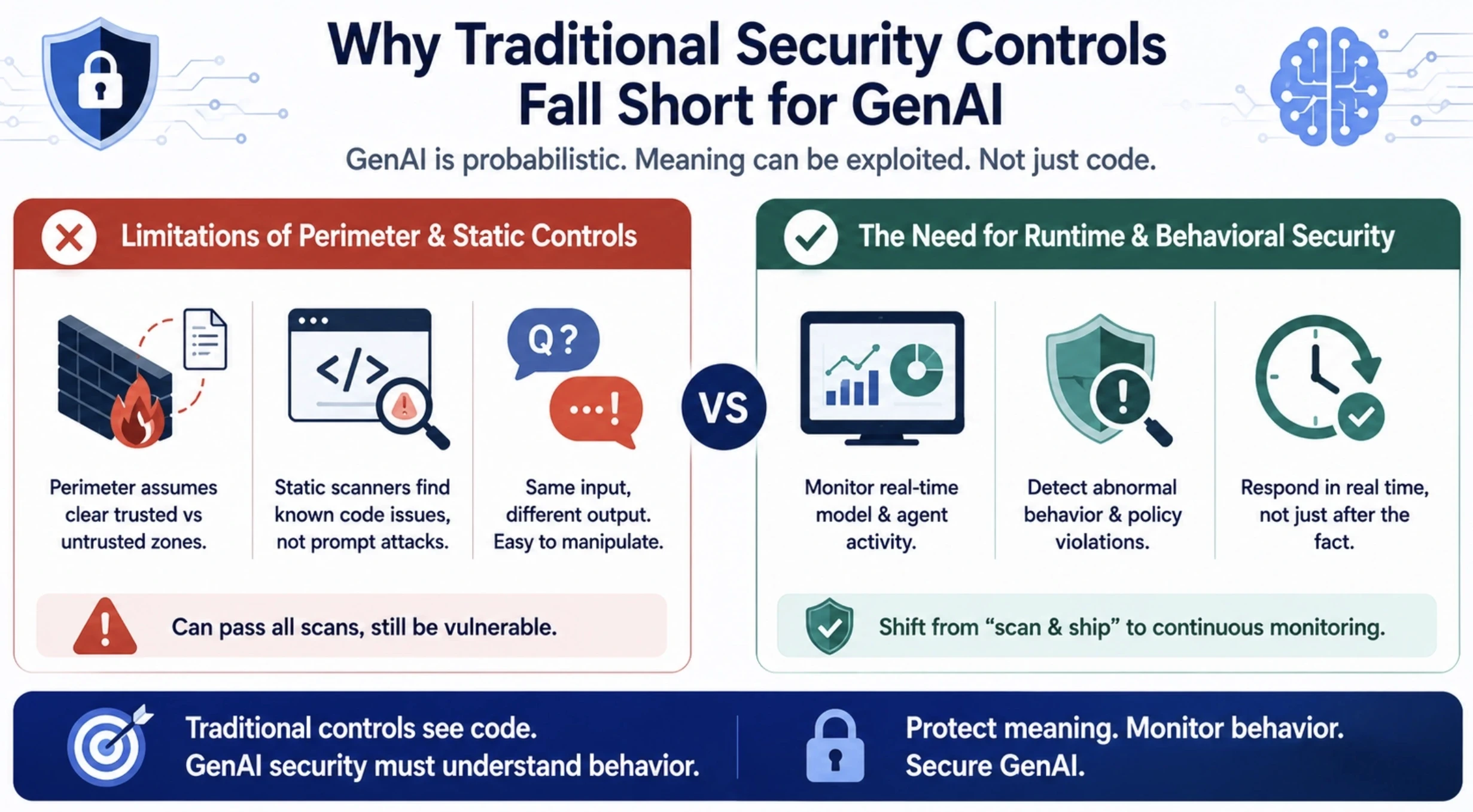
Limitations of Perimeter and Static Controls
While perimeter security always has a clear separation between trusted and untrusted zones, a document uploaded by a user, a webpage loaded by an agent or a tool response returned in the middle of a conversation can all be an injection vector as soon as the model processes them as context. Static application security testing tools are also designed to detect "known" patterns of vulnerability in source code, rather than to test for the impact of adversarial natural-language input on the behaviour of a model. Once the code base is in this gap, it can pass all the traditional scans and ship a model that is trivially manipulated.
The Need for Runtime and Behavioral Security
Unlike most traditional application types, runtime protection is more relevant to GenAI risk than structural protection. Security teams must be able to see and observe the actual production activity of a model or agent, detect when it moves out of the expected bounds and take action in real time, rather than just reacting to a log file. The transition from the "scan and ship" security models to an in-line monitoring model with a focus on the model's live behaviour is a significant move.
Building a GenAI Security Program: Governance, Policy, and Risk Frameworks
Just as in any mature security role, a GenAI security program should be structured, know how it will be used, and always measure risk against the structure. If it is not built on this foundation, individual controls are applied to individual tools and the environment is not controlled.
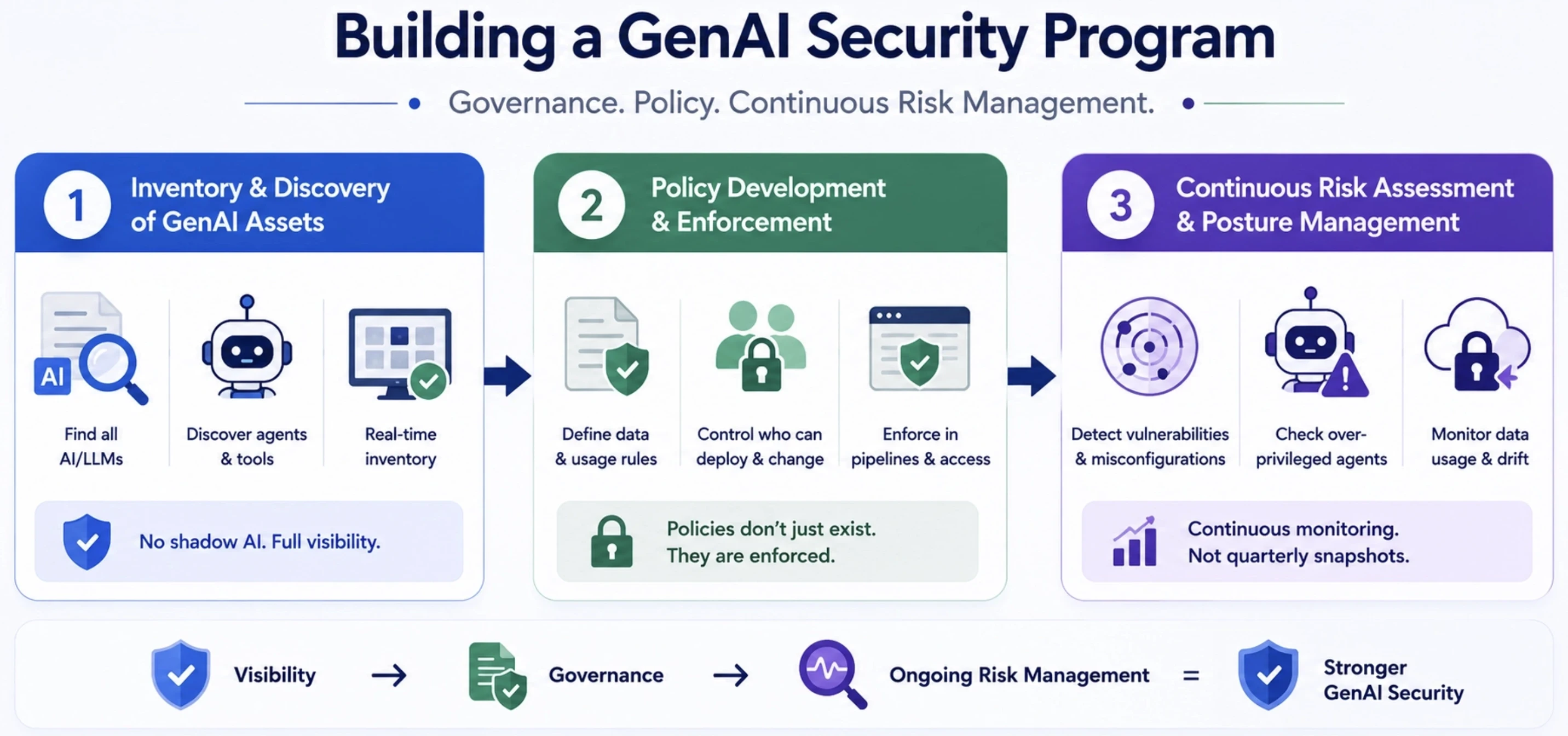
Inventory and Discovery of GenAI Assets
You can't protect what you don't know exists, and GenAI adoption is more likely to be a gradual process, where teams create LLM features, end-users leverage public AI tools, or vendors sneak them into their products. That's where shadow AI is really a governance challenge: unapproved tools running without enterprise policy, with no audit logs, no data restrictions, and no security checks. To address this, Akto automatically identifies and catalogues the different types of LLMs, AI agents and MCP tools in an environment, providing security teams with an inventory in real time rather than a point-in-time spreadsheet that quickly becomes obsolete.
Policy Development and Enforcement
Good AI governance rules create rules from abstract risk concerns: what data should be allowed in which models, what kind of data can be shared with third-party APIs, and who has the right to deploy new agents or tweak existing models. Policies only matter if they're enforced, so it's important to make sure that they're part of deployment pipelines and access systems—not just documented and forgotten.
Continuous Risk Assessment and Posture Management
AI security posture management is an extension of the concepts of posture management, coverage gaps, misconfigurations, and drift detection to the AI stack, specifically. It requires a constant analysis of which models have known vulnerabilities, which agents are too powerful for the tools they are using and where sensitive data is going without proper controls in place. Since GenAI environments are rapidly evolving, with new features being deployed as teams ship, posture assessments must be ongoing and not conducted on a quarterly basis.
Stepwise Mitigation Strategies for GenAI Security Risks
While it is easy to reduce the risk mitigation of GenAI to a checklist, the steps do have a logical sequence, and each step depends on the controls put in place before it: Secure interaction layer first, data and training layer second, and autonomous action layer third.
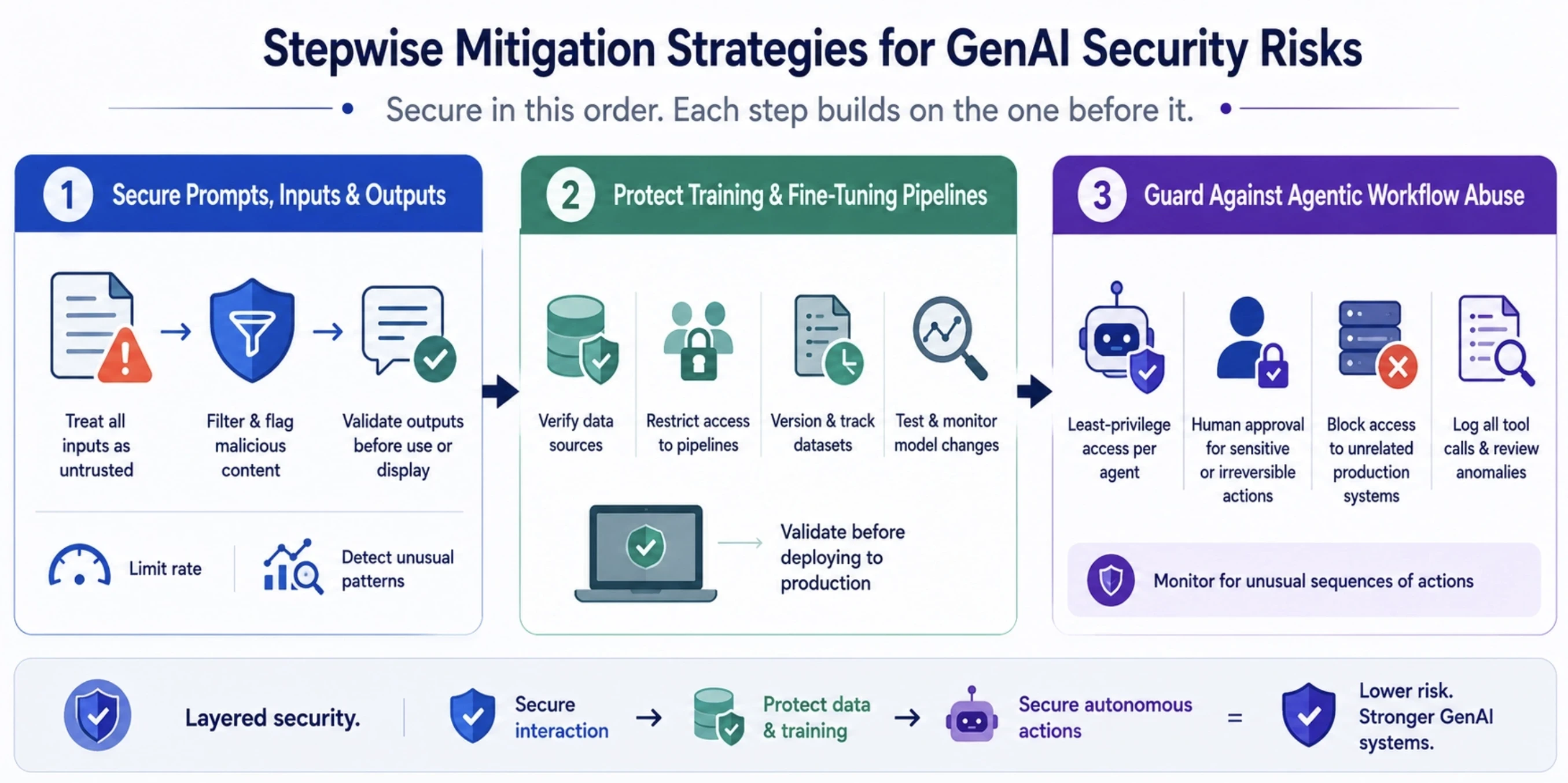
Securing Prompts, Inputs, and Outputs
The first principle of prompt injection prevention is to assume that all data received from any source, be it a person, a textual document or an external API, is malicious. Practical input/output checking: Removal or flagging of embedded instructions in retrieved content; limiting of system prompts to make them less easy to override; and running outputs through a second check before acting on or displaying them. Limiting the rate and detecting unexpected patterns in prompts can also help identify patterns of systematic probing even before they work.
Protecting Model Training and Fine-Tuning Pipelines
One of the most promising ways to reduce risk for AI models is to apply the same approach to training data that well-developed organizations have to open-source software dependencies. This includes checking the source of the datasets, ensuring that only defined users have access to modify the training pipelines, versioning datasets to track the history of changes and testing new versions of a model before releasing it to production to detect unexpected drift.
Guarding Against Agentic Workflow Abuse
Agentic systems require access controls that are very precisely tailored to the individual agent's requirements rather than to the fact that it is an agent. Practical actions include distinguishing access rights for each agent, setting gates on sensitive or irreversible tasks that require human approval, and preventing each agent from accessing production systems they are not responsible for, as well as logging each tool call so that the use of unusual sequences of actions can be scrutinized afterwards.
Implementing Automated, Continuous Security Controls for GenAI Models
Manual review is not catching up with environments that evolve every day with new agents, tools and integrations. As the AI presence continues to expand, automated AI security controls transform discovery, testing, and enforcement into an ongoing process instead of a periodic exercise.
Automated Discovery and Inventory of Agentic AI Assets
With continuous discovery, new LLMs, agents and MCP tools are discovered and catalogued automatically as they emerge in the environment, whether deployed through a sanctioned pipeline or spun up independently by a team. This constant visibility is the key to the rest of the controls in this section, as testing and guardrails can only be applied to assets that are known.
Continuous Red Teaming and Behavioral Testing
A continuous AI red teaming exercise mimics the tools an attacker might use, adversarial prompts, and edge case inputs against production models to uncover vulnerabilities before they become known by real-world attackers. Red teaming should be an iterative process, as model behaviour can change as a result of updates, fine-tuning, or connected tools changes; therefore, the process cannot be checked off at launch time.
Runtime Guardrails and Real-Time Attack Blocking
Runtimes are instrumented with guardrails at runtime: when a prompt injection attack is made, it is prevented from reaching the model; if an agent tries to call an unauthorized tool, the runtime stops it; if an agent is trying to expose sensitive data, it gets redacted before it is sent out of an output. That's where the security in behaviour becomes real, turning policy into automated, real-time enforcement, not after-the-fact review.
Posture Management and Incident Response for GenAI
AI incident response requires playbooks tailored to failure modes, prompt injection attacks, or data leakage through outputs, or an agent taking an unauthorized action, with posture management to monitor risk over time and across the entire AI estate. All of this is housed in one place at Akto: automated discovery and inventory, ongoing red teaming against real-world attack patterns, runtime guardrails to prevent unsafe behaviour, and posture visibility to let security teams know where their AI risk really lies, not from pieces of disconnected tools.
Training, Awareness, and Human-in-the-Loop Safeguards
Without people who understand the risks they are creating when building and operating GenAI systems, technical controls will not be effective. GenAI security training and human-in-the-loop design are the security measures that are able to pick up on what automation cannot, especially on judgment calls that autonomous systems cannot make on their own.
Designing Effective GenAI Security Training
Therefore, the methods and risks of GenAI use must be taught, and while there are many avenues for generic security training, there is no clear equivalent for GenAI security training. Effectively training GenAI security requires addressing prompt injection recognition, safe use of sensitive information around GenAI tools, and the unique risks of shadow GenAI use, in which employees route their company data through unapproved assistants. Training should be tailored to the role: Developers who are extending the model should receive different training levels than those who use an AI assistant day to day.
Human Oversight in Agentic AI Operations
Human in the loop means that sensitive or irreversible actions, financial transactions, data deletion, external communications, etc. must be approved by humans and not fully automated. It isn't a distrust of technology; it is simply a matching of oversight with the consequence of failure. CISOs should ensure that this is combined with secure-by-design processes throughout the development lifecycle – oversight is taken into account, not added on as an afterthought after deployment.
Future-Proofing GenAI Security: Emerging Threats and Evolving Defenses
Potential future security challenges for GenAI will continue to grow proportional to the complexity of the systems that are deployed. The more agents are autonomous and interconnected, the greater the attack surface, and defences must take steps to stay ahead of it.
Anticipating Next-Gen Attack Surfaces
The risks with multi-agent systems do not exist in single-model systems; if one agent is compromised, it can affect other agents with which it interacts, and the agent coordinating the agents can be attacked instead of a single model. The uncertainty is further compounded by third-party foundation models, where organizations may have limited visibility into the training of these models and potential vulnerabilities that could be transferred to downstream systems. Of course, regulatory pressure is also growing, and the handling of data across borders and compliance requirements is a new challenge for AI are only a few of the factors that make secure look like a new definition.
Evolving Security Architectures for GenAI
Security architectures are evolving to a continuous model that considers compromise and concentrates on detection and containment over prevention. See more of a convergence between AI security and current DevSecOps pipelines as AI-specific testing and guardrails become a regular component of the software development pipeline and not a separate, bolted-on function.
Final Thoughts: Operationalizing GenAI Security in the Real World
GenAI model security is not a single project but a discipline that extends from discovery to governance, through threat identification and mitigation, automation, training and evolution. If an organization thinks of GenAI security as an additional AppSec asset, not a unique and different attack surface, they will continue to be left behind.
Akto supports security teams to do this with LLMs, AI agents, MCP tools, discovery, continuous red teaming, runtime guardrails and posture management, tailored to the way these systems operate in production. If your GenAI footprint has outpaced your security efforts, schedule an Agentic AI security demo to learn how Akto can help bring your GenAI footprint back to the ground.
FAQs: GenAI Model Security Risks
1. What are the main security risks of generative AI models?
The primary concerns are data leakage, potential misuse of sensitive data, compliance issues, and vulnerabilities at the model level, such as prompt injection, which occurs when malicious inputs are crafted to alter the model's responses or actions.
2. What is prompt injection in the context of GenAI?
Prompt injection attacks work by exploiting a machine learning prompt by injecting malicious instructions into it; this trick misleads the model into generating harmful or unexpected answers, which it considers to be legitimate input.
3. Why can't traditional security tools protect GenAI systems?
Cloud Security Program Management (CSPM) is a traditional tool used to evaluate cloud infrastructure configurations, but it is not designed to inventory AI models or identify misconfigurations in LLM integrations or attack paths that start in AI workloads and traverse through sensitive cloud data stores.
4. How common is it for organizations to secure their GenAI deployments properly?
Even though 82% of the participants who were asked to say that secure and reliable AI is necessary to the success of their business, only 24% of current GenAI projects incorporate security considerations.
5. What are agentic workflow risks in GenAI?
Agentic workflows come with risks such as data leakage from poorly secured agents, data misuse due to unauthorized access or manipulation, and compliance issues related to data privacy laws such as GDPR and CCPA.
6. How should organizations start building a GenAI security program?
The first step is to identify all the AI systems in the environment, as AI visibility is the cornerstone of tackling the entire stack: models, data, access, compliance, incident response and posture visibility.
7. What controls help prevent unauthorized GenAI actions?
Implement role-based access control (RBAC), limit API permissions, separate models from sensitive environments, securely store credentials, and enforce human approval for sensitive actions.
8. How should incident response differ for GenAI compared to traditional IT?
Playbooks of failure modes specific to AI systems, prompt injection attempts, model manipulation, leakage of data through AI outputs, and generation of harmful content are different from network or endpoint failure modes, and require different muscle memory in relation to GenAI incident response; similarly, tabletop exercises should simulate GenAI incidents rather than network or endpoint incidents.
9. What role does human oversight play in securing agentic AI?
To better protect customer privacy and address the complex risks of GenAI models, CISOs should ensure their approach to software development is human-in-the-loop and also has a secure-by-design design.
10. Are third-party foundation models a security concern?
Yes, there is concern because there is no transparency into third party foundation models, which could bring in new vulnerabilities into an organization's system.
11. Can a single tool solve all GenAI security risks?
Not one solution will fit all of the risks; a variety of solutions will need to be coordinated and tailored to fit the organization's particular risk.

Experience enterprise-grade Agentic Security solution