AI Security Governance: Frameworks, Enforcement and Real-World Controls
Learn how AI security governance works - from NIST and ISO 42001 frameworks to real-world enforcement for agentic and LLM applications.

Rushali

Humans are no longer in the loop for making decisions that are now made by AI, and that's altering the scope of what security teams are responsible for. Each LLM deployment, AI agent, and tool connected to MCP introduces an additional risk that cannot be detected with traditional application security controls. AI security governance fills that gap: It is a set of structured processes for managing risk, assigning accountability and enforcing standards through AI systems from creation to retirement. This is particularly crucial for agentic AI security and LLM application security, where systems are autonomous, they call other tools in chains, and generate unpredictable output. This guide dives into the frameworks that define the current landscape of AI governance, risk management strategies that put it into practice, and controls that bring it into production.
What is AI Security Governance and Why Does It Matter?
AI security governance refers to the mix of policies, controls and governance frameworks to guide an organisation in the safe construction, deployment and tracking of AI systems. From the decision to make a new model available in dealerships to a review and revocation of access to internal tools for an autonomous agent. Governance is not a single security control, but rather acts as the glue that holds risk management, compliance, and technical enforcement together, ensuring organizations do not find themselves in situations where AI adoption outpaces their ability to manage it.
The stakes are getting higher as AI is moving beyond experimentation. Customer support, internal knowledge tools, and even more autonomous agents that call APIs, move data and carry out actions without human intervention - all of this is infused with language models. But without control, each one of those deployments is an uncontrolled risk and has its own unknowns.
Core Principles of AI Security Governance
There are certain principles that appear in all of the thoughtful programs for AI governance, no matter the industry or sector. AI transparency is about being able to know what a system does, what data it uses, and how it arrives at an output, as opposed to a system that is an unexaminable black box. AI explainability takes it a step further and demands that the decisions be traceable to specific inputs and some logic that would enable an audit or a regulatory inquiry.
Holding people accountable is also very much at the heart of this. There must be someone in the organisation taking ownership of the risk the AI system introduces, and not assuming it. The rest of the security best practices most frameworks agree on include least-privilege access, data minimization and continuous monitoring. While none of these principles is new to security teams, their application to systems that create output and increasingly, output-driven action, necessitates a new thought-through approach to the implementation of each one.
Unique Risks in Agentic and LLM Applications
A traditional software package will have the same behavior when it is run with the same input for each execution. LLMs are not. AI agents are not. Most unique risks in agentic AI security and LLM application security can be traced back to that non-determinism. A Prompt Injection Attack can fool the model to forget its instructions or to release information it was not meant to give out. An agent that can use several tools can trigger a seemingly harmless action which will lead to a harmful action by a chain that no single action would be able to trigger on its own.
Agentic systems are more complicated than those that only produce text, as they can act independently as well. While the average human is unaware of the manipulation, an agent with API access, database credentials and/or the ability to call other tools could act on the manipulated instruction before any human is aware of the issue. Governance programs that view AI agents as merely another piece of software are just as oblivious, and that is why agentic risk must be addressed using controls that go beyond traditional application security.
AI Governance Frameworks: NIST, ISO, and Global Regulations
Governance principles are more actionable when you can refer to a framework. AI governance frameworks provide organisations with a common language for risk, a process for documentation, and in many cases, a possible way to show compliance to regulators, customers or partners. Most mature programs aren't based on one standard alone; they incorporate a risk management standard, an internationally certified management system, and they add regional regulation.
NIST AI Risk Management Framework (AI RMF)
The NIST AI RMF is the most widely adopted voluntary AI risk management framework in the U.S. It breaks down AI risk management into four key areas: govern, map, measure and manage. Govern sets up the culture and organization for risk management to work. To identify the context and risks of a particular AI system, map is used. Measure uses quantitative and qualitative methods to evaluate these risks. Manage focuses on the risks and takes action on the risks revealed by the surfaces of measure.
One of the best aspects of NIST AI RMF is that it does not specify particular controls. That makes it a common point of reference in other countries, and one of the reasons it has become a structure for organizations to build around and has other sector-specific requirements.
ISO 42001 and Other Standards
As a new international standard, ISO 42001 is the first standard specifically targeting AI management systems, and like ISO 27001 for information security, it is based on certification. It calls for companies to set up, put into practice, and sustain an AI administration system, such as managing AI risks, lifecycle management, and the like. As it's certifiable, ISO 42001 provides an organization with a means to show a mature governance stance to auditors and enterprise customers, not just to claim.
Other standards that merit attention: ISO/IEC 23894, AI risk management guidance, and the FDA guidance for AI in medical devices, among others. In industries that are subject to regulation, organisations often must correlate their controls to multiple of these at once.
Global Regulatory Landscape
AI regulatory compliance is a moving target for organizations with cross-border operations, as the pace of regulation has not been consistent throughout the world. The EU AI Act is the most thorough one, ranking AI systems by risk level and imposing stringent requirements like conformity assessments and transparency on systems deemed as high risk. AI Act compliance is now at the top of the board agenda for businesses with a presence in the EU market, regardless of their headquarters.
The U.S. regulation is more diffuse, comprising a combination of state laws, industry regulations, and federal guidance, rather than any single law. Other markets are taking steps to create their own solutions, some more similar to the EU's risk-based approach, and others favoring sector-specific rules. It is no longer a one-off compliance task but a continuing duty of AI governance teams.
AI Risk Management: From Assessment to Continuous Monitoring
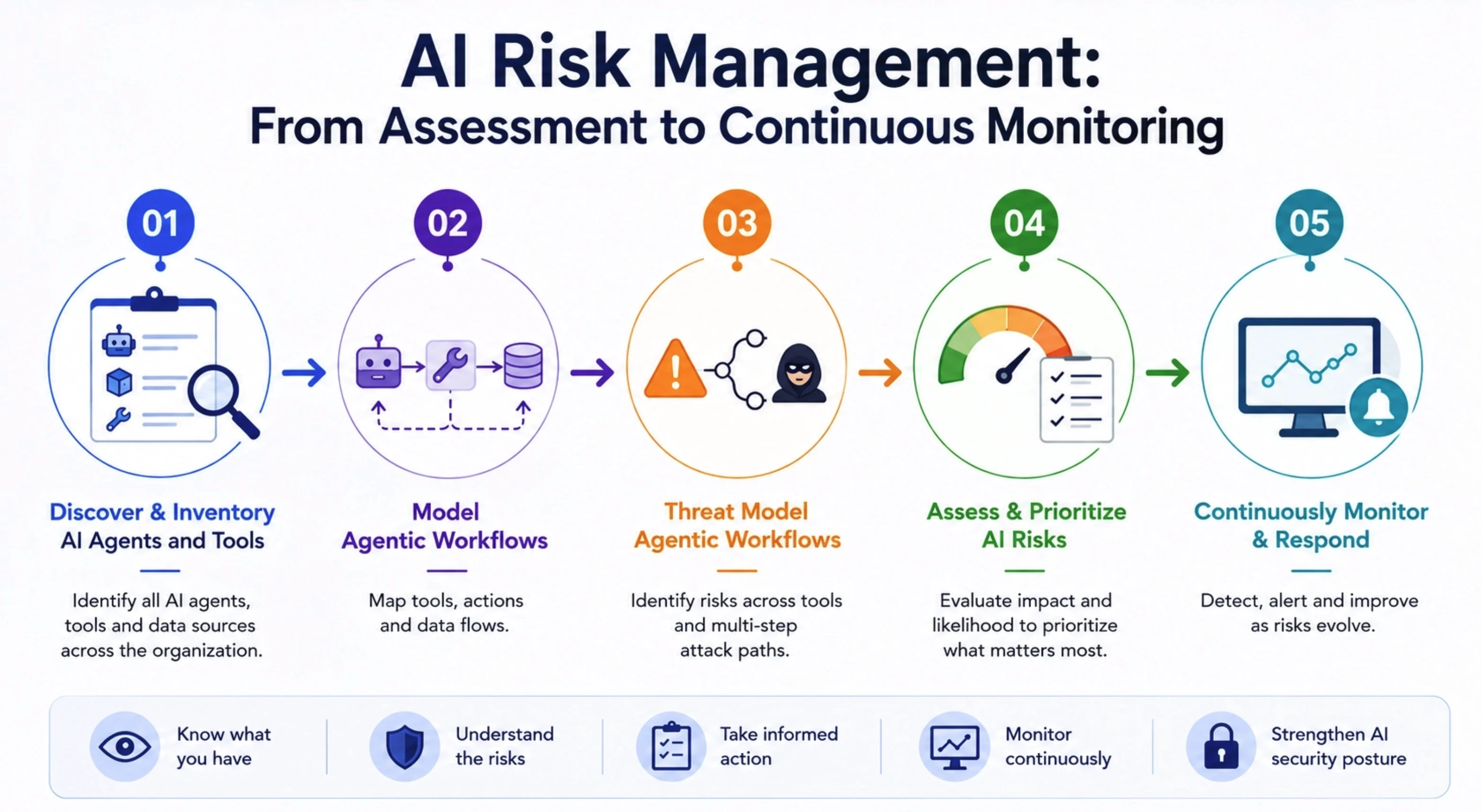
AI risk management is the day-to-day application of frameworks that make good governance a reality. It begins with understanding what AI systems are in place in the organization, and it involves continual monitoring of their operation after deployment, as risks in AI systems are not static following a one-time review.
Discovery and Inventory of AI Agents and Tools
The first place that organizations discover they lack when they begin a governance program is the ability to control what they can't see; that's the power AI models bring. Many organizations that have not developed an inventory process have unsanctioned LLM integrations, agents created by individual teams without security review, and shadow AI use. A full inventory should also include what tools and data sources are available for each AI agent or LLM application.
It is one of the places where automated tooling has an impact on manual tracking. As an agentic AI discovery capability, Akto automatically catalogs MCP servers, AI agents and the tools and resources they connect to on cloud, infrastructure and even on employee devices, making the inventory process manual and incomplete now complete and visible in real-time.
Threat Modeling for Agentic Workflows
After an inventory is created, it is necessary to consider threat modeling the agentic workflows and their actions, not just the traditional applications. That means charting out tool chains: What if an agent who has access to a customer database has access to an email-sending tool, and a maliciously typed input tells the agent to meld the two. It implies thinking about the possibility of altering an agent's behavior by modifying its internal state as opposed to the actual model it is interacting with, even when the modifying tool is located within an MCP server.
Multi-step attacks that involve multiple malicious steps need to be considered as well when performing threat modeling for agentic systems. Security teams with only a single turn in mind will lack the attack patterns that are unique to autonomous, tool-using systems.
Roles, Accountability, and Organizational Structures
Governance can only be effective if someone is responsible for it. Artificial Intelligence (AI) governance roles and clear accountability structures are essential for turning governance into a reality that influences the development and use of AI. Defining AI governance roles and creating clear accountability structures can be the difference between a governance program that exists on paper and one that has a real impact on how AI gets built and deployed.
AI Security Governance Committees and RACI Models
The majority of mature organizations form a cross-functional AI security governance committee comprising security, legal, compliance, data science and engineering leaders. This team is the one to make the policy, to review high-risk deployments and to handle issues of disagreement between the fast-moving teams and the risk-focused teams.
This committee is not a bottleneck when a RACI model is created and this model outlines who is responsible, accountable, consulted, and informed for every governance decision. There has to be an owner of the decision to give an agent access to a new tool or data source, which is why it needs to be its own line in the RACI: someone else must take that responsibility, and it cannot fall on the engineer who created the integration.
Incident Response and Auditability
If an AI system fails, for example, if it hallucinates something that causes harm to customers or an agent does something unauthorized, the organisation must have a response plan that takes into account the types of failure that may be unique to AI. That is incident response playbooks that address prompt injection, data leakage via cascaded agent operations and model behavior drift, not just common breach scenarios.
This is made possible with an AI audit trail after the fact. All major model interactions, tool calls, and agent decisions should be recorded in a manner that will allow for the investigation of incidents and external audit. If this logging is not in place, an organization may not be able to determine what an agent did during an incident, impairing the response and potentially any regulatory investigation.
Integrating Security and Governance in Agentic and LLM Applications
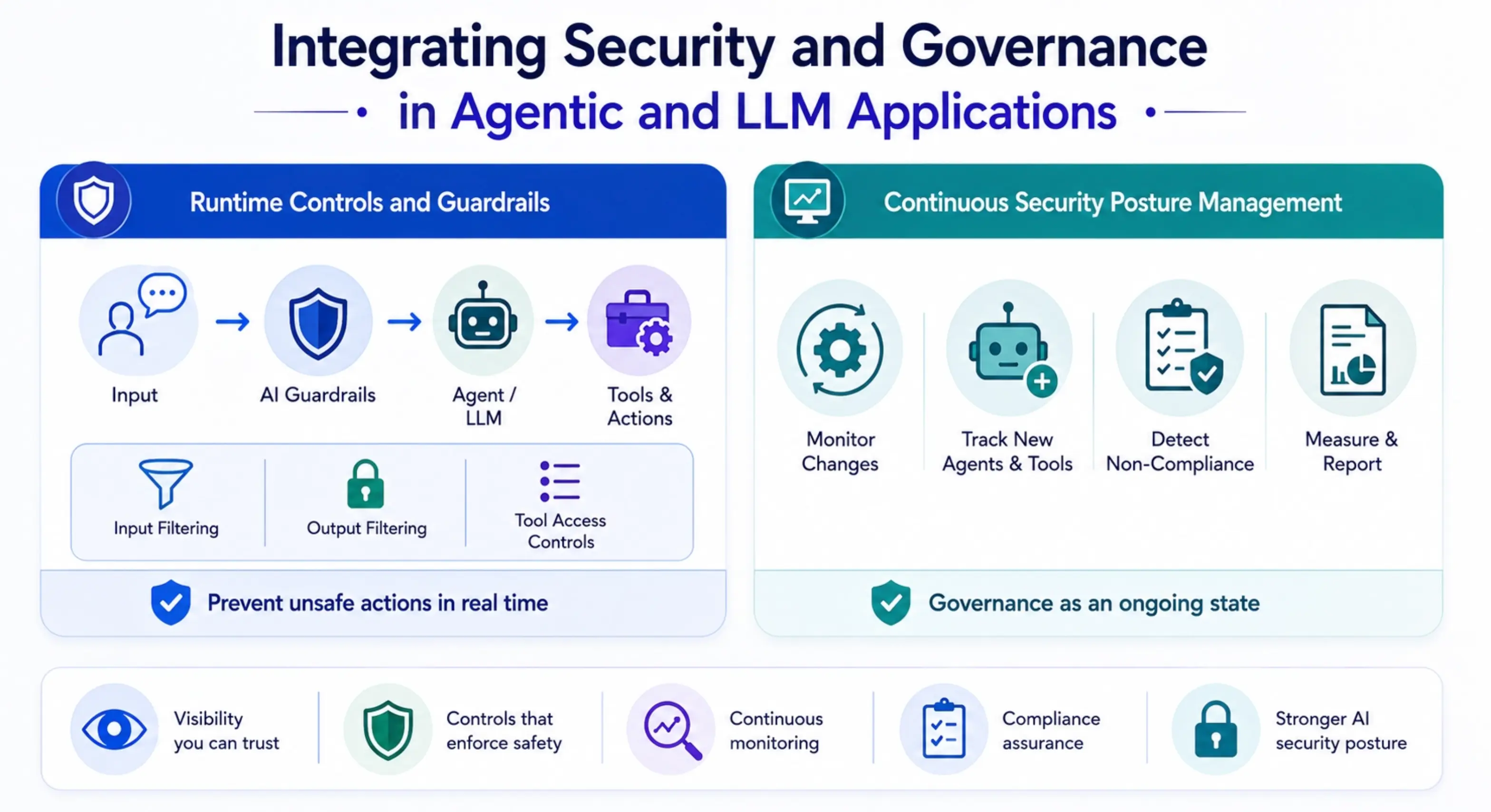
While policy and organizational structure help to define the direction, the security controls will actually prevent unsafe behavior in a running system. The challenge of integrating security into agentic and LLM applications is to incorporate enforcement into the architecture, rather than just highlight what they should expect to happen.
Runtime Controls and Guardrails
AI guardrails are then the runtime layer that filters inputs and outputs, sets access limits and prevents actions that go beyond approved behaviour. Prompt injection can be prevented from reaching the model by input filtering. Output filtering can be used to prevent sensitive data from leaving the system, even if a model is modified to attempt to expose sensitive data from the system. However, guardrails for agentic systems must also specify which tools an agent can call and when, as the worst failure occurs at the point of action, not just generation.
Continuous Security Posture Management
The continuous monitoring nature of cloud and application security is also applied to AI systems, which is known as AI security posture management. This includes tracking changes of configuration in guardrail policies, tracking the agents added to new tools since the last review and flagging models and integrations that are out of compliance with the guardrails governance policy. Posture management can transform governance into an on-going state, not just a snapshot of a point in time, which can be measured and reported on.
Automated Red Teaming and Continuous Testing for AI Security Governance
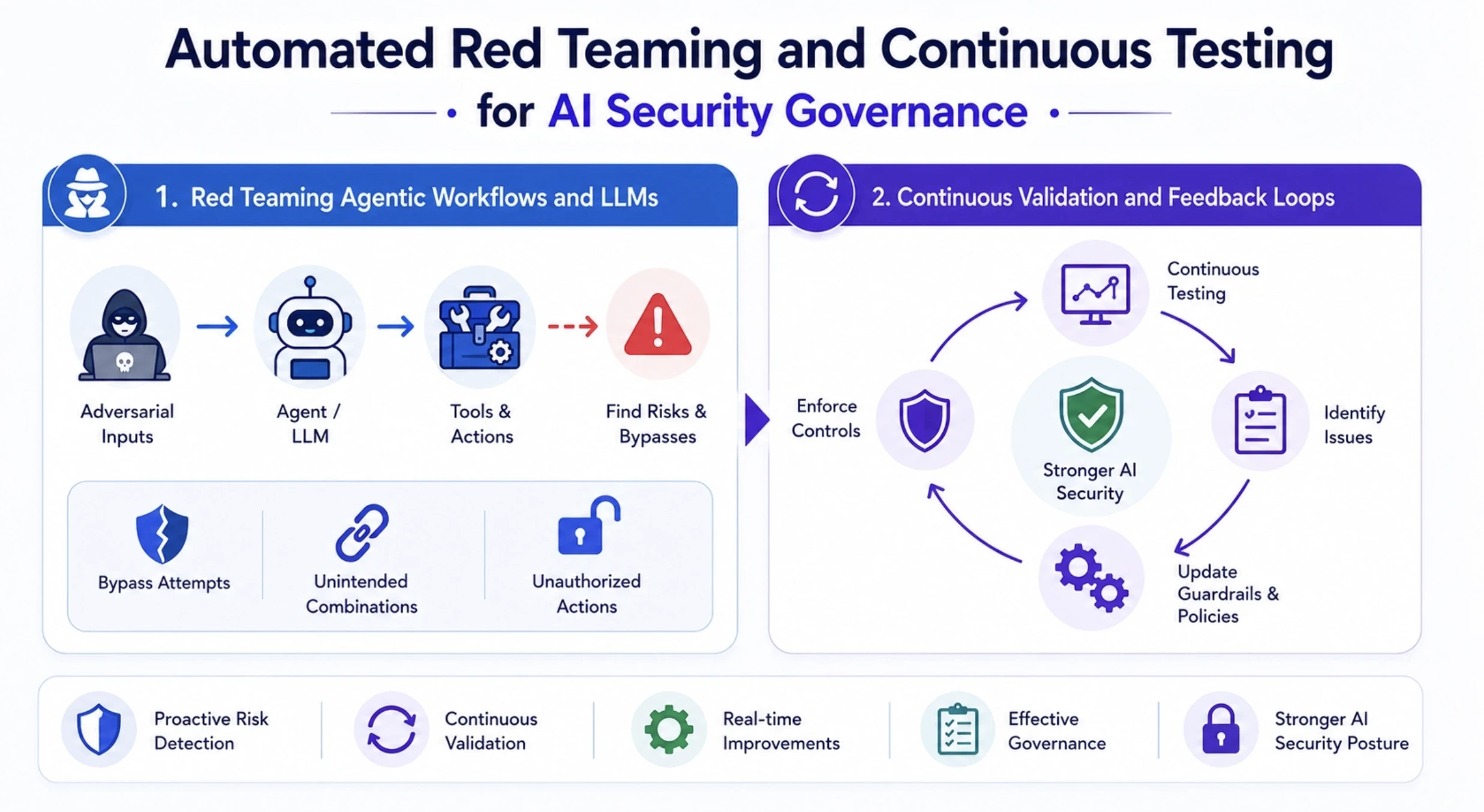
Governance programs can only be assured of the effectiveness of their controls via AI red teaming, but even the best guardrails and policies must be tested with actual attack methods. While manual red teaming will have its place, the frequency of model, prompt, and agent changes requires continuous, automated testing to stay current.
Red Teaming Agentic Workflows and LLMs
An adversarial prompt aimed at getting around safety instructions, obtaining training data, or even causing an unintended action is often a crucial step in red teaming an LLM. Red teaming an agentic workflow must go beyond that and determine whether an agent could be tempted to use a tool for which it was not intended, the ability to connect actions together in an unexpected way, or to use it without authorization. This is anything from an attack pattern using the tool to try to manipulate an agent's execution path, to a malicious input that fools an agent into bypassing a validation step that it is supposed to perform.
Continuous Validation and Feedback Loops
The red team exercise is a snapshot of this system's condition on the day of the test. Since models are continually updated, prompts are continually iterated, and agents are continually given access to new tools, validation must be continuous, not periodic. The Red team results should be directly incorporated into the guardrail configuration and policy adjustment, thereby closing the gap between testing and enforcement, and not simply be added on to a report that is ignored.
Enforcing AI Security Governance in Agentic and LLM Applications
All frameworks and policies have to be implemented at the level of the actual consequence of a bad outcome in production. AI governance enforcement is when governance is enforced: automated discovery, testing, and runtime controls; policy isn't just documented but enforced for all AI agents, LLM applications, and MCP tools within the environment.
Akto's Approach: Automated Enforcement and Posture Management
AI security governance is not an annual review, but an ongoing, automated process at Akto. The platform identifies and indexes servers, AI agents and tools that those AI agents connect to throughout an organization's infrastructure and even employees devices, providing the security team with the inventory that governance relies on. Afterwards, Akto automatically tests agentic workflows and LLM applications for known attack patterns and monitors for broken authorisation, while also providing runtime guardrails to prevent unsafe actions from affecting the application. Governance policies remain enforced and don't become stale documentation, as agents gain new tool access or configurations change over time. While agents gain access to new tools or while tool configurations change, Akto's agentic security posture management layer ensures that enforcement remains current.
Case Study: Real-World AI Security Governance with Akto
Think about how an AI Security Governance approach could be applied by a security team in a typical enterprise. The team begins by identifying them: Akto's agentic AI discovery tool is deployed across the cloud infrastructure and workstations of employees to uncover all LLM integrations and AI agents, even those that have not been formally reviewed. These assets are the starting point for governance policy: who should have access to which tools, what classifications of data should be protected by more controls, and what integrations should be phased out.
The team then adds ongoing red teaming on the most vulnerable agentic workflows to further constrain guardrail configurations, to be further restricted when forced by an incident. Run-time protection then keeps those guardrails in check with traffic, and posture management provides the security team with a heads-up when new agents or tool integrations come into play. This is because the outcome is a governance program that is a continuous loop instead of just an annual checklist, that is, one that is up to date with the pace of agentic AI system evolution.
Final Thought: Operationalizing AI Security Governance for the Future
AI security governance becomes real when an autonomous agent is given access to a real system, a real customer or real data. While AI frameworks such as the NIST AI RMF and ISO 42001 provide a framework for managing that risk, these structures can't prevent the use of a prompt injection attack or an agent abusing a tool the organization doesn't have access to. This requires discovery, ongoing red teaming and runtime enforcement to work together as one operational loop.
Akto connects that circle to agentic and LLM applications, finding all AI agents, constantly testing them, and enforcing guardrails in real time that ensure governance policy is upheld. When your organization is ready to take AI security governance from document to action, book an AI security governance demo with Akto to see how it integrates with you.
Frequently Asked Questions: AI Security Governance
1. How is AI security governance different from traditional IT governance?
Traditional IT governance is about systems with a known predictable behavior. Non-deterministic outputs, autonomous decision-making, prompt injection, and agentic, self-directed workflow actions are some of the other aspects of AI that need to be considered when it comes to security governance.
2. What frameworks are used for AI governance?
There are several widely used AI frameworks, such as the NIST AI Risk Management Framework (AI RMF), ISO/IEC 42001, and upcoming regional laws like the EU AI Act. Most organizations use more than one framework for the purposes of risk management and compliance.
3. Is ISO 42001 mandatory for AI governance?
While ISO 42001 is not a mandatory standard, it has become a standard to showcase a robust AI management system to regulators, customers, and partners.
4. What are the biggest security risks in agentic AI applications?
Uncontrolled access to tools and APIs, prompt injection, data leakage via chained actions, poor audit trails, and agents performing autonomous actions without human supervision.
5. Who should own AI security governance within an organization?
Most mature organizations use a cross-functional AI governance committee involving security, legal, compliance, data science, and engineering leads, often structured with a RACI model to clarify decision rights and accountability.
6. How often should AI systems be red-teamed?
Given how frequently LLMs and agentic workflows are updated, red teaming should be continuous or triggered by every significant model, prompt, or tool-access change, not treated as a one-time or annual exercise.
7. What is runtime enforcement in AI security governance?
Runtime enforcement refers to real-time guardrails, like input and output filtering, access controls, and behavior monitoring, that stop unsafe or non-compliant AI actions as they happen, rather than relying solely on pre-deployment testing.
8. Can AI governance be automated?
Yes. Platforms like Akto automate discovery, posture management, and enforcement, reducing manual oversight burden while maintaining continuous visibility into AI agent behavior and compliance status.
9. What's the first step to building an AI security governance program?
Start with discovery and inventory, identifying every AI agent, model, and tool in use across the organization, since you can't govern or secure what you don't know exists.

Experience enterprise-grade Agentic Security solution