AI Agent Identity Security Risks: The Complete 2026 Threat Landscape
The real risks created by ungoverned AI agent identities - ranked, quantified, and backed by 2026 data - from over-privileged agents to credential theft.

Bhagyashree

Nearly half of all security professionals 48% now say the top attack vector heading into 2027 will be agentic AI and autonomous systems, eclipsing concerns about deepfakes, ransomware, and supply chain compromise. And this concern isn’t isolated - a new survey this year shows a whopping 92% of all security professionals worry about the effects of AI agents on their organization. It all comes back to a problem that nearly all organizations still struggle to solve: identity.
AI agents don’t log in like people; they hold standing credentials, cascade permissions across systems, and operate at machine speed autonomously, often with higher permissions and no sessions in place that act as gate checkpoints to stop compromises before they gain steam.
One stolen password to one system causes one bad login. A stolen credential from an agent can enable tens of thousands of automatic actions before anybody notices. The gap between how fast agentic systems can act and how slowly our identity systems have adapted explains why both of these stats are skyrocketing. And this is what the rest of this piece unpacks.
What is an AI Agent Identity Security Risk
AI agent identity security risk is a risk that originates from the agent’s authentication, authorization, and monitoring mechanisms related to the execution of the agent on the systems and data to be processed, distinct from the risks presented by the agent’s model behavior or its infrastructure. In other words, the agent’s identity must provide it with legitimate opportunities to perform particular functions involving accessing specific data and be accountable for its actions.
Overall, any vulnerabilities in these aspects can be considered agent identity security risks, thereby comprising the agent’s attack surface. However, unlike in the case of other security risks, an agent’s identity is not static. This is primarily because agents perform their operation by relaying on different tools and can forward requests to sub-agents, or resort to action chains that involve behaviors not anticipated by the permission model, thus continuously shifting the trust paradigm.
Why AI Agent Identity Has Become the Top Security Concern of 2026
AI agents now read email, query databases, and call APIs across enterprise systems with little human oversight. That autonomy has made agent identity, not model safety or hallucination, the top security risk of 2026, as agents don't fit the human or service-account molds that identity programs were built around.
The Scale of Adoption vs. the Readiness Gap
Non-human identities already outnumber human ones inside most enterprises, and agentic AI is widening that gap fast. Many are created ad hoc and outlive the project that spawned them, becoming "orphaned" accounts with no clear owner. Visibility hasn't caught up: most organizations can't reliably tell agent activity from human activity, and credential rotation and offboarding remain rare. An overprivileged agent, acting at machine speed across many systems, carries a far bigger blast radius than an overprivileged human account.
What Regulators Are Already Saying (U.S. DoW Guidance, EU AI Act Deadlines)
The U.S. Department of War is pushing rapid, large-scale agent deployment through its 2026 AI Strategy. Meanwhile, the EU AI Act's high-risk deadlines were just pushed to December 2027, though transparency rules still apply in August 2026, leaving agent identity governance largely up to enterprises themselves.
What are the top AI Agent Identity Risks
Here is each bullet point condensed to fifty to seventy words:
1. Over-Privileged and Excessive-Entitlement Agents
The agents are granted access rights to ensure that everything works correctly; they hardly get limited. In most cases, the least privileged agents are used when addressing a specific issue but not for the entire system. As a result, each agent integration could cause disastrous effects if one privilege had been compromised since they have access to everything that they have been privileged to.
2. Static or Hardcoded Credentials
Some agents require authentication credentials to execute their functions, making them vulnerable to attacks. The credentials, however, are often hardcoded in the configuration files, scripts, or environment variables. The compromised information is used to gain unauthorized access to a greater number of systems since it remains the same, thus eliminating the need for constant changes as would be the case with human-generated passwords.
3. Limited Visibility and Logging
Most agents operate by relaying on each other through sub-agents, making it hard to track down the exact one responsible for a particular issue. When an organization lacks the visibility and auditing capabilities required to monitor and record everything that every agent does, there is no way of knowing what exactly happens within their systems. It also implies that there are blind spots, hindering the detection and response to suspicious activities.
4. Prompt Injection and Identity Spoofing
Various websites have been compromised to create malicious prompts that could mislead users into giving out their credentials. Some attackers could also use prompts to make agents in their systems act on their behalf. This is because the prompts could run automatically and on the authority of the legitimate agent without requiring any input from the user.
5. Insecure Tool and Plugin Integrations
Developers design the agents to make the most out of the various tools at their disposal, relying on their authenticity and security. However, the tools and plugins lack the same level of protection as the agents, making them weak points where attacks originate. One must never underestimate the vulnerabilities that prompt injections present, especially when working with agents.
6. Data Exfiltration via Agent Outputs
Exfiltration of data through the outputs of agents is a serious concern because of their ease and reliability. The problem emanates from the fact that most agents generate their results through their outputs, making it possible to manipulate them and target crucial data. The compromised data could then be extracted in a file, API call, or response and encrypted automatically without anyone realizing.
The Risk Nobody's Talking About: Attacks With No Technical Exploit
Every risk assumes a technical foothold. This one does not - it exploits language, trust, and interpretation instead.
Governance Takeover Through Natural Language Alone
Requires no technical foothold - no malware, stolen credentials, or exploited vulnerability.
Agents are governed by natural-language instructions (system prompts, policies, requests).
An attacker who can influence that language can redirect behavior or permissions interpretation.
Phrasing alone can convince an agent a restricted action is authorized.The compromise happens entirely through reshaping how the agent understands its own mandate.
Why Traditional Detection Tools Miss This Category Entirely
Security tooling is designed to detect technical indicators: malware hashes, anomalous traffic, unauthorized API calls.
A governance takeover produces none of these signals.
The agent uses its normal, legitimate credentials and tools exactly as intended.
The compromise lives in how the agent interpreted its mandate, not in any technical action.
Requires a different layer of defense: semantic monitoring, independent policy enforcement, and human checkpoints for high-impact decisions.
Credential Hygiene Failures Specific to Agent Identities
Agent Identity-Specific Credential Hygiene Failures: For too long, agents haven’t been considered insiders-and attackers are leveraging that oversight at unprecedented speed.
The Confidence Gap:
Only 19% Consider Agents to be Insider Threats. Organizations are still thinking of AI agents as tools rather than identities-a classification gap that leads to a governance gap. According to a joint report by DTEX Systems and Ponemon Institute, only 19% of organizations classify AI agents as being the same as human insider threats.
Agents that slip under the insider threat radar don’t receive the access reviews, baseline monitoring, or off-boarding procedures applied to human privileged users, despite often being assigned standing high privilege.
The 89% Increase in AI-Enabled Adversary Attacks:
Attackers are also moving faster. CrowdStrike’s 2026 Global Threat Report revealed that AI-enabled adversaries are ramping up their activities by 89% year-over-year, weaponizing AI for reconnaissance, credential theft, and evading detection. Perhaps most tellingly, 82% of those detected involved no malware-adversaries were using valid credentials, established trust relationships, and accepted SaaS integrations to traverse environments. This change is critical for agent credential hygiene: If attackers are compromising identity paths that appear “trusted” and using no malware to do it, static or unrotated agent credentials represent an even greater attack target, granting exactly the “trusted” access security teams expect to fly below the radar.
Shadow AI as an Identity Risk, Not Just a Policy Problem
Shadow AI presents an interesting risk surface as not only policy-violating but as identities with access that aren’t governed. I think the problem is much bigger than the policy aspect because any unsanctioned agent is an unmanaged identity with access, which can be a problem for organizations.
Unsanctioned tools as ungoverned agent identities
Anytime someone creates an agent or connects an external tool without security approval, that creates a new identity not under any other governance system. There is no baseline for assessing their risk because they didn’t come from anywhere, and there is no inventory of these agents for security to review. These agents are given OAuth scopes or API access to perform their intended functions, but because they weren’t reviewed, their access isn’t necessarily limited in any way. In addition, most of the time, no one is responsible for these agents, which means they can linger long after their initial creation date with no one being accountable for decommissioning or reviewing their access.
Builder risk surface: Compromised builders as an attack surface to agents
The risk surface of creating or building agents is also something to consider since the people building the agents most likely have access to every other system in the stack, like code repositories, API keys, cloud providers, etc., to construct the agent in the first place. This makes the builder’s identity a prime attack surface to compromise and gain access to every other system in the environment through the agent. A compromised user account can provide threat actors with a foothold inside the organization to manipulate the agent’s code or configurations to expand their attack surface later.
What Happens When These AI Agentic Risks Materialize
Failure to address the dangers associated with agentic AIs will not only raise the probability of an incident but also impact breach-related timelines and regulatory expectations.
The Forrester Predicts that an Agentic AI-Driven Breach is Coming
The threat is real, according to Forrester’s cybersecurity research, which foresees the breach fueling dismissals that could trigger an early public report of the first genuinely significant AI security incident. Forrester analysts emphasize that the issue is one of governance and not an act of aggression, noting that the problem is that businesses are rushing to adopt agentic processes without adequate oversight or access restrictions. They highlight that the danger of multiple “agent” interactions lies in the possibility that a mistake made by one of them may propagate through the chain rather than being immediately visible and isolated.
EU AI Act’s Risk of Exposure to Regulatory Scrutiny
This paragraph covers recent updates, as negotiators in charge of the EU AI Act have agreed on a much-needed delay in high-risk AI requirements as part of a broader regulatory relief package. As a result, standalone systems operating in domains connected to employment, essential public services, and other restricted areas will have more time to prepare, while those built into larger, mixed systems will have an extended transition period. Note that transparency regulations still take effect on the initially planned date, and that the existing general provisions on AI remain fully enforceable.
Practically speaking, this means that enterprises have more breathing room before the high-risk agentic AI systems’ auditing, human checks, and traceability requirements are fully enforced. However, legal counsel warning their executive counterparts not to count on this reprieve to halt their preparations is correct, as the discovery and risk assessment of all agents taking part in the process will be time-consuming and not particularly paperwork-intensive. The fine for failure to comply remains either a percentage of the organization’s worldwide revenues or a substantial sum specified directly by the legislation.
Mitigating AI Agent Identity Security Risks
There are two primary approaches to addressing risks associated with AI agent digital identities: controls over agent entitlements and the organizational accountability for agent-related risks.
Foundational Controls
The first set of controls addresses agents as identities. By considering agents as first-class identities, one may begin applying a variety of foundational controls that would generally be applied to users but may have been previously overlooked for agents. Examples of controls in this category include the principle of least privilege and just-in-time entitlements for all agents, reducing their access credentials to short-lived dynamic assertions, and centralized auditing and logging of agent activity with clear assignment of all actions to a particular agent, session, and delegation chain. In addition, agents should have validation of their outputs and tool calls
before executing any high-risk processes, have each available tool and plug-in that can be used validated, and have the implementation of output filters designed for generative interfaces and not traditional network communications.
Accountability
While technical controls are critical, they must be supported by organizational accountability for mitigating agent-related risks. This aspect requires that agents fall under established insider risk management and identity governance frameworks. It also mandates the allocation of responsibility for reviewing and auditing agent activity, entitlement reviews, and kill switches or other mechanisms that allow the immediate deactivation of any rogue agent that would attempt to circumvent security controls.
Finally, organizational accountability implies that there should be executive oversight and visibility into the agent inventory to prevent any shadow agents from evading the existing entitlement review processes, especially those with higher-risk privileges that could be abused by threat actors. The organizational accountability component also involves segregation of duties and operational ownership for agent-related tasks, such as development, maintenance, and operation, combined with continuous monitoring of agent-related entitlements or the ability to access them, as with traditional privileged access management solutions. Such checks and balances prevent any single entity within the organization from being able to bypass the security controls and cause damage to critical systems.
How Akto tackles the risks from AI agent identity
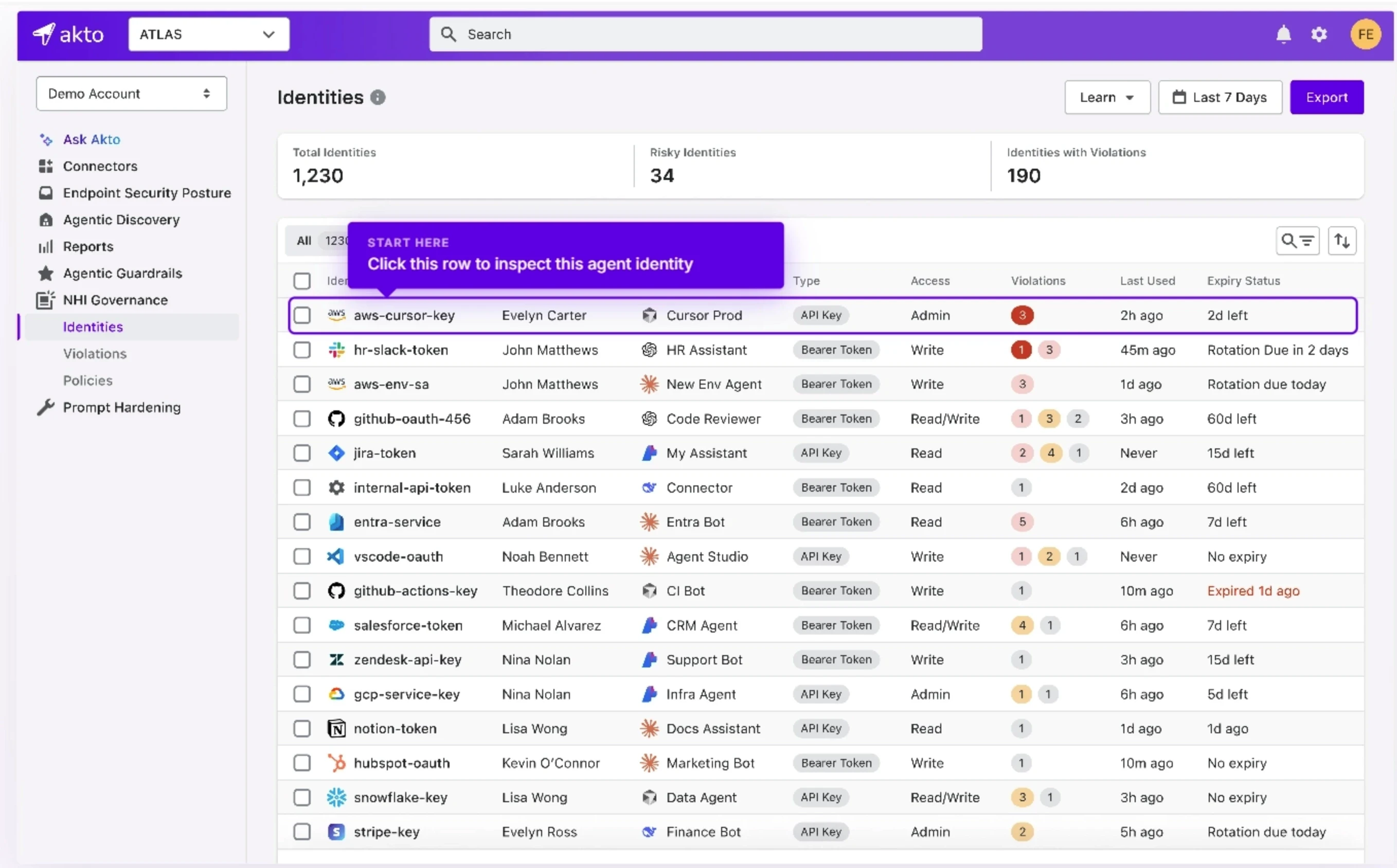
Most IAM programs are not prepared to deal with the unique challenges posed by AI agents. Akto's new AI Agent Identity product directly addresses each of the risks described in this article.
Akto tackles the discovery challenge first, finding all non-human identities associated with an agent, including API keys, bearer tokens, and OAuth credentials, and linking them to the agent using the credentials, who is responsible for them, and what scope they provide, solving the ownership and blast radius challenges of entitled agents that can make privileged queries and calls.
Akto then applies agent-aware IAM policies (least-privilege, scopes, rotation schedules, approvals) for each agent individually and across fleets, addressing the risks of static credentials, over-entitled agents, and lack of approval workflows for all these non-human identities.
But the biggest difference is in how Akto handles policy violations. When an agent violates a policy, Akto detects and reports the immediate blast radius of the violation and suggests how to remediate the risk, with a full audit trail and visibility into agent action and decisions. This addresses the discovery and logging challenges by giving security teams visibility into agent actions and decisions.
Unlike IAM tools built around the idea of non-human identities that follow scripted operations, Akto's agent security tools recognize that agents often make decisions and operate autonomously, taking action outside of predefined sets of allowable operations. This allows Akto to implement agent-specific IAM policies that address the risks of default administrative credentials, unauthorized use of agents, and the expansion of agent capabilities beyond their initial scope.
Finally, this approach is part of Akto's holistic approach to agent security that includes Agentic Discovery, Agentic Guardrails, and Red Teaming across attack surfaces. Agent Identity is another layer of security integrated into the broader agent security program, as opposed to relying on a set of disparate tools that only address individual aspects of agent risk.
Final Thoughts on AI Agent Identity Security Risks
AI agents increase identity risk surface areas that companies have already struggled to control (privileged access, credentials, visibility) exponentially faster than human operators. The twist with agents is their vulnerability to attacks that target language models directly, and their lack of first-class identity management, typically as they are deployed and operated by another entity. This makes their governance, security, and access management critically important.
Frequently Asked Questions: AI Agent Identity Security Risks
1.What are the biggest AI agent identity security risks in 2026?
Over-privileged agents that are given entitlements greater than their need-to-know, agents with static/hardcoded credentials, lack of agent visibility/logging, prompt injection and spoofing, insecure tooling/integrations, and data exfiltration from agent outputs – in addition to takeover of agent permissions through language model capabilities and shadow AI.
2.What did the U.S. and Five Eyes guidance reveal about agentic AI?
Australian Signals Directorate’s Australian Cyber Security Centre, the U.S. Cybersecurity and Infrastructure Security Agency and National Security Agency, the Canadian Centre for Cyber Security, the New Zealand National Cyber Security Centre, and the UK’s National Cyber Security Centre jointly warned that agentic AI should only be used for low-risk and non-sensitive operations, and should not be granted access to sensitive information or critical infrastructure.
3.Can attackers take over AI agents without any code or prompt injection?
Yes, because of governance takeover. Since agentic AI processes instructions in natural language, an attacker with the ability to modify the prompt can fool the model into believing that a particular request or action is authorized, even if it is not. This does not require any code or prompt injection.
3.What is “governance takeover” and why is it such a concern for AI agent security?
Governance takeover refers to the ability of an attacker to modify an organization’s policies or rules related to an AI agent to gain unauthorized access or take advantage of the system. Since natural language processing dominates the input method, the attacker can modify the prompt or modify the language model’s interpretation of the prompt in a way that makes it believe that a particular instruction is authorized when in fact it is not. The attack is successful because the model follows the new instructions using its entitlements and tools, as if they were legitimate.
4.How can organizations reduce the risk of data exfiltration from AI agents?
By enforcing data loss prevention policies that apply to data outputs from AI agents as well as traditional channels, limiting the amount of data that can be processed by an agent, and ensuring sensitive data is validated before being used in an agent or output by an agent, especially for high-impact actions such as file download or webhook callback.
5.How does Akto help detect and mitigate AI agent identity security risks?
Akto enables organizations to discover, inventory, and monitor all agents, MCP servers, and tools in their environment. It continuously identifies risky behaviors and provides remediation guidance through red teaming and posture management, and takes an agent-native approach to identity and entitlement security, surfacing violations in the context of the specific agent, its blast radius, and potential remediation options.

Experience enterprise-grade Agentic Security solution