AI Guardrails Tools: A Framework for Choosing by Architecture
AI guardrails tools classified by deployment architecture - gateway, sidecar, SDK, and endpoint - so you can match the tool type to your actual stack.

Arpashree

The question most teams ask is which AI guardrails tools rank highest. That's the wrong first question. The right one is which guardrails deployment architecture actually fits where your AI runs, since a tool built for one architecture can be genuinely excellent and still be the wrong purchase for an environment it was never designed to sit inside. If you want a ranked list of specific vendors, that lives on our AI security tools page. This page answers a narrower, more foundational question first: which of the four common architectures for AI guardrails tools matches your actual stack, before you ever start comparing named products against each other. Getting AI guardrails tool selection right means solving this architecture question first and treating vendor comparison as the second step, not the first.
Why Architecture Matters More Than Rank
A guardrails tool built as an SDK library, meant to be embedded directly in application code, can be the best SDK on the market and still be entirely useless if most of your organization's AI traffic runs through a shared model gateway that no individual application team controls. The reverse is just as true: a gateway-based tool that excels at intercepting API-level traffic has no visibility into what happens inside a sidecar-deployed agent running in its own container, reasoning and calling tools in a process the gateway never sees. Ranking tools against each other without first establishing which architecture you actually need produces a shortlist that looks reasonable on paper and fails the moment someone tries to actually deploy the winner. Architecture fit isn't a secondary consideration after finding the best tool. It's the filter that determines which tools are even eligible to be considered in the first place.
This mistake tends to happen for a predictable reason: most published comparisons rank tools on the same flat list, feature by feature, price by price, regardless of which architecture each one is actually built around. Reading that kind of comparison without first knowing your own architecture requirement means comparing an apple to an orange and picking whichever one has better marketing copy. A security team that starts from "what's the best guardrails tool" instead of "what architecture does our environment actually need" will frequently shortlist tools that can't be deployed the way the evaluation assumed, discovering the mismatch only once procurement is already underway and a proof of concept quietly stalls.
The Four Deployment Architectures for Guardrail Tools
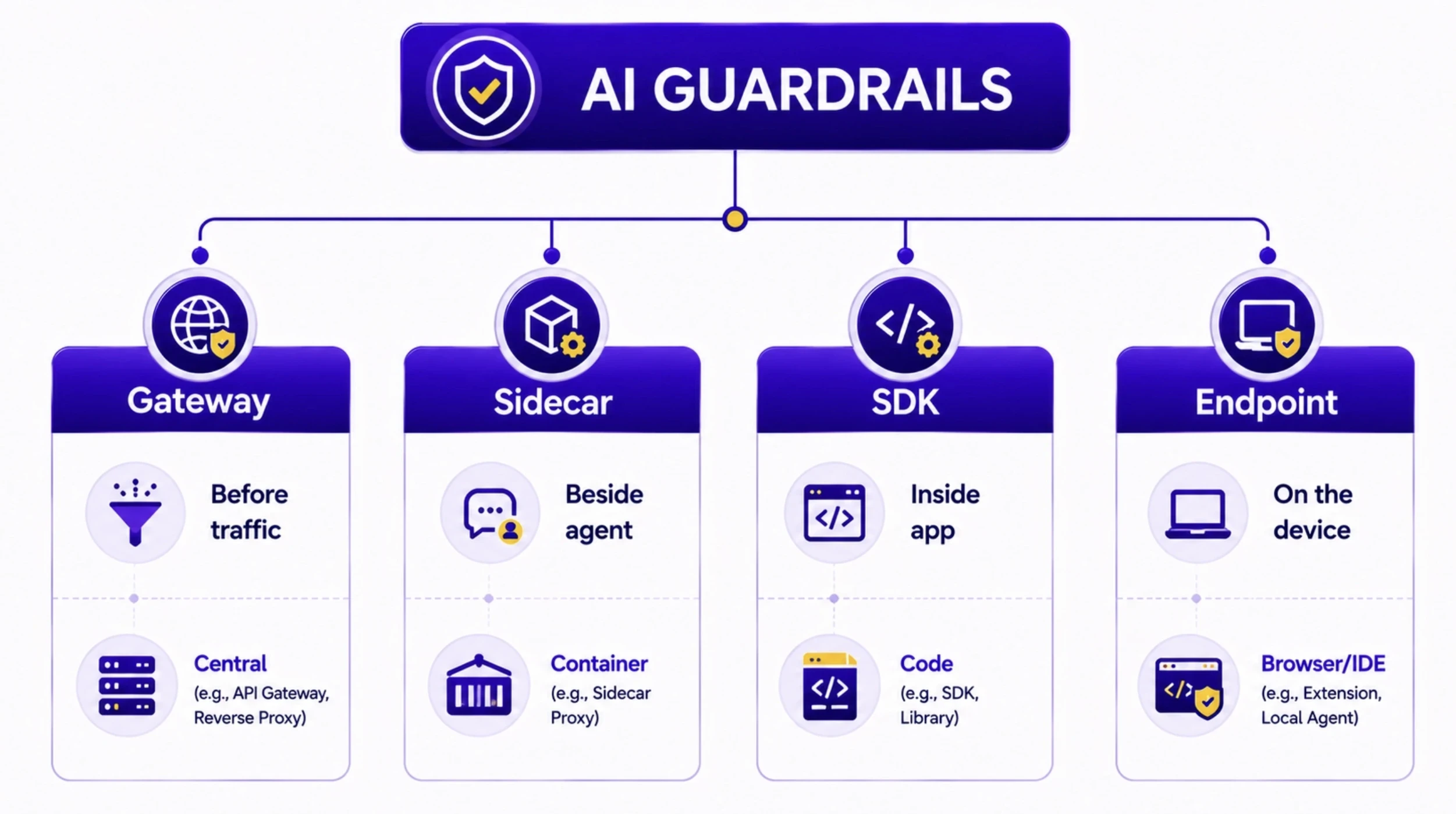
Nearly every AI guardrails tool on the market fits into one of four architectural patterns, and understanding what each one actually does structurally matters more than any individual product's feature list. The gateway vs sidecar guardrails distinction alone accounts for a large share of the confusion teams run into when comparing tools that look similar on a feature sheet but behave completely differently once deployed.
Gateway/Proxy-Based (Sits in Front of Model Traffic)
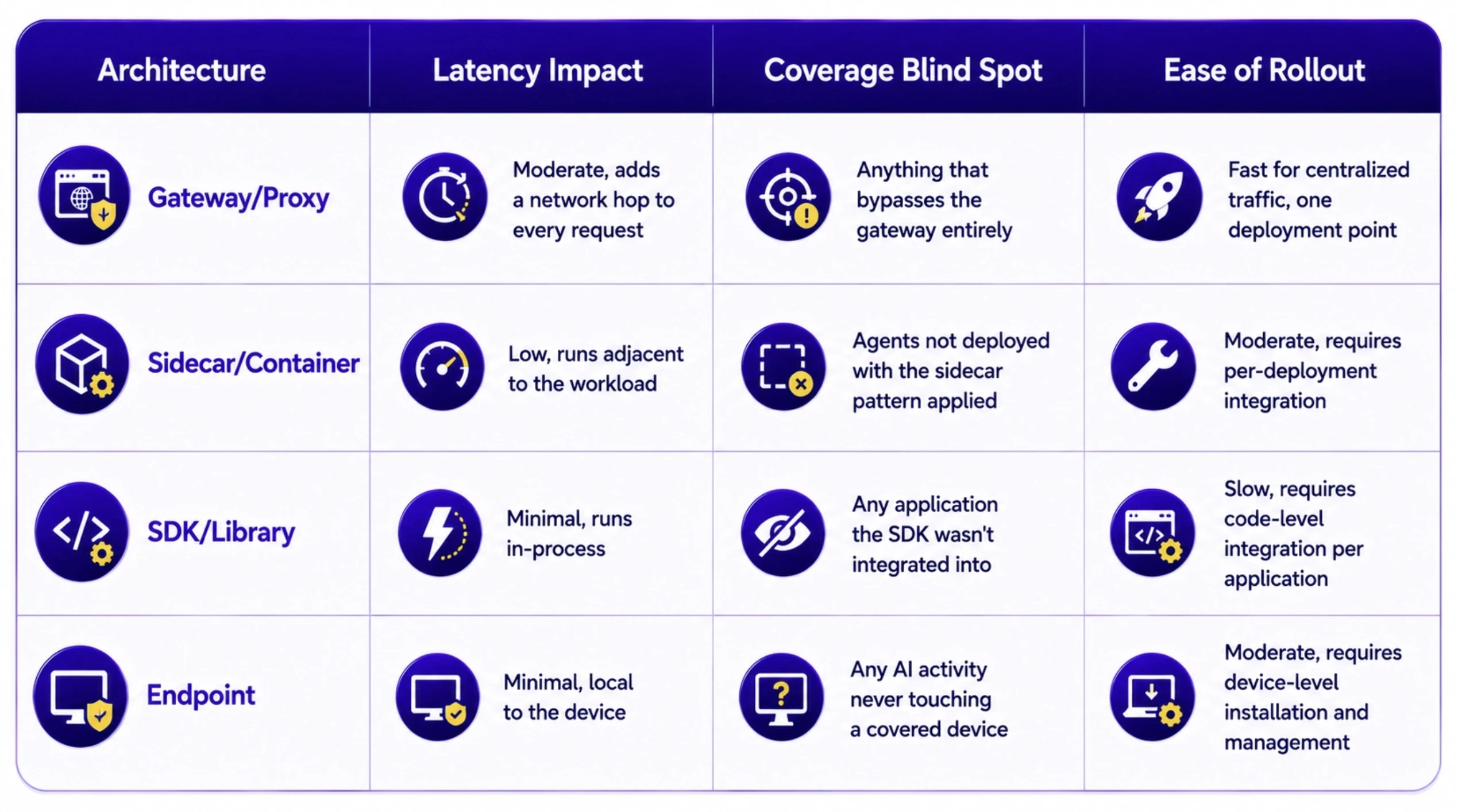
Gateway-based guardrails sit in front of model traffic, intercepting every request and response as it passes between an application and the underlying model or provider. This architecture centralizes enforcement: one deployment point can apply policy across every application routing through it, regardless of how many different teams built those applications or which model each one calls. The tradeoff is coverage. A gateway only sees what actually passes through it, so any AI activity that bypasses the gateway, a developer calling a model API directly, a tool running entirely inside an agent's own process, is invisible to it by construction. Gateway architecture also introduces a genuine latency consideration, since every request now makes an additional hop before reaching its destination.
Gateway deployments tend to appeal first to security and platform teams rather than individual application teams, since a single gateway deployment can be stood up once and applied broadly without requiring every downstream team to change how they build. That centralization is the architecture's biggest strength and its biggest organizational risk at the same time: if the gateway becomes a bottleneck, whether for latency, for reliability, or simply because a team routes around it to move faster, the coverage it was meant to provide quietly erodes without anyone necessarily noticing until an incident makes the gap obvious.
Sidecar/Container-Based (Deployed Alongside the Agent)
Sidecar container guardrails deploy alongside the specific agent or application they're protecting, typically as a separate container in the same pod or deployment unit, intercepting traffic at the point closest to where the agent actually runs rather than at a shared, centralized layer. This gives visibility a gateway can't match for containerized, Kubernetes-native environments, since the sidecar can observe an agent's internal tool calls and intermediate reasoning steps rather than only its external API traffic. The cost is operational: a sidecar has to be deployed alongside every agent it protects, which means coverage scales with how consistently an organization applies that deployment pattern rather than with a single central chokepoint.
Teams already running a service mesh or a mature Kubernetes platform tend to find sidecar deployment relatively natural, since it fits the same operational pattern already used for observability or networking sidecars elsewhere in the stack. Teams without that existing pattern often underestimate the ongoing operational cost, since a sidecar that isn't consistently included in every new agent's deployment template quietly becomes a gap the moment a new team spins up an agent without it.
SDK/Library-Based (Embedded in Application Code)
SDK library guardrails get embedded directly into an application's own codebase, giving a development team the finest-grained control of any architecture, since the guardrail logic runs in-process with full access to application context a gateway or sidecar would never see. SDK-based AI guardrails are the natural fit for a team building a custom agent from scratch, where enforcement can be woven directly into the agent's own decision loop. The tradeoff is consistency: an SDK-based approach only protects the specific applications a team has actually integrated it into, which means coverage depends entirely on developer discipline across every team and every application, with no centralized backstop catching what a given team simply didn't wire up.
Endpoint-Based (Runs on the Employee Device, Browser, IDE)
Endpoint browser IDE guardrails run directly on an employee's device, inside a browser extension or an IDE plugin, governing AI usage at the point where an employee is actually interacting with a model rather than anywhere in the backend infrastructure. Endpoint AI guardrails are the only architecture with any visibility at all into shadow AI usage, such as an employee pasting sensitive data into a personal AI account or a developer using an unauthorized coding assistant, since none of the other three architectures sit anywhere near that interaction. The tradeoff is device dependency: endpoint coverage only exists where the endpoint agent is actually installed and running, and it has no visibility into AI traffic that never touches an employee's device at all, like a backend agent calling a model directly from server infrastructure.
Matching Architecture to Your Environment
The right architecture, or combination of architectures, depends entirely on where your organization's AI activity actually happens. Most organizations, in practice, need more than one of the four, since a single environment rarely confines all its AI activity to one deployment pattern.
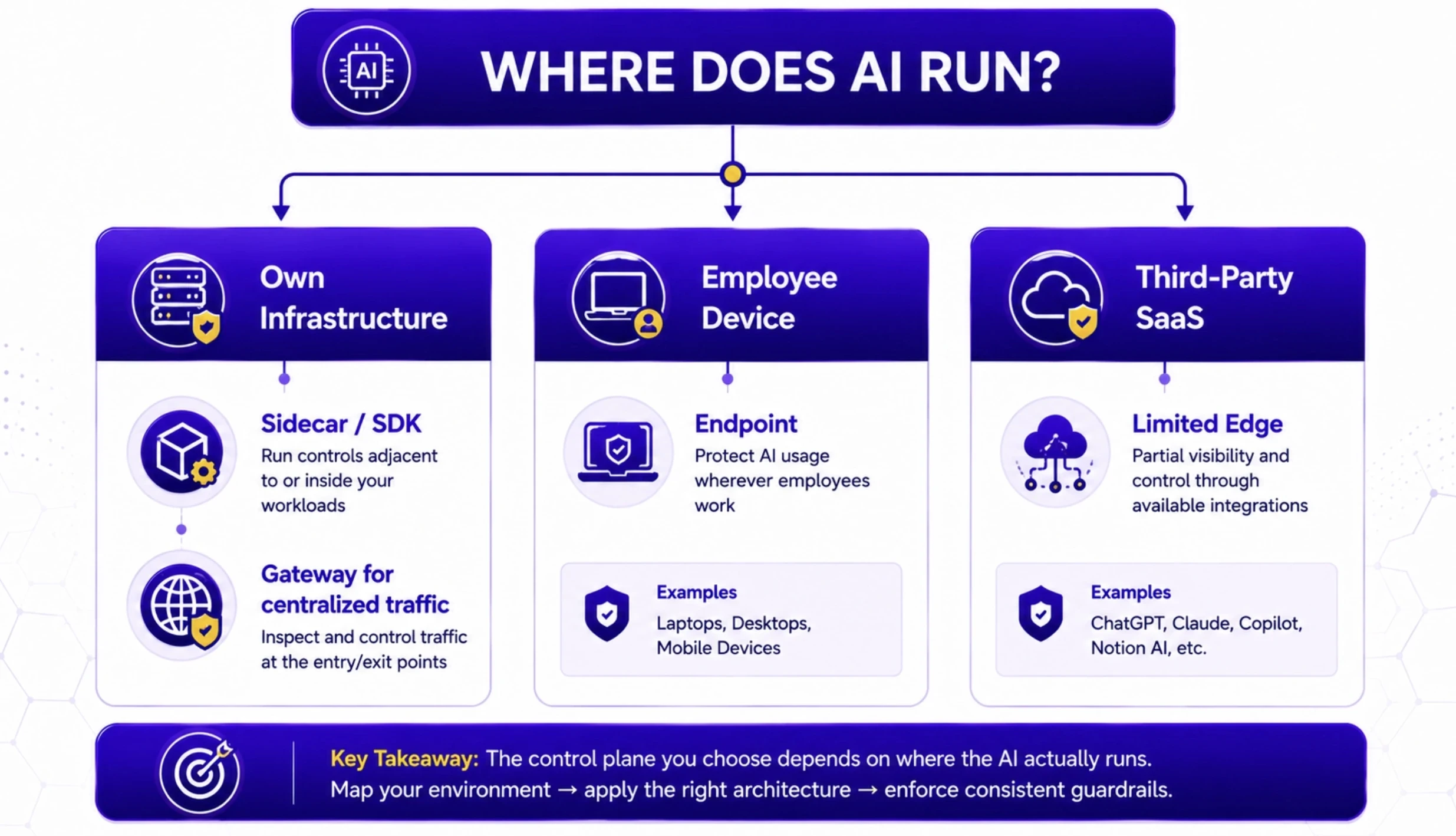
Homegrown Agents in Your Own Infrastructure
Homegrown agent guardrails deployed for internally built agents running in your own infrastructure are usually best served by sidecar or SDK architecture, since both give visibility into the agent's internal reasoning and tool calls that a gateway sitting only at the API boundary would miss entirely. A team with strong Kubernetes maturity often leans sidecar; a team building a smaller number of custom agents with tight in-house engineering control often leans SDK.
Employee AI Usage Across Browsers and IDEs
Employee AI usage guardrails covering what staff does with AI security tools day to day, inside a browser, inside a coding IDE, need endpoint architecture specifically, since this is shadow AI territory that a backend-focused architecture structurally cannot reach. No amount of gateway or sidecar coverage protects against an employee using a personal AI account entirely outside any organizational infrastructure.
Multi-Model, Multi-Provider Environments
A multi-provider AI environment, where different teams call different model providers through different integration patterns, tends to favor gateway architecture specifically, since a shared gateway is the one point every request can be routed through regardless of which underlying model or provider handles it. A multi-model guardrails architecture built around a shared gateway centralizes policy enforcement in a way that would otherwise require re-implementing the same controls separately for each provider's own SDK or API pattern.
SaaS-Embedded Copilots You Don't Control
SaaS-embedded copilot guardrails present a genuinely different problem, since a copilot built into a third-party SaaS product, a CRM's built-in assistant, or a support platform's AI agent runs entirely inside infrastructure you don't own and can't deploy a gateway, sidecar, or SDK into. Here, the architecture question shifts from "which of the four do we deploy" to "what visibility can we get at all," typically limited to whatever API-level logging or endpoint-level observation is available at the edges of that SaaS product, since none of the four architectures can reach inside a vendor's own backend.
What Each Architecture Is Strong and Weak At
Latency tradeoffs guardrails introduce, and the deployment coverage blind spots each pattern leaves open, are the two factors most worth weighing before committing to an architecture.
Open Source vs. Commercial Within Each Architecture
The open-source-versus-commercial choice plays out differently depending on which architecture a team has already settled on. Open-source options are strongest in the SDK and gateway categories, where a security-mature engineering team can integrate a library directly or stand up an open-source proxy with full control over the enforcement logic, at the cost of ongoing maintenance and rule-updating that a commercial vendor would otherwise handle. Sidecar architecture leans more commercial in practice, since the operational overhead of building and maintaining a custom sidecar deployment pattern across a Kubernetes environment tends to outweigh the savings versus a vendor product built specifically for that pattern. Endpoint architecture is almost entirely commercial today, since building and distributing a reliable browser extension or IDE plugin across an entire workforce is a genuinely different engineering problem than backend interception, one open-source projects have rarely tackled at the polish level enterprise deployment requires.
This split isn't arbitrary. Open source tends to win where the engineering problem is well-bounded, and the integrating team already has deep expertise, writing enforcement logic into a codebase they already own, or standing up a proxy in infrastructure they already operate. Commercial tools tend to win where the engineering problem involves distribution and ongoing maintenance at a scale most internal teams don't want to own indefinitely, managing a fleet of endpoint installations, or maintaining a sidecar pattern consistently across every team that spins up a new agent. Weighing that split honestly, rather than defaulting to whichever option a team happens to be more familiar with, is worth doing explicitly before committing budget or engineering time to either path.
A Decision Checklist Before You Shortlist Vendors
Before comparing named products, confirm the architecture question first: where does your AI traffic actually run, backend infrastructure you control, employee devices, or third-party SaaS you don't control. Confirm whether that traffic is centralized through a shared gateway or distributed across many independently built applications and agents. Confirm whether your engineering team has the Kubernetes maturity to operate a sidecar pattern reliably, or the bandwidth to integrate an SDK consistently across every team building AI applications. Once those answers are clear, the field of eligible architectures narrows considerably, and only then does it make sense to move to the actual vendor evaluation criteria, covered in full on our AI security vendor evaluation guide.
How Akto Covers Multiple Architectures at Once
Rather than specializing in a single architecture, Akto covers gateway, sidecar, and endpoint deployment as distinct options within one platform. Akto's AI Agent Gateway provides centralized, proxy-based enforcement for organizations routing AI traffic through a shared chokepoint. A Kubernetes-native sidecar deployment covers homegrown agents running in containerized infrastructure, giving visibility into internal tool calls a gateway alone wouldn't reach. And Atlas extends coverage to the endpoint, browsers and IDEs, closing the shadow AI gap none of the backend-focused architectures can reach on their own.
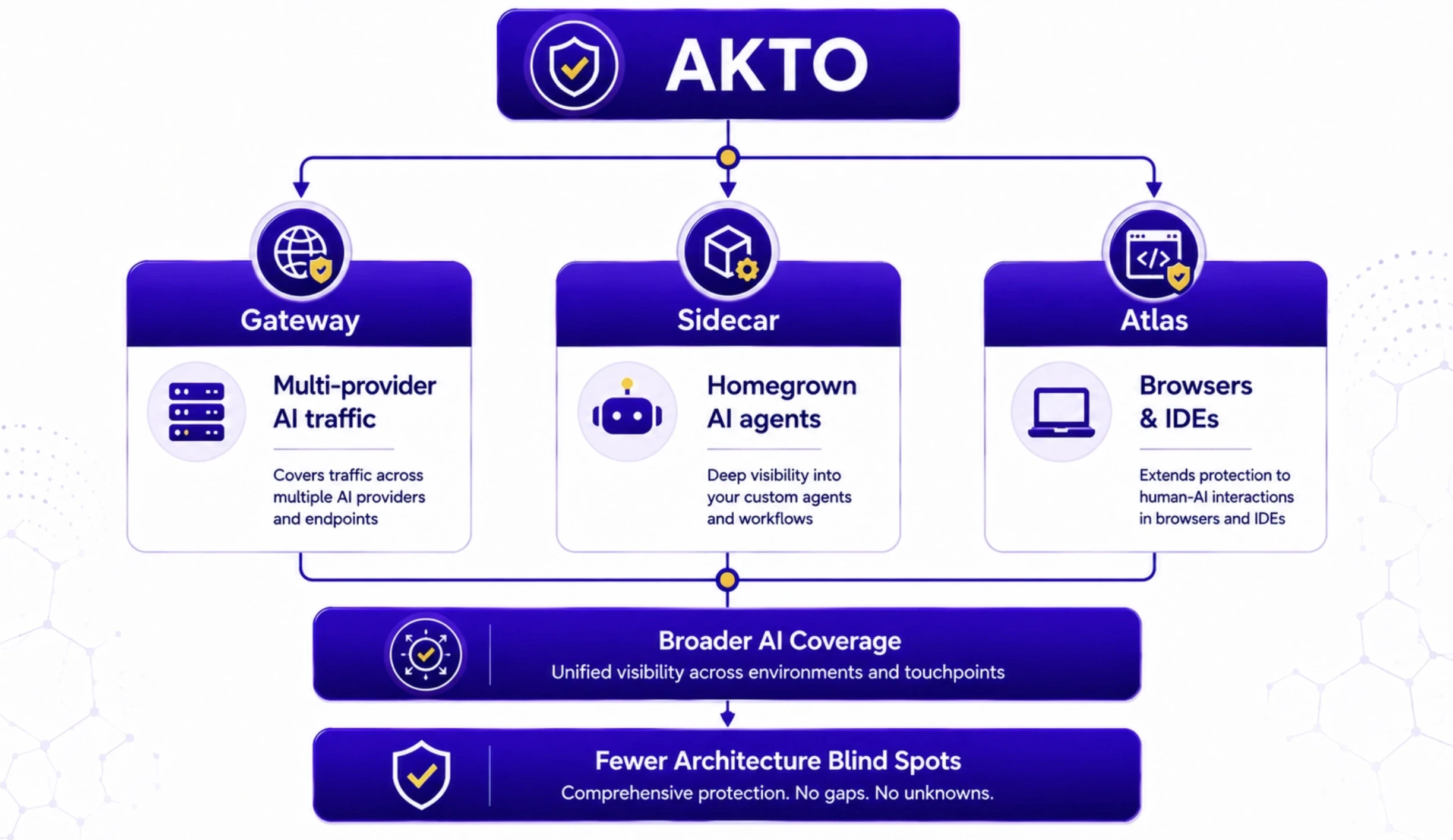
This is positioned as architecture coverage rather than a ranking claim: an organization running a mixed environment, some traffic centralized, some agents homegrown, some usage happening on employee devices, doesn't have to choose a single architecture and accept the blind spots that choice creates. A team can start with whichever architecture matches its most pressing gap today, a gateway for multi-provider traffic, a sidecar for a fleet of homegrown agents, Atlas for shadow AI on employee devices, and extend coverage to the others as the rest of the environment matures, without switching platforms each time the next architectural gap becomes the priority.
Frequently Asked Questions on AI Guardrails Tools
1. What are the main deployment architectures for AI guardrails tools?
Four: gateway/proxy-based, which sits in front of model traffic; sidecar/container-based, deployed alongside a specific agent; SDK/library-based, embedded directly in application code; and endpoint-based, running on an employee's device.
2. What's the difference between gateway-based and sidecar-based guardrails?
A gateway sits centrally in front of all traffic routed through it, giving broad coverage but no visibility into what bypasses it. A sidecar deploys alongside a specific agent's own container, giving deeper visibility into that agent's internal behavior at the cost of needing to be deployed individually per workload.
3. When does an SDK/library-based guardrails tool make more sense than a gateway?
When a team is building a custom agent from scratch and needs enforcement woven directly into the agent's own decision loop with full application context, rather than relying on a centralized layer that only sees traffic at the API boundary.
4. How do you secure AI usage on employee devices where a gateway can't reach?
Endpoint architecture, running as a browser extension or IDE plugin directly on the device, is the only one of the four architectures with visibility into shadow AI usage happening entirely outside backend infrastructure.
5. What are the latency tradeoffs between different guardrail architectures?
Gateway architecture adds the most latency, since it introduces an additional network hop for every request. Sidecar, SDK, and endpoint architectures run adjacent to or inside the workload they protect, keeping latency impact minimal by comparison.
6. Can one tool cover multiple architectures, or do most specialize in one?
Most tools specialize in one architecture, since gateway, sidecar, SDK, and endpoint each require genuinely different engineering approaches. Platforms that cover more than one, like combining gateway and endpoint coverage, do exist but are the exception rather than the norm.
7. How should the choice of architecture change for SaaS-embedded copilots you don't control?
None of the four architectures can be deployed inside a third-party SaaS product's own infrastructure, so coverage there is limited to whatever API-level logging or endpoint-level observation is available at the edges of that product rather than a full architectural deployment.
8. Where can I find a ranked comparison of specific named guardrail vendors instead?
See our AI security tools page for a ranked, named-vendor comparison. This page focuses specifically on the architecture question that should come before that comparison.
9. How does Akto cover gateway, sidecar, and endpoint architectures within one platform?
Akto's AI Agent Gateway handles centralized, proxy-based enforcement, a Kubernetes-native sidecar deployment covers homegrown containerized agents, and Atlas extends coverage to browsers and IDEs at the endpoint, together closing the blind spots any single architecture would leave open.

Experience enterprise-grade Agentic Security solution