How to Build an AI Security RFP for Finance in 2026
A practical framework for building an AI security RFP for financial services - regulatory requirements, vendor red flags, and the questions that matter.

Arpashree

The standard SaaS vendor security questionnaire asks whether data is encrypted at rest and whether the vendor has a SOC 2 report. Neither question tells you anything about whether an AI agent will read a customer's account history, reason over it, and initiate a transaction on its own. An AI security RFP for finance needs an entirely different evaluation lens than the procurement checklist that worked for the last decade of SaaS purchases, because the systems being evaluated now reason, act, and interact autonomously with regulated customer data.
Why Generic Vendor Security Questionnaires Fail for AI in Financial Services
A generic questionnaire assumes static software: fixed inputs, fixed outputs, a permissions model that doesn't change once it's configured. AI systems, especially agentic ones, break every part of that assumption.
What Changes When AI Agents Reason, Act, and Interact Autonomously
An AI vendor security questionnaire financial services teams have used for years typically asks about data handling and access controls at rest. It rarely asks what happens when a system reasons over that data and decides, on its own, to call a tool, initiate a transfer, or flag an account for review. Autonomy changes the risk calculus entirely: the same underlying data access that was low-risk when a human reviewed every output becomes high-risk the moment a model can act on its own conclusions without a checkpoint in between.
The Five Capability Areas AI Security Vendors Actually Cluster Around
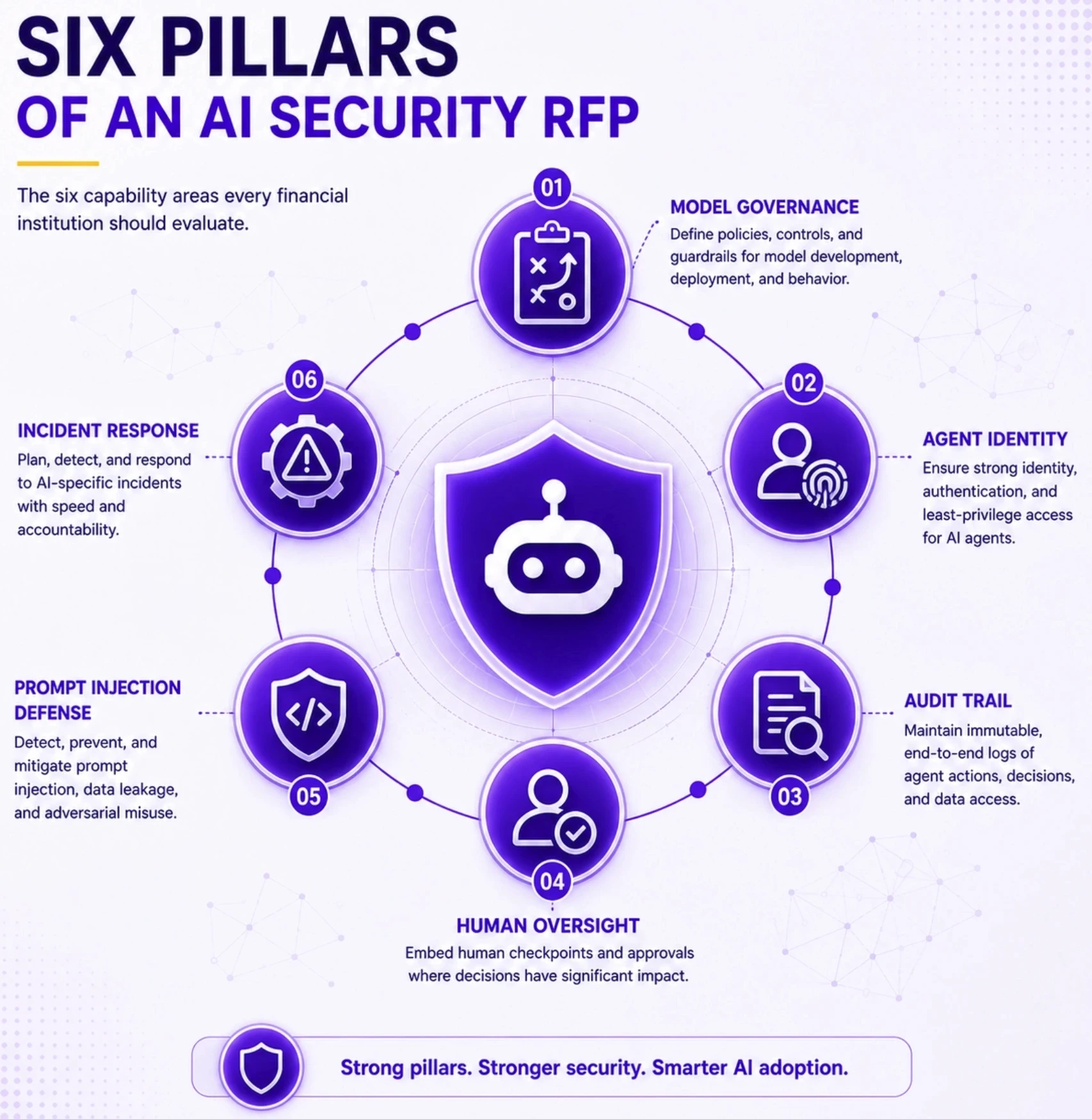
Most AI security vendors serving financial institutions cluster around five capability areas: model governance and policy enforcement, identity and authentication for agents themselves, audit trail generation, human oversight design, and defense against prompt injection and data leakage. Few vendors are strong across all five, which is exactly why AI security procurement finance teams need a structured RFP, effectively an agentic AI RFP template built around these five areas, rather than a generic list of financial services AI compliance requirements copied from a prior SaaS purchase.
The Regulatory Foundation Your RFP Must Cover
Every RFP question below should trace back to a specific regulatory expectation, not a generic best practice, since that traceability is what makes vendor answers defensible to an examiner later.
SOC 2 Type II, ISO 27001, and ISO 42001
SOC 2 Type II and ISO 27001 remain baseline expectations for any vendor touching financial data, covering operational security controls over time rather than a point-in-time assessment. ISO 42001 certification is the newer, AI-specific layer: a certifiable AI management system standard covering governance, risk, and lifecycle controls specific to AI systems, and increasingly requested by name in financial services RFPs precisely because SOC 2 and ISO 27001 were never built with AI-specific risks in mind.
FINRA, SEC and Regulation S-P
FINRA's 2026 Annual Regulatory Oversight Report, published December 2025, added a standalone GenAI section for the first time and explicitly addressed AI agents that can act or transact, part of a broader push toward formal FINRA GenAI governance, recommending narrow scope, defined permissions, complete audit trails, and explicit human checkpoints before execution. The report also ties AI-related cybersecurity expectations directly to SEC Regulation S-P Rule 30, which requires written policies and procedures describing the administrative, technical, and physical safeguards protecting customer information. Any vendor RFP for a broker-dealer or investment adviser should ask directly how a vendor's controls map to both.
PCI-DSS and Cardholder Data Access Controls
Any AI system that can read, summarize, or reason over cardholder data falls under PCI-DSS scope regardless of whether it was designed with payment data in mind. RFP questions here need to go beyond "is cardholder data encrypted" and ask specifically about PCI-DSS AI agent access: whether an agent's access to that data is scoped, logged, and separable from its other permissions, since a single overly broad agent identity can pull PCI-DSS scope into systems never meant to carry it.
DORA (for EU-Regulated Institutions)
The EU's Digital Operational Resilience Act applies directly to AI vendors serving EU-regulated financial institutions, since DORA treats AI providers as ICT third parties subject to the same operational resilience, incident reporting, and contractual oversight requirements as any other critical technology vendor. DORA AI compliance means an RFP needs to ask about incident notification timelines, testing obligations, and exit provisions specifically, not just general security posture.
GDPR Article 22 and Automated Decision-Making
GDPR Article 22 automated decision-making provisions give individuals the right not to be subject to a decision based solely on automated processing that produces legal or similarly significant effects, with narrow exceptions. Any vendor whose AI system contributes to credit decisions, fraud flags, or account actions affecting EU customers needs to be able to describe exactly where a human sits in that decision loop, and an RFP should ask for that description in specific, verifiable terms rather than a general assurance of "human oversight."
COSO's 2026 Generative AI Internal Controls Guidance
COSO's Achieving Effective Internal Control Over Generative AI, released February 2026, is the definitive piece of COSO generative AI internal controls guidance, extending the long-standing COSO Internal Control-Integrated Framework to generative AI for the first time through a capability-based lens and a six-step roadmap: govern, inventory, assess, design, implement, monitor. For financial institutions, this matters because COSO's framework already underpins SOX internal control assessments. Hence, a vendor unable to map its controls to that structure creates real friction for a customer's own internal audit function.
The U.S. Treasury's Financial Services AI Risk Management Framework
The U.S. Treasury Financial Services AI Risk Management Framework, released in February 2026 in partnership with the Cyber Risk Institute, is voluntary but built to become the reference examiners and auditors reach for. It maps 230 control objectives across seven risk domains and the full AI lifecycle, aligned with the broader NIST AI RMF. An RFP that asks a vendor to map its own controls against this framework directly is asking a question most vendors haven't been asked yet, which is precisely why the answer is revealing.
Core RFP Question Categories
These six categories translate the regulatory foundation above into specific, answerable questions a vendor can't dodge with a marketing paragraph.
Model Governance and Deterministic Policy Enforcement
Ask whether policy enforcement happens at the model layer, where a system prompt can be argued around, or at a deterministic reasoning AI vendor layer that enforces rules independent of what the model decides. A vendor whose only answer is "the model is instructed not to" hasn't actually built an enforcement layer.
Agent Identity and Authentication (mTLS, OAuth 2.0, Signed JWT)
Agent identity authentication needs to be as rigorous as human identity authentication, if not more so given how fast agent identities can be created and retired. Ask specifically whether agent-to-agent and agent-to-system calls are authenticated via mTLS, OAuth 2.0 (mTLS OAuth 2.0 together is increasingly the baseline), or signed JWTs with defined expiry, and whether credentials use rotating tokens or sit static indefinitely.
Audit Trail Completeness and Reconstructability
Audit trail completeness should be tested with a specific scenario in the RFP itself: can the vendor reconstruct a single agent action from 90 days ago, including what triggered it, what data it touched, and under what authority it acted. A vendor that can only produce aggregate logs, not a specific reconstructable event, fails this question regardless of how the rest of their answer reads.
Human-in-the-Loop Design and Autonomy Governance
Human-in-the-loop design should be documented as an autonomy governance matrix, a specific mapping of which actions require human approval, which are automated with monitoring, and which are fully autonomous, rather than a general statement that humans are "in the loop." Ask the vendor to produce that matrix for your specific use case, not a generic one from their sales deck.
Prompt Injection and Data Leakage Defense
Ask what specific prompt injection vendor defense exists, both against direct attacks and instructions embedded in documents or retrieved content, and how the vendor tests for it. A vendor that treats prompt injection as a solved problem rather than an ongoing, continuously tested risk is underselling the actual state of the field.
Incident Response and Model Version Pinning
Model version pinning, the ability to lock a specific model version in production rather than silently inheriting a provider's next update, matters because a model update can change behavior in ways that invalidate prior testing overnight. Ask how incident response specifically handles an AI-driven incident differently from a conventional software outage.
Weighting Criteria by Use Case
Not every AI system in a financial institution carries the same risk, and an RFP scoring rubric should reflect that rather than applying one weighting scheme to every vendor.
LLM Customer Service vs. RAG vs. Agentic Financial Transactions
A customer-facing LLM chatbot with no transaction authority carries meaningfully lower stakes than a RAG system pulling from account records, which in turn carries lower stakes than an agentic system that can actually initiate a financial transaction. Weighting criteria should scale audit trail, human-in-the-loop, and identity authentication requirements up sharply as autonomy and transaction authority increase.
Building a Quantitative Scoring Rubric
A working scoring rubric assigns numeric weights to each of the six RFP question categories based on the use case's autonomy level, then scores vendor responses against defined, verifiable criteria rather than a subjective impression. This is what turns an RFP into evidence a procurement committee and a future examiner can both actually rely on.
Red Flags in Vendor Responses
Certain vendor answers should stop an evaluation cold, regardless of how polished the rest of the response looks.
"The Logic Is in the Model" and Other Unverifiable Answers
Any answer amounting to "the logic is in the model" is an admission that the vendor cannot point to a deterministic, testable control, since a model's internal reasoning isn't something a vendor or a customer can audit directly. This is one of the clearest procurement red flags in the entire evaluation.
Confidence Scores Presented as Explanations
A vendor presenting a numeric confidence score as if it were an explanation for a decision is substituting a statistic for actual reasoning transparency. A confidence score tells you how sure a model was, not why it reached that conclusion, and conflating the two should be treated as a serious gap in explainability.
Static API Keys and Unrotated Credentials
A static API key red flag shows up more often than it should in vendor architecture diagrams: long-lived credentials embedded directly in configuration, never rotated, shared across environments. This is a lifecycle failure with a direct line to real incidents, and any vendor unable to describe automatic rotation and expiry should be scored accordingly.
Validating Vendor Claims Beyond the RFP
An RFP response is a claim. Validating it requires structured testing and references calibrated to check that claim specifically.
Structuring a Two-Week Proof of Value
A proof of value AI security evaluation should run for roughly two weeks against a realistic subset of actual data and workflows, testing the specific scenarios the RFP raised: can the vendor reconstruct an audit trail on demand, does the autonomy governance matrix hold up under adversarial testing, does incident response actually trigger the way the RFP described it would.
Reference Calls Calibrated to Each Vendor's Strongest Category
Vendor reference calls are only useful when calibrated to the category a vendor claimed strength in during the RFP, since a generic reference conversation rarely surfaces whether a specific claim about audit trail reconstruction or identity authentication actually held up in someone else's production environment.
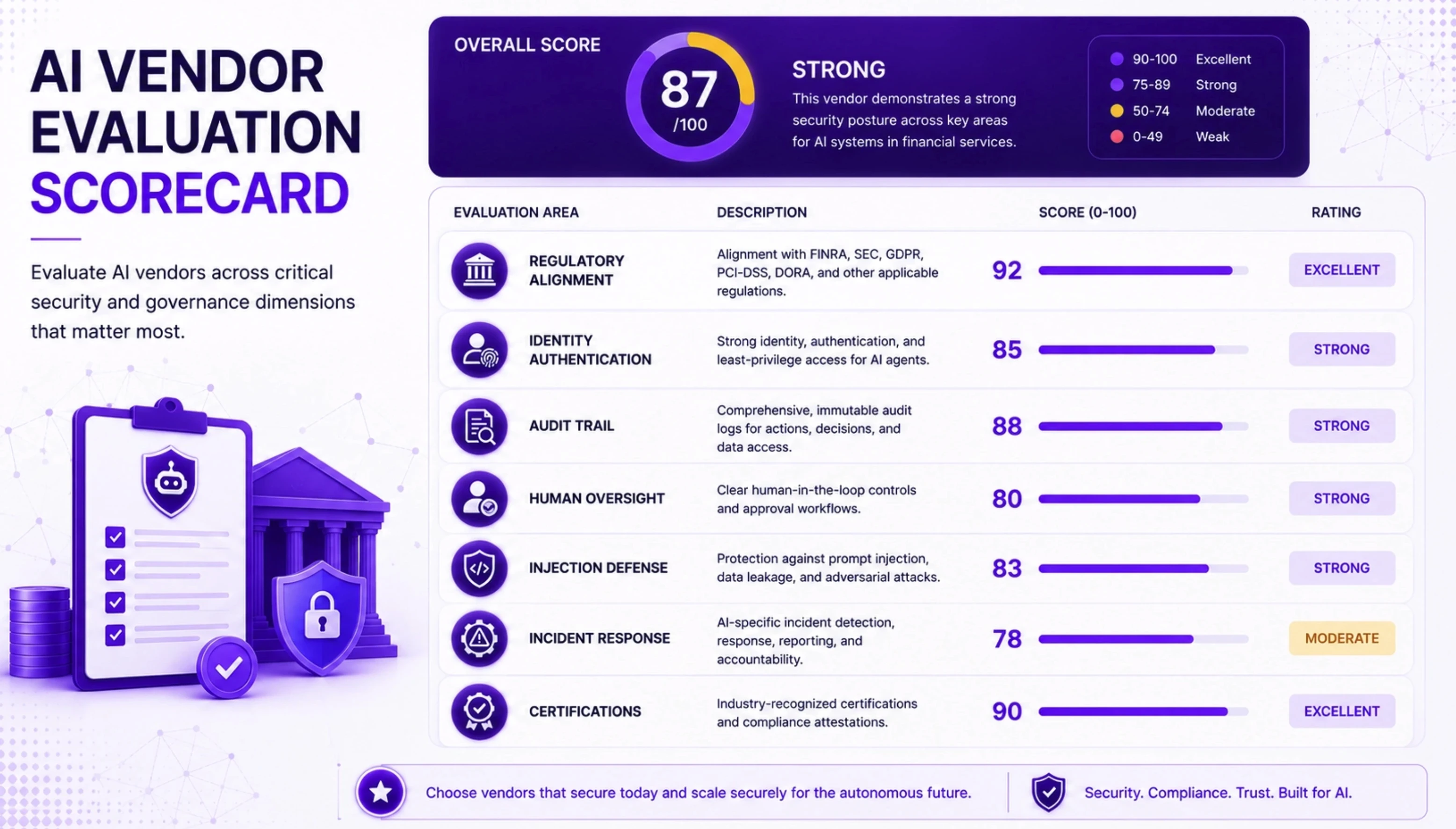
A Sample AI Security RFP Framework for Financial Services
Use this as a scorecard structure for any vendor response:
Regulatory alignment: Can the vendor map its controls to FINRA, SEC Reg S-P, DORA, GDPR Article 22, COSO, and the Treasury FS AI RMF as applicable? Pass/Fail per framework.
Model governance: Is policy enforcement deterministic and independent of model behavior? Score 1-5.
Agent identity: Are mTLS, OAuth 2.0, or signed JWTs used with automatic rotation? Score 1-5.
Audit trail: Can a specific action from 90 days ago be fully reconstructed? Pass/Fail.
Human oversight: Does an autonomy governance matrix exist for this specific use case? Pass/Fail.
Injection defense: Is prompt injection defense continuously tested, not a one-time claim? Score 1-5.
Incident response: Is there an AI-specific incident playbook distinct from general IT incident response? Pass/Fail.
Certifications: SOC 2 Type II, ISO 27001, ISO 42001, and AIUC-1 where applicable. List held certifications.
How Akto Answers These RFP Requirements
Akto maps directly onto the core RFP categories above, and onto the kind of AI vendor risk assessment financial services procurement teams now run before signing: continuous discovery of AI agents and MCP connections answers the inventory question before an RFP even gets to specifics, continuous red teaming against prompt injection, tool misuse, and privilege escalation answers the injection defense category with ongoing evidence rather than a point-in-time claim, and findings feed into runtime guardrails that enforce policy deterministically rather than relying on model behavior alone. Every action is logged in a structured, reconstructable format built to satisfy the audit trail test financial services RFPs increasingly include, drawing on the same expectations the FINRA 2026 Regulatory Oversight Report set out, with reporting mapped to the OWASP Top 10 for LLM Applications, MITRE ATLAS, and NIST AI RMF so the evidence a vendor produces is the same evidence an examiner already recognizes.
FAQs: How to Build an AI Security RFP for Finance
1. Why don't generic SaaS security questionnaires work for evaluating AI vendors?
They assume static software with fixed inputs and outputs. AI systems, especially agentic ones, reason over data and take autonomous action, which introduces risks like prompt injection, privilege drift, and unverifiable decision logic that a standard questionnaire was never built to surface.
2. What regulatory frameworks should a financial services AI security RFP cover?
At minimum: SOC 2 Type II, ISO 27001, ISO 42001, FINRA guidance and SEC Regulation S-P, PCI-DSS where cardholder data is involved, DORA for EU-regulated institutions, GDPR Article 22, COSO's 2026 GenAI internal controls guidance, and the U.S. Treasury's Financial Services AI Risk Management Framework.
3. What is DORA, and how does it apply to AI vendor evaluation for EU-regulated institutions?
DORA is the EU's Digital Operational Resilience Act, and it treats AI vendors as ICT third parties subject to operational resilience, incident reporting, and contractual oversight requirements, meaning DORA AI compliance needs its own dedicated RFP section for EU-regulated buyers.
4. What does GDPR Article 22 require for AI-driven automated decision-making?
It gives individuals the right not to be subject to a decision based solely on automated processing that produces legal or similarly significant effects, with narrow exceptions, which means any vendor contributing to credit or account decisions needs to document where human review sits in that process clearly.
5. What is COSO's 2026 guidance on internal controls for generative AI?
Achieving Effective Internal Control Over Generative AI, released February 2026, extends COSO's existing Internal Control-Integrated Framework to GenAI through a capability-based approach and a six-step roadmap: govern, inventory, assess, design, implement, and monitor.
6. What questions should an RFP ask about AI agent identity and authentication?
Ask specifically whether agent-to-agent and agent-to-system calls use mTLS, OAuth 2.0, or signed JWTs with defined expiry, and whether credentials rotate automatically rather than sitting static and unrotated indefinitely.
7. What counts as a red flag answer when a vendor describes their AI's decision logic?
Answers like "the logic is in the model," or a confidence score presented as if it were an explanation, both signal the vendor cannot point to a deterministic, auditable control behind the decision.
8. How should organizations weight RFP criteria differently for LLM chatbots vs. agentic financial transaction systems?
Audit trail, identity authentication, and human-in-the-loop requirements should scale up sharply as a system's autonomy and transaction authority increase, since a customer-facing chatbot with no transaction authority carries meaningfully lower stakes than an agent that can initiate a transfer.
9. What is an autonomy governance matrix, and why should vendors be able to show one?
It's a specific mapping of which agent actions require human approval, which are automated with monitoring, and which run fully autonomously. A vendor that can only offer a general assurance of "human oversight" hasn't actually documented this.
10. How should a proof-of-value evaluation for an AI security vendor be structured?
Run it for roughly two weeks against a realistic subset of real data and workflows, specifically testing the claims made in the RFP: audit trail reconstruction, autonomy matrix behavior under adversarial testing, and whether incident response actually triggers as described.
11. Why are reference calls calibrated to a vendor's strongest RFP category more useful than generic references?
A generic reference conversation rarely probes the specific claim that matters most to your evaluation. Calibrating the call to the vendor's own strongest claimed category tests whether that specific claim held up in someone else's production environment.
12. What certifications (ISO 42001, AIUC-1) should financial services ask AI vendors about?
ISO 42001 for AI management system governance and AIUC-1, the newer AI agent-specific standard covering security, safety, reliability, accountability, and data privacy through quarterly technical testing, are both increasingly requested by name in financial services RFPs.
13. What audit trail evidence should an AI vendor be able to reconstruct on demand?
A specific agent action from roughly 90 days earlier: what triggered it, what data or systems it touched, under what authority it acted, and the outcome, not just an aggregate log summary.
14. Why are static, unrotated API keys considered a procurement red flag?
Long-lived credentials embedded in configuration and never rotated are a lifecycle failure with a direct line to real incidents, since a single leaked static key grants standing access with no expiration to revoke it against.
15. How does Akto address the requirements typically found in a financial services AI security RFP?
Akto covers continuous agent and MCP discovery, ongoing red teaming against prompt injection and tool misuse, runtime guardrails that enforce policy deterministically, and structured audit logging mapped to OWASP, MITRE ATLAS, and NIST AI RMF, addressing the inventory, injection defense, model governance, and audit trail categories an RFP would score.

Experience enterprise-grade Agentic Security solution