Top 7 LLM Security Testing Tools for AppSec Teams
The 7 LLM security testing tools AppSec teams actually shortlist in 2026 - CI/CD fit, OWASP/NIST mapping, deployment model, and who each one is best for.

Arpashree
If you need a step-by-step process for running an LLM security test, it's in our methodology guide. This is the shortlist: the best LLM security testing tools AppSec teams actually put in front of a buying committee in 2026. Two disciplines get conflated constantly in this space. Red teaming simulates an adversary trying to break an LLM application through prompt injection, jailbreaks, or tool misuse. Vulnerability scanning checks a system against a known catalog of weaknesses. Both matter, but the criterion that actually separates AppSec tools for LLM applications from a generic AI-safety tool is whether it runs where AppSec already works: inside CI/CD, gating a pull request, not just producing a PDF after a quarterly assessment.
How These Tools Were Evaluated
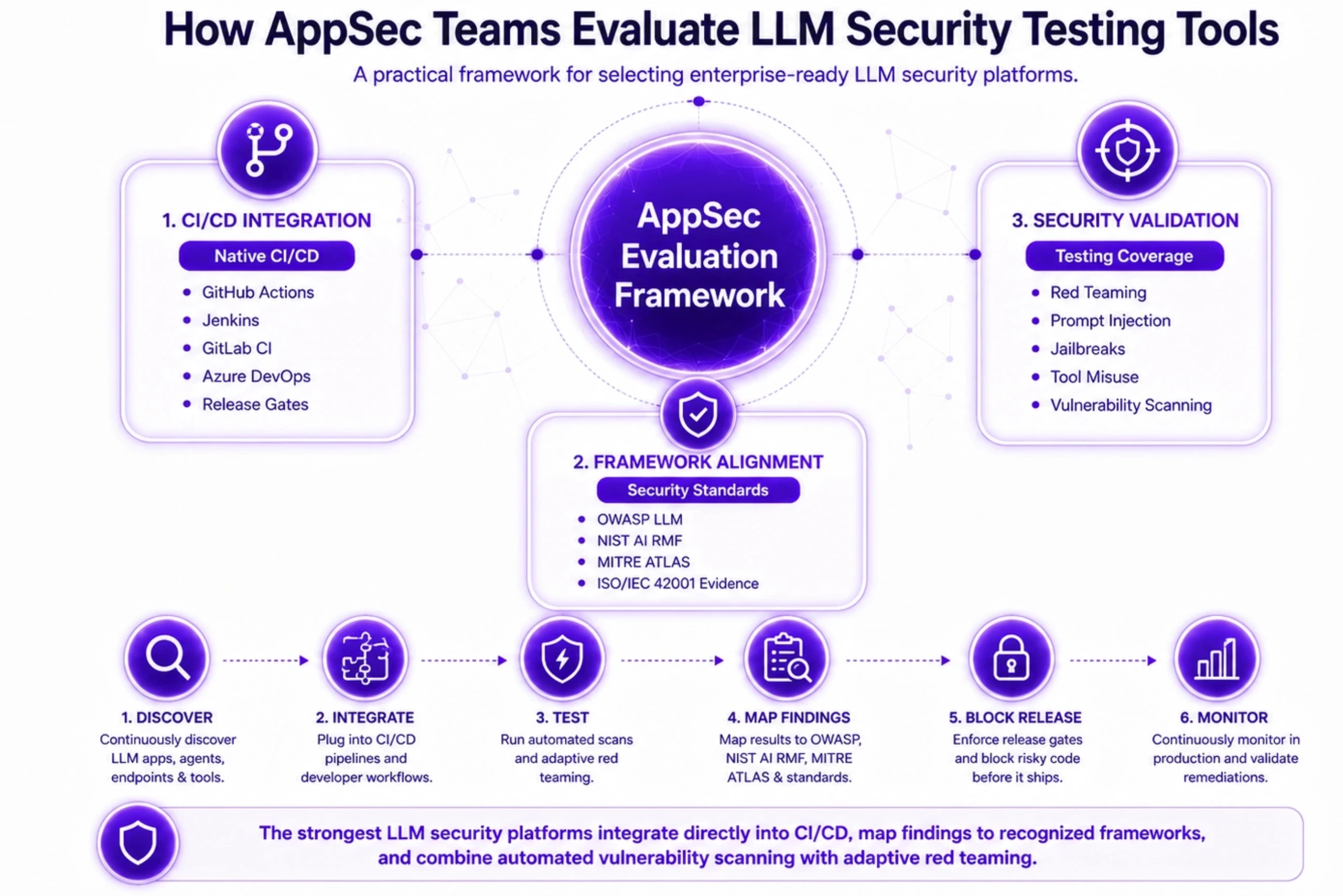
Every tool on this list was assessed against the same three criteria an AppSec team would actually apply during a real evaluation.
CI/CD and Developer Workflow Integration
LLM security testing tools that can't run as a GitHub Action, a Jenkins step, or a CLI command inside an existing pipeline end up as a side process a security team runs periodically, disconnected from the pace code actually ships at. Native CI/CD LLM security testing turns a security check into a release gate rather than a report nobody reads until after an incident, and pull request security scanning specifically, catching a vulnerable prompt or tool configuration before it merges, is what separates pre-deployment gate controls that actually block a bad release from ones that only advise after the fact.
Framework Mapping (OWASP, NIST AI RMF, MITRE ATLAS, ISO/IEC 42001)
OWASP Top 10 for LLM Applications mapping and NIST AI RMF compliance testing give findings a shared vocabulary that security, engineering, and compliance teams can all use without translating between three internal taxonomies. MITRE ATLAS coverage extends that further into named adversarial tactics and techniques. ISO/IEC 42001 sits a level up from all of these: it's a certifiable AI management system standard, not a technical testing framework, so the tools below feed evidence into an ISO 42001 program rather than mapping to it directly the way they map to OWASP or NIST.
Red Teaming vs. Vulnerability Scanning Coverage
The distinction between red teaming vs vulnerability scanning shows up clearly once you look at what each tool actually automates. LLM vulnerability scanning tools check known weaknesses at speed and low cost. Genuine LLM red teaming tools generate adaptive, multi-turn adversarial testing that adjusts its approach based on how the target responds, closer to a real attacker than a static checklist, and prompt injection testing specifically needs this adaptive quality since a fixed set of known injection strings stops working the moment an attacker varies the wording.
The Top 7 LLM Security Testing Tools for AppSec Teams
Among the many top AI security testing tools 2026 has produced, these seven are the ones that actually clear an AppSec evaluation rather than just an AI security checklist.
1. Akto
Deployment model: SaaS or self-hosted, agentic-first. Akto continuously discovers LLM applications, AI agents, and MCP server connections across an environment, then runs large-scale, continuously updated red teaming probe libraries covering prompt injection, tool misuse, and memory poisoning, mapped to the OWASP Top 10 for LLM Applications, the OWASP Agentic AI Top 10, and MITRE ATLAS. Findings feed directly into runtime guardrails and CI/CD release gates, so a vulnerability found during testing gets enforced in production rather than sitting in a backlog. Best fit: enterprise AppSec teams that need discovery, pre-production testing, and runtime protection for agentic and MCP-connected systems in one platform rather than stitching together point solutions. Differentiator: it's built around continuous discovery as the starting point, closing the gap most tools on this list leave open, testing only the agents a team already knows to point them at.
2. Mindgard
Deployment model: enterprise SaaS, sales-gated, no public pricing or self-serve tier. Mindgard, spun out of a decade of Lancaster University AI security research, runs automated, adaptive red teaming across LLMs, agents, and multimodal models, integrating via a GitHub Action or CLI and mapping findings to MITRE ATLAS and the OWASP Top 10 for LLMs. Best fit: enterprise security teams running multiple models and modalities that want a mature, research-backed automated red teaming platform without building attack libraries in-house. Differentiator: broad modality coverage extending past text into image, audio, and multimodal systems.
3. Confident AI / DeepTeam
Deployment model: DeepTeam is a free, Apache 2.0 open-source LLM security scanner that runs locally via CLI or Python; Confident AI is the paired hosted platform for dashboards, production monitoring, and team workflows. DeepTeam ships 40-plus vulnerability types and 10-plus attack methods, including multi-turn jailbreaks, built on the DeepEval evaluation framework, with out-of-the-box alignment to OWASP and NIST AI RMF. Best fit: engineering teams that want full control over how attacks are run and judged, with the option to add a managed platform later rather than being locked into one from day one. Differentiator: red teaming and evaluation share the same underlying framework, so a team already using DeepEval for quality testing adds security testing without a second tool to learn.
4. General Analysis
Deployment model: cloud platform, connects to GitHub, model providers, and cloud runtime to build an inventory automatically. General Analysis runs automated red teaming using multi-turn adversarial methods like Tree-of-Attacks, Crescendo, and PAIR against LLM apps, RAG pipelines, MCP servers, and coding agents, testing tool misuse, privilege escalation, and multi-step exploit chains at the system boundary rather than the model in isolation. Findings map to OWASP and NIST AI RMF and can be converted into regression tests and CI/CD release gates. Best fit: teams running production agentic systems with complex tool and permission graphs who need testing that reflects how an agent actually operates, not just how its underlying model responds to a prompt. Differentiator: system-boundary testing that traces how one compromised tool or data source can steer a privileged action elsewhere in an agent's graph.
5. Pynt
Deployment model: CLI-based, agnostic across CI/CD tools, verified integrations with Jenkins, GitLab, GitHub Actions, and Azure DevOps. Pynt is API-first rather than LLM-native: it treats LLM endpoints as APIs, using zero-configuration discovery and context-aware testing to catch business logic flaws, prompt injection, and misuse across both the OWASP API Security Top 10 and the OWASP Top 10 for LLMs. Best fit: API-heavy LLM applications where the LLM endpoint is one of many APIs a team already needs to secure, and a dedicated LLM-only tool would mean running two separate testing programs. Differentiator: LLM API security testing that sits inside the same workflow as an organization's existing API security program rather than requiring a parallel one.
6. Garak and PyRIT
Deployment model: both fully open source, run locally, no vendor lock-in. PyRIT, Microsoft's Python Risk Identification Toolkit, started as an internal tool for testing Copilot and gives security engineers programmatic building blocks for custom multi-turn attacks, including Crescendo and Tree of Attacks with Pruning. Garak, maintained by NVIDIA, is a vulnerability scanner running roughly 100 attack vectors across up to 20,000 prompts per scan, strong on jailbreak and prompt injection coverage at the model endpoint. Best fit: teams standardizing on open-source who have the engineering capacity to script and maintain their own testing harness, and research or security teams doing baseline model-level scanning before layering on system-level tools. Differentiator: no cost and full transparency into exactly what's being tested, at the cost of needing in-house expertise to configure either one well.
7. Promptfoo
Deployment model: open source (MIT license), CLI and Node.js library, runs entirely locally by default. Promptfoo combines LLM evaluation with a red teaming mode offering 50-plus attack plugins across prompt injection, jailbreaks, PII leakage, and excessive agency, with built-in OWASP LLM Top 10 presets, NIST AI RMF mappings, and MITRE ATLAS coverage, plus native GitHub Actions integration. Worth knowing before adopting it: OpenAI acquired Promptfoo in March 2026, folding its technology into OpenAI's enterprise Frontier platform while committing to keep the open-source tool free and MIT-licensed. Best fit: developer-first teams that want a free, CI/CD-native starting point with genuine enterprise adoption behind it already. Differentiator: the single largest open-source community on this list, at 350,000-plus developers and adoption across roughly a quarter of the Fortune 500, though buyers evaluating multi-model neutrality should factor in its new ownership under a frontier model lab.
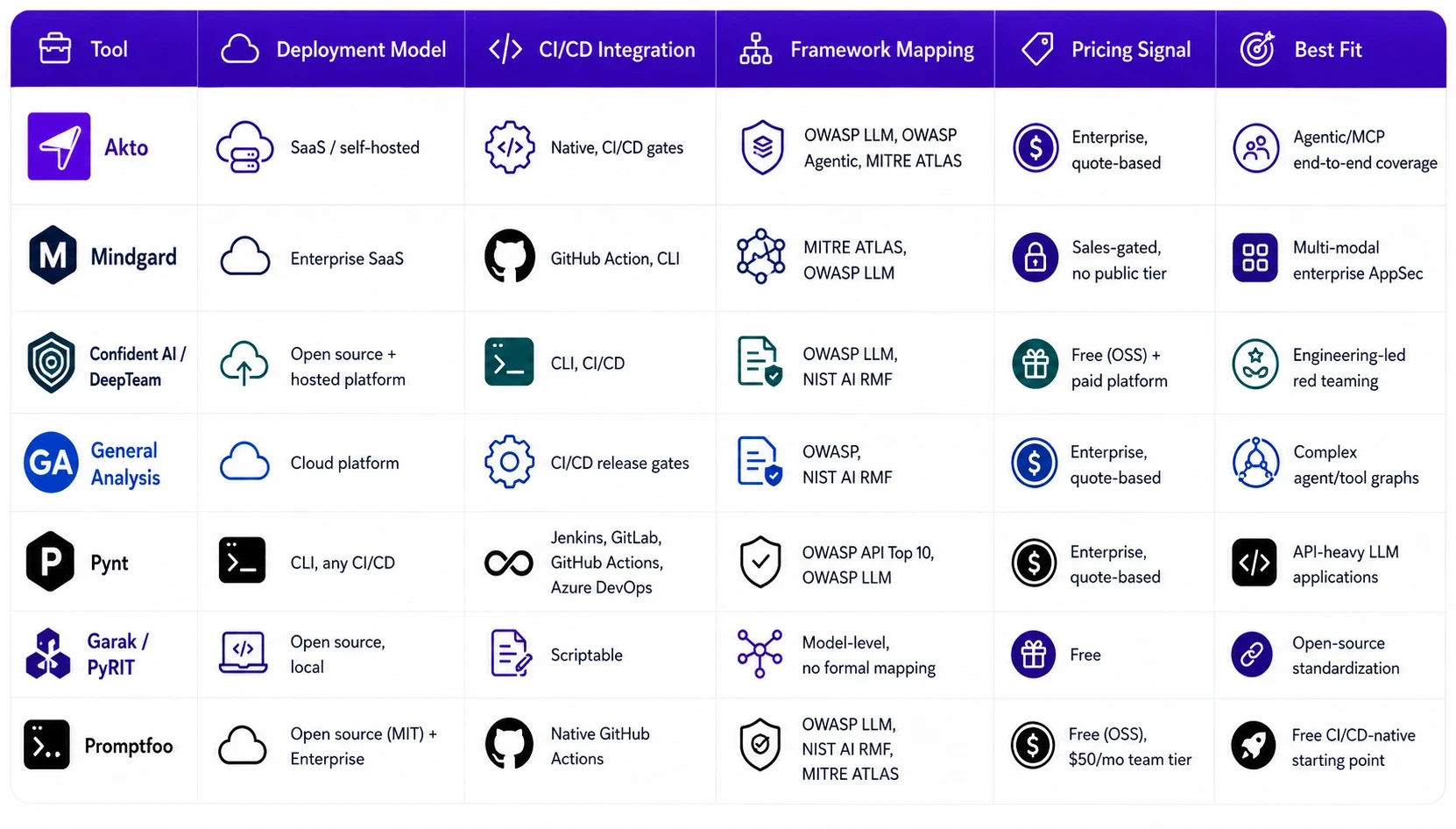
Comparison at a Glance
Choosing by Team Profile
Best for Enterprise AppSec Teams Needing End-to-End Agentic Coverage
Akto and General Analysis both cover discovery, testing, and runtime response for agentic and MCP-connected systems, making either the strongest fit when the scope goes past a single LLM endpoint into multi-tool, multi-agent production systems.
Best for Teams Standardizing on Open-Source
Garak and PyRIT, alongside DeepTeam, give a team full visibility and control with no licensing cost, at the price of needing in-house expertise to configure and maintain the testing harness.
Best for API-Heavy LLM Applications
Pynt fits naturally for teams that already run an API security program and want LLM endpoints tested inside that same workflow rather than standing up a separate LLM-only tool.
Best Free Starting Point
Promptfoo's MIT-licensed core, native CI/CD integration, and built-in OWASP and NIST mappings make it the lowest-friction way to get real security testing running before evaluating a paid platform.
Recent Market Consolidation AppSec Buyers Should Know About
The vendor landscape here has moved fast. Check Point announced its acquisition of Lakera in September 2025, closing in Q4 2025, folding Lakera's red teaming and runtime guardrail products into Check Point's Infinity platform and turning Lakera's Zurich office into Check Point's AI security research center. Palo Alto Networks announced its acquisition of Protect AI in April 2025 and completed it that July, integrating Protect AI's model scanning and automated red teaming into Prisma AIRS. And most recently, OpenAI acquired Promptfoo in March 2026, one of the seven tools on this list, committing to keep it open source while integrating its technology into OpenAI's own enterprise Frontier platform. None of this changes what these tools do today, but it's worth factoring into a multi-year buying decision: a point solution acquired by a platform vendor tends to get pulled toward that vendor's roadmap, and a testing tool now owned by a model provider is a different vendor-neutrality conversation than it was a year ago.
FAQs: Top 7 LLM Security Testing Tools for AppSec Teams
1. What are the top LLM security testing tools for AppSec teams in 2026?
Akto, Mindgard, Confident AI/DeepTeam, General Analysis, Pynt, Garak, and PyRIT, and Promptfoo are the seven tools AppSec teams most commonly shortlist, spanning enterprise platforms, open-source frameworks, and API-focused testing.
2. What's the difference between LLM red teaming and LLM vulnerability scanning?
Red teaming simulates an adaptive adversary attempting to manipulate an LLM system through prompt injection, jailbreaks, or tool misuse. Vulnerability scanning checks a system against a catalog of known weaknesses. Strong tools do both, but they're distinct disciplines with different depth and cost.
3. Which LLM security testing tools integrate natively with CI/CD pipelines like GitHub Actions or Jenkins?
Akto, Mindgard, General Analysis, Pynt, and Promptfoo all offer native CI/CD integration through GitHub Actions, CLI commands, or dedicated plugins. Garak and PyRIT can be scripted into a pipeline but require more manual setup.
4. What frameworks should an LLM security testing tool map findings to?
At minimum, the OWASP Top 10 for LLM Applications and NIST AI RMF, with MITRE ATLAS as a strong addition for agentic and multi-step attack coverage. ISO/IEC 42001 is a management system standard these tools feed evidence into rather than map to directly.
5. What is the difference between a point-solution LLM security tool and a full platform?
The point solution vs security platform distinction comes down to scope. A point solution, like Garak or a standalone scanner, does one thing well: testing a model endpoint. A full platform, like Akto or General Analysis, adds discovery, runtime enforcement, and CI/CD gating around that testing, covering the full lifecycle rather than a single stage.
6. Are Garak, PyRIT, and Promptfoo suitable for enterprise AppSec teams, or only for research use?
All three are used in production AppSec workflows, not just research. Promptfoo in particular has enterprise adoption across roughly 25% of the Fortune 500. Garak and PyRIT are more commonly paired with additional tooling for full lifecycle coverage.
7. What happened to Lakera after the Check Point acquisition?
Check Point announced its acquisition of Lakera in September 2025, closing in Q4 2025. Lakera's red teaming (Lakera Red) and runtime guardrail (Lakera Guard) products are being integrated into Check Point's Infinity platform, with Lakera's Zurich office becoming Check Point's AI security research center.
8. What happened to Protect AI after the Palo Alto Networks acquisition?
Palo Alto Networks announced its intent to acquire Protect AI in April 2025 and completed the deal in July 2025. Protect AI's model scanning and automated red teaming capabilities were integrated into Palo Alto's Prisma AIRS platform.
9. Which LLM security testing tool is best for API-heavy LLM applications?
Pynt, since it treats LLM endpoints as part of an existing API security program rather than requiring a separate LLM-only testing tool, covering both the OWASP API Security Top 10 and the OWASP Top 10 for LLMs in one workflow.
10. Do these tools also cover agentic and MCP-connected AI systems, or only single-prompt LLM apps?
Akto and General Analysis specifically test agentic workflows, tool calls, and MCP server connections. Mindgard, DeepTeam, and Promptfoo cover agents to varying degrees. Garak and PyRIT are primarily focused on model-endpoint testing rather than full agentic workflows.
11. What should AppSec teams look for in automated reporting and compliance documentation?
Look for findings mapped to recognized frameworks like OWASP and NIST AI RMF by default, exportable evidence rather than a dashboard-only view, and reports specific enough to hand to an auditor without a security team translating them first.
12. Is there a good free or open-source starting point before adopting a commercial platform?
Promptfoo is the most CI/CD-ready free option, with DeepTeam a close second for teams that want deeper programmatic control. Garak and PyRIT suit teams with more in-house scripting capacity.
13. How does Akto compare to Mindgard and Confident AI for enterprise AppSec use?
Akto differentiates by continuously discovering agentic and MCP-connected systems as the starting point, feeding directly into runtime guardrails. Mindgard offers mature, research-backed coverage across more modalities. Confident AI pairs an open-source framework with a lighter-weight hosted platform, appealing to engineering-led teams that want to start open source and add a platform layer later.
14. Can these tools test both pre-deployment code and post-deployment runtime behavior?
Akto and General Analysis explicitly cover both stages, testing pre-production and feeding findings into runtime guardrails. Mindgard, Pynt, and Promptfoo are strongest pre-deployment and in CI/CD, with runtime coverage varying by plan and configuration.
15. How often should LLM security testing tools be run, once before launch, or continuously?
Continuously. A configuration or model that passed testing last month can still be exposed to a newly disclosed attack technique today, and every one of the platforms on this list is built around recurring, automated testing rather than a single pre-launch assessment.
Important Links

Experience enterprise-grade Agentic Security solution