What Claude Mythos Reveals About the Future of Cybersecurity
Claude Mythos isn't just a threat to fear - it's an audit you've already failed and an alarm for what's coming. A CISO's guide to acting on both.

Krishanu
It is tempting to read Mythos as a weapon that arrived overnight. It is more useful to treat Mythos as two things at once: an audit you have already failed, and an alarm for the attacks you have not yet seen.
When Anthropic unveiled Claude Mythos Preview in April 2026, the headlines wrote themselves. A model too dangerous to release. Thousands of vulnerabilities surfaced across every major operating system and browser. A 27-year-old flaw in OpenBSD, an operating system whose entire reputation rests on being hard to break. A Firefox vulnerability set turned into 181 working exploits, where the previous flagship model had managed two. Access is gated to roughly fifty critical-infrastructure vendors under Project Glasswing, with OpenAI reportedly weighing the same restraint for its own cyber model.
The shockwave is understandable. But,i t is also a distraction. For security leaders, the question is not whether Mythos is frightening; it is what the model exposes about the ground we were already standing on, and what to do with that knowledge before the capability becomes commonplace. The honest answer requires holding two ideas together at the same time.
The audit: Mythos shows you what was always broken
The most important technical detail in Anthropic's own write-up is the one most coverage skipped: these capabilities were not trained in. They emerged as a byproduct of general improvements in code, reasoning, and autonomy.
The same competence that lets the model patch a vulnerability lets it find and exploit one. That should reframe how we think about the threat. The bugs Mythos surfaced were not created by the model. The 17-year-old remote-code-execution flaw in FreeBSD's NFS server did not appear in April; it had been sitting in production code for nearly two decades. What changed is that the cost of finding it collapsed from weeks of an elite researcher's time to a few hours and a few dollars of computing.
This is the uncomfortable revelation. We were never as secure as our incident counts suggested. We were protected by friction, the scarcity of human expertise, and the time it took to apply it. Remove the friction and a reservoir of latent, decades-old weakness becomes visible all at once.
Cognizant's Vishal Salvi put the structural consequence well: detection has become abundant while remediation has stayed scarce, and that gap is now the central problem in security. We are entering a period where defenders will know far more about their weaknesses than they can possibly fix.
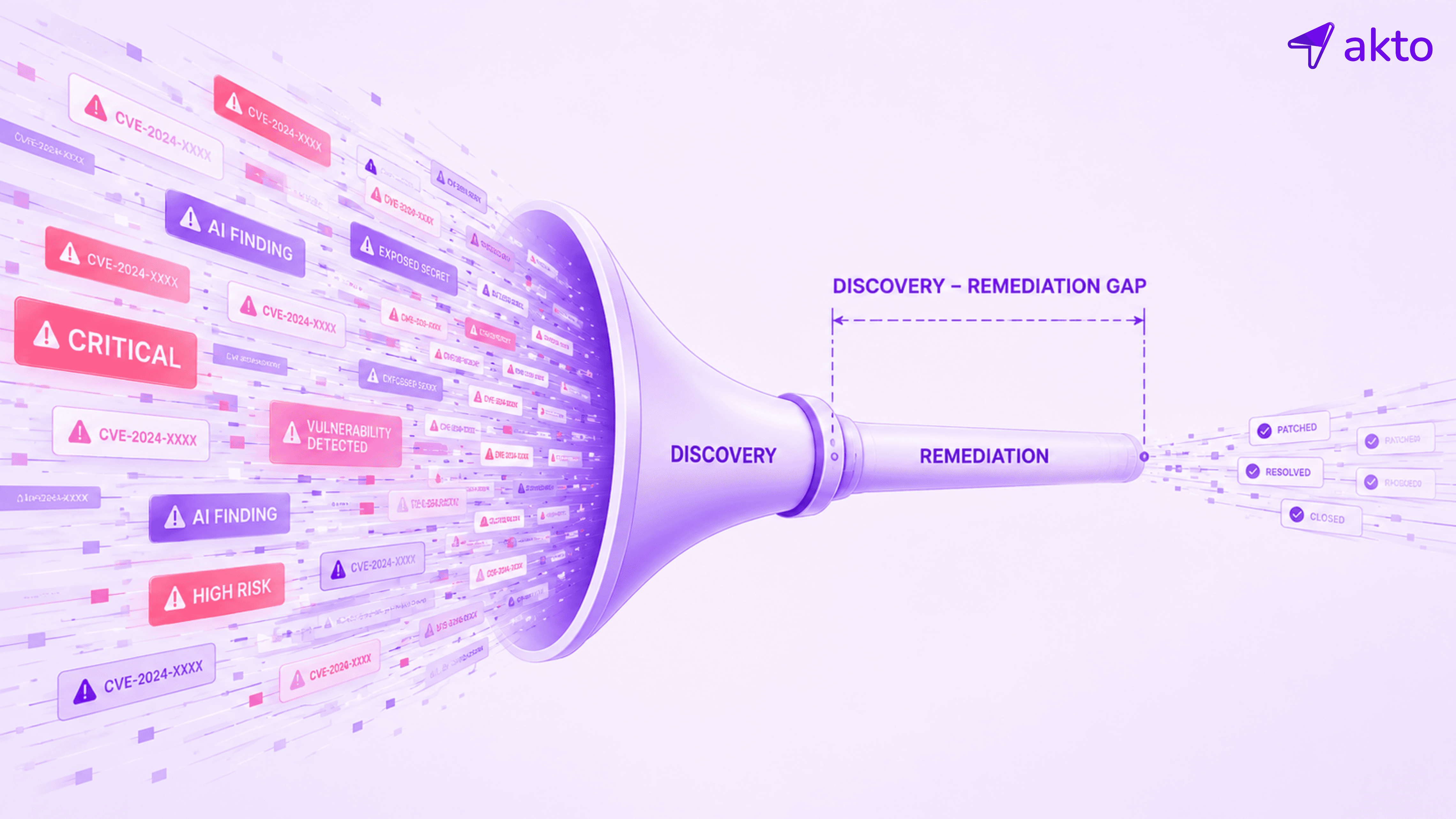
Treated as an audit, this is not bad news - it is overdue news.
The implication is that Mythos-class capability belongs inside your remediation program, not just in your threat model. Cloudflare, working within Glasswing, reportedly used the model to surface roughly 2,000 bugs with a false-positive rate that beat human testers.
You do not have Glasswing access, but you have current frontier models that, as Anthropic notes, already find high- and critical-severity bugs almost everywhere people point them. The organizations that start now, building the scaffolds, the triage pipelines, the validation discipline - will be the ones ready when this capability is ambient.
The work is less about the model and more about the muscle: can your team turn a flood of findings into shipped fixes at machine speed?
The alarm: gear up for the risks it previews
The audit framing is necessary but not sufficient, because the same capability runs in both directions. The UK's AI Security Institute, evaluating Mythos independently, found it succeeded on 73% of expert-level capture-the-flag tasks and became the first model to complete its 32-step simulated network intrusion end to end, work it estimates would take a human team twenty hours. This is a preview of an autonomous, multi-stage attack capability that compresses every timeline defenders rely on.
Two nuances matter for how you prepare.
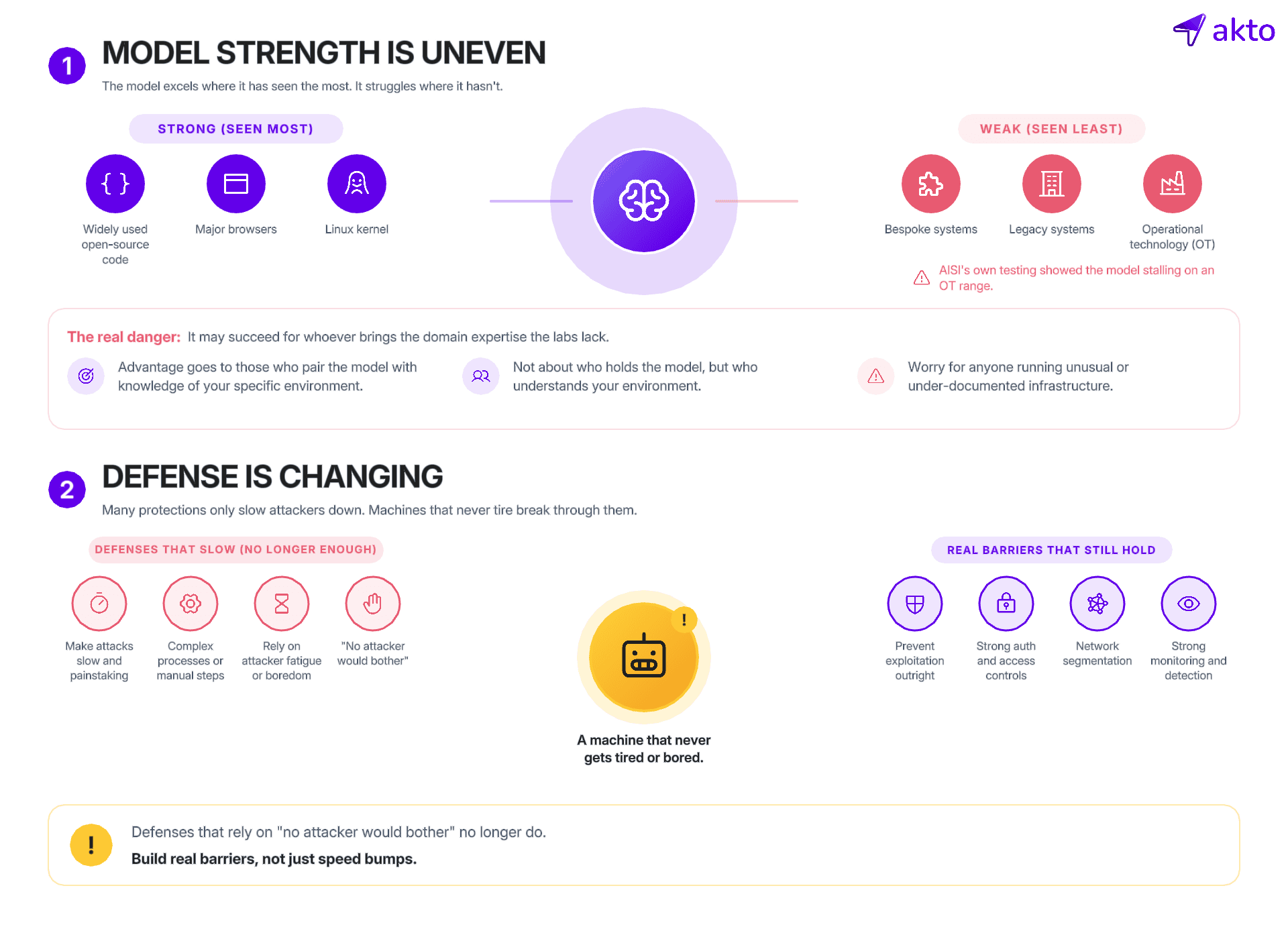
First, the model is strongest where it has seen the most: widely used open-source code, major browsers, the Linux kernel. It is weakest on the bespoke, the legacy, and the operational-technology systems that sit outside its training distribution - AISI's own testing showed it stalling on an OT range. The danger, as David Lie and Bruce Schneier have argued, is not that Mythos fails in those domains. It is that it may succeed for whoever brings the domain expertise the labs lack. The advantage in this next era accrues not to whoever holds the model, but to whoever pairs it with knowledge of your specific environment. That should worry anyone running unusual or under-documented infrastructure.
Second, Anthropic's researchers pointed to a quieter shift in what actually counts as a defense. Many of our protections work simply by making an attack slow and painstaking, not truly impossible. Those crumble against a machine that never gets tired or bored. Real barriers - the ones that block an attack outright rather than just slow it down, still hold. Defenses that rely on "no attacker would bother" no longer do.
What this asks of security leaders
The practical agenda follows from holding both truths at once.
Close the discovery-to-remediation gap as your first priority. Detection abundance without remediation capacity is not progress; it is documented exposure. Shorten patch cycles, tighten enforcement windows, automate where breakage risk once justified delay, and treat CVE-bearing dependency bumps as urgent rather than routine.
Harness the capability defensively now. Run current frontier models against your own code, your cloud configurations, your pull requests. Use them for first-pass triage, deduplication, and reproduction steps. The skill of directing these tools well takes time to build, and the practice transfers.
Keep humans who understand the system. The recurring warning across this debate, from practitioners and researchers alike, is that an organization whose defenders no longer understand their own security posture becomes acutely fragile. Build offensive and defensive teams that test each other, but do not automate away comprehension.
Invest in fundamentals, because they still work. AISI's testing succeeded against weakly defended systems; their ranges lacked active defenders and detection tooling, and they were explicit that they cannot yet say Mythos beats hardened environments. Mature logging, access control, and patch hygiene remain the highest-return moves available.
What We Don't Know Yet
Skepticism is warranted. The security firm Aisle replicated many of Anthropic's published anecdotes using smaller, cheaper public models, raising a real question of whether Mythos is a discontinuity or an acceleration of a trend already underway. We have seen a highlight reel, not the unfiltered output, and the false-positive rate on that fuller picture remains undisclosed. None of this changes the trajectory. It simply argues for clear eyes.
The deeper unresolved issue is governance: a private company is currently deciding, with finite staff and finite budget, which of the world's critical systems gets defended first. Glasswing is a credible stopgap and a useful proof of concept, but good intentions are not a governance system. The constructive ask is not radical openness - it is transparency: aggregate metrics, independent auditing, and funded access for the academic and domain specialists, no consortium of fifty can replace.
Mythos is almost certainly not the ceiling. Treat it accordingly, as the audit that tells you what to fix, and the alarm that tells you what is coming. The organizations that act on both will define the next equilibrium. The ones that pick only one will be dragged into it.

Experience enterprise-grade Agentic Security solution