What Are the Risks of Shadow AI? Key Threats and How to Reduce Them
Understand the biggest shadow AI risks - data exposure, compliance violations, and unmonitored agents - and how to detect and reduce them.

Bhagyashree
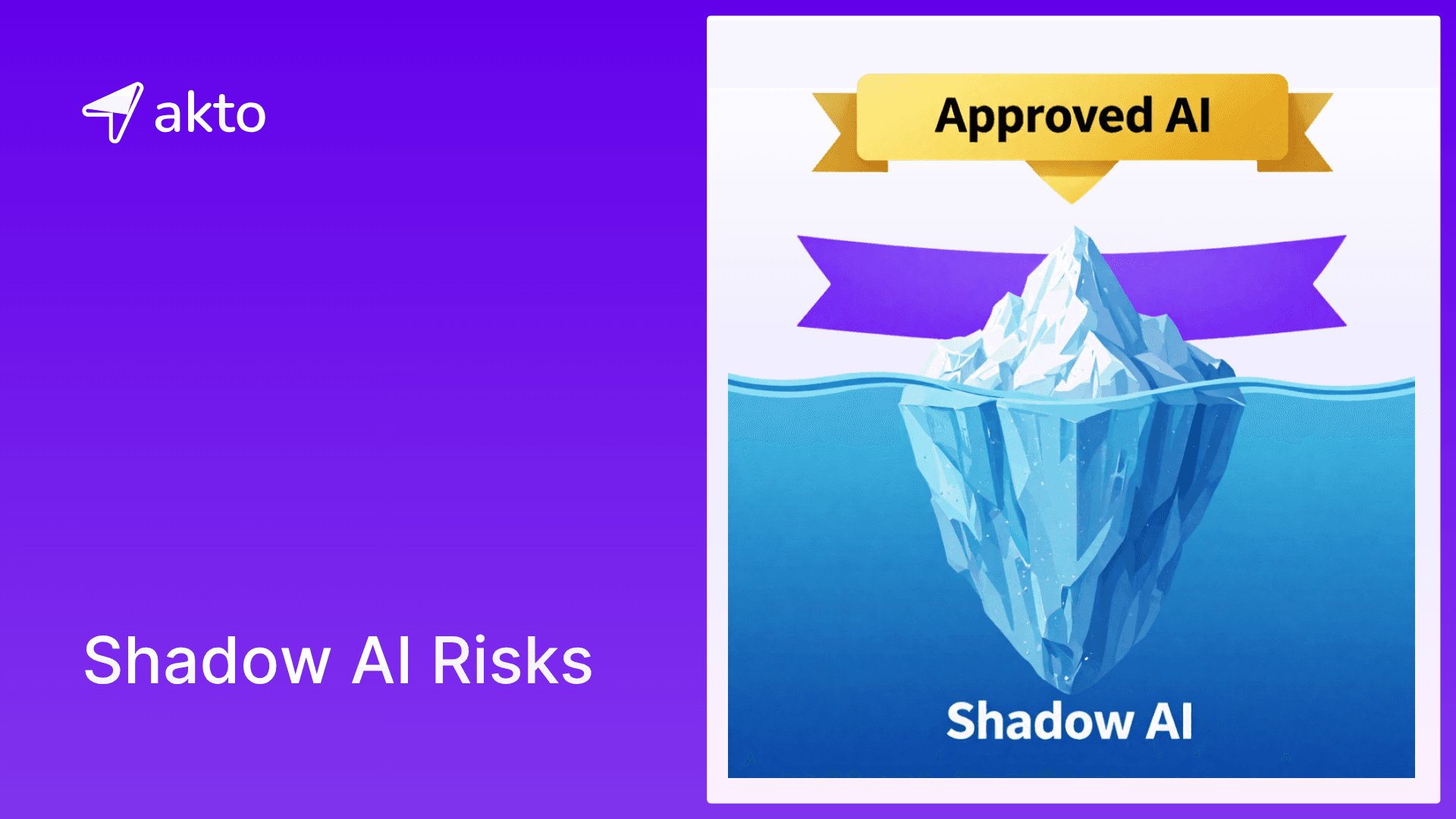
AI system have been around us since past few years, but how many organizations are using the approved AI tools for their workflows?. Right now, employees across your organizations could be using AI tools that is not approved, connecting them to the systems which are not approved. As per the Upguard state of shadow AI report, more than 80% of workers use unapproved AI tools and IBMs 2025 cost of data breach report found that one in five organizations have already experienced a breach which is linked to unsanctioned AI.
The gap between how fast the employees adopt AI and how organizations are governing it at a slow pace has created a new category of enterprise risk which is known as “Shadow AI Risk”.
In this blog, we explore what are shadow AI Risks, their impact to organization and how to mitigate them effectively.
What is Shadow AI Risk?
Shadow AI risk refers to a type a risk wherein the use of AI tools inside an organization without security approval, review, approval or monitoring. These tools are adopted independently by employees who focus on improving productivity, support technical tasks or make the communication simple. Although usually well intentioned, these options often bypass established security controls.
This risk usually occurs from employee or any individual pasting a proprietary code into generative AI platform to entire department that deploys unapproved AI plugins which process sensitive customer data. Other common occurrences include transcription platforms, summarization tools, spreadsheet assistants, GitHub copilot used on personal accounts, open-source models that run locally on laptops at work, and analytics plug ins.
Difference between Shadow AI and Shadow IT
Until few years ago, AI was still a niche technology that only big companies could afford to implement. Now, large number of AI tools are easily available for use not just by various types of organizations, but even for the average end user. Unfortunately, this level of easy access of AI has led to occurrence of shadow AI from the much broader trend of shadow IT. Furthermore, shadow AI often sits on top of shadow IT, thus further increasing the risk landscape which makes risk containment more difficult than before.
In NIST, it states that AI Risk Management Framework that generative AI introduces new patterns of informal use that start more rapidly than organizations can govern or document. The outcome is an environment where the prompt driven actions, integrated copilots and personal AI account enable significant growth in a un-monitored activity. This speed offers challenges for security teams who cannot depend on traditional discovery methods to identify or understand how AI models are being used across the organization.
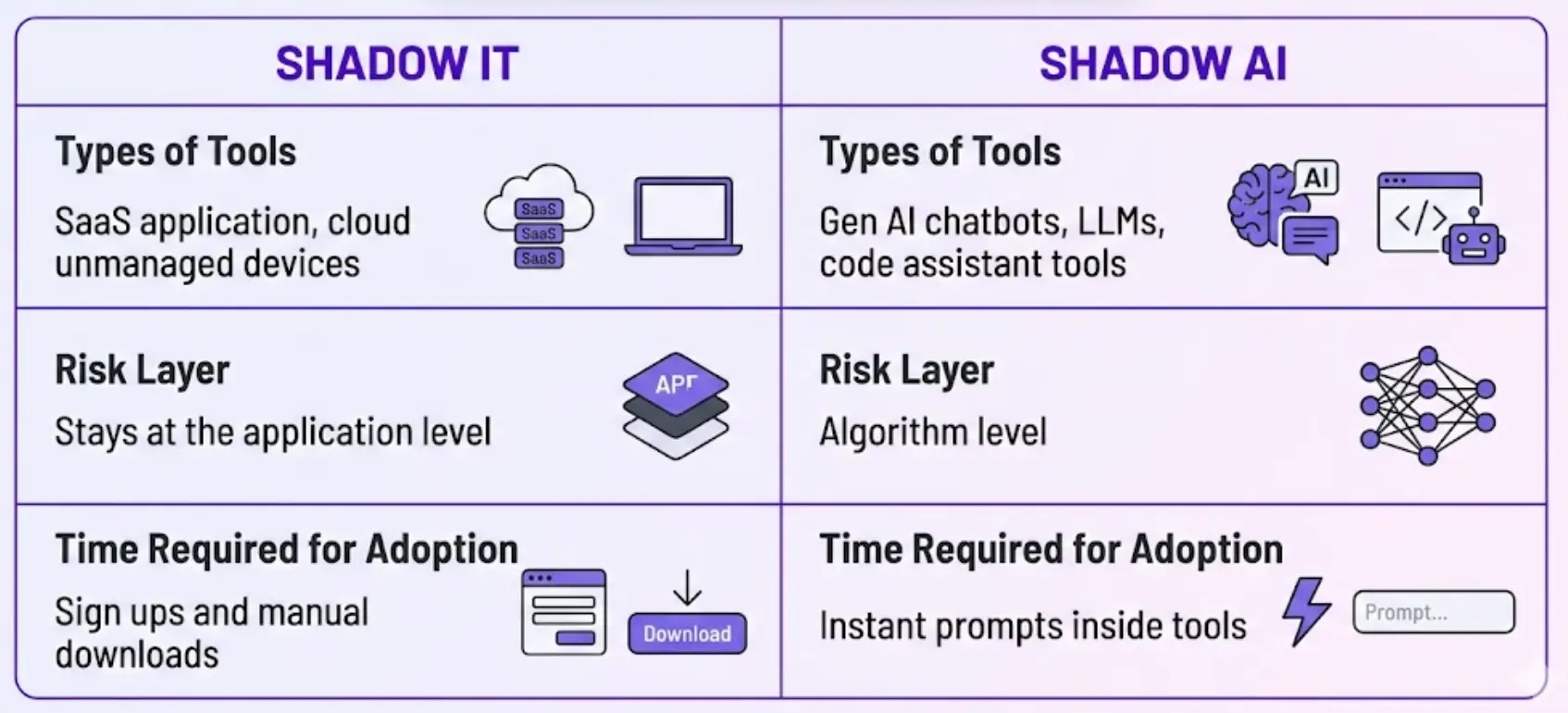
Shadow IT and Shadow AI are two different concepts. The key differences are explained below:
Aspect | Shadow IT | Shadow AI |
|---|---|---|
Types of Tools | SaaS application, cloud services, unmanaged devices. | Gen AI chatbots, LLMs, code assistant tools. |
Threat Identification | Somewhat visible through CASB (Cloud Access Security Broker) or the DLP (Data Leak Prevention) tools. | Most often browser based and therefore challenging to detect and mitigate. |
Governed via | SaaS governance programs with more policies, procedures and practices to maintain asset visibility, security and control. | Needs a comprehensive AI governance program that combines SaaS governance with AI-specific acceptable user policies, procedures to monitor, control and optimize AI behavior and output, model use, use of training data. |
Risk Layers | It stays at the application level. | Is not limited to app level. It is also present at algorithm level. |
Time Required for Adoption | Adoption grows through sign ups and manual downloads. | Adoption grows instantly through prompts inside the current tools or browser. |
User behavior | Users adopt external apps or cloud services to fill gaps in approved tooling. | Users depend on AI models or copilots that are integrated into workflows through public accounts. |
Risk Visibility | IT teams can often endpoints, see logins and unusual network activity. | AI activity is usually hidden inside application logs that does not separate AI actions from normal user events. |
Operational Impact | Tools could disrupt the workflows if they fail, but remain contained. | AI-driven outputs influence the decisions, operational flows in real time, code analysis in real time which makes errors tough to detect. |
Data Exposure Path | Data is shared with unapproved SaaS services via syncs and uploads. | Data is constantly evolved, learned from, or retained by AI systems during prompt interactions and automated workflows. |
How does Shadow AI Occur: Modern Attack Surfaces and Adoption Drivers
Shadow AI expands because of organizations slower response to capture threats. Three structural factors that consistently enables the unauthorized AI adoption are:
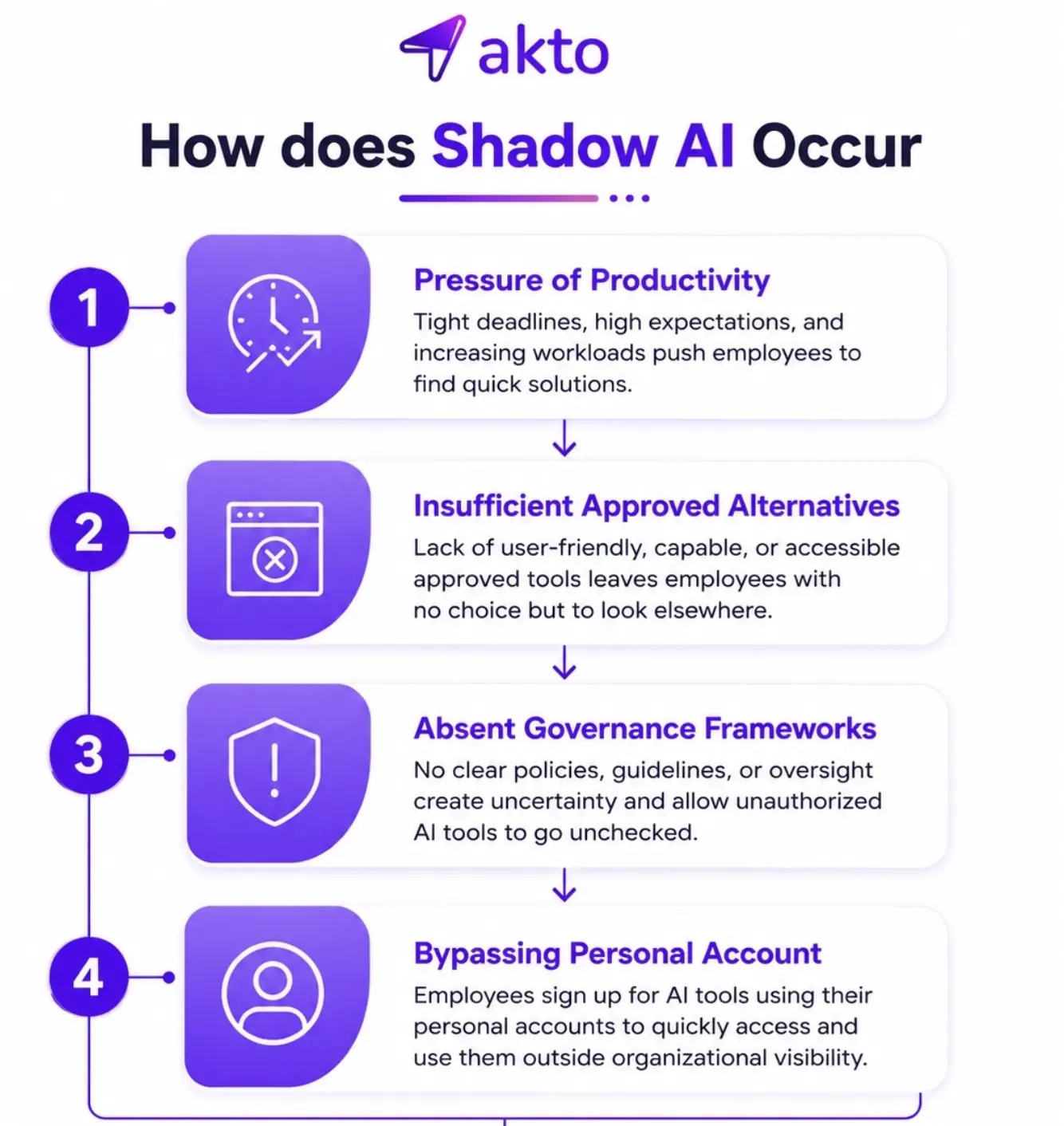
Pressure of Productivity
Employees these days focus more on speed over process. 64% of employees say that AI helps them complete tasks much faster and that productivity pull does not follow the policy. As per healthbrew, in healthcare alone over 50% of administrators point out faster workflows as the main reason they reach for unapproved tools, often before the IT has analyzed any alternative.
Insufficient Approved Alternatives
When the enterprise approved tools are insufficient, employees begin to find their own. 27% report that unapproved tools simply provide much better functionality. Whereas, 56% of employees use unauthorized AI tools at work, while only few of around 23% use the tools their organization actually offers and governs.
Lack of Governance Frameworks
As per IBM 2025, only 37% of the organizations have a documented AI governance policy. Without any definite rules, employees make their own decisions on which tools to use and what data to share. As per Cato networks, approximately 69% of organizations either do not monitor AI usage or address it only reactively.
Bypassing Personal Account
Around 47% of generative AI users access the tools via personal accounts, which completely bypasses security controls in the enterprise. A 2025 Menlo security report found that 68% of employees used personal accounts to access the free tools such as Chat GPT with 57% that enters sensitive company data in the process.
Common Entry Points for Shadow AI in the Enterprise
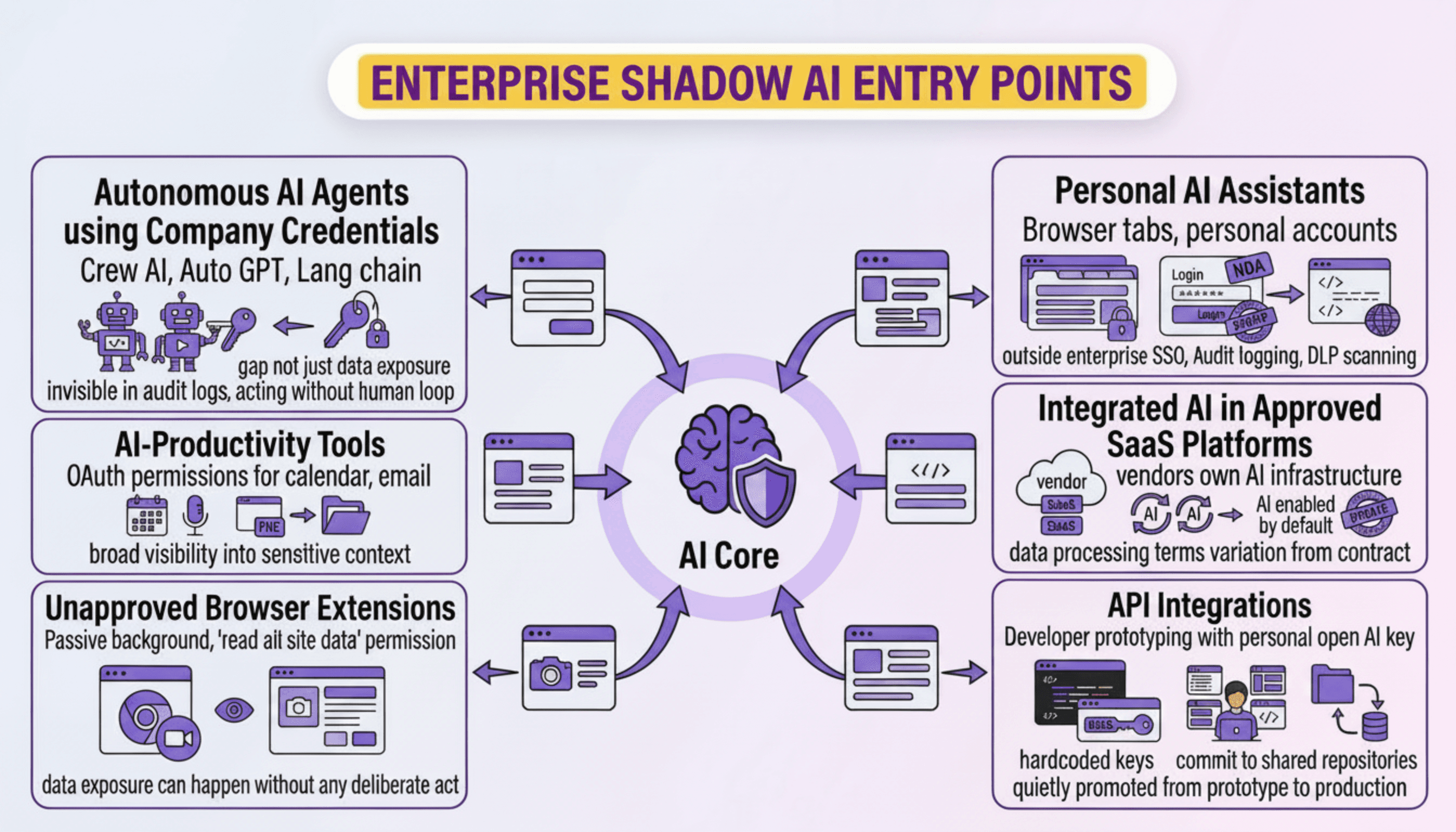
Some of the most common entry points for shadow AI are as follows:
Autonomous AI Agents using Company Credentials
This entry point is one of the fastest growing in Shadow AI. An employee can build or install an agentic workflow by using the tools such as Crew AI, Auto GPT or a custom Lang chain setup and offers access to company systems through OAuth tokens, API keys or even the stored credentials. Unlike a chatbot waits for human prompt, these agents can act autonomously and continuously like sending mails, querying databases, writing to shared drives, triggering webhooks. Because, the actions are attributed to employee’s own credentials, where it looks completely legitimate in the audit logs. The gap is not just data exposure its that the AI system which makes decisions and taking actions within the enterprise perimeter without any human loop and no audit trail that differentiates automated from human activity.
Personal AI Assistants
This is the most common entry point and the most toughest to remove through policy alone. Employees open a browser tab, log into the Chat GPT, Gemini or a similar consumer service with personal account and paste in whatever platform they are working on - code under NDA, draft contracts, customer data, internal strategy documents. Because the session runs on within a personal account, it stays outside the enterprise SSO, Audit logging, DLP scanning. The data leaves the network as an ordinary HTTPS traffic which indistinguishable from any other web browsing.
Unapproved Browser Extensions
Extensions represent a particularly risk because they work with read access to every single page the user visit which consists of tools, CRMs, HR systems and intranet pages. An employee installs a free AI writing assistant from the chrome web store, provides these tools all the “read all site data” permissions without much of thought and from that point the extension can slowly forward page content to the third-party AI backend. Unlike a browser tab the user consciously opens, extensions run passively in the background which means the data exposure can happen without any deliberate act by employee after installation.
API Integrations
Developers are most often a source of this vector. A developer needs a prototype something quickly, signs up for personal Open AI or Anthropic API key, and hardcodes it into a script or an internal tool. That key and any data sent through it sits completely outside the enterprise procurement, data processing agreements and rate limit controls. The problem starts compounding when those scripts commits to shared repositories, that are copied by colleagues or quietly promoted from the prototype to the production without going through an IT review.
AI-Productivity Tools
AI tools often request broad OAuth permissions like giving access to calendars, emails, microphone or the file system which give them a good visibility into the sensitive business context than any single conversation would suggest. A meeting transcription tool for example may process board discussions, M&A calls or HR conversations as a matter of course.
Integrated AI in Approved SaaS Platforms
This vector is distinctive because it comes via tools the enterprise has already approved. Popular SaaS vendors have been slowly allowing AI features often turned on by default with product update that process the customer data, internal documentation and support tickets using the vendors own AI infrastructure. The risk here is not essentially that the vendor is untrustworthy, its that the data processing terms of these AI features can vary from the original contract and security teams most often are not looped in when the product teams accept new features terms on behalf of organization.
The Real Risks of Shadow AI: Beyond Data Leakage
The conversation around the shadow AI in enterprise security has been dominated by only one concern: employees pasting the sensitive data into the chatbots. The concern is genuine, but it has accidently created a false sense of scope. Organizations that has addressed data leakage via DLP tooling and policy consider the problem managed. Data leakage is the most common symptom of shadow AI, but sits at the shallow end of deep tech stack.
Data Leakage
When employee submits proprietary code, customer data or financial models to consumer AI service, that data crosses a network boundary that bypasses all the existing egress controls. It is processed under the terms the enterprise never agreed to, which is potentially used for model training and it leaves without notifying a single alert.
Prompt Injection Exposure
When the AI tools perform tasks such as web browsing or writes emails on the employer’s behalf, cyber attackers can integrate hidden instructions inside the content to corrupt the AI’s next function to forward threads, exfiltrate attachments or modify the records. As agentic tools expand, this becomes a genuine attack vector not a theoretical one.
Unauthorized API Access
Developers that build internal tools with personal API keys offer access arrangements completely outside the enterprise governance. No centralized visibility is present into which models are called or what type of data is sent. Leaked keys offer external actors direct access to AI endpoints most often with the ability to send random data at the organization’s expense.
Model Hallucinations in Business Context
AI models produce well-structured, outputs disguised as positive and accurate which are sometimes factually wrong. An employee who use shadow AI tool to draft contract clauses, summarize the regulations or conduct financial calculations may not recognize a corrupted or hallucinated result. Decisions, communications and commitments then gets built on the top of errors with zero audit trail which indicates AI’s involvement.
Compliance Violations
Regulatory compliance frameworks such as GDPR, HIPAA, SOX and PCI-DSS obligations are violated the moment sensitive data touches an uncovered vendor. These breaches are usually invisible to legal and compliance teams until the audit or regulatory inquiry forces a reframing of security controls that were never in place.
Examples of Shadow IT Risks
Let’s take a look at some specific examples of shadow IT that remains outside the visibility of IT and information security teams.
1. Developer tools
Developers often use unauthorized programming libraries, frameworks or open source software to mitigate challenges and pressure of agile environments. Unauthorized dev tools can come with powerful capabilities that empower employees and teams, but their hidden presence can create unpredictable challenges.
2. External software subscriptions
Employees could subscribe to a service or software for specific project and then can lose track of its status. These dormant, neglected, and hidden software subscriptions are capable of causing a major and expensive problems for enterprises.
3. SaaS
Shadow SaaS is one of the common example of shadow IT. There are thousands of free or freemium SaaS solutions that could attract employees who want to augment their work with without undergoing the permissions processes. A simple example of shadow SaaS can be an employee from accounting department using a unsanctioned SaaS graphic design tool to create a report.
4. Cloud storage and collaboration tools
Employees may use a variety of unapproved applications from cloud storage and collaboration suites for short period of time or project to project basis or for some collaboration. Even storage and collaboration tools from trusted providers can be vulnerable if they are not under the supervision of IT department.
Automated Discovery and Cataloging of Shadow AI Agents
Modern security teams need automated, runtime focused methods for detecting and controlling shadow AI activity. Policies and employee awareness alone are not enough -shadow AI accelerates much faster than manual process can monitor, and the tools themselves are expanding unknowingly invisible inside the approved AI tools.
Here are some techniques to do automated discovery and and cataloging of shadow AI agents.
AI Traffic Analysis
Traditional web filters lack AI platform databases and lack the modern security features. AI-aware proxies and CASB platforms that monitor LLM endpoints with user identity that consistently surface far more shadow AI usage than the employee self-reporting ever expose. The primary signals that contain high frequency HTTPS calls to known inference endpoints, large prompt sized payloads and outbound data transfers to AI provider domains from services without any documented AI integration.
API Telemetry Inspection
Agentic shadow AI that rarely announces that it shows up as unusual OAuth token usage or systematic outbound calls to model the APIs from unexpected internal services. API telemetry captures this at the integration layer, prior to the data movement outside the system. Logging has detect prompt initiation, response receipt, data lineage and cost by the team. The NIST AI RMF treats this audit trail as primary control and not an optional improvement.
SaaS AI Discovery
AI is now integrated in every SaaS systems. Discovery mechanisms need to cover purpose-built AI apps, features inside approved platforms, and OAuth integrations passing the enterprise data to external models and not just the standalone tools employees install themselves. Over more than 1000 new AI platforms have been launched in 2025. At this rate, regular audits are systematically are incorrect. Continuous automated discovery with the custom domain rules that are regularly updated often is the only effective option.
Asset Inventory or Classification
The detection without classification allows noise. The cloud security alliance recommends a 5 step framework such as discovery, classification, assessing risk, implementing controls and monitoring continuously. Every tool in the inventory requires a data sensitivity tier, compliance flag and owns a business unit.
MCP and Connector Visibility
The MCP servers allows AI Agents connect to internal systems such as slack, GitHub, databases without the approval of IT. An enterprise gateway which implements OAuth 2.1, role based access, and full tool invocation logs is now very crucial. Without this, security teams have no record of what the AI agents are accessing or conducting on their behalf.
Best Practices to Prevent Shadow AI Risks
Proper shadow AI governance needs continuous visibility, security automation and policy enforcement. Without a systematic program, employees may utilize the AI tools outside IT oversight to create compliance gaps, data exposure risks, and operational blind spots.
AI Usage Policies
Begin with a tiered tool registry like approved, tolerated and prohibited. Every AI tool an employee could realistically use need to fall into one of these buckets with clear reasoning behind the classification. Policies need to cover prompt hygiene, IP ownership of AI driven outputs and third-party data sharing restrictions baked into vendor agreements. Write the policies in plain language. Besides this, version control policies alongside your technical controls so changes are traceable.
Governance Workflows
Every AI tool must be mandated to go through a systematic flow → risk scoring → approval workflow with published SLAs. A reasonable approach should be to take more time to thoroughly review high risk AI tools that offers employees an alternative to routine workflows. Besides this, track all exceptions in ticketing system with mandatory re-review after 90 days. Publish the monthly governance metrics such as approvals, denials, shadow detection - to leadership where visibility creates accountability.
Employee Awareness Program
Proper programs layer continuous education like onboarding modules, quarterly refreshers and just in time browser nudges that fire when employees navigates to unapproved tool. Build AI champion network - one person per business unit who understands the policy, surface shadow usage early and addresses this as a 2-way communication channel between teams and security and pair this it frictionless self-reporting channel.
Zero Trust for AI Systems
Add never-trust-always-verify to every AI model, API and integration. Route all the AI API calls through a standardized, policy enforcing API gateway. It needs mutual TLS for model endpoint and rotate certificates every quarter. The key zero trust principle that AI introduces beyond traditional models is the model behavior is itself a trust surface. More than authenticating the caller, track if the models outputs are within the intended ethics and boundaries. If there is a difference in behavior, unusual output lengths, topics or refusal patterns is a perfect security signal.
Final thoughts on Shadow AI Risks
The gap that undermines the most shadow AI governance programs is not a policy - it is inventory. You cannot add zero trust to a system you have not identified. You cannot run a risk assessment on a tool you do not know exists. You cant enforce least privilege on an agent that was never provisioned through your approved channels. Autonomous agents function with elevated access to SaaS tools and internal APIs, entirely outside IT governance. AI tools embed through OAuth and create hidden connections that traditional monitoring lacks. The blast radius of compromised shadow AI deployment one that has spent several months getting access nobody knew it had could be severe.
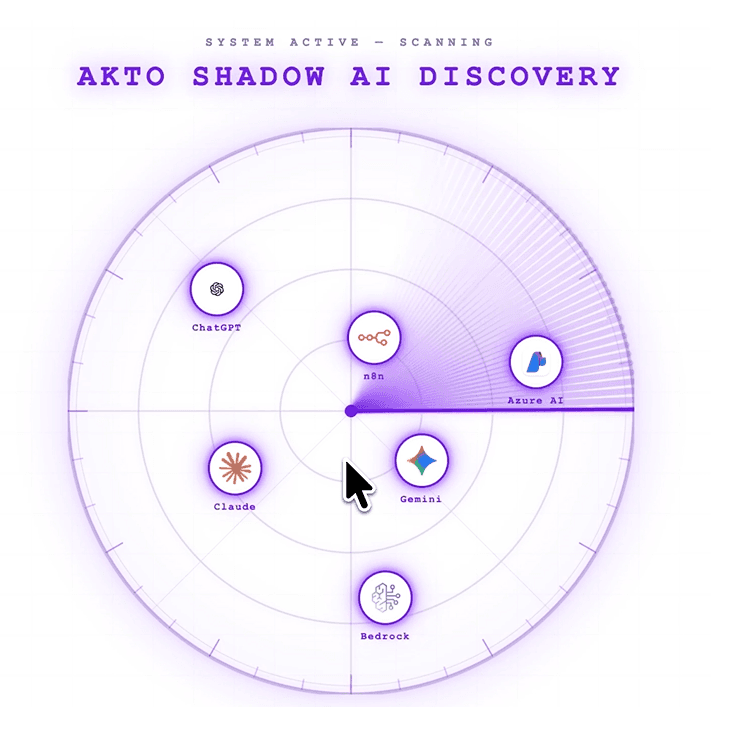
Akto’s Shadow AI discovery was built for exactly this environment which continuously surface every AI tool, integration, agent across the workforce that map how they connect to your data and systems which gives security teams real-time context they need to act.
Watch Akto’s Shadow AI Discovery in action by booking a AI Security demo today!
Important Links

Experience enterprise-grade Agentic Security solution