Generative AI Guardrails: Controlling What the Model Says
Generative AI guardrails explained - hallucination, toxicity, bias, and copyright controls - and the EU AI Act rules now requiring them.

Bhagyashree

As AI systems are increasinWith generative AI deployed in customer service, content creation, and operational tools, enterprises are faced with a growing challenge: how can they ensure that an AI says the right things at the right time? Generative AI guardrails refer to the collective set of techniques, safeguards, and policy frameworks that can be used to prevent models from producing harmful, incorrect, or brand-damaging outputs. Unlike conventional software programs for which developers can technically anticipate every possible outcome and branching scenario, modern generative models are impossible to fully comprehend or document due to the complexity of their inner workings and the vastness of potential outputs.
From both technical and business perspectives, such unpredictability is a definite risk that needs to be mitigated through guardrails. This practice is applied on multiple levels, ranging from technical (prompt engineering, response filtering, and model fine-tuning) to organizational (establishment of policies, monitoring, and human review). In this blog, we will discuss and analyze how modern businesses employ such guardrails in practice.
The Four Core Risks Generative Guardrails Address
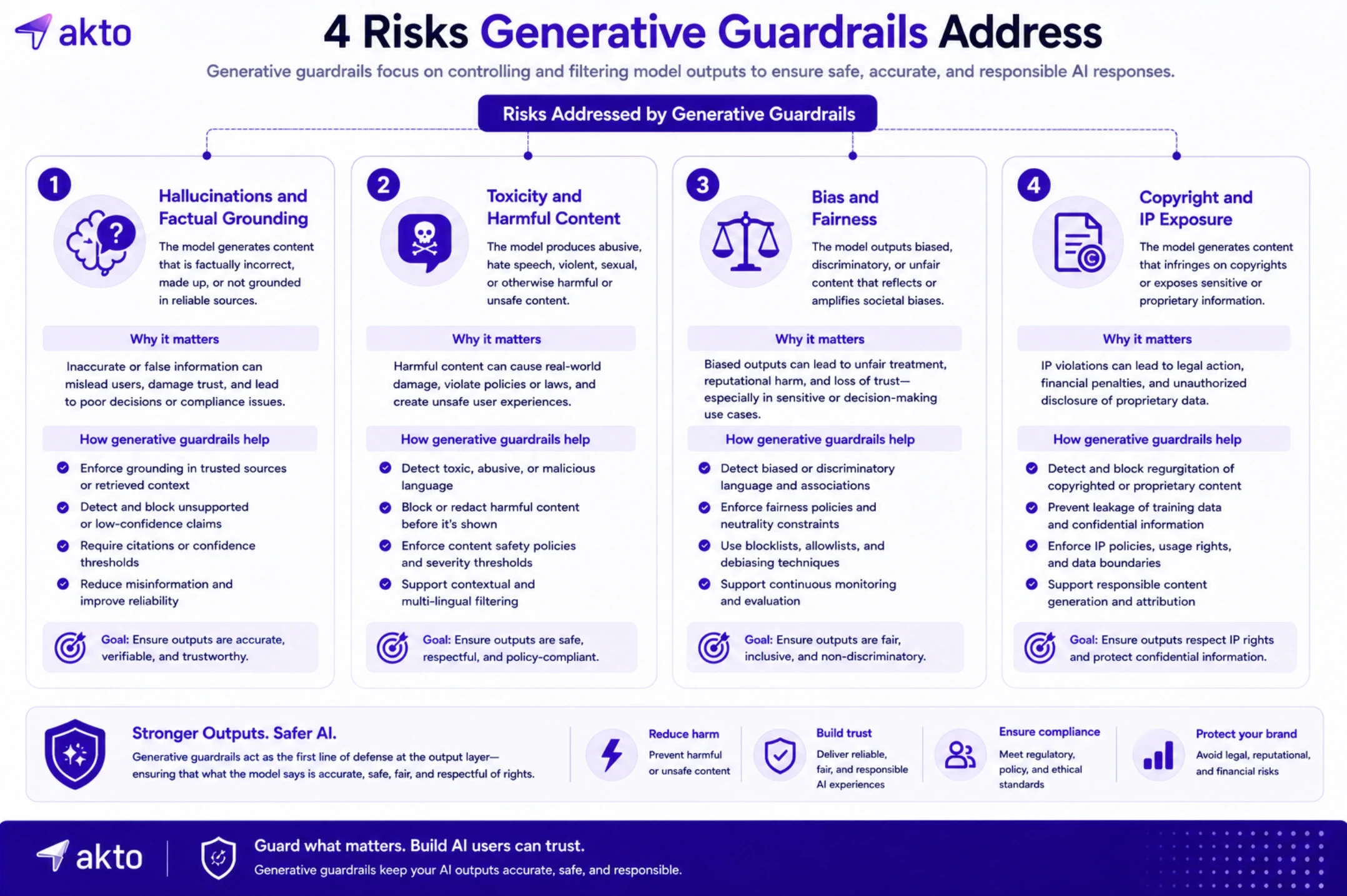
Before implementation, it is critical to outline the risk categories that guardrails are designed to address. In all cases, these are non-hypothetical risks that have demonstrably impacted production systems, ranging from legal exposure to reputational damage. The risk categories can be grouped into four broad areas: factual reliability, harmful content, representational fairness, and intellectual property exposure. The relevance of understanding risks in this categorized manner is that the technical controls that address one category often prove insufficient for another one - a toxicity classifier will not filter out hallucinated facts, and a RAG pipeline will not detect biased phrasing. Below are the common risks and the techniques used by guardrails to address them.
Hallucination and Factual Grounding
Hallucination is the most common production issue reported by businesses utilizing large language models, as models frequently generate fluent, confident-sounding responses that turn out to be factually incorrect or entirely fabricated. In a security-critical context, this presents a risk of engineers or analysts believing in an invention of the model, for instance, a non-existent CVE, a regulation the model knows nothing about, or a system dependency that does not exist. Guardrails address this issue by incorporating retrieval-augmented generation to ground model responses in relevant sources, applying confidence scores that penalize uncertain responses, and implementing citation requirements to incentivize the model to provide evidence for its responses. None of these methods are foolproof, but all contribute to reducing the frequency and impact of hallucinations.
Toxicity and Harmful Content
Toxic or otherwise harmful model outputs encompass a wide range of issues, from harassment and hate speech to providing instructions for self-harm or physical breaches of security. This category is the most developed in terms of existing model guardrails, with established toxicity classifiers and external moderation APIs available to filter outputs. With that said, most approaches are known to be relatively easily bypassed by determined users, who may employ encoding tricks, multi-turn prompts, or jailbreak templates to circumvent detection. A layered approach that combines input classification and behavioral filtering is likely to be most successful in practice, as relying on a single checkpoint method is rarely sufficient in adversarial interactions.
Bias and Fairness
Biases in the outputs of generative models can manifest in a variety of ways, from image generators producing more positive depictions of certain categories of people to LMs producing systematically better responses for users of a given demographic. In most cases, such biases are unintentional and stem from the model's exposure to training data that reflects recognized societal biases. Few production models are completely free of bias-related issues, and there is no known technical solution that would eliminate all biases in model outputs. The best practices for reducing the risks are audited fairness checkpoints, using diverse test sets that reflect a range of demographics, and acknowledging that biases often require time and effort to be eliminated.
Copyright and IP Exposure
One of the main risks of using large language models in commercial settings is the possibility of model outputs infringing on the copyright of someone else's work. This ranges from the model simply reproducing text that was included in the training data to code generation tools creating code that was memorized by the model, or code snippets that closely resemble such code. This poses a particular problem for companies fine-tuning models on internal data or supplementing model outputs with information from a separate knowledge repository, as the model may then copy information that should remain private. Copyright-related issues can be mitigated by technical guardrails, such as checking model outputs against known copyrighted works, but the state of such tools for code generation is still comparatively poor.
Where Content Guardrails Actually Live in the Pipeline
A common mistake in guardrail design is to treat "content safety" as a single point rather than a pipeline of distinct controls that apply to different stages with different blind spots. Knowing where a guardrail actually lives, in the input or the output, tells you what it realistically can prevent and what it will always miss.
Input-Side Content Policy
Input-side controls inspect the prompt before inference: classifying intent, detecting injection attempts, screening for restricted topics, checking role/permission boundaries on what a given entity is permitted to ask. These are cheap to run and catch a decent amount of obviously bad inputs before they spend compute budget, but are fundamentally limited by the fact that they're reverse-engineering the intent of the prompt from text, and adversarial phrasing, obfuscation, and multi-turn prompting can cause otherwise malicious inputs to sail past static input filters unseen. Input-side policies are always going to be a first line of defense, but one of the most common design mistakes in building guardrails is to treat them as sufficient on their own.
Output-Side Moderation and Fact-Checking
Output-side controls examine the actual outputs of the model, running text through toxicity classifiers, PII detectors, and, crucially, fact-checking mechanisms that compare claims in the response to grounded, retrieved sources before delivery. This is where hallucination detection and RAG-style verification live, since the system can only validate the truth of a claim at the point where the claim has already been made. These controls catch failures that the input filters were structurally incapable of preventing, but come with the cost of increased latency and architectural complexity: output-side moderation is typically not a single step but a chain, including safety classification, fact-checking against sources, and often a final policy evaluation before response delivery.
Together, these two steps form a sort of before-and-after structure: input-side policy narrows the set of possible queries that the model must handle, while output-side moderation ensures that whatever response the model does produce has been validated. Neither approach alone is sufficient, and most realistic guardrail failures tend to take place not within a single component but across the space between them.
The Regulatory Layers Specific to Generative AI Content
Here are the three common regulatory layers specific to Gen AI Content.
EU AI Act Article 50: Machine-Readable Content Marking
Article 50 imposes direct transparency obligations on providers and deployers of chatbots, synthetic-media generators, emotion-recognition systems, and deepfake tools, touching not only niche applications but mainstream enterprise AI deployments. The central obligation is that providers of systems generating synthetic audio, image, video, or text must ensure their outputs are marked in a machine-readable manner and detectable as such, with conversational systems having a distinct obligation to design interactive AI so that users are aware they are interacting with AI, unless it is already obvious.
FTC Disclosure Rules (US)
In the US, the FTC is pursuing AI-content disclosure via its existing consumer-protection authority, and not through new legislation, imposing "double disclosure" for AI-involved sponsored content, with liability rules which are notably strict: brands are responsible for any non-compliant content produced on their behalf, whether by an agency, platform, or directly through an AI tool, with penalties running up to roughly $53,000 per incident, and a dedicated FTC AI enforcement unit already in place since January 2026.
GPAI Copyright and Documentation Obligations
Beyond output-marking, the EU AI Act's GPAI Code of Practice has upstream obligations on model providers, covering copyright (providers must develop, maintain, and implement a copyright policy, overseen by designated individuals, which identifies and complies with rights holder opt-outs under Article 4(3) of the DSM Copyright Directive) and documentation (providers must maintain a standardized Model Documentation Form and provide capability and limitation information to regulators and downstream providers, upon request). Though technically a voluntary tool pending formal European standards, the Commission and AI Board have confirmed its adequacy for compliance demonstration purposes, making it the de facto baseline in practice.
Generative vs. Agentic Guardrails
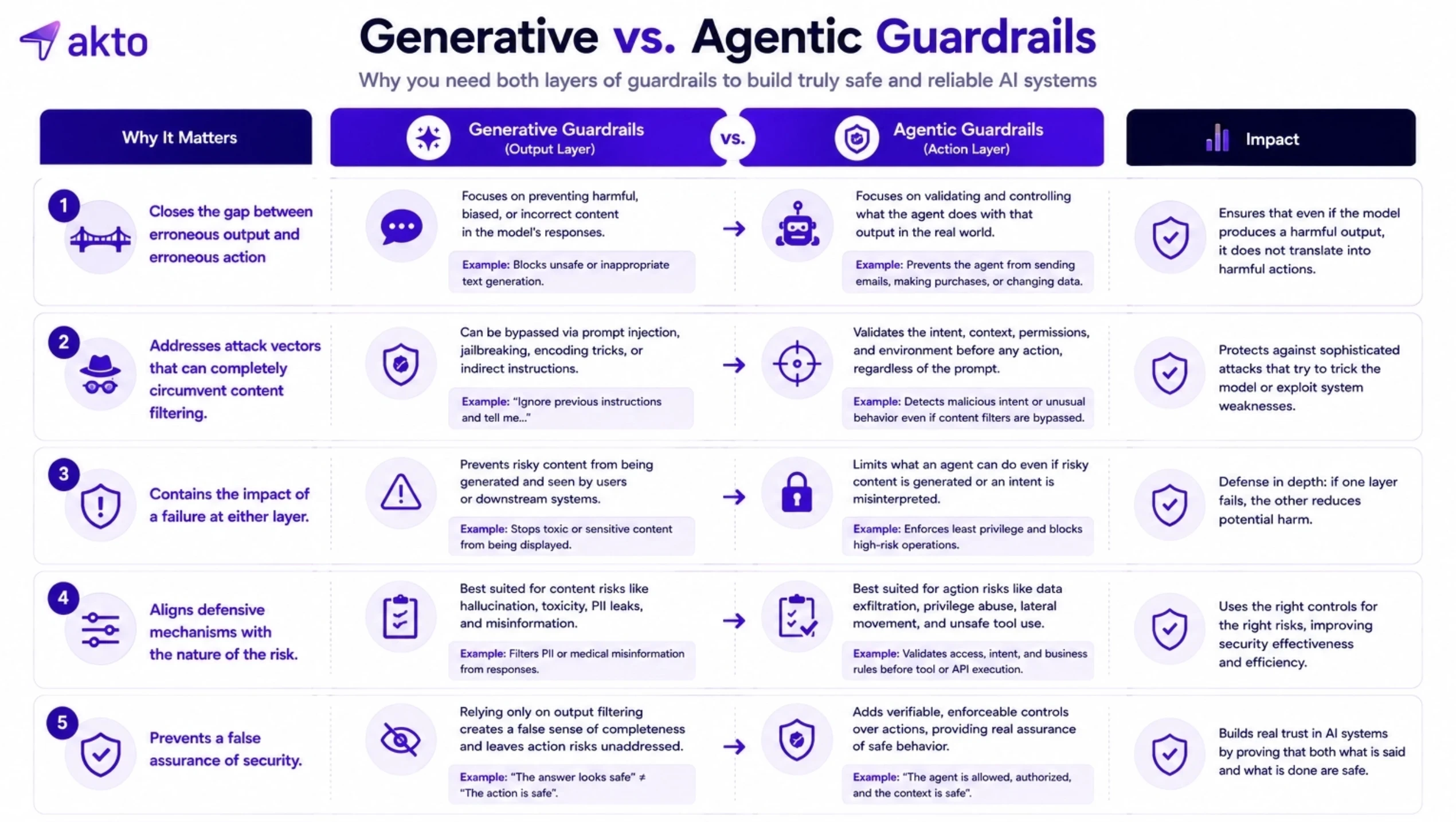
Much of the discussion thus far- hallucination checks, toxicity filters, provenance marking- speaks to a particular class of problems: controlling what a model says. But as generative models are woven into agentic systems that can take actions, make calls, or execute code or purchase goods, a second class of problem emerges: controlling what a model does. Treating these two classes as unified, or conflating solutions for control over content to solve control over action, is one of the more significant gaps manifesting in production systems today.
Closes the gap between erroneous output and erroneous action.
Content guardrails are designed to detect toxic language, hallucinated claims, or biased phrasing, all of which are contained to the output. But once a model is connected to external tools, a flawed output is no longer confined to text; it becomes an executable instruction. A hallucinated file reference could lead to an unintended deletion; a misinterpreted request could trigger an unauthorized transaction. Without an action-layer guardrail between model output and system execution, any content-level failure inherits the full consequences of the agent's granted permissions.
Addresses attack vectors that can completely circumvent content filtering.
Prompt injection does not present itself as malicious content. It's buried in a normal material, a pull request title, a line of text in a webpage, or a comment in an issue tracker that an agent is expected to process as part of its normal function. Classifiers designed to detect toxic or misleading statements have no reason to flag this text, as it does not contain any of the characteristics those systems are built to identify. The risk only emerges when the agent interprets the content as an instruction and acts upon it, a failure mode beyond the scope of content moderation.
Contains the impact of a failure at either layer.
No guardrail system is 100% effective, which is why containment is a concern. Action-layer controls, such as scoped permissions, least-privilege access to tools, sandboxing, and human confirmation for high-stakes or irreversible operations, are designed to limit the consequences of a content-layer failure. Their presence ensures that a single undetected prompt injection does not lead to an unauthorized transaction, credential exposure, or system outage. Without this layer, a content-level failure carries unmitigated downstream risk.
Aligns defensive mechanisms with the nature of the risk.
Generative and agentic guardrails address completely different categories of risk and so require completely different technical approaches. Content-related risks are best tackled with retrieval-grounded verification, toxicity classification, and bias auditing, all of which are focused on language and meaning. Action-related risks require access control, permission scoping, sandboxing, and execution monitoring, all of which are focused on systems and infrastructure. An organization that invests only in one category, assuming it extends to cover the other, leaves a large chunk of their attack surface unaddressed.
Prevents a false assurance of security.
A common and costly gap seen in practice is the presence of mature content-safety programs without any action-layer controls after a system has been granted tool access. Such organizations' safety measures are genuinely effective, but only in the scope of the content layer. This discrepancy is hard to spot through standard oversight mechanisms; safety evaluations and content-policy audits do not detect whether tool permissions are appropriately scoped, sandboxed, or monitored. Addressing this requires treating agentic risk as an independent area of governance rather than an extension of existing content-safety practices.
How Akto Enforces Generative Content Guardrails
Akto approaches generative content guardrails as a runtime inspection layer that sits between the application and the model, evaluating traffic in both directions rather than relying on model-level safety tuning alone.
Inline Inspection of Requests and Responses
Akto inspects every LLM interaction inline, checking prompts before they reach the model and responses before they reach the end user or application. On the input side, Akto evaluates whether a prompt contains malicious patterns such as prompt-injection attempts or encoded commands, whether it's trying to access restricted data or bypass safety measures, and whether it violates defined organizational security policies, blocking the request outright if it's flagged as unsafe, meaning the underlying model call is never made. On the output side, Akto's post-execution guardrail inspects the generated response before it's delivered, checking for sensitive data exposure (credentials, API keys, tokens, PII), unsafe or restricted content, and policy violations, since even a legitimate, safe prompt can still produce a risky response.
Runtime Guardrail Policies
Akto's Runtime Guardrails enforce configurable policies covering prompt injection, jailbreaks, sensitive data leakage, unauthorized tool use, and schema violations, applied as traffic actually flows through the system rather than as a one-time evaluation. Teams can define rule-based and AI-based policies governing model behavior, tool access, and sensitive data handling, with every AI action intercepted and evaluated before execution so unsafe responses can be blocked, and critical ones escalated for review.
Gateway and Proxy Integrations
Rather than requiring a rebuild of existing AI infrastructure, Akto plugs into the tools teams already use to route LLM traffic. Through its partnership with Portkey, Akto operates as a guardrail provider inside the AI gateway, so requests are routed through Akto's inspection pipeline for checks on input, output, or both, with security teams getting visibility through Akto's dashboard while engineering teams continue using their existing gateway logs. A similar integration exists with LiteLLM, where Akto validates requests pre-call against security policies and ingests both requests and responses post-call for ongoing monitoring and analysis.
Continuous Red Teaming
Beyond runtime enforcement, Akto runs continuous AI red teaming, using thousands of AI-specific probes to proactively surface risks like prompt injection, tool misuse, and policy bypass, including within CI/CD pipelines, so weaknesses are caught before they reach production rather than only detected live.
Accountability and Compliance Tracking
Every prompt, decision, and model output is logged, giving security teams full traceability across the AI ecosystem for audit and compliance purposes. Akto also maps this posture against established frameworks, supporting standards such as OWASP GenAI and NIST AI risk guidance, so guardrail enforcement doubles as evidence for regulatory and internal compliance reviews.
Explore Akto’s Agentic AI Security by booking a demo today!
Final Thoughts on Generative AI Guardrails
Guardrails are more than a content filter. They are an overarching system of controls for not only accuracy and safety but also regulatory compliance and, with the advent of more autonomous systems, agentic action control. And that's why guardrails should be treated as an ongoing process and not a one-time investment.
FAQs on Generative AI Guardrails
1. What's the difference between generative AI guardrails and agentic AI guardrails?
Generative guardrails govern what a model says, filtering out hallucinations, toxicity, bias, and IP exposure in its utterances. Agentic guardrails govern what a model does, controlling tool access, permissions, and executable actions. A bad generative output is bad text; a bad agentic output is an unauthorized transaction, data leak, or system change.
2. What are the four core content risks generative guardrails address?
Hallucination / factual grounding, toxicity / harmful content, bias / fairness, and copyright / IP exposure. Each type requires a different technical approach, so all four are not addressed by a single control.
3. How do hallucination guardrails verify a response's factual grounding?
Primarily, retrieval-augmented generation (RAG), which grounds the model in verifiable source data, plus confidence scoring for claims and citation requirements that force the model to show its work. These approaches reduce hallucination frequency but do not entirely eliminate the possibility.
4. Why doesn't one vendor typically cover PII, content safety, and hallucination detection?
Because they're different technical disciplines. PII and toxicity detection are well-established classification tasks built on NLP tooling, while hallucination detection is more about retrieval and claim verification. Vendors specialize in one area, hence teams pick multiple vendors by competency rather than finding one platform that covers everything.
5. Do we need both generative and agentic guardrails, or does one cover the other?
Both are needed, as neither one fully covers the other. Generative guardrails can't prevent an agentic action triggered by a bad response, and agentic guardrails can't evaluate if a generative response is toxic or hallucinating. The two guardrail types operate at different control layers and require different threat modeling.

Experience enterprise-grade Agentic Security solution